

Feasibility of Group Problem Management Plus (PM+) to improve mental health and functioning of adults in earthquake-affected communities in Nepal
Open accessThe DOI matches its Crossref record; 38 of the 38 references it cites were found in a registry or an index; none of the 24 sources its claims cite is checked for support yet.
Abstract
AIMS: Psychological interventions that are brief, acceptable, effective and can be delivered by non-specialists are especially necessary in low- and middle-income countries, where mental health systems are unable to address the high level of psychosocial needs. Problem Management Plus (PM+) is a five-session intervention designed for those impaired by psychological distress while living in communities affected by adversity. Individual PM+ has demonstrated effectiveness in reducing distress in Kenya and Pakistan, and a group version of PM+ (Group PM+) was effective for conflict-affected women in Pakistan. This paper describes a feasibility and acceptability trial of locally adapted Group PM+ for women and men in an earthquake-affected region of rural Nepal. METHODS: In this feasibility cluster randomised controlled trial, participants in the experimental arm were offered five sessions of Group PM+ and participants in the control arm received enhanced usual care (EUC), which entailed brief psycho-education and providing referral options to primary care services with health workers trained in the mental health Gap Action Programme Intervention Guide (mhGAP-IG). A mixed-methods design was used to assess the feasibility and acceptability of Group PM+. Feasibility was assessed with criteria including fidelity and retention of participants. Acceptability was assessed through in-depth interviews with participants, family members, programme staff and other stakeholders. The primary clinical outcome was depression symptoms assessed using the Patient Health Questionnaire (PHQ-9) administered at baseline and 8-8.5 weeks post-baseline (i.e. after completion of Group PM+ or EUC). RESULTS: We recruited 121 participants (83% women and 17% men), with equal allocation to the Group PM+ and EUC arms (1:1). Group PM+ was delivered over five 2.5-3 hour sessions by trained and supervised gender-matched local non-specialists, with an average attendance of four out of five sessions. The quantitative and qualitative results demonstrated feasibility and acceptability for non-specialists to deliver Group PM+. Though the study was not powered to assess for effectiveness, for all five key outcome measures, including the primary clinical outcome, the estimated mean improvement was larger in the Group PM+ arm than the EUC arm. CONCLUSION: The intervention and trial procedures were acceptable to participants, family members, and programme staff. The communities and participants found the intervention to be beneficial. Because feasibility and acceptability were established in this trial, a fully powered randomised controlled trial will be conducted for larger scale implementation to determine the effectiveness of the intervention in Nepal.
Overview
CoChat Summary
TL;DR
This pilot cluster randomized trial found that locally adapted Group PM+ was feasible and acceptable for adults in earthquake-affected rural Nepal, including both women and men. The study was not powered for effectiveness, but all five key outcomes improved more in the Group PM+ arm than in enhanced usual care.
Key findings
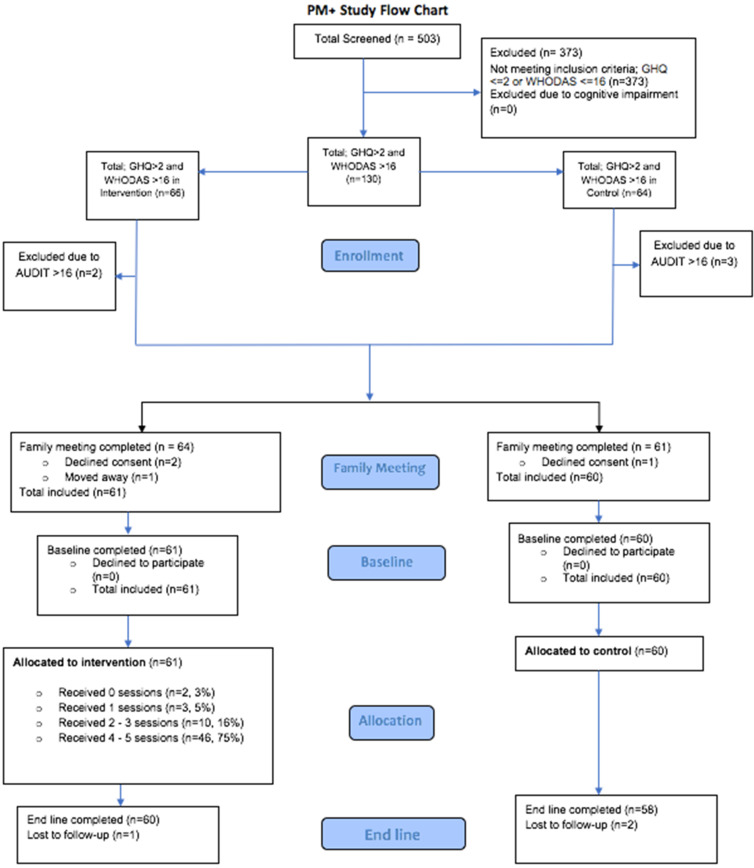
- The trial recruited 121 participants and achieved 97.5% retention from baseline to endline; 52.5% attended all five group sessions, and only 5 participants (8%) attended fewer than three sessions.
- Group PM+ was delivered in five 2.5–3 hour sessions by trained local non-specialists, with 10 groups and an average attendance of 4 out of 5 sessions.
- For all five key outcomes—including the primary outcome, PHQ-9 depression symptoms—the estimated mean improvement was larger in the Group PM+ arm than in enhanced usual care, but no formal between-group comparisons were made because the study was not powered for effectiveness.
- Baseline mean scores were reported as PHQ-9 9.8 (4.9) in Group PM+ vs 10.7 (4.4) in EUC; across the 118 participants with endline data, mean scores improved in both arms, with larger mean decreases in Group PM+.
Methods
- Design: Two-arm feasibility cluster randomized controlled trial comparing Group PM+ with enhanced usual care (EUC) in rural Sindhuli district, Nepal.
- Sample/data: 121 participants (reported as 83% women and 17% men) were enrolled after screening 503 individuals; qualitative interviews included participants, family members, facilitators, CPSWs, control participants, and mhGAP-trained health workers.
- Main analysis: Quantitative analyses were predominantly descriptive, comparing mean changes within arms and estimating clustering via intracluster correlation coefficients (ICC); qualitative data were analyzed using thematic content analysis.
Limitations
- The paper states that the study was not powered to assess effectiveness, so it did not make formal between-group comparisons.
- The discussion notes a risk of contamination and an inability to maintain complete blinding; the text also says the sites were close and staff were trained together, which may have increased communication across arms.
- Evident from the text: only two VDCs were included, so the pilot provides limited basis for estimating clustering at the VDC level and limits generalizability beyond this setting.
Model-written summary. Check it against the paper before relying on it.
Integrity signals
Registry
Cites
Statistics
Figures
Verification
Claims the paper makes
0 Valid · 0 Not valid · 16 Not checked · 77 Own results and interpretations
None of the sources cited for this claim have been checked yet.
In the paper
“Referring to mental health issues as ‘man ko samasya’ (heart–mind problems) (Kohrt and Harper, 2008) or ‘tension’ (an English term used commonly in Nepal for distress) (Clarke et al., 2014b; Rai et al., 2018), non-stigmatising idioms of distress made the study more acceptable to community members.”
§ Feasibility of Group Problem Management Plus (PM+) to improve mental health and functioning of adults in earthquake-affected communities in Nepal > Results > Qualitative outcomes
What the sources say
- Not checked yetcites Kohrt and Harper, 2008
- Not checked yetcites Clarke et al., 2014b
- Not checked yetcites Rai et al., 2018
plainstates a cause- Asserted: passes — The authors put it forward as true.
- Checkable: passes — It can be checked against evidence.
- Load-bearing: unclear — It is unclear whether the paper’s conclusions depend on it.
- Based: passes — The paper gives a reason why it holds.
A result the paper reports from its own data — it cites no other source for it, so there is none to check. The quote shows it is in the paper.
In the paper
“Male and female Group PM+ participants responded positively to the programme.”
§ Feasibility of Group Problem Management Plus (PM+) to improve mental health and functioning of adults in earthquake-affected communities in Nepal > Results > Qualitative outcomes
plain- Asserted: passes — The authors put it forward as true.
- Checkable: passes — It can be checked against evidence.
- Load-bearing: unclear — It is unclear whether the paper’s conclusions depend on it.
- Based: passes — The paper gives a reason why it holds.
A result the paper reports from its own data — it cites no other source for it, so there is none to check. The quote shows it is in the paper.
In the paper
“At baseline, outcomes were broadly comparable between the participants of the Group PM+ and EUC arms with mean (s.d.) PHQ-9 scores of 9.8 (4.9) and 10.7 (4.4) in the Group PM+ and EUC arms, respectively (Table 4).”
§ Feasibility of Group Problem Management Plus (PM+) to improve mental health and functioning of adults in earthquake-affected communities in Nepal > Results > Clinical outcomes At baseline, outcomes were broadly comparable between the participants of the Group PM+ and EUC arms with mean (s.d.) PHQ-9 scores of 9.8 (4.9) and 10.7 (4.4) in the Group PM+ and EUC arms, respectively (Table 4). Across the 121 participants, the PHQ-9 had a mean (s.d.) of 10.3 (4.6). The WHODAS had a mean (s.d.) of 21.3 (4.8), the GHQ-12 had a mean (s.d.) of 22.8 (5.0), the PMHP had a mean (s.d.) of 10.7 (3.0), and the PCL-5 had a mean (s.d.) of 19.5 (6.8). Baseline outcomes for the 118 participants who also had data at endline were comparable to those of the overall study population of 121 participants. For the 118 participants with endline data, nearly all outcomes improved on average over time in both arms, decreases in PHQ-9, GHQ-10, WHODAS, PMPH and PCL in both study arms and an increase in MSPSS in both study arms. For all five key outcomes, the estimated mean improvement was larger in the Group PM+ arm than the EUC arm, with larger mean decreases in scores observed for all five outcomes. No formal between-group comparisons were made given that the pilot trial was not powered to detect meaningful differences. For the other outcomes of RTC and MSPSS, as hypothesised, both increased on average in the Group PM+ arm, whereas very small decreases were observed in the EUC group; of 5.0 (s.d. = 5.8) in Group PM+ compared to an average decrease in EUC of −0.7 (4.6). Estimates of clustering by ward at baseline were large ranging from 0.10 (95% CI 0.03–0.41) for WHODAS to 0.21 (0.08–0.45) for PCL-5 when clustering was by ward at enrolment. Estimates of clustering by group at endline were smaller ranging from 0.03 (95% CI 0–0.97) to 0.09 (0.01–0.62), though were not estimable for PHQ-9 and PCL-5. As expected, confidence intervals were wide in all cases due to the small sample size.
plainn = 121- Asserted: passes — The authors put it forward as true.
- Checkable: passes — It can be checked against evidence.
- Load-bearing: passes — The paper’s conclusions depend on it.
- Based: passes — The paper gives a reason why it holds.
A result the paper reports from its own data — it cites no other source for it, so there is none to check. The quote shows it is in the paper.
In the paper
“CPSWs reported that community sensitisation events helped clarify to the community that this programme was for people with general distress rather than severe mental illness.”
§ Feasibility of Group Problem Management Plus (PM+) to improve mental health and functioning of adults in earthquake-affected communities in Nepal > Results > Qualitative outcomes
plainstates a cause- Asserted: passes — The authors put it forward as true.
- Checkable: passes — It can be checked against evidence.
- Load-bearing: unclear — It is unclear whether the paper’s conclusions depend on it.
- Based: passes — The paper gives a reason why it holds.
A result the paper reports from its own data — it cites no other source for it, so there is none to check. The quote shows it is in the paper.
In the paper
“with only five participants (8%) attending fewer than three of the five group sessions (Table 2).”
§ Feasibility of Group Problem Management Plus (PM+) to improve mental health and functioning of adults in earthquake-affected communities in Nepal > Results > Feasibility and acceptability
plainn = 5- Asserted: passes — The authors put it forward as true.
- Checkable: passes — It can be checked against evidence.
- Load-bearing: passes — The paper’s conclusions depend on it.
- Based: passes — The paper gives a reason why it holds.
27 more claims
Create a free account to see all 93 claims and to verify the 24 references still open.
- Probably not a substantial claim. 37
- It may state two separate claims as one. 41
Claims other papers make about this one
Each is checked against this paper’s own text: does it say what the citing paper says it does?
The source backs part of the claim, not all of it — or backs it for a different population, condition or comparison.
In the citing paper
“Depressive symptoms, daily functioning, psychological distress, PTSD symptoms, and psychosocial problems improved more in the PM+ arm than the enhanced TAU arm at 8 weeks post-intervention.”
From Promoting Recovery from Disasters, Pandemics, and Trauma: A Systematic Review of Brief Psychological Interventions to Reduce Distress in Adults, Children, and Adolescents (2023) · cites this paper as [35]
Experimental — accuracy not yet measuredThe source backs part of the claim, not all of it — or backs it for a different population, condition or comparison.
In the citing paper
“The results of two cRCTs [35,36] indicated that PM+ applied in a group significantly reduced psychological distress and depressive symptoms post-intervention.”
From Promoting Recovery from Disasters, Pandemics, and Trauma: A Systematic Review of Brief Psychological Interventions to Reduce Distress in Adults, Children, and Adolescents (2023) · cites this paper as [35]
Experimental — accuracy not yet measuredThe source backs part of the claim, not all of it — or backs it for a different population, condition or comparison.
In the citing paper
“Furthermore, the long-term effectiveness of some interventions cannot be assessed because ten completed studies on these interventions did not report follow-up measurements [21,27,35,36,37,40,41,47,53,57].”
From Promoting Recovery from Disasters, Pandemics, and Trauma: A Systematic Review of Brief Psychological Interventions to Reduce Distress in Adults, Children, and Adolescents (2023) · cites this paper as [35]
Experimental — accuracy not yet measuredThe cited source says what the claim attributes to it.
In the citing paper
“PM+ was tested in a cRCT in N = 121 participants [35] in earthquake-affected communities in Nepal.”
Citations
Cites
Psychometric Characteristics of the Multidimensional Scale of Perceived Social Support
Zimet, G. D., Powell, S. S., Farley, G. K., Werkman, S., & Berkoff, K. A. (1990) · Journal of Personality Assessment · doi:10.1080/00223891.1990.9674095 · Cited by 4,855 · cited 1×
“Additionally, The Multidimensional Scale of Perceived Social Support (MSPSS) self-assesses participants’ connectedness with family and friends (Zimet et al., 1990) and has been locally adapted (Hendrickson et al., 2018) and validated to use with Nepali populations (Tonsing et al., 2012).”
MethodPsychometric Characteristics of the Multidimensional Scale of Perceived Social Support
Zimet, G., Powell, S., Farley, G., Werkman, S., & Berkoff, K. (1990) · Journal of Personality Assessment · doi:10.1207/s15327752jpa5503&4_17 · Cited by 4,854
The Lancet Commission on global mental health and sustainable development
Patel, V., Saxena, S., Lund, C., Thornicroft, G., Baingana, F., Bolton, P., Chisholm, D., Collins, P. Y., Cooper, J. L., Eaton, J., et al. (2018) · The Lancet · doi:10.1016/s0140-6736(18)31612-x · Cited by 3,692
Self-citationUndertreatment of people with major depressive disorder in 21 countries
Thornicroft, G., Chatterji, S., Evans-Lacko, S., Gruber, M., Sampson, N., Aguilar-Gaxiola, S., Al-Hamzawi, A., Alonso, J., Andrade, L., Borges, G., et al. (2017) · British Journal of Psychiatry · doi:10.1192/bjp.bp.116.188078 · Cited by 1,121 · cited 1×
“LMICs have limited availability to provide adequate mental health treatment (Luitel et al., 2015; Thornicroft et al., 2017).”
BackgroundHuman resources for mental health care: current situation and strategies for action
Kakuma, R., Minas, H., van Ginneken, N., Dal Poz, M. R., Desiraju, K., Morris, J. E., Saxena, S., & Scheffler, R. M. (2011) · The Lancet · doi:10.1016/s0140-6736(11)61093-3 · Cited by 979 · cited 5×
“Innovative psychological treatments that utilise task-sharing are necessary to increase the availability of quality care in LMICs (Patel et al., 2018).”
BackgroundInfluentialPsychological Treatments for the World: Lessons from Low- and Middle-Income Countries
Singla, D. R., Kohrt, B. A., Murray, L. K., Anand, A., Chorpita, B. F., & Patel, V. (2017) · Annual Review of Clinical Psychology · doi:10.1146/annurev-clinpsy-032816-045217 · Cited by 913 · cited 1×
“Though this study is not powered, findings are in line with current evidence that effective psychological interventions can be delivered by nonspecialised workers (Singla et al., 2017).”
ResultSelf-citationDawson, K. S., Bryant, R. A., Harper, M., Kuowei Tay, A., Rahman, A., Schafer, A., & van Ommeren, M. (2015) · World Psychiatry · doi:10.1002/wps.20255 · Cited by 440 · cited 2×
“Problem Management Plus (PM+) is a five-session intervention developed by the World Health Organization (WHO) suitable for low-resource settings for clients impaired by psychological distress (Dawson et al., 2015).”
BackgroundSelf-citationKohrt, B. A., Jordans, M. J. D., Rai, S., Shrestha, P., Luitel, N. P., Ramaiya, M. K., Singla, D. R., & Patel, V. (2015) · Behaviour Research and Therapy · doi:10.1016/j.brat.2015.03.009 · Cited by 370 · cited 1×
“Traumatic events were assessed using the Traumatic Events Inventory (TEI) (Schwartz et al., 2005), which has been previously used in Nepal (Kohrt et al., 2015c).”
MethodSelf-citationBryant, R. A., Schafer, A., Dawson, K. S., Anjuri, D., Mulili, C., Ndogoni, L., Koyiet, P., Sijbrandij, M., Ulate, J., Harper Shehadeh, M., et al. (2017) · PLOS Medicine · doi:10.1371/journal.pmed.1002371 · Cited by 321 · cited 1×
“Randomised controlled trials (RCTs) in Pakistan and Kenya found that PM+ delivered individually is effective for managing practical or psychological problems (Dawson et al., 2016; Bryant et al., 2017; Khan et al., 2019).”
BackgroundSelf-citationKohrt, B. A., & Hruschka, D. J. (2010) · Culture, Medicine, and Psychiatry · doi:10.1007/s11013-010-9170-2 · Cited by 277
Self-citation
Research works printed but not linked: 1
- Minhas FA and Mubbashar MH (1996) Validation of General Health Questionnaire (GHQ-12) in primary care settings of Pakistan. Journal of College of Physicians and Surgeons Pakistan 6, 133– 136.
Cited by
van Ginneken, N., Chin, W. Y., Lim, Y. C., Ussif, A., Singh, R., Shahmalak, U., Purgato, M., Rojas-García, A., Uphoff, E., McMullen, S., et al. (2021) · Cochrane Database of Systematic Reviews · doi:10.1002/14651858.cd009149.pub3 · Cited by 188
Jordans, M. J. D., Kohrt, B. A., Sangraula, M., Turner, E. L., Wang, X., Shrestha, P., Ghimire, R., van’t Hof, E., Bryant, R. A., Dawson, K. S., et al. (2021) · PLOS Medicine · doi:10.1371/journal.pmed.1003621 · Cited by 120
“Regarding mediation, the tool used to evaluate mechanisms of action, the RTC, was developed and piloted during the preceding feasibility study [28].”
BackgroundMethodSelf-citationSchäfer, S. K., Thomas, L. M., Lindner, S., & Lieb, K. (2023) · World Psychiatry · doi:10.1002/wps.21129 · Cited by 115
Sangraula, M., Kohrt, B. A., Ghimire, R., Shrestha, P., Luitel, N. P., van’t Hof, E., Dawson, K., & Jordans, M. J. D. (2021) · Global Mental Health · doi:10.1017/gmh.2021.5 · Cited by 78
Self-citationA network meta-analysis of psychosocial interventions for refugees and asylum seekers with PTSD
Turrini, G., Tedeschi, F., Cuijpers, P. J., Giovane, C. D., Kip, A., Morina, N., Nosè, M., Ostuzzi, G., Purgato, M., Ricciardi, C., et al. (2021) · BMJ Global Health · doi:10.1136/bmjgh-2021-005029 · Cited by 76
Spaaij, J., Kiselev, N., Berger, C., Bryant, R. A., Cuijpers, P. J., de Graaff, A. M., Fuhr, D. C., Hemmo, M., McDaid, D., Moergeli, H., et al. (2022) · European Journal of Psychotraumatology · doi:10.1080/20008198.2021.2002027 · Cited by 75
Self-citationKeynejad, R. C., Spagnolo, J., & Thornicroft, G. (2022) · Evidence-Based Mental Health · doi:10.1136/ebmental-2021-300401 · Cited by 54
Perera, C., Aldamman, K., Hansen, M., Haahr-Pedersen, I., Caballero-Bernal, J., Caldas-Castañeda, O. N., Chaparro-Plata, Y., Dinesen, C., Wiedemann, N., & Vallières, F. (2022) · SSM - Mental Health · doi:10.1016/j.ssmmh.2022.100109 · Cited by 54
Koly, K. N., Baskin, C., Khanam, M. I., Rao, M., Rasheed, S., Law, G. R., Sarker, F., & Gnani, S. (2021) · Frontiers in Psychiatry · doi:10.3389/fpsyt.2021.741328 · Cited by 49
Coleman, S., Mukasakindi, H., Rose, A. L., Galea, J. T., Nyirandagijimana, B., Hakizimana, J., Bienvenue, R., Kundu, P., Uwimana, E., Uwamwezi, A., et al. (2021) · Intervention · doi:10.4103/intv.intv_41_20 · Cited by 46
“Tension” and distress in South Asia: A systematic literature review
Weaver, L. J., & Karasz, A. (2022) · SSM - Mental Health · doi:10.1016/j.ssmmh.2022.100092 · Cited by 38
Lotzin, A., Franc de Pommereau, A., & Laskowsky, I. (2023) · International Journal of Environmental Research and Public Health · doi:10.3390/ijerph20075339 · Cited by 36
“(2020) [35] Problem Management Plus (PM+) [34] cRCT N = 121 Earthquake Reduction in psychological distress Face-to-face Adults A total of 5 for 2.”
BackgroundMethodResultInfluentialMwangala, P. N., Makandi, M., Kerubo, A., Nyongesa, M. K., & Abubakar, A. A. (2024) · BJPsych Open · doi:10.1192/bjo.2024.55 · Cited by 32
Cultural Adaptation of a Low-Intensity Group Psychological Intervention for Syrian Refugees
Akhtar, A., Engels, M., Bawaneh, A., Bird, M., Bryant, R., Cuijpers, P., Hansen, P., Al-Hayek, H., Ilkkursun, Z., Kurt, G., et al. (2021) · Intervention · doi:10.4103/intv.intv_38_20 · Cited by 28
Self-citationPurgato, M., Prina, E., Ceccarelli, C., Cadorin, C., Abdulmalik, J. O., Amaddeo, F., Arcari, L., Churchill, R., Jordans, M. J., Lund, C., et al. (2023) · Cochrane Database of Systematic Reviews · doi:10.1002/14651858.cd014722.pub2 · Cited by 27
Self-citationPedersen, G. A., Sangraula, M., Shrestha, P., Lakshmin, P., Schafer, A., Ghimire, R., Luitel, N. P., Jordans, M. J. D., & Kohrt, B. A. (2021) · Journal on Education in Emergencies · doi:10.33682/u4t0-acde · Cited by 25
Self-citationIdentifying Core Competencies for Remote Delivery of Psychological Interventions: A Rapid Review
Pedersen, G. A., Pfeffer, K. A., Brown, A. D., Carswell, K., Willhoite, A., Schafer, A., & Kohrt, B. A. (2022) · Psychiatric Services · doi:10.1176/appi.ps.202100677 · Cited by 24
Self-citationPapola, D., Prina, E., Ceccarelli, C., Cadorin, C., Gastaldon, C., Ferreira, M. C., Tol, W. A., van Ommeren, M., Barbui, C., & Purgato, M. (2024) · Cochrane Database of Systematic Reviews · doi:10.1002/14651858.cd014300.pub2 · Cited by 23
Greene, M. C., Bonz, A. G., Cristobal, M., Vega, C., Andersen, L. S., Angulo, A., Armijos, A., Guevara, M. E., Benavides, L., de la Cruz, A., et al. (2022) · Pilot and Feasibility Studies · doi:10.1186/s40814-022-01085-1 · Cited by 21
Gibson, K., Little, J., Cowlishaw, S., Ipitoa Toromon, T., Forbes, D., & O’Donnell, M. (2021) · European Journal of Psychotraumatology · doi:10.1080/20008198.2021.1948253 · Cited by 20
“A comparison of facilitator fidelity to programme protocols in the present trial, compared to trials of PM +, is also encouraging, with the per cent of sessions adhering to protocol being comparable, if not superior, in the present study (de Graaff et al., 2020; Rahman et al., 2016; Sangraula et al., 2020).”
BackgroundResultInfluentialMathias, K. R., Jain, S., Fraser, R., Davis, M., Kimijima-Dennemeyer, R. M., Pillai, P., Deshpande, S. N., & Wolters, M. K. (2023) · PLOS Global Public Health · doi:10.1371/journal.pgph.0001736 · Cited by 18
hAnrachtaigh, É. Ó., Brown, G. P., Beck, A. F., Conway, R., Jones, H. G., & Angelakis, I. (2024) · Depression and Anxiety · doi:10.1155/2024/5037662 · Cited by 17
Bhardwaj, A., Maharjan, S. M., Magar, A. J., Shrestha, R., Dongol, A. S., Hagaman, A. K., van Heerden, A. C., Caracoglia, J., Gallo, J. J., Murray, S. M., et al. (2024) · SSM - Mental Health · doi:10.1016/j.ssmmh.2024.100340 · Cited by 16
Self-citationLogie, C. H., Okumu, M., Kortenaar, J., Gittings, L., Khan, N., Hakiza, R., Musoke, D. K., Nakitende, A., Katisi, B., Kyambadde, P., et al. (2022) · JMIR Research Protocols · doi:10.2196/42342 · Cited by 14
Qi, A., -, F. W., & Cao, T. (2023) · Iranian Journal of Public Health · doi:10.18502/ijph.v52i2.11885 · Cited by 14
Koly, K. N., Saba, J., Christopher, E., Hossain, A. N. N., Akter, T., Rahman, Z., Ahmed, H. U., & Eaton, J. (2024) · BMC Health Services Research · doi:10.1186/s12913-024-10742-5 · Cited by 13
Nisar, A., Yin, J., Nan, Y., Luo, H., Han, D., Yang, L., Li, J., Wang, D., Rahman, A., & Li, X. (2022) · International Journal of Environmental Research and Public Health · doi:10.3390/ijerph19074094 · Cited by 13
van der Boor, C., Taban, D., Tol, W. A., Akellot, J., Neuman, M., Weiss, H. A., Greco, G., Vassall, A., May, C. R., Nadkarni, A., et al. (2024) · Trials · doi:10.1186/s13063-024-07980-7 · Cited by 12
Leresche, E., Hossain, M., de Rubeis, M. L., Hermans, V., Burtscher, D., Rossi, R., Lonsdale, C., & Singh, N. (2023) · Conflict and Health · doi:10.1186/s13031-023-00534-9 · Cited by 12
Shrestha, R., Sapkota, D., Mehra, D., Ekström, A. M., & Deuba, K. (2023) · JMIR Research Protocols · doi:10.2196/45917 · Cited by 9
Varker, T., Fredrickson, J., Agathos, J. A., Howlett, P., Howard, A., & O'Donnell, M. L. (2025) · Journal of Traumatic Stress · doi:10.1002/jts.23127 · Cited by 9
McBain, R. K., Mwale, O., Ruderman, T., Kayira, W., Connolly, E., Chalamanda, M., Kachimanga, C., Khongo, B. D., Wilson, J., Wroe, E. B., et al. (2021) · Trials · doi:10.1186/s13063-021-05601-1 · Cited by 9
Greene, M. C., Castellar, D., Sangraula, M., Camargo, N., Diaz, J., Meriño, V., Miller-Suchet, L., Coneo, A. M. C., Venegas, M., Cristobal, M., et al. (2024) · Cambridge Prisms Global Mental Health · doi:10.1017/gmh.2024.95 · Cited by 8
Self-citationMuñoz, M. D. L. F. R., Chrzan‐Dętkoś, M., Uka, A., García-López, H. S., Bina, R., & Le, H. (2024) · Archives of Women s Mental Health · doi:10.1007/s00737-024-01537-y · Cited by 8
Sangraula, M., Greene, M. C., Castellar, D., Hoz, J. C. F. D., Diaz, J., Meriño, V., Miller-Suchet, L., Cristobal, M., Coneo, A. M. C., Morales, L., et al. (2023) · Intervention · doi:10.4103/intv.intv_4_23 · Cited by 8
Self-citationThe modern role of paraprofessionals in delivering brief psychological interventions
Morrison, N. R., Chang, M., Xie, A., & Kim, Y. (2024) · Counselling and Psychotherapy Research · doi:10.1002/capr.12854 · Cited by 7
Park, S., Cubillos, L., Martínez‐Camblor, P., Bartels, S. M., Torrey, W. C., John, D. T., Cepeda, M., Bell, K. R., Castro, S., Suárez‐Obando, F., et al. (2023) · Psychiatric Services · doi:10.1176/appi.ps.20220267 · Cited by 7
Imtiaz, S., Khaleeq, N., Sanauddin, N., Afaq, S., Jennings, H. M., Tahir, A., Abdeali, M., Khan, Z., Khan, F., Zafar, R., et al. (2026) · Global Health Action · doi:10.1080/16549716.2025.2599011 · Cited by 6
Zhang, B., Huai, P., Jin, R., Mu, L., & Lv, J. (2025) · Journal of Psychosocial Nursing and Mental Health Services · doi:10.3928/02793695-20250305-02 · Cited by 5
Logie, C. H., Okumu, M., Admassu, Z., Mackenzie, F., Gittings, L., Kortenaar, J., Khan, N., Hakiza, R., Musoke, D. K., Nakitende, A., et al. (2025) · Cambridge Prisms Global Mental Health · doi:10.1017/gmh.2025.3 · Cited by 5
Pinto, J. V., Hunt, C. J., & O’Toole, B. I. (2022) · JMIR Research Protocols · doi:10.2196/38223 · Cited by 5
Massazza, A., Fuhr, D. C., Bogdanov, S., Tol, W. A., Roberts, B., Nadkarni, A., Akudrabo, G., Andersen, L. S., Dumchev, K. V., Karachevskyy, A., et al. (2021) · International Journal of Qualitative Methods · doi:10.1177/16094069211063031 · Cited by 5
Papola, D., Tedeschi, F., Efthimiou, O., Harrer, M., Ramia, J. A., Acartürk, C., Akhtar, A., Alkneme, M. S., Bryant, R. A., Burchert, S., et al. (2026) · The Lancet Psychiatry · doi:10.1016/s2215-0366(26)00193-8 · Cited by 4
Self-citationKohrt, B. A., Sangraula, M., Turner, E. L., Pfeffer, K. A., Best, C., Caracoglia, J., Cid‐Vega, A., Gwaikolo, W., McEneaney, C., Platt, A. C., et al. (2025) · Psychiatric Research and Clinical Practice · doi:10.1176/appi.prcp.20250027 · Cited by 4
Self-citationHassan, E., Prakash, B. K., Magar, J., Luitel, N. P., Kohrt, B. A., Jordans, M. J. D., & Rose‐Clarke, K. (2022) · Frontiers in Psychiatry · doi:10.3389/fpsyt.2022.949251 · Cited by 4
Self-citationGalea, J. T., Sanabria, G., Greene, K. Y., Thompson, M., Doering, T., Fuchs, D., Grey, A., Saucedo, A., Rosler, M., & Simmons, C. (2022) · Community Mental Health Journal · doi:10.1007/s10597-022-01053-2 · Cited by 4
Psychosocial Intervention Programs in Natural Disaster Affected Individuals: A Systematic Review
İkican, T. Ç., & Mor, E. (2023) · CURARE Journal of Nursing · doi:10.26650/curare.2023.1293930 · Cited by 3
Logie, C. H., Okumu, M., Tailor, L. S., Mackenzie, F., Admassu, Z., Hakiza, R., Musoke, D. K., Katisi, B., Nakitende, A., Kyambadde, P., et al. (2024) · BMJ Open · doi:10.1136/bmjopen-2024-087470 · Cited by 2
Mental Health Following Earthquake in South-east Asia: A Systematic Review and Meta-analysis
Majumder, J., Saha, I., Bagepally, B. S., Munikrishnappa, D., Kalita, M., Ray, S., Saha, A., & Chakrabarti, A. (2025) · Journal of Mental Health and Human Behaviour · doi:10.4103/jmhhb.jmhhb_318_24 · Cited by 2
A Literature Review on the Role of Paraprofessionals in Delivering Brief Psychological Interventions
Lubin, E. J., Xie, A., Chang, M., & Kim, Y. (2025) · Administration and Policy in Mental Health and Mental Health Services Research · doi:10.1007/s10488-025-01482-7 · Cited by 3
Sumariuk, B. (2025) · Health & Education · doi:10.32782/health-2025.1.5 · Cited by 2
Metz, K. L., Figge, C. J., Alto, M. E., Kane, J. C., & Murray, L. K. (2021) · Springer eBooks · doi:10.1007/978-3-030-57296-9_145 · Cited by 2
Papathanasiou, C., Pantelidou, S., Belekou, P., Μενεδιάτου, Α., Μάντζαρη, Α., & Stylianidis, S. (2024) · Psychology the Journal of the Hellenic Psychological Society · doi:10.12681/psy_hps.31517 · Cited by 2
Mwale, O., Kasambara, K., Houde, A., Mpinga, K., Kayira, W., Harawa, M., Kamwiyo, M., Isaacs, R., Nhlema, B., Ruderman, T., et al. (2025) · Global Health Action · doi:10.1080/16549716.2025.2500785 · Cited by 2
Sangraula, M., Kohrt, B. A., Ghimire, R., Shrestha, P., Luitel, N. P., Hof, E. V., Dawson, K. S., & Jord, M. J. (2020) · Research Square · doi:10.21203/rs.3.rs-40265/v1 · Cited by 2
Self-citationKeyan, D., Dawson, K. S., Yadav, S., Azevedo, S., Choi‐Christou, J., Maliakkal, D. J., Pillai, M. K., Chokhani, R., Thomas, E., George, T. S., et al. (2025) · European Journal of Psychotraumatology · doi:10.1080/20008066.2025.2503603 · Cited by 1
Self-citationKanougiya, S. (2026) · Archives of Women s Mental Health · doi:10.1007/s00737-025-01666-y · Cited by 1
Papola, D., Patania, F., Pedersen, G. A., Patel, A., Cristofalo, D., Purgato, M., Patel, V., & Barbui, C. (2026) · Journal of Behavioral and Cognitive Therapy · doi:10.1016/j.jbct.2026.100590 · Cited by 1
Coşkun-Toker, A., Kurt, G., Malkoç, G., & Acartürk, C. (2026) · BJPsych Open · doi:10.1192/bjo.2026.12016 · Cited by 1
Marchetti, M., Patania, F., Piccoli, M., Bryant, R. A., Frankova, I., Gagliato, M., Keyan, D., Mazzoni, G. A. L., Molina, A. C., Sijbrandij, M., et al. (2026) · Epidemiology and Psychiatric Sciences · doi:10.1017/s2045796026100845 · Cited by 1
Self-citationWHO-mhGAP, MHPSS, IHME, and Other Internet Resources to Address the Global Burden of Mental Health
Kohn, R. (2021) · Springer eBooks · doi:10.1007/978-3-319-70134-9_116-1 · Cited by 1
Mwale, O., Mpinga, K., Rukundo, T., Kamwiyo, M., Kayira, W., Matanje, B., Munyaneza, F., Ruderman, T., Raviola, G. J., Smith, S. L., et al. (2025) · BMJ Open · doi:10.1136/bmjopen-2024-095494 · Cited by 1
Closing the mental health treatment gap: study protocol for a pilot feasibility trial
Savani, S., Sirrianni, L., Germany, A., Droesch, R. M., & Smith, D. S. (2025) · Social Work in Mental Health · doi:10.1080/15332985.2025.2557850 · Cited by 1
A study on the efficacy of Group PM+ on depressed mood in medical studentsPreprint
Zhang, B., Ji, S., Cui, Y., Guo, Y., Jiang, C., Yang, T., Yu, F., & He, K. (2024) · Research Square · doi:10.21203/rs.3.rs-4858811/v1 · Cited by 1
Social workers, white supremacy culture and refugee mental health care
Clayden, A. (2023) · Iowa Research Online (The University of Iowa) · doi:10.25820/etd.007186 · Cited by 1
Metz, K. L., Figge, C. J., Alto, M. E., Kane, J. C., & Murray, L. K. (2021) · Springer eBooks · doi:10.1007/978-3-319-70134-9_145-1
Journal on Education in Emergencies: Volume 7, Issue 2 (Complete)
Dybdahl, R., Williams, J. H., D’Sa, N., Krupar, A., Kim, H. Y., Gjicali, K., Wu, Z., Dolan, C. T., Olayemi, M., Tucker, M., et al. (2021) · Journal on Education in Emergencies · doi:10.33682/1fpc-xz19
Self-citationWHO-mhGAP, MHPSS, IHME, and Other Internet Resources to Address the Global Burden of Mental Health
Kohn, R. (2021) · Springer eBooks · doi:10.1007/978-3-030-57296-9_116
Mental Health and Social Support Interventions
Emmelkamp, P. M. G. (2023) · Springer eBooks · doi:10.1007/978-3-031-34078-9_6
Er, F., & Kara, Y. (2023) · Dokuz Eylül Üniversitesi Sosyal Bilimler Enstitüsü Dergisi · doi:10.16953/deusosbil.1192220
Mental Health on Survivor of Natural Disaster: Literature Review
Hendriati, N., Iswinarti, & Salwani, A. (2024) · Scientia · doi:10.51773/sssh.v3i1.251
Reliability, Validity and CFA for Mindfulness Self Efficacy Scale-R (MSES-R) in Urdu Language
Sheikh, A. S., & Dawood, S. (2023) · Human Nature Journal of Social Sciences · doi:10.71016/hnjss/ym888g81
A Systematic Review of the Effectiveness of Treatments for Depression in Rural and Remote Residents
Bentley, A., Hogan, L., Howard, J., Singh, R., Watt, L., Hall, A. E., & Tzelepis, F. (2025) · Clinical Psychology & Psychotherapy · doi:10.1002/cpp.70058
Koly, K. N., Saba, J., Christopher, E., Hossain, A. N. N., Akter, T., Rahman, Z., Ahmed, H. U., & Eaton, J. (2024) · Figshare · doi:10.6084/m9.figshare.25333372
Leresche, E., Hossain, M., de Rubeis, M. L., Hermans, V., Burtscher, D., Rossi, R., Lonsdale, C., & Singh, N. (2023) · Figshare · doi:10.6084/m9.figshare.24002894
Earthquakes and Mental Health in South Asia
Rajkumar, R. P. (2026) · Springer eBooks · doi:10.1007/978-981-95-3690-0_10
Mwangala, P. N., Omondi, K., & Abubakar, A. A. (2026) · medRxiv · doi:10.64898/2026.03.23.26349068
Antia, K., Bogdanov, S., Biklian, O., Качай, В., van der Boor, C., Roberts, B., Dumchev, K. V., & Fuhr, D. C. (2026) · PLOS mental health. · doi:10.1371/journal.pmen.0000639 · Cited by 1
Poudel‐Tandukar, K., Laws, H., Martell, C. R., Rai, S., Ramdam, R., Meyer, J. S., Bertone‐Johnson, E. R., Jacelon, C. S., & Hollon, S. D. (2026) · Epidemiology and Psychiatric Sciences · doi:10.1017/s2045796026100742
Ateeb, M., Zakki, S. A., Haq, I. U., Rashid, A., Zülfiqar, N., Khan, M. D., & Khan, K. S. A. (2026) · Mental Health & Prevention · doi:10.1016/j.mhp.2026.200580
Mohamed, H. C. N., Oteyo, J. S., & Ayadi, A. M. E. (2026) · Health Research in Africa · doi:10.67260/hra.v4i11.8125
Metadata
- Authors
- Sangraula, M., Turner, E. L., Luitel, N. P., van ‘t Hof, E., Shrestha, P., Ghimire, R., Bryant, R., Marahatta, K., van Ommeren, M., Kohrt, B. A., & Jordans, M. J. D.
- Affiliations
- Duke University (US)
- UNSW Sydney (AU)
- World Health Organization (CH)
- George Washington University (US)
- King's College London (GB)
- Corresponding author
- Sangraula, M.
- ORCID
- Venue
- Epidemiology and Psychiatric Sciences
- Publisher
- Cambridge University Press (CUP)
- Published
- 2020
- Volume
- 29
- Pages
- e130-e130
- ISSN
- 2045-7960 (ISSN-L)
- 2045-7979
- PMC
- PMC7264859
- OpenAlex
- W3031371061
- Cited by
- 75
- References
- 37
- Citations by year
- 2026: 10 · 2025: 11 · 2024: 14 · 2023: 12 · 2022: 12 · 2021: 15 · 2020: 1
- FWCI
- 10.93
- Type
- journal article
- Language
- en
- Open access
- gold
- doi.org
- Locations
- Epidemiology and Psychiatric Sciences (publishedVersion, cc-by)
- PubMed Central (publishedVersion, cc-by)
- PubMed (publishedVersion)
- UvA-DARE (University of Amsterdam) (publishedVersion, cc-by)
- Research Portal (King's College London) (publishedVersion, other-oa)
- Minerva Access (University of Melbourne) (submittedVersion, cc-by)
- Data Archiving and Networked Services (DANS) (submittedVersion, other-oa)
- Funders
- World Health Organization
- Topics
- Health Sciences › Medicine › Psychiatry and Mental health › Mental Health Treatment and Access
- Social Sciences › Psychology › Clinical Psychology › Posttraumatic Stress Disorder Research
- Social Sciences › Psychology › Applied Psychology › Digital Mental Health Interventions
- Keywords
- Problem Management Plus, group therapy, depression, psychological distress, Nepal, non-specialist mental health workers, intervention feasibility, acceptability, Mental Health Gap Action Programme, rural mental health, psychosocial interventions
- MeSH terms
- Adult, Depression, Feasibility Studies, Female, Humans, Interviews as Topic, Male, Nepal, Patient Acceptance of Health Care, Patient Education as Topic, Psychotherapy, Group, Rural Population, Treatment Outcome, Survivors, Earthquakes
About these checks
Registry, retraction, Cites and statistics results are computed, not judged, with one exception: a printed reference that no index lists is read once by a model before it counts as a citation error. Claims are extracted by a model and kept only when their quote appears verbatim in the text; each cited source is then checked, with a model’s help, for whether it says what the claim relies on. Those verdicts can be wrong — read the claim’s quote and the cited source before relying on one.
A language model drew the claims from the paper on 2026-10-11, under version 3 of the claim definition (model deepseek-v4.1-flash, prompt extract-v3).
A second model labelled each claim on 2026-10-11 (model jev-1.13-20260917, definition revision gold-guideline-v0.2).
Statistics and arithmetic are recomputed, not judged.
Confidence bands are shown only for fields calibrated on our annotated test set. None is calibrated yet, so no band is shown.
What counts as a claim ›How we measure confidence ›How we check this ›
Are you an author, or do you see a problem with this page? Request a review
Data sources
Bibliographic data: Semantic Scholar, OpenAlex, Crossref.
Contains information from the Semantic Scholar Academic Graph Datasets, made available under the ODC Attribution License (ODC-BY 1.0).
Semantic Scholar’s data is described in: Kinney, R., et al. (2023). The Semantic Scholar Open Data Platform. arXiv:2301.10140.
