

The DOI matches its Crossref record; 4 of the 4 references it cites were found in a registry or an index.
Self-Adjuvanting TLR7/8 Agonist and Fentanyl Hapten Co-Conjugate Achieves Enhanced Protection against Fentanyl Challenge
Open accessAbstract
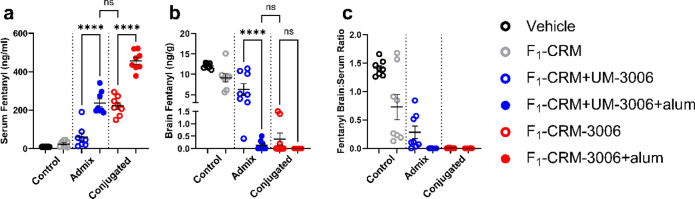
High Resolution Image Download MS PowerPoint Slide Currently approved pharmacotherapies for opioid use disorders (OUDs) and overdose reversal agents are insufficient to slow the spread of OUDs due to the proliferation of fentanyl. This is evident in the 31% rise in drug overdose deaths from 2019 to 2022, with rates increasing from 21.6 to 28.3 overdoses per 100,000 deaths. Vaccines are a potential alternative or adjunct therapy for the treatment of several substance use disorders (nicotine, cocaine) but have shown limited clinical success due to suboptimal antibody titers. In this study, we demonstrate that coconjugation of a Toll-like receptor 7/8 (TLR7/8) agonist (UM-3006) alongside a fentanyl-based hapten (F 1 ) on the surface of the carrier protein cross-reactive material 197 (CRM) significantly increased generation of high-affinity fentanyl-specific antibodies. This demonstrated enhanced protection against fentanyl challenges relative to an unconjugated (admix) adjuvant control in mice. Inclusion of aluminum hydroxide (alum) adjuvant further increased titers and enhanced protection, as determined by analysis of fentanyl concentration in serum and brain tissue. Collectively, our findings present a promising approach to enhance the efficacy of antiopioid vaccines, underscoring the need for extensive exploration of TLR7/8 agonist conjugates as a compelling strategy to combat opioid use disorders.
Overview
The claims and statistics of this paper haven’t been checked yet.
Run the check — free, no account needed. It reads the open-access text and checks the sources it cites.
Integrity signals
Registry
Cites
Statistics
Figures
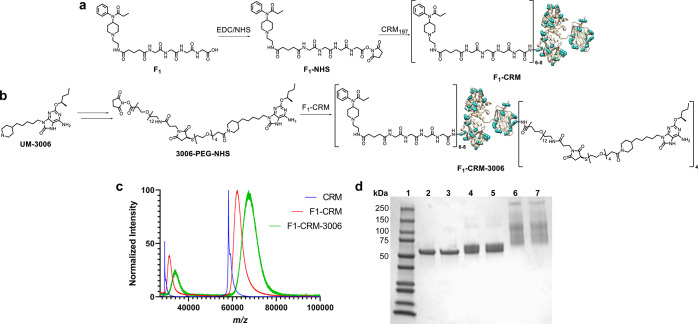
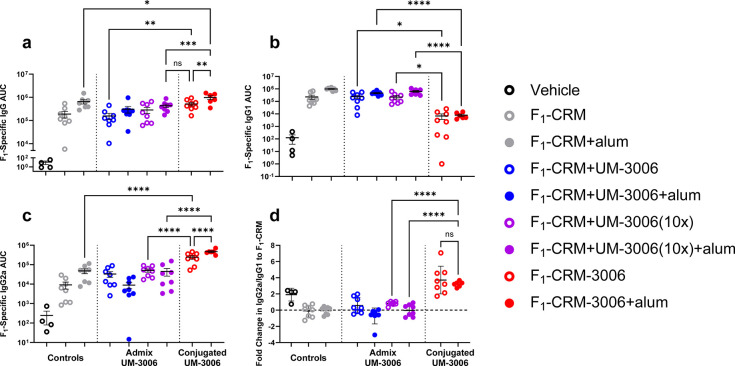
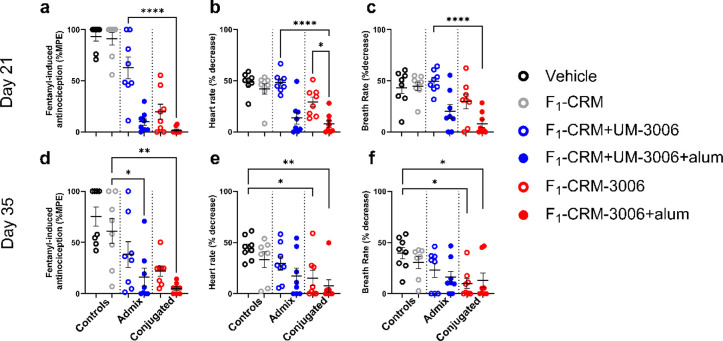
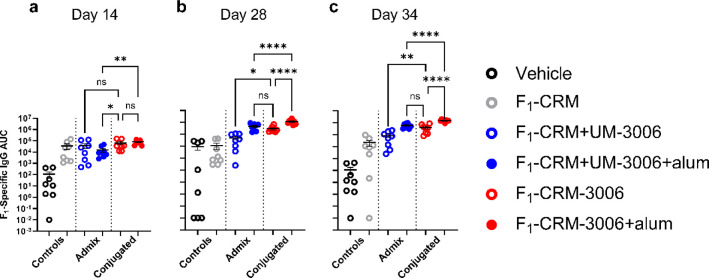
Verification
Claims the paper makes
The claims and statistics of this paper haven’t been checked yet.
Run the check — free, no account needed. It reads the open-access text and checks the sources it cites.
Self-check
Percentages, sums and reported differences re-computed from the paper’s own numbers.
The self-check needs the paper’s full text.
Citations
Cites
Regulation of antibody isotype secretion by subsets of antigen-specific helper T cells
Stevens, T. L., Bossie, A., Sanders, V. M., Fernandez-Botran, R., Coffman, R. L., Mosmann, T. R., & Vitetta, E. S. (1988) · Nature · doi:10.1038/334255a0 · Cited by 933
Towards an understanding of the adjuvant action of aluminium
Marrack, P., McKee, A. S., & Munks, M. W. (2009) · Nature Reviews Immunology · doi:10.1038/nri2510 · Cited by 887
A vaccine against nicotine for smoking cessation: a randomized controlled trial
Cornuz, J., Zwahlen, S., Jungi, W. F., Osterwalder, J., Klingler, K., van Melle, G., Bangala, Y., Guessous, I., Müller, P., Willers, J., et al. (2008) · PLoS ONE · doi:10.1371/journal.pone.0002547 · Cited by 281
PEGylated Protein Drugs: Basic Science and Clinical Applications
(2009) · doi:10.1007/978-3-7643-8679-5 · Cited by 241
Research works printed but not linked: 55
- 10.1001/jama.2017.13358 · DOI
- 10.1001/jama.2018.2844 · DOI
- 10.1016/j.drugpo.2017.06.010 · DOI
- 10.1016/j.drugalcdep.2016.11.033 · DOI
- National Academies of Sciences, Engineering, and Medicine; Health and Medicine Division; Board on Health Sciences Policy; Disorder, Committee on Medication-Assisted Treatment for Opioid Use Disorder, 2019, Medications for Opioid Use Disorder Save Lives
- 10.1046/j.1360-0443.2001.96226710.x · DOI
- 10.1016/j.drugalcdep.2006.09.012 · DOI
- 10.1038/s41380-020-0661-4 · DOI
- 10.1016/j.biopsych.2019.06.020 · DOI
- 10.1371/journal.pone.0266142 · DOI
- 10.1016/j.neuropharm.2019.06.001 · DOI
- 10.1177/2042098617744161 · DOI
- 10.1124/jpet.119.258566 · DOI
- 10.1111/bph.15573 · DOI
- 10.1111/jcpt.13484 · DOI
- 10.1021/acs.jmedchem.0c01042 · DOI
- 10.1007/s12264-022-00872-3 · DOI
- 10.1007/s40263-020-00722-8 · DOI
- 10.1111/nyas.14329 · DOI
- 10.1016/j.neuropharm.2019.06.001 · DOI
- 10.1038/s41541-023-00694-y · DOI
- 10.1021/acs.bioconjchem.1c00179 · DOI
- 10.1021/acsomega.2c00820 · DOI
- 10.1038/clpt.2010.317 · DOI
- 10.1001/archgenpsychiatry.2009.128 · DOI
- 10.1016/j.vaccine.2014.07.085 · DOI
- 10.1021/mp400631w · DOI
- 10.1021/acs.molpharmaceut.7b00933 · DOI
- 10.1371/journal.pone.0096547 · DOI
- 10.1016/j.vaccine.2013.04.027 · DOI
- 10.1038/s41598-018-23777-6 · DOI
- 10.3389/fimmu.2020.00406 · DOI
- 10.1038/nbt.3371 · DOI
- 10.4049/jimmunol.1600497 · DOI
- 10.4049/immunohorizons.1700063 · DOI
- 10.1016/j.jhep.2007.02.025 · DOI
- 10.1016/j.vaccine.2011.05.061 · DOI
- 10.1038/srep29063 · DOI
- 10.1021/acs.jmedchem.6b00489 · DOI
- 10.1182/blood-2005-01-0342 · DOI
- 10.1073/pnas.0507484102 · DOI
- 10.1039/D1CC00795E · DOI
- 10.1016/j.ejpb.2016.07.004 · DOI
- 10.1016/j.isci.2020.100935 · DOI
- 10.1016/B978-0-12-801009-9.00005-7 · DOI
- 10.1002/elps.200600807 · DOI
- 10.1126/science.3107127 · DOI
- 10.1002/eji.1830230805 · DOI
- 10.1124/jpet.120.000124 · DOI
- 10.1172/JCI45416 · DOI
- 10.1124/jpet.118.253674 · DOI
- 10.1021/acs.molpharmaceut.0c00497 · DOI
- 10.1021/acschemneuro.0c00064 · DOI
- 10.3389/fimmu.2022.857779 · DOI
- 10.4049/jimmunol.2100204 · DOI
Metadata
- Authors
- Powers, N., Massena, C., Crouse, B., Smith, M., Hicks, L., Evans, J. T., Miller, S., Pravetoni, M., & Burkhart, D.
- Affiliations
- University of Montana (US)
- University of Minnesota (US)
- University of Washington (US)
- Corresponding author
- Burkhart, David
- ORCID
- Venue
- Bioconjugate Chemistry
- Publisher
- American Chemical Society (ACS)
- Published
- 2023-09-27
- Volume
- 34
- Issue
- 10
- Pages
- 1811-1821
- ISSN
- 1043-1802 (ISSN-L)
- 1520-4812
- PMC
- PMC10587865
- OpenAlex
- W4387079244
- Cited by
- 15
- References
- 4
- Citations by year
- 2026: 2 · 2025: 6 · 2024: 6 · 2023: 1
- FWCI
- 2.47
- Type
- journal article
- Language
- en
- Open access
- hybrid
- doi.org
- Licence
- Locations
- Bioconjugate Chemistry (publishedVersion, cc-by-nc-nd)
- PubMed Central (publishedVersion, cc-by-nc-nd)
- PubMed (publishedVersion)
- Funders
- National Institute on Drug Abuse (F31-DA054760, UG3DA048386)
- National Institutes of Health (75N93020C00039, R01AI137146-01A1)
- Topics
- Life Sciences › Immunology and Microbiology › Immunology › Monoclonal and Polyclonal Antibodies Research
- Life Sciences › Immunology and Microbiology › Immunology › Immunotherapy and Immune Responses
- Health Sciences › Medicine › Public Health, Environmental and Occupational Health › Opioid Use Disorder Treatment
- Keywords
- fentanyl, opioid use disorder, TLR7/8 agonist, hapten conjugation, CRM197, aluminum hydroxide adjuvant, antibody titers, opioid overdose, vaccine adjuvants
- MeSH terms
- Adjuvants, Immunologic, Analgesics, Opioid, Animals, Antigens, Fentanyl, Haptens, Opioid-Related Disorders, Vaccines, Toll-Like Receptor 7, Mice
About these checks
Registry, retraction, Cites and statistics results are computed, not judged, with one exception: a printed reference that no index lists is read once by a model before it counts as a citation error. Claims are extracted by a model and kept only when their quote appears verbatim in the text; each cited source is then checked, with a model’s help, for whether it says what the claim relies on. Those verdicts can be wrong — read the claim’s quote and the cited source before relying on one.
Statistics and arithmetic are recomputed, not judged.
Confidence bands are shown only for fields calibrated on our annotated test set. None is calibrated yet, so no band is shown.
What counts as a claim ›How we measure confidence ›How we check this ›
Are you an author, or do you see a problem with this page? Request a review
