

The DOI matches its Crossref record; 149 of the 149 references it cites were found in a registry or an index.
Using Deep Graph Neural Networks Improves Physics-Based Hydration Free Energy Predictions Even for Molecules Outside of the Training Set Distribution
Open accessPublished version of a preprint
Abstract
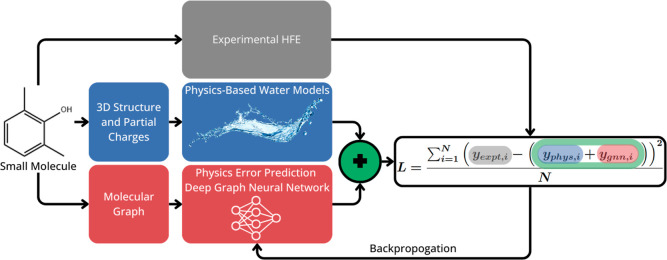
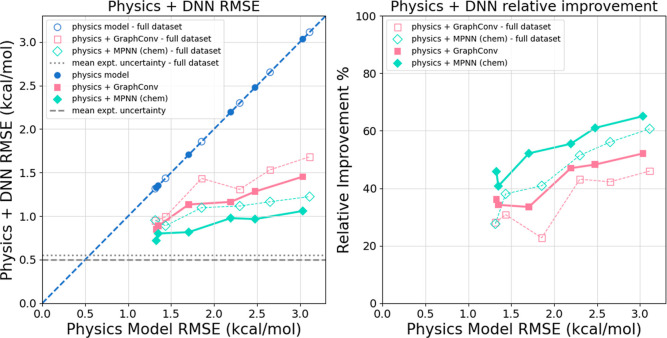
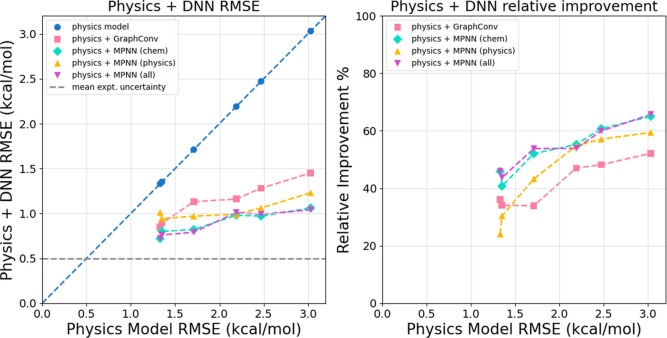
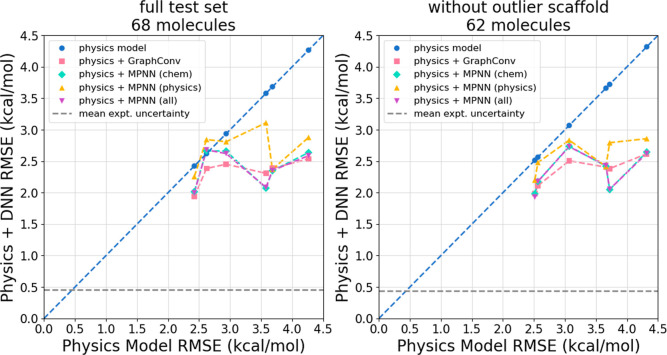
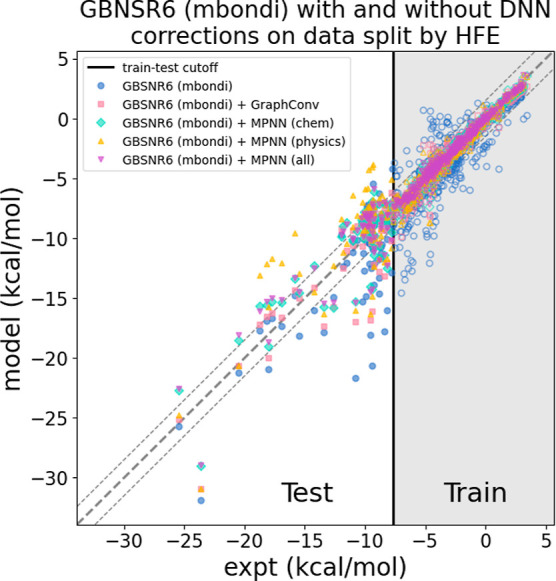
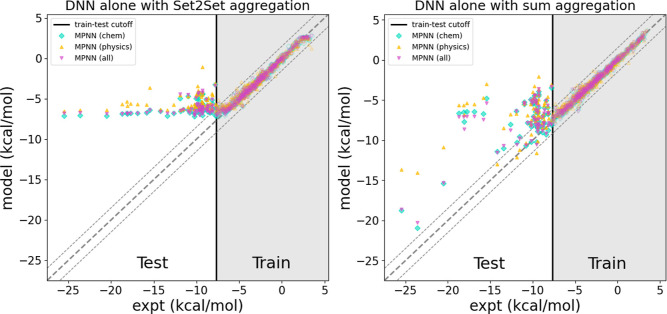
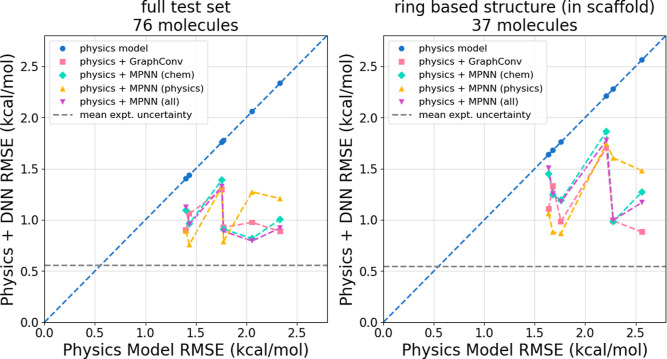
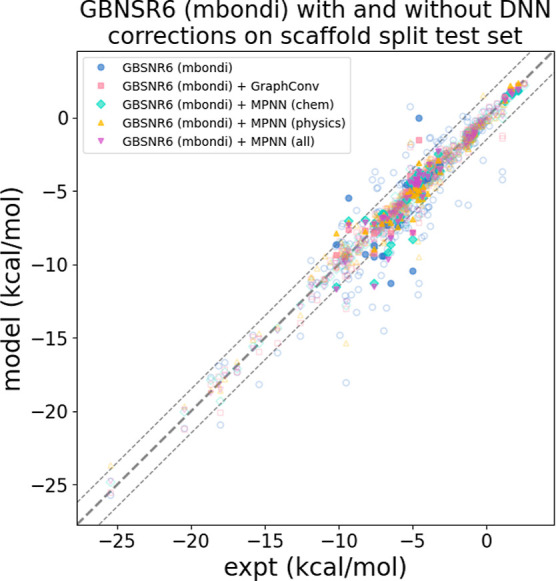
The accuracy of computational water models is crucial to atomistic simulations of biomolecules. Here we explore a decoupled framework that combines classical physics-based models with deep neural networks (DNNs) to correct residual error in hydration free energy (HFE) prediction. Our main goal is to evaluate this framework on out-of-distribution data (molecules that differ significantly from those used in training), where DNNs are known to struggle. Several common physics-based solvation models are used in the evaluation. Graph neural network architectures are tested for their ability to generalize using multiple data set splits, including out-of-distribution HFEs and unseen molecular scaffolds. Our most important finding is that for out-of-distribution data, where DNNs alone often struggle, the physics + DNN models consistently improve physics model predictions. For in-distribution data, the DNN corrections significantly improve the accuracy of physics-based models, with a final RMSE below 1 kcal/mol and a relative improvement between 40% and 65% in most cases. The accuracy of physics + DNN models tends to improve when the 6% of molecules with the highest experimental uncertainty are removed. This study provides insights into the potential and limitations of combining physics and machine learning for molecular modeling, offering a practical and generalizable strategy of using DNN as independent postprocessing correction.
Overview
The claims and statistics of this paper haven’t been checked yet.
Run the check — free, no account needed. It reads the open-access text and checks the sources it cites.
Integrity signals
Registry
Cites
Statistics
Figures
Verification
Claims the paper makes
The claims and statistics of this paper haven’t been checked yet.
Run the check — free, no account needed. It reads the open-access text and checks the sources it cites.
Self-check
Percentages, sums and reported differences re-computed from the paper’s own numbers.
The self-check needs the paper’s full text.
Citations
Cites
LeCun, Y., Bengio, Y., & Hinton, G. (2015) · Nature · doi:10.1038/nature14539 · Cited by 84,126
Highly accurate protein structure prediction with AlphaFold
Jumper, J., Evans, R., Pritzel, A., Green, T., Figurnov, M., Ronneberger, O., Tunyasuvunakool, K., Bates, R., Žídek, A., Potapenko, A., et al. (2021) · Nature · doi:10.1038/s41586-021-03819-2 · Cited by 43,764
Comparison of simple potential functions for simulating liquid water
Jorgensen, W. L., Chandrasekhar, J., Madura, J. D., Impey, R. W., & Klein, M. L. (1983) · The Journal of Chemical Physics · doi:10.1063/1.445869 · Cited by 41,298
PyTorch: An Imperative Style, High-Performance Deep Learning Library
Paszke, A., Gross, S., Massa, F., Lerer, A., Bradbury, J., Chanan, G., Killeen, T., Lin, Z., Gimelshein, N., Antiga, L., et al. (2019) · arXiv · doi:10.48550/arxiv.1912.01703 · Cited by 31,473
Advances in neural information processing systems 7
Cios, K., & Shields, M. (1997) · Neurocomputing · doi:10.1016/s0925-2312(97)90018-7 · Cited by 22,059
Raissi, M., Perdikaris, P., & Karniadakis, G. E. (2019) · Journal of Computational Physics · doi:10.1016/j.jcp.2018.10.045 · Cited by 20,384
Quantum Mechanical Continuum Solvation Models
Tomasi, J., Mennucci, B., & Cammi, R. (2005) · Chemical Reviews · doi:10.1021/cr9904009 · Cited by 16,868
Unified Approach for Molecular Dynamics and Density-Functional Theory
Car, R., & Parrinello, M. (1985) · Physical Review Letters · doi:10.1103/physrevlett.55.2471 · Cited by 10,754
TensorFlow: Large-Scale Machine Learning on Heterogeneous Distributed Systems
Abadi, M., Agarwal, A., Barham, P., Brevdo, E., Chen, Z., Citro, C., Corrado, G. S., Davis, A., Dean, J., Devin, M., et al. (2016) · arXiv · doi:10.48550/arxiv.1603.04467 · Cited by 9,408
Physics-informed machine learning
Karniadakis, G. E., Kevrekidis, I. G., Lu, L., Perdikaris, P., Wang, S., & Yang, L. (2021) · Nature Reviews Physics · doi:10.1038/s42254-021-00314-5 · Cited by 8,718
Research works printed but not linked: 12
- 10.1021/jp994072s · DOI · Paper page
- Goodfellow I., 2016, Deep Learning
- 10.48550/arXiv.1706.08566 · DOI
- Duvenaud D. K., 2015, Adv. Neural Inf. Process. Syst., 28, 1
- 10.1039/D1SC06946B · DOI
- 10.48550/arXiv.1705.08532 · DOI
- 10.1002/wcms.1347 · DOI
- Srivastava N., 2014, J. Mach. Learn. Res., 15, 1929
- 10.48550/arXiv.1511.06391 · DOI · Paper page
- 10.1021/ct100392h · DOI
- Marenich, A. V.; Kelly, C. P.; Thompson, J. D.; Hawkins, G. D.; Chambers, C. C.; Giesen, D. J.; Winget, P.; Cramer, C. J.; Truhlar, D. G. Minnesota Solvation Database (MNSOL) version 2012. 2020, http://hdl.handle.net/11299/213300.
- 10.48550/arXiv.1612.01474 · DOI · Paper page
Metadata
- Authors
- Elder, L. H., & Onufriev, A. V.
- Affiliations
- Virginia Tech (US)
- Corresponding author
- Onufriev, Alexey V.
- Venue
- The Journal of Physical Chemistry B
- Publisher
- American Chemical Society (ACS)
- Published
- 2025-07-11
- Volume
- 129
- Issue
- 29
- Pages
- 7483-7498
- ISSN
- 1520-5207 (ISSN-L)
- 1520-6106
- PMC
- PMC12302205
- OpenAlex
- W4412188548
- Cited by
- 2
- References
- 149
- Citations by year
- 2026: 2
- FWCI
- 0.73
- Type
- journal article
- Language
- en
- Open access
- hybrid
- doi.org
- Licence
- Locations
- The Journal of Physical Chemistry B (publishedVersion, cc-by)
- ChemRxiv (acceptedVersion, cc-by)
- PubMed Central (publishedVersion, cc-by)
- PubMed (publishedVersion)
- Funders
- National Institute of General Medical Sciences (R01 GM144596)
- Topics
- Physical Sciences › Physics and Astronomy › Atomic and Molecular Physics, and Optics › Advanced Chemical Physics Studies
- Life Sciences › Pharmacology, Toxicology and Pharmaceutics › Drug Discovery › Computational Drug Discovery Methods
- Physical Sciences › Materials Science › Materials Chemistry › Machine Learning in Materials Science
- Keywords
- hydration free energy, graph neural networks, out-of-distribution generalization, hybrid physics-machine learning models, molecular solvation, experimental uncertainty
About these checks
Registry, retraction, Cites and statistics results are computed, not judged, with one exception: a printed reference that no index lists is read once by a model before it counts as a citation error. Claims are extracted by a model and kept only when their quote appears verbatim in the text; each cited source is then checked, with a model’s help, for whether it says what the claim relies on. Those verdicts can be wrong — read the claim’s quote and the cited source before relying on one.
Statistics and arithmetic are recomputed, not judged.
Confidence bands are shown only for fields calibrated on our annotated test set. None is calibrated yet, so no band is shown.
What counts as a claim ›How we measure confidence ›How we check this ›
Are you an author, or do you see a problem with this page? Request a review
How to cite
Cite CoChat for the checks on this page, and the paper for its own findings.
- This page
- CoChat. (2026). Citation check: Using Deep Graph Neural Networks Improves Physics-Based Hydration Free Energy Predictions Even for Molecules Outside of the Training Set Distribution. https://app.cochat.ai/papers/10.1021/acs.jpcb.5c02263
- The paper
- Elder, L. H., & Onufriev, A. V. (2025). Using Deep Graph Neural Networks Improves Physics-Based Hydration Free Energy Predictions Even for Molecules Outside of the Training Set Distribution. The Journal of Physical Chemistry B. https://doi.org/10.1021/acs.jpcb.5c02263
Data sources
Bibliographic data: Semantic Scholar, OpenAlex, Crossref.
Contains information from the Semantic Scholar Academic Graph Datasets, made available under the ODC Attribution License (ODC-BY 1.0).
Semantic Scholar’s data is described in: Kinney, R., et al. (2023). The Semantic Scholar Open Data Platform. arXiv:2301.10140.
