

The DOI matches its Crossref record; 2 of the 2 references it cites were found in a registry or an index.
Characterization of 2,4-Dianilinopyrimidines Against Five P. falciparum Kinases PfARK1, PfARK3, PfNEK3, PfPK9, and PfPKB
Open accessPublished version of a preprint
Abstract
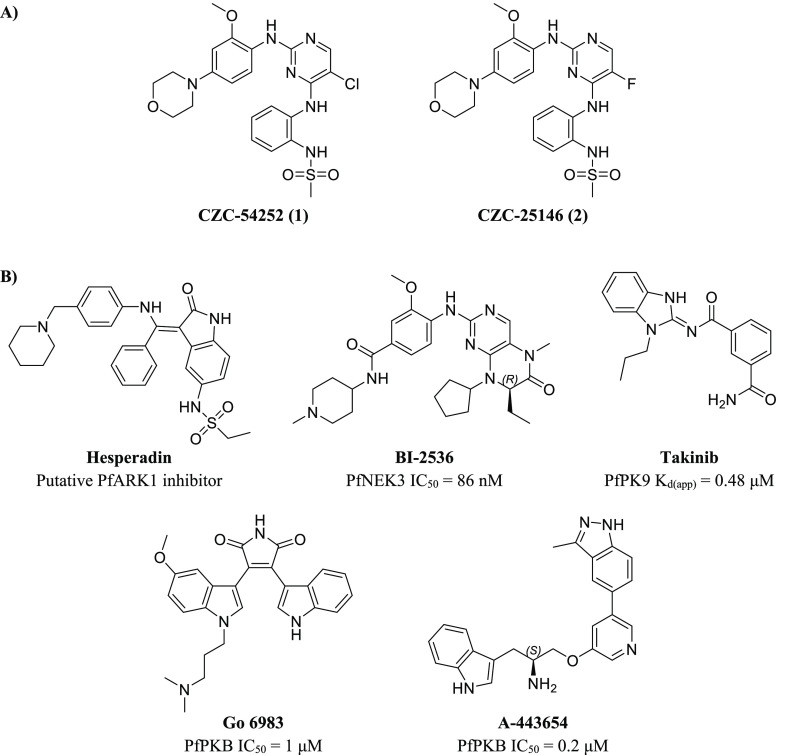
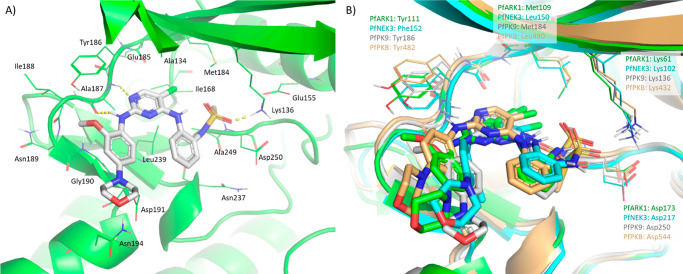
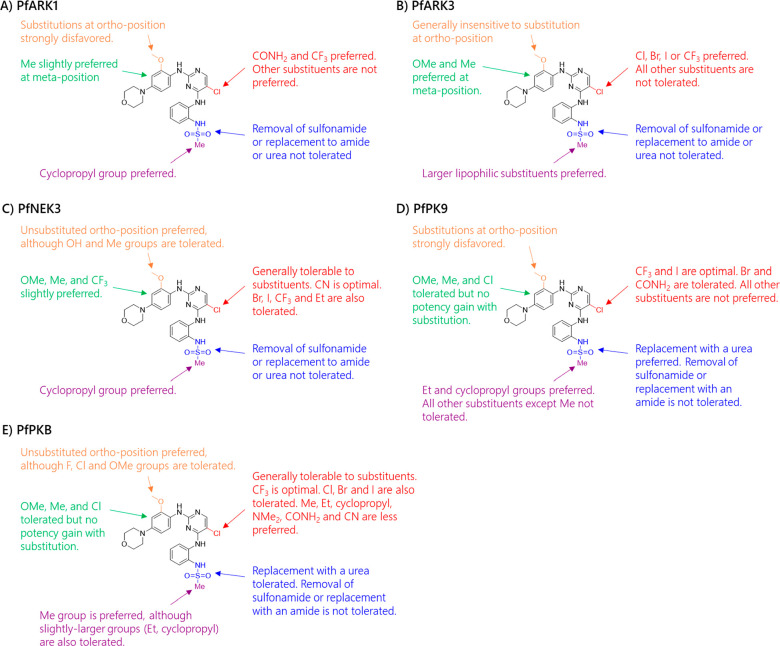
High Resolution Image Download MS PowerPoint Slide Plasmodium kinases are increasingly recognized as potential novel antiplasmodial targets for the treatment of malaria, but only a small subset of these kinases have had structure–activity relationship (SAR) campaigns reported. Herein we report the discovery of CZC-54252 ( 1 ) as an inhibitor of five P. falciparum kinases PfARK1, PfARK3, PfNEK3, PfPK9, and PfPKB. 39 analogues were evaluated against all five kinases to establish SAR at three regions of the kinase active site. Nanomolar inhibitors of each kinase were discovered. We identified common and divergent SAR trends across all five kinases, highlighting substituents in each region that improve potency and selectivity for each kinase. Potent analogues were evaluated against the P. falciparum blood stage. Eight submicromolar inhibitors were discovered, of which 37 demonstrated potent antiplasmodial activity (EC 50 = 0.16 μM). Our results provide an understanding of features needed to inhibit each individual kinase and lay groundwork for future optimization efforts toward novel antimalarials.
Overview
The claims and statistics of this paper haven’t been checked yet.
Run the check — free, no account needed. It reads the open-access text and checks the sources it cites.
Integrity signals
Registry
Cites
Statistics
Figures
Verification
Claims the paper makes
The claims and statistics of this paper haven’t been checked yet.
Run the check — free, no account needed. It reads the open-access text and checks the sources it cites.
Self-check
Percentages, sums and reported differences re-computed from the paper’s own numbers.
The self-check needs the paper’s full text.
Citations
Cites
Highly accurate protein structure prediction with AlphaFold
Jumper, J., Evans, R., Pritzel, A., Green, T., Figurnov, M., Ronneberger, O., Tunyasuvunakool, K., Bates, R., Žídek, A., Potapenko, A., et al. (2021) · Nature · doi:10.1038/s41586-021-03819-2 · Cited by 43,764
Development of Selective Covalent Janus Kinase 3 Inhibitors
Tan, L., Akahane, K., McNally, R., Reyskens, K. M. S. E., Ficarro, S. B., Liu, S., Herter-Sprie, G. S., Koyama, S., Pattison, M. J., Labella, K., et al. (2015) · Journal of Medicinal Chemistry · doi:10.1021/acs.jmedchem.5b00710 · Cited by 122
Research works printed but not linked: 44
- Brown J. R., 2013, Protein Phosphorylation in Parasites, 261, 10.1002/9783527675401.ch13 · DOI
- 10.4155/fmc.12.183 · DOI
- 10.1021/acsinfecdis.0c00724 · DOI
- 10.1080/14728222.2023.2185511 · DOI
- 10.1186/1471-2164-5-79 · DOI
- 10.1002/prot.20278 · DOI
- 10.1038/ncomms1558 · DOI
- 10.1126/science.aap7847 · DOI
- 10.1007/s10822-013-9700-4 · DOI
- 10.1016/j.bmc.2015.08.006 · DOI
- 10.1038/nature09107 · DOI
- 10.1371/journal.pone.0149996 · DOI
- 10.1016/j.ejmech.2016.08.055 · DOI
- 10.1016/j.bmc.2021.116348 · DOI
- 10.1021/acsinfecdis.3c00025 · DOI
- 10.1021/cb2002413 · DOI
- 10.1021/ja104491h · DOI
- 10.1111/j.1365-2958.2010.07442.x · DOI
- 10.1111/cmi.12571 · DOI
- 10.1039/C4MD00045E · DOI
- 10.1038/s42003-020-01424-z · DOI
- 10.1016/j.febslet.2006.10.003 · DOI
- 10.1016/j.bbrc.2007.07.047 · DOI
- 10.1016/j.ejmech.2022.115043 · DOI
- 10.1073/pnas.0611601104 · DOI
- 10.1016/j.chembiol.2018.11.003 · DOI
- 10.1038/s41598-021-01267-6 · DOI
- 10.1074/jbc.M312855200 · DOI
- 10.1074/jbc.M509807200 · DOI
- 10.1016/j.molbiopara.2006.01.009 · DOI
- 10.1371/journal.pone.0035855 · DOI
- 10.1074/jbc.M708465200 · DOI
- 10.1093/nar/gkab1061 · DOI · Paper page
- 10.1021/jm400378w · DOI
- 10.1021/acs.jmedchem.1c02080 · DOI
- 10.1016/j.bmcl.2007.03.078 · DOI
- 10.1021/jacs.5b07090 · DOI
- 10.1021/jm301495v · DOI
- 10.1073/pnas.0609412103 · DOI
- 10.1111/j.1747-0285.2007.00594.x · DOI
- 10.1021/acs.jmedchem.6b00389 · DOI
- 10.1021/jm500261q · DOI
- 10.1128/AAC.48.5.1803-1806.2004 · DOI
- 10.1021/jp507569e · DOI
Metadata
- Authors
- Ong, H. W., de Silva, C., Avalani, K., Kwarcinski, F., Mansfield, C. R., Chirgwin, M., Truong, A., Derbyshire, E. R., Zutshi, R., & Drewry, D. H.
- Affiliations
- University of North Carolina at Chapel Hill (US)
- Luceome Biotechnologies (United States) (US)
- Duke University (US)
- Corresponding author
- Derbyshire, Emily R.
- Zutshi, Reena
- Drewry, David H.
- ORCID
- Venue
- ACS Medicinal Chemistry Letters
- Publisher
- American Chemical Society (ACS)
- Published
- 2023-11-27
- Volume
- 14
- Issue
- 12
- Pages
- 1774-1784
- ISSN
- 1948-5875 (ISSN-L)
- PMC
- PMC10726455
- OpenAlex
- W4389043310
- Cited by
- 6
- References
- 2
- Citations by year
- 2026: 1 · 2025: 4 · 2024: 1
- FWCI
- 1.54
- Type
- journal article
- Language
- en
- Open access
- hybrid
- doi.org
- Licence
- Locations
- ACS Medicinal Chemistry Letters (publishedVersion, cc-by-nc-nd)
- PubMed Central (publishedVersion, cc-by-nc-nd)
- PubMed (publishedVersion)
- Funders
- Division of Chemistry (CHE-1726291)
- Division of Graduate Education (1644868)
- National Institute of Allergy and Infectious Diseases (1R44AI150237-01)
- Structural Genomics Consortium (1097737)
- Topics
- Health Sciences › Medicine › Public Health, Environmental and Occupational Health › Malaria Research and Control
- Physical Sciences › Chemistry › Organic Chemistry › Heterocyclic Compound Synthesis and Bioactivity
- Life Sciences › Pharmacology, Toxicology and Pharmaceutics › Drug Discovery › Phytochemical compounds biological activities
- Keywords
- kinase inhibitors, antiplasmodial agents, structure-activity relationship, malaria drug targets, blood-stage parasites, kinase selectivity
About these checks
Registry, retraction, Cites and statistics results are computed, not judged, with one exception: a printed reference that no index lists is read once by a model before it counts as a citation error. Claims are extracted by a model and kept only when their quote appears verbatim in the text; each cited source is then checked, with a model’s help, for whether it says what the claim relies on. Those verdicts can be wrong — read the claim’s quote and the cited source before relying on one.
Statistics and arithmetic are recomputed, not judged.
Confidence bands are shown only for fields calibrated on our annotated test set. None is calibrated yet, so no band is shown.
What counts as a claim ›How we measure confidence ›How we check this ›
Are you an author, or do you see a problem with this page? Request a review
