

A Qualitative Analysis of Self-Harm and Suicide in Sri Lankan Printed Newspapers
Open accessThe DOI matches its Crossref record; 28 of the 28 references it cites were found in a registry or an index.
Abstract
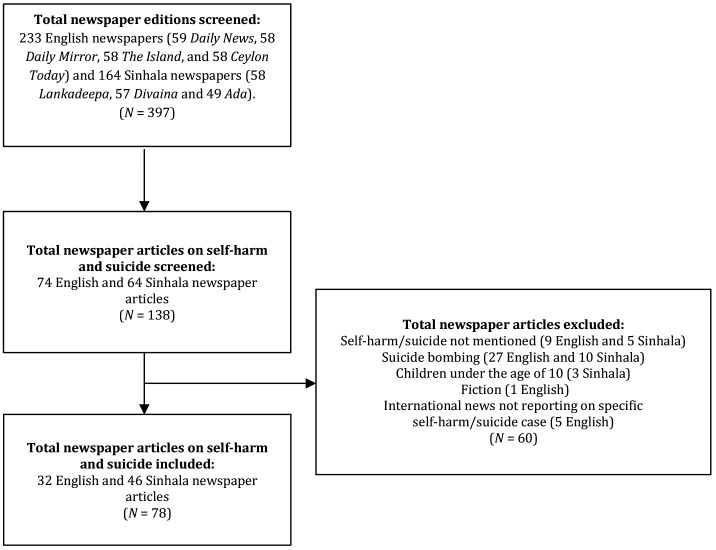
Background: Media reporting may influence suicidal behavior. In-depth exploration of how self-harm and suicide are portrayed in newspaper articles in a middle-income country such as Sri Lanka is lacking. Aims: We aimed to explore how self-harm and suicide are portrayed in Sri Lankan printed newspapers. Method: Seven English- and Sinhala-language Sri Lankan newspapers were screened for articles reporting on self-harm and suicide (December 1, 2014 to January 31, 2015). A thematic analysis was conducted. Results: In the 78 articles identified for analysis, certain aspects were overemphasized (inappropriate behavior) and others underemphasized (alcohol and complexities of self-harm). Explanations of self-harm were one-sided and a suicide prevention narrative was lacking. Limitations: Another time-frame and inclusion of Tamil newspapers as well as social media and online publications would provide additional understanding. Conclusion: The study found an indication of simplistic reporting. Greater focus on prevention and a nuanced portrayal of self-harm could reduce stigma and imitative behavior.
Overview
The claims and statistics of this paper haven’t been checked yet.
Free: it reads the open-access text and checks the first 5 claims that cite a source we can check. Create a free account to check every claim.
Integrity signals
Registry
Cites
Statistics
Figures
Verification
Claims the paper makes
The claims and statistics of this paper haven’t been checked yet.
Free: it reads the open-access text and checks the first 5 claims that cite a source we can check. Create a free account to check every claim.
Claims other papers make about this one
Each is checked against this paper’s own text: does it say what the citing paper says it does?
In the citing paper
“Some of the most powerful ways that the media perpetuate stigma worldwide are by using stigmatising language and by simplistically or inaccurately linking mental health conditions with violence.266,267”
From The Lancet Commission on ending stigma and discrimination in mental health (2022) · cites this paper as [267]
Self-check
Percentages, sums and reported differences re-computed from the paper’s own numbers.
The self-check needs the paper’s full text.
Citations
Cites
Using thematic analysis in psychology
Braun, V., & Clarke, V. (2006) · Qualitative Research in Psychology · doi:10.1191/1478088706qp063oa · Cited by 194,414 · cited 1×
“An inductive, thematic analysis was conducted to identify, analyze, and report common themes on self-harm and suicide within the data (Braun & Clarke, 2006).”
MethodChildren of Global Migration: Transnational Families and Gendered Woes
Parreñas, R. (2005) · Stanford University Press eBooks · doi:10.1515/9781503624627 · Cited by 1,163
Analysing Newspapers: An Approach from Critical Discourse Analysis
Richardson, J. E. (2006) · Cited by 853
The International Handbook of Suicide and Attempted Suicide
(2000) · doi:10.1002/9780470698976 · Cited by 819
Role of media reports in completed and prevented suicide: Werther v. Papageno effects
Niederkrotenthaler, T., Voracek, M., Herberth, A., Till, B., Strauss, M., Etzersdorfer, E., Eisenwort, B., & Sonneck, G. (2010) · British Journal of Psychiatry · doi:10.1192/bjp.bp.109.074633 · Cited by 719
Gender and alcohol consumption: patterns from the multinational GENACIS project
Wilsnack, R. W., Wilsnack, S. C., Kristjanson, A. F., Vogeltanz‐Holm, N. D., & Gmel, G. (2009) · Addiction · doi:10.1111/j.1360-0443.2009.02696.x · Cited by 714
MEDIA(TED) DISCOURSE AND SOCIETY: Rethinking the framework of Critical Discourse Analysis
Carvalho, A. (2008) · Journalism Studies · doi:10.1080/14616700701848162 · Cited by 442 · cited 1×
“Although inspired by CDA, we did not conduct a full discourse analysis (Carvalho, 2008).”
MethodMedia Guidelines on the Reporting of Suicide
Pirkis, J., Blood, R. W., Beautrais, A., Burgess, P., & Skehan, J. (2006) · Crisis · doi:10.1027/0227-5910.27.2.82 · Cited by 259
Media Guidelines for the Responsible Reporting of Suicide: A Review of Effectiveness
Bohanna, I., & Wang, X. (2012) · Crisis · doi:10.1027/0227-5910/a000137 · Cited by 175 · cited 2×
“Further, responsible reporting can de-stigmatize and educate about suicide, provide information about help-seeking, and may lead to policy interventions (Bohanna & Wang, 2012; WHO, 2017).”
BackgroundKnipe, D. W., Chang, S.-S., Dawson, A., Eddleston, M., Konradsen, F., Metcalfe, C., & Gunnell, D. (2017) · PLOS ONE · doi:10.1371/journal.pone.0172893 · Cited by 152
Self-citationReaching for the bottle of pesticide—A cry for help. Self-inflicted poisonings in Sri Lanka
Konradsen, F., van der Hoek, W., & Peiris, P. (2005) · Social Science & Medicine · doi:10.1016/j.socscimed.2005.08.020 · Cited by 124
Collective Violence and Everyday Practice in Sri Lanka
Spencer, J. (1990) · Modern Asian Studies · doi:10.1017/s0026749x00010489 · Cited by 120 · cited 4×
“Traditionally, Sri Lankan men are expected to be self-controlled, guardians of women’s behavior, and main breadwinners (Obeyesekere, 1984; Spencer, 1990a).”
BackgroundInfluentialArmstrong, G., Vijayakumar, L., Niederkrotenthaler, T., Jayaseelan, M., Kannan, R., Pirkis, J., & Jorm, A. F. (2018) · Australian & New Zealand Journal of Psychiatry · doi:10.1177/0004867418772343 · Cited by 116 · cited 2×
“A striking finding was that the majority of articles included no suicide prevention narrative, consistent with other research from the region (Armstrong et al., 2018; Arafat, Khan, Niederkrotenthaler, Ueda, & Armstrong, 2020).”
BackgroundResultCulture, Gender, and Suicidal Behavior in Sri Lanka
Marecek, J. (1998) · Suicide and Life-Threatening Behavior · doi:10.1111/j.1943-278x.1998.tb00627.x · Cited by 98 · cited 1×
“This has previously been found in Sri Lankan self-harm literature where several studies have highlighted how a purpose of self-harm is to communicate something that cannot be said in words, typically to close relations (Marecek, 1998; Sørensen et al., 2017).”
BackgroundMilk Teeth and Jet Planes: Kin Relations in Families of Sri Lanka's Transnational Domestic Servants
Gamburd, M. R. (2008) · City & Society · doi:10.1111/j.1548-744x.2008.00003.x · Cited by 94 · cited 1×
“Especially the absence of migrating mothers have, in Sri Lanka and internationally, been viewed to be “abnormal” owing to its impact on the well-being of the left-behind children (Gamburd, 2008; Parrenas, 2005).”
BackgroundPreventing deaths from pesticide self-poisoning—learning from Sri Lanka's success
Knipe, D. W., Gunnell, D., & Eddleston, M. (2017) · The Lancet Global Health · doi:10.1016/s2214-109x(17)30208-5 · Cited by 90
Arafat, S. M. Y., Khan, M. M., Niederkrotenthaler, T., Ueda, M., & Armstrong, G. (2019) · Crisis · doi:10.1027/0227-5910/a000603 · Cited by 77
Suffering, Frustration, and Anger: Class, Gender and History in Sri Lankan Suicide Stories
Widger, T. (2012) · Culture Medicine and Psychiatry · doi:10.1007/s11013-012-9250-6 · Cited by 64 · cited 2×
“The importance of kinship in the context of self-harm in Sri Lanka was, for example, highlighted in an ethnographic study (Widger, 2012b) and a qualitative study of self-harm in ru- © 2020 Hogrefe Publishing Distributed as a Hogrefe OpenMind article under the license CC BY 4.0…”
BackgroundInfluentialA comparison of non-fatal self-poisoning among males and females, in Sri Lanka
Rajapakse, T., Griffiths, K. M., Christensen, H., & Cotton, S. (2014) · BMC Psychiatry · doi:10.1186/s12888-014-0221-z · Cited by 52
Sørensen, J. B., Agampodi, T. C., Sørensen, B. R., Siribaddana, S., Konradsen, F., & Rheinländer, T. (2017) · BMJ Global Health · doi:10.1136/bmjgh-2017-000462 · Cited by 40 · cited 1×
“…misuse were associated with risk of self-harm (Knipe et al., 2018) and that individuals who self-harmed were struggling with a number of life stressors, such as domestic violence, financial strain, and difficulties in living up to gendered expectations of the marriage (Sørensen et al., 2017).”
BackgroundSelf-citationAttempted suicide in Sri Lanka – An epidemiological study of household and community factors
Knipe, D. W., Gunnell, D., Pearson, M., Jayamanne, S. F., Pieris, R., Priyadarshana, C., Weerasinghe, M., Hawton, K. E., Konradsen, F., Eddleston, M., et al. (2018) · Journal of Affective Disorders · doi:10.1016/j.jad.2018.01.028 · Cited by 39
Sørensen, J. B., Pearson, M., Andersen, M. W., Weerasinghe, M., Rathnaweera, M., Rathnapala, D. G. C., Eddleston, M., & Konradsen, F. (2018) · Crisis · doi:10.1027/0227-5910/a000534 · Cited by 32
Suicide and the morality of kinship in Sri Lanka
Widger, T. (2012) · Contributions to Indian Sociology · doi:10.1177/006996671104600205 · Cited by 30 · cited 3×
“The importance of kinship in the context of self-harm in Sri Lanka was, for example, highlighted in an ethnographic study (Widger, 2012b) and a qualitative study of self-harm in ru- © 2020 Hogrefe Publishing Distributed as a Hogrefe OpenMind article under the license CC BY 4.0…”
BackgroundInfluentialTaking Stock – What Is Known About Suicide in Sri Lanka: A Systematic Review of Diverse Literature
Pearson, M., Zwi, A. B., Rouse, A. K., Fernando, R., Buckley, N. A., & McDuie‐Ra, D. (2014) · Crisis · doi:10.1027/0227-5910/a000244 · Cited by 29 · cited 1×
“One explanation could be that suicide is rarely linked to severe mental illnesses in Sri Lanka (Pearson et al., 2014) and that newspapers reflect this.”
BackgroundMedia Influences on Suicidal Thoughts and Behaviors
Pirkis, J., Mok, K., Robinson, J., & Nordentoft, M. (2016) · Wiley eBooks · doi:10.1002/9781118903223.ch42 · Cited by 28
Knipe, D. W., Lambert, H., Pearson, M., Eddleston, M., Jayamanne, S. F., Wickramage, K. P., Hawton, K. E., Konradsen, F., Metcalfe, C., & Gunnell, D. (2019) · BMC Psychiatry · doi:10.1186/s12888-018-2000-8 · Cited by 19 · cited 1×
“A recent Sri Lankan cohort study found that the risk of self-harm was elevated in households with a female migrant (Knipe et al., 2019).”
BackgroundRecent Trends in International Migration
OECD (2007) · International migration outlook · doi:10.1787/migr_outlook-2007-3-en · Cited by 10
Rothstein, J. M. (2000) · Physical Therapy · doi:10.1093/ptj/80.6.554 · Cited by 6
Research works printed but not linked: 7
- Asian Development Bank & Deutsche Gesellschaft für Internationale Zusammenarbeit (GIZ). (2015). Country gender assesment Sri Lanka – an update. Mandaluyong City, Philippines: Asian Development Bank.
- Deshapriya, S., Hattotuwa, S., & Jempson, M. (2003). Suicide sensitive journalism handbook. Colombo, Sri Lanka: Centre for Policy Alternatives & PressWise Trust (UK).
- Obeyesekere, G. (1984). The cult of the goddess Pattini. Chicago, IL: University of Chicago Press.
- Spencer, J.. (1990a). A Sinhala village in time of trouble. Oxford, UK: Oxford University Press.
- The Editors' Guild of Sri Lanka. (2014). The Editors' Guild of Sri Lanka – code of professional practice. Colombo, Sri Lanka: Author.
- World Health Organization. (2014). Preventing suicide: A global imperative. Geneva, Switzerland: Author.
- World Health Organization. (2017). Preventing suicide: A resource for media professionals, update 2017 (WHO/MSDO/MERO/17.5). Geneva, Switzerland: Author.
Cited by
The Lancet Commission on ending stigma and discrimination in mental health
Thornicroft, G., Sunkel, C., Alikhon Aliev, A., Baker, S., Brohan, E., el Chammay, R., Davies, K., Demissie, M., Duncan, J., Fekadu, W., et al. (2022) · The Lancet · doi:10.1016/s0140-6736(22)01470-2 · Cited by 748
Armstrong, G., Vijayakumar, L., Cherian, A. V., Krishnaswamy, K., & Pathare, S. (2021) · BMJ Open · doi:10.1136/bmjopen-2020-047166 · Cited by 22
Reflections on the trends of suicide in Sri Lanka, 1997–2022: The need for continued vigilance
Bandara, P., Wickrama, P., Sivayokan, S., Knipe, D. W., & Rajapakse, T. N. (2024) · PLOS Global Public Health · doi:10.1371/journal.pgph.0003054 · Cited by 15
Armstrong, G., Goyal, S., Dhar, A., Vijayakumar, L., Haregu, T., Singh, L. K., & Jain, S. (2023) · Journal of Affective Disorders Reports · doi:10.1016/j.jadr.2023.100653 · Cited by 16
Exploring suicide in Greenland - A scoping review of the literature
Sørensen, J. B., Øst, C. L., Heilmann, P., Alberdi, F., & Morthorst, B. R. (2024) · Mental Health & Prevention · doi:10.1016/j.mhp.2024.200383 · Cited by 5
Metadata
- Authors
- Brandt Sørensen, J., Pearson, M., Armstrong, G., Andersen, M. W., Weerasinghe, M., Hawton, K., & Konradsen, F.
- Affiliations
- Department of Public Health, University of Copenhagen, Denmark
- University of Edinburgh (GB)
- The University of Melbourne (AU)
- University of Copenhagen (DK)
- Rajarata University of Sri Lanka (LK)
- University of Oxford (GB)
- ORCID
- Venue
- Crisis
- Publisher
- Hogrefe Publishing Group
- Published
- 2021-01
- Volume
- 42
- Issue
- 1
- Pages
- 56-63
- ISSN
- 0227-5910 (ISSN-L)
- 2151-2396
- PMC
- PMC8208295
- OpenAlex
- W3023991218
- Cited by
- 17
- References
- 28
- Citations by year
- 2026: 3 · 2024: 8 · 2023: 1 · 2022: 2 · 2021: 2
- FWCI
- 0.60
- Type
- journal article
- Language
- en
- Open access
- hybrid
- doi.org
- Licence
- Locations
- Crisis (publishedVersion, cc-by)
- PubMed Central (publishedVersion, cc-by)
- PubMed (publishedVersion)
- Research at the University of Copenhagen (University of Copenhagen) (publishedVersion, cc-by)
- Minerva Access (University of Melbourne) (submittedVersion, cc-by)
- Edinburgh Research Explorer (University of Edinburgh) (submittedVersion, cc-by)
- Funders
- American Foundation for Suicide Prevention
- Wellcome Trust
- Topics
- Social Sciences › Psychology › Clinical Psychology › Suicide and Self-Harm Studies
- Social Sciences › Communication › Journalism and Media Studies
- Social Sciences › Sociology and Political Science › Homicide, Infanticide, and Child Abuse
- Keywords
- self-harm, suicide, media representation, media coverage, Sri Lanka, suicide prevention, stigma, imitation
- MeSH terms
- Humans, Imitative Behavior, Newspapers as Topic, Sri Lanka, Suicide, Self-Injurious Behavior
About these checks
Registry, retraction, Cites and statistics results are computed, not judged, with one exception: a printed reference that no index lists is read once by a model before it counts as a citation error. Claims are extracted by a model and kept only when their quote appears verbatim in the text; each cited source is then checked, with a model’s help, for whether it says what the claim relies on. Those verdicts can be wrong — read the claim’s quote and the cited source before relying on one.
Statistics and arithmetic are recomputed, not judged.
Confidence bands are shown only for fields calibrated on our annotated test set. None is calibrated yet, so no band is shown.
What counts as a claim ›How we measure confidence ›How we check this ›
Are you an author, or do you see a problem with this page? Request a review
Data sources
Bibliographic data: Semantic Scholar, OpenAlex, Crossref.
Contains information from the Semantic Scholar Academic Graph Datasets, made available under the ODC Attribution License (ODC-BY 1.0).
Semantic Scholar’s data is described in: Kinney, R., et al. (2023). The Semantic Scholar Open Data Platform. arXiv:2301.10140.
