

14C‐Free Carbon Is a Major Contributor to Cellular Biomass in Geochemically Distinct Groundwater of Shallow Sedimentary Bedrock Aquifers
Open accessThe DOI matches its Crossref record; 86 of the 87 references it cites were found in a registry or an index, and 1 are not checked yet.
Abstract
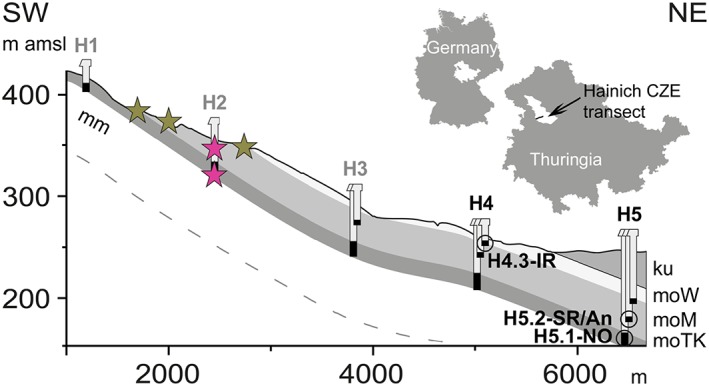
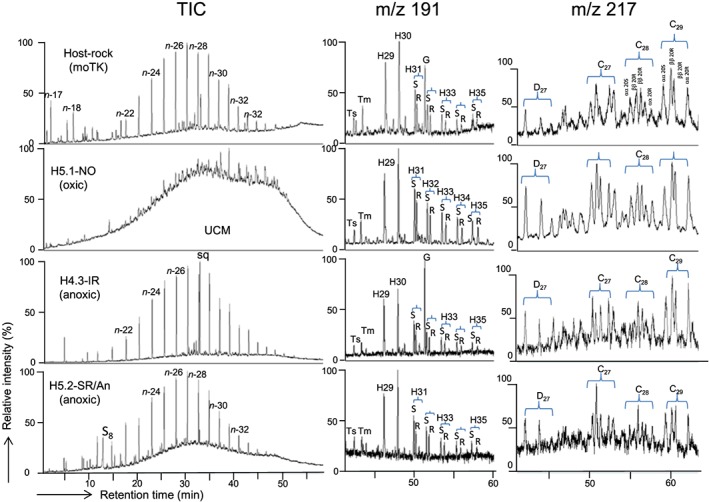
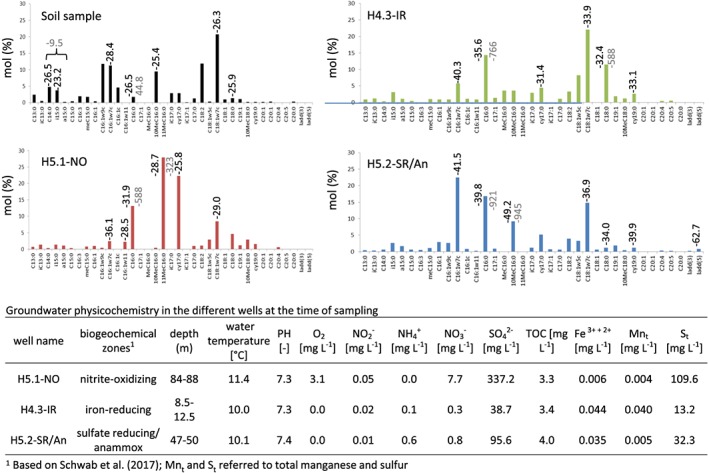
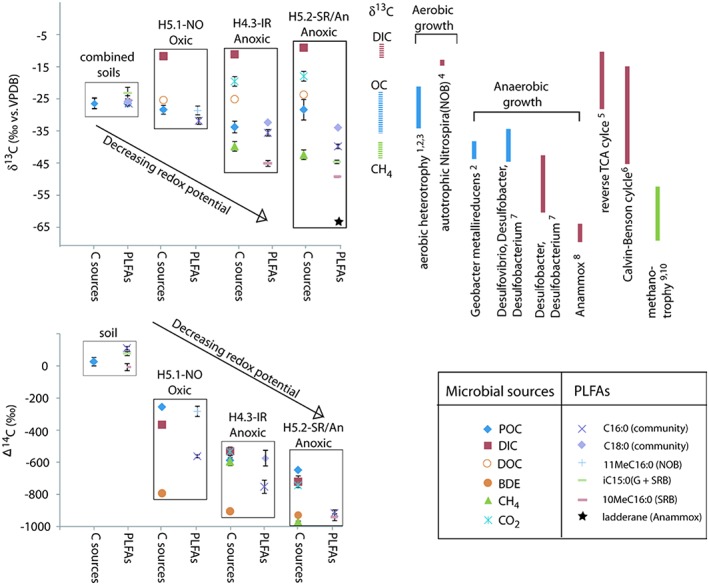
Despite the global significance of the subsurface biosphere, the degree to which it depends on surface organic carbon (OC) is still poorly understood. Here, we compare stable and radiogenic carbon isotope compositions of microbial phospholipid fatty acids (PLFAs) with those of in situ potential microbial C sources to assess the major C sources for subsurface microorganisms in biogeochemical distinct shallow aquifers (Critical Zone Exploratory, Thuringia Germany). Despite the presence of younger OC, the microbes assimilated 14 C‐free OC to varying degrees; ~31% in groundwater within the oxic zone, ~47% in an iron reduction zone, and ~70% in a sulfate reduction/anammox zone. The persistence of trace amounts of mature and partially biodegraded hydrocarbons suggested that autochthonous petroleum‐derived hydrocarbons were a potential 14 C‐free C source for heterotrophs in the oxic zone. In this zone, Δ 14 C values of dissolved inorganic carbon (−366 ± 18‰) and 11MeC16:0 (−283 ± 32‰), an important component in autotrophic nitrite oxidizers, were similar enough to indicate that autotrophy is an important additional C fixation pathway. In anoxic zones, methane as an important C source was unlikely since the 13 C‐fractionations between the PLFAs and CH 4 were inconsistent with kinetic isotope effects associated with methanotrophy. In the sulfate reduction/anammox zone, the strong 14 C‐depletion of 10MeC16:0 (−942 ± 22‰), a PLFA common in sulfate reducers, indicated that those bacteria were likely to play a critical part in 14 C‐free sedimentary OC cycling. Results indicated that the 14 C‐content of microbial biomass in shallow sedimentary aquifers results from complex interactions between abundance and bioavailability of naturally occurring OC, hydrogeology, and specific microbial metabolisms.
Overview
The claims and statistics of this paper haven’t been checked yet.
Free: it reads the open-access text and checks the first 5 claims that cite a source we can check. Create a free account to check every claim.
Integrity signals
Registry
Cites
Statistics
Figures
Verification
Claims the paper makes
The claims and statistics of this paper haven’t been checked yet.
Free: it reads the open-access text and checks the first 5 claims that cite a source we can check. Create a free account to check every claim.
Claims other papers make about this one
Each is checked against this paper’s own text: does it say what the citing paper says it does?
The source backs part of the claim, not all of it — or backs it for a different population, condition or comparison.
In the citing paper
“Furthermore, the inherent and active microbial communities in the sediments might have assimilated 14 C-free GOC into their biomass, as shown by Schwab et al. (2019).”
From Geogenic organic carbon in terrestrial sediments and its contribution to total soil carbon (2021) · cites this paper as Schwab et al. (2019)
Experimental — accuracy not yet measured
Self-check
Percentages, sums and reported differences re-computed from the paper’s own numbers.
The self-check needs the paper’s full text.
Citations
Cites
A RAPID METHOD OF TOTAL LIPID EXTRACTION AND PURIFICATION
Bligh, E. G., & Dyer, W. J. (1959) · Canadian Journal of Biochemistry and Physiology · doi:10.1139/o59-099 · Cited by 54,751 · cited 1×
“A 5% aliquot of the Bligh ‐ Dyer extract (BDE; Bligh and Dyer (1959)) was used for 14 C analyses.”
Discussion Reporting of 14 C Data
Stuiver, M., & Polach, H. A. (1977) · Radiocarbon · doi:10.1017/s0033822200003672 · Cited by 5,640
Characterizing aquatic dissolved organic matter.
Leenheer, J. A., & Croué, J.-P. (2003) · PubMed · Cited by 4,891
Carbon and hydrogen isotope systematics of bacterial formation and oxidation of methane
Whiticar, M. J. (1999) · Chemical Geology · doi:10.1016/s0009-2541(99)00092-3 · Cited by 3,146
Peters, K. E., Walters, C. C., & Moldowan, J. M. (2004) · Cambridge University Press eBooks · doi:10.1017/cbo9780511524868 · Cited by 2,089 · cited 2×
“…ET AL. predominance of Tm (17 α (H) ‐ 22,29,30 ‐ trisnorhopane) over Ts (18 α (H) ‐ 22,29,30 ‐ trisnorhopane; Ts/Ts + Tm ratio from 0.67 and 0.69) and the 22S/22S + 22R homohopane ratios of ~0.5 indicated organic matter transformation within the oil and gas maturity window (Peters et al., 2005).”
InfluentialA review of sterol markers for marine and terrigenous organic matter
Volkman, J. K. (1986) · Organic Geochemistry · doi:10.1016/0146-6380(86)90089-6 · Cited by 1,951
Large-scale forest girdling shows that current photosynthesis drives soil respiration
Högberg, P., Nordgren, A., Buchmann, N., Taylor, A. F. S., Ekblad, A., Högberg, M. N., Nyberg, G., Ottosson-Löfvenius, M., & Read, D. J. (2001) · Nature · doi:10.1038/35081058 · Cited by 1,868 · cited 1×
“In soils, organic carbon (OC) recently fixed products of photosynthesis are abundant and provide the major energy source for heterotrophs, which compose the major component of bacterial biomass (Högberg et al., 2001).”
BackgroundDetermination of the sedimentary microbial biomass by extractible lipid phosphate
White, D. C., Davis, W. M., Nickels, J. S., King, J. D., & Bobbie, R. J. (1979) · Oecologia · doi:10.1007/bf00388810 · Cited by 1,702
Manual of Environmental Microbiology
(2007) · Wiley eBooks · doi:10.1128/9781555815882 · Cited by 1,360
Frostegård, Å., Tunlid, A., & Bååth, E. (1993) · Applied and Environmental Microbiology · doi:10.1128/aem.59.11.3605-3617.1993 · Cited by 1,348
Research works printed but not linked: 1
- Ockert, W., & Rein, S. (2000). Biostratigraphische gliederung des oberen muschelkalks in Thüringen. Beiträge zur Geologie von Thüringen, 7, 195– 228.
Cited by
Carbon fixation rates in groundwater similar to those in oligotrophic marine systems
Overholt, W. A., Trumbore, S. E., Xu, X., Bornemann, T. L. V., Probst, A. J., Krüger, M., Herrmann, M., Thamdrup, B., Bristow, L. A., Taubert, M., et al. (2022) · Nature Geoscience · doi:10.1038/s41561-022-00968-5 · Cited by 116
Self-citationWegner, C., Gaspar, M., Geesink, P., Herrmann, M., Marz, M., & Küsel, K. (2018) · Applied and Environmental Microbiology · doi:10.1128/aem.02346-18 · Cited by 103
Self-citationBolstering fitness via CO2 fixation and organic carbon uptake: mixotrophs in modern groundwater
Taubert, M., Overholt, W. A., Heinze, B. M., Matanfack, G. A., Houhou, R., Jehmlich, N., von Bergen�, M., Rösch, P., Popp, J., & Küsel, K. (2021) · The ISME Journal · doi:10.1038/s41396-021-01163-x · Cited by 70
“This includes carbohydrate degradation pathways for surface-derived plant polymers [8, 61], amino acid, and nucleotide uptake systems for microbially derived carbon [62, 63], C1 metabolic functions for C1 carbon compounds from biomass degradation [64], and hydrocarbon degradation pathways for rock-derived carbon [65,…”
BackgroundSelf-citationSchroeter, S. A., Yan, L., Lehmann, R. G., Roth, V.-N., Schwab, V. F., Totsche, K. U., Küsel, K., & Gleixner, G. (2019) · Frontiers in Earth Science · doi:10.3389/feart.2019.00296 · Cited by 56
Self-citationThe endolithic bacterial diversity of shallow bedrock ecosystems
Lazar, C. S., Lehmann, R. G., Stoll, W., Rosenberger, J., Totsche, K. U., & Küsel, K. (2019) · The Science of The Total Environment · doi:10.1016/j.scitotenv.2019.04.281 · Cited by 51
Self-citation
Metadata
- Authors
- Schwab, V. F., Nowak, M. E., Elder, C. D., Trumbore, S. E., Xu, X., Gleixner, G., Lehmann, R., Pohnert, G., Muhr, J., Küsel, K., & Totsche, K. U.
- Affiliations
- Max Planck Institute for Biogeochemistry (DE)
- University of California, Irvine (US)
- Friedrich Schiller University Jena (DE)
- German Centre for Integrative Biodiversity Research (DE)
- Corresponding author
- Schwab, Valérie F.
- ORCID
- Venue
- Water Resources Research
- Publisher
- American Geophysical Union (AGU)
- Published
- 2019-03
- Volume
- 55
- Issue
- 3
- Pages
- 2104-2121
- ISSN
- 0043-1397 (ISSN-L)
- 1944-7973
- PMC
- PMC6487957
- OpenAlex
- W2907746665
- Cited by
- 31
- References
- 86
- Citations by year
- 2026: 2 · 2025: 4 · 2024: 1 · 2023: 4 · 2022: 4 · 2021: 8 · 2019: 7
- FWCI
- 3.47
- Type
- journal article
- Language
- en
- Open access
- hybrid
- doi.org
- Licence
- Locations
- Water Resources Research (publishedVersion, cc-by-nc-nd)
- PubMed Central (publishedVersion, cc-by-nc-nd)
- PubMed (publishedVersion)
- eScholarship (California Digital Library) (submittedVersion, cc-by)
- MPG.PuRe (Max Planck Society) (submittedVersion, cc-by-nc-nd)
- MPG.PuRe (Max Planck Society) (submittedVersion, other-oa)
- Funders
- Deutsche Forschungsgemeinschaft (CRC 1076 “AquaDiva”)
- Topics
- Physical Sciences › Earth and Planetary Sciences › Geochemistry and Petrology › Groundwater and Isotope Geochemistry
- Physical Sciences › Environmental Science › Ecology › Isotope Analysis in Ecology
- Physical Sciences › Environmental Science › Environmental Chemistry › Methane Hydrates and Related Phenomena
- Keywords
- subsurface biosphere, microbial phospholipid fatty acids, sediment organic carbon, iron reduction, sulfate reduction, anammox, methane, methanotrophy, dissolved inorganic carbon
About these checks
Registry, retraction, Cites and statistics results are computed, not judged, with one exception: a printed reference that no index lists is read once by a model before it counts as a citation error. Claims are extracted by a model and kept only when their quote appears verbatim in the text; each cited source is then checked, with a model’s help, for whether it says what the claim relies on. Those verdicts can be wrong — read the claim’s quote and the cited source before relying on one.
Statistics and arithmetic are recomputed, not judged.
Confidence bands are shown only for fields calibrated on our annotated test set. None is calibrated yet, so no band is shown.
What counts as a claim ›How we measure confidence ›How we check this ›
Are you an author, or do you see a problem with this page? Request a review
How to cite
Cite CoChat for the checks on this page, and the paper for its own findings.
- This page
- CoChat. (2026). Citation check: 14C‐Free Carbon Is a Major Contributor to Cellular Biomass in Geochemically Distinct Groundwater of Shallow Sedimentary Bedrock Aquifers. https://app.cochat.ai/papers/10.1029/2017wr022067
- The paper
- Schwab, V. F., Nowak, M. E., Elder, C. D., Trumbore, S. E., Xu, X., Gleixner, G., Lehmann, R., Pohnert, G., Muhr, J., Küsel, K., & Totsche, K. U. (2019). 14C‐Free Carbon Is a Major Contributor to Cellular Biomass in Geochemically Distinct Groundwater of Shallow Sedimentary Bedrock Aquifers. Water Resources Research. https://doi.org/10.1029/2017wr022067
Data sources
Bibliographic data: Semantic Scholar, OpenAlex, Crossref.
Contains information from the Semantic Scholar Academic Graph Datasets, made available under the ODC Attribution License (ODC-BY 1.0).
Semantic Scholar’s data is described in: Kinney, R., et al. (2023). The Semantic Scholar Open Data Platform. arXiv:2301.10140.
