

Convective Boundary Layer Control of the Sea Surface Temperature in the Tropics
Open accessThe DOI matches its Crossref record; 64 of the 64 references it cites were found in a registry or an index.
Abstract
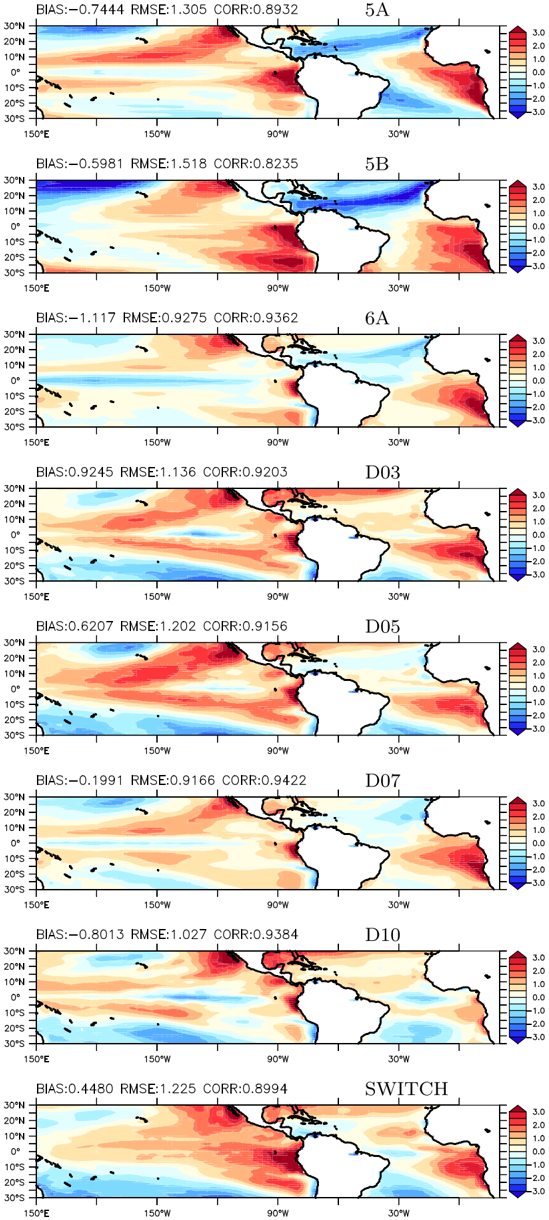
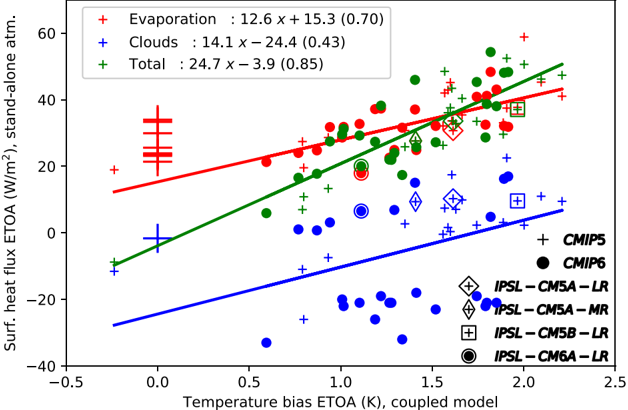
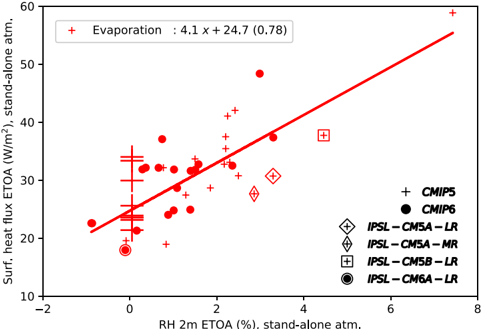
Using successive versions of a global climate model, we show how convective transport to the free troposphere of the humidity evaporated at the surface or, reciprocally, entrainment of dry air from the free troposphere into the mixed layer, controls surface evaporative cooling and then sea surface temperature. This control is as important as the radiative effect of boundary layer clouds on radiation. Those aspects are shown to be improved when activating a mass flux representation of the organized structures of the convective boundary layer coupled to eddy diffusion, the so‐called “thermal plume model,” leading to an increased near‐surface drying compared to the use of turbulent diffusion alone. Controlling detrainment by air properties from just above the boundary layer allows the thermal plume model to be valid for both cumulus and stratocumulus regimes, improving the contrast in near‐surface humidity between the trade winds region and East Tropical oceans. Using pairs of stand‐alone atmospheric simulations forced by sea surface temperature and of coupled atmosphere‐ocean simulations, we show how the improvement of the surface fluxes that arise from this improved physics projects into an improvement of the representation of sea surface temperature patterns in the coupled model, and in particular into a reduction of the East Tropical Ocean warm bias. The work presented here led to the bias reduction in sea surface temperature in the Institute Pierre Simon Laplace coupled model, IPSL‐CM6A, developed recently for the 6th phase of the Coupled Model Intercomparison Project, CMIP6.
Overview
The claims and statistics of this paper haven’t been checked yet.
Free: it reads the open-access text and checks the first 5 claims that cite a source we can check. Create a free account to check every claim.
Integrity signals
Registry
Cites
Statistics
Figures








Verification
Claims the paper makes
The claims and statistics of this paper haven’t been checked yet.
Free: it reads the open-access text and checks the first 5 claims that cite a source we can check. Create a free account to check every claim.
Claims other papers make about this one
Each is checked against this paper’s own text: does it say what the citing paper says it does?
The cited source says what the claim attributes to it.
In the citing paper
“In particular, the rather good score in simulating SST in IPSL-6A comes from the fact that we targeted on purpose some biases in the atmospheric fluxes that directly impact persistent temperature biases as the East-Tropical-Ocean (53) and Circum Antartica warm biases.”
From Toward machine-assisted tuning avoiding the underestimation of uncertainty in climate change projections (2023) · cites this paper as [53]
Self-check
Percentages, sums and reported differences re-computed from the paper’s own numbers.
The self-check needs the paper’s full text.
Citations
Cites
An Overview of CMIP5 and the Experiment Design
Taylor, K. E., Stouffer, R. J., & Meehl, G. A. (2012) · Bulletin of the American Meteorological Society · doi:10.1175/bams-d-11-00094.1 · Cited by 14,052 · cited 3×
“The average biases across models contributing to the Coupled Model Intercomparison Project (Taylor et al., 2012) have not changed between CMIP3 and CMIP5 (see, e.g., Xu et al., 2014), although separated by 7 years, as confirmed by the Intergovernmental Panel on Climate Change Fifth Assessment…”
MethodInteraction of a Cumulus Cloud Ensemble with the Large-Scale Environment, Part I
Arakawa, A., & Schubert, W. H. (1974) · Journal of the Atmospheric Sciences · doi:10.1175/1520-0469(1974)031<0674:ioacce>2.0.co;2 · Cited by 2,481 · cited 1×
“…approach to represent such nonlocal vertical transport in the convective boundary layer consists in combining eddy diffusion with a mass flux representation of vertical transport by convective cells or rolls inherited from parameterizations of cumulus convection (Arakawa & Schubert, 1974).”
BackgroundA Hierarchy of Turbulence Closure Models for Planetary Boundary Layers
Mellor, G. L., & Yamada, T. (1974) · Journal of the Atmospheric Sciences · doi:10.1175/1520-0469(1974)031<1791:ahotcm>2.0.co;2 · Cited by 2,390 · cited 1×
“In the version 5B, the computation of Kz is replaced by a prognostic equation for the turbulent kinetic energy, following the scheme by Mellor and Yamada (1974) adapted to the atmosphere by Yamada (1983).”
MethodPresentation and Evaluation of the IPSL‐CM6A‐LR Climate Model
Boucher, O., Servonnat, J., Albright, A. L., Aumont, O., Balkanski, Y., Bastrikov, V., Bekki, S., Bonnet, R., Bony, S., Bopp, L., et al. (2020) · Journal of Advances in Modeling Earth Systems · doi:10.1029/2019ms002010 · Cited by 1,694 · cited 1×
“The present study is based on pairs of stand-alone atmospheric simulations with imposed SST and coupled ocean-atmosphere simulations with the IPSL coupled model (Boucher et al., 2020).”
MethodSelf-citationThe global climatology of an interannually varying air-sea flux data set.
Large, W. G., & Yeager, S. G. (2009) · Climate Dynamics · doi:10.1007/s00382-008-0441-3 · Cited by 1,636
(2014) · Climate Change 2013 – The Physical Science Basis · doi:10.1017/cbo9781107415324.020 · Cited by 1,629 · cited 3×
“The average biases across models contributing to the Coupled Model Intercomparison Project (Taylor et al., 2012) have not changed between CMIP3 and CMIP5 (see, e.g., Xu et al., 2014), although separated by 7 years, as confirmed by the Intergovernmental Panel on Climate Change Fifth Assessment Report (IPCC AR5) (Flato…”
BackgroundLocal Versus Nonlocal Boundary-Layer Diffusion in a Global Climate Model
Holtslag, A. A. M., & Boville, B. A. (1993) · Journal of Climate · doi:10.1175/1520-0442(1993)006<1825:lvnbld>2.0.co;2 · Cited by 1,109 · cited 1×
“This thermal plume model was shown by Hourdin et al. (2002) to better represent the convective transport in dry convective conditions than the sophisticated eddy diffusion formulation of Yamada (1983) or the counter-gradient approach of Holtslag and Boville (1993).”
MethodA Scheme for Representing Cumulus Convection in Large-Scale Models
Emanuel, K. A. (1991) · Journal of the Atmospheric Sciences · doi:10.1175/1520-0469(1991)048<2313:asfrcc>2.0.co;2 · Cited by 1,067 · cited 1×
“It differs from the “Standard Physics,” by the representation of the boundary layer presented below, and modification of the Emanuel (1991) deep convection scheme, which is coupled to a parameterization of the cold pools created below convective towers by the evaporation of precipitation (Grandpeix…”
MethodNEMO Ocean Engine Reference Manual
Madec, G., Bell, M. J., Benshila, R., Blaker, A., Boudrallé-Badie, R., Bricaud, C., Bruciaferri, D., Carneiro, D., Castrillo, M., Calvert, D., et al. (2013) · Archivio istituzionale della ricerca (Alma Mater Studiorum Università di Bologna) · doi:10.5281/zenodo.1464816 · Cited by 1,007
Toward Optimal Closure of the Earth's Top-of-Atmosphere Radiation Budget
Loeb, N. G., Wielicki, B. A., Doelling, D. R., Smith, G. L., Keyes, D. F., Kato, S., Manalo-Smith, N., & Wong, T. (2009) · Journal of Climate · doi:10.1175/2008jcli2637.1 · Cited by 960 · cited 1×
“The second edition of the CERES-EBAF L3b product is used as a reference for radiative fluxes (Loeb et al., 2009).”
Method
Research works printed but not linked: 6
- 10.1175/1520-0442(2003)016 · doi:10.1175/1520-0442(2003)016
- Jam, A. (2012). Paramétrisation de la couche limite: Du modèle des thermiques au modèle statistique de nuage (PhD thesis), advized by Hourdin, Frédéric, Sciences de l'environnement, Paris 6 2012, 2012PA066672. https://www.theses.fr/2012PA066672
- 10.1175/1520-0493(2001)129 · doi:10.1175/1520-0493(2001)129
- 10.1175/1520-0442(1996)009 · doi:10.1175/1520-0442(1996)009
- Shie, C., Chiu, L., Adler, R., Gao, S., Chokngamwong, R., Lin, I., & Wang, F. (2010). A recently revived and produced global air-sea surface turbulent fluxes dataset-GSSTF2b: Validations and findings. In Proceedings of the Joint 2010 CWB Weather Analysis and Forecasting and COAA 5th International Ocean-Atmosphere Conference.
- 10.1175/1520-0442(1999)012 · doi:10.1175/1520-0442(1999)012
Cited by
Presentation and Evaluation of the IPSL‐CM6A‐LR Climate Model
Boucher, O., Servonnat, J., Albright, A. L., Aumont, O., Balkanski, Y., Bastrikov, V., Bekki, S., Bonnet, R., Bony, S., Bopp, L., et al. (2020) · Journal of Advances in Modeling Earth Systems · doi:10.1029/2019ms002010 · Cited by 1,694
“Arctic sea ice was one of the targets considered during the tuning process (Hourdin et al., 2020a).”
BackgroundMethodInfluentialSelf-citationLMDZ6A: The Atmospheric Component of the IPSL Climate Model With Improved and Better Tuned Physics
Hourdin, F., Rio, C., Grandpeix, J., Madeleine, J., Cheruy, F., Rochetin, N., Jam, A., Musat, I., Idelkadi, A., Fairhead, L., et al. (2020) · Journal of Advances in Modeling Earth Systems · doi:10.1029/2019ms001892 · Cited by 268
Self-citationPresentation and Evaluation of the IPSL‐CM6A‐LR Ensemble of Extended Historical Simulations
Bonnet, R., Boucher, O., Deshayes, J., Gastineau, G., Hourdin, F., Mignot, J., Servonnat, J., & Swingedouw, D. (2021) · Journal of Advances in Modeling Earth Systems · doi:10.1029/2021ms002565 · Cited by 88
Self-citationHourdin, F., Williamson, D., Rio, C., Couvreux, F., Roehrig, R., Villefranque, N., Musat, I., Fairhead, L., Diallo, F. B., & Volodina, V. (2021) · Journal of Advances in Modeling Earth Systems · doi:10.1029/2020ms002225 · Cited by 83
Self-citationRecent progress in simulating two types of ENSO – from CMIP5 to CMIP6
Hou, M., & Tang, Y. (2022) · Frontiers in Marine Science · doi:10.3389/fmars.2022.986780 · Cited by 50
Metadata
- Authors
- Hourdin, F., Rio, C., Jam, A., Traore, A., & Musat, I.
- Affiliations
- Centre National de la Recherche Scientifique (FR)
- Corresponding author
- Hourdin, Frédéric
- Venue
- Journal of Advances in Modeling Earth Systems
- Publisher
- American Geophysical Union (AGU)
- Published
- 2020-05-29
- Volume
- 12
- Issue
- 6
- ISSN
- 1942-2466 (ISSN-L)
- OpenAlex
- W3014934722
- Cited by
- 24
- References
- 61
- Citations by year
- 2026: 1 · 2025: 2 · 2024: 1 · 2023: 4 · 2022: 6 · 2021: 6 · 2020: 4
- FWCI
- 1.86
- Type
- journal article
- Language
- en
- Open access
- gold
- doi.org
- Licence
- Locations
- Journal of Advances in Modeling Earth Systems (publishedVersion, cc-by)
- HAL (submittedVersion, other-oa)
- DOAJ (DOAJ: Directory of Open Access Journals) (submittedVersion, cc-by-sa)
- Funders
- Agence Nationale de la Recherche (ANR-13-MONU-0008)
- Topics
- Physical Sciences › Environmental Science › Global and Planetary Change › Climate variability and models
- Physical Sciences › Earth and Planetary Sciences › Atmospheric Science › Meteorological Phenomena and Simulations
- Physical Sciences › Earth and Planetary Sciences › Oceanography › Oceanographic and Atmospheric Processes
- Keywords
- convective boundary layer, sea surface temperature, detrainment, entrainment, evaporative cooling, surface fluxes, cumulus parameterization, stratocumulus, trade winds, boundary layer clouds, CMIP6
About these checks
Registry, retraction, Cites and statistics results are computed, not judged, with one exception: a printed reference that no index lists is read once by a model before it counts as a citation error. Claims are extracted by a model and kept only when their quote appears verbatim in the text; each cited source is then checked, with a model’s help, for whether it says what the claim relies on. Those verdicts can be wrong — read the claim’s quote and the cited source before relying on one.
Statistics and arithmetic are recomputed, not judged.
Confidence bands are shown only for fields calibrated on our annotated test set. None is calibrated yet, so no band is shown.
What counts as a claim ›How we measure confidence ›How we check this ›
Are you an author, or do you see a problem with this page? Request a review
Data sources
Bibliographic data: Semantic Scholar, OpenAlex, Crossref.
Contains information from the Semantic Scholar Academic Graph Datasets, made available under the ODC Attribution License (ODC-BY 1.0).
Semantic Scholar’s data is described in: Kinney, R., et al. (2023). The Semantic Scholar Open Data Platform. arXiv:2301.10140.
