

Convective Boundary Layer Control of the Sea Surface Temperature in the Tropics
Open accessThe DOI matches its Crossref record; 64 of the 64 references it cites were found in a registry or an index.
Abstract
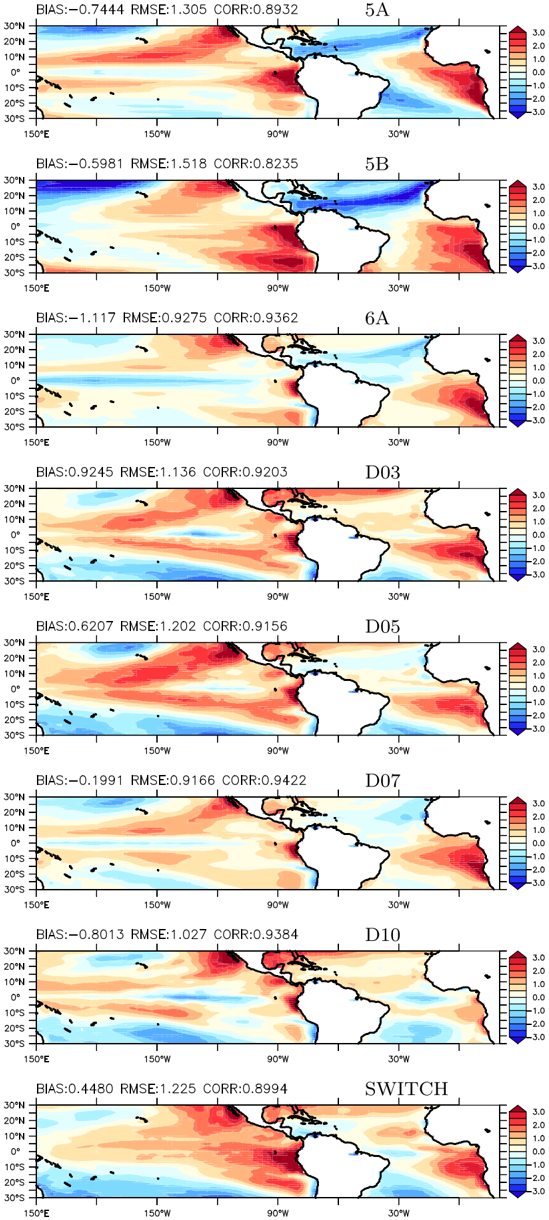
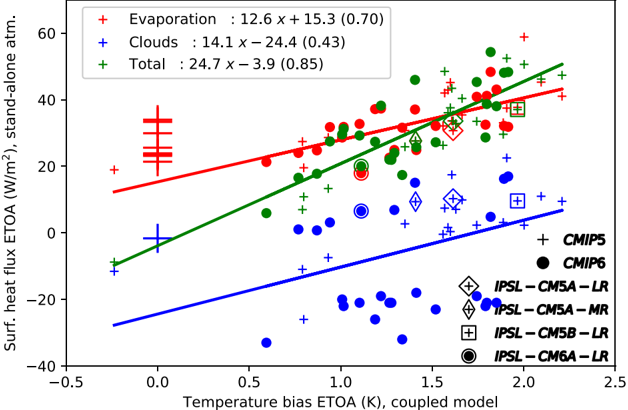
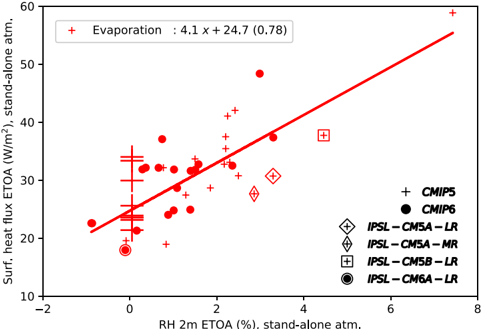
Using successive versions of a global climate model, we show how convective transport to the free troposphere of the humidity evaporated at the surface or, reciprocally, entrainment of dry air from the free troposphere into the mixed layer, controls surface evaporative cooling and then sea surface temperature. This control is as important as the radiative effect of boundary layer clouds on radiation. Those aspects are shown to be improved when activating a mass flux representation of the organized structures of the convective boundary layer coupled to eddy diffusion, the so‐called “thermal plume model,” leading to an increased near‐surface drying compared to the use of turbulent diffusion alone. Controlling detrainment by air properties from just above the boundary layer allows the thermal plume model to be valid for both cumulus and stratocumulus regimes, improving the contrast in near‐surface humidity between the trade winds region and East Tropical oceans. Using pairs of stand‐alone atmospheric simulations forced by sea surface temperature and of coupled atmosphere‐ocean simulations, we show how the improvement of the surface fluxes that arise from this improved physics projects into an improvement of the representation of sea surface temperature patterns in the coupled model, and in particular into a reduction of the East Tropical Ocean warm bias. The work presented here led to the bias reduction in sea surface temperature in the Institute Pierre Simon Laplace coupled model, IPSL‐CM6A, developed recently for the 6th phase of the Coupled Model Intercomparison Project, CMIP6.
Overview
The claims and statistics of this paper haven’t been checked yet.
Free: it reads the open-access text and checks the first 5 claims that cite a source we can check. Create a free account to check every claim.
Integrity signals
Registry
Cites
Statistics
Figures








Verification
Claims the paper makes
The claims and statistics of this paper haven’t been checked yet.
Free: it reads the open-access text and checks the first 5 claims that cite a source we can check. Create a free account to check every claim.
Claims other papers make about this one
Each is checked against this paper’s own text: does it say what the citing paper says it does?
The cited source says what the claim attributes to it.
In the citing paper
“In particular, the rather good score in simulating SST in IPSL-6A comes from the fact that we targeted on purpose some biases in the atmospheric fluxes that directly impact persistent temperature biases as the East-Tropical-Ocean (53) and Circum Antartica warm biases.”
From Toward machine-assisted tuning avoiding the underestimation of uncertainty in climate change projections (2023) · cites this paper as [53]
Self-check
Percentages, sums and reported differences re-computed from the paper’s own numbers.
The self-check needs the paper’s full text.
Citations
Cites
An Overview of CMIP5 and the Experiment Design
Taylor, K. E., Stouffer, R. J., & Meehl, G. A. (2012) · Bulletin of the American Meteorological Society · doi:10.1175/bams-d-11-00094.1 · Cited by 14,052 · cited 3×
“The average biases across models contributing to the Coupled Model Intercomparison Project (Taylor et al., 2012) have not changed between CMIP3 and CMIP5 (see, e.g., Xu et al., 2014), although separated by 7 years, as confirmed by the Intergovernmental Panel on Climate Change Fifth Assessment…”
MethodInteraction of a Cumulus Cloud Ensemble with the Large-Scale Environment, Part I
Arakawa, A., & Schubert, W. H. (1974) · Journal of the Atmospheric Sciences · doi:10.1175/1520-0469(1974)031<0674:ioacce>2.0.co;2 · Cited by 2,481 · cited 1×
“…approach to represent such nonlocal vertical transport in the convective boundary layer consists in combining eddy diffusion with a mass flux representation of vertical transport by convective cells or rolls inherited from parameterizations of cumulus convection (Arakawa & Schubert, 1974).”
BackgroundA Hierarchy of Turbulence Closure Models for Planetary Boundary Layers
Mellor, G. L., & Yamada, T. (1974) · Journal of the Atmospheric Sciences · doi:10.1175/1520-0469(1974)031<1791:ahotcm>2.0.co;2 · Cited by 2,390 · cited 1×
“In the version 5B, the computation of Kz is replaced by a prognostic equation for the turbulent kinetic energy, following the scheme by Mellor and Yamada (1974) adapted to the atmosphere by Yamada (1983).”
MethodPresentation and Evaluation of the IPSL‐CM6A‐LR Climate Model
Boucher, O., Servonnat, J., Albright, A. L., Aumont, O., Balkanski, Y., Bastrikov, V., Bekki, S., Bonnet, R., Bony, S., Bopp, L., et al. (2020) · Journal of Advances in Modeling Earth Systems · doi:10.1029/2019ms002010 · Cited by 1,694 · cited 1×
“The present study is based on pairs of stand-alone atmospheric simulations with imposed SST and coupled ocean-atmosphere simulations with the IPSL coupled model (Boucher et al., 2020).”
MethodSelf-citationThe global climatology of an interannually varying air-sea flux data set.
Large, W. G., & Yeager, S. G. (2009) · Climate Dynamics · doi:10.1007/s00382-008-0441-3 · Cited by 1,636
(2014) · Climate Change 2013 – The Physical Science Basis · doi:10.1017/cbo9781107415324.020 · Cited by 1,629 · cited 3×
“The average biases across models contributing to the Coupled Model Intercomparison Project (Taylor et al., 2012) have not changed between CMIP3 and CMIP5 (see, e.g., Xu et al., 2014), although separated by 7 years, as confirmed by the Intergovernmental Panel on Climate Change Fifth Assessment Report (IPCC AR5) (Flato…”
BackgroundLocal Versus Nonlocal Boundary-Layer Diffusion in a Global Climate Model
Holtslag, A. A. M., & Boville, B. A. (1993) · Journal of Climate · doi:10.1175/1520-0442(1993)006<1825:lvnbld>2.0.co;2 · Cited by 1,109 · cited 1×
“This thermal plume model was shown by Hourdin et al. (2002) to better represent the convective transport in dry convective conditions than the sophisticated eddy diffusion formulation of Yamada (1983) or the counter-gradient approach of Holtslag and Boville (1993).”
MethodA Scheme for Representing Cumulus Convection in Large-Scale Models
Emanuel, K. A. (1991) · Journal of the Atmospheric Sciences · doi:10.1175/1520-0469(1991)048<2313:asfrcc>2.0.co;2 · Cited by 1,067 · cited 1×
“It differs from the “Standard Physics,” by the representation of the boundary layer presented below, and modification of the Emanuel (1991) deep convection scheme, which is coupled to a parameterization of the cold pools created below convective towers by the evaporation of precipitation (Grandpeix…”
MethodNEMO Ocean Engine Reference Manual
Madec, G., Bell, M. J., Benshila, R., Blaker, A., Boudrallé-Badie, R., Bricaud, C., Bruciaferri, D., Carneiro, D., Castrillo, M., Calvert, D., et al. (2013) · Archivio istituzionale della ricerca (Alma Mater Studiorum Università di Bologna) · doi:10.5281/zenodo.1464816 · Cited by 1,007
Toward Optimal Closure of the Earth's Top-of-Atmosphere Radiation Budget
Loeb, N. G., Wielicki, B. A., Doelling, D. R., Smith, G. L., Keyes, D. F., Kato, S., Manalo-Smith, N., & Wong, T. (2009) · Journal of Climate · doi:10.1175/2008jcli2637.1 · Cited by 960 · cited 1×
“The second edition of the CERES-EBAF L3b product is used as a reference for radiative fluxes (Loeb et al., 2009).”
MethodHourdin, F., Musat, I., Bony, S., Braconnot, P., Codron, F., Dufresne, J.-L., Fairhead, L., Filiberti, M.-A., Friedlingstein, P., Grandpeix, J.-Y., et al. (2006) · Climate Dynamics · doi:10.1007/s00382-006-0158-0 · Cited by 844 · cited 1×
“Similarly in version 5A, different formulations for the Kz coefficient were used, depending on a threshold for the strength of the boundary layer top inversion (Hourdin et al., 2006).”
MethodSelf-citationA New Moist Turbulence Parameterization in the Community Atmosphere Model
Bretherton, C. S., & Park, S. (2009) · Journal of Climate · doi:10.1175/2008jcli2556.1 · Cited by 739 · cited 1×
“Several successful studies in that respect advocate for switching parameterizations off and on between very stable or more unstable conditions (Bretherton & Park, 2009; Lock, 2001).”
BackgroundCOSP: Satellite simulation software for model assessment
Bodas-Salcedo, A., Webb, M. J., Bony, S., Chepfer, H., Dufresne, J.-L., Klein, S. A., Zhang, Y., Marchand, R., Haynes, J. M., Pincus, R., et al. (2011) · Bulletin of the American Meteorological Society · doi:10.1175/2011bams2856.1 · Cited by 701 · cited 1×
“For comparison with models, the COSP satellite simulator is used online in the model (Bodas-Salcedo et al., 2011; Chepfer et al., 2008).”
MethodThe Art and Science of Climate Model Tuning
Hourdin, F., Mauritsen, T., Gettelman, A., Golaz, J.-C., Balaji, V., Duan, Q., Folini, D., Ji, D., Klocke, D., Qian, Y., et al. (2017) · Bulletin of the American Meteorological Society · doi:10.1175/bams-d-15-00135.1 · Cited by 611
Self-citationQuantifying Southern Oscillation-Precipitation Relationships
Ropelewski, C. F., & Halpert, M. S. (1996) · Journal of Climate · doi:10.1175/1520-0442(1996)009<1043:qsopr>2.0.co;2 · Cited by 543
The GCM‐Oriented CALIPSO Cloud Product (CALIPSO‐GOCCP)
Chepfer, H., Bony, S., Winker, D., Cesana, G., Dufresne, J. L., Minnis, P., Stubenrauch, C. J., & Zeng, S. (2010) · Journal of Geophysical Research: Atmospheres · doi:10.1029/2009jd012251 · Cited by 429 · cited 1×
“Cloudiness is evaluated using the CALIOP Lidar observations aboard the satellite Calipso from the Aqua-train (Chepfer et al., 2010).”
MethodAn ERA40-based atmospheric forcing for global ocean circulation models
Brodeau, L., Barnier, B., Treguier, A.-M., Penduff, T., & Gulev, S. (2010) · Ocean Modelling · doi:10.1016/j.ocemod.2009.10.005 · Cited by 398
A Combined Eddy-Diffusivity Mass-Flux Approach for the Convective Boundary Layer
Siebesma, A. P., Soares, P. M. M., & Teixeira, J. (2007) · Journal of the Atmospheric Sciences · doi:10.1175/jas3888.1 · Cited by 395 · cited 2×
“2 of 23 cloudy topped boundary layers are represented in a unified way (Hourdin et al., 2002; Soares et al., 2004; Siebesma et al., 2007).”
BackgroundPeruvian Stratus Clouds and the Tropical Pacific Circulation: A Coupled Ocean-Atmosphere GCM Study
Ma, C.-C., Mechoso, C. R., Robertson, A. W., & Arakawa, A. (1996) · Journal of Climate · doi:10.1175/1520-0442(1996)009<1635:pscatt>2.0.co;2 · Cited by 304 · cited 1×
“The underestimation of the shadowing effect due to a lack or underestimation of stratocumulus clouds that cover those regions all year long, has for long been identified as a possible major source of sea surface warm biases (Ma et al., 1996; Richter, 2015; Yu & Mechoso, 1999).”
BackgroundHourdin, F., Foujols, M.-A., Codron, F., Guemas, V., Dufresne, J.-L., Bony, S., Denvil, S., Guez, L., Lott, F., Ghattas, J., et al. (2013) · Climate Dynamics · doi:10.1007/s00382-012-1411-3 · Cited by 302
Self-citationHourdin, F., Grandpeix, J.-Y., Rio, C., Bony, S., Jam, A., Cheruy, F., Rochetin, N., Fairhead, L., Idelkadi, A., Musat, I., et al. (2013) · Climate Dynamics · doi:10.1007/s00382-012-1343-y · Cited by 299
Self-citationThe Counter-Gradient Heat Flux in the Lower Atmosphere and in the Laboratory
Deardorff, J. W. (1966) · Journal of the Atmospheric Sciences · doi:10.1175/1520-0469(1966)023<0778:acl>2.0.co;2 · Cited by 289
The Counter-Gradient Heat Flux in the Lower Atmosphere and in the Laboratory
Deardorff, J. W. (1966) · Journal of the Atmospheric Sciences · doi:10.1175/1520-0469(1966)023<0503:tcghfi>2.0.co;2 · Cited by 277 · cited 1×
“It is known, in particular since the pioneering work of Deardorff (1966), that convective cells or plumes that scale with the depth of the boundary layer transport heat up the gradient of potential temperature, a phenomenon that cannot be captured by traditional eddy diffusion approaches.”
BackgroundUse of CALIPSO lidar observations to evaluate the cloudiness simulated by a climate model
Chepfer, H., Bony, S., Winker, D., Chiriaco, M., Dufresne, J. ‐., & Sèze, G. (2008) · Geophysical Research Letters · doi:10.1029/2008gl034207 · Cited by 269 · cited 1×
“For comparison with models, the COSP satellite simulator is used online in the model (Bodas-Salcedo et al., 2011; Chepfer et al., 2008).”
MethodLMDZ6A: The Atmospheric Component of the IPSL Climate Model With Improved and Better Tuned Physics
Hourdin, F., Rio, C., Grandpeix, J., Madeleine, J., Cheruy, F., Rochetin, N., Jam, A., Musat, I., Idelkadi, A., Fairhead, L., et al. (2020) · Journal of Advances in Modeling Earth Systems · doi:10.1029/2019ms001892 · Cited by 268 · cited 2×
“This model configuration is described in a companion paper (Hourdin et al., 2020) in the same special collection.”
BackgroundMethodSelf-citationClimate model biases in the eastern tropical oceans: causes, impacts and ways forward.
Richter, I. (2015) · WIREs Climate Change · doi:10.1002/wcc.338 · Cited by 253 · cited 5×
“First, evaporative cooling is often overestimated over the whole tropics in stand-alone atmospheric simulations (Richter, 2015; Xu et al., 2014), hiding the fact that this overestimation is less pronounced over the ETO.”
BackgroundInfluentialAn eddy‐diffusivity/mass‐flux parametrization for dry and shallow cumulus convection
Soares, P. M. M., Miranda, P. M. A., Siebesma, A. P., & Teixeira, J. (2004) · Quarterly Journal of the Royal Meteorological Society · doi:10.1256/qj.03.223 · Cited by 215 · cited 2×
“2 of 23 cloudy topped boundary layers are represented in a unified way (Hourdin et al., 2002; Soares et al., 2004; Siebesma et al., 2007).”
BackgroundThe Hamburg Ocean Atmosphere Parameters and Fluxes from Satellite Data – HOAPS-3
Andersson, A., Fennig, K., Klepp, C., Bakan, S., Graßl, H., & Schulz, J. (2010) · Earth System Science Data · doi:10.5194/essd-2-215-2010 · Cited by 207 · cited 1×
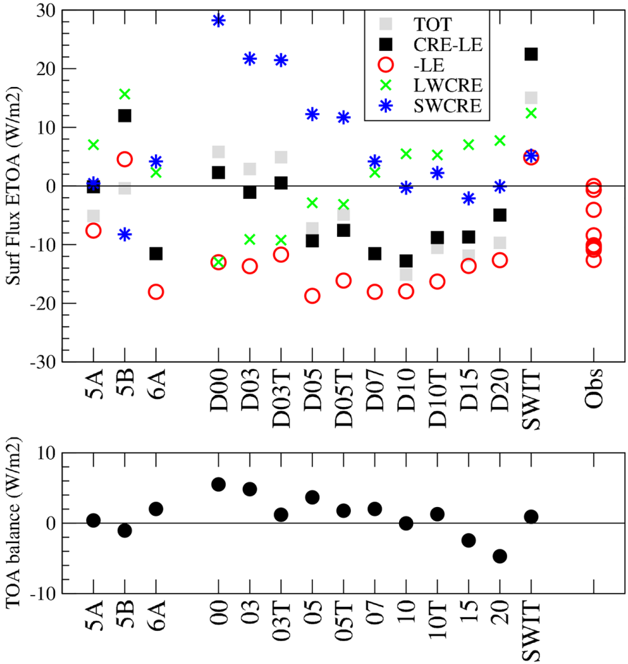
“However, the bias is probably in the range of observational error bars as suggested by comparing the ETOA of the reference HOAPS3 data set (Andersson et al., 2010), which is usually used for evaluation of the LMDZ model, with eight alternate data sets documented by Găinuşă-Bogdan et al. (2015)…”
MethodSimulations of Nocturnal Drainage Flows by aq2lTurbulence Closure Model
Yamada, T. (1983) · Journal of the Atmospheric Sciences · doi:10.1175/1520-0469(1983)040<0091:sondfb>2.0.co;2 · Cited by 184 · cited 5×
“In the version 5B, the computation of Kz is replaced by a prognostic equation for the turbulent kinetic energy, following the scheme by Mellor and Yamada (1974) adapted to the atmosphere by Yamada (1983).”
BackgroundMethodInfluentialShifting the diurnal cycle of parameterized deep convection over land
Rio, C., Hourdin, F., Grandpeix, J. ‐., & Lafore, J. ‐. (2009) · Geophysical Research Letters · doi:10.1029/2008gl036779 · Cited by 177 · cited 2×
“It differs from the “Standard Physics,” by the representation of the boundary layer presented below, and modification of the Emanuel (1991) deep convection scheme, which is coupled to a parameterization of the cold pools created below convective towers by the evaporation of precipitation (Grandpeix & Lafore, 2010; Gra…”
BackgroundMethodSelf-citationA New Air–Sea Interaction Gridded Dataset from ICOADS With Uncertainty Estimates
Berry, D. I., & Kent, E. C. (2009) · Bulletin of the American Meteorological Society · doi:10.1175/2008bams2639.1 · Cited by 177 · cited 1×
“The NOC2 data set (−12.6 W m−2, Berry & Kent, 2009) that shows the lowest −LE ETOA is much closer to the minimum of simulated ETOAs.”
MethodInfluentialZuidema, P., Chang, P., Medeiros, B., Kirtman, B. P., Mechoso, R., Schneider, E. K., Toniazzo, T., Richter, I., Small, R. J., Bellomo, K., et al. (2016) · Bulletin of the American Meteorological Society · doi:10.1175/bams-d-15-00274.1 · Cited by 175 · cited 1×
“…controls vertical humidity profiles in the first km above surface, given the scarcity of observation and the error in surface turbulent fluxes in ERA-Interim when compared to buoy observations (see Table 1 in Zuidema et al., 2016), ERA-Interim cannot be considered as a reference for this aspect.”
ResultSensitivity of the West African hydrological cycle in ORCHIDEE to infiltration processes
d'Orgeval, T., Polcher, J., & de Rosnay, P. (2008) · Hydrology and Earth System Sciences · doi:10.5194/hess-12-1387-2008 · Cited by 169 · cited 1×
“Note that all the simulations are coupled with the Orchidee land surface model (D'Orgeval et al., 2008).”
MethodA Density Current Parameterization Coupled with Emanuel’s Convection Scheme. Part I: The Models
Grandpeix, J.-Y., & Lafore, J.-P. (2010) · Journal of the Atmospheric Sciences · doi:10.1175/2009jas3044.1 · Cited by 159
Yu, J.-Y., & Mechoso, C. R. (1999) · Journal of Climate · doi:10.1175/1520-0442(1999)012<3305:lbavop>2.0.co;2 · Cited by 143 · cited 1×
“The underestimation of the shadowing effect due to a lack or underestimation of stratocumulus clouds that cover those regions all year long, has for long been identified as a possible major source of sea surface warm biases (Ma et al., 1996; Richter, 2015; Yu & Mechoso, 1999).”
BackgroundA Thermal Plume Model for the Convective Boundary Layer: Representation of Cumulus Clouds
Rio, C., & Hourdin, F. (2008) · Journal of the Atmospheric Sciences · doi:10.1175/2007jas2256.1 · Cited by 127 · cited 2×
“The extension of the thermal plume model to the representation of cumulus clouds (Rio & Hourdin, 2008; Rio et al., 2010) and its coupling with a statistical cloud scheme based on a bi-Gaussian distribution of subgrid-scale total water (Jam et al., 2013) was shown to improve the representation of…”
BackgroundSelf-citationDiagnosing southeast tropical Atlantic SST and ocean circulation biases in the CMIP5 ensemble
Zhao, X., Chang, P., Richter, I., Kim, W. M., & Tang, G. (2014) · Climate Dynamics · doi:10.1007/s00382-014-2247-9 · Cited by 123 · cited 3×
“First, evaporative cooling is often overestimated over the whole tropics in stand-alone atmospheric simulations (Richter, 2015; Xu et al., 2014), hiding the fact that this overestimation is less pronounced over the ETO.”
BackgroundHourdin, F., Couvreux, F., & Menut, L. (2002) · Journal of the Atmospheric Sciences · doi:10.1175/1520-0469(2002)059<1105:potdcb>2.0.co;2 · Cited by 123 · cited 4×
“2 of 23 cloudy topped boundary layers are represented in a unified way (Hourdin et al., 2002; Soares et al., 2004; Siebesma et al., 2007).”
BackgroundMethodInfluentialSelf-citationThe Numerical Representation of Entrainment in Parameterizations of Boundary Layer Turbulent Mixing
Lock, A. P. (2001) · Monthly Weather Review · doi:10.1175/1520-0493(2001)129<1148:tnroei>2.0.co;2 · Cited by 116 · cited 1×
“Several successful studies in that respect advocate for switching parameterizations off and on between very stable or more unstable conditions (Bretherton & Park, 2009; Lock, 2001).”
BackgroundZheng, Y., Shinoda, T., Lin, J., & Kiladis, G. N. (2011) · Journal of Climate · doi:10.1175/2011jcli4172.1 · Cited by 105 · cited 2×
“Second, when considering fluxes directly in coupled atmosphere-ocean models (de Szoeke et al., 2010; Richter, 2015; Zheng et al., 2011), the evaporative cooling over the ETO is generally overestimated as a consequence of the warm SST bias.”
BackgroundRio, C., Hourdin, F., Couvreux, F., & Jam, A. (2010) · Boundary-Layer Meteorology · doi:10.1007/s10546-010-9478-z · Cited by 98 · cited 4×
“The extension of the thermal plume model to the representation of cumulus clouds (Rio & Hourdin, 2008; Rio et al., 2010) and its coupling with a statistical cloud scheme based on a bi-Gaussian distribution of subgrid-scale total water (Jam et al., 2013) was shown to improve the representation of…”
BackgroundInfluentialSelf-citationVignon, E., Hourdin, F., Genthon, C., Van de Wiel, B. J. H., Gallée, H., Madeleine, J., & Beaumet, J. (2018) · Journal of Advances in Modeling Earth Systems · doi:10.1002/2017ms001184 · Cited by 75 · cited 1×
“This parameterization has been revisited for version 6A to better represent strong inversion in very stable boundary layers (Vignon et al., 2018).”
BackgroundSelf-citationAn assessment of surface heat fluxes from J‐OFURO2 at the KEO and JKEO sites
Tomita, H., Kubota, M., Cronin, M. F., Iwasaki, S., Konda, M., & Ichikawa, H. (2010) · Journal of Geophysical Research Atmospheres · doi:10.1029/2009jc005545 · Cited by 74
de Szoeke, S. P., Fairall, C. W., Wolfe, D. E., Bariteau, L., & Zuidema, P. (2010) · Journal of Climate · doi:10.1175/2010jcli3411.1 · Cited by 71 · cited 1×
“Second, when considering fluxes directly in coupled atmosphere-ocean models (de Szoeke et al., 2010; Richter, 2015; Zheng et al., 2011), the evaporative cooling over the ETO is generally overestimated as a consequence of the warm SST bias.”
Oceanic origin of southeast tropical Atlantic biases
Zhao, X., Li, M., Patricola, C. M., & Chang, P. (2013) · Climate Dynamics · doi:10.1007/s00382-013-1901-y · Cited by 69
Cheruy, F., Campoy, A., Dupont, J., Ducharne, A., Hourdin, F., Haeffelin, M., Chiriaco, M., & Idelkadi, A. (2012) · Climate Dynamics · doi:10.1007/s00382-012-1469-y · Cited by 69
Self-citationAir moisture control on ocean surface temperature, hidden key to the warm bias enigma
Hourdin, F., Găinusă‐Bogdan, A., Braconnot, P., Dufresne, J., Traore, A., & Rio, C. (2015) · Geophysical Research Letters · doi:10.1002/2015gl066764 · Cited by 68 · cited 13×
“…simulated in a coupled atmosphere-ocean model with surface flux biases in atmospheric simulations forced by SST with the same atmospheric model, Hourdin et al. (2015) showed that the SST warm bias across coupled models is strongly boundary layer thermals controls near-surface humidity and in…”
BackgroundMethodResultInfluentialSelf-citationRole of wind stress in driving SST biases in the Tropical Atlantic
Voldoire, A., Exarchou, E., Sanchez-Gomez, E., Demissie, T., Deppenmeier, A.-L., Frauen, C., Goubanova, K., Hazeleger, W., Keenlyside, N., Koseki, S., et al. (2019) · Climate Dynamics · doi:10.1007/s00382-019-04717-0 · Cited by 68 · cited 2×
“This misrepresentation of oceanic cooling may be due to deficiencies in oceanic models themselves or to a misrepresentation of the surface wind stress (Voldoire et al., 2019).”
BackgroundMethodSelf-citationLocatelli, R., Bousquet, P., Hourdin, F., Saunois, M., Cozic, A., Couvreux, F., Grandpeix, J., Lefebvre, M., Rio, C., Bergamaschi, P., et al. (2015) · Geoscientific model development · doi:10.5194/gmd-8-129-2015 · Cited by 67 · cited 2×
“, 2017; Rio & Hourdin, 2008); (4) the vertical transport of atmospheric tracers (Locatelli et al., 2015), and more recently, after the introduction of the modification of lateral detrainment, (5) the representation of top entrainment of water vapor and transition from stratocumulus to cumulus clouds (Hourdin et al.”
BackgroundSelf-citationA Density Current Parameterization Coupled with Emanuel’s Convection Scheme. Part II: 1D Simulations
Grandpeix, J.-Y., Lafore, J.-P., & Cheruy, F. (2010) · Journal of the Atmospheric Sciences · doi:10.1175/2009jas3045.1 · Cited by 61 · cited 1×
“…of the boundary layer presented below, and modification of the Emanuel (1991) deep convection scheme, which is coupled to a parameterization of the cold pools created below convective towers by the evaporation of precipitation (Grandpeix & Lafore, 2010; Grandpeix et al., 2010; Rio et al., 2009).”
BackgroundRochetin, N., Grandpeix, J.-Y., Rio, C., & Couvreux, F. (2014) · Journal of the Atmospheric Sciences · doi:10.1175/jas-d-12-0337.1 · Cited by 52 · cited 2×
“For CMIP6, the “New Physics” version was improved in several aspects, using a new radiative scheme, introducing a stochastic triggering of deep convection (Rochetin et al., 2014) and, more importantly for the present paper, activating the thermal plume model in regions of strong inversion (Hourdin et al.”
MethodSelf-citationVannière, B., Guilyardi, É., Toniazzo, T., Madec, G., & Woolnough, S. J. (2014) · Climate Dynamics · doi:10.1007/s00382-014-2051-6 · Cited by 52 · cited 1×
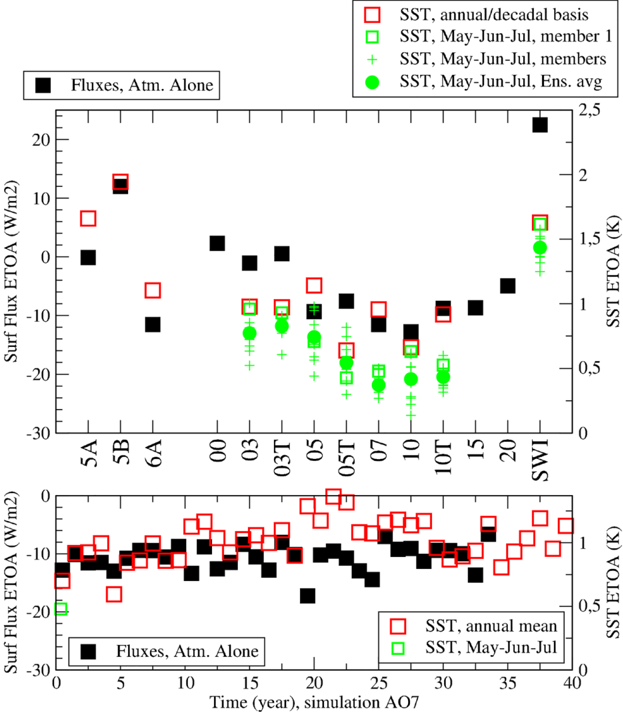
“In order to conserve computer resources and given that much of the SST bias patterns appear at short time scales (see, e.g., Vannière et al., 2014), we use 10-member ensembles of 6-month-long coupled experiments initialized in February for the sensitivity experiments to the value of the D parameter…”
MethodBrient, F., Couvreux, F., Villefranque, N., Rio, C., & Honnert, R. (2019) · Geophysical Research Letters · doi:10.1029/2018gl081499 · Cited by 51 · cited 1×
“…boundary layer top entrainment, would probably deserve to be replaced by a more physical representation of the entrainment of dry air from the free troposphere into the boundary layer, as, for example, by an explicit representation of downdrafts within stratocumulus clouds (Brient et al., 2019).”
BackgroundSelf-citationA two‐stream model of the vertical transport of trace species in the convective boundary layer
Chatfield, R. B., & Brost, R. A. (1987) · Journal of Geophysical Research: Atmospheres · doi:10.1029/jd092id11p13263 · Cited by 46 · cited 1×
“In this approach first suggested by Chatfield and Brost (1987) and often called EDMF for “Eddy Diffusion Mass Flux,” dry and HOURDIN ET AL.”
MethodHourdin, F., Jam, A., Rio, C., Couvreux, F., Sandu, I., Lefebvre, M., Brient, F., & Idelkadi, A. (2019) · Journal of Advances in Modeling Earth Systems · doi:10.1029/2019ms001666 · Cited by 45 · cited 7×
“, 2014) and, more importantly for the present paper, activating the thermal plume model in regions of strong inversion (Hourdin et al., 2019).”
BackgroundInfluentialSelf-citationJam, A., Hourdin, F., Rio, C., & Couvreux, F. (2012) · Boundary-Layer Meteorology · doi:10.1007/s10546-012-9789-3 · Cited by 44 · cited 2×
“, when there is a positive heat flux at the surface), the PDF is bimodal, one mode being associated with the thermal plume and the other one with its environment (Jam et al., 2013).”
BackgroundSelf-citationLand surface processes in a simplified general circulation model
Laval, K., Sadourny, R., & Serafini, Y. (1981) · Geophysical & Astrophysical Fluid Dynamics · doi:10.1080/03091928108243677 · Cited by 39 · cited 8×
“5A 95 × 95-L39 (Laval et al., 1981), Γ = 1 K/km NO Kz conditioned by a threshold on top inversion 5B idem (Yamada, 1983), Γ = 0 (Rio et al.”
BackgroundMethodInfluentialHourdin, F., Gueye, M., Diallo, B., Dufresne, J., Escribano, J., Menut, L., Marticorena, B., Siour, G., & Guichard, F. (2015) · Atmospheric chemistry and physics · doi:10.5194/acp-15-6775-2015 · Cited by 32 · cited 13×
“…simulated in a coupled atmosphere-ocean model with surface flux biases in atmospheric simulations forced by SST with the same atmospheric model, Hourdin et al. (2015) showed that the SST warm bias across coupled models is strongly boundary layer thermals controls near-surface humidity and in…”
BackgroundMethodResultInfluentialSelf-citationDiallo, F. B., Hourdin, F., Rio, C., Traore, A. K., Mellul, L., Guichard, F., & Kergoat, L. (2017) · Journal of Advances in Modeling Earth Systems · doi:10.1002/2017ms001081 · Cited by 29 · cited 2×
“…efficient daytime convective transport dries the surface over continental surfaces by exporting the evaporated surface water more efficiently to the dry troposphere, in better agreement with observations (Cheruy et al., 2013; Diallo et al., 2017) and produces better mixed boundary layer profiles.”
BackgroundSelf-citationOmens of coupled model biases in the CMIP5 AMIP simulations
Găinuşă-Bogdan, A., Hourdin, F., Traoré, A. K., & Braconnot, P. (2018) · Climate Dynamics · doi:10.1007/s00382-017-4057-3 · Cited by 20 · cited 3×
“…extending previous analysis to the new CMIP6 multi-model ensemble, the present study first confirms conclusions reached by Hourdin et al. (2015) and Găinuşă-Bogdan et al. (2018): (1) the warm SST bias over the ETO is due in a large part to erroneous representation of the contrast between…”
BackgroundResultInfluentialSelf-citationAveraging-Related Biases in Monthly Latent Heat Fluxes
Hughes, P. J., Bourassa, M. A., Rolph, J. J., & Smith, S. R. (2012) · Journal of Atmospheric and Oceanic Technology · doi:10.1175/jtech-d-11-00184.1 · Cited by 18
Găinuşă-Bogdan, A., Braconnot, P., & Servonnat, J. (2015) · Journal of Geophysical Research Atmospheres · doi:10.1002/2014jd022985 · Cited by 11 · cited 2×
“For latent heat fluxes, we use 10 in situ, satellite-based and blended climatological products, which were analyzed in detail by (Găinuşă-Bogdan et al., 2015).”
MethodCovariability of SST and surface heat fluxes in reanalyses and CMIP3 climate models
Yu, B., Boer, G. J., Zwiers, F. W., & Merryfield, W. J. (2009) · Climate Dynamics · doi:10.1007/s00382-009-0669-6 · Cited by 11
(2003) · doi:10.1175/1520-0442(2003)016
Research works printed but not linked: 6
- 10.1175/1520-0442(2003)016 · doi:10.1175/1520-0442(2003)016
- Jam, A. (2012). Paramétrisation de la couche limite: Du modèle des thermiques au modèle statistique de nuage (PhD thesis), advized by Hourdin, Frédéric, Sciences de l'environnement, Paris 6 2012, 2012PA066672. https://www.theses.fr/2012PA066672
- 10.1175/1520-0493(2001)129 · doi:10.1175/1520-0493(2001)129
- 10.1175/1520-0442(1996)009 · doi:10.1175/1520-0442(1996)009
- Shie, C., Chiu, L., Adler, R., Gao, S., Chokngamwong, R., Lin, I., & Wang, F. (2010). A recently revived and produced global air-sea surface turbulent fluxes dataset-GSSTF2b: Validations and findings. In Proceedings of the Joint 2010 CWB Weather Analysis and Forecasting and COAA 5th International Ocean-Atmosphere Conference.
- 10.1175/1520-0442(1999)012 · doi:10.1175/1520-0442(1999)012
Cited by
Presentation and Evaluation of the IPSL‐CM6A‐LR Climate Model
Boucher, O., Servonnat, J., Albright, A. L., Aumont, O., Balkanski, Y., Bastrikov, V., Bekki, S., Bonnet, R., Bony, S., Bopp, L., et al. (2020) · Journal of Advances in Modeling Earth Systems · doi:10.1029/2019ms002010 · Cited by 1,694
“Arctic sea ice was one of the targets considered during the tuning process (Hourdin et al., 2020a).”
BackgroundMethodInfluentialSelf-citationLMDZ6A: The Atmospheric Component of the IPSL Climate Model With Improved and Better Tuned Physics
Hourdin, F., Rio, C., Grandpeix, J., Madeleine, J., Cheruy, F., Rochetin, N., Jam, A., Musat, I., Idelkadi, A., Fairhead, L., et al. (2020) · Journal of Advances in Modeling Earth Systems · doi:10.1029/2019ms001892 · Cited by 268
Self-citationPresentation and Evaluation of the IPSL‐CM6A‐LR Ensemble of Extended Historical Simulations
Bonnet, R., Boucher, O., Deshayes, J., Gastineau, G., Hourdin, F., Mignot, J., Servonnat, J., & Swingedouw, D. (2021) · Journal of Advances in Modeling Earth Systems · doi:10.1029/2021ms002565 · Cited by 88
Self-citationHourdin, F., Williamson, D., Rio, C., Couvreux, F., Roehrig, R., Villefranque, N., Musat, I., Fairhead, L., Diallo, F. B., & Volodina, V. (2021) · Journal of Advances in Modeling Earth Systems · doi:10.1029/2020ms002225 · Cited by 83
Self-citationRecent progress in simulating two types of ENSO – from CMIP5 to CMIP6
Hou, M., & Tang, Y. (2022) · Frontiers in Marine Science · doi:10.3389/fmars.2022.986780 · Cited by 50
Metadata
- Authors
- Hourdin, F., Rio, C., Jam, A., Traore, A., & Musat, I.
- Affiliations
- Centre National de la Recherche Scientifique (FR)
- Corresponding author
- Hourdin, Frédéric
- Venue
- Journal of Advances in Modeling Earth Systems
- Publisher
- American Geophysical Union (AGU)
- Published
- 2020-05-29
- Volume
- 12
- Issue
- 6
- ISSN
- 1942-2466 (ISSN-L)
- OpenAlex
- W3014934722
- Cited by
- 24
- References
- 61
- Citations by year
- 2026: 1 · 2025: 2 · 2024: 1 · 2023: 4 · 2022: 6 · 2021: 6 · 2020: 4
- FWCI
- 1.86
- Type
- journal article
- Language
- en
- Open access
- gold
- doi.org
- Licence
- Locations
- Journal of Advances in Modeling Earth Systems (publishedVersion, cc-by)
- HAL (submittedVersion, other-oa)
- DOAJ (DOAJ: Directory of Open Access Journals) (submittedVersion, cc-by-sa)
- Funders
- Agence Nationale de la Recherche (ANR-13-MONU-0008)
- Topics
- Physical Sciences › Environmental Science › Global and Planetary Change › Climate variability and models
- Physical Sciences › Earth and Planetary Sciences › Atmospheric Science › Meteorological Phenomena and Simulations
- Physical Sciences › Earth and Planetary Sciences › Oceanography › Oceanographic and Atmospheric Processes
- Keywords
- convective boundary layer, sea surface temperature, detrainment, entrainment, evaporative cooling, surface fluxes, cumulus parameterization, stratocumulus, trade winds, boundary layer clouds, CMIP6
About these checks
Registry, retraction, Cites and statistics results are computed, not judged, with one exception: a printed reference that no index lists is read once by a model before it counts as a citation error. Claims are extracted by a model and kept only when their quote appears verbatim in the text; each cited source is then checked, with a model’s help, for whether it says what the claim relies on. Those verdicts can be wrong — read the claim’s quote and the cited source before relying on one.
Statistics and arithmetic are recomputed, not judged.
Confidence bands are shown only for fields calibrated on our annotated test set. None is calibrated yet, so no band is shown.
What counts as a claim ›How we measure confidence ›How we check this ›
Are you an author, or do you see a problem with this page? Request a review
Data sources
Bibliographic data: Semantic Scholar, OpenAlex, Crossref.
Contains information from the Semantic Scholar Academic Graph Datasets, made available under the ODC Attribution License (ODC-BY 1.0).
Semantic Scholar’s data is described in: Kinney, R., et al. (2023). The Semantic Scholar Open Data Platform. arXiv:2301.10140.
