

The DOI matches its Crossref record; 2 of the 2 references it cites were found in a registry or an index.
Investigation of Forest Fire Activity Changes Over the Central India Domain Using Satellite Observations During 2001–2020
Open accessAbstract
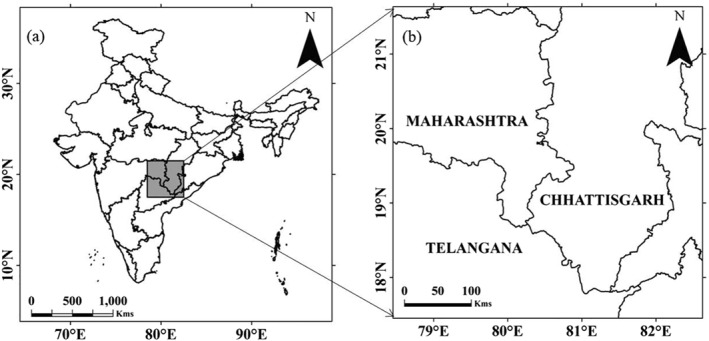
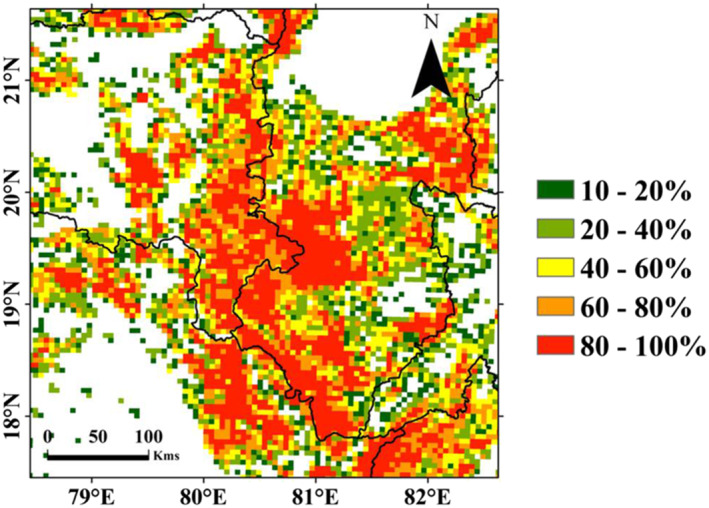
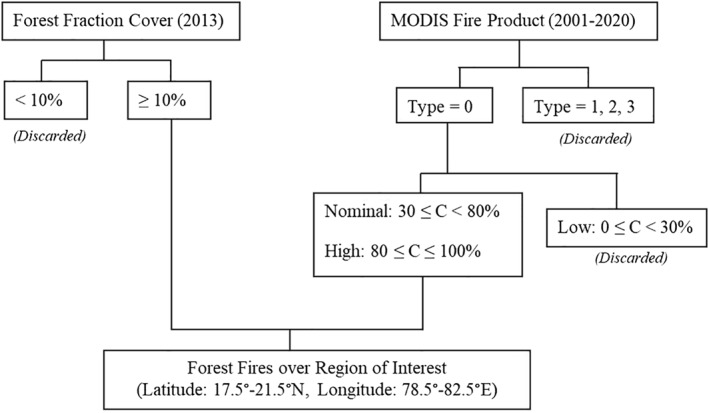
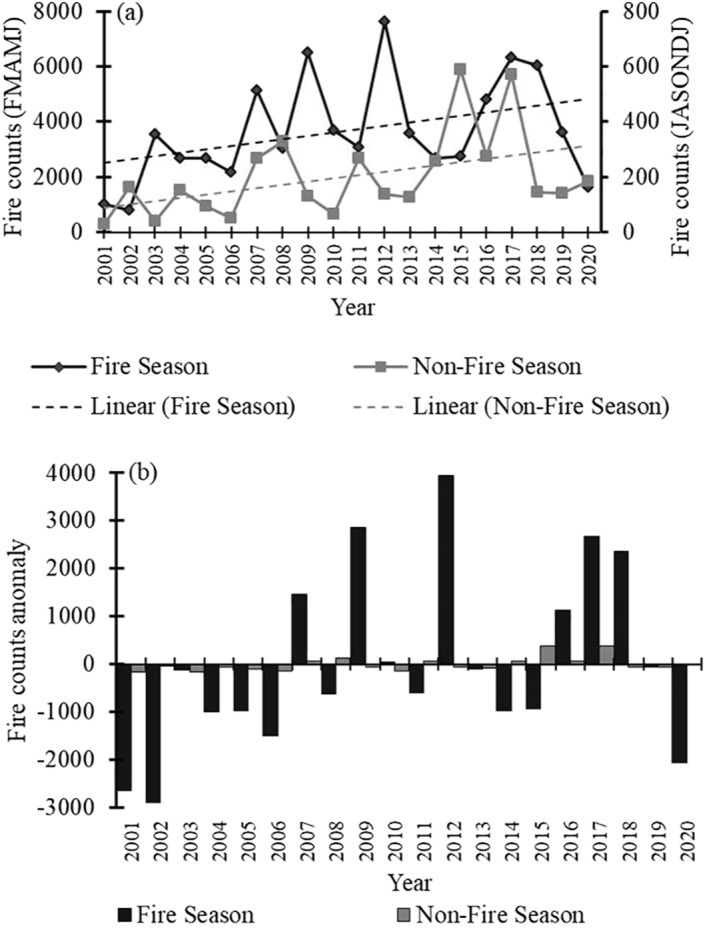
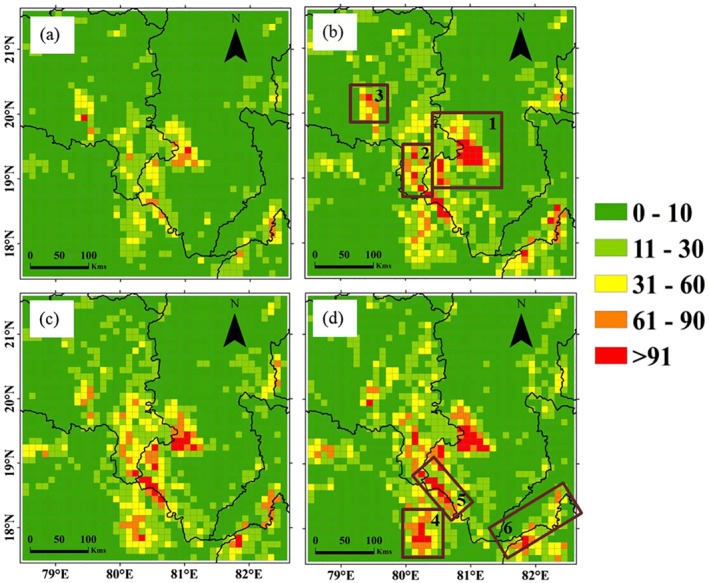
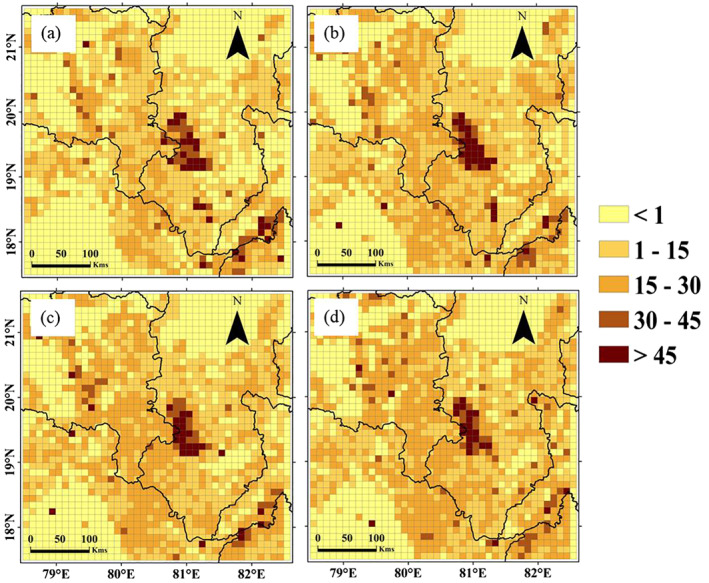
Recurrent and large forest fires negatively impact ecosystem, air quality, and human health. Moderate Resolution Imaging Spectroradiometer fire product is used to identify forest fires over central India domain, an extremely fire prone region. The study finds that from 2001 to 2020, ∼70% of yearly forest fires over the region occurred during March (1,857.5 counts/month) and April (922.8 counts/month). Some years such as 2009, 2012, and 2017 show anomalously high forest fires. The role of persistent warmer temperatures and multiple climate extremes in increasing forest fire activity over central India is comprehensively investigated. Warmer period from 2006 to 2020 showed doubling and tripling of forest fire activity during forest fire (February–June; FMAMJ) and non‐fire (July–January; JASONDJ) seasons, respectively. From 2015 JASONDJ to 2018 FMAMJ, central India experienced a severe heatwave, a rare drought and an extremely strong El Niño, the combined effect of which is linked to increased forest fires. Further, the study assesses quinquennial spatiotemporal changes in forest fire characteristics such as fire count density and average fire intensity. Deciduous forests of Jagdalpur‐Gadchiroli Range and Indravati National Park in Chhattisgarh state are particularly fire prone (>61 fire counts/grid) during FMAMJ and many forest fires are of high intensity (>45 MW). Statistical associations link high near surface air temperature and low precipitation during FMAMJ to significantly high soil temperature, low soil moisture content, low evapotranspiration and low normalized difference vegetation index. This creates a significantly drier environment, conducive for high forest fire activity in the region.
Overview
The claims and statistics of this paper haven’t been checked yet.
Run the check — free, no account needed. It reads the open-access text and checks the sources it cites.
Integrity signals
Registry
Cites
Statistics
Figures
Verification
Claims the paper makes
The claims and statistics of this paper haven’t been checked yet.
Run the check — free, no account needed. It reads the open-access text and checks the sources it cites.
Claims other papers make about this one
Each is checked against this paper’s own text: does it say what the citing paper says it does?
The cited source says what the claim attributes to it.
In the citing paper
“Heatwaves also increase the risk of forest-fires (Jain et al 2021).”
From Attribution of 2022 early-spring heatwave in India and Pakistan to climate change: lessons in assessing vulnerability and preparedness in reducing impacts (2023) · cites this paper as Jain et al 2021
Self-check
Percentages, sums and reported differences re-computed from the paper’s own numbers.
The self-check needs the paper’s full text.
Citations
Cites
The human dimension of fire regimes on Earth
Bowman, D. M. J. S., Balch, J., Artaxo, P., Bond, W. J., Cochrane, M. A., D’Antonio, C. M., DeFries, R., Johnston, F. H., Keeley, J. E., Krawchuk, M. A., et al. (2011) · Journal of Biogeography · doi:10.1111/j.1365-2699.2011.02595.x · Cited by 1,230 · cited 1×
“Forest fire is an increasingly common phenomenon that affects almost all forest types and biomes on earth, largely causing global to regional changes in the air quality, radiation budget, land-atmosphere interactions, nutrient cycles, and ecological balance (Bowman et al., 2011; Cochrane, 2009; Giglio et al., 2016).”
BackgroundUsing Fire to Increase the Scale, Benefits, and Future Maintenance of Fuels Treatments
North, M., Collins, B. M., & Stephens, S. (2012) · Journal of Forestry · doi:10.5849/jof.12-021 · Cited by 317
Research works printed but not linked: 74
- 10.1007/s00704-010-0396-2 · DOI
- 10.1007/s41324-018-0175-1 · DOI
- Andreae M. O., 1991, Global biomass burning‐atmospheric, climatic, and biospheric implications, 3, 10.7551/mitpress/3286.003.0003 · DOI
- 10.1007/978-1-4615-2524-0_6 · DOI
- 10.5721/EuJRS20164921 · DOI
- 10.1080/02827581.2021.1918239 · DOI
- 10.1016/j.jastp.2017.03.017 · DOI
- 10.1029/2003JD003697 · DOI · Paper page
- 10.1016/j.tree.2005.04.025 · DOI · Paper page
- 10.1111/geb.13058 · DOI
- 10.3329/jesnr.v5i2.14840 · DOI
- 10.1007/3-540-27468-5_86 · DOI
- 10.1038/s41558-017-0014-8 · DOI
- 10.1007/978-3-540-77381-8_1 · DOI
- 10.1126/science.250.4988.1669 · DOI
- 10.1029/2004JD004924 · DOI
- FAO., 2007, Fire management global assessment 2006, i
- 10.1007/s10584-005-5935-y · DOI
- 10.1016/S0048-9697(00)00524-6 · DOI
- 10.1007/s10584-015-1521-0 · DOI · Paper page
- Forest Survey of India (FSI), 2019, India State of Forest Report 2019, i
- Forest Survey of India (FSI), 2020, FSI Technical Information Series, 1
- 10.1038/s41598-017-07956-5 · DOI
- 10.1016/j.rse.2008.10.006 · DOI
- Giglio L., 2018, MODIS collection 6 active fire product user’s guide revision B
- 10.1016/j.rse.2016.02.054 · DOI
- 10.4209/aaqr.200460 · DOI
- 10.1023/A:1005371923658 · DOI
- 10.1007/s12040-020-1381-5 · DOI
- 10.1289/ehp.1002288 · DOI
- 10.3390/f11030286 · DOI
- India Meteorological Department (IMD), 2021, Statement on climate of India during 2020, 1
- Intergovernmental Panel on Climate Change (IPCC), 2018, Global Warming of 1.5°C, An IPCC Special Report on the impacts of global warming of 1.5°C above pre‐industrial levels and related global greenhouse gas emission pathways, in the context of strengthening the global response to the threat of climate change, sustainable development, and efforts to eradicate poverty
- Jain M., 2021, Extremes in atmospheric processes and phenomenas: Assessment, impacts and mitigation
- 10.1088/1748-9326/aa9853 · DOI
- 10.1007/s40010-017-0452-8 · DOI
- 10.1126/science.1131152 · DOI
- 10.1016/j.wace.2013.07.006 · DOI
- Kumar M., 2013, Effect of fire on soil nutrients and under storey vegetation in Chir pine forest in Garhwal Himalaya, India, ActaEcologicaSinica, 33, 59
- 10.1007/s42452-021-04391-0 · DOI
- 10.1029/2005GL022860 · DOI
- 10.5194/acp-20-8827-2020 · DOI
- 10.1111/gcb.13275 · DOI · Paper page
- 10.1177/0309133307079365 · DOI · Paper page
- 10.1002/asl.959 · DOI
- 10.1016/j.foreco.2013.12.003 · DOI
- 10.1007/s12040-009-0040-7 · DOI
- 10.1007/s00703-016-0469-6 · DOI
- 10.1016/j.worlddev.2020.105120 · DOI
- 10.1016/j.jenvman.2006.11.017 · DOI
- 10.1007/s11676-011-0206-4 · DOI
- 10.1007/s10531-015-1033-2 · DOI
- 10.1007/s10661-015-4990-8 · DOI
- 10.18520/cs/v112/i07/1521-1532 · DOI
- 10.5194/acp-5-799-2005 · DOI
- 10.1016/j.rse.2005.04.007 · DOI
- 10.1016/j.ejrh.2020.100727 · DOI
- 10.1029/2018JD028428 · DOI
- Satendra, 2014, Forest fire disaster management, i
- Saxena P., 2019, Criteria air pollutants and their impact on environmental health, 157, 10.1007/978-981-13-9992-3 · DOI
- 10.1016/j.heliyon.2021.e06973 · DOI
- 10.1016/j.foreco.2019.117723 · DOI
- Sonwani S., 2016, Proceedings of Indian aerosol science and technology association conference on aerosol and climate change: Insight and challenges. IASTA Bulletin, 269
- 10.1007/s10874-019-09396-z · DOI
- Sonwani S., 2021, Water‐insoluble carbonaceous components in rainwater over an urban background location in Northern India during pre‐monsoon and monsoon seasons, Environmental Science and Pollution Research, 1
- 10.1029/2008JD010717 · DOI
- 10.5194/acp-13-5227-2013 · DOI
- 10.1146/annurev.es.20.110189.001131 · DOI
- 10.1007/s10661-005-9122-4 · DOI
- 10.1175/BAMS-D-16-0145.1 · DOI · Paper page
- 10.1038/s41598-019-55036-7 · DOI
- 10.1071/WF09002 · DOI · Paper page
- 10.5194/acp-21-3833-2021 · DOI
- 10.5194/bg-16-1629-2019 · DOI
Cited by
Sorted by citations
Zachariah, M., Arulalan, T., AchutaRao, K., Saeed, F., Jha, R., Dhasmana, M. K., Mondal, A., Bonnet, R., Vautard, R., Philip, S., et al. (2023) · Environmental Research Climate · doi:10.1088/2752-5295/acf4b6 · Cited by 48
Metadata
- Authors
- Jain, M., Saxena, P., Sharma, S., & Sonwani, S.
- Affiliations
- Jawaharlal Nehru University (IN)
- University of Delhi (IN)
- Physical Research Laboratory (IN)
- Corresponding author
- Sonwani, Saurabh
- Venue
- GeoHealth
- Publisher
- American Geophysical Union (AGU)
- Published
- 2021-12
- Volume
- 5
- Issue
- 12
- Pages
- e2021GH000528-e2021GH000528
- ISSN
- 2471-1403 (ISSN-L)
- PMC
- PMC8696561
- OpenAlex
- W4200432480
- Cited by
- 74
- References
- 2
- Citations by year
- 2026: 6 · 2025: 23 · 2024: 20 · 2023: 12 · 2022: 12 · 2021: 1
- FWCI
- 4.61
- Type
- journal article
- Language
- en
- Open access
- gold
- doi.org
- Licence
- Locations
- GeoHealth (publishedVersion, cc-by-nc-nd)
- PubMed Central (publishedVersion, cc-by-nc-nd)
- PubMed (publishedVersion)
- DOAJ (DOAJ: Directory of Open Access Journals) (submittedVersion, cc-by-sa)
- Topics
- Physical Sciences › Environmental Science › Global and Planetary Change › Fire effects on ecosystems
- Physical Sciences › Engineering › Safety, Risk, Reliability and Quality › Fire Detection and Safety Systems
- Physical Sciences › Environmental Science › Global and Planetary Change › Atmospheric aerosols and clouds
- Keywords
- Central India, fire seasonality, fire intensity, heat waves, El Niño, drought, climate extremes, soil moisture, evapotranspiration, NDVI, Chhattisgarh, fire-prone forests, satellite fire detection
About these checks
Registry, retraction, Cites and statistics results are computed, not judged, with one exception: a printed reference that no index lists is read once by a model before it counts as a citation error. Claims are extracted by a model and kept only when their quote appears verbatim in the text; each cited source is then checked, with a model’s help, for whether it says what the claim relies on. Those verdicts can be wrong — read the claim’s quote and the cited source before relying on one.
Statistics and arithmetic are recomputed, not judged.
Confidence bands are shown only for fields calibrated on our annotated test set. None is calibrated yet, so no band is shown.
What counts as a claim ›How we measure confidence ›How we check this ›
Are you an author, or do you see a problem with this page? Request a review
How to cite
Cite CoChat for the checks on this page, and the paper for its own findings.
- This page
- CoChat. (2026). Citation check: Investigation of Forest Fire Activity Changes Over the Central India Domain Using Satellite Observations During 2001–2020. https://app.cochat.ai/papers/10.1029/2021gh000528
- The paper
- Jain, M., Saxena, P., Sharma, S., & Sonwani, S. (2021). Investigation of Forest Fire Activity Changes Over the Central India Domain Using Satellite Observations During 2001–2020. GeoHealth. https://doi.org/10.1029/2021gh000528
