

On the Correspondence Between Atmosphere‐Only and Coupled Simulations for Radiative Feedbacks and Forcing From CO 2
Open accessPublished version of a preprint
The DOI matches its Crossref record; 80 of the 80 references it cites were found in a registry or an index.
Abstract
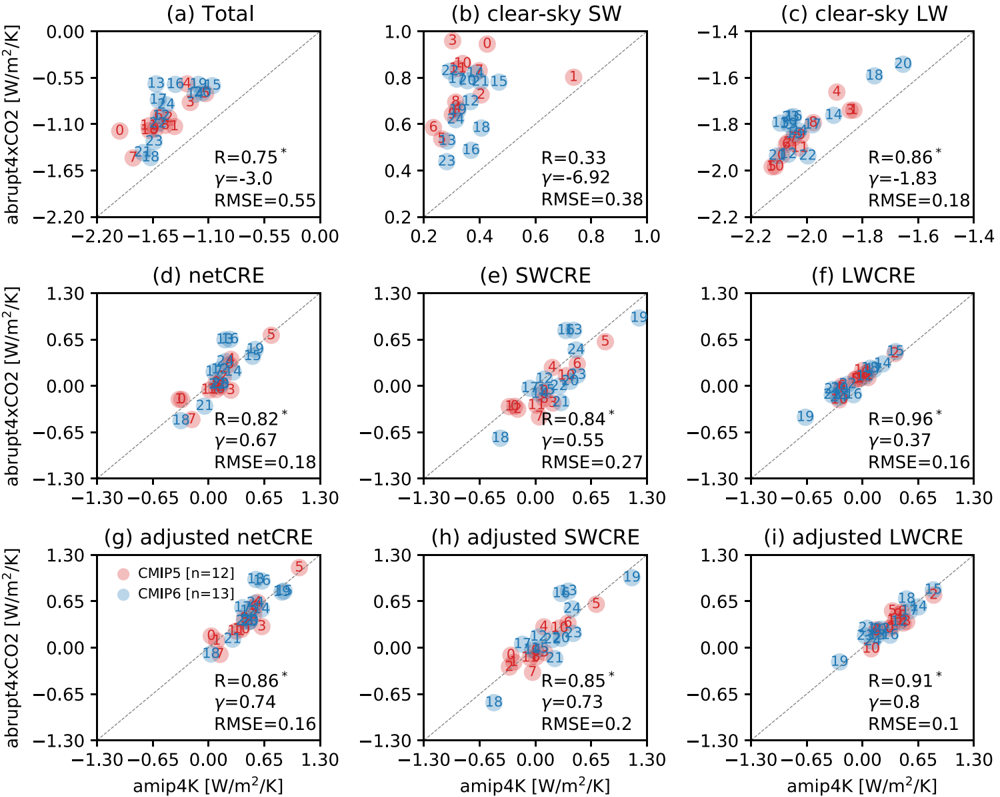
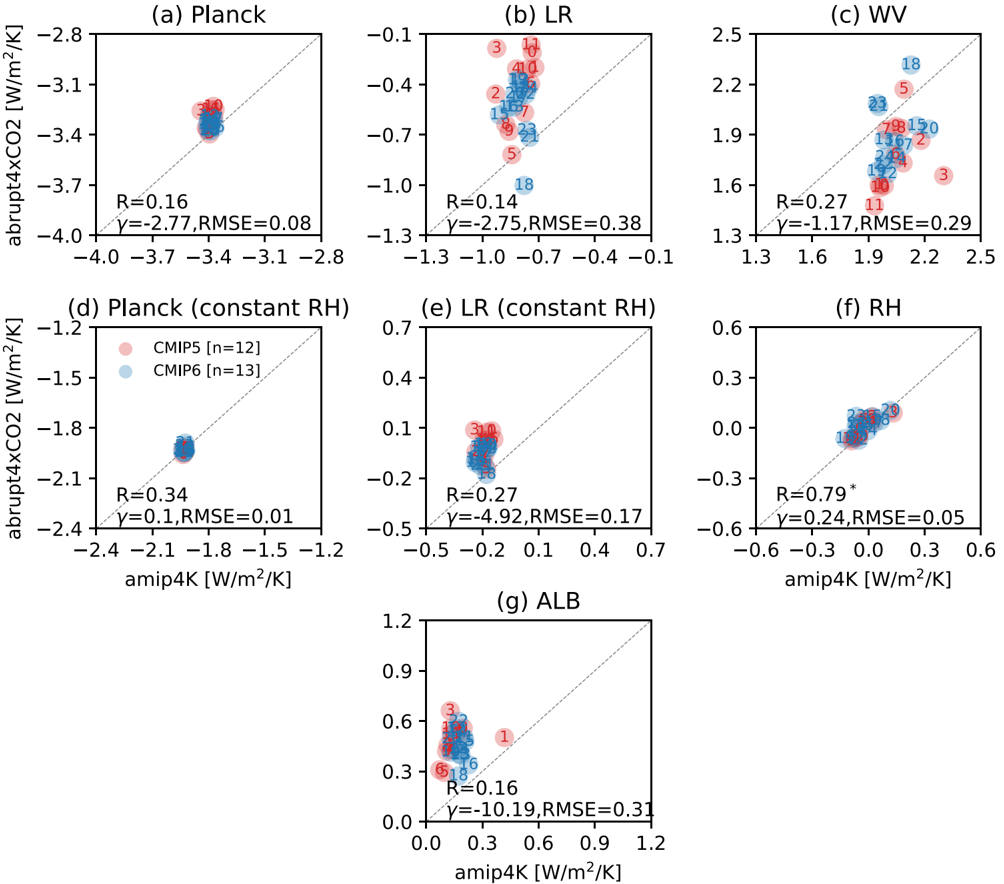
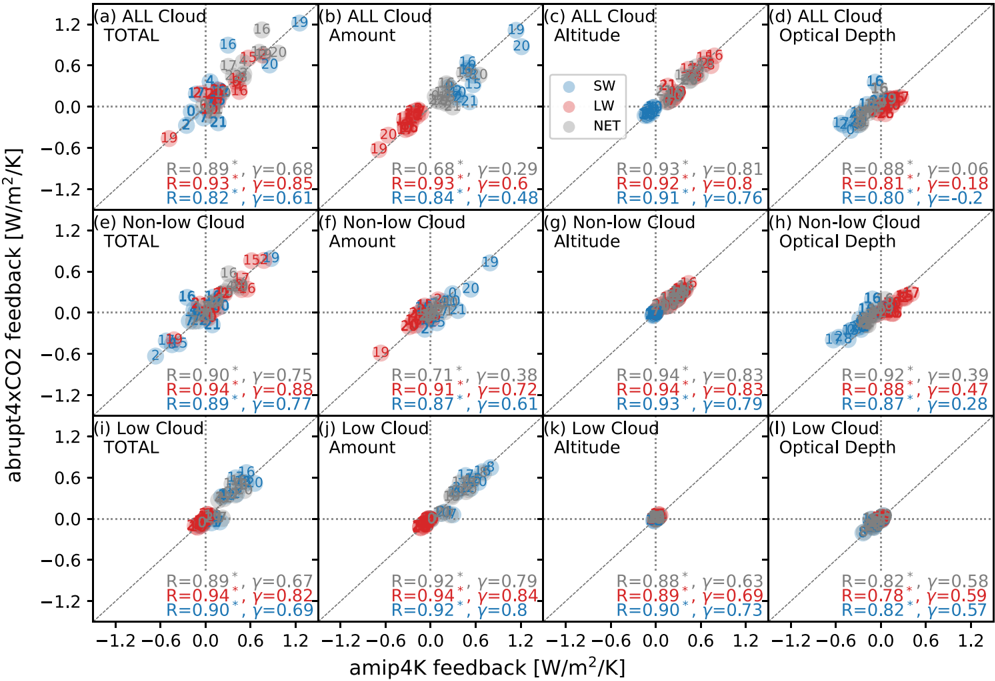
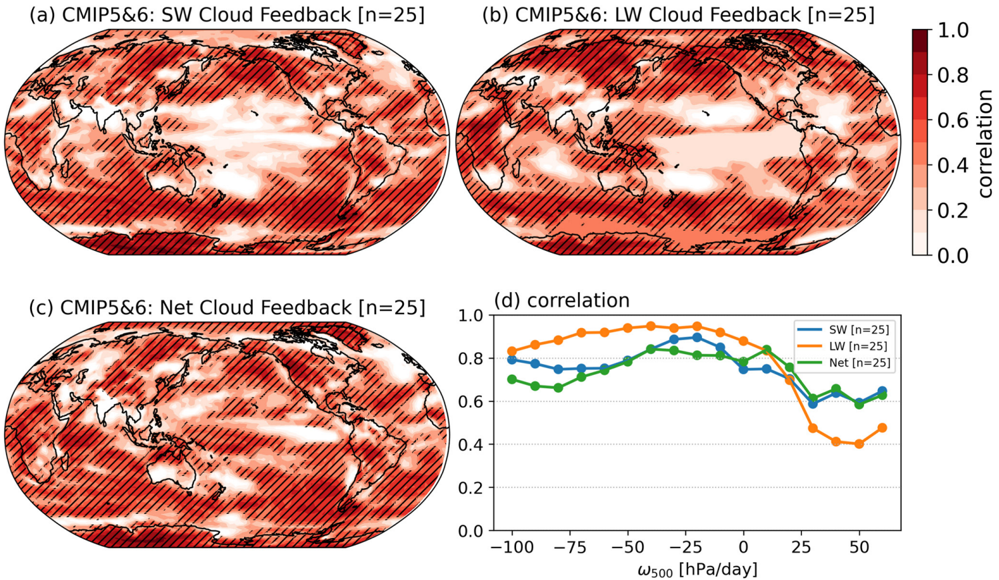
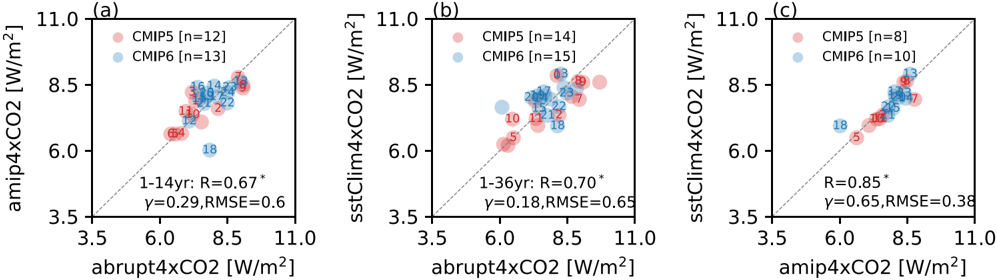
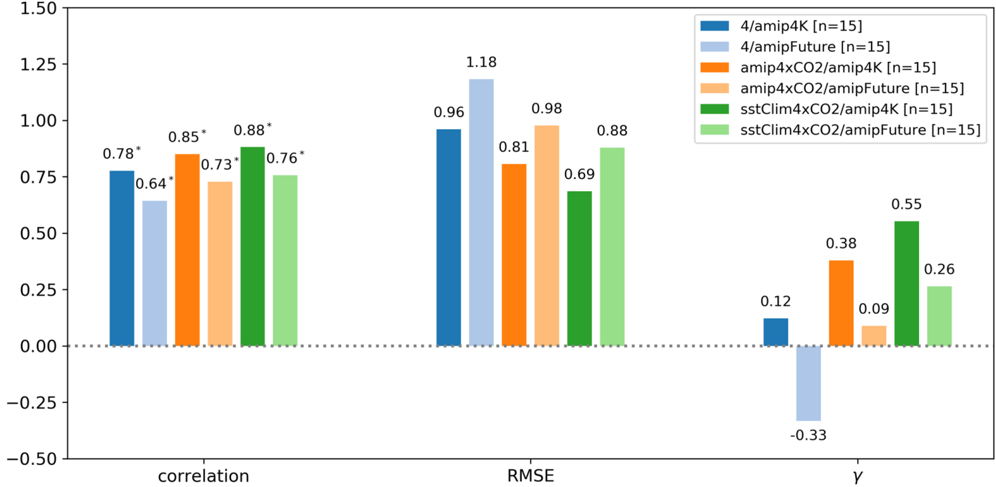
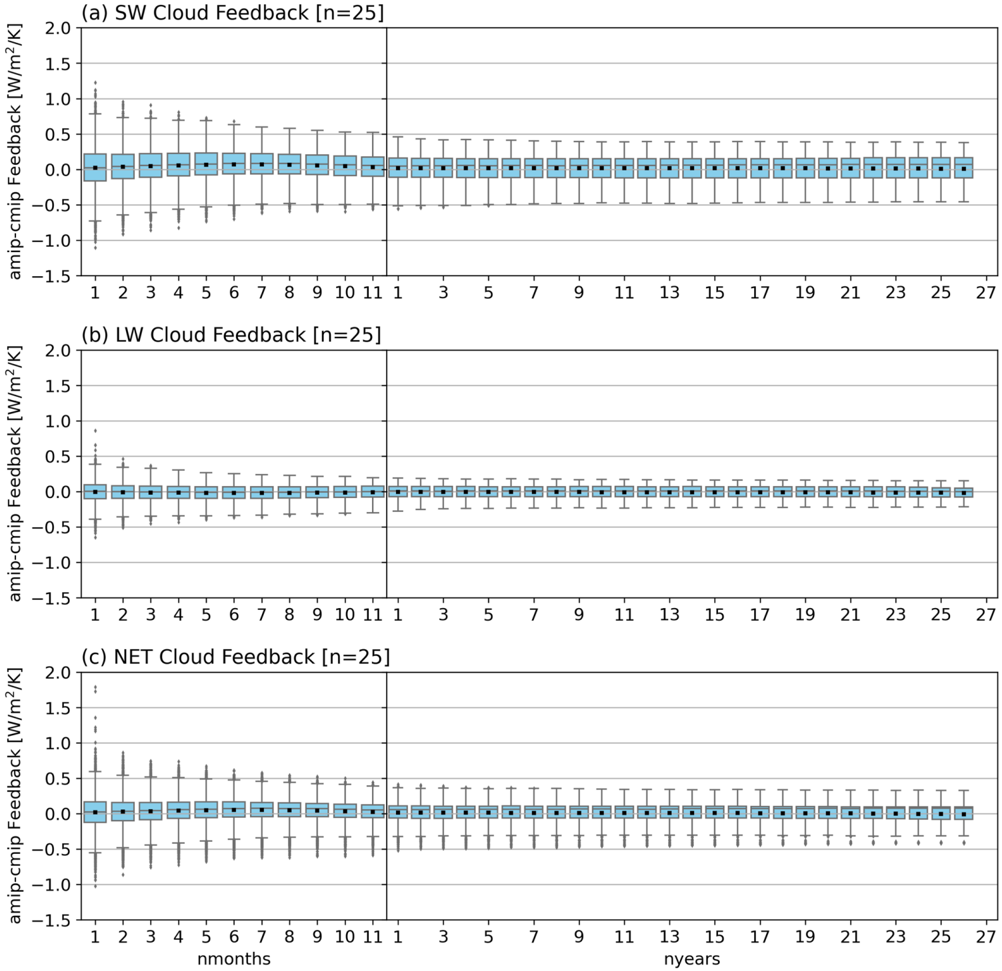
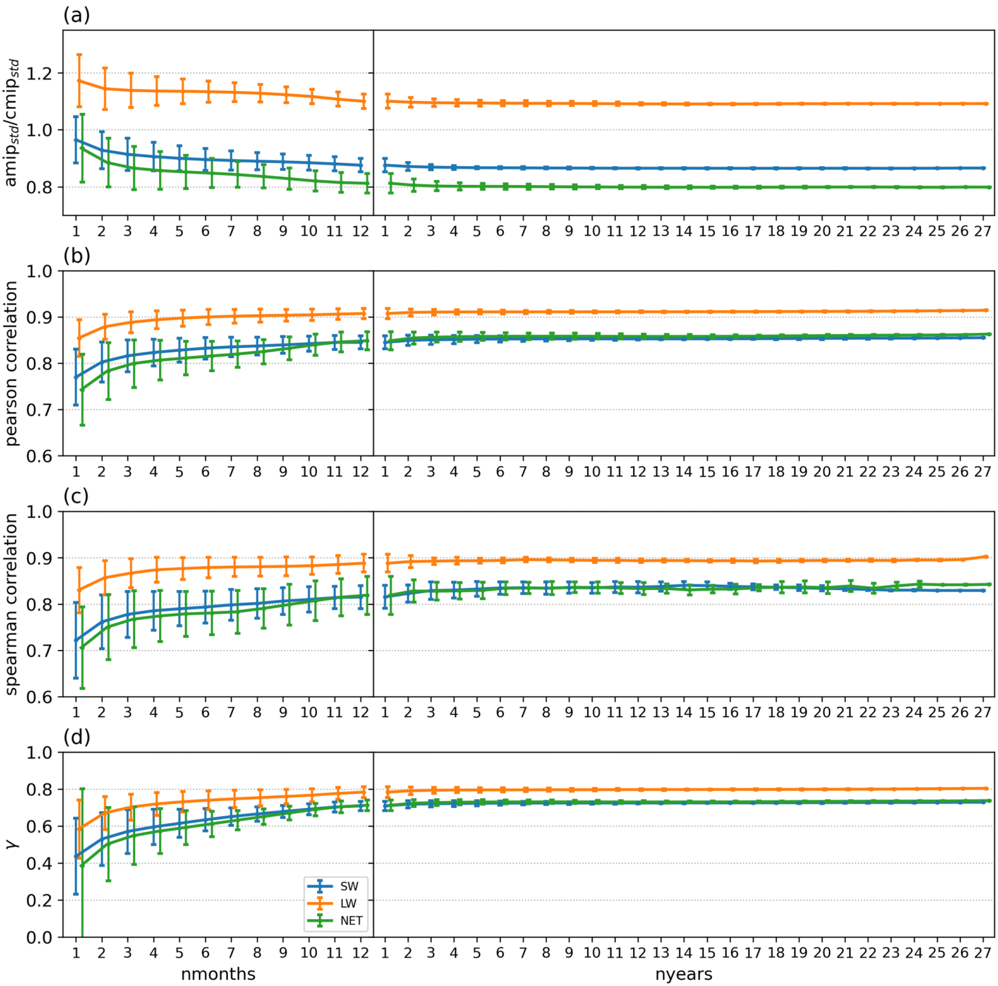
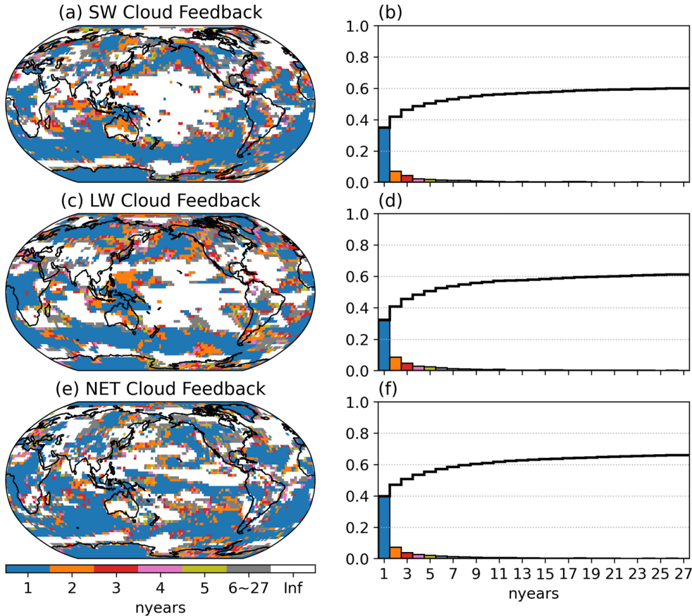
Atmosphere‐only experiments are widely used to investigate climate feedbacks simulated in more computationally expensive fully coupled global climate model simulations. We confirm that this remains a valid approach by comparing the radiative feedbacks and forcing between coupled and atmosphere‐only simulations for the latest models taking part in the 6th phase of the Coupled Model Intercomparison Project (CMIP6). For global‐mean cloud feedbacks, we find a better than previously known correspondence between these experiments, which applies even to the response of individual cloud properties (amount, altitude, and optical depth) and holds even when considering atmosphere‐only simulations of only 1 yr duration. For regional cloud feedbacks, the correspondence between the two experiments is generally present at every geographic location except for the tropical Pacific but takes longer experiments to reveal. For the lapse rate and surface albedo feedbacks, the correspondence between the two experiments is weaker due to the non‐uniform warming pattern and loss of sea ice in the coupled experiment. For the across‐model relationship between 4xCO 2 effective radiative forcing and feedback, we find a different behavior across experiments in CMIP6 than in CMIP5, casting doubt on the physical significance of previous results that highlighted an anti‐correlation between the two quantities. Overall, these results confirm the utility of atmosphere‐only experiments particularly to study cloud feedbacks, which are the dominant source of inter‐model spread in climate sensitivity.
Overview
The claims and statistics of this paper haven’t been checked yet.
Free: it reads the open-access text and checks the first 5 claims that cite a source we can check. Create a free account to check every claim.
Integrity signals
Registry
Cites
Statistics
Figures








Verification
Claims the paper makes
The claims and statistics of this paper haven’t been checked yet.
Free: it reads the open-access text and checks the first 5 claims that cite a source we can check. Create a free account to check every claim.
Claims other papers make about this one
Each is checked against this paper’s own text: does it say what the citing paper says it does?
The source backs part of the claim, not all of it — or backs it for a different population, condition or comparison.
In the citing paper
“Although some propositions exist to account for the difference between ECScpl and ECSatm (51), we prefer here to use the simplest estimate of ECSatm, the proposed correction not affecting generally the ranking of the ECS values (see section SI2 and fig. S7).”
From Toward machine-assisted tuning avoiding the underestimation of uncertainty in climate change projections (2023) · cites this paper as [51]
Experimental — accuracy not yet measuredThe source backs part of the claim, not all of it — or backs it for a different population, condition or comparison.
In the citing paper
“For a number of reasons (51), this ECSatm computation gives a rather poor estimate of the effective ECS of the coupled model.”
From Toward machine-assisted tuning avoiding the underestimation of uncertainty in climate change projections (2023) · cites this paper as [51]
Experimental — accuracy not yet measured
Self-check
Percentages, sums and reported differences re-computed from the paper’s own numbers.
The self-check needs the paper’s full text.
Citations
Cites
An Overview of CMIP5 and the Experiment Design
Taylor, K. E., Stouffer, R. J., & Meehl, G. A. (2012) · Bulletin of the American Meteorological Society · doi:10.1175/bams-d-11-00094.1 · Cited by 14,052 · cited 2×
“An additional benefit of atmosphere-only simulations is that radiative feedbacks and forcing can be estimated in a straightforward manner via experiments forced by imposed changes in SSTs or CO2 concentration as described in Cloud Feedback Model Intercomparison Project (CFMIP; Taylor et al., 2012; Webb et al., 2017) a…”
MethodEyring, V., Bony, S., Meehl, G. A., Senior, C. A., Stevens, B., Stouffer, R. J., & Taylor, K. E. (2016) · Geoscientific Model Development · doi:10.5194/gmd-9-1937-2016 · Cited by 11,981
The Community Climate System Model Version 4
Gent, P. R., Danabasoglu, G., Donner, L. J., Holland, M. M., Hunke, E. C., Jayne, S. R., Lawrence, D. M., Neale, R. B., Rasch, P. J., Vertenstein, M., et al. (2011) · Journal of Climate · doi:10.1175/2011jcli4083.1 · Cited by 3,133
Climate change projections using the IPSL-CM5 Earth System Model: from CMIP3 to CMIP5
Dufresne, J.-L., Foujols, M.-A., Denvil, S., Caubel, A., Marti, O., Aumont, O., Balkanski, Y., Bekki, S., Bellenger, H., Benshila, R., et al. (2013) · Climate Dynamics · doi:10.1007/s00382-012-1636-1 · Cited by 1,755
Causes of Higher Climate Sensitivity in CMIP6 Models
Zelinka, M. D., Myers, T. A., McCoy, D. T., Po‐Chedley, S., Caldwell, P. M., Ceppi, P., Klein, S. A., & Taylor, K. E. (2020) · Geophysical Research Letters · doi:10.1029/2019gl085782 · Cited by 1,747 · cited 3×
“derived from the fixed RH framework (Figures 2d–2f), exhibit much smaller inter-model spread than do the traditional Planck, water vapor, and lapse rate feedbacks (Figures 2a–2c), consistent with previous studies (Held & Shell, 2012; Zelinka et al., 2020).”
BackgroundResultSelf-citationDevelopment and evaluation of an Earth-System model – HadGEM2
Collins, W. J., Bellouin, N., Doutriaux-Boucher, M., Gedney, N., Halloran, P., Hinton, T., Hughes, J., Jones, C. D., Joshi, M., Liddicoat, S., et al. (2011) · Geoscientific Model Development · doi:10.5194/gmd-4-1051-2011 · Cited by 1,516
Hansen, J., Sato, M., Ruedy, R., Nazarenko, L., Lacis, A., Schmidt, G. A., Russell, G., Aleinov, I., Bauer, M., Bauer, S., et al. (2005) · Journal of Geophysical Research: Atmospheres · doi:10.1029/2005jd005776 · Cited by 1,486 · cited 1×
“, 2004) and Hansen method (Hansen et al., 2005) to estimate the 4xCO2 ERF for coupled and amip4xCO2/sstClim4xCO2 experiments, respectively.”
MethodMIROC-ESM 2010: model description and basic results of CMIP5-20c3m experiments
Watanabe, S., Hajima, T., Sudo, K., Nagashima, T., Takemura, T., Okajima, H., Nozawa, T., Kawase, H., Abe, M., Yokohata, T., et al. (2011) · Geoscientific Model Development · doi:10.5194/gmd-4-845-2011 · Cited by 1,395
Atmospheric component of the MPI‐M Earth System Model: ECHAM6
Stevens, B., Giorgetta, M., Esch, M., Mauritsen, T., Crueger, T., Rast, S., Salzmann, M., Schmidt, H., Bader, J., Block, K., et al. (2013) · Journal of Advances in Modeling Earth Systems · doi:10.1002/jame.20015 · Cited by 1,379
The CNRM-CM5.1 global climate model: description and basic evaluation
Voldoire, A., Sanchez-Gomez, E., Salas y Mélia, D., Decharme, B., Cassou, C., Sénési, S., Valcke, S., Beau, I., Alias, A., Chevallier, M., et al. (2013) · Climate Dynamics · doi:10.1007/s00382-011-1259-y · Cited by 1,366
Cited by
Donahue, A. S., Caldwell, P., Bertagna, L., Beydoun, H., Bogenschutz, P., Bradley, A., Clevenger, T. C., Foucar, J. G., Golaz, J., Guba, O., et al. (2024) · Journal of Advances in Modeling Earth Systems · doi:10.1029/2024ms004314 · Cited by 87
The Green's Function Model Intercomparison Project (GFMIP) Protocol
Bloch‐Johnson, J., Rugenstein, M. A. A., Alessi, M. J., Proistosescu, C., Zhao, M., Zhang, B., Williams, A. I. L., Gregory, J. M., Cole, J. N. S., Dong, Y., et al. (2024) · Journal of Advances in Modeling Earth Systems · doi:10.1029/2023ms003700 · Cited by 69
“…found that running such models with prescribed sea surface temperature and sea ice boundary conditions from a coupled simulation induces similar changes in radiative fluxes as the original coupled simulation (e.g., Andrews et al., 2015; Haugstad et al., 2017; Qin et al., 2022; Ringer et al., 2014).”
MethodHourdin, F., Ferster, B., Deshayes, J., Mignot, J., Musat, I., & Williamson, D. (2023) · Science Advances · doi:10.1126/sciadv.adf2758 · Cited by 49
“Although some propositions exist to account for the difference between ECS and ECS (51), we prefer here to use the simplest estimate of ECS, the proposed correction not affecting generally the ranking of the ECS values (see section SI2 and fig.”
BackgroundMethodInfluentialSystematic and objective evaluation of Earth system models: PCMDI Metrics Package (PMP) version 3
Lee, J., Gleckler, P. J., Ahn, M., Ordoñez, A. C., Ullrich, P. A., Sperber, K. R., Taylor, K. E., Planton, Y., Guilyardi, É., Durack, P. J., et al. (2024) · Geoscientific model development · doi:10.5194/gmd-17-3919-2024 · Cited by 72
“…a different model variable, we have added vio-lin plots (Hintze and Nelson, 1998) to show probability density functions representing the distributions of model performance obtained from CMIP5 (shaded in blue on the left side of the axis) and CMIP6 (shaded in orange on the right side of the axis).”
MethodSelf-citationCauses of Reduced Climate Sensitivity in E3SM From Version 1 to Version 2
Qin, Y., Zheng, X., Klein, S. A., Zelinka, M. D., Ma, P., Golaz, J., & Xie, S. (2024) · Journal of Advances in Modeling Earth Systems · doi:10.1029/2023ms003875 · Cited by 22
“…with uniform 4 K sea surface temperature (SST) warming have been shown to provide good estimates of the cloud feedbacks in the fully coupled experiments (Qin et al., 2022; Ringer et al., 2014), and are mainly used to diagnose the impacts of model modifications on the cloud feedback changes.”
MethodSelf-citation
Metadata
- Authors
- Qin, Y., Zelinka, M. D., & Klein, S. A.
- Affiliations
- Lawrence Livermore National Laboratory (US)
- Corresponding author
- Qin, Yi
- Venue
- Journal of Geophysical Research: Atmospheres
- Publisher
- American Geophysical Union (AGU)
- Published
- 2022-02-07
- Volume
- 127
- Issue
- 3
- ISSN
- 0148-0227 (ISSN-L)
- 2169-897X
- 2169-8996
- OpenAlex
- W4210263897
- Cited by
- 34
- References
- 80
- Citations by year
- 2026: 4 · 2025: 9 · 2024: 9 · 2023: 8 · 2022: 4
- FWCI
- 2.99
- Type
- journal article
- Language
- en
- Open access
- hybrid
- doi.org
- Locations
- Journal of Geophysical Research Atmospheres (publishedVersion, cc-by)
- OSTI OAI (U.S. Department of Energy Office of Scientific and Technical Information) (submittedVersion)
- Funders
- U.S. Department of Energy (DEAC5207NA27344, AC52‐07NA27344)
- Lawrence Livermore National Laboratory (DE‐AC5207NA27344, 07NA27344, DE-AC52, AC52-07NA27344)
- Topics
- Physical Sciences › Environmental Science › Global and Planetary Change › Climate variability and models
- Physical Sciences › Environmental Science › Global and Planetary Change › Atmospheric aerosols and clouds
- Physical Sciences › Earth and Planetary Sciences › Atmospheric Science › Meteorological Phenomena and Simulations
- Keywords
- coupled climate simulations, radiative feedback, radiative forcing, CO2 forcing, cloud feedback, lapse rate feedback, surface albedo feedback, effective radiative forcing, climate sensitivity, CMIP6, inter-model spread, sea ice decline, tropical Pacific
About these checks
Registry, retraction, Cites and statistics results are computed, not judged, with one exception: a printed reference that no index lists is read once by a model before it counts as a citation error. Claims are extracted by a model and kept only when their quote appears verbatim in the text; each cited source is then checked, with a model’s help, for whether it says what the claim relies on. Those verdicts can be wrong — read the claim’s quote and the cited source before relying on one.
Statistics and arithmetic are recomputed, not judged.
Confidence bands are shown only for fields calibrated on our annotated test set. None is calibrated yet, so no band is shown.
What counts as a claim ›How we measure confidence ›How we check this ›
Are you an author, or do you see a problem with this page? Request a review
How to cite
Cite CoChat for the checks on this page, and the paper for its own findings.
- This page
- CoChat. (2026). Citation check: On the Correspondence Between Atmosphere‐Only and Coupled Simulations for Radiative Feedbacks and Forcing From CO 2. https://app.cochat.ai/papers/10.1029/2021jd035460
- The paper
- Qin, Y., Zelinka, M. D., & Klein, S. A. (2022). On the Correspondence Between Atmosphere‐Only and Coupled Simulations for Radiative Feedbacks and Forcing From CO 2. Journal of Geophysical Research: Atmospheres. https://doi.org/10.1029/2021jd035460
Data sources
Bibliographic data: Semantic Scholar, OpenAlex, Crossref.
Contains information from the Semantic Scholar Academic Graph Datasets, made available under the ODC Attribution License (ODC-BY 1.0).
Semantic Scholar’s data is described in: Kinney, R., et al. (2023). The Semantic Scholar Open Data Platform. arXiv:2301.10140.
