

Optimizing Injection Locations Relaxes Altitude‐Lifetime Trade‐Off for Stratospheric Aerosol Injection
Open accessThe DOI matches its Crossref record; 39 of the 39 references it cites were found in a registry or an index.
Abstract
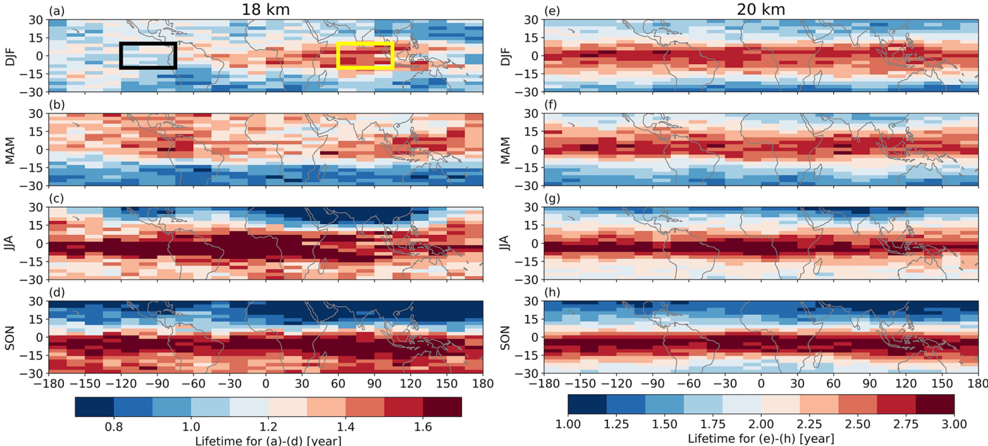
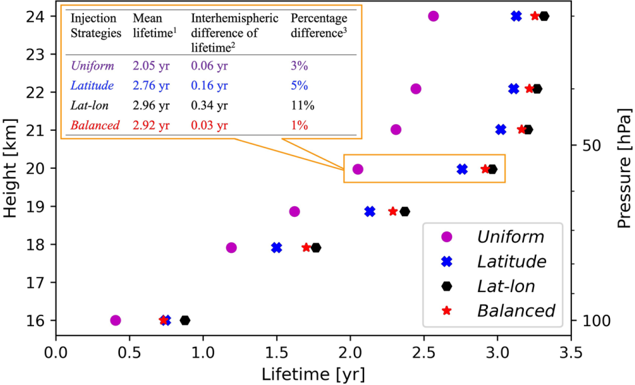
Stratospheric Aerosol Injection (SAI) aims to offset some climate hazards by injecting aerosols into the stratosphere to reflect solar radiation. The lifetime of injected particles influences SAI's radiative efficacy—the ratio of radiative forcing to particle mass flux. We employ a Lagrangian trajectory model with particle sedimentation to simulate how background circulations influence the transport of passive particles (without microphysical growth) in the stratosphere and quantify sensitivities of particle lifetime to injection locations. At 20 km, optimizing injection locations can increase particle lifetime by >40%. Injection strategies can be constrained to maintain an interhemispheric balance of particle lifetime without significantly decreasing total lifetime. Generally, increasing injection altitude increases particle lifetime while also increasing costs and environmental impacts of deployment aircraft. Optimizing injection latitude and longitude can relax this altitude‐lifetime trade‐off by increasing lifetime without needing to increase altitude, which warrants further testing in global climate models with aerosol microphysics.
Overview
The claims and statistics of this paper haven’t been checked yet.
Free: it reads the open-access text and checks the first 5 claims that cite a source we can check. Create a free account to check every claim.
Integrity signals
Registry
Cites
Statistics
Figures


Verification
Claims the paper makes
The claims and statistics of this paper haven’t been checked yet.
Free: it reads the open-access text and checks the first 5 claims that cite a source we can check. Create a free account to check every claim.
Claims other papers make about this one
Each is checked against this paper’s own text: does it say what the citing paper says it does?
The cited source says what the claim attributes to it.
In the citing paper
“Injections at longitudes with equator-ward winds yield particles with a longer lifetime than those with poleward ones16.”
From Engineering and logistical concerns add practical limitations to stratospheric aerosol injection strategies (2025) · cites this paper as [16]
The cited source says what the claim attributes to it.
In the citing paper
“Aerosols injected at higher altitudes have higher stratospheric lifetimes, with injections at altitudes greater than 20 km more likely to be advected by a deep branch of the BDC, slowing the time it takes for them to reach the tropopause16.”
From Engineering and logistical concerns add practical limitations to stratospheric aerosol injection strategies (2025) · cites this paper as [16]
Self-check
Percentages, sums and reported differences re-computed from the paper’s own numbers.
The self-check needs the paper’s full text.
Citations
Cites
Hersbach, H., Bell, B., Berrisford, P., Hirahara, S., Horányi, A., Muñoz‐Sabater, J., Nicolas, J., Peubey, C., Radu, R., Schepers, D., et al. (2020) · Quarterly Journal of the Royal Meteorological Society · doi:10.1002/qj.3803 · Cited by 31,882
Estimating regression models with unknown break‐points
Muggeo, V. M. R. (2003) · Statistics in Medicine · doi:10.1002/sim.1545 · Cited by 2,371 · cited 1×
“By applying a bilinear regression (Muggeo, 2003) to the vertical profile of particle lifetime in each injection scenario (shown in Figure S7 in Supporting Information S1), we can see there is an elbow point at around 20.”
MethodThe LAGRANTO Lagrangian analysis tool – version 2.0
Sprenger, M., & Wernli, H. (2015) · Geoscientific Model Development · doi:10.5194/gmd-8-2569-2015 · Cited by 538
Regional climate responses to geoengineering with tropical and Arctic SO2 injections
Robock, A., Oman, L., & Stenchikov, G. L. (2008) · Journal of Geophysical Research: Atmospheres · doi:10.1029/2008jd010050 · Cited by 456
Seasonal cycle of the residual mean meridional circulation in the stratosphere
Rosenlof, K. H. (1995) · Journal of Geophysical Research: Atmospheres · doi:10.1029/94jd03122 · Cited by 405 · cited 1×
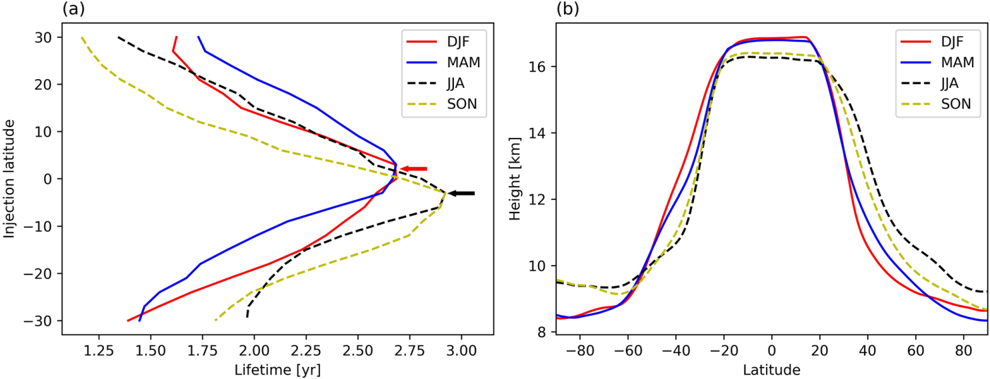
“Figure 2a also shows a seasonal cycle: particles injected in the winter hemisphere, DJF in North Hemisphere (NH) or JJA in South Hemisphere (SH), generally have a longer lifetime than those injected in the summer hemisphere (JJA in NH or DJF in SH), which is consistent with the fact that the BDC is stronger in the win…”
Asymmetric forcing from stratospheric aerosols impacts Sahelian rainfall
Haywood, J. M., Jones, A., Bellouin, N., & Stephenson, D. (2013) · Nature Climate Change · doi:10.1038/nclimate1857 · Cited by 367
A “tropical pipe” model of stratospheric transport
Plumb, R. A. (1996) · Journal of Geophysical Research: Atmospheres · doi:10.1029/95jd03002 · Cited by 309
Kravitz, B., MacMartin, D. G., Mills, M. J., Richter, J. H., Tilmes, S., Lamarque, J., Tribbia, J. J., & Vitt, F. (2017) · Journal of Geophysical Research: Atmospheres · doi:10.1002/2017jd026874 · Cited by 275
The impact of geoengineering aerosols on stratospheric temperature and ozone
Heckendorn, P., Weisenstein, D., Fueglistaler, S., Luo, B. P., Rozanov, E., Schraner, M., Thomason, L. W., & Peter, T. (2009) · Environmental Research Letters · doi:10.1088/1748-9326/4/4/045108 · Cited by 254
Stratospheric aerosol injection tactics and costs in the first 15 years of deployment
Smith, W., & Wagner, G. (2018) · Environmental Research Letters · doi:10.1088/1748-9326/aae98d · Cited by 181
Research works printed but not linked: 3
- Draxler, R., & Hess, G. (1997). Description of the HYSPLIT_4 model-ling system. NOAA Technical Memorandum ERL AOML, 224.
- Van der Hoven, I. (1968). Deposition of particles and gases In D. Slade (Ed.), Meteorology and atomic energy (p. 445), TID-24190, NTIS.
- WMO. (1957). Meteorology -a three-dimensional science: Second session of the commission for aerology. World Meteorological Organization Bulletin, IV(4), 134-138.
Cited by
Narenpitak, P., Kongkulsiri, S., Tomkratoke, S., & Sirisup, S. (2024) · Scientific Reports · doi:10.1038/s41598-024-73149-6 · Cited by 31
Stratospheric residence time and the lifetime of volcanic stratospheric aerosols
Toohey, M., Jia, Y., Khanal, S., & Tegtmeier, S. (2025) · Atmospheric chemistry and physics · doi:10.5194/acp-25-3821-2025 · Cited by 29
“We interpret these results as suggesting that lifetimes below 18 months are unlikely given the observed aerosol mass time series and sulfur injection amounts and the uncertainties on these observations”
Low‐Altitude High‐Latitude Stratospheric Aerosol Injection Is Feasible With Existing Aircraft
Duffey, A., Henry, M., Smith, W., Tsamados, M. C., & Irvine, P. J. (2025) · Earth s Future · doi:10.1029/2024ef005567 · Cited by 18
“…for a given injection mass. Injection at higher altitude and in locations with a more favorable stratospheric transport (Nie-meier et al., 2011; Sun et al., 2023) increases the mean lifetime of injected material and thus the steady‐state burden (Kleinschmitt et al., 2018; Lee, Visioni, et al.,…”
Stratospheric transport and tropospheric sink of solar geoengineering aerosol: a Lagrangian analysis
Sun, H., Bourguet, S., Luan, L., & Keith, D. (2024) · npj Climate and Atmospheric Science · doi:10.1038/s41612-024-00664-8 · Cited by 6
“Previous studies 22,53,77 show that particles injected at higher altitudes tend to have a longer stratospheric lifetime, especially for injection altitudes lower than 21 km.”
InfluentialSelf-citationHack, M., McNeill, V. F., Steingart, D., & Wagner, G. (2025) · Scientific Reports · doi:10.1038/s41598-025-20447-2 · Cited by 7
“Altitude Aerosols injected at higher altitudes have higher stratospheric lifetimes, with injections at altitudes greater than 20 km more likely to be advected by a deep branch of the BDC, slowing the time it takes for them to reach the tropopause 16 .”
Metadata
- Authors
- Sun, H., Bourguet, S., Eastham, S., & Keith, D.
- Affiliations
- Harvard University (US)
- Massachusetts Institute of Technology (US)
- Corresponding author
- Sun, Hongwei
- Venue
- Geophysical Research Letters
- Publisher
- American Geophysical Union (AGU)
- Published
- 2023-08-22
- Volume
- 50
- Issue
- 16
- ISSN
- 0094-8276 (ISSN-L)
- 1944-8007
- OpenAlex
- W4386073314
- Cited by
- 14
- References
- 39
- Citations by year
- 2026: 4 · 2025: 7 · 2024: 3
- FWCI
- 1.57
- Type
- journal article
- Language
- en
- Open access
- gold
- doi.org
- Licence
- Locations
- Geophysical Research Letters (publishedVersion, cc-by-nc)
- DOAJ (DOAJ: Directory of Open Access Journals) (submittedVersion, cc-by-sa)
- Knowledge@UChicago (University of Chicago) (submittedVersion)
- University of Chicago
- Funders
- Harvard University
- Topics
- Physical Sciences › Environmental Science › Global and Planetary Change › Climate Change and Geoengineering
- Physical Sciences › Environmental Science › Global and Planetary Change › Atmospheric aerosols and clouds
- Physical Sciences › Earth and Planetary Sciences › Atmospheric Science › Atmospheric chemistry and aerosols
- Keywords
- stratospheric aerosol injection, particle lifetimes, radiative forcing, passive particle transport, stratospheric circulation, Lagrangian trajectory model, particle settling, interhemispheric balance, solar radiation management
About these checks
Registry, retraction, Cites and statistics results are computed, not judged, with one exception: a printed reference that no index lists is read once by a model before it counts as a citation error. Claims are extracted by a model and kept only when their quote appears verbatim in the text; each cited source is then checked, with a model’s help, for whether it says what the claim relies on. Those verdicts can be wrong — read the claim’s quote and the cited source before relying on one.
Statistics and arithmetic are recomputed, not judged.
Confidence bands are shown only for fields calibrated on our annotated test set. None is calibrated yet, so no band is shown.
What counts as a claim ›How we measure confidence ›How we check this ›
Are you an author, or do you see a problem with this page? Request a review
Data sources
Bibliographic data: Semantic Scholar, OpenAlex, Crossref.
Contains information from the Semantic Scholar Academic Graph Datasets, made available under the ODC Attribution License (ODC-BY 1.0).
Semantic Scholar’s data is described in: Kinney, R., et al. (2023). The Semantic Scholar Open Data Platform. arXiv:2301.10140.
