

Sharing concerns: Interpersonal worry regulation in romantic couples.
Open accessThe DOI matches its Crossref record; 46 of the 48 references it cites were found in a registry or an index, and 1 are not checked yet.
Abstract
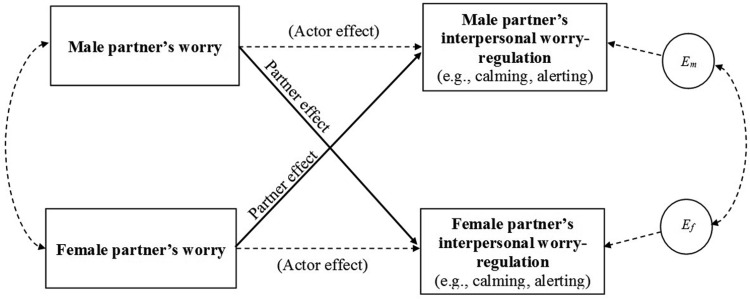
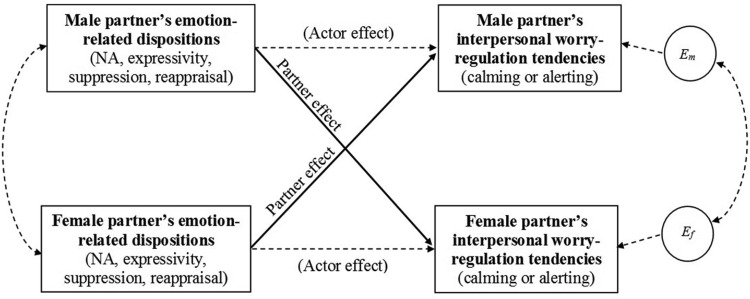
Two dyadic studies investigated interpersonal worry regulation in heterosexual relationships. In Study 1, we video-recorded 40 romantic couples discussing shared concerns. Male partners' worry positively predicted female partners' interpersonal calming attempts, and negatively predicted female partners' interpersonal alerting attempts (i.e., attempts to make their partners appreciate the seriousness of concerns). Video-cued recall data also indicated that changes in partner A's worry over time positively predicted partner B's motivation to reduce partner A's worry, and that this effect was stronger when B was the female partner. Study 2 was a dyadic survey of 100 couples. Individual differences in partner A's negative affect were positive predictors of partner B's interpersonal calming, and individual differences in partner A's expressive suppression were negative predictors of partner B's interpersonal calming. Further, individual differences in male partners' expressivity were significant positive predictors of female partners' interpersonal calming, and individual differences in male partners' reappraisal were significant positive predictors of female partners' interpersonal alerting. These findings suggest that interpersonal worry regulation relates to partners' expression and intrapersonal regulation of worry, but not equally for men and women. (PsycINFO Database Record
Overview
The claims and statistics of this paper haven’t been checked yet.
Free: it reads the open-access text and checks the first 5 claims that cite a source we can check. Create a free account to check every claim.
Integrity signals
Registry
Cites
Statistics
Figures
Verification
Claims the paper makes
The claims and statistics of this paper haven’t been checked yet.
Free: it reads the open-access text and checks the first 5 claims that cite a source we can check. Create a free account to check every claim.
Claims other papers make about this one
Each is checked against this paper’s own text: does it say what the citing paper says it does?
The cited source says what the claim attributes to it.
In the citing paper
“For instance, expressions of worry in romantic relationships motivated partners’ attempts to comfort the expresser (Parkinson et al. 2016).”
From The Social Effects of Emotions (2022) · cites this paper as Parkinson et al. 2016
Self-check
Percentages, sums and reported differences re-computed from the paper’s own numbers.
The self-check needs the paper’s full text.
Citations
Cites
Development and validation of brief measures of positive and negative affect: The PANAS scales.
Watson, D., Clark, L. A., & Tellegen, A. (1988) · Journal of Personality and Social Psychology · doi:10.1037/0022-3514.54.6.1063 · Cited by 32,433
Stress, social support, and the buffering hypothesis
Cohen, S., & Wills, T. A. (1985) · Psychological Bulletin · doi:10.1037/0033-2909.98.2.310 · Cited by 18,093 · cited 1×
“Interpersonal calming is intended to provide partners with emotional support and may alleviate their negative affect by reducing stress appraisals or enhancing appraisals of coping potential (e.g., Cohen & Wills, 1985).”
BackgroundGross, J. J., & John, O. P. (2003) · Journal of Personality and Social Psychology · doi:10.1037/0022-3514.85.2.348 · Cited by 11,929
Tripartite model of anxiety and depression: psychometric evidence and taxonomic implications
Clark, L. A., & Watson, D. (1991) · Journal of Abnormal Psychology · doi:10.1037/0021-843x.100.3.316 · Cited by 4,601 · cited 2×
“The specific hypotheses of Study 2 were that partner A’s dispositional negative affect (including worry-related anxiety, Clark & Watson, 1991) and expressivity would be positive predictors of partner B’s interpersonal calming and negative predictors of partner B’s interpersonal alerting, and that…”
BackgroundPower, approach, and inhibition.
Keltner, D., Gruenfeld, D. H., & Anderson, C. (2003) · Psychological Review · doi:10.1037/0033-295x.110.2.265 · Cited by 3,427
Social Functions of Emotions at Four Levels of Analysis
Keltner, D., & Haidt, J. (1999) · Cognition and Emotion · doi:10.1080/026999399379168 · Cited by 1,743 · cited 3×
“Participants rated their motivation to regulate their partner’s worry every 10 s during the second video-cued recall task in response to the following question: “To what extent did you want your partner to feel less worried during this clip?” The 7-point response scale ran from 1 (not at all) to 7 (completely).(5) Ana…”
BackgroundMethodThe social consequences of expressive suppression
Butler, E. A., Egloff, B., Wlhelm, F. H., Smith, N. C., Erickson, E. A., & Gross, J. J. (2003) · Emotion · doi:10.1037/1528-3542.3.1.48 · Cited by 1,400 · cited 1×
“The reported effects of partner A’s suppression and alerting on partner B’s calming and alerting also strongly imply that intrapersonal and interpersonal emotion regulation are interrelated (see also Butler et al., 2003).”
BackgroundGroup inhibition of bystander intervention in emergencies.
Latane, B., & Darley, J. M. (1968) · Journal of Personality and Social Psychology · doi:10.1037/h0026570 · Cited by 1,252 · cited 1×
“For example, calm expressions can reduce other people’s alertness to potential risks leading to less cautious responses (Latané & Darley, 1968), whereas anxious expressions can increase other people’s alertness to potential risks leading to more cautious responses (Parkinson, Phiri, & Simons, 2012;…”
BackgroundInterpersonal emotion regulation.
Zaki, J., & Williams, W. C. (2013) · Emotion · doi:10.1037/a0033839 · Cited by 988 · cited 1×
“In other words, partners regulate their own emotions (intrapersonal emotion regulation) as a way of regulating the emotions experienced by their partners (interpersonal emotion regulation, Zaki & Williams, 2013).”
BackgroundMaternal emotional signaling: Its effect on the visual cliff behavior of 1-year-olds.
Sorce, J. F., Emde, R. N., Campos, J. J., & Klinnert, M. D. (1985) · Developmental Psychology · doi:10.1037/0012-1649.21.1.195 · Cited by 885
Research works printed but not linked: 1
- Kenny D. A., Kashy D. A., & Cook W. L. (2006). Dyadic data analysis. New York, NY: Guilford Press.
Cited by
The Social Effects of Emotions
van Kleef, G. A., & Côté, S. (2022) · Annual Review of Psychology · doi:10.1146/annurev-psych-020821-010855 · Cited by 534
“For instance,expressions of worry in romantic relationships motivated partners’ attempts to comfort the expresser (Parkinson et al. 2016).”
Integrating Empathy and Interpersonal Emotion Regulation
Zaki, J. (2020) · Annual Review of Psychology · doi:10.1146/annurev-psych-010419-050830 · Cited by 259
“For example, during discussions of the future, romantic partners alert each other to the seriousness of potential problems, upregulating their partner’s worry (Parkinson et al. 2016).”
BackgroundThe four key characteristics of interpersonal emotion regulation
Niven, K. (2017) · Current Opinion in Psychology · doi:10.1016/j.copsyc.2017.06.015 · Cited by 165
Self-citationLevy‐Gigi, E., & Shamay‐Tsoory, S. (2016) · Journal of Behavior Therapy and Experimental Psychiatry · doi:10.1016/j.jbtep.2016.11.008 · Cited by 123
Male emotionality: ‘boys don’t cry’ versus ‘it’s good to talk’
McQueen, F. (2017) · NORMA · doi:10.1080/18902138.2017.1336877 · Cited by 71
Russell, E., & Daniels, K. (2018) · Human Relations · doi:10.1177/0018726717751034 · Cited by 90
“…in (Beal and Ghandour, 2011; Beal et al., 2006, 2013; Dockray et al., 2010; Elfering et al., 2005; Fisher et al., 2016; Ouweneel et al., 2012; Parkinson et al., 2016), without necessarily considering how this approach impacts on measurement protocols or whether items reflect the…”
BackgroundMethodInfluentialWaterschoot, J., Morbée, S., Vermote, B., BRENNING, K. M., Flamant, N., Vansteenkiste, M., & Soenens, B. (2022) · Current Psychology · doi:10.1007/s12144-021-02623-5 · Cited by 70
Cruel to Be Kind: Factors Underlying Altruistic Efforts to Worsen Another Person’s Mood
López‐Pérez, B., Howells, L., & Gummerum, M. (2017) · Psychological Science · doi:10.1177/0956797617696312 · Cited by 53
“The use of video recording of dyads discussing real-life concerns or worries may also be helpful (Parkinson, Simons, & Niven, 2016).”
Pacella, D., & López‐Pérez, B. (2018) · Computers & Education · doi:10.1016/j.compedu.2018.04.005 · Cited by 56
Shepherd, D. A., Seyb, S., & Williams, T. A. (2023) · Journal of Business Venturing · doi:10.1016/j.jbusvent.2023.106290 · Cited by 53
Tamir, M., & Millgram, Y. (2017) · Advances in motivation science · doi:10.1016/bs.adms.2016.12.001 · Cited by 67
Predicting workplace relational dynamics using an affective model of relationships
Lopez‐Kidwell, V., Niven, K. R., & Labianca, G. (2018) · Journal of Organizational Behavior · doi:10.1002/job.2300 · Cited by 41
Self-citationSmith, T. W., & Weihs, K. L. (2019) · Psychosomatic Medicine · doi:10.1097/psy.0000000000000739 · Cited by 50
“partner’s worry predicts the other’s efforts to calm that partner, a potentially beneficial between-person emotion regulation process that is attenuated by emotional suppression (177).”
BackgroundBradley, C. M., Greer, L. L., Trinh, E. N., & Sanchez‐Burks, J. (2023) · Academy of Management Annals · doi:10.5465/annals.2022.0044 · Cited by 44
Pascoal, P. M., Raposo, C. F., & Roberto, M. S. (2020) · International Journal of Environmental Research and Public Health · doi:10.3390/ijerph17217864 · Cited by 41
“Co-worry may be a warning signal in a relationship about possible dangers (an alerting function) or an attempt to seek interpersonal comfort or assistance (a comfort-seeking function) [26,27].”
BackgroundInterpersonal emotion regulation in Asperger's syndrome and borderline personality disorder
López‐Pérez, B., Ambrona, T., & Gummerum, M. (2016) · British Journal of Clinical Psychology · doi:10.1111/bjc.12124 · Cited by 37
Heart to Heart: How Your Emotions Affect Other People
Parkinson, B. (2019) · Cambridge University Press eBooks · doi:10.1017/9781108696234 · Cited by 33
Self-citationBridging supportive communication and interpersonal emotion regulation: An integrative review
Nozaki, Y., & Gross, J. J. (2025) · Journal of Social and Personal Relationships · doi:10.1177/02654075251335816 · Cited by 33
“…only hedonic but also counter-hedonic emotion regulation (e.g., increasing partner ’ s anger to facilitate competitive performance, increasing recipient ’ s worry to appreciate the seriousness of concern; Netzer et al., 2015; Niven et al., 2009; Nozaki & Kobayashi, 2024; Parkinson et al., 2016).”
Communal relational context (or lack thereof) shapes emotional lives
Clark, M. S., Armentano, L. A., Boothby, E. J., & Hirsch, J. L. (2017) · Current Opinion in Psychology · doi:10.1016/j.copsyc.2017.07.023 · Cited by 28
Heart to Heart: A Relation-Alignment Approach to Emotion’s Social Effects
Parkinson, B. (2021) · Emotion Review · doi:10.1177/1754073921990733 · Cited by 30
“Consistent with this account, Parkinson et al. (2016) found that participants’ levels of interpersonal alerting were reliably predicted by their partners’ tendency to use reappraisal to downregulate their negative emotions.”
Self-citationProsocial versus instrumental motives for interpersonal emotion regulation
Niven, K. R., Henkel, A. P., & Hanratty, J. (2018) · Journal of Theoretical Social Psychology · doi:10.1002/jts5.36 · Cited by 27
Self-citationSignals of Emotion Regulation in a Social Dilemma: Detection from Face and Context
Hoegen, R., Gratch, J. S., Parkinson, B., & Shore, D. M. (2019) · International Conference on Affective Computing and Intelligent Interaction and workshops · doi:10.1109/acii.2019.8925478 · Cited by 21
“To elucidate the relationship between a sender’s actual emotion and regulation and a receiver’s decoding of their expression, participants completed video-cued recall immediately after the iterated prisoner’s dilemma game [22], [23].”
MethodSelf-citationKinkead, A., Salas, C., & Pérez, J. C. (2022) · Current Psychology · doi:10.1007/s12144-022-04188-3 · Cited by 19
“In other words, it is a tradition in the study of affectivity that recognizes that both emotions and their regulation tend to occur in essentially social settings (Dixon-Gordon et al., 2015; Parkinson et al., 2016; Zaki & Williams, 2013), and as such encompasses two ways of understanding it.”
BackgroundInfluentialMargolin, G., Daspe, M., Timmons, A. C., Corner, G. W., Pettit, C., Rasmussen, H. F., Chaspari, T., Han, S. C., Arbel, R., Shapiro, L. S., et al. (2022) · Journal of Family Psychology · doi:10.1037/fam0000979 · Cited by 16
A theoretical model for understanding relationship functioning in intercultural romantic couples
Fonseca, A. L., Ye, T., Koyama, J., Curran, M. A., & Butler, E. A. (2020) · Personal Relationships · doi:10.1111/pere.12349 · Cited by 15
Be Afraid, Be Very Afraid! Motivated Intergroup Emotion Regulation
Netzer, L., Halperin, E., & Tamir, M. (2020) · Personality and Social Psychology Bulletin · doi:10.1177/0146167220910833 · Cited by 17
“For instance, some individuals might induce worry in their spouses to stress the seriousness of joint concerns (Parkinson et al., 2016).”
BackgroundMoody and thin‐skinned? The interplay of neuroticism and momentary affect in older romantic couples
Mueller, S., Wagner, J., Hülür, G., Hoppmann, C. A., Ram, N., & Gerstorf, D. (2020) · British Journal of Psychology · doi:10.1111/bjop.12452 · Cited by 14
“For example, individuals living with a partner high in neuroticism might be more likely to engage in counter-regulatory efforts and attempt to up-regulate their ownpositive affect when their partner is feeling down in order to keep the dyadic system in balance (see Koranyi & Rothermund, 2012; Parkinson et al., 2016),…”
BackgroundDinc, B. A., & Gable, S. L. (2025) · Annual Review of Psychology · doi:10.1146/annurev-psych-020325-033825 · Cited by 11
Lazarus, G., Pshedetzky‐Shochat, R., Zahavi, T., Gleason, M. E. J., & Rafaeli, E. (2021) · Journal of Social and Personal Relationships · doi:10.1177/02654075211043291 · Cited by 9
“…will be associated with the actors’ relationship quality ratings both concurrently and prospectively; although no partner effects for NED have been reported to date, poor emotion regulation techniques have been found to exert partner effects (e.g., Klein et al., 2016; Parkinson et al., 2016).”
BackgroundPerseverative thinking is associated with features of spoken language
Stade, E. C., Ungar, L., Havaldar, S., & Ruscio, A. M. (2023) · Behaviour Research and Therapy · doi:10.1016/j.brat.2023.104307 · Cited by 10
“Furthermore, in conversations between romantic partners about a topic of shared concern, self-rated worry exhibits moderate to large associations with partner-and observer-rated expressed worry (Parkinson et al., 2016).”
The impact of emotional expressions on the popularity of discussion threads: evidence from Reddit
Abouei, M., Kordzadeh, N., Ghasemaghaei, M., & Khan, B. (2025) · Internet Research · doi:10.1108/intr-12-2023-1187 · Cited by 10
Narrating Anger Appropriately: Implications for Narrative Form and Successful Coping
Habermas, T., & Bongard, S. (2024) · Emotion Review · doi:10.1177/17540739241230817 · Cited by 5
“Fear stories may also be told to alert someone involved (Parkinson et al., 2016).”
Llera, S. J., Shin, K. E., Erickson, T. M., Przeworski, A., & Newman, M. G. (2021) · Elsevier eBooks · doi:10.1016/b978-0-12-818697-8.00213-2 · Cited by 8
Comment: Respecifying Emotional Influence
Parkinson, B. (2017) · Emotion Review · doi:10.1177/1754073916669597 · Cited by 6
Self-citationCoordination in interpersonal systems
Butler, E. A. (2022) · Cognition & Emotion · doi:10.1080/02699931.2023.2168624 · Cited by 9
“…component) can increase their negative emotion (an individual affective component), which gets transmitted to their social partner (interpersonal coupling), potentially escalating worry in the first person depending on how the second person regulates it (Parkinson, 2011; Parkinson et al., 2016).”
BackgroundChristensen, K. A., van Dyk, I. S., Southward, M. W., & Vasey, M. W. (2021) · Journal of Clinical Psychology · doi:10.1002/jclp.23214 · Cited by 4
Ocampo, A. C., Gu, J., Wang, L., Groth, M., Tse, H. H. M., & Zhao, H. (2024) · Journal of Business Research · doi:10.1016/j.jbusres.2024.115049 · Cited by 4
Parkinson, B. (2019) · Cambridge University Press eBooks · doi:10.1017/9781108696234.006 · Cited by 1
Self-citationEfficacy of the Gottman Method on Family Cohesion and Emotional Self-Regulation Among Couples
Sarchuni, S. (2024) · Journal of Assessment and Research in Applied Counseling · doi:10.61838/kman.jarac.6.3.14 · Cited by 2
Are we doing good? Perceived emotion regulation success and relationship quality in couples
Li, Y., Kunzmann, U., Kanske, P., & Rohr, M. K. (2025) · Frontiers in Psychology · doi:10.3389/fpsyg.2025.1683846 · Cited by 2
“…relationships, these processes include efforts to modulate one’s own and one’s partner’s emotions, both Li et al. 10.3389/fpsyg.2025.1683846 of which have been identified as key contributors to relationship quality and stability (Bloch et al., 2014; Mazzuca et al., 2019; Parkinson et al., 2016).”
InfluentialDiwan, L. I., Lin, K. J., Cheng, B. H., & Tu, Y. (2026) · Personnel Psychology · doi:10.1111/peps.70035 · Cited by 1
Understanding Social Anxiety Symptoms Through Interpersonal Emotion Regulation Strategies
Perry, M. M. (2020) · Cited by 3
Parkinson, B. (2019) · Cambridge University Press eBooks · doi:10.1017/9781108696234.002 · Cited by 1
Self-citationDyadische emotieregulatie en coping bij ouders van een ernstig ziek kind
Koivula, K., Laitila, A. A., Koiki, H., Korhonen, M., & Honkalampi, K. M. (2020) · Gezinstherapie Wereldwijd · doi:10.1007/s12440-020-00117-7
Parkinson, B. (2019) · Cambridge University Press eBooks · doi:10.1017/9781108696234.007
Self-citationFacial Activity and Emotion Expression
Parkinson, B. (2019) · Cambridge University Press eBooks · doi:10.1017/9781108696234.003
Self-citationParkinson, B. (2019) · Cambridge University Press eBooks · doi:10.1017/9781108696234.008
Self-citationWhat’s at the Heart of Emotions?
Parkinson, B. (2019) · Cambridge University Press eBooks · doi:10.1017/9781108696234.001
Self-citationExplaining Emotional Influence
Parkinson, B. (2019) · Cambridge University Press eBooks · doi:10.1017/9781108696234.004
Self-citationParkinson, B. (2019) · Cambridge University Press eBooks · doi:10.1017/9781108696234.011
Self-citationParkinson, B. (2019) · Cambridge University Press eBooks · doi:10.1017/9781108696234.005
Self-citationParkinson, B. (2019) · Cambridge University Press eBooks · doi:10.1017/9781108696234.009
Self-citationParkinson, B. (2019) · Cambridge University Press eBooks · doi:10.1017/9781108696234.010
Self-citationUrsu, A., Turliuc, M. N., & Măirean, C. (2022) · Psihologija · doi:10.2298/psi220709018u · Cited by 1
Beyond the fearful ape hypothesis: Humans are also supplicating and appeasing apes
Mercadante, E., Witkower, Z., Hohm, I., & Tracy, J. L. (2023) · Behavioral and Brain Sciences · doi:10.1017/s0140525x22001765
Delattre, B., Shore, D. M., & Parkinson, B. (2023) · PsyArXiv (OSF Preprints) · doi:10.31234/osf.io/w7vez
Self-citationKinkead, A. (2025) · Cognitive Therapy and Research · doi:10.1007/s10608-025-10621-1 · Cited by 1
A Review of the Relationship between Interpersonal Emotion Regulation and Depression in Adolescents
林, 苑. (2025) · Advances in Social Sciences · doi:10.12677/ass.2025.147642
Valuing your partner more: Linking emotional intelligence to better relationship quality
Xiao, H. H., Double, K. S., Pinkus, R. T., & MacCann, C. (2025) · Journal of Social and Personal Relationships · doi:10.1177/02654075251399696 · Cited by 1
“…whether these associations generalize to more challenging or con fl ictual contexts, future research could use laboratory experiments (e.g., Parkinson et al., 2016) to observe real-time extrinsic regulation during emotionally charged interactions using behavioural coding and…”
Validation of the French version of the Interpersonal Emotion Regulation for Couples Scale
Rattaz, V., Notari, S. C., Mónaco, E., Lacroix, A., & Horsch, A. (2026) · European Review of Applied Psychology · doi:10.1016/j.erap.2025.101113
A unifying taxonomy of dyadic emotional processes
Verhees, M. W. F. T., Mesquita, B., Ceulemans, E., Hofmans, J., Verhofstadt, L., & Kuppens, P. (2026) · Trends in Cognitive Sciences · doi:10.1016/j.tics.2025.12.008
How Communal Relational Contexts Shape (and Are Shaped by) Emotional Lives
Clark, M. S., Adkins, C., Chughtai, M. K., & Elizabeth, H. S. (2026) · Cambridge University Press eBooks · doi:10.1017/9781009381949.019
Age and Interpersonal Emotion Regulation in the Workplace
Verma, A., Niven, K. R., & Thomas, N. (2026) · Emerald Group Publishing Limited eBooks · doi:10.1108/s1746-979120260000020028
Self-citationCulture and Emotions in Romantic Relationships
Schouten, A., Boiger, M., Kirchner‐Häusler, A., & Mesquita, B. (2026) · Cambridge University Press eBooks · doi:10.1017/9781108768436.009
How Cultural Differences in Emotion Come About
Leersnyder, J. D. (2026) · Cambridge University Press eBooks · doi:10.1017/9781108768436.006
Better with age? Exploring age and interpersonal emotion regulation in the workplace
Verma, A., Niven, K. R., & Thomas, N. (2026) · European Journal of Work and Organizational Psychology · doi:10.1080/1359432x.2026.2692451
Self-citationWhy Lose Sleep? Worry Content and Sleep Disturbance Attributed to Worry
Soto, A., & Kelly, W. (2026) · Journal of International Scholarship · doi:10.65030/jis.011012
Jung, S., Kim, H. C., Cha, M. C., Kim, Y. W., Ji, Y. G., & Lee, S. C. (2026) · International Journal of Human-Computer Interaction · doi:10.1080/10447318.2026.2750596
Metadata
- Authors
- Parkinson, B., Simons, G., & Niven, K.
- Affiliations
- University of Manchester (GB)
- Corresponding author
- Parkinson, Brian
- Venue
- Emotion
- Published
- 2016-06
- Volume
- 16
- Issue
- 4
- Pages
- 449-458
- ISSN
- 1528-3542 (ISSN-L)
- 1931-1516
- PMC
- PMC4868124
- OpenAlex
- W2269442305
- Semantic Scholar
- ae61a4e0a774a0771ee66fa8a5469fd3f03df977
- Cited by
- 69
- References
- 48
- Citations by year
- 2026: 9 · 2025: 7 · 2024: 3 · 2023: 5 · 2022: 5 · 2021: 6 · 2020: 6 · 2019: 16 · 2018: 4 · 2017: 6 · 2016: 2
- FWCI
- 14.68
- Type
- journal article
- Language
- en
- Open access
- hybrid
- doi.org
- Licence
- Locations
- Emotion (publishedVersion, other-oa)
- Europe PMC (PubMed Central) (publishedVersion, cc-by)
- PubMed Central (publishedVersion, cc-by)
- PubMed (publishedVersion)
- University of Birmingham Research Portal (University of Birmingham) (publishedVersion, cc-by)
- White Rose Research Online (University of Leeds, The University of Sheffield, University of York) (acceptedVersion)
- Research Explorer (The University of Manchester) (submittedVersion)
- Funders
- Economic and Social Research Council (RES-060-25-0044)
- Topics
- Social Sciences › Psychology › Social Psychology › Attachment and Relationship Dynamics
- Social Sciences › Psychology › Experimental and Cognitive Psychology › Anxiety, Depression, Psychometrics, Treatment, Cognitive Processes
- Social Sciences › Psychology › Clinical Psychology › Child and Adolescent Psychosocial and Emotional Development
- Keywords
- romantic partners, negative affect, expressive suppression, cognitive reappraisal, gender differences, intrapersonal emotion regulation, heterosexual couples
- MeSH terms
- Adolescent, Adult, Emotions, Female, Humans, Interpersonal Relations, Male, Middle Aged, Sexual Partners, Young Adult
About these checks
Registry, retraction, Cites and statistics results are computed, not judged, with one exception: a printed reference that no index lists is read once by a model before it counts as a citation error. Claims are extracted by a model and kept only when their quote appears verbatim in the text; each cited source is then checked, with a model’s help, for whether it says what the claim relies on. Those verdicts can be wrong — read the claim’s quote and the cited source before relying on one.
Statistics and arithmetic are recomputed, not judged.
Confidence bands are shown only for fields calibrated on our annotated test set. None is calibrated yet, so no band is shown.
What counts as a claim ›How we measure confidence ›How we check this ›
Are you an author, or do you see a problem with this page? Request a review
Data sources
Bibliographic data: Semantic Scholar, OpenAlex, Crossref.
Contains information from the Semantic Scholar Academic Graph Datasets, made available under the ODC Attribution License (ODC-BY 1.0).
Semantic Scholar’s data is described in: Kinney, R., et al. (2023). The Semantic Scholar Open Data Platform. arXiv:2301.10140.
