

Sharing concerns: Interpersonal worry regulation in romantic couples.
Open accessThe DOI matches its Crossref record; 46 of the 48 references it cites were found in a registry or an index, and 1 are not checked yet.
Abstract
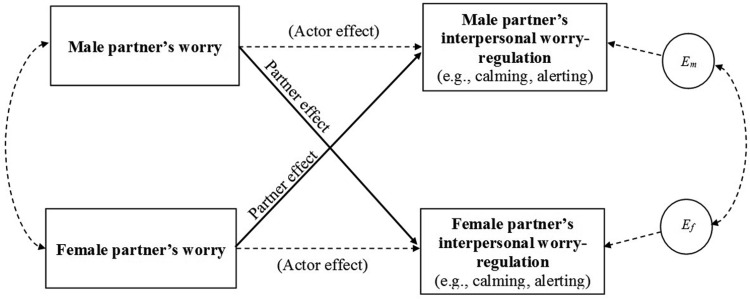
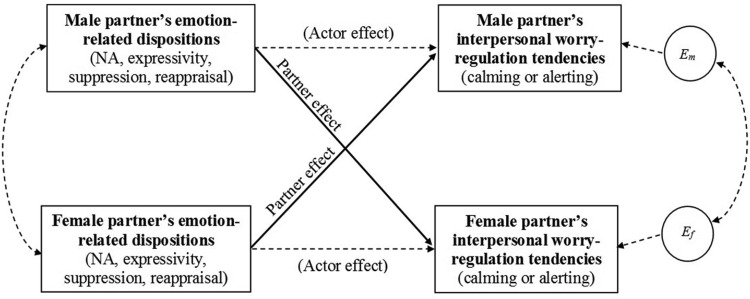
Two dyadic studies investigated interpersonal worry regulation in heterosexual relationships. In Study 1, we video-recorded 40 romantic couples discussing shared concerns. Male partners' worry positively predicted female partners' interpersonal calming attempts, and negatively predicted female partners' interpersonal alerting attempts (i.e., attempts to make their partners appreciate the seriousness of concerns). Video-cued recall data also indicated that changes in partner A's worry over time positively predicted partner B's motivation to reduce partner A's worry, and that this effect was stronger when B was the female partner. Study 2 was a dyadic survey of 100 couples. Individual differences in partner A's negative affect were positive predictors of partner B's interpersonal calming, and individual differences in partner A's expressive suppression were negative predictors of partner B's interpersonal calming. Further, individual differences in male partners' expressivity were significant positive predictors of female partners' interpersonal calming, and individual differences in male partners' reappraisal were significant positive predictors of female partners' interpersonal alerting. These findings suggest that interpersonal worry regulation relates to partners' expression and intrapersonal regulation of worry, but not equally for men and women. (PsycINFO Database Record
Overview
The claims and statistics of this paper haven’t been checked yet.
Free: it reads the open-access text and checks the first 5 claims that cite a source we can check. Create a free account to check every claim.
Integrity signals
Registry
Cites
Statistics
Figures
Verification
Claims the paper makes
The claims and statistics of this paper haven’t been checked yet.
Free: it reads the open-access text and checks the first 5 claims that cite a source we can check. Create a free account to check every claim.
Claims other papers make about this one
Each is checked against this paper’s own text: does it say what the citing paper says it does?
The cited source says what the claim attributes to it.
In the citing paper
“For instance, expressions of worry in romantic relationships motivated partners’ attempts to comfort the expresser (Parkinson et al. 2016).”
From The Social Effects of Emotions (2022) · cites this paper as Parkinson et al. 2016
Self-check
Percentages, sums and reported differences re-computed from the paper’s own numbers.
The self-check needs the paper’s full text.
Citations
Cites
Development and validation of brief measures of positive and negative affect: The PANAS scales.
Watson, D., Clark, L. A., & Tellegen, A. (1988) · Journal of Personality and Social Psychology · doi:10.1037/0022-3514.54.6.1063 · Cited by 32,433
Stress, social support, and the buffering hypothesis
Cohen, S., & Wills, T. A. (1985) · Psychological Bulletin · doi:10.1037/0033-2909.98.2.310 · Cited by 18,093 · cited 1×
“Interpersonal calming is intended to provide partners with emotional support and may alleviate their negative affect by reducing stress appraisals or enhancing appraisals of coping potential (e.g., Cohen & Wills, 1985).”
BackgroundGross, J. J., & John, O. P. (2003) · Journal of Personality and Social Psychology · doi:10.1037/0022-3514.85.2.348 · Cited by 11,929
Tripartite model of anxiety and depression: psychometric evidence and taxonomic implications
Clark, L. A., & Watson, D. (1991) · Journal of Abnormal Psychology · doi:10.1037/0021-843x.100.3.316 · Cited by 4,601 · cited 2×
“The specific hypotheses of Study 2 were that partner A’s dispositional negative affect (including worry-related anxiety, Clark & Watson, 1991) and expressivity would be positive predictors of partner B’s interpersonal calming and negative predictors of partner B’s interpersonal alerting, and that…”
BackgroundPower, approach, and inhibition.
Keltner, D., Gruenfeld, D. H., & Anderson, C. (2003) · Psychological Review · doi:10.1037/0033-295x.110.2.265 · Cited by 3,427
Social Functions of Emotions at Four Levels of Analysis
Keltner, D., & Haidt, J. (1999) · Cognition and Emotion · doi:10.1080/026999399379168 · Cited by 1,743 · cited 3×
“Participants rated their motivation to regulate their partner’s worry every 10 s during the second video-cued recall task in response to the following question: “To what extent did you want your partner to feel less worried during this clip?” The 7-point response scale ran from 1 (not at all) to 7 (completely).(5) Ana…”
BackgroundMethodThe social consequences of expressive suppression
Butler, E. A., Egloff, B., Wlhelm, F. H., Smith, N. C., Erickson, E. A., & Gross, J. J. (2003) · Emotion · doi:10.1037/1528-3542.3.1.48 · Cited by 1,400 · cited 1×
“The reported effects of partner A’s suppression and alerting on partner B’s calming and alerting also strongly imply that intrapersonal and interpersonal emotion regulation are interrelated (see also Butler et al., 2003).”
BackgroundGroup inhibition of bystander intervention in emergencies.
Latane, B., & Darley, J. M. (1968) · Journal of Personality and Social Psychology · doi:10.1037/h0026570 · Cited by 1,252 · cited 1×
“For example, calm expressions can reduce other people’s alertness to potential risks leading to less cautious responses (Latané & Darley, 1968), whereas anxious expressions can increase other people’s alertness to potential risks leading to more cautious responses (Parkinson, Phiri, & Simons, 2012;…”
BackgroundInterpersonal emotion regulation.
Zaki, J., & Williams, W. C. (2013) · Emotion · doi:10.1037/a0033839 · Cited by 988 · cited 1×
“In other words, partners regulate their own emotions (intrapersonal emotion regulation) as a way of regulating the emotions experienced by their partners (interpersonal emotion regulation, Zaki & Williams, 2013).”
BackgroundMaternal emotional signaling: Its effect on the visual cliff behavior of 1-year-olds.
Sorce, J. F., Emde, R. N., Campos, J. J., & Klinnert, M. D. (1985) · Developmental Psychology · doi:10.1037/0012-1649.21.1.195 · Cited by 885
Research works printed but not linked: 1
- Kenny D. A., Kashy D. A., & Cook W. L. (2006). Dyadic data analysis. New York, NY: Guilford Press.
Cited by
The Social Effects of Emotions
van Kleef, G. A., & Côté, S. (2022) · Annual Review of Psychology · doi:10.1146/annurev-psych-020821-010855 · Cited by 534
“For instance,expressions of worry in romantic relationships motivated partners’ attempts to comfort the expresser (Parkinson et al. 2016).”
Integrating Empathy and Interpersonal Emotion Regulation
Zaki, J. (2020) · Annual Review of Psychology · doi:10.1146/annurev-psych-010419-050830 · Cited by 259
“For example, during discussions of the future, romantic partners alert each other to the seriousness of potential problems, upregulating their partner’s worry (Parkinson et al. 2016).”
BackgroundThe four key characteristics of interpersonal emotion regulation
Niven, K. (2017) · Current Opinion in Psychology · doi:10.1016/j.copsyc.2017.06.015 · Cited by 165
Self-citationLevy‐Gigi, E., & Shamay‐Tsoory, S. (2016) · Journal of Behavior Therapy and Experimental Psychiatry · doi:10.1016/j.jbtep.2016.11.008 · Cited by 123
Male emotionality: ‘boys don’t cry’ versus ‘it’s good to talk’
McQueen, F. (2017) · NORMA · doi:10.1080/18902138.2017.1336877 · Cited by 71
Metadata
- Authors
- Parkinson, B., Simons, G., & Niven, K.
- Affiliations
- University of Manchester (GB)
- Corresponding author
- Parkinson, Brian
- Venue
- Emotion
- Published
- 2016-06
- Volume
- 16
- Issue
- 4
- Pages
- 449-458
- ISSN
- 1528-3542 (ISSN-L)
- 1931-1516
- PMC
- PMC4868124
- OpenAlex
- W2269442305
- Semantic Scholar
- ae61a4e0a774a0771ee66fa8a5469fd3f03df977
- Cited by
- 69
- References
- 48
- Citations by year
- 2026: 9 · 2025: 7 · 2024: 3 · 2023: 5 · 2022: 5 · 2021: 6 · 2020: 6 · 2019: 16 · 2018: 4 · 2017: 6 · 2016: 2
- FWCI
- 14.68
- Type
- journal article
- Language
- en
- Open access
- hybrid
- doi.org
- Licence
- Locations
- Emotion (publishedVersion, other-oa)
- Europe PMC (PubMed Central) (publishedVersion, cc-by)
- PubMed Central (publishedVersion, cc-by)
- PubMed (publishedVersion)
- University of Birmingham Research Portal (University of Birmingham) (publishedVersion, cc-by)
- White Rose Research Online (University of Leeds, The University of Sheffield, University of York) (acceptedVersion)
- Research Explorer (The University of Manchester) (submittedVersion)
- Funders
- Economic and Social Research Council (RES-060-25-0044)
- Topics
- Social Sciences › Psychology › Social Psychology › Attachment and Relationship Dynamics
- Social Sciences › Psychology › Experimental and Cognitive Psychology › Anxiety, Depression, Psychometrics, Treatment, Cognitive Processes
- Social Sciences › Psychology › Clinical Psychology › Child and Adolescent Psychosocial and Emotional Development
- Keywords
- romantic partners, negative affect, expressive suppression, cognitive reappraisal, gender differences, intrapersonal emotion regulation, heterosexual couples
- MeSH terms
- Adolescent, Adult, Emotions, Female, Humans, Interpersonal Relations, Male, Middle Aged, Sexual Partners, Young Adult
About these checks
Registry, retraction, Cites and statistics results are computed, not judged, with one exception: a printed reference that no index lists is read once by a model before it counts as a citation error. Claims are extracted by a model and kept only when their quote appears verbatim in the text; each cited source is then checked, with a model’s help, for whether it says what the claim relies on. Those verdicts can be wrong — read the claim’s quote and the cited source before relying on one.
Statistics and arithmetic are recomputed, not judged.
Confidence bands are shown only for fields calibrated on our annotated test set. None is calibrated yet, so no band is shown.
What counts as a claim ›How we measure confidence ›How we check this ›
Are you an author, or do you see a problem with this page? Request a review
Data sources
Bibliographic data: Semantic Scholar, OpenAlex, Crossref.
Contains information from the Semantic Scholar Academic Graph Datasets, made available under the ODC Attribution License (ODC-BY 1.0).
Semantic Scholar’s data is described in: Kinney, R., et al. (2023). The Semantic Scholar Open Data Platform. arXiv:2301.10140.
