

Two-dimensional gas of massless Dirac fermions in graphene
Open accessThe DOI matches its Crossref record; 32 of the 32 references it cites were found in a registry or an index; 12 of the 52 sources its claims cite were checked for support.
Abstract
Quantum electrodynamics (resulting from the merger of quantum mechanics and relativity theory) has provided a clear understanding of phenomena ranging from particle physics to cosmology and from astrophysics to quantum chemistry. The ideas underlying quantum electrodynamics also influence the theory of condensed matter, but quantum relativistic effects are usually minute in the known experimental systems that can be described accurately by the non-relativistic Schrödinger equation. Here we report an experimental study of a condensed-matter system (graphene, a single atomic layer of carbon) in which electron transport is essentially governed by Dirac's (relativistic) equation. The charge carriers in graphene mimic relativistic particles with zero rest mass and have an effective ‘speed of light’ c* ≈ 106 m s-1. Our study reveals a variety of unusual phenomena that are characteristic of two-dimensional Dirac fermions. In particular we have observed the following: first, graphene's conductivity never falls below a minimum value corresponding to the quantum unit of conductance, even when concentrations of charge carriers tend to zero; second, the integer quantum Hall effect in graphene is anomalous in that it occurs at half-integer filling factors; and third, the cyclotron mass mc of massless carriers in graphene is described by E = mcc*2. This two-dimensional system is not only interesting in itself but also allows access to the subtle and rich physics of quantum electrodynamics in a bench-top experiment.
Overview
CoChat Summary
TL;DR
Graphene is a two-dimensional gas of massless Dirac fermions with linear dispersion and an effective speed of light \(c^* \approx 10^6\) m/s. Transport measurements reveal an anomalous half-integer quantum Hall effect, a minimum conductivity, cyclotron mass \(m_c = E/c^{*2}\), and a \(\pi\) Berry-phase shift in Shubnikov–de Haas oscillations.
Key findings
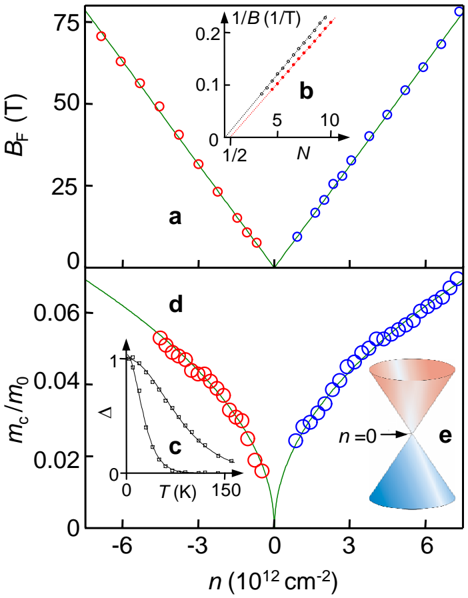
- Graphene’s charge carriers behave as massless Dirac fermions: the data imply \(E = \hbar k c^*\) for both electrons and holes, with \(c^* \approx 1 \times 10^6\) m/s; the cyclotron mass varies between \(\approx 0.02\) and \(0.07\,m_0\) and follows \(m_c \propto n^{1/2}\).
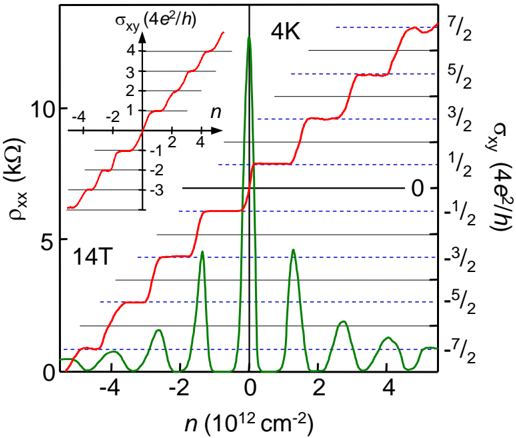
- The integer quantum Hall effect is anomalous: plateaux occur at half-integer \(\nu\), with sequence \((4e^2/h)(N+\tfrac12)\) and the first plateau at \(2e^2/h\); two-layer graphene returns to the normal integer sequence.
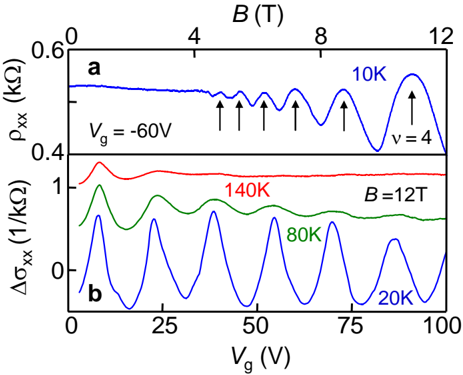
- Shubnikov–de Haas oscillations show a single set for electrons and holes, with \(B_F = \beta n\), \(\beta \approx 1.04 \times 10^{-15}\) T·m\(^2\) (\(\pm 2\%\)), yielding degeneracy \(f=4\); the oscillations exhibit a phase shift of \(\pi\) attributed to Berry’s phase.
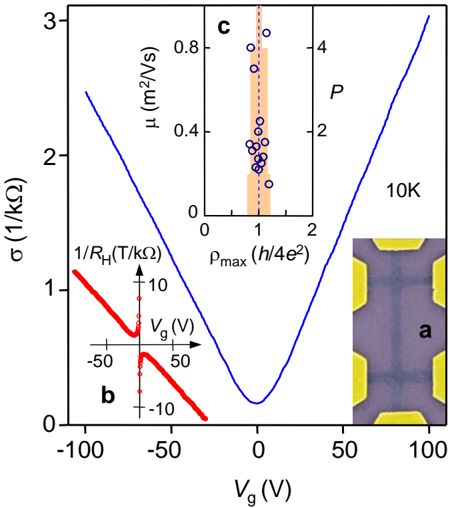
- Conductivity never falls below a minimum: \(\rho_{\max} \approx 6.5\) k\(\Omega\) in 15 devices (experimental error \(\approx 15\%\)), associated with \(h/fe^2 = 6.45\) k\(\Omega\), independent of mobility (which varied by a factor of 10) and of temperature between 4 and 100 K.
Methods
- Graphene samples were obtained by micromechanical cleavage of graphite, followed by identification and selection of monolayers using optical, scanning-electron, and atomic-force microscopies; selected films were processed into multi-terminal devices, with some devices made from 2 or 3 layers.
- Transport measurements included the electric field effect, Hall coefficient, Shubnikov–de Haas oscillations, and quantum Hall effect in magnetic fields; mobility was measured between 10 and 100 K, minimum conductivity between 4 and 100 K, and SdHO up to 140 K and room temperature.
- Analysis used fan diagrams to determine \(B_F\), fits of SdHO amplitude to \(T/\sinh(2\pi^2 k_B T m_c / h eB)\), and semiclassical expressions \(B_F = (h/2\pi e)S(E)\) and \(m_c = (h^2/2\pi)\partial S(E)/\partial E\) to infer \(E \propto k\).
Limitations
- The paper has no dedicated limitations section; stated caveats include that mobility was “probably still limited by defects in parent graphite,” that the two-layer finite-mass result is “to be published elsewhere,” and that most theories suggest a minimum conductivity of \(\approx e^2/\pi h\), in disagreement with the experiment.
- Evident from the text: devices are unprotected from the environment (though stable under ambient conditions), some measured devices consisted of 2 or 3 graphene layers, and the transition region was often shifted from zero \(V_g\) due to chemical doping, although annealing normally eliminated the shift.
- The inference of linear dispersion relies on a semiclassical model that the paper says is justified by recent theory, so the experimental conclusion depends on that theoretical framework.
Model-written summary. Check it against the paper before relying on it.
Integrity signals
Registry
Cites
Statistics
Figures
Verification
Claims the paper makes
3 Valid · 5 Not valid · 11 Not checked · 51 Own results and interpretations
The cited sources support only part of this claim — read each source’s verdict below.
In the paper
“d) Shubnikov-de Haas oscillations in graphene exhibit a phase shift of π due to Berry's phase”
- Also stated in: § Two-Dimensional Gas of Massless Dirac Fermions in Graphene · plain
“The shift is due to Berry's phase [9,15].”
What the sources say
- Partly supportedcites [9] Berger, C. et al. Ultrathin epitaxial graphite: 2D electron gas properties and a route toward graphene-based nanoelectronics. J. Phys. Chem. B 108, 19912–19916 (2004) sourceExperimental — accuracy not yet measured
The Figure 2 caption (p. 3) reports Shubnikov–de Haas oscillations in an epitaxial graphene sample. The discussion on pp. 3–4 addresses their occurrence and period, but does not report a π phase shift or attribute one to Berry’s phase. (LLM, conf=0.85)
- Partly supportedcites [15] Gusynin, V. P. & Sharapov, S. G. Unconventional integer quantum Hall effect in grapheme. Preprint at http://xxx.lanl.gov/abs/cond-mat/0506575 (2005). sourceExperimental — accuracy not yet measured
Our copy (Introduction, p. 1) does state that 'the phase of de Haas van Alphen and Shubnikov de Haas oscillations for Dirac quasiparticles is shifted ... compared to the phase of non-relativistic quasiparticles' (citing Refs. 7-10), so the existence of a phase shift in graphene is supported; the magnitude symbol itself is lost in our copy's undecoded formulas. What is NOT supported is the causal attribution to Berry's phase: no passage of our copy mentions Berry's phase at all (searched: 'Berry phase pseudospin topological phase π', 'oscillation phase factor'). Instead the paper explains the unconventional magneto-transport phenomena by the quantum anomaly of the n = 0 Landau level — its halved degeneracy and B-independent energy (p. 1 and p. 3) — and relates the oscillation minima to fillings ν_B = 2n+1 (p. 3). (LLM, conf=0.75)
plainstates a cause- Asserted: passes — The authors put it forward as true.
- Checkable: passes — It can be checked against evidence.
- Load-bearing: passes — The paper’s conclusions depend on it.
- Based: passes — The paper gives a reason why it holds.
- Also stated in: § Two-Dimensional Gas of Massless Dirac Fermions in Graphene · plain
The cited sources that could be checked couldn’t confirm or dispute this claim.
In the paper
“we invoke the formal expression [9-12] for the energy of massless relativistic fermions in quantized fields, EN =[2 e h c ∗ 2 B ( N +½ ± ½)] 1/2”
What the sources say
- Could not verifycites [9] Berger, C. et al. Ultrathin epitaxial graphite: 2D electron gas properties and a route toward graphene-based nanoelectronics. J. Phys. Chem. B 108, 19912–19916 (2004) sourceExperimental — accuracy not yet measured
The discussion of magnetoconductance (p. 3) says Shubnikov–de Haas oscillations indicate quantization of the electron energy spectrum, but it gives no energy formula. Searches for massless relativistic fermions, Landau levels, and the N + 1/2 ± 1/2 term found no passage stating the claimed expression. (LLM, conf=0.76)
- Not checked — no full text of the sourcecites [10] Bunch, J. S., Yaish, Y., Brink, M., Bolotin, K. & McEuen, P. L. Coulomb oscillations and Hall effect in quasi-2D graphite quantum dots. Nano Lett. 5, 287–290 (2005) source
- Not checked — no full text of the sourcecites [11] Dresselhaus, M. S. & Dresselhaus, G. Intercalation compounds of graphite. Adv. In Phys. 51, 1–186 (2002) source
- Not matchedcites [12] Brandt, N. B., Chudinov, S. M. & Ponomarev, Y. G. Semimetals 1: Graphite and Its Compounds (North-Holland, Amsterdam, 1988)
We searched by its title and found no matching paper.
plain- Asserted: passes — The authors put it forward as true.
- Checkable: passes — It can be checked against evidence.
- Load-bearing: passes — The paper’s conclusions depend on it.
- Based: passes — The paper gives a reason why it holds.
- Could not verify
The cited sources that could be checked couldn’t confirm or dispute this claim.
In the paper
“The employed semiclassical model is fully justified by a recent theory for graphene [9], which shows that SdHO's amplitude can indeed be described by the above expression T /sinh(2 π 2 k B Tm c / h eB ) with m c = E / c ∗ 2 .”
What the sources say
- Could not verifycites [9] Berger, C. et al. Ultrathin epitaxial graphite: 2D electron gas properties and a route toward graphene-based nanoelectronics. J. Phys. Chem. B 108, 19912–19916 (2004) sourceExperimental — accuracy not yet measured
The discussion of magnetoconductance (pp. 3–4) reports observed Shubnikov–de Haas oscillations, but does not give a theory for their amplitude. Searches for the temperature-dependent amplitude expression and m_c = E/c*² found no passage addressing either, so our copy cannot verify the attributed claim. (LLM, conf=0.76)
boostedstates a cause- Asserted: passes — The authors put it forward as true.
- Checkable: passes — It can be checked against evidence.
- Load-bearing: passes — The paper’s conclusions depend on it.
- Based: passes — The paper gives a reason why it holds.
- Could not verify
The cited sources that could be checked couldn’t confirm or dispute this claim.
In the paper
“The latter can be viewed as a direct consequence of the Atiyah-Singer index theorem that plays an important role in quantum field theory and the theory of superstrings [13,14].”
What the sources say
- Not checked — no full text of the sourcecites [13] Vonsovsky, S. V. & Katsnelson, M. I. Quantum Solid State Physics (Springer, New York, 1989) source
- Could not verifycites [14] Gusynin, V. P. & Sharapov, S. G. Magnetic oscillations in planar systems with the Dirac-like spectrum of quasiparticle excitations. Phys. Rev. B 71, 125124 (2005) sourceExperimental — accuracy not yet measured
Our copy of Gusynin & Sharapov II gives the relativistic Landau-level spectrum with n = 0, 1, ... in the Introduction (p. 1) and discusses the lowest level E_1 and its crossing of the Fermi surface (Discussion, p. 6; Sect. II.B, p. 6), but it never invokes or discusses the Atiyah-Singer index theorem, topology, or zero-mode counting as the reason for a level pinned at E = 0. Searches on 'Atiyah-Singer index theorem zero-energy Landau level', 'index theorem topological zero modes chiral anomaly', and 'zero-energy Landau level n=0 degeneracy independent of field strength' returned only the spectrum/quantization-condition passages. Since the index-theorem grounding is simply not addressed in our copy (and no alternative work is credited for it there), the attribution can be neither confirmed nor contradicted. (LLM, conf=0.68)
plainstates a cause- Asserted: passes — The authors put it forward as true.
- Checkable: passes — It can be checked against evidence.
- Load-bearing: unclear — It is unclear whether the paper’s conclusions depend on it.
- Based: passes — The paper gives a reason why it holds.
The cited sources that could be checked couldn’t confirm or dispute this claim.
In the paper
“in agreement with band structure calculations [6,7]”
What the sources say
- Could not verifycites [6] Novoselov, K. S. et al. Two dimensional atomic crystals. Proc. Natl Acad. Sci. USA 102, 10451–10453 (2005) sourceExperimental — accuracy not yet measured
The discussion of graphene transport in “Two Dimensional Atomic Crystals” (p. 3) reports carrier concentrations and mobilities, but not a fitted c* or a comparison with band-structure calculations. Searches for the velocity, its approximate value, and band-structure calculations found no passage addressing that comparison. (LLM, conf=0.76)
- Could not verifycites [7] Novoselov, K. S. et al. Electric field effect in atomically thin carbon films. Science 306, 666–669 (2004) sourceExperimental — accuracy not yet measured
The discussion on p. 2 says graphene is expected to have linear energy dispersion and massless carriers, but gives no calculated velocity to compare with c* ≈ 1·10^6 m/s. Searches for the velocity and band-structure comparison found no passage in our copy establishing the claimed agreement. (LLM, conf=0.73)
plainstates an association- Asserted: passes — The authors put it forward as true.
- Checkable: passes — It can be checked against evidence.
- Load-bearing: passes — The paper’s conclusions depend on it.
- Based: passes — The paper gives a reason why it holds.
- Could not verify
34 more claims
Create a free account to see all 70 claims and to verify the 10 references still open.
- It may state two separate claims as one. 27
- Probably not a substantial claim. 8
Claims other papers make about this one
Each is checked against this paper’s own text: does it say what the citing paper says it does?
The source backs part of the claim, not all of it — or backs it for a different population, condition or comparison.
In the citing paper
“Recently, the non-relativistic electrons in graphene monolayer were found to obey the massless relativistic dispersion known as the Dirac cone, leading to the realization of analogies to Zitterbewegung and Klein tunneling in low-energy condensed-matter physics and atom optics 4 -19 .”
From Observation of interaction-induced phenomena of relativistic quantum mechanics (2021) · cites this paper as [4]
Experimental — accuracy not yet measuredThe source backs part of the claim, not all of it — or backs it for a different population, condition or comparison.
In the citing paper
“Dirac points in graphene1–3 or photonic graphene12 belong to the first type, which occur in lattices with unbroken T. These occur in pairs and are stabilized by a symmetry of the underlying lattice.”
From Observation of an unpaired photonic Dirac point (2020) · cites this paper as [1]
Experimental — accuracy not yet measuredThe cited source says what the claim attributes to it.
In the citing paper
“The energy spectrum of ˆ H 1 is E n = sgn( n ) ℏ Ω √ | n | , where n = 0 , ± 1 , . . . , see Fig. 1.”
From Theory of electron Zitterbewegung in graphene probed by femtosecond laser pulses (2009) · cites this paper as [36]
The cited source says what the claim attributes to it.
In the citing paper
“Around Dirac cones, conduction and valence bands intersect linearly at a degenerate point resulting in the linear energy band and massless relativistic transport of electrons as quasiparticles [4].”
From Observing movement of Dirac cones from single-photon dynamics (2021) · cites this paper as [4]
The check wasn’t confident either way, so it gives no verdict — never disputed.
In the citing paper
“photonic Dirac points are known to occur in pairs in “photonic graphene” and other similar photonic crystals”
From Observation of an unpaired photonic Dirac point (2020) · cites this paper as [1]
Experimental — accuracy not yet measured
3 more claims about this paper
Create a free account to see every claim other papers make about this one.
Citations
Cites
Electric Field Effect in Atomically Thin Carbon Films
Novoselov, K. S., Geim, A. K., Morozov, S. V., Jiang, D., Zhang, Y., Dubonos, S. V., Grigorieva, I. V., & Firsov, A. A. (2004) · Science · doi:10.1126/science.1102896 · Cited by 66,834
Self-citationTwo-dimensional atomic crystals
Novoselov, K. S., Jiang, D., Schedin, F., Booth, T. J., Khotkevich, V. V., Morozov, S. V., & Geim, A. K. (2005) · Proceedings of the National Academy of Sciences · doi:10.1073/pnas.0502848102 · Cited by 11,788
Self-citationScaling Theory of Localization: Absence of Quantum Diffusion in Two Dimensions
Abrahams, E., Anderson, P. W., Licciardello, D. C., & Ramakrishnan, T. V. (1979) · Physical Review Letters · doi:10.1103/physrevlett.42.673 · Cited by 6,134
Berger, C., Song, Z., Li, T., Li, X., Ogbazghi, A. Y., Feng, R., Dai, Z., Marchenkov, A. N., Conrad, E. H., First, P. N., et al. (2004) · The Journal of Physical Chemistry B · doi:10.1021/jp040650f · Cited by 3,548
The Universe in a Helium Droplet
Volovik, G. E. (2009) · doi:10.1093/acprof:oso/9780199564842.001.0001 · Cited by 2,632
Intercalation compounds of graphite
Dresselhaus, M. S., & Dresselhaus, G. (2002) · Advances in Physics · doi:10.1080/00018730110113644 · Cited by 2,139
Geometry, Topology and Physics
Nakahara, M. (1990) · doi:10.1887/0750306068 · Cited by 1,620
Geometry, Topology and Physics
Nakahara, M. (2018) · CRC Press eBooks · doi:10.1201/9781315275826 · Cited by 1,505
Unconventional Integer Quantum Hall Effect in Graphene
Gusynin, V. P., & Sharapov, S. G. (2005) · Physical Review Letters · doi:10.1103/physrevlett.95.146801 · Cited by 1,374
Field Theories of Condensed Matter Systems
Fradkin, E. (2007) · Medical Entomology and Zoology · Cited by 1,118
Research works printed but not linked: 1
- Mott, N.F. & Davis, E.A. Electron Processes in Non-Crystalline Materials (Clarendon Press, Oxford, 1979).
Cited by
Items 15,901–16,000 of 21,614
Nigella sativa Seed Extract in Green Synthesis and Nanocomposite
Soltane, R., Mtat, D., Chrouda, A., et al. (2020) · Food bioactive ingredients · doi:10.1007/978-3-030-48798-0_12 · Cited by 4
Interdimensional effects in systems with quasirelativistic dispersion relations
Zulkoskey, A. C., Dick, R., & Tanaka, K. (2014) · Physical Review A · doi:10.1103/physreva.89.052103 · Cited by 4
Geometrical and magnetic properties of vanadium clusters supported on graphene
Zou, Y. S., Zhan, C., Wu, J., et al. (2013) · Journal of the Korean Physical Society · doi:10.3938/jkps.63.225 · Cited by 4
Electron Tunneling through a Trapezoidal Barrier in Graphene
Xu, X., Xu, G.-J., & Cao, J. (2010) · Japanese Journal of Applied Physics · doi:10.1143/jjap.49.085201 · Cited by 4
Goudarzi, H., Sedghi, H., Khezerlou, M., et al. (2010) · Physica C Superconductivity · doi:10.1016/j.physc.2010.08.010 · Cited by 4
Dominant Charge Density Order in TaTe 4
Rong, H., Gu, Q., Yang, X., et al. (2024) · Physical Review Letters · doi:10.1103/physrevlett.133.116403 · Cited by 4
Optical activity of helical quantum-dot supercrystals
Baimuratov, A. S., Tepliakov, N. V., Gun’ko, Y. K., et al. (2017) · Optics and Spectroscopy · doi:10.1134/s0030400x17010039 · Cited by 4
The Aharonov-Bohm effect in a 3-D Gross-Neveu model with compactification at finite temperature
Zhukovsky, V. C., & Kolmakov, P. B. (2013) · Moscow University Physics Bulletin · doi:10.3103/s0027134913040127 · Cited by 4
Recent progress of transport theory in Dirac quantum materials
Wang, H.-W., Fu, B., & Shen, S.-Q. (2023) · Acta Physica Sinica · doi:10.7498/aps.72.20230672 · Cited by 8
Sołtys, J., Borysiuk, J., Piechota, J., & Krukowski, S. (2012) · Journal of Vacuum Science & Technology B Nanotechnology and Microelectronics Materials Processing Measurement and Phenomena · doi:10.1116/1.4715549 · Cited by 4
Resistive-switching behavior in stacked graphene diode
Ohi, M., Fukunaga, F., Murakami, H., et al. (2023) · Japanese Journal of Applied Physics · doi:10.35848/1347-4065/acbbd4 · Cited by 4
Collective excitations and the nature of Mott transition in undoped gapped graphene
Jafari, S. A. (2012) · Journal of Physics Condensed Matter · doi:10.1088/0953-8984/24/30/305601 · Cited by 4
Özdemir, M., Atasever, Ö., Özdemir, B., et al. (2016) · Journal of Electronic Materials · doi:10.1007/s11664-016-4564-8 · Cited by 4
Noormohammadi, E., & SANJABI, S. (2019) · Surface Review and Letters · doi:10.1142/s0218625x19501117 · Cited by 4
Wang, X., Wang, R., Wang, S., et al. (2018) · Applied Physics Letters · doi:10.1063/1.5006226 · Cited by 4
Prasad, M. S., Krishnaveni, K., Dhananjayulu, M., et al. (2015) · RSC Advances · doi:10.1039/c4ra16587j · Cited by 4
Tran, V.-A., Nguyễn, V. H., & Charlier, J. (2024) · 2D Materials · doi:10.1088/2053-1583/ad27e8 · Cited by 5
“These Dirac cones result in massless Dirac fermions with relativistic-like behaviors near the Fermi level and interesting ambipolar characteristics [5].”
BackgroundZhou, S., Su, Y., Xiao, Y., et al. (2014) · Nanotechnology · doi:10.1088/0957-4484/25/26/265201 · Cited by 4
2D Carbon Material‐Based Bio‐Abiotic Interfaces
Du, H., Chen, W., Kong, X., & Wen, L. (2025) · Small Methods · doi:10.1002/smtd.202500662 · Cited by 8
Metal−Insulator Transition in Strained Graphene: A Quantum Monte Carlo Study
Zhang, L., Ma, C., & Ma, T. (2021) · physica status solidi (RRL) - Rapid Research Letters · doi:10.1002/pssr.202100287 · Cited by 6
Remote electron plasmon polaron in graphene
Krstajić, P. M., & Peeters, F. M. (2012) · Physical Review B · doi:10.1103/physrevb.85.085436 · Cited by 4
Analysis of Possible Quantum Metastable States in Ballistic Graphene-Based Josephson Junctions
Lambert, J., Carabello, S. A., & Ramos, R. (2010) · IEEE Transactions on Applied Superconductivity · doi:10.1109/tasc.2010.2084055 · Cited by 4
Meda, U. S., & Raikar, O. M. (2026) · Renewable and Sustainable Energy Reviews · doi:10.1016/j.rser.2026.116844 · Cited by 7
Graphene and Its Derivatives: Fundamental Properties
Sharma, R., Sharma, S., & Sarkar, A. (2020) · Composites science and technology · doi:10.1007/978-981-15-9180-8_2 · Cited by 6
Aharonov-Bohm effect in graphene Möbius strips: an analytical treatment
de Souza, J. F. O., Ribeiro, C. A. D. L., & Furtado, C. (2017) · The European Physical Journal B · doi:10.1140/epjb/e2017-70719-2 · Cited by 4
Tunable broadband superradiance near a graphene/hyperbolic metamaterial/graphene sandwich structure
Zhou, Y., Mu, H.-Q., Wang, T., et al. (2022) · The European Physical Journal B · doi:10.1140/epjb/s10051-022-00456-0 · Cited by 4
“σ is the optical conductivity of graphene, which includes both intraband conductivity σD and interband conductivity σI [58].”
BackgroundMaruyama, T., Naritsuka, S., & Amemiya, K. (2015) · The Journal of Physical Chemistry C · doi:10.1021/acs.jpcc.5b05854 · Cited by 4
Selected Emerging THz Technologies
Damm, C., Schwefel, H. G. L., Sedlmeir, F., Hartnagel, H. L., Preu, S., & Weickhmann, C. (2015) · Wiley eBooks · doi:10.1002/9781118920411.ch8 · Cited by 7
Ding, M., Inoue, T., Enriquez, J. I., Halim, H. H., Ogawa, Y., Taniyasu, Y., Hamamoto, Y., Morikawa, Y., & Kobayashi, Y. (2023) · The Journal of Physical Chemistry C · doi:10.1021/acs.jpcc.3c06132 · Cited by 3
“10 Monolayer graphene has a unique band structure with a linear electronic dispersion, which results in high carrier mobility 1,2 and uniform light absorption of a wide range of wavelengths.”
BackgroundEvaluation of the ability of pure and gold-doped graphyne-like BN-yne as a chemical drug sensor
Alamri, S., Hsu, C., Al-Ma’abreh, A. M., et al. (2023) · Diamond and Related Materials · doi:10.1016/j.diamond.2023.110303 · Cited by 4
Eschmann, L., Neuendorf, J., & Rohlfing, M. (2021) · Physical review. B./Physical review. B · doi:10.1103/physrevb.104.245403 · Cited by 4
On the intra- and interband plasmon modes in doped armchair graphene nanoribbons
Hoi, B. D., Davoudiniya, M., & Yarmohammadi, M. (2017) · Superlattices and Microstructures · doi:10.1016/j.spmi.2017.11.047 · Cited by 4
Xiao, S., Hao, J., Shi, T., et al. (2024) · Nanotechnology · doi:10.1088/1361-6528/ad7509 · Cited by 4
Enhanced magnetic properties of cobalt-doped graphene nanoribbons
Kaur, N., & Pal, K. (2017) · Applied Physics A · doi:10.1007/s00339-017-0893-6 · Cited by 4
Magnetically Controlled Nanofocusing of a Graphene Plasmonic Lens
Zhu, B., Ren, G., Gao, Y., et al. (2017) · Plasmonics · doi:10.1007/s11468-017-0566-5 · Cited by 4
Band gap and correlated phenomena in bilayer and trilayer graphene
Lee, Y., Myhro, K., Tran, D., et al. (2013) · Proceedings of SPIE, the International Society for Optical Engineering/Proceedings of SPIE · doi:10.1117/12.2016521 · Cited by 4
Venancio, B. F., Ghizoni, H. S., & da Luz, M. G. E. (2023) · Physical review. B./Physical review. B · doi:10.1103/physrevb.108.094303 · Cited by 6
Organic π‐Conjugated Molecules for Organic Semiconductors and Photovoltaic Materials
Zhang, D., Zhan, X., Wang, Z., et al. (2012) · doi:10.1002/9783527664801.ch20 · Cited by 4
Modeling a Quantum Hall System via Elliptic Equations
Sowa, A. (2008) · Advances in Mathematical Physics · doi:10.1155/2009/514081 · Cited by 4
Omeer, T. A., Mohammed, M. H., Jarullah, B., et al. (2023) · Chemical Physics Impact · doi:10.1016/j.chphi.2023.100341 · Cited by 4
Effect of p-pairing symmetry on tunneling conductance in a gapped graphene–superconductor junction
Goudarzi, H., Sedghi, H., & Khezerlou, M. (2011) · Physica E Low-dimensional Systems and Nanostructures · doi:10.1016/j.physe.2011.02.016 · Cited by 4
Yadav, P., Srivastava, P. K., Ray, N., & Ghosh, S. (2016) · Physical review. B./Physical review. B · doi:10.1103/physrevb.94.121406 · Cited by 4
Time‐Compact Scheme for the One‐Dimensional Dirac Equation
Cao, J.-J., Li, X., Qiu, J.-L., & Zhang, J.-J. (2016) · Discrete Dynamics in Nature and Society · doi:10.1155/2016/3670139 · Cited by 4
Berk, N., Seymen, H., Özerli, H., et al. (2025) · Journal of Materials Science Materials in Electronics · doi:10.1007/s10854-025-14491-x · Cited by 4
TD-carbon: A new face-centered cubic carbon allotrope
Cao, Y., Zhang, C., Ding, X., et al. (2022) · Chemical Physics · doi:10.1016/j.chemphys.2022.111458 · Cited by 4
Cichy, A., Kapcia, K. J., & Ptok, A. (2022) · Physical review. B./Physical review. B · doi:10.1103/physrevb.105.214510 · Cited by 4
“The extraordinary properties of the honeycomb lattice are mainly associated with massless Dirac fermions, which are located in the corners of the Brillouin zone [7].”
BackgroundLü, Y., Sheng, W., Jin, J., et al. (2016) · New Journal of Physics · doi:10.1088/1367-2630/aa5116 · Cited by 4
Oudah, M., Kung, H., Sahu, S., Heinsdorf, N., Schulz, A., Philippi, K., Sanchez, M.-V. D. T., Cai, Y., Kojima, K. M., Schnyder, A. P., et al. (2024) · npj Quantum Materials · doi:10.1038/s41535-024-00686-8 · Cited by 10
“Starting from the discovery of a Dirac semimetallic state in graphene 1,2 , the study of semimetals has grown to include ever more exotic fl avors of topological states in materials with Dirac or Weyl crossings in their band structures 3 – 5 .”
Design of electron wave filters in monolayer graphene with velocity modulations
Sun, L.-F., Dong, L.-M., & Fang, C. (2013) · Chinese Physics B · doi:10.1088/1674-1056/22/4/047203 · Cited by 4
Meta-Machine-Learning-Based Quantum Scar Detector
Han, C.-D., Wang, C.-Z., & Lai, Y. (2023) · Physical Review Applied · doi:10.1103/physrevapplied.19.064042 · Cited by 5
Density functional studies of small silicon clusters adsorbed on graphene
Yong, Y., Hao, X., Li, C., et al. (2015) · RSC Advances · doi:10.1039/c5ra02081f · Cited by 4
Transport evidence of mass-less Dirac fermions in (Cd1−x−yZnxMny)3As2 (x + y = 0.4)
Захвалинский, В. С., Никуличева, Т. Б., Pilyuk, E. A., Lähderanta, E., Shakhov, M. A., Ivanov, O. N., Кочура, Е. П., Кочура, А. В., & Аронзон, Б. А. (2020) · Materials Research Express · doi:10.1088/2053-1591/ab688b · Cited by 6
Chern structure in the Bose-insulating phase of Sr2RuO4 nanofilms
Nobukane, H., Matsuyama, T., & Tanda, S. (2017) · Scientific Reports · doi:10.1038/srep41291 · Cited by 3
Semiconducting properties of perchlorate-doped graphene using an electrochemical method
Park, C.-S., Chu, D., Shon, Y., et al. (2017) · RSC Advances · doi:10.1039/c7ra00332c · Cited by 4
Spectroscopic characterization of nitrogen- and boron-doped graphene layers
Kamoi, S., Kim, J. G., Hasuike, N., Kisoda, K., & Harima, H. (2015) · Japanese Journal of Applied Physics · doi:10.7567/jjap.54.115101 · Cited by 4
Cheng, X. H., Xue, W., Zhuang-Zhi, W., et al. (2019) · Acta Physica Sinica · doi:10.7498/aps.68.20182090 · Cited by 4
Synthesis &Structural Study on Graphene Nano Particles
Kashinath, L., Kumar, R. S., Hayakawa, Y., et al. (2013) · International Journal of Science and Engineering Applications · doi:10.7753/ijseancrtam.1003 · Cited by 4
Time-resolved impurity-invisibility in graphene nanoribbons
Tuovinen, R., Sentef, M., da Rocha, C., et al. (2019) · MPG.PuRe (Max Planck Society) · Cited by 4
Transport characteristics of epitaxial graphene proximitized to a two-dimensional Pb interface layer
Gruschwitz, M., Güldenpfennig, T., Cordier, A., et al. (2024) · Physical review. B./Physical review. B · doi:10.1103/physrevb.109.245430 · Cited by 4
Saravanan, G., Sankaranarayanan, S., Gnanamuthu, R., et al. (2021) · Materials Advances · doi:10.1039/d0ma00924e · Cited by 4
Structure and Spin-Polarized Transport of Co Atomic Chains on Graphene with Topological Line Defects
Jiang, C., Chen, Q., Ge, G., et al. (2016) · Journal of Cluster Science · doi:10.1007/s10876-015-0954-y · Cited by 4
Theory of conductivity of chiral particles
Kailasvuori, J., Šopík, B., & Trushin, M. (2013) · Journal of Statistical Mechanics Theory and Experiment · doi:10.1088/1742-5468/2013/12/p12006 · Cited by 4
Absolute negative conductivity in graphene with the Hubbard interaction in a magnetic field
Belonenko, M. B., Lebedev, N. G., YANYUSHKINA, N. N., et al. (2010) · Physics of the Solid State · doi:10.1134/s1063783410090283 · Cited by 4
Scanning tunneling microscopy study of in-plane graphene-hexagonal boron nitride heterostructures
Meng-Xi, L., Zhang, Y., & Zhong-Fan, L. (2015) · Acta Physica Sinica · doi:10.7498/aps.64.078101 · Cited by 4
Hybrid electrode based on carbon nanotube and graphene for ultraviolet light-emitting diodes
Seo, T. H., Lee, G. H., Park, S., et al. (2015) · Applied Physics Express · doi:10.7567/apex.8.102101 · Cited by 4
Kiswandhi, A., Maesato, M., Tomeno, S., Yoshida, Y., Shimizu, Y., Shahi, P., Gouchi, J., Uwatoko, Y., Saito, G., & Kitagawa, H. (2020) · Physical review. B./Physical review. B · doi:10.1103/physrevb.101.245124 · Cited by 4
Tunable shrink induced graphene composites for chemical sensors and microfluidics
Zhang, B., & Cui, T. (2012) · Proceedings, IEEE micro electro mechanical systems · doi:10.1109/memsys.2012.6170419 · Cited by 4
Tuning the magnetic phase of a graphene nanodot using its dielectric environment
Sheng, W., Zhang, Y., & Zhou, A. (2016) · Nanotechnology · doi:10.1088/0957-4484/27/15/155201 · Cited by 4
Effect of gap fluctuations on conductance of monolayer and bilayer graphene superlattices
Esmailpour, A., Pakdel, F., & Jahanaray, R. (2013) · Physica E Low-dimensional Systems and Nanostructures · doi:10.1016/j.physe.2013.06.023 · Cited by 4
Manipulating interface states in monolayer–bilayer graphene planar junctions
Zhao, F. P., Xu, L., & Zhang, J. (2016) · Journal of Physics Condensed Matter · doi:10.1088/0953-8984/28/18/185001 · Cited by 4
Lü, Q., Ding, C., Wang, X., et al. (2022) · New Journal of Physics · doi:10.1088/1367-2630/ac9cfd · Cited by 4
Manipulation of Dirac Fermions in Nanochain-Structured Graphene
Dong, W., Bao, D., Sun, J., Liu, F., & Du, S. (2021) · Chinese Physics Letters · doi:10.1088/0256-307x/38/9/097101 · Cited by 4
Nonlinear response of the quantum Hall system to a strong electromagnetic radiation
Avetissian, H. K., & Mkrtchian, G. F. (2016) · Physics Letters A · doi:10.1016/j.physleta.2016.09.024 · Cited by 4
Proximity Effect of Epitaxial Iron Phthalocyanine Molecules on High-Quality Graphene Devices
Pan, H., Wang, X., Wang, Q., Wu, X., Liu, C., Lin, N., & Zhao, Y. (2021) · Chinese Physics Letters · doi:10.1088/0256-307x/38/8/087201 · Cited by 4
Modulation of curved graphene nanoribbon optical absorption spectra by an electric field
Li, T. S., Lin, M. F., & Chang, S.-C. (2012) · The Philosophical Magazine A Journal of Theoretical Experimental and Applied Physics · doi:10.1080/14786435.2012.705913 · Cited by 4
Optics of Flat Carbon – Spectroscopic Ellipsometry of Graphene Flakes
Kravets, V. G., Nair, R. R., Blake, P., Ponomarenko, L. A., Riaz, I., Jalil, R., Anissimova, S., Grigorenko, A. N., Novoselov, K. S., & Geim, A. K. (2010) · NATO science for peace and security series. B, Physics and biophysics · doi:10.1007/978-94-007-0044-4_1 · Cited by 4
Self-citationOptically-modulated edge states and resonant tunneling based on valley-Zeeman spin–orbit coupling
Lü, X.-L., Lu, F., Li, R.-X., et al. (2024) · Results in Physics · doi:10.1016/j.rinp.2024.107623 · Cited by 4
Sachidanand, P. S., Mohan, M., Reshmi, S., et al. (2024) · IOP Conference Series Materials Science and Engineering · doi:10.1088/1757-899x/1300/1/012008 · Cited by 4
Ye, P., Yuan, R., Zhao, X. H., et al. (2017) · Journal of Applied Physics · doi:10.1063/1.4980109 · Cited by 4
The hydrogenation-dependent thermal expansion properties of hydrogenated graphene
He, H., & Pan, B. (2014) · The European Physical Journal B · doi:10.1140/epjb/e2014-40661-0 · Cited by 5
Superconducting proximity effect in graphene nanostructures
Hayashi, M., Yoshioka, H., & Kanda, A. (2010) · Journal of Physics Conference Series · doi:10.1088/1742-6596/248/1/012002 · Cited by 4
Mechanical Detection of the De Haas–van Alphen Effect in Graphene
Manninen, J., Laitinen, A., Massel, F., & Hakonen, P. J. (2022) · Nano Letters · doi:10.1021/acs.nanolett.2c02655 · Cited by 4
Evidence for Dirac nodal-line fermions in a phosphorous square-net superconductor
Ishizaka, S., Ino, A., Kono, T., Miyai, Y., Kumar, S., Shimada, K., Kitô, H., Hase, I., Ishida, S., Oka, K., et al. (2022) · Physical review. B./Physical review. B · doi:10.1103/physrevb.105.l121103 · Cited by 4
Topologically Protected Doubling of Tilted Dirac Fermions in Two Dimensions
Kawarabayashi, T., Aoki, H., & Hatsugai, Y. (2019) · physica status solidi (b) · doi:10.1002/pssb.201800524 · Cited by 4
Friedel theorem for Dirac fermions in D dimensions
Lin, D. (2006) · Physical Review A · doi:10.1103/physreva.74.032109 · Cited by 4
Synthesis of graphene using Micro Chemical Vapor Deposition
Zhou, Q., & Lin, L. (2010) · Proceedings, IEEE micro electro mechanical systems · doi:10.1109/memsys.2010.5442571 · Cited by 4
High-resolution imaging of graphene by tip-enhanced coherent anti-Stokes Raman scattering
Kou, X., Zhou, Q., Wang, D., et al. (2018) · Journal of Innovative Optical Health Sciences · doi:10.1142/s1793545818410031 · Cited by 4
Recent advances in remediating organic-laden wastewater using graphene-based nanomaterials
Oluwasina, O. O., & Adelodun, A. A. (2024) · Nanotechnology for Environmental Engineering · doi:10.1007/s41204-024-00373-w · Cited by 5
“The high surface area (2630 m 2 g −1 for single-layer graphene) [26, 100], electron transport capabilities [101, 102], high tensile strength [103], and formidable thermal and electrical conductivities [104] have piqued tremendous interest in graphene for research purposes and industry applications.”
Dirac Dynamics in Waveguide Arrays: From Zitterbewegung to Photonic Topological Insulators
Dreisow, F., Rechtsman, M. C., Zeuner, J. M., Plotnik, Y., Keil, R., Nolte, S., Segev, M., & Szameit, A. (2017) · Quantum Science and Technology · doi:10.1007/978-3-319-52025-4_8 · Cited by 4
Hydrogen bonding to graphene surface: A comparative computational study
Cheshmedzhieva, D., Ilieva, S. V., & Galabov, B. (2023) · Inorganica Chimica Acta · doi:10.1016/j.ica.2023.121454 · Cited by 4
Liu, F., Lo, S., Chuang, C., et al. (2014) · Nanoscale · doi:10.1039/c4nr02980a · Cited by 4
Edge-state-induced energy splitting of exciton triplet states in graphene nanoflakes
Lü, Y., Sheng, W., Jin, J., et al. (2016) · Journal of Applied Physics · doi:10.1063/1.4968794 · Cited by 4
Stathis, A., Stavrou, M., Papadakis, I., et al. (2020) · Advanced Photonics Research · doi:10.1002/adpr.202000014 · Cited by 4
Non-trivial band gaps and charge transfer in Janus-like functionalized bilayer boron arsenide
Ullah, S., Denis, P. A., & Sato, F. (2019) · Computational Materials Science · doi:10.1016/j.commatsci.2019.109186 · Cited by 4
Quantum Hall effect at 0.002 T in graphene
Yu, G. L., Mayorov, A. S., Wang, P., et al. (2026) · Nature Communications · doi:10.1038/s41467-026-68695-8 · Cited by 4
“The dominant scattering mechanism in graphene is long-range Coulomb scattering induced by charge impurities, which form electron-hole puddles that indicate charge inhomogeneity near the charge neutrality point (CNP) 3,14,15 .”
Self-citationTuneable infrared perfect absorber based on spatially separated double-layer graphene
Yang, R., Xu, W., Zhu, Z., et al. (2019) · Journal of Optics · doi:10.1088/2040-8986/ab2971 · Cited by 4
The Band-Gap Modulation of Graphyne Nanoribbons by Edge Quantum Entrapment
Liu, Y., Bo, M., Sun, C. Q., et al. (2018) · Nanomaterials · doi:10.3390/nano8020092 · Cited by 4
Qiu, Y.-H., Qiu, X.-S., & Huang, C. (2024) · ACS Applied Electronic Materials · doi:10.1021/acsaelm.4c01347 · Cited by 4
Sarkar, S., Sadhu, A., Mondal, D., et al. (2025) · Journal of Physics and Chemistry of Solids · doi:10.1016/j.jpcs.2025.112629 · Cited by 4
Kim, J., Kim, S., Hwang, S., et al. (2017) · Nanotechnology · doi:10.1088/1361-6528/aaa067 · Cited by 4
Metadata
- Authors
- Novoselov, K. S., Geim, A. K., Morozov, S. V., Jiang, D., Katsnelson, M. I., Grigorieva, I. V., Dubonos, S. V., & Firsov, A. A.
- Affiliations
- University of Manchester (GB)
- Institute of Microelectronics Technology and High Purity Materials (RU)
- Radboud University Nijmegen (NL)
- Corresponding author
- Novoselov, K. S.
- Geim, A. K.
- Venue
- Nature
- Published
- 2005-11
- Volume
- 438
- Issue
- 7065
- Pages
- 197-200
- ISSN
- 0028-0836 (ISSN-L)
- 1476-4687
- OpenAlex
- W2125284466
- Semantic Scholar
- 228e604ea7c1333a99663b6b547cf47b98e721e7
- Cited by
- 21,611
- References
- 32
- Citations by year
- 2026: 442 · 2025: 677 · 2024: 798 · 2023: 924 · 2022: 992 · 2021: 1082 · 2020: 1230 · 2019: 1268 · 2018: 1350 · 2017: 1395 · 2016: 1501 · 2015: 1473 · 2014: 1387 · 2013: 1382 · 2012: 1375
- FWCI
- 217.72
- Type
- journal article
- Language
- en
- Open access
- green
- arxiv.org
- Licence
- www.springer.com/tdm (tdm)
- Locations
- Nature (publishedVersion)
- PubMed (publishedVersion)
- arXiv (Cornell University) (submittedVersion)
- RePEc: Research Papers in Economics (submittedVersion)
- Research Explorer (The University of Manchester) (submittedVersion)
- Radboud Repository (Radboud University) (submittedVersion)
- arXiv (Cornell University)
- Topics
- Physical Sciences › Materials Science › Materials Chemistry › Graphene research and applications
- Physical Sciences › Physics and Astronomy › Condensed Matter Physics › Topological Materials and Phenomena
- Physical Sciences › Physics and Astronomy › Atomic and Molecular Physics, and Optics › Quantum Electrodynamics and Casimir Effect
- Keywords
- graphene, massless Dirac fermions, two-dimensional Dirac fermions, quantum Hall effect, cyclotron mass, electron transport, relativistic electrons
About these checks
Registry, retraction, Cites and statistics results are computed, not judged, with one exception: a printed reference that no index lists is read once by a model before it counts as a citation error. Claims are extracted by a model and kept only when their quote appears verbatim in the text; each cited source is then checked, with a model’s help, for whether it says what the claim relies on. Those verdicts can be wrong — read the claim’s quote and the cited source before relying on one.
The claim verdicts this report counts are experimental: their accuracy is not yet measured.
A language model drew the claims from the paper on 2026-10-10, under version 3 of the claim definition (model deepseek-v4.1-flash, prompt extract-v3).
A second model labelled each claim on 2026-10-10 (model jev-1.13-20260917, definition revision gold-guideline-v0.2).
Cited sources are checked with a language model’s help (gpt-6-sol and qwen3.8-omni-flash).
Statistics and arithmetic are recomputed, not judged.
Confidence bands are shown only for fields calibrated on our annotated test set. None is calibrated yet, so no band is shown.
What counts as a claim ›How we measure confidence ›How we check this ›
Are you an author, or do you see a problem with this page? Request a review
Data sources
Bibliographic data: Semantic Scholar, OpenAlex, Crossref.
Contains information from the Semantic Scholar Academic Graph Datasets, made available under the ODC Attribution License (ODC-BY 1.0).
Semantic Scholar’s data is described in: Kinney, R., et al. (2023). The Semantic Scholar Open Data Platform. arXiv:2301.10140.
