

Two-dimensional gas of massless Dirac fermions in graphene
Open accessThe DOI matches its Crossref record; 32 of the 32 references it cites were found in a registry or an index; 12 of the 52 sources its claims cite were checked for support.
Abstract
Quantum electrodynamics (resulting from the merger of quantum mechanics and relativity theory) has provided a clear understanding of phenomena ranging from particle physics to cosmology and from astrophysics to quantum chemistry. The ideas underlying quantum electrodynamics also influence the theory of condensed matter, but quantum relativistic effects are usually minute in the known experimental systems that can be described accurately by the non-relativistic Schrödinger equation. Here we report an experimental study of a condensed-matter system (graphene, a single atomic layer of carbon) in which electron transport is essentially governed by Dirac's (relativistic) equation. The charge carriers in graphene mimic relativistic particles with zero rest mass and have an effective ‘speed of light’ c* ≈ 106 m s-1. Our study reveals a variety of unusual phenomena that are characteristic of two-dimensional Dirac fermions. In particular we have observed the following: first, graphene's conductivity never falls below a minimum value corresponding to the quantum unit of conductance, even when concentrations of charge carriers tend to zero; second, the integer quantum Hall effect in graphene is anomalous in that it occurs at half-integer filling factors; and third, the cyclotron mass mc of massless carriers in graphene is described by E = mcc*2. This two-dimensional system is not only interesting in itself but also allows access to the subtle and rich physics of quantum electrodynamics in a bench-top experiment.
Overview
CoChat Summary
TL;DR
Graphene is a two-dimensional gas of massless Dirac fermions with linear dispersion and an effective speed of light \(c^* \approx 10^6\) m/s. Transport measurements reveal an anomalous half-integer quantum Hall effect, a minimum conductivity, cyclotron mass \(m_c = E/c^{*2}\), and a \(\pi\) Berry-phase shift in Shubnikov–de Haas oscillations.
Key findings
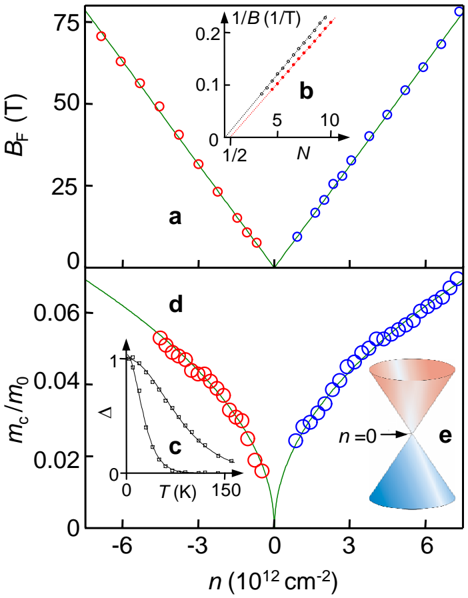
- Graphene’s charge carriers behave as massless Dirac fermions: the data imply \(E = \hbar k c^*\) for both electrons and holes, with \(c^* \approx 1 \times 10^6\) m/s; the cyclotron mass varies between \(\approx 0.02\) and \(0.07\,m_0\) and follows \(m_c \propto n^{1/2}\).
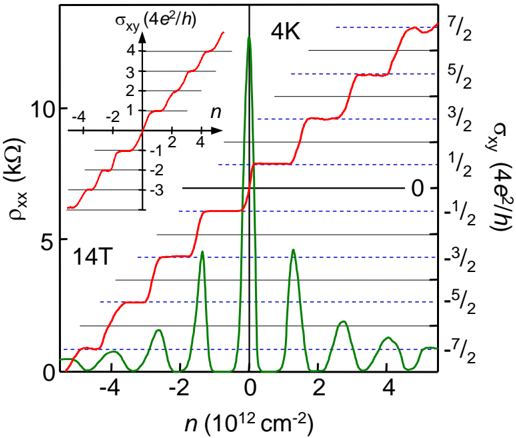
- The integer quantum Hall effect is anomalous: plateaux occur at half-integer \(\nu\), with sequence \((4e^2/h)(N+\tfrac12)\) and the first plateau at \(2e^2/h\); two-layer graphene returns to the normal integer sequence.
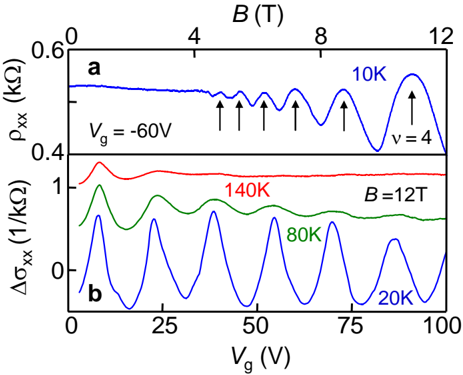
- Shubnikov–de Haas oscillations show a single set for electrons and holes, with \(B_F = \beta n\), \(\beta \approx 1.04 \times 10^{-15}\) T·m\(^2\) (\(\pm 2\%\)), yielding degeneracy \(f=4\); the oscillations exhibit a phase shift of \(\pi\) attributed to Berry’s phase.
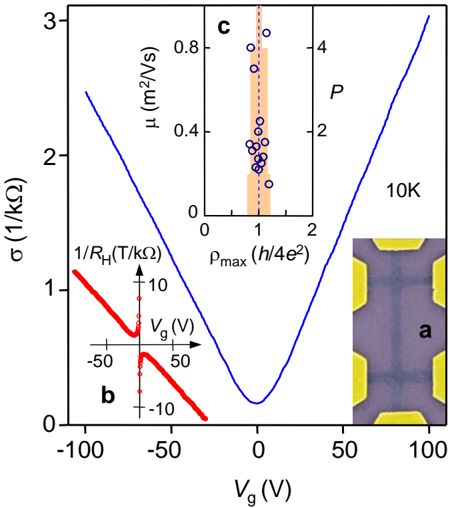
- Conductivity never falls below a minimum: \(\rho_{\max} \approx 6.5\) k\(\Omega\) in 15 devices (experimental error \(\approx 15\%\)), associated with \(h/fe^2 = 6.45\) k\(\Omega\), independent of mobility (which varied by a factor of 10) and of temperature between 4 and 100 K.
Methods
- Graphene samples were obtained by micromechanical cleavage of graphite, followed by identification and selection of monolayers using optical, scanning-electron, and atomic-force microscopies; selected films were processed into multi-terminal devices, with some devices made from 2 or 3 layers.
- Transport measurements included the electric field effect, Hall coefficient, Shubnikov–de Haas oscillations, and quantum Hall effect in magnetic fields; mobility was measured between 10 and 100 K, minimum conductivity between 4 and 100 K, and SdHO up to 140 K and room temperature.
- Analysis used fan diagrams to determine \(B_F\), fits of SdHO amplitude to \(T/\sinh(2\pi^2 k_B T m_c / h eB)\), and semiclassical expressions \(B_F = (h/2\pi e)S(E)\) and \(m_c = (h^2/2\pi)\partial S(E)/\partial E\) to infer \(E \propto k\).
Limitations
- The paper has no dedicated limitations section; stated caveats include that mobility was “probably still limited by defects in parent graphite,” that the two-layer finite-mass result is “to be published elsewhere,” and that most theories suggest a minimum conductivity of \(\approx e^2/\pi h\), in disagreement with the experiment.
- Evident from the text: devices are unprotected from the environment (though stable under ambient conditions), some measured devices consisted of 2 or 3 graphene layers, and the transition region was often shifted from zero \(V_g\) due to chemical doping, although annealing normally eliminated the shift.
- The inference of linear dispersion relies on a semiclassical model that the paper says is justified by recent theory, so the experimental conclusion depends on that theoretical framework.
Model-written summary. Check it against the paper before relying on it.
Integrity signals
Registry
Cites
Statistics
Figures
Verification
Claims the paper makes
3 Valid · 5 Not valid · 11 Not checked · 51 Own results and interpretations
The cited sources support only part of this claim — read each source’s verdict below.
In the paper
“d) Shubnikov-de Haas oscillations in graphene exhibit a phase shift of π due to Berry's phase”
- Also stated in: § Two-Dimensional Gas of Massless Dirac Fermions in Graphene · plain
“The shift is due to Berry's phase [9,15].”
What the sources say
- Partly supportedcites [9] Berger, C. et al. Ultrathin epitaxial graphite: 2D electron gas properties and a route toward graphene-based nanoelectronics. J. Phys. Chem. B 108, 19912–19916 (2004) sourceExperimental — accuracy not yet measured
The Figure 2 caption (p. 3) reports Shubnikov–de Haas oscillations in an epitaxial graphene sample. The discussion on pp. 3–4 addresses their occurrence and period, but does not report a π phase shift or attribute one to Berry’s phase. (LLM, conf=0.85)
- Partly supportedcites [15] Gusynin, V. P. & Sharapov, S. G. Unconventional integer quantum Hall effect in grapheme. Preprint at http://xxx.lanl.gov/abs/cond-mat/0506575 (2005). sourceExperimental — accuracy not yet measured
Our copy (Introduction, p. 1) does state that 'the phase of de Haas van Alphen and Shubnikov de Haas oscillations for Dirac quasiparticles is shifted ... compared to the phase of non-relativistic quasiparticles' (citing Refs. 7-10), so the existence of a phase shift in graphene is supported; the magnitude symbol itself is lost in our copy's undecoded formulas. What is NOT supported is the causal attribution to Berry's phase: no passage of our copy mentions Berry's phase at all (searched: 'Berry phase pseudospin topological phase π', 'oscillation phase factor'). Instead the paper explains the unconventional magneto-transport phenomena by the quantum anomaly of the n = 0 Landau level — its halved degeneracy and B-independent energy (p. 1 and p. 3) — and relates the oscillation minima to fillings ν_B = 2n+1 (p. 3). (LLM, conf=0.75)
plainstates a cause- Asserted: passes — The authors put it forward as true.
- Checkable: passes — It can be checked against evidence.
- Load-bearing: passes — The paper’s conclusions depend on it.
- Based: passes — The paper gives a reason why it holds.
- Also stated in: § Two-Dimensional Gas of Massless Dirac Fermions in Graphene · plain
The cited sources that could be checked couldn’t confirm or dispute this claim.
In the paper
“we invoke the formal expression [9-12] for the energy of massless relativistic fermions in quantized fields, EN =[2 e h c ∗ 2 B ( N +½ ± ½)] 1/2”
What the sources say
- Could not verifycites [9] Berger, C. et al. Ultrathin epitaxial graphite: 2D electron gas properties and a route toward graphene-based nanoelectronics. J. Phys. Chem. B 108, 19912–19916 (2004) sourceExperimental — accuracy not yet measured
The discussion of magnetoconductance (p. 3) says Shubnikov–de Haas oscillations indicate quantization of the electron energy spectrum, but it gives no energy formula. Searches for massless relativistic fermions, Landau levels, and the N + 1/2 ± 1/2 term found no passage stating the claimed expression. (LLM, conf=0.76)
- Not checked — no full text of the sourcecites [10] Bunch, J. S., Yaish, Y., Brink, M., Bolotin, K. & McEuen, P. L. Coulomb oscillations and Hall effect in quasi-2D graphite quantum dots. Nano Lett. 5, 287–290 (2005) source
- Not checked — no full text of the sourcecites [11] Dresselhaus, M. S. & Dresselhaus, G. Intercalation compounds of graphite. Adv. In Phys. 51, 1–186 (2002) source
- Not matchedcites [12] Brandt, N. B., Chudinov, S. M. & Ponomarev, Y. G. Semimetals 1: Graphite and Its Compounds (North-Holland, Amsterdam, 1988)
We searched by its title and found no matching paper.
plain- Asserted: passes — The authors put it forward as true.
- Checkable: passes — It can be checked against evidence.
- Load-bearing: passes — The paper’s conclusions depend on it.
- Based: passes — The paper gives a reason why it holds.
- Could not verify
The cited sources that could be checked couldn’t confirm or dispute this claim.
In the paper
“The employed semiclassical model is fully justified by a recent theory for graphene [9], which shows that SdHO's amplitude can indeed be described by the above expression T /sinh(2 π 2 k B Tm c / h eB ) with m c = E / c ∗ 2 .”
What the sources say
- Could not verifycites [9] Berger, C. et al. Ultrathin epitaxial graphite: 2D electron gas properties and a route toward graphene-based nanoelectronics. J. Phys. Chem. B 108, 19912–19916 (2004) sourceExperimental — accuracy not yet measured
The discussion of magnetoconductance (pp. 3–4) reports observed Shubnikov–de Haas oscillations, but does not give a theory for their amplitude. Searches for the temperature-dependent amplitude expression and m_c = E/c*² found no passage addressing either, so our copy cannot verify the attributed claim. (LLM, conf=0.76)
boostedstates a cause- Asserted: passes — The authors put it forward as true.
- Checkable: passes — It can be checked against evidence.
- Load-bearing: passes — The paper’s conclusions depend on it.
- Based: passes — The paper gives a reason why it holds.
- Could not verify
The cited sources that could be checked couldn’t confirm or dispute this claim.
In the paper
“The latter can be viewed as a direct consequence of the Atiyah-Singer index theorem that plays an important role in quantum field theory and the theory of superstrings [13,14].”
What the sources say
- Not checked — no full text of the sourcecites [13] Vonsovsky, S. V. & Katsnelson, M. I. Quantum Solid State Physics (Springer, New York, 1989) source
- Could not verifycites [14] Gusynin, V. P. & Sharapov, S. G. Magnetic oscillations in planar systems with the Dirac-like spectrum of quasiparticle excitations. Phys. Rev. B 71, 125124 (2005) sourceExperimental — accuracy not yet measured
Our copy of Gusynin & Sharapov II gives the relativistic Landau-level spectrum with n = 0, 1, ... in the Introduction (p. 1) and discusses the lowest level E_1 and its crossing of the Fermi surface (Discussion, p. 6; Sect. II.B, p. 6), but it never invokes or discusses the Atiyah-Singer index theorem, topology, or zero-mode counting as the reason for a level pinned at E = 0. Searches on 'Atiyah-Singer index theorem zero-energy Landau level', 'index theorem topological zero modes chiral anomaly', and 'zero-energy Landau level n=0 degeneracy independent of field strength' returned only the spectrum/quantization-condition passages. Since the index-theorem grounding is simply not addressed in our copy (and no alternative work is credited for it there), the attribution can be neither confirmed nor contradicted. (LLM, conf=0.68)
plainstates a cause- Asserted: passes — The authors put it forward as true.
- Checkable: passes — It can be checked against evidence.
- Load-bearing: unclear — It is unclear whether the paper’s conclusions depend on it.
- Based: passes — The paper gives a reason why it holds.
The cited sources that could be checked couldn’t confirm or dispute this claim.
In the paper
“in agreement with band structure calculations [6,7]”
What the sources say
- Could not verifycites [6] Novoselov, K. S. et al. Two dimensional atomic crystals. Proc. Natl Acad. Sci. USA 102, 10451–10453 (2005) sourceExperimental — accuracy not yet measured
The discussion of graphene transport in “Two Dimensional Atomic Crystals” (p. 3) reports carrier concentrations and mobilities, but not a fitted c* or a comparison with band-structure calculations. Searches for the velocity, its approximate value, and band-structure calculations found no passage addressing that comparison. (LLM, conf=0.76)
- Could not verifycites [7] Novoselov, K. S. et al. Electric field effect in atomically thin carbon films. Science 306, 666–669 (2004) sourceExperimental — accuracy not yet measured
The discussion on p. 2 says graphene is expected to have linear energy dispersion and massless carriers, but gives no calculated velocity to compare with c* ≈ 1·10^6 m/s. Searches for the velocity and band-structure comparison found no passage in our copy establishing the claimed agreement. (LLM, conf=0.73)
plainstates an association- Asserted: passes — The authors put it forward as true.
- Checkable: passes — It can be checked against evidence.
- Load-bearing: passes — The paper’s conclusions depend on it.
- Based: passes — The paper gives a reason why it holds.
- Could not verify
34 more claims
Create a free account to see all 70 claims and to verify the 10 references still open.
- It may state two separate claims as one. 27
- Probably not a substantial claim. 8
Claims other papers make about this one
Each is checked against this paper’s own text: does it say what the citing paper says it does?
The source backs part of the claim, not all of it — or backs it for a different population, condition or comparison.
In the citing paper
“Recently, the non-relativistic electrons in graphene monolayer were found to obey the massless relativistic dispersion known as the Dirac cone, leading to the realization of analogies to Zitterbewegung and Klein tunneling in low-energy condensed-matter physics and atom optics 4 -19 .”
From Observation of interaction-induced phenomena of relativistic quantum mechanics (2021) · cites this paper as [4]
Experimental — accuracy not yet measuredThe source backs part of the claim, not all of it — or backs it for a different population, condition or comparison.
In the citing paper
“Dirac points in graphene1–3 or photonic graphene12 belong to the first type, which occur in lattices with unbroken T. These occur in pairs and are stabilized by a symmetry of the underlying lattice.”
From Observation of an unpaired photonic Dirac point (2020) · cites this paper as [1]
Experimental — accuracy not yet measuredThe cited source says what the claim attributes to it.
In the citing paper
“The energy spectrum of ˆ H 1 is E n = sgn( n ) ℏ Ω √ | n | , where n = 0 , ± 1 , . . . , see Fig. 1.”
From Theory of electron Zitterbewegung in graphene probed by femtosecond laser pulses (2009) · cites this paper as [36]
The cited source says what the claim attributes to it.
In the citing paper
“Around Dirac cones, conduction and valence bands intersect linearly at a degenerate point resulting in the linear energy band and massless relativistic transport of electrons as quasiparticles [4].”
From Observing movement of Dirac cones from single-photon dynamics (2021) · cites this paper as [4]
The check wasn’t confident either way, so it gives no verdict — never disputed.
In the citing paper
“photonic Dirac points are known to occur in pairs in “photonic graphene” and other similar photonic crystals”
From Observation of an unpaired photonic Dirac point (2020) · cites this paper as [1]
Experimental — accuracy not yet measured
3 more claims about this paper
Create a free account to see every claim other papers make about this one.
Citations
Cites
Electric Field Effect in Atomically Thin Carbon Films
Novoselov, K. S., Geim, A. K., Morozov, S. V., Jiang, D., Zhang, Y., Dubonos, S. V., Grigorieva, I. V., & Firsov, A. A. (2004) · Science · doi:10.1126/science.1102896 · Cited by 66,834
Self-citationTwo-dimensional atomic crystals
Novoselov, K. S., Jiang, D., Schedin, F., Booth, T. J., Khotkevich, V. V., Morozov, S. V., & Geim, A. K. (2005) · Proceedings of the National Academy of Sciences · doi:10.1073/pnas.0502848102 · Cited by 11,788
Self-citationScaling Theory of Localization: Absence of Quantum Diffusion in Two Dimensions
Abrahams, E., Anderson, P. W., Licciardello, D. C., & Ramakrishnan, T. V. (1979) · Physical Review Letters · doi:10.1103/physrevlett.42.673 · Cited by 6,134
Berger, C., Song, Z., Li, T., Li, X., Ogbazghi, A. Y., Feng, R., Dai, Z., Marchenkov, A. N., Conrad, E. H., First, P. N., et al. (2004) · The Journal of Physical Chemistry B · doi:10.1021/jp040650f · Cited by 3,548
The Universe in a Helium Droplet
Volovik, G. E. (2009) · doi:10.1093/acprof:oso/9780199564842.001.0001 · Cited by 2,632
Intercalation compounds of graphite
Dresselhaus, M. S., & Dresselhaus, G. (2002) · Advances in Physics · doi:10.1080/00018730110113644 · Cited by 2,139
Geometry, Topology and Physics
Nakahara, M. (1990) · doi:10.1887/0750306068 · Cited by 1,620
Geometry, Topology and Physics
Nakahara, M. (2018) · CRC Press eBooks · doi:10.1201/9781315275826 · Cited by 1,505
Unconventional Integer Quantum Hall Effect in Graphene
Gusynin, V. P., & Sharapov, S. G. (2005) · Physical Review Letters · doi:10.1103/physrevlett.95.146801 · Cited by 1,374
Field Theories of Condensed Matter Systems
Fradkin, E. (2007) · Medical Entomology and Zoology · Cited by 1,118
Research works printed but not linked: 1
- Mott, N.F. & Davis, E.A. Electron Processes in Non-Crystalline Materials (Clarendon Press, Oxford, 1979).
Cited by
Items 16,901–17,000 of 21,614
Polyethylene: graphene—a magnetic tunable metacomposite
Ramasamy, R. P., Aswal, V. K., Rafailovich, M. H., et al. (2020) · Journal of Materials Science Materials in Electronics · doi:10.1007/s10854-020-04380-w · Cited by 3
Features and Prospects for Epitaxial Graphene on SiC
Norimatsu, W., Terasawa, T., MATSUDA, K., et al. (2019) · Handbook of Graphene · doi:10.1002/9781119468455.ch6 · Cited by 3
Anomalous increase of the thermal emf in epitaxial graphene on size-quantized films
Алисултанов, З. З., & Мирзегасанова, Н. А. (2014) · Low Temperature Physics · doi:10.1063/1.4878124 · Cited by 3
UNUSUAL QUANTUM HALL EFFECTS, INDEX THEOREM AND SUPERSYMMETRY IN GRAPHENE
Park, K.-S., & Yi, K.-S. (2009) · International Journal of Modern Physics B · doi:10.1142/s0217979209053540 · Cited by 5
Effect of size and shape of graphene sheets on nanoscale peeling process by atomic force microscopy
Okamoto, R., & Sasaki, N. (2019) · Japanese Journal of Applied Physics · doi:10.7567/1347-4065/ab4769 · Cited by 3
Temperature effect on the magnetic oscillations in 2D materials
Escudero, F. N., Ardenghi, J. S., & Jasen, P. V. (2019) · LA Referencia (Red Federada de Repositorios Institucionales de Publicaciones Científicas) · Cited by 3
Enhanced thermoelectric performance of graphene p−n junction nanoribbon
Song, T., Yang, N.-X., Wang, R., Liao, H., Song, C.-Y., & Cheng, X.-Y. (2024) · Physica E Low-dimensional Systems and Nanostructures · doi:10.1016/j.physe.2024.116057 · Cited by 3
Villegas, C. E. P., Tavares, M. R. S., & Marques, G. E. (2010) · Nanotechnology · doi:10.1088/0957-4484/21/36/365401 · Cited by 3
Electromagnetic Wave Propagation in Two-Dimensional Photonic Crystals
Oleg, L., Vladimir, S., Ya., R., & Yurii, E. (2011) · InTech eBooks · doi:10.5772/14165 · Cited by 4
Two-dimensional Dirac nodal-line semimetal protected by symmetryPreprint
Cui, X., Li, Y., Guo, D., Guo, P., Lou, C., Mei, G., Chen, L., Tan, S., Liu, Z.-X., Liu, K., et al. (2020) · arXiv (Cornell University) · doi:10.48550/arxiv.2012.15220 · Cited by 8
Novel ReSe semiconductor designed by structure prediction and phase diagram calculation
Zhu, C.-C., Liu, Z., Li, S., et al. (2021) · Journal of Materials Science · doi:10.1007/s10853-020-05744-7 · Cited by 3
Superconducting proximity effect through graphene and graphite films
Hayashi, M., Yoshioka, H., & Kanda, A. (2008) · Journal of Physics Conference Series · doi:10.1088/1742-6596/109/1/012014 · Cited by 3
Solvable potentials for the 1D Dirac equation using the tridiagonal matrix representations
Assi, I. A., Bahlouli, H., & Alhaidari, A. D. (2016) · AIP conference proceedings · doi:10.1063/1.4953124 · Cited by 3
Uncooled infrared sensing using graphene
Lai, K. W. C., Xi, N., Fung, C. K. M., et al. (2011) · IEEE Nanotechnology Materials and Devices Conference (NMDC) · doi:10.1109/nmdc.2011.6155320 · Cited by 3
Syamsai, R. (2022) · Elsevier eBooks · doi:10.1016/b978-0-323-89952-9.00003-8 · Cited by 3
Work function modulation of AuCl4− molecule adsorbed on graphene: A first-principles simulation
Fang, H., Wang, R., & Yan, H. Y. (2011) · Chemical Physics Letters · doi:10.1016/j.cplett.2011.09.060 · Cited by 3
High carrier mobility and strong anisotropy in the family of monolayer SnP2X6 (X=S, Se, Te)
Li, F., Bo, X., Wu, C., Zhang, Y., Li, S., & Wu, H. (2024) · Computational Materials Science · doi:10.1016/j.commatsci.2024.113245 · Cited by 3
Studies on the properties of surface and edges of N-layer graphenes
Chen, M., Zhou, H., Qiu, C., Yang, H., Fang, Y., & Sun, L. (2011) · Science China Physics Mechanics and Astronomy · doi:10.1007/s11433-011-4483-x · Cited by 3
Realizability conditions for relativistic gases with a non-zero heat flux
Boccelli, S., & McDonald, J. G. (2022) · Physics of Fluids · doi:10.1063/5.0106214 · Cited by 3
Theory of sub-Sharvin charge transport in graphene disks
Rycerz, A., & Witkowski, P. (2022) · Physical review. B./Physical review. B · doi:10.1103/physrevb.106.155428 · Cited by 4
Transition metals doped Zr2CF2 as promising sensor and adsorbent for NH3
Zhao, Z., Zhou, Q., Wang, Y., et al. (2024) · International Journal of Hydrogen Energy · doi:10.1016/j.ijhydene.2024.03.071 · Cited by 3
Dispersion Relations near the Conical Point in Some Hexagonal Lattices
Ishibashi, Y., & Iwata, M. (2014) · Ferroelectrics · doi:10.1080/00150193.2013.849172 · Cited by 3
Graphene—The Material of the Era
Anjali, C., & Kizhakayil, R. N. (2024) · Advanced structured materials · doi:10.1007/978-3-031-68464-7_1 · Cited by 8
High-Efficiency Cladding-Free Thermo-Optic Modulators via 1T′-MoTe 2 /Silicon Waveguides
Tang, Z., Wang, H., Wang, H., He, C., Liu, L., Wang, C., Zhai, J., Chen, S. L., Gan, Z., Li, X., et al. (2025) · ACS Nano · doi:10.1021/acsnano.5c08879 · Cited by 3
Ardakani, S. B., & Faez, R. (2019) · Scientia Iranica · doi:10.24200/sci.2019.50322.1635 · Cited by 3
Conduction Models and Electronic Structure of CPs
Chandrasekhar, P. (2018) · Springer eBooks · doi:10.1007/978-3-319-69378-1_28 · Cited by 4
Hydrogen storage characteristics of the B3O3 monolayer
Mardanian, R., Kokabi, A., & Touski, S. B. (2025) · Physica Scripta · doi:10.1088/1402-4896/add8f0 · Cited by 3
Barbe, J., Silva, A. E. A., Valero, A., Guillot, J., Philippe, A., Barborini, E., & Lamblin, G. (2026) · ACS Omega · doi:10.1021/acsomega.5c03143 · Cited by 3
Murtaza, G., Abbas, G., Iqbal, Z., et al. (2024) · Optics Communications · doi:10.1016/j.optcom.2024.130573 · Cited by 3
Thickness and strain engineering of structural and electronic properties for 2D square-octagon AlN
Hou, W., Qi, Z., Zang, H., et al. (2020) · International Journal of Smart and Nano Materials · doi:10.1080/19475411.2020.1801879 · Cited by 3
“Inspired by the successful of graphene [1,2], a great deal of research efforts are devoted toward the investigation of two-dimensional (2D) materials in last decade [3,4].”
BackgroundCui, Y., Li, J., & Zhang, L. (2020) · Acta Physica Sinica · doi:10.7498/aps.70.20201619 · Cited by 3
The coupled electromagnetic field effects on quantum transport in an electrically modulated graphene
Ma, N., Zhang, S., Liu, D., & Zhang, W. (2015) · Physics Letters A · doi:10.1016/j.physleta.2015.11.007 · Cited by 3
Compact confinement of radially polarized light in graphene cylindrical hybrid plasmonic waveguide
Zhang, S., He, S., Li, K., et al. (2019) · doi:10.1117/12.2536575 · Cited by 3
“Graphene, a newly emerged 2D material consisting of carbon atoms arranged in a hexagonal lattice [14][15], is a valuable candidate for plasmonic waveguides operating in the mid-infrared range [16][17].”
BackgroundCompact and high-efficiency device for Raman scattering measurement using optical fibers
Mitsui, T. (2014) · Review of Scientific Instruments · doi:10.1063/1.4902342 · Cited by 3
Josephson effect of massive pseudospin-1 fermions in the ferromagnetic dice lattice
Ding, Z., Wang, D., Lu, L., Li, M., Tao, Y. C., & Huang, F. (2024) · Annals of Physics · doi:10.1016/j.aop.2024.169848 · Cited by 6
Confined State and Electronic Transport in an Artificial Graphene-Based Tunnel Junction
Yuan, J., Zhang, J.-J., Zeng, Q.-J., Zhang, J., & Cheng, Z. (2011) · Communications in Theoretical Physics · doi:10.1088/0253-6102/56/6/28 · Cited by 3
Fu, Y.-S., & Wang, J. (2024) · Annals of Physics · doi:10.1016/j.aop.2024.169811 · Cited by 5
Abnormal electronic transport in disordered four-terminal graphene nanodevice
Kordbacheh, A. A., Jafari, A., & Arjmand, M. (2013) · Journal of theoretical and applied physics · doi:10.1186/2251-7235-7-54 · Cited by 3
Intrinsically patterned corrals in monolayer Ag5Se2 and selective molecular co-adsorption
Lu, J., Song, S., Zhang, S., et al. (2022) · Nano Research · doi:10.1007/s12274-022-4314-6 · Cited by 3
Zhou, B., Zhou, B., Zhou, B., et al. (2012) · Physics Letters A · doi:10.1016/j.physleta.2012.04.012 · Cited by 3
Thickness-dependent excitonic properties of WSe 2 /FePS 3 van der Waals heterostructures
Zhang, X., Wang, C., Ou, Z., et al. (2022) · Nanoscale · doi:10.1039/d2nr05455h · Cited by 3
Intermediate phase induced by dilution in a correlated Dirac Fermi system
Tian, L., Meng, J., & Ma, T. (2022) · Physical review. B./Physical review. B · doi:10.1103/physrevb.106.205144 · Cited by 3
Electron delocalization in clusters
Mercero, J. M., & Ugalde, J. M. (2022) · Elsevier eBooks · doi:10.1016/b978-0-12-822943-9.00013-9 · Cited by 3
Bottom‐up Approaches to Nanographenes through Organic Synthesis
̃na, D. P. (2010) · doi:10.1002/9783527630554.ch11 · Cited by 3
Two-dimensional VDW crystal SnP3 with high carrier mobility and extraordinary sunlight absorbance
Wang, C., Hu, T., & Kan, E. (2019) · Chinese Journal of Chemical Physics · doi:10.1063/1674-0068/cjcp1809212 · Cited by 3
Impact of carbon material on RF MEMS switch
Mafinejad, Y., Zarghami, M., Kouzani, A. Z., et al. (2013) · Iranian Conference on Electrical Engineering · doi:10.1109/iraniancee.2013.6599542 · Cited by 3
Neupane, H. K., & Adhikari, N. P. (2021) · Journal of Nepal Physical Society · doi:10.3126/jnphyssoc.v7i2.38578 · Cited by 3
Modification of thermal and electronic properties of bilayer graphene by using slow Na + ions
Ryu, M., Lee, P., Kim, J., et al. (2016) · Nanotechnology · doi:10.1088/0957-4484/27/48/485704 · Cited by 3
Free-standing graphene-based nanohybrid paper electrode as an anode for lithium-ion batteries
Yun, Y. S., & Jin, H. (2014) · RSC Advances · doi:10.1039/c4ra04434g · Cited by 3
Chen, T.-W. (2013) · Journal of Physics Condensed Matter · doi:10.1088/0953-8984/25/15/155801 · Cited by 3
The Unconventional Transport Properties of Dirac Fermions in Graphyne
Lin, X., Wang, H., Pan, H., & Xu, H. (2013) · Chinese Physics Letters · doi:10.1088/0256-307x/30/7/077305 · Cited by 3
Pseudospin–orbital coupling for pseudospintronic device in graphene
Tan, S. G., Jalil, M. B. A., Koh, D. E., & Lee, H. K. (2010) · Journal of Magnetism and Magnetic Materials · doi:10.1016/j.jmmm.2010.02.043 · Cited by 7
Seebeck coefficient of two-dimensional Dirac electrons in an organic conductor under pressure
Suzumura, Y., & Ogata, M. (2023) · Physical review. B./Physical review. B · doi:10.1103/physrevb.107.195416 · Cited by 3
Salas, O., Garcés, E. J. J., & Magana, L. F. (2018) · Crystals · doi:10.3390/cryst8050208 · Cited by 3
Optical alignment of oval graphene flakes
Mobini, E., Rahimzadegan, A., Alaee, R., et al. (2017) · Max Planck Digital Library · Cited by 3
Effective mass of a two-dimensional √3 × √3 Ga single atomic layer on Si(111)
Schnedler, M., Jiang, Y. X., Wu, K., et al. (2014) · Surface Science · doi:10.1016/j.susc.2014.07.024 · Cited by 3
PHOTOSENSITIVE FIELD-EFFECT TRANSISTOR BASED ON REDUCED GRAPHENE OXIDE FILM
Olenych, I. B., & Monastyrskii, L. S. (2023) · Sensor Electronics and Microsystem Technologies · doi:10.18524/1815-7459.2023.2.278625 · Cited by 3
Electronic properties of impurity-infected few-layer graphene nanoribbons
Mousavi, H., & Bagheri, M. (2014) · Physica B Condensed Matter · doi:10.1016/j.physb.2014.11.021 · Cited by 3
Ti Impurity Effect on the Optical Coefficients in 2D Cu 2 Si: A DFT Study*
Nourozi, B., Boochani, A., Abdolmaleki, A., et al. (2018) · Communications in Theoretical Physics · doi:10.1088/0253-6102/69/1/101 · Cited by 3
Energy quantization at the three-quarter Dirac point in a magnetic field
Hasegawa, Y., & Kishigi, K. (2019) · Physical review. B./Physical review. B · doi:10.1103/physrevb.99.045409 · Cited by 3
Chiral tunneling through double barrier structure in twisted graphene bilayer
Bahlaoui, A., & Zahidi, Y. (2024) · Physica E Low-dimensional Systems and Nanostructures · doi:10.1016/j.physe.2023.115880 · Cited by 3
Emergent antiferromagnetism in Y-shaped Kekulé graphene
Wen, C., Han, W., Feng, X., Zhu, X., Zhao, W. S., Yang, S. A., Feng, S., & Guo, H. (2022) · Physical review. B./Physical review. B · doi:10.1103/physrevb.106.245116 · Cited by 3
Chirality effect in disordered graphene ribbon junctions
Long, W. (2012) · Journal of Physics Condensed Matter · doi:10.1088/0953-8984/24/17/175302 · Cited by 4
Transport properties of 2H-NbSe2 synthesized by selenization of Nb thin films
Zaitsev, A. G., Beck, A., Fuchs, D., Hott, R., & Schneider, R. (2023) · Superconductor Science and Technology · doi:10.1088/1361-6668/ad1464 · Cited by 4
Dynamical charge and pseudospin currents in graphene and possible Cooper pair formation
Morawetz, K. (2016) · Physical review. B./Physical review. B · doi:10.1103/physrevb.94.165415 · Cited by 3
Electronic Structures and Magnetic Properties
Delhaès, P. (2013) · Wiley eBooks · doi:10.1002/9781118557617.ch7 · Cited by 3
Young, R. J., Deng, L., Gong, L., et al. (2013) · Springer eBooks · doi:10.1007/978-3-642-20595-8_19 · Cited by 3
Xu, L., Yin, B., Yan, H.-W., et al. (2015) · RSC Advances · doi:10.1039/c5ra12254f · Cited by 3
Anagaw, M. Y., & Hailemariam, S. M. (2020) · Journal of Atomic Molecular Condensate and Nano Physics · doi:10.26713/jamcnp.v7i2.1422 · Cited by 3
Two-dimensional oxygen functionalized honeycomb and zigzag dumbbell silicene with robust Dirac cones
Chen, X., Li, L., Peeters, F. M., et al. (2021) · New Journal of Physics · doi:10.1088/1367-2630/abdb6e · Cited by 3
I–V characteristics of an atomically thin graphene-boron nitride heterostructure
Mokkath, J. H. (2020) · Chemical Physics Letters · doi:10.1016/j.cplett.2020.138115 · Cited by 3
Magnetic-Modulation Effects in Bilayer Bernal Graphene
Wu, J.-Y., Ho, Y.-H., & Lin, M.-F. (2010) · The Journal of Physical Chemistry C · doi:10.1021/jp101530q · Cited by 3
Stacking induced symmetry breaking and gap opening in Dirac half-metal MnF 3
Xiang, W., & Zhou, B. (2025) · Physical Chemistry Chemical Physics · doi:10.1039/d4cp04213a · Cited by 3
Graphene Applications in Batteries and Energy Devices
Chandrasekhar, P. (2018) · Springer eBooks · doi:10.1007/978-3-319-69378-1_21 · Cited by 3
Quantum oscillations in a tunable graphene bilayer
Falkovsky, L. A. (2011) · Low Temperature Physics · doi:10.1063/1.3670023 · Cited by 3
BAND STRUCTURE AND ELECTRON VELOCITY MEASUREMENT IN CARBON NANOTUBES AND GRAPHENE
Nicholas, R. J., & Chuang, K.-C. (2009) · International Journal of Modern Physics B · doi:10.1142/s021797920906213x · Cited by 3
Time-dependent transport in graphene Mach-Zender interferometers
Forghieri, G., Bordone, P., & Bertoni, A. (2022) · Physical review. B./Physical review. B · doi:10.1103/physrevb.106.165402 · Cited by 3
Zhang, X., Liu, Y., Hu, S., et al. (2018) · Soft Matter · doi:10.1039/c8sm01549j · Cited by 3
Structural and electronic properties of B2N3 planar nanostructure: A computational investigation
Li, J., Fan, X., Wei, Y., et al. (2016) · Chemical Physics Letters · doi:10.1016/j.cplett.2016.08.033 · Cited by 3
Applications of heteropoly acids in industry
Heravi, M. M., & Bamoharram, F. F. (2022) · Elsevier eBooks · doi:10.1016/b978-0-323-88441-9.00005-3 · Cited by 3
Tőke, C. (2013) · Physical Review B · doi:10.1103/physrevb.88.241411 · Cited by 3
Conformal sensors enhanced by flexible terahertz microstructures
Bao, Y., Yin, Q., Liu, C., Wang, B., Wang, H., Ying, Y. B., & Xu, W. (2025) · TrAC Trends in Analytical Chemistry · doi:10.1016/j.trac.2025.118545 · Cited by 4
Dinadayalane, T. C., & Leszczyński, J. (2017) · Springer eBooks · doi:10.1007/978-3-319-27282-5_22 · Cited by 3
Graphene Epitaxially Grown on Vicinal 4H-SiC(0001) Substrates
Ye, M., Cui, Y., Qiao, S., et al. (2009) · e-Journal of Surface Science and Nanotechnology · doi:10.1380/ejssnt.2009.29 · Cited by 3
Epoxy/graphite nanocomposites as dielectric resins with enhanced thermal conductivity
Metz, R., Chacón, L. D., Atencio, R., & Dieudonné, P. (2022) · Electrical Engineering · doi:10.1007/s00202-022-01595-4 · Cited by 3
Quantum magnetotransport properties of Floquet topological insulators
Tahir, M. (2017) · Physica E Low-dimensional Systems and Nanostructures · doi:10.1016/j.physe.2017.04.018 · Cited by 3
Tuấn, T. A., Nam, N. D., Nhàn, N. T. T., & Bau, N. Q. (2024) · MATERIALS TRANSACTIONS · doi:10.2320/matertrans.mt-mg2022020 · Cited by 3
“In graphene, the behavior of electrons is similar to that of relativistic particles of zero mass [1].”
Thermal desorption of structured water layer on epitaxial graphene
Minami, T., Ochi, S., Nakai, H., Kinoshita, T., Ohno, Y., & Nagase, M. (2021) · AIP Advances · doi:10.1063/5.0075191 · Cited by 4
A polynomial approach to the spectrum of Dirac–Weyl polygonal Billiards
Quintela, M. F. C. M., & dos Santos, J. M. B. L. (2020) · Journal of Physics Condensed Matter · doi:10.1088/1361-648x/abbe77 · Cited by 3
“Following the pioneering work of Berry and Mondragon [8], and the discovery that two-dimensional (2D) materials, such as graphene, can be described by effective continuum models with the DiracWeyl equation [9, 10], there has been a upsurge of interest in the properties of confined relativistic particles (Dirac Billiar…”
BackgroundInfluentialModification of electronic properties of graphene by using low-energy K+ ions
Kim, J., Lee, P., Ryu, M., et al. (2016) · Applied Physics Letters · doi:10.1063/1.4948764 · Cited by 3
Gopalsamy, K., & Pachamuthu, M. P. (2025) · Materials Today Chemistry · doi:10.1016/j.mtchem.2025.103192 · Cited by 4
Sensing the quantized reactivity of graphene
Lopes, L. C., & Bueno, P. R. (2021) · Analytica Chimica Acta · doi:10.1016/j.aca.2021.338735 · Cited by 3
Cyclophosphamide drug sensing characteristics by using pure and Ti-doped graphyne-like BN-yne
Hamza, T. A., Hussein, E. S., Kadhim, M. M., Rheima, A. M., Marjani, M. F. A., Alattia, L. H., Mahdi, Z. M., Hachim, S. K., & Adel, M. (2023) · Inorganic Chemistry Communications · doi:10.1016/j.inoche.2023.110535 · Cited by 3
Reconfigurable multifunctional graphene-based antenna for cancer therapy with THz wave ablation
Geyikoglu, M. D., Polat, H. K., Çavuşoğlu, B., et al. (2023) · Optical and Quantum Electronics · doi:10.1007/s11082-023-04864-z · Cited by 3
Particle–hole pair states of layered materials
Lokot, L. E. (2014) · Physica E Low-dimensional Systems and Nanostructures · doi:10.1016/j.physe.2014.12.022 · Cited by 4
Кузнецов, А. В., Морозов, В. А., Savenkov, G. G., et al. (2021) · Technical Physics · doi:10.1134/s1063784221030154 · Cited by 3
On the Electron-Phonon Interactions in Graphene
Kandemir, B. S. (2013) · NATO science for peace and security series. B, Physics and biophysics · doi:10.1007/978-94-007-6618-1_6 · Cited by 3
Goncalves, A. M. B., Malachias, Â., Mazzoni, M. S. C., et al. (2012) · Nanotechnology · doi:10.1088/0957-4484/23/17/175603 · Cited by 3
Humidity sensor element based on porous silicon – reduced graphene oxide sandwich-like structures
Olenych, I. B., Horbenko, Y. Y., Monastyrskii, L. S., Aksimentyeva, О. І., & Boyko, Y. V. (2023) · Molecular Crystals and Liquid Crystals · doi:10.1080/15421406.2023.2224981 · Cited by 5
Dihingia, K. D., Saha, S., & Sastry, G. N. (2022) · Journal of Physics and Chemistry of Solids · doi:10.1016/j.jpcs.2022.110717 · Cited by 3
Metadata
- Authors
- Novoselov, K. S., Geim, A. K., Morozov, S. V., Jiang, D., Katsnelson, M. I., Grigorieva, I. V., Dubonos, S. V., & Firsov, A. A.
- Affiliations
- University of Manchester (GB)
- Institute of Microelectronics Technology and High Purity Materials (RU)
- Radboud University Nijmegen (NL)
- Corresponding author
- Novoselov, K. S.
- Geim, A. K.
- Venue
- Nature
- Published
- 2005-11
- Volume
- 438
- Issue
- 7065
- Pages
- 197-200
- ISSN
- 0028-0836 (ISSN-L)
- 1476-4687
- OpenAlex
- W2125284466
- Semantic Scholar
- 228e604ea7c1333a99663b6b547cf47b98e721e7
- Cited by
- 21,611
- References
- 32
- Citations by year
- 2026: 442 · 2025: 677 · 2024: 798 · 2023: 924 · 2022: 992 · 2021: 1082 · 2020: 1230 · 2019: 1268 · 2018: 1350 · 2017: 1395 · 2016: 1501 · 2015: 1473 · 2014: 1387 · 2013: 1382 · 2012: 1375
- FWCI
- 217.72
- Type
- journal article
- Language
- en
- Open access
- green
- arxiv.org
- Licence
- www.springer.com/tdm (tdm)
- Locations
- Nature (publishedVersion)
- PubMed (publishedVersion)
- arXiv (Cornell University) (submittedVersion)
- RePEc: Research Papers in Economics (submittedVersion)
- Research Explorer (The University of Manchester) (submittedVersion)
- Radboud Repository (Radboud University) (submittedVersion)
- arXiv (Cornell University)
- Topics
- Physical Sciences › Materials Science › Materials Chemistry › Graphene research and applications
- Physical Sciences › Physics and Astronomy › Condensed Matter Physics › Topological Materials and Phenomena
- Physical Sciences › Physics and Astronomy › Atomic and Molecular Physics, and Optics › Quantum Electrodynamics and Casimir Effect
- Keywords
- graphene, massless Dirac fermions, two-dimensional Dirac fermions, quantum Hall effect, cyclotron mass, electron transport, relativistic electrons
About these checks
Registry, retraction, Cites and statistics results are computed, not judged, with one exception: a printed reference that no index lists is read once by a model before it counts as a citation error. Claims are extracted by a model and kept only when their quote appears verbatim in the text; each cited source is then checked, with a model’s help, for whether it says what the claim relies on. Those verdicts can be wrong — read the claim’s quote and the cited source before relying on one.
The claim verdicts this report counts are experimental: their accuracy is not yet measured.
A language model drew the claims from the paper on 2026-10-10, under version 3 of the claim definition (model deepseek-v4.1-flash, prompt extract-v3).
A second model labelled each claim on 2026-10-10 (model jev-1.13-20260917, definition revision gold-guideline-v0.2).
Cited sources are checked with a language model’s help (gpt-6-sol and qwen3.8-omni-flash).
Statistics and arithmetic are recomputed, not judged.
Confidence bands are shown only for fields calibrated on our annotated test set. None is calibrated yet, so no band is shown.
What counts as a claim ›How we measure confidence ›How we check this ›
Are you an author, or do you see a problem with this page? Request a review
Data sources
Bibliographic data: Semantic Scholar, OpenAlex, Crossref.
Contains information from the Semantic Scholar Academic Graph Datasets, made available under the ODC Attribution License (ODC-BY 1.0).
Semantic Scholar’s data is described in: Kinney, R., et al. (2023). The Semantic Scholar Open Data Platform. arXiv:2301.10140.
