

Two-dimensional gas of massless Dirac fermions in graphene
Open accessThe DOI matches its Crossref record; 32 of the 32 references it cites were found in a registry or an index; 12 of the 52 sources its claims cite were checked for support.
Abstract
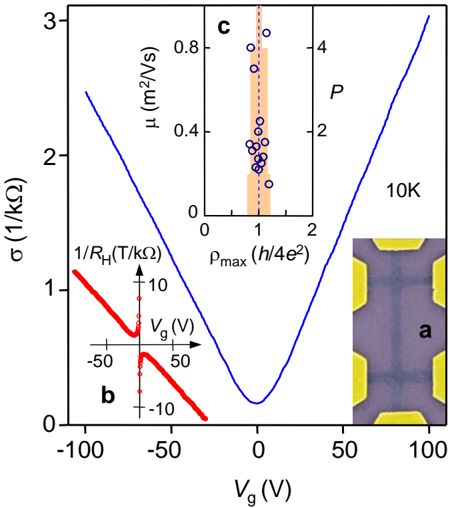
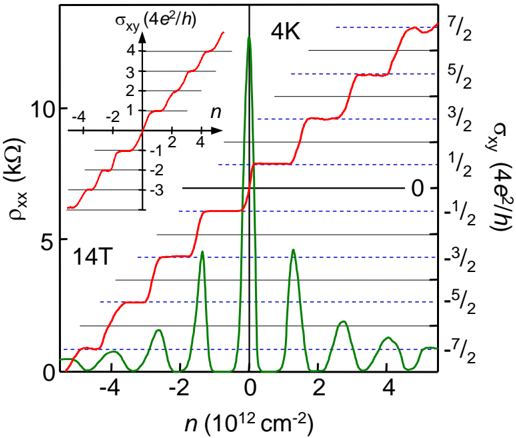
Quantum electrodynamics (resulting from the merger of quantum mechanics and relativity theory) has provided a clear understanding of phenomena ranging from particle physics to cosmology and from astrophysics to quantum chemistry. The ideas underlying quantum electrodynamics also influence the theory of condensed matter, but quantum relativistic effects are usually minute in the known experimental systems that can be described accurately by the non-relativistic Schrödinger equation. Here we report an experimental study of a condensed-matter system (graphene, a single atomic layer of carbon) in which electron transport is essentially governed by Dirac's (relativistic) equation. The charge carriers in graphene mimic relativistic particles with zero rest mass and have an effective ‘speed of light’ c* ≈ 106 m s-1. Our study reveals a variety of unusual phenomena that are characteristic of two-dimensional Dirac fermions. In particular we have observed the following: first, graphene's conductivity never falls below a minimum value corresponding to the quantum unit of conductance, even when concentrations of charge carriers tend to zero; second, the integer quantum Hall effect in graphene is anomalous in that it occurs at half-integer filling factors; and third, the cyclotron mass mc of massless carriers in graphene is described by E = mcc*2. This two-dimensional system is not only interesting in itself but also allows access to the subtle and rich physics of quantum electrodynamics in a bench-top experiment.
Overview
CoChat Summary
TL;DR
Graphene is a two-dimensional gas of massless Dirac fermions with linear dispersion and an effective speed of light \(c^* \approx 10^6\) m/s. Transport measurements reveal an anomalous half-integer quantum Hall effect, a minimum conductivity, cyclotron mass \(m_c = E/c^{*2}\), and a \(\pi\) Berry-phase shift in Shubnikov–de Haas oscillations.
Key findings
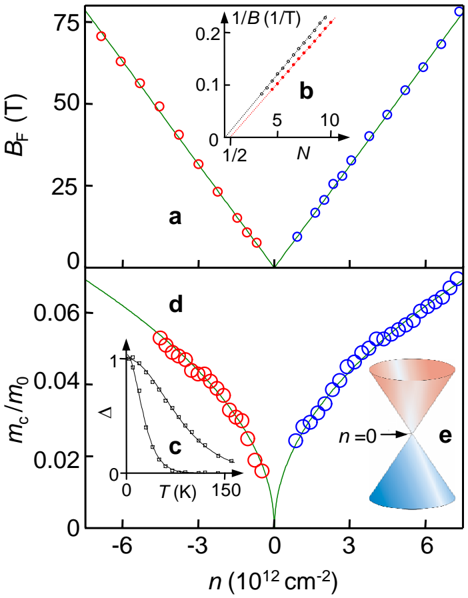
- Graphene’s charge carriers behave as massless Dirac fermions: the data imply \(E = \hbar k c^*\) for both electrons and holes, with \(c^* \approx 1 \times 10^6\) m/s; the cyclotron mass varies between \(\approx 0.02\) and \(0.07\,m_0\) and follows \(m_c \propto n^{1/2}\).
- The integer quantum Hall effect is anomalous: plateaux occur at half-integer \(\nu\), with sequence \((4e^2/h)(N+\tfrac12)\) and the first plateau at \(2e^2/h\); two-layer graphene returns to the normal integer sequence.
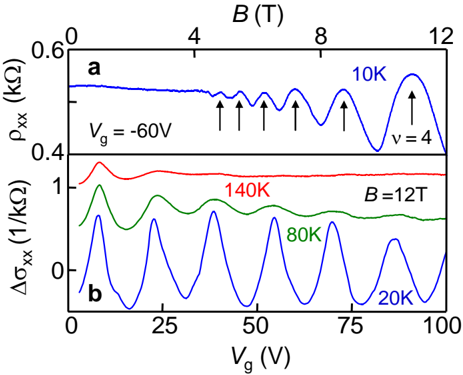
- Shubnikov–de Haas oscillations show a single set for electrons and holes, with \(B_F = \beta n\), \(\beta \approx 1.04 \times 10^{-15}\) T·m\(^2\) (\(\pm 2\%\)), yielding degeneracy \(f=4\); the oscillations exhibit a phase shift of \(\pi\) attributed to Berry’s phase.
- Conductivity never falls below a minimum: \(\rho_{\max} \approx 6.5\) k\(\Omega\) in 15 devices (experimental error \(\approx 15\%\)), associated with \(h/fe^2 = 6.45\) k\(\Omega\), independent of mobility (which varied by a factor of 10) and of temperature between 4 and 100 K.
Methods
- Graphene samples were obtained by micromechanical cleavage of graphite, followed by identification and selection of monolayers using optical, scanning-electron, and atomic-force microscopies; selected films were processed into multi-terminal devices, with some devices made from 2 or 3 layers.
- Transport measurements included the electric field effect, Hall coefficient, Shubnikov–de Haas oscillations, and quantum Hall effect in magnetic fields; mobility was measured between 10 and 100 K, minimum conductivity between 4 and 100 K, and SdHO up to 140 K and room temperature.
- Analysis used fan diagrams to determine \(B_F\), fits of SdHO amplitude to \(T/\sinh(2\pi^2 k_B T m_c / h eB)\), and semiclassical expressions \(B_F = (h/2\pi e)S(E)\) and \(m_c = (h^2/2\pi)\partial S(E)/\partial E\) to infer \(E \propto k\).
Limitations
- The paper has no dedicated limitations section; stated caveats include that mobility was “probably still limited by defects in parent graphite,” that the two-layer finite-mass result is “to be published elsewhere,” and that most theories suggest a minimum conductivity of \(\approx e^2/\pi h\), in disagreement with the experiment.
- Evident from the text: devices are unprotected from the environment (though stable under ambient conditions), some measured devices consisted of 2 or 3 graphene layers, and the transition region was often shifted from zero \(V_g\) due to chemical doping, although annealing normally eliminated the shift.
- The inference of linear dispersion relies on a semiclassical model that the paper says is justified by recent theory, so the experimental conclusion depends on that theoretical framework.
Model-written summary. Check it against the paper before relying on it.
Integrity signals
Registry
Cites
Statistics
Figures
Verification
Claims the paper makes
3 Valid · 5 Not valid · 11 Not checked · 51 Own results and interpretations
The cited sources support only part of this claim — read each source’s verdict below.
In the paper
“d) Shubnikov-de Haas oscillations in graphene exhibit a phase shift of π due to Berry's phase”
- Also stated in: § Two-Dimensional Gas of Massless Dirac Fermions in Graphene · plain
“The shift is due to Berry's phase [9,15].”
What the sources say
- Partly supportedcites [9] Berger, C. et al. Ultrathin epitaxial graphite: 2D electron gas properties and a route toward graphene-based nanoelectronics. J. Phys. Chem. B 108, 19912–19916 (2004) sourceExperimental — accuracy not yet measured
The Figure 2 caption (p. 3) reports Shubnikov–de Haas oscillations in an epitaxial graphene sample. The discussion on pp. 3–4 addresses their occurrence and period, but does not report a π phase shift or attribute one to Berry’s phase. (LLM, conf=0.85)
- Partly supportedcites [15] Gusynin, V. P. & Sharapov, S. G. Unconventional integer quantum Hall effect in grapheme. Preprint at http://xxx.lanl.gov/abs/cond-mat/0506575 (2005). sourceExperimental — accuracy not yet measured
Our copy (Introduction, p. 1) does state that 'the phase of de Haas van Alphen and Shubnikov de Haas oscillations for Dirac quasiparticles is shifted ... compared to the phase of non-relativistic quasiparticles' (citing Refs. 7-10), so the existence of a phase shift in graphene is supported; the magnitude symbol itself is lost in our copy's undecoded formulas. What is NOT supported is the causal attribution to Berry's phase: no passage of our copy mentions Berry's phase at all (searched: 'Berry phase pseudospin topological phase π', 'oscillation phase factor'). Instead the paper explains the unconventional magneto-transport phenomena by the quantum anomaly of the n = 0 Landau level — its halved degeneracy and B-independent energy (p. 1 and p. 3) — and relates the oscillation minima to fillings ν_B = 2n+1 (p. 3). (LLM, conf=0.75)
plainstates a cause- Asserted: passes — The authors put it forward as true.
- Checkable: passes — It can be checked against evidence.
- Load-bearing: passes — The paper’s conclusions depend on it.
- Based: passes — The paper gives a reason why it holds.
- Also stated in: § Two-Dimensional Gas of Massless Dirac Fermions in Graphene · plain
The cited sources that could be checked couldn’t confirm or dispute this claim.
In the paper
“we invoke the formal expression [9-12] for the energy of massless relativistic fermions in quantized fields, EN =[2 e h c ∗ 2 B ( N +½ ± ½)] 1/2”
What the sources say
- Could not verifycites [9] Berger, C. et al. Ultrathin epitaxial graphite: 2D electron gas properties and a route toward graphene-based nanoelectronics. J. Phys. Chem. B 108, 19912–19916 (2004) sourceExperimental — accuracy not yet measured
The discussion of magnetoconductance (p. 3) says Shubnikov–de Haas oscillations indicate quantization of the electron energy spectrum, but it gives no energy formula. Searches for massless relativistic fermions, Landau levels, and the N + 1/2 ± 1/2 term found no passage stating the claimed expression. (LLM, conf=0.76)
- Not checked — no full text of the sourcecites [10] Bunch, J. S., Yaish, Y., Brink, M., Bolotin, K. & McEuen, P. L. Coulomb oscillations and Hall effect in quasi-2D graphite quantum dots. Nano Lett. 5, 287–290 (2005) source
- Not checked — no full text of the sourcecites [11] Dresselhaus, M. S. & Dresselhaus, G. Intercalation compounds of graphite. Adv. In Phys. 51, 1–186 (2002) source
- Not matchedcites [12] Brandt, N. B., Chudinov, S. M. & Ponomarev, Y. G. Semimetals 1: Graphite and Its Compounds (North-Holland, Amsterdam, 1988)
We searched by its title and found no matching paper.
plain- Asserted: passes — The authors put it forward as true.
- Checkable: passes — It can be checked against evidence.
- Load-bearing: passes — The paper’s conclusions depend on it.
- Based: passes — The paper gives a reason why it holds.
- Could not verify
The cited sources that could be checked couldn’t confirm or dispute this claim.
In the paper
“The employed semiclassical model is fully justified by a recent theory for graphene [9], which shows that SdHO's amplitude can indeed be described by the above expression T /sinh(2 π 2 k B Tm c / h eB ) with m c = E / c ∗ 2 .”
What the sources say
- Could not verifycites [9] Berger, C. et al. Ultrathin epitaxial graphite: 2D electron gas properties and a route toward graphene-based nanoelectronics. J. Phys. Chem. B 108, 19912–19916 (2004) sourceExperimental — accuracy not yet measured
The discussion of magnetoconductance (pp. 3–4) reports observed Shubnikov–de Haas oscillations, but does not give a theory for their amplitude. Searches for the temperature-dependent amplitude expression and m_c = E/c*² found no passage addressing either, so our copy cannot verify the attributed claim. (LLM, conf=0.76)
boostedstates a cause- Asserted: passes — The authors put it forward as true.
- Checkable: passes — It can be checked against evidence.
- Load-bearing: passes — The paper’s conclusions depend on it.
- Based: passes — The paper gives a reason why it holds.
- Could not verify
The cited sources that could be checked couldn’t confirm or dispute this claim.
In the paper
“The latter can be viewed as a direct consequence of the Atiyah-Singer index theorem that plays an important role in quantum field theory and the theory of superstrings [13,14].”
What the sources say
- Not checked — no full text of the sourcecites [13] Vonsovsky, S. V. & Katsnelson, M. I. Quantum Solid State Physics (Springer, New York, 1989) source
- Could not verifycites [14] Gusynin, V. P. & Sharapov, S. G. Magnetic oscillations in planar systems with the Dirac-like spectrum of quasiparticle excitations. Phys. Rev. B 71, 125124 (2005) sourceExperimental — accuracy not yet measured
Our copy of Gusynin & Sharapov II gives the relativistic Landau-level spectrum with n = 0, 1, ... in the Introduction (p. 1) and discusses the lowest level E_1 and its crossing of the Fermi surface (Discussion, p. 6; Sect. II.B, p. 6), but it never invokes or discusses the Atiyah-Singer index theorem, topology, or zero-mode counting as the reason for a level pinned at E = 0. Searches on 'Atiyah-Singer index theorem zero-energy Landau level', 'index theorem topological zero modes chiral anomaly', and 'zero-energy Landau level n=0 degeneracy independent of field strength' returned only the spectrum/quantization-condition passages. Since the index-theorem grounding is simply not addressed in our copy (and no alternative work is credited for it there), the attribution can be neither confirmed nor contradicted. (LLM, conf=0.68)
plainstates a cause- Asserted: passes — The authors put it forward as true.
- Checkable: passes — It can be checked against evidence.
- Load-bearing: unclear — It is unclear whether the paper’s conclusions depend on it.
- Based: passes — The paper gives a reason why it holds.
The cited sources that could be checked couldn’t confirm or dispute this claim.
In the paper
“in agreement with band structure calculations [6,7]”
What the sources say
- Could not verifycites [6] Novoselov, K. S. et al. Two dimensional atomic crystals. Proc. Natl Acad. Sci. USA 102, 10451–10453 (2005) sourceExperimental — accuracy not yet measured
The discussion of graphene transport in “Two Dimensional Atomic Crystals” (p. 3) reports carrier concentrations and mobilities, but not a fitted c* or a comparison with band-structure calculations. Searches for the velocity, its approximate value, and band-structure calculations found no passage addressing that comparison. (LLM, conf=0.76)
- Could not verifycites [7] Novoselov, K. S. et al. Electric field effect in atomically thin carbon films. Science 306, 666–669 (2004) sourceExperimental — accuracy not yet measured
The discussion on p. 2 says graphene is expected to have linear energy dispersion and massless carriers, but gives no calculated velocity to compare with c* ≈ 1·10^6 m/s. Searches for the velocity and band-structure comparison found no passage in our copy establishing the claimed agreement. (LLM, conf=0.73)
plainstates an association- Asserted: passes — The authors put it forward as true.
- Checkable: passes — It can be checked against evidence.
- Load-bearing: passes — The paper’s conclusions depend on it.
- Based: passes — The paper gives a reason why it holds.
- Could not verify
34 more claims
Create a free account to see all 70 claims and to verify the 10 references still open.
- It may state two separate claims as one. 27
- Probably not a substantial claim. 8
Claims other papers make about this one
Each is checked against this paper’s own text: does it say what the citing paper says it does?
The source backs part of the claim, not all of it — or backs it for a different population, condition or comparison.
In the citing paper
“Recently, the non-relativistic electrons in graphene monolayer were found to obey the massless relativistic dispersion known as the Dirac cone, leading to the realization of analogies to Zitterbewegung and Klein tunneling in low-energy condensed-matter physics and atom optics 4 -19 .”
From Observation of interaction-induced phenomena of relativistic quantum mechanics (2021) · cites this paper as [4]
Experimental — accuracy not yet measuredThe source backs part of the claim, not all of it — or backs it for a different population, condition or comparison.
In the citing paper
“Dirac points in graphene1–3 or photonic graphene12 belong to the first type, which occur in lattices with unbroken T. These occur in pairs and are stabilized by a symmetry of the underlying lattice.”
From Observation of an unpaired photonic Dirac point (2020) · cites this paper as [1]
Experimental — accuracy not yet measuredThe cited source says what the claim attributes to it.
In the citing paper
“The energy spectrum of ˆ H 1 is E n = sgn( n ) ℏ Ω √ | n | , where n = 0 , ± 1 , . . . , see Fig. 1.”
From Theory of electron Zitterbewegung in graphene probed by femtosecond laser pulses (2009) · cites this paper as [36]
The cited source says what the claim attributes to it.
In the citing paper
“Around Dirac cones, conduction and valence bands intersect linearly at a degenerate point resulting in the linear energy band and massless relativistic transport of electrons as quasiparticles [4].”
From Observing movement of Dirac cones from single-photon dynamics (2021) · cites this paper as [4]
The check wasn’t confident either way, so it gives no verdict — never disputed.
In the citing paper
“photonic Dirac points are known to occur in pairs in “photonic graphene” and other similar photonic crystals”
From Observation of an unpaired photonic Dirac point (2020) · cites this paper as [1]
Experimental — accuracy not yet measured
3 more claims about this paper
Create a free account to see every claim other papers make about this one.
Citations
Cites
Electric Field Effect in Atomically Thin Carbon Films
Novoselov, K. S., Geim, A. K., Morozov, S. V., Jiang, D., Zhang, Y., Dubonos, S. V., Grigorieva, I. V., & Firsov, A. A. (2004) · Science · doi:10.1126/science.1102896 · Cited by 66,834
Self-citationTwo-dimensional atomic crystals
Novoselov, K. S., Jiang, D., Schedin, F., Booth, T. J., Khotkevich, V. V., Morozov, S. V., & Geim, A. K. (2005) · Proceedings of the National Academy of Sciences · doi:10.1073/pnas.0502848102 · Cited by 11,788
Self-citationScaling Theory of Localization: Absence of Quantum Diffusion in Two Dimensions
Abrahams, E., Anderson, P. W., Licciardello, D. C., & Ramakrishnan, T. V. (1979) · Physical Review Letters · doi:10.1103/physrevlett.42.673 · Cited by 6,134
Berger, C., Song, Z., Li, T., Li, X., Ogbazghi, A. Y., Feng, R., Dai, Z., Marchenkov, A. N., Conrad, E. H., First, P. N., et al. (2004) · The Journal of Physical Chemistry B · doi:10.1021/jp040650f · Cited by 3,548
The Universe in a Helium Droplet
Volovik, G. E. (2009) · doi:10.1093/acprof:oso/9780199564842.001.0001 · Cited by 2,632
Intercalation compounds of graphite
Dresselhaus, M. S., & Dresselhaus, G. (2002) · Advances in Physics · doi:10.1080/00018730110113644 · Cited by 2,139
Geometry, Topology and Physics
Nakahara, M. (1990) · doi:10.1887/0750306068 · Cited by 1,620
Geometry, Topology and Physics
Nakahara, M. (2018) · CRC Press eBooks · doi:10.1201/9781315275826 · Cited by 1,505
Unconventional Integer Quantum Hall Effect in Graphene
Gusynin, V. P., & Sharapov, S. G. (2005) · Physical Review Letters · doi:10.1103/physrevlett.95.146801 · Cited by 1,374
Field Theories of Condensed Matter Systems
Fradkin, E. (2007) · Medical Entomology and Zoology · Cited by 1,118
Research works printed but not linked: 1
- Mott, N.F. & Davis, E.A. Electron Processes in Non-Crystalline Materials (Clarendon Press, Oxford, 1979).
Cited by
Items 9,501–9,600 of 21,614
Interplay between snake and quantum edge states in a graphene Hall bar with a pn-junction
Milovanović, S. P., Masir, M. R., & Peeters, F. M. (2014) · Applied Physics Letters · doi:10.1063/1.4896769 · Cited by 20
The investigation of cobalt intercalation underneath epitaxial graphene on 6H-SiC(0 0 0 1)
Zhang, Y., Zhang, H., Cai, Y., et al. (2016) · Nanotechnology · doi:10.1088/1361-6528/aa53c3 · Cited by 20
Jiang, C.-H., Yao, C., Wang, Z.-M., Wang, X., & Wang, L. Y. (2022) · Applied Surface Science · doi:10.1016/j.apsusc.2022.153920 · Cited by 20
Enhancement of Initial Growth of ZnO Films on Layer-Structured Bi2Te3 by Atomic Layer Deposition
Kim, K.-C., Cho, C. J., Lee, J., et al. (2014) · Chemistry of Materials · doi:10.1021/cm502940v · Cited by 20
Imaging Buried Molecules: Fullerenes Under Graphene
Varykhalov, A., Gudat, W., & Rader, O. (2010) · Advanced Materials · doi:10.1002/adma.201000695 · Cited by 20
Wang, Z., Xiao, J., & Li, X. (2011) · Solid State Communications · doi:10.1016/j.ssc.2011.11.002 · Cited by 21
Relativistic lattice kinetic theory: Recent developments and future prospects
Succi, S., Mendoza, M., Mohseni, F., & Karlin, I. V. (2014) · The European Physical Journal Special Topics · doi:10.1140/epjst/e2014-02257-0 · Cited by 20
Sanad, M. F., Abdellatif, S. O., & Ghali, H. A. (2019) · Journal of Materials Science Materials in Electronics · doi:10.1007/s10854-019-02371-0 · Cited by 20
“Furthermore graphene shows extremely high thermal conductivity which could reach 8000 W mK–1 [21, 22], with unique electronic properties [23], making it capable of working as a heat spreader [24].”
BackgroundQuasiparticle scattering off phase boundaries in epitaxial graphene
Mahmood, A., Mallet, P., & Veuillen, J. ‐. (2012) · Nanotechnology · doi:10.1088/0957-4484/23/5/055706 · Cited by 20
Landau levels in bulk graphite by Raman spectroscopy
García‐Flores, A. F., Terashita, H., Granado, E., & Kopelevich, Y. (2009) · Physical Review B · doi:10.1103/physrevb.79.113105 · Cited by 21
Six-membered-ring inorganic materials: definition and prospects
Liu, G., Chen, X., Liu, B., Ren, W., & Cheng, H. (2020) · National Science Review · doi:10.1093/nsr/nwaa248 · Cited by 23
Observation of Anisotropic Second Harmonic Generation in Two-Dimensional Niobium Diselenide
Younus, K., Zhou, Y. R., Zhu, M., et al. (2024) · The Journal of Physical Chemistry Letters · doi:10.1021/acs.jpclett.4c00923 · Cited by 20
Focus on graphene and related materials
Giubileo, F., Martucciello, N., & Bartolomeo, A. D. (2017) · Nanotechnology · doi:10.1088/1361-6528/aa848d · Cited by 20
The effects of biaxial strain and electric field on the electronic properties in stanene
Ren, C.-C., Ji, W.-X., Zhang, C., et al. (2016) · Materials Research Express · doi:10.1088/2053-1591/3/10/105008 · Cited by 20
Thamer, S., Al-Tamimi, B. H., & Farid, S. B. H. (2019) · Materials Today Proceedings · doi:10.1016/j.matpr.2019.09.192 · Cited by 23
Supercurrent in superconducting graphene
Kopnin, N. B., & Sonin, E. B. (2010) · Physical Review B · doi:10.1103/physrevb.82.014516 · Cited by 21
Effect of disorder on longitudinal resistance of a graphene p−n junction in the quantum Hall regime
Chen, J.-C., Yeung, T. C. A., & Sun, Q. (2010) · Physical Review B · doi:10.1103/physrevb.81.245417 · Cited by 22
Quantum Hall studies of a semi-Dirac nanoribbon
Sinha, P., Murakami, S., & Basu, S. (2020) · Physical review. B./Physical review. B · doi:10.1103/physrevb.102.085416 · Cited by 21
Enhanced carrier mobility in anisotropic two-dimensional tetrahex-carbon through strain engineering
Peng, X., Wei, Q., & Yang, G. (2020) · Carbon · doi:10.1016/j.carbon.2020.04.022 · Cited by 20
Zhang, W., & Ji, W.-X. (2020) · Physical Chemistry Chemical Physics · doi:10.1039/d0cp03564e · Cited by 20
Su, C.-C., Li, C.-S., Wang, T.-C., Guan, S.-Y., Sankar, R., Chou, F. C., Chang, C.-S., Lee, W.-L., Guo, G., & Chuang, T.-M. (2018) · New Journal of Physics · doi:10.1088/1367-2630/aae5c8 · Cited by 21
Tunable metal–insulator transitions in bilayer graphene by thermal annealing
Gopinadhan, K., Shin, Y. J., & Yang, H. (2011) · Applied Physics Letters · doi:10.1063/1.3598403 · Cited by 20
Kong, X., Cui, B., Zhao, W., et al. (2014) · Organic Electronics · doi:10.1016/j.orgel.2014.10.016 · Cited by 20
The Future of Graphene: Preparation from Biomass Waste and Sports Applications
Wu, Y., Li, Y., & Zhang, X. (2024) · Molecules · doi:10.3390/molecules29081825 · Cited by 29
GaN/HfSn2N4 heterojunction with superior polarization sensitivity and strong optical absorption
Cui, Z., Qi, Z., Diao, Z., Qi, X., & Wang, S. (2026) · Micro and Nanostructures · doi:10.1016/j.micrna.2026.208688 · Cited by 25
Spectroscopic Investigations of Phonons in Epitaxial Graphene
Politano, A. (2016) · Critical reviews in solid state and materials sciences/CRC critical reviews in solid state and materials sciences · doi:10.1080/10408436.2016.1138852 · Cited by 22
Impurity spectra of graphene under electric and magnetic fields
Sun, S., & Zhu, J. (2014) · Physical Review B · doi:10.1103/physrevb.89.155403 · Cited by 19
2D Nanosheet Paint from Solvent-Exfoliated Bi2Te3 Ink
Carroll, E., Buckley, D., Mogili, N. V. V., McNulty, D., Moreno, M. S., Glynn, C., Collins, G., Holmes, J. D., Razeeb, K. M., & O’Dwyer, C. (2017) · Chemistry of Materials · doi:10.1021/acs.chemmater.7b02321 · Cited by 32
Liang, Z., Cai, X., Tan, S., et al. (2012) · Physical Chemistry Chemical Physics · doi:10.1039/c2cp43453a · Cited by 20
Electric-field induced modification of electronic properties of few-layer graphene nanoribbons
Huang, Y. C., Chang, C. P., & Lin, M. F. (2008) · Journal of Applied Physics · doi:10.1063/1.3028271 · Cited by 17
Li, Q., & Ping, H. (2014) · Materials Science in Semiconductor Processing · doi:10.1016/j.mssp.2014.02.013 · Cited by 20
A comparative study on the edge states in phosphorene quantum dots and rings
Jiang, Z., Liang, F., & Zhang, X. D. (2016) · Physics Letters A · doi:10.1016/j.physleta.2016.11.006 · Cited by 20
Challenge beyond Graphene: Metal Oxide/Graphene/Metal Oxide Electrodes for Optoelectronic Devices
Kim, S., Kim, S., Kwon, K. C., et al. (2016) · ACS Applied Materials & Interfaces · doi:10.1021/acsami.5b12443 · Cited by 20
Numerical Analysis on Ribbon-Array-Sheet Coupled Graphene Terahertz Absorber
Xing, R., Dong, C., Zhu, B., et al. (2016) · IEEE Photonics Technology Letters · doi:10.1109/lpt.2016.2590822 · Cited by 20
Strain-Controlled Current Switching in Weyl Semimetals
Rafi‐Ul‐Islam, S. M., Siu, Z. B., Sun, C., & Jalil, M. B. A. (2020) · Physical Review Applied · doi:10.1103/physrevapplied.14.034007 · Cited by 23
Solution-Based Property Tuning of Black Phosphorus
Fan, S., Shen, W., Liu, J., et al. (2018) · ACS Applied Materials & Interfaces · doi:10.1021/acsami.8b14887 · Cited by 20
Tunable cavity-enhanced terahertz frequency-domain optical Hall effect
Knight, S., Schoeche, S., Kühne, P., et al. (2020) · Review of Scientific Instruments · doi:10.1063/5.0010267 · Cited by 20
Surface Confined Hydrogenation of Graphene Nanoribbons
Sung, Y., Vejayan, H., Baddeley, C. J., et al. (2022) · ACS Nano · doi:10.1021/acsnano.1c11372 · Cited by 20
Geometrical interpretation and curvature distribution in nanocarbons
Gupta, S., & Saxena, A. (2011) · Journal of Applied Physics · doi:10.1063/1.3553860 · Cited by 20
Field-induced confined states in graphene
Moriyama, S., Morita, Y., Watanabe, E., et al. (2014) · Applied Physics Letters · doi:10.1063/1.4864074 · Cited by 20
Interpillar phononics in pillared-graphene hybrid nanostructures
Loh, G. C., Teo, E. H. T., & Tay, B. K. (2011) · Journal of Applied Physics · doi:10.1063/1.3651089 · Cited by 20
Screening of a charged impurity in graphene in a magnetic field
Sobol, O. O., Pyatkovskiy, P. K., Gorbar, E. V., et al. (2016) · Physical review. B./Physical review. B · doi:10.1103/physrevb.94.115409 · Cited by 20
Optical interband transitions in strained phosphorene
Khang, P. D., Davoudiniya, M., Phuong, L. T. T., et al. (2019) · Physical Chemistry Chemical Physics · doi:10.1039/c9cp01833f · Cited by 20
The different adsorption mechanism of methane molecule onto a boron nitride and a graphene flakes
Seyed‐Talebi, S. M., & Neek-Amal, M. (2014) · Journal of Applied Physics · doi:10.1063/1.4898336 · Cited by 20
Pure spin current generation in monolayer graphene by quantum pumping
Zhang, Q., Lin, Z., & Chan, K. S. (2012) · Journal of Physics Condensed Matter · doi:10.1088/0953-8984/24/7/075302 · Cited by 20
The role of phonon–phonon and electron–phonon scattering in thermal transport in PdCoO 2
Cheng, L., Yan, Q., & Hu, M. (2017) · Physical Chemistry Chemical Physics · doi:10.1039/c7cp03667a · Cited by 20
Ren, Y., Rao, R. S., Bhusal, S., et al. (2020) · ACS Applied Nano Materials · doi:10.1021/acsanm.0c01555 · Cited by 20
On low‐lying excited states of extended nanographenes
Tsuneda, T., Singh, R. K., & Nakata, A. (2017) · Journal of Computational Chemistry · doi:10.1002/jcc.24846 · Cited by 20
Devasenathipathy, R., Mani, V., Chen, S., et al. (2015) · International Journal of Electrochemical Science · doi:10.1016/s1452-3981(23)05079-4 · Cited by 20
Raman Spectra of Luminescent Graphene Oxide (GO)-Phosphor Hybrid Nanoscrolls
Rani, J. R., Oh, S. W., & Jang, J. (2015) · Materials · doi:10.3390/ma8125470 · Cited by 20
He, G., Gong, F., Liu, J., et al. (2017) · Polymer Composites · doi:10.1002/pc.24431 · Cited by 20
Quasiparticle properties of graphene in the presence of disorder
Qaiumzadeh, A., Arabchi, N., & Asgari, R. (2008) · Solid State Communications · doi:10.1016/j.ssc.2008.05.036 · Cited by 20
Lan, Y.-S., Lu, Q., Hu, C.-E., Chen, X.-R., & Chen, Q.-F. (2018) · Applied Physics A · doi:10.1007/s00339-018-2311-0 · Cited by 19
Band gap engineering of graphene through quantum confinement and edge distortions
Villamagua, L., Carini, M., Stashans, A., et al. (2016) · Ricerche di Matematica · doi:10.1007/s11587-016-0278-8 · Cited by 20
MXene-based nanomaterials as adsorbents for wastewater treatment: a review on recent trends
Jena, R. K., Das, H. T., Patra, B. N., & Das, N. (2022) · Frontiers of Materials Science · doi:10.1007/s11706-022-0592-x · Cited by 20
Ab initio study of energy-band modulation in graphene-based two-dimensional layered superlattices
Xu, Y., Liu, Y., Chen, H., et al. (2012) · Journal of Materials Chemistry · doi:10.1039/c2jm35652j · Cited by 20
Hybrid graphene-plasmon gratings
Guo, T., & Argyropoulos, C. (2023) · Journal of Applied Physics · doi:10.1063/5.0152664 · Cited by 19
Modification of graphene oxide for applying as mid-infrared photodetector
Jabbarzadeh, F., Siahsar, M., Dolatyari, M., et al. (2015) · Applied Physics B · doi:10.1007/s00340-015-6176-z · Cited by 20
Coulomb problem for graphene with the gapped electron spectrum
Kuleshov, V. M., Mur, V. D., Narozhny, N. B., Fedotov, A. M., & Lozovik, Y. E. (2015) · Journal of Experimental and Theoretical Physics Letters · doi:10.1134/s0021364015040098 · Cited by 26
Plasma-Modification of graphene oxide for advanced ammonia sensing
Hamzaj, A. K., Donà, E., Santhosh, N. M., Shvalya, V., Košiček, M., & Cvelbar, U. (2024) · Applied Surface Science · doi:10.1016/j.apsusc.2024.160006 · Cited by 23
Yamaguchi, J., Hayashi, K., Sato, S., et al. (2013) · Applied Physics Letters · doi:10.1063/1.4801927 · Cited by 20
Atomic structure and electronic properties of folded graphene nanoribbons: A first-principles study
Yin, W.-J., Xie, Y.-E., Liu, L.-M., et al. (2013) · Journal of Applied Physics · doi:10.1063/1.4803153 · Cited by 20
Mandal, B., Chung, J. S., & Kang, S. G. (2018) · The Journal of Physical Chemistry C · doi:10.1021/acs.jpcc.8b00080 · Cited by 24
Lee, M. W., Kim, H., Yoon, H., et al. (2016) · Carbon · doi:10.1016/j.carbon.2016.05.018 · Cited by 20
Ehsani, A., Heidari, A. A., & Asgari, R. (2019) · The Chemical Record · doi:10.1002/tcr.201800176 · Cited by 22
Effect of gadolinium adatoms on the transport properties of graphene
Alemani, M., Barfuss, A., Geng, B., Girit, Ç., Reisenauer, P., Crommie, M. F., Wang, F., Zettl, A. K., & Hellman, F. (2012) · Physical Review B · doi:10.1103/physrevb.86.075433 · Cited by 20
Adjizian, J.-J., Lherbier, A., Dubois, S. M. ‐., et al. (2015) · Nanoscale · doi:10.1039/c5nr06825h · Cited by 20
High yield synthesis of boron-based nanosheets
Saraswat, R., James, A. L., & Jasuja, K. (2019) · Advances in Applied Ceramics Structural Functional and Bioceramics · doi:10.1080/17436753.2019.1584481 · Cited by 20
Gazzola, G., Cherchiglia, A., Cabral, L. A., Nemes, M. C., & Sampaio, M. (2013) · Europhysics Letters (EPL) · doi:10.1209/0295-5075/104/27002 · Cited by 19
Carbon nanotube and graphene multiple-thread yarns
Zhong, X., Wang, R., Yangyang, W., et al. (2012) · Nanoscale · doi:10.1039/c2nr32735j · Cited by 20
Liu, S., Liu, S., Li, D., et al. (2013) · Physical Review B · doi:10.1103/physrevb.88.115434 · Cited by 20
Fabrication and electrical properties of MoS2 nanodisc-based back-gated field effect transistors
Gu, W., Shen, J., & Ma, X. (2014) · Nanoscale Research Letters · doi:10.1186/1556-276x-9-100 · Cited by 20
Spin transport in graphene superlattice under strain
Sattari, F. (2016) · Journal of Magnetism and Magnetic Materials · doi:10.1016/j.jmmm.2016.04.054 · Cited by 21
Magneto-transport properties of gapped graphene
Jiang, L., Zheng, Y., Li, H., & Shen, H. (2010) · Nanotechnology · doi:10.1088/0957-4484/21/14/145703 · Cited by 20
Tan, Y., Song, Y., & Zheng, Q. (2013) · Chinese Journal of Polymer Science · doi:10.1007/s10118-013-1234-7 · Cited by 20
Mun, J. H., Lim, S. K., & Cho, B. J. (2012) · Journal of The Electrochemical Society · doi:10.1149/2.059206jes · Cited by 20
Pratheepa, M. I., & Lawrence, M. (2020) · SN Applied Sciences · doi:10.1007/s42452-020-2123-7 · Cited by 20
RetractedSpin thermopower and thermoconductance in a ferromagnetic graphene nanoribbon
Cheng, S.-G. (2012) · Journal of Physics Condensed Matter · doi:10.1088/0953-8984/24/38/385302 · Cited by 20
Electronic structure of a monoatomic Cu2 Si layer on a Si(111) substrate
Cameau, M., Yukawa, R., Chen, C.-H., et al. (2019) · Physical Review Materials · doi:10.1103/physrevmaterials.3.044004 · Cited by 20
Highly enhanced electrochemical responses of rutin by nanostructured Fe2O3/RGO composites
Wu, Y. C., Hu, C., Huang, M., et al. (2014) · Ionics · doi:10.1007/s11581-014-1310-1 · Cited by 20
George, J., Deringer, V. L., & Dronskowski, R. (2014) · Inorganic Chemistry · doi:10.1021/ic5023328 · Cited by 20
Do silicene nanoribbons have high carrier mobilities?
Wang, G. (2013) · Europhysics Letters (EPL) · doi:10.1209/0295-5075/101/27005 · Cited by 20
Novel Transport Properties in Monolayer Graphene with Velocity Modulation
Sun, L.-F., Fang, C., & Liang, T. (2013) · Chinese Physics Letters · doi:10.1088/0256-307x/30/4/047201 · Cited by 24
Zhao, M. Y., Li, X., Fang, S., et al. (2022) · Applied Surface Science · doi:10.1016/j.apsusc.2022.155505 · Cited by 20
Zero-mode anomalies of massless Dirac electron in graphene
Ando, T. (2011) · Journal of Applied Physics · doi:10.1063/1.3575639 · Cited by 21
Coverage dependent work function of graphene on a Cu(111) substrate with intercalated alkali metals
Cook, B., Russakoff, A., & Varga, K. (2015) · Applied Physics Letters · doi:10.1063/1.4921756 · Cited by 20
Xian, F., Jia, L., Sugahara, Y., Xue, H., Yamauchi, Y., Sasaki, T., & Ma, R. (2022) · ACS Applied Materials & Interfaces · doi:10.1021/acsami.2c15764 · Cited by 20
Intravalley multiple scattering of quasiparticles in graphene
Vaishnav, J. Y., Anderson, J. Q., & Walls, J. D. (2011) · Physical Review B · doi:10.1103/physrevb.83.165437 · Cited by 19
Kang, J. W., Hwang, S., & Kim, K.-S. (2012) · Computational Materials Science · doi:10.1016/j.commatsci.2012.07.027 · Cited by 20
Alloy engineering of electronic and optical properties of tetragonal monolayer zinc chalcogenides
Zhou, J. J., & Wu, X. (2016) · Journal of Alloys and Compounds · doi:10.1016/j.jallcom.2016.10.264 · Cited by 20
Origins of low lattice thermal conductivity in 2D carbon allotropes
Dong, H., Zhang, Z., Feng, Z., et al. (2021) · Journal of Materials Research and Technology · doi:10.1016/j.jmrt.2021.02.032 · Cited by 20
Singh, R., Ladol, J., Khajuria, H., & Sheikh, H. N. (2017) · Acta chimica slovenica · doi:10.17344/acsi.2016.2995 · Cited by 20
The Interactions of Oxygen with Small Gold Clusters on Nitrogen-Doped Graphene
Chen, X., Sun, S., Li, F., Wang, X., & Xia, D. (2013) · Molecules · doi:10.3390/molecules18033279 · Cited by 21
Nikkhah, S. J., Moghbeli, M. R., & Hashemianzadeh, S. M. (2015) · Journal of Molecular Modeling · doi:10.1007/s00894-015-2665-6 · Cited by 20
Soliton Fractional Charges in Graphene Nanoribbon and Polyacetylene: Similarities and Differences
Yang, S.-R. E. (2019) · Nanomaterials · doi:10.3390/nano9060885 · Cited by 22
Electronic and Transport Properties of Epitaxial Graphene on SiC and 3C-SiC/Si: A Review
Pradeepkumar, A., Gaskill, D. K., & Iacopi, F. (2020) · Applied Sciences · doi:10.3390/app10124350 · Cited by 22
“The first observation of the electric field-effect in graphene (using mechanically exfoliated graphene onto SiO2/Si) was reported by K.S. Novoselov and A.K. Geim [29], where the charge transport was switched between electron and hole gases via the gate voltage.”
ResultInfluentialFirst-Principles Study of Adsorption of Alkali Metals (Li, Na, K) on Graphene
Oli, B. D., Bhattarai, C., Nepal, B., et al. (2013) · Springer proceedings in physics · doi:10.1007/978-3-642-34216-5_51 · Cited by 20
Tailoring the electronic properties of a Z-shaped graphene field effect transistor via B/N doping
Gupta, M., Gaur, N., Kumar, P., et al. (2014) · Physics Letters A · doi:10.1016/j.physleta.2014.12.046 · Cited by 20
Density of states in randomly shaped graphene quantum dots
Espinosa-Ortega, T., Luk’yanchuk, I. A., & Rubo, Y. G. (2010) · Superlattices and Microstructures · doi:10.1016/j.spmi.2010.06.018 · Cited by 20
Photo-Induced Doping in Graphene/Silicon Heterostructures
Wang, X., Zou, L., Li, D., et al. (2014) · The Journal of Physical Chemistry C · doi:10.1021/jp509878m · Cited by 20
Metadata
- Authors
- Novoselov, K. S., Geim, A. K., Morozov, S. V., Jiang, D., Katsnelson, M. I., Grigorieva, I. V., Dubonos, S. V., & Firsov, A. A.
- Affiliations
- University of Manchester (GB)
- Institute of Microelectronics Technology and High Purity Materials (RU)
- Radboud University Nijmegen (NL)
- Corresponding author
- Novoselov, K. S.
- Geim, A. K.
- Venue
- Nature
- Published
- 2005-11
- Volume
- 438
- Issue
- 7065
- Pages
- 197-200
- ISSN
- 0028-0836 (ISSN-L)
- 1476-4687
- OpenAlex
- W2125284466
- Semantic Scholar
- 228e604ea7c1333a99663b6b547cf47b98e721e7
- Cited by
- 21,611
- References
- 32
- Citations by year
- 2026: 442 · 2025: 677 · 2024: 798 · 2023: 924 · 2022: 992 · 2021: 1082 · 2020: 1230 · 2019: 1268 · 2018: 1350 · 2017: 1395 · 2016: 1501 · 2015: 1473 · 2014: 1387 · 2013: 1382 · 2012: 1375
- FWCI
- 217.72
- Type
- journal article
- Language
- en
- Open access
- green
- arxiv.org
- Licence
- www.springer.com/tdm (tdm)
- Locations
- Nature (publishedVersion)
- PubMed (publishedVersion)
- arXiv (Cornell University) (submittedVersion)
- RePEc: Research Papers in Economics (submittedVersion)
- Research Explorer (The University of Manchester) (submittedVersion)
- Radboud Repository (Radboud University) (submittedVersion)
- arXiv (Cornell University)
- Topics
- Physical Sciences › Materials Science › Materials Chemistry › Graphene research and applications
- Physical Sciences › Physics and Astronomy › Condensed Matter Physics › Topological Materials and Phenomena
- Physical Sciences › Physics and Astronomy › Atomic and Molecular Physics, and Optics › Quantum Electrodynamics and Casimir Effect
- Keywords
- graphene, massless Dirac fermions, two-dimensional Dirac fermions, quantum Hall effect, cyclotron mass, electron transport, relativistic electrons
About these checks
Registry, retraction, Cites and statistics results are computed, not judged, with one exception: a printed reference that no index lists is read once by a model before it counts as a citation error. Claims are extracted by a model and kept only when their quote appears verbatim in the text; each cited source is then checked, with a model’s help, for whether it says what the claim relies on. Those verdicts can be wrong — read the claim’s quote and the cited source before relying on one.
The claim verdicts this report counts are experimental: their accuracy is not yet measured.
A language model drew the claims from the paper on 2026-10-10, under version 3 of the claim definition (model deepseek-v4.1-flash, prompt extract-v3).
A second model labelled each claim on 2026-10-10 (model jev-1.13-20260917, definition revision gold-guideline-v0.2).
Cited sources are checked with a language model’s help (gpt-6-sol and qwen3.8-omni-flash).
Statistics and arithmetic are recomputed, not judged.
Confidence bands are shown only for fields calibrated on our annotated test set. None is calibrated yet, so no band is shown.
What counts as a claim ›How we measure confidence ›How we check this ›
Are you an author, or do you see a problem with this page? Request a review
Data sources
Bibliographic data: Semantic Scholar, OpenAlex, Crossref.
Contains information from the Semantic Scholar Academic Graph Datasets, made available under the ODC Attribution License (ODC-BY 1.0).
Semantic Scholar’s data is described in: Kinney, R., et al. (2023). The Semantic Scholar Open Data Platform. arXiv:2301.10140.
