

The DOI matches its Crossref record; 51 of the 51 references it cites were found in a registry or an index.
Improved maize reference genome with single-molecule technologies
Published version of a preprint
Abstract
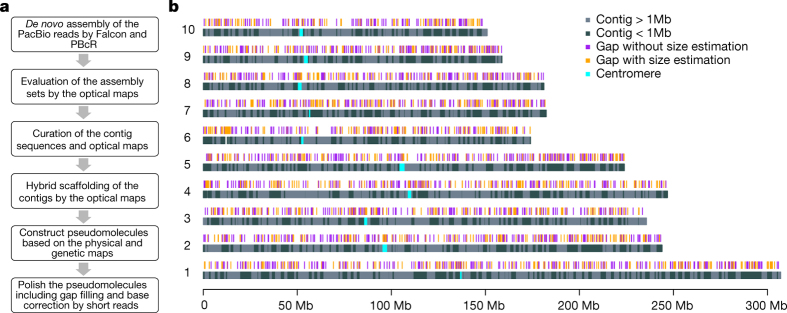
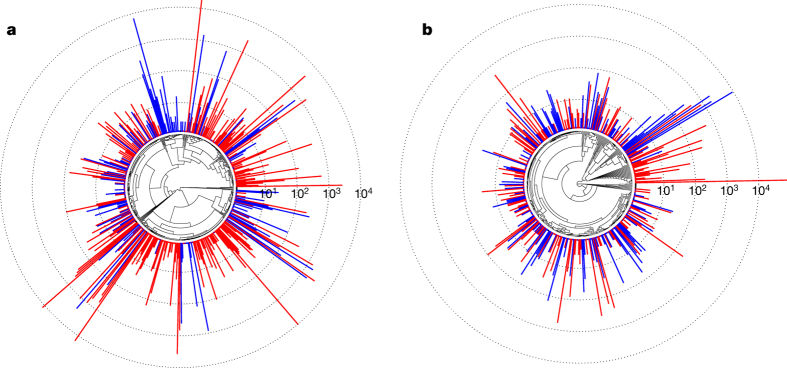
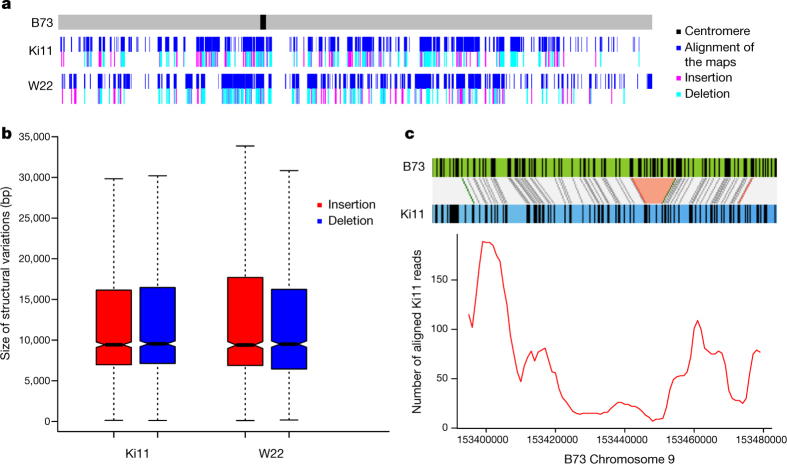
ABSTRACT Complete and accurate reference genomes and annotations provide fundamental tools for characterization of genetic and functional variation. These resources facilitate elucidation of biological processes and support translation of research findings into improved and sustainable agricultural technologies. Many reference genomes for crop plants have been generated over the past decade, but these genomes are often fragmented and missing complex repeat regions. Here, we report the assembly and annotation of maize, a genetic and agricultural model species, using Single Molecule Real-Time (SMRT) sequencing and high-resolution optical mapping. Relative to the previous reference genome, our assembly features a 52-fold increase in contig length and significant improvements in the assembly of intergenic spaces and centromeres. Characterization of the repetitive portion of the genome revealed over 130,000 intact transposable elements (TEs), allowing us to identify TE lineage expansions unique to maize. Gene annotations were updated using 111,000 full-length transcripts obtained by SMRT sequencing. In addition, comparative optical mapping of two other inbreds revealed a prevalence of deletions in the low gene density region and maize lineage-specific genes.
Overview
The claims and statistics of this paper haven’t been checked yet.
Run the check — free, no account needed. It reads the open-access text and checks the sources it cites.
Integrity signals
Registry
Cites
Statistics
Figures
Verification
Claims the paper makes
The claims and statistics of this paper haven’t been checked yet.
Run the check — free, no account needed. It reads the open-access text and checks the sources it cites.
Claims other papers make about this one
Each is checked against this paper’s own text: does it say what the citing paper says it does?
In the citing paper
“For instance, the maize reference genome harbors >100,000 LTR elements falling into ~20,000 distinct families accounting for about half of the genomic DNA (Jiao et al. 2017).”
From RepeatModeler2 for automated genomic discovery of transposable element families (2020) · cites this paper as Jiao et al. 2017
Self-check
Percentages, sums and reported differences re-computed from the paper’s own numbers.
The self-check needs the paper’s full text.
Citations
Cites
The Sequence Alignment/Map format and SAMtools
Li, H., Handsaker, B., Wysoker, A., Fennell, T., Ruan, J., Homer, N., Marth, G., Abecasis, G., Durbin, R., & 1000 Genome Project Data Processing Subgroup (2009) · Bioinformatics · doi:10.1093/bioinformatics/btp352 · Cited by 62,041
Fast and accurate short read alignment with Burrows-Wheeler transform
Li, H., & Durbin, R. (2009) · Bioinformatics · doi:10.1093/bioinformatics/btp324 · Cited by 58,607
Fast gapped-read alignment with Bowtie 2
Langmead, B., & Salzberg, S. L. (2012) · Nature Methods · doi:10.1038/nmeth.1923 · Cited by 56,400
Walker, B. J., Abeel, T., Shea, T., Priest, M., Abouelliel, A., Sakthikumar, S., Cuomo, C. A., Zeng, Q., Wortman, J., Young, S. K., et al. (2014) · PLoS ONE · doi:10.1371/journal.pone.0112963 · Cited by 9,197
Versatile and open software for comparing large genomes
Kurtz, S., Phillippy, A., Delcher, A. L., Smoot, M., Shumway, M., Antonescu, C., & Salzberg, S. L. (2004) · Genome Biology · doi:10.1186/gb-2004-5-2-r12 · Cited by 5,254
The B73 Maize Genome: Complexity, Diversity, and Dynamics
Schnable, P. S., Ware, D., Fulton, R. S., Stein, J. C., Wei, F., Pasternak, S., Liang, C., Zhang, J., Fulton, L., Graves, T., et al. (2009) · Science · doi:10.1126/science.1178534 · Cited by 4,096
Self-citationTransposable elements and the epigenetic regulation of the genome
Slotkin, R. K., & Martienssen, R. (2007) · Nature Reviews Genetics · doi:10.1038/nrg2072 · Cited by 2,044
Phased diploid genome assembly with single-molecule real-time sequencing
Chin, C.-S., Peluso, P., Sedlazeck, F. J., Nattestad, M., Concepcion, G. T., Clum, A., Dunn, C., O'Malley, R., Figueroa-Balderas, R., Morales-Cruz, A., et al. (2016) · Nature Methods · doi:10.1038/nmeth.4035 · Cited by 1,904
Self-citationThe origin and behavior of mutable loci in maize
McClintock, B. (1950) · Proceedings of the National Academy of Sciences · doi:10.1073/pnas.36.6.344 · Cited by 1,747
LTRharvest, an efficient and flexible software for de novo detection of LTR retrotransposons
Ellinghaus, D., Kurtz, S., & Willhoeft, U. (2008) · BMC Bioinformatics · doi:10.1186/1471-2105-9-18 · Cited by 1,641
Cited by
RepeatModeler2 for automated genomic discovery of transposable element families
Flynn, J. M., Hubley, R., Goubert, C., Rosen, J., Clark, A. G., Feschotte, C., & Smit, A. F. (2020) · Proceedings of the National Academy of Sciences · doi:10.1073/pnas.1921046117 · Cited by 3,848
Piercing the dark matter: bioinformatics of long-range sequencing and mapping
Sedlazeck, F. J., Lee, H., Darby, C. A., & Schatz, M. C. (2018) · Nature Reviews Genetics · doi:10.1038/s41576-018-0003-4 · Cited by 530
The population genetics of structural variants in grapevine domestication
Zhou, Y., Minio, A., Massonnet, M., Solares, E., Lv, Y., Beridze, T., Cantu, D., & Gaut, B. S. (2019) · Nature Plants · doi:10.1038/s41477-019-0507-8 · Cited by 339
TRITEX: chromosome-scale sequence assembly of Triticeae genomes with open-source tools
Monat, C., Padmarasu, S., Lux, T., Wicker, T., Gundlach, H., Himmelbach, A., Ens, J., Li, C., Muehlbauer, G. J., Schulman, A. H., et al. (2019) · Genome Biology · doi:10.1186/s13059-019-1899-5 · Cited by 251
Yang, T., Liu, R., Luo, Y., Hu, S., Wang, D., Wang, C., Pandey, M. K., Ge, S., Xu, Q., Li, N., et al. (2022) · Nature Genetics · doi:10.1038/s41588-022-01172-2 · Cited by 191
Metadata
- Authors
- Jiao, Y., Peluso, P., Shi, J., Liang, T., Stitzer, M. C., Wang, B., Campbell, M. S., Stein, J. C., Wei, X., Chin, C.-S., Guill, K., Regulski, M., Kumari, S., Olson, A., Gent, J., Schneider, K. L., Wolfgruber, T. K., May, M. R., Springer, N. M., Antoniou, E., McCombie, W. R., Presting, G. G., McMullen, M., Ross-Ibarra, J., Dawe, R. K., Hastie, A., Rank, D. R., & Ware, D.
- Venue
- Nature
- Published
- 2017-06
- Volume
- 546
- Issue
- 7659
- Pages
- 524-527
- ISSN
- 0028-0836
- 1476-4687
- PMC
- PMC7052699
- Cited by
- 1,210
- References
- 51
- Language
- en
- Licence
- creativecommons.org/licenses/by/4.0 (tdm)
About these checks
Registry, retraction, Cites and statistics results are computed, not judged, with one exception: a printed reference that no index lists is read once by a model before it counts as a citation error. Claims are extracted by a model and kept only when their quote appears verbatim in the text; each cited source is then checked, with a model’s help, for whether it says what the claim relies on. Those verdicts can be wrong — read the claim’s quote and the cited source before relying on one.
Statistics and arithmetic are recomputed, not judged.
Confidence bands are shown only for fields calibrated on our annotated test set. None is calibrated yet, so no band is shown.
What counts as a claim ›How we measure confidence ›How we check this ›
Are you an author, or do you see a problem with this page? Request a review
How to cite
Cite CoChat for the checks on this page, and the paper for its own findings.
- This page
- CoChat. (2026). Citation check: Improved maize reference genome with single-molecule technologies. https://app.cochat.ai/papers/10.1038/nature22971
- The paper
- Jiao, Y., Peluso, P., Shi, J., Liang, T., Stitzer, M. C., Wang, B., Campbell, M. S., Stein, J. C., Wei, X., Chin, C.-S., Guill, K., Regulski, M., Kumari, S., Olson, A., Gent, J., Schneider, K. L., Wolfgruber, T. K., May, M. R., Springer, N. M., . . . Ware, D. (2017). Improved maize reference genome with single-molecule technologies. Nature. https://doi.org/10.1038/nature22971
Data sources
Bibliographic data: Semantic Scholar, OpenAlex, Crossref.
Contains information from the Semantic Scholar Academic Graph Datasets, made available under the ODC Attribution License (ODC-BY 1.0).
Semantic Scholar’s data is described in: Kinney, R., et al. (2023). The Semantic Scholar Open Data Platform. arXiv:2301.10140.
