

Adding control to arbitrary unknown quantum operations
Open accessThe DOI matches its Crossref record; 42 of the 42 references it cites were found in a registry or an index.
Abstract
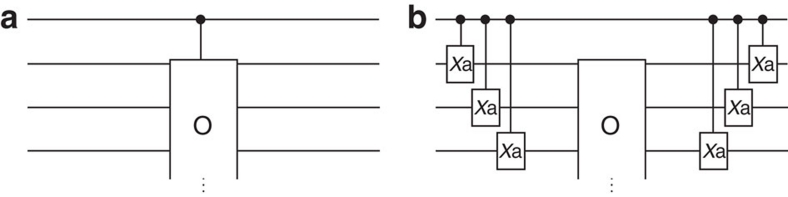
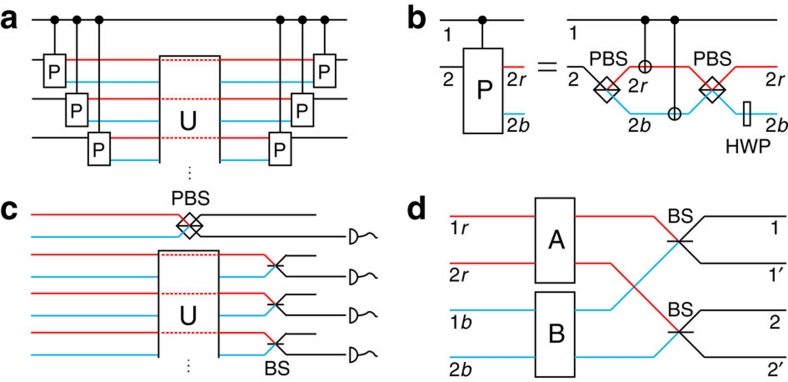
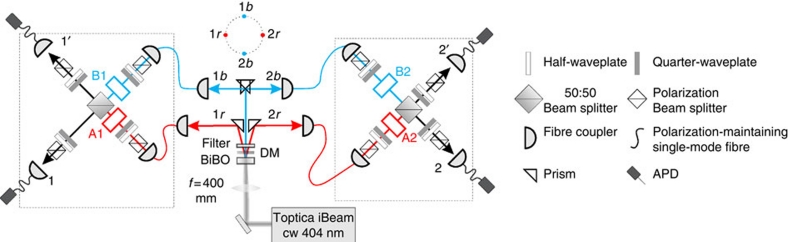
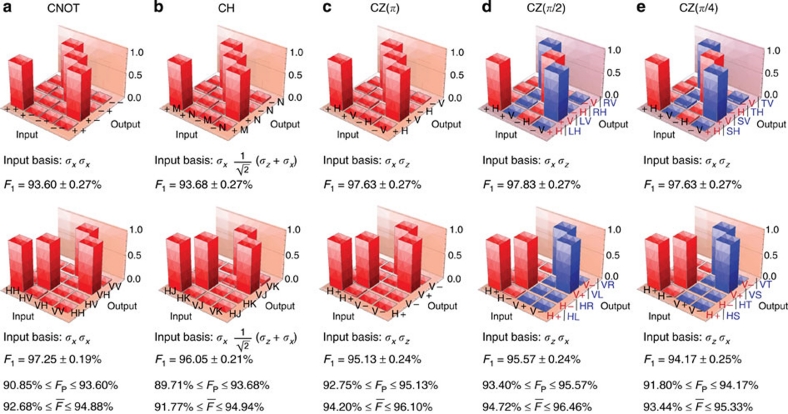
Although quantum computers promise significant advantages, the complexity of quantum algorithms remains a major technological obstacle. We have developed and demonstrated an architecture-independent technique that simplifies adding control qubits to arbitrary quantum operations—a requirement in many quantum algorithms, simulations and metrology. The technique, which is independent of how the operation is done, does not require knowledge of what the operation is, and largely separates the problems of how to implement a quantum operation in the laboratory and how to add a control. Here, we demonstrate an entanglement-based version in a photonic system, realizing a range of different two-qubit gates with high fidelity. Quantum computing has advantages over conventional computing, but the complexity of quantum algorithms creates technological challenges. Here, an architecture-independent technique, that simplifies adding control qubits to arbitrary quantum operations, is developed and demonstrated.
Overview
The claims and statistics of this paper haven’t been checked yet.
Free: it reads the open-access text and checks the first 5 claims that cite a source we can check. Create a free account to check every claim.
Integrity signals
Registry
Cites
Statistics
Figures
Verification
Claims the paper makes
The claims and statistics of this paper haven’t been checked yet.
Free: it reads the open-access text and checks the first 5 claims that cite a source we can check. Create a free account to check every claim.
Claims other papers make about this one
Each is checked against this paper’s own text: does it say what the citing paper says it does?
The source backs part of the claim, not all of it — or backs it for a different population, condition or comparison.
In the citing paper
“In principle, efficient quantum computation can be achieved using single-photon sources, linear optics, and single-photon detectors [25, 29, 30].”
From Experimental Quantum Computing to Solve Systems of Linear Equations (2013) · cites this paper as [25]
Experimental — accuracy not yet measuredIn the citing paper
“The technique of coherently controlling multiple qubits and executing complex, multiple-gate quantum circuits presents an advance on linear optics quantum computation [21, 25] and allows to test other similar quantum algorithms such as solving differential equations [26, 27] and data fitting [28].”
From Experimental Quantum Computing to Solve Systems of Linear Equations (2013) · cites this paper as [25]
Self-check
Percentages, sums and reported differences re-computed from the paper’s own numbers.
The self-check needs the paper’s full text.
Citations
Cites
Quantum Computation and Quantum Information
Nielsen, M. A., Chuang, I., & Grover, L. K. (2002) · American Journal of Physics · doi:10.1119/1.1463744 · Cited by 21,895
Quantum computation and quantum information
Law, J. (2001) · ACM SIGSOFT Software Engineering Notes · doi:10.1145/505482.505499 · Cited by 18,842
Algorithms for quantum computation: discrete logarithms and factoring
Shor, P. W. (2002) · Proceedings 35th Annual Symposium on Foundations of Computer Science · doi:10.1109/sfcs.1994.365700 · Cited by 8,713
Gisin, N., Ribordy, G., Tittel, W., & Zbinden, H. (2002) · Reviews of Modern Physics · doi:10.1103/revmodphys.74.145 · Cited by 8,515
Simulating physics with computers
Feynman, R. P. (1982) · International Journal of Theoretical Physics · doi:10.1007/bf02650179 · Cited by 7,691
A scheme for efficient quantum computation with linear optics
Knill, E., Laflamme, R., & Milburn, G. J. (2001) · Nature · doi:10.1038/35051009 · Cited by 5,880 · cited 1×
“This entanglement-based scheme would be useful for small-scale applications as well as subroutines in larger calculations, and it could be made deterministic, following the original prescription for linear optical quantum computatio”
MethodRaussendorf, R., & Briegel, H. J. (2001) · Physical Review Letters · doi:10.1103/physrevlett.86.5188 · Cited by 4,477 · cited 1×
“We then show that the equivalent operation can be achieved by exploiting an entangled initial state—reminiscent, but distinct from, cluster state quantum computin”
BackgroundQuantum Mechanics Helps in Searching for a Needle in a Haystack
Grover, L. K. (1997) · Physical Review Letters · doi:10.1103/physrevlett.79.325 · Cited by 4,306 · cited 1×
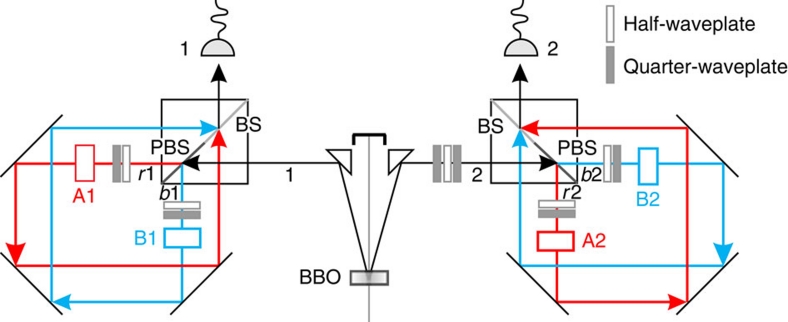
“Then two spatial modes 1r,1b (2r,2b) of photon 1 (2) are combined at a Bs.”
BackgroundLadd, T. D., Jelezko, F., Laflamme, R., Nakamura, Y., Monroe, C., & O’Brien, J. L. (2010) · Nature · doi:10.1038/nature08812 · Cited by 3,592
Self-citationHansen, H. M., Hurwitz, W. N., & Madow, W. G. (1953) · Wiley eBooks · Cited by 1,614
Cited by
Items 101–182 of 182
Algorithmic Primitives for Quantum-Assisted Quantum Control
Policharla, G.-V., & Vinjanampathy, S. (2021) · Physical Review Letters · doi:10.1103/physrevlett.127.220504 · Cited by 6
Delben, G. J., & da Luz, M. G. E. (2016) · Quantum Information Processing · doi:10.1007/s11128-016-1241-z · Cited by 6
“, essential to deal with arbitrary quantum operations in quantum computation [47,48]); (c) straightforward to apply in the fundamental case of V representing an external laser field [1,4]; and (d) generic regarding the system characteristics, i.”
MethodThe Power of Qutrit Logic for Quantum Computation
Luo, M.-X., Ma, S.-Y., Chen, X., & Yang, Y. (2013) · International Journal of Theoretical Physics · doi:10.1007/s10773-013-1586-3 · Cited by 7
Algorithmic Primitives for Quantum-Assisted Quantum Control
Policharla, G.-V., & Vinjanampathy, S. (2020) · arXiv · doi:10.48550/arxiv.2011.13777 · Cited by 6
Dark-state photonic entanglement filters
Longhi, S. (2025) · Optics Letters · doi:10.1364/ol.565738 · Cited by 5
Aungskunsiri, K., Bonneau, D., Carolan, J., Fry, D., Hadden, J. P., Ho, S., Kennard, J., Knauer, S., Martín-López, E., Meinecke, J. D. A., et al. (2013) · Conference on Lasers and Electro-Optics Europe & European Quantum Electronics Conference (CLEO/Europe-EQEC) · doi:10.1109/cleoe-iqec.2013.6801611 · Cited by 5
Self-citationMultiple multicontrol unitary operations: Implementation and applications
Lin, Q. (2018) · Science China Physics Mechanics and Astronomy · doi:10.1007/s11433-017-9140-8 · Cited by 5
Experimental implementation of arbitrary entangled operations
Hong, S., Park, C. H., Choi, Y.-H., Kim, Y.-S., Cho, Y., Oh, K., & Lim, H. (2020) · New Journal of Physics · doi:10.1088/1367-2630/abb64a · Cited by 5
Experimental superposition of time directions
Strömberg, T., Schiansky, P., Quintino, M. T., Antesberger, M., Rozema, L. A., Agresti, I., Brukner, Č., & Walther, P. J. (2022) · Zenodo (CERN European Organization for Nuclear Research) · doi:10.5281/zenodo.7352614 · Cited by 5
Precision magnetometry exploiting excited state quantum phase transitions
Wang, Q., & Marzolino, U. (2024) · SciPost Physics · doi:10.21468/scipostphys.17.2.043 · Cited by 4
“3, is dominated by the time of the controlled unitaries ĈU t (reducible to the time-evolution Ût = e−iĤht [66, 67, 68, 69, 70]), namely t = 2j∆t with j = 0,1, .”
BackgroundUnlocking the advantage of qubit communication in multi-node network configurations
Chakraborty, A., Naik, S. G., Lobo, E. P., Patra, R. K., Sen, S., Alimuddin, M., Mukherjee, A., & Banik, M. (2025) · New Journal of Physics · doi:10.1088/1367-2630/adb174 · Cited by 6
Universal weighted graph state generation with the cross phase modulation
Hu, J., & Lin, Q. (2016) · The European Physical Journal D · doi:10.1140/epjd/e2016-70075-y · Cited by 4
Realization of a hybrid multi-qubit quantum phase gate in circuit QED
Zhang, Y., Su, Q.-P., Kang, Y., Zheng, W., Li, S., Yang, C., & Yu, Y. (2024) · Applied Physics Letters · doi:10.1063/5.0227281 · Cited by 5
Coherent randomized benchmarking
Miguel-Ramiro, J., Pirker, A., & Dür, W. (2021) · Physical Review Research · doi:10.1103/physrevresearch.3.033038 · Cited by 4
Generalized Hofmann quantum process fidelity bounds for quantum filters
Sedlák, M., & Fiurášek, J. (2016) · Physical Review A · doi:10.1103/physreva.93.042316 · Cited by 4
Bertlmann, R. A., & Friis, N. (2023) · Oxford University Press eBooks · doi:10.1093/oso/9780199683338.003.0012 · Cited by 3
Entanglement meter: estimation of entanglement with single copy in interferometer
Kanjilal, S., Pandey, V., & Pati, A. K. (2023) · New Journal of Physics · doi:10.1088/1367-2630/accd8d · Cited by 4
Quantum photonic gates with two-dimensional random walkers
Gangaraj, S. A. H., & Nguyen, D. T. (2025) · Optics Express · doi:10.1364/oe.550032 · Cited by 5
Experimental replication of single-qubit quantum phase gates
Mičuda, M., Stárek, R., Straka, I., Miková, M., Sedlák, M., Ježek, M., & Fiurášek, J. (2016) · Physical Review A · doi:10.1103/physreva.93.052318 · Cited by 3
Optical quantum router with cross-phase modulation
Chen, Y., & Lin, Q. (2014) · Science China Information Sciences · doi:10.1007/s11432-014-5217-2 · Cited by 4
Quantum Channels and Quantum Operations
Bertlmann, R. A., & Friis, N. (2023) · Oxford University Press eBooks · doi:10.1093/oso/9780199683338.003.0021 · Cited by 2
Bypassing eigenstate thermalization with experimentally accessible quantum dynamics
Vikram, A. (2026) · SciPost Physics · doi:10.21468/scipostphys.21.1.029 · Cited by 5
Quantum algorithms for learning Walsh spectra of multi-output Boolean functions
Jingyi, C., Guo, J., Xu, L., & Li, M. (2019) · Quantum Information Processing · doi:10.1007/s11128-019-2303-9 · Cited by 2
“References[41–43] introduced several approaches for adding a control qubit to an unknown operation.”
BackgroundError convergence of quantum linear system solvers
Ginzburg, M. D., & Marzolino, U. (2026) · Physical Review A · doi:10.1103/rjvs-sj7h · Cited by 3
Implementation of a quantum Fredkin gate using an entanglement resource
Ferreyrol, F., Ralph, T. C., & Pryde, G. J. (2013) · Conference on Lasers and Electro-Optics Europe & European Quantum Electronics Conference (CLEO/Europe-EQEC) · doi:10.1109/cleoe-iqec.2013.6801703 · Cited by 2
Self-citationAlternative scheme of universal optical programmable multi-qubit gates for polarization qubits
Pewkhom, P., Suwanna, S., & Kalasuwan, P. (2020) · Quantum Information Processing · doi:10.1007/s11128-020-02699-1 · Cited by 2
“Examples of such scenarios, such as controlling operation of an unknown U (2), the complete quantum phaseestimation algorithm via semiclassical Fourier transform, entanglement filters, the quantum approximate optimization algorithm, and Szegedy quantumwalks, have been demonstrated already [18,23,24].”
BackgroundMethodResultSelf-citationQuantum Multiple Valued Kernel Circuits
Sinha, A., & Thornton, M. A. (2022) · IEEE International Symposium on Multiple-Valued Logic (ISMVL) · doi:10.1109/ismvl52857.2022.00008 · Cited by 2
“…memory embedded within the kernel calculation circuit, it is possible to use the four different basis states for the T addr qudit to retrieve the To create the controlled-U j gates, the process described in [17] can be used to add a control qudit to the synthesized U j gates that comprise T data .”
MethodExperimental Quantum Measurement with a Few Photons
Rozema, L. A. (2014) · TSpace (University of Toronto) · Cited by 4
Theory and experimental demonstration of Wigner tomography of unknown unitary quantum gates
Devra, A., Damme, L. V., Ende, F. V., Malvetti, E., & Glaser, S. J. (2026) · Quantum Information Processing · doi:10.1007/s11128-026-05269-z · Cited by 1
Two-qubits Controlled-unitary Quantum Gates for Quantum Computing by Silicon Photonic Chip
Huang, J. G., Kwek, L. C., Gong, J., Gao, W., Chong, Y. D., Ser, W., & Liu, A. Q. (2017) · Conference on Lasers and Electro-Optics · doi:10.1364/cleo_at.2017.jw2a.21 · Cited by 1
“Introduction Quantum computing provides exceptionally high computational power for a wide range of applications, ranging from quantum chemistry, quantum biology to quantum communication [1-3].”
BackgroundShadbolt, P. (2015) · Springer theses · doi:10.1007/978-3-319-21518-1_6 · Cited by 1
A perspective on the Development of Quantum Computers and the Security challenges
Nahi, A. A., Flaih, L. R., & Jasim, K. F. (2022) · Cihan University-Erbil International Conference on Communication Engineering and Computer Science (CIC-COCOS) · doi:10.24086/cocos2022/paper.754 · Cited by 1
The Three-Dimensional Schrödinger Equation
Bertlmann, R. A., & Friis, N. (2023) · Oxford University Press eBooks · doi:10.1093/oso/9780199683338.003.0007 · Cited by 1
Bertlmann, R. A., & Friis, N. (2023) · Oxford University Press eBooks · doi:10.1093/oso/9780199683338.003.0014 · Cited by 1
Bertlmann, R. A., & Friis, N. (2023) · Oxford University Press eBooks · doi:10.1093/oso/9780199683338.003.0013 · Cited by 1
Bertlmann, R. A., & Friis, N. (2023) · Oxford University Press eBooks · doi:10.1093/oso/9780199683338.003.0018 · Cited by 2
Variational Learning of Integrated Quantum Photonic Circuits via Genetic Algorithm
Zhang, H., Yang, C., Mok, W., Wan, L., Cai, H. N., Li, Q., Gao, F., Luo, X., Lo, G., Chin, L. K., et al. (2024) · Laser & Photonics Review · doi:10.1002/lpor.202400359 · Cited by 2
Algorithms Bridging Quantum Computation and Chemistry
McClean, J. R. (2015) · Digital Access to Scholarship at Harvard (DASH) (Harvard University) · Cited by 2
Bertlmann, R. A., & Friis, N. (2023) · Oxford University Press eBooks · doi:10.1093/oso/9780199683338.003.0006 · Cited by 1
Entanglement and Simplified Quantum Information Operations
Patel, R. B., Kocsis, S., Ho, J., Hall, M. J. W., Ferreyrol, F., Bennet, A., Ralph, T. C., & Pryde, G. J. (2014) · Frontiers in Optics · doi:10.1364/fio.2014.fw4c.1
Self-citationYing, M. (2016) · Elsevier eBooks · doi:10.1016/b978-0-12-802306-8.00006-9
Controlled unknown quantum operations on hybrid systems
He, Y., & Luo, M.-X. (2016) · Chinese Physics B · doi:10.1088/1674-1056/25/12/120304
Quantum algorithms on a four-qubit photonic controlled-shift gate
Ho, J., Patel, R. B., Ralph, T. C., & Pryde, G. J. (2019) · Quantum Information and Measurement (QIM) · doi:10.1364/qim.2019.f5a.41
Self-citation(2016) · Elsevier eBooks · doi:10.1016/b978-0-12-802306-8.09999-7
Bachor, H., & Ralph, T. C. (2019) · Wiley eBooks · doi:10.1002/9783527695805.ch13
Self-citationBertlmann, R. A., & Friis, N. (2023) · Oxford University Press eBooks · doi:10.1093/oso/9780199683338.002.0003
Bertlmann, R. A., & Friis, N. (2023) · Oxford University Press eBooks · doi:10.1093/oso/9780199683338.002.0004
Particle Physics—Bell Inequalities
Bertlmann, R. A., & Friis, N. (2023) · Oxford University Press eBooks · doi:10.1093/oso/9780199683338.003.0026
Bertlmann, R. A., & Friis, N. (2023) · Oxford University Press eBooks · doi:10.1093/oso/9780199683338.003.0019
Bertlmann, R. A., & Friis, N. (2023) · Oxford University Press eBooks · doi:10.1093/oso/9780199683338.003.0011
Bertlmann, R. A., & Friis, N. (2023) · Oxford University Press eBooks · doi:10.1093/oso/9780199683338.003.0025
Bertlmann, R. A., & Friis, N. (2023) · Oxford University Press eBooks · doi:10.1093/oso/9780199683338.002.0006
The Time-Independent Schrödinger Equation
Bertlmann, R. A., & Friis, N. (2023) · Oxford University Press eBooks · doi:10.1093/oso/9780199683338.003.0004
Bertlmann, R. A., & Friis, N. (2023) · Oxford University Press eBooks · doi:10.1093/oso/9780199683338.003.0023
Mathematical Formalism of Quantum Mechanics
Bertlmann, R. A., & Friis, N. (2023) · Oxford University Press eBooks · doi:10.1093/oso/9780199683338.003.0003
Open Quantum Systems, Decoherence, Atom-Field Coupling
Bertlmann, R. A., & Friis, N. (2023) · Oxford University Press eBooks · doi:10.1093/oso/9780199683338.003.0022
The Time-Dependent Schrödinger Equation
Bertlmann, R. A., & Friis, N. (2023) · Oxford University Press eBooks · doi:10.1093/oso/9780199683338.003.0002
Perturbative Methods in Quantum Mechanics
Bertlmann, R. A., & Friis, N. (2023) · Oxford University Press eBooks · doi:10.1093/oso/9780199683338.003.0010
Bertlmann, R. A., & Friis, N. (2023) · Oxford University Press eBooks · doi:10.1093/oso/9780199683338.002.0008
Bertlmann, R. A., & Friis, N. (2023) · Oxford University Press eBooks · doi:10.1093/oso/9780199683338.003.0024
Electromagnetism in Quantum Mechanics
Bertlmann, R. A., & Friis, N. (2023) · Oxford University Press eBooks · doi:10.1093/oso/9780199683338.003.0009
Bertlmann, R. A., & Friis, N. (2023) · Oxford University Press eBooks · doi:10.1093/oso/9780199683338.003.0001
Bertlmann, R. A., & Friis, N. (2023) · Oxford University Press eBooks · doi:10.1093/oso/9780199683338.003.0008
High-Dimensional Quantum Systems
Bertlmann, R. A., & Friis, N. (2023) · Oxford University Press eBooks · doi:10.1093/oso/9780199683338.003.0017
Quantum Entropy and Correlations in Quantum Information
Bertlmann, R. A., & Friis, N. (2023) · Oxford University Press eBooks · doi:10.1093/oso/9780199683338.003.0020
Quantification and Conversion of Entanglement
Bertlmann, R. A., & Friis, N. (2023) · Oxford University Press eBooks · doi:10.1093/oso/9780199683338.003.0016
Particle Physics—Entanglement and Decoherence
Bertlmann, R. A., & Friis, N. (2023) · Oxford University Press eBooks · doi:10.1093/oso/9780199683338.003.0027
Bertlmann, R. A., & Friis, N. (2023) · Oxford University Press eBooks · doi:10.1093/oso/9780199683338.003.0015
The Quantum Harmonic Oscillator
Bertlmann, R. A., & Friis, N. (2023) · Oxford University Press eBooks · doi:10.1093/oso/9780199683338.003.0005
Ying, M. (2024) · Elsevier eBooks · doi:10.1016/b978-0-44-315942-8.00024-1
(2024) · Elsevier eBooks · doi:10.1016/b978-0-44-315942-8.00030-7
Distributed Quantum Computations
Luo, M. (2024) · Springer eBooks · doi:10.1007/978-981-97-6226-2_5
Efficient Quantum Estimation of Hamiltonian Spectra via Shallow Circuits
Zhu, P., Wu, C., Wang, Y., Liu, J., Xia, G., Wang, Y., Zheng, Q., Yu, M., Zhao, C. M., Du, Y., et al. (2025) · Journal of Chemical Theory and Computation · doi:10.1021/acs.jctc.4c01601
Digital Quantum Simulation of Wavepacket Correlations in a Chemical Reaction
Mohtashim, S. I., & Kais, S. (2026) · Entropy · doi:10.3390/e28020144
“Mathematically, so, in circuit form, each U must be promoted to a controlled operation [33].”
Dong, Q. (2021) · Institutional Repositories DataBase (IRDB) · doi:10.15083/0002006665
Multipartite causal relations in quantum theory
Wechs, J. (2020) · theses.fr (ABES) · doi:10.70675/ee7ec00fz8807z4385z99aezdcb6820ec8aa · Cited by 1
Controlling the spectral properties of quantum light sources based on a quantum dot in a nanowire
Kotal, S. (2021) · theses.fr (ABES) · doi:10.70675/58f335acz8948z4dd1z91d7z0543236bcff2 · Cited by 2
Experimental qudit-assisted quantum operations by dimension expansion and partial measurement
Chi, Y., Pan, C., Lu, X. P., Zhu, Y., & Wang, F. (2026) · APL Photonics · doi:10.1063/5.0309870 · Cited by 1
Quantumness of quantum phase estimation algorithms
Marzolino, U. (2026) · Annals of Physics · doi:10.1016/j.aop.2026.170599
Linear optical fan-out gates using fewer ancillary single photons with enhanced success probability
Liu, W., & Wei, H. (2026) · Physical Review Applied · doi:10.1103/cs4d-lpfj · Cited by 1
Experimental Methods for “Experimental Superposition of a Quantum Evolution with Its Time Reverse”
Strömberg, T. (2026) · Springer theses · doi:10.1007/978-3-032-14267-2_6
Metadata
- Authors
- Zhou, X.-Q., Ralph, T. C., Kalasuwan, P., Zhang, M., Peruzzo, A., Lanyon, B. P., & O'Brien, J. L.
- Affiliations
- The University of Queensland (AU)
- University of Bristol (GB)
- Cornell University (US)
- Universität Innsbruck (AT)
- Venue
- Nature Communications
- Published
- 2011-08-02
- Volume
- 2
- Issue
- 1
- Pages
- 413-413
- ISSN
- 2041-1723 (ISSN-L)
- PMC
- PMC3267055
- OpenAlex
- W2134719239
- Cited by
- 173
- References
- 42
- Citations by year
- 2026: 6 · 2025: 8 · 2024: 11 · 2023: 42 · 2022: 10 · 2021: 15 · 2020: 8 · 2019: 9 · 2018: 8 · 2017: 6 · 2016: 15 · 2015: 6 · 2014: 18 · 2013: 9 · 2012: 1
- FWCI
- 8.53
- Type
- journal article
- Language
- en
- Open access
- hybrid
- doi.org
- Licence
- cc-by-nc-nd
- creativecommons.org/licenses/by-nc-nd/3.0/ (tdm)
- creativecommons.org/licenses/by-nc-nd/3.0/ (vor)
- Locations
- Nature Communications (publishedVersion, cc-by-nc-nd)
- Europe PMC (PubMed Central) (publishedVersion, cc-by-nc-nd)
- PubMed Central (publishedVersion, cc-by-nc-nd)
- PubMed (publishedVersion)
- arXiv (Cornell University) (submittedVersion)
- UWA Profiles and Research Repository (UWA) (submittedVersion, cc-by)
- RePEc: Research Papers in Economics (submittedVersion)
- RMIT Research Repository (RMIT University Library) (submittedVersion)
- Figshare (submittedVersion)
- Explore Bristol Research (submittedVersion)
- Bristol Research (University of Bristol) (submittedVersion)
- arXiv (Cornell University)
- Funders
- Leverhulme Trust
- Intelligence Advanced Research Projects Activity
- Engineering and Physical Sciences Research Council (EP/F010524/1)
- Topics
- Physical Sciences › Computer Science › Artificial Intelligence › Quantum Computing Algorithms and Architecture
- Physical Sciences › Physics and Astronomy › Atomic and Molecular Physics, and Optics › Quantum Information and Cryptography
- Physical Sciences › Physics and Astronomy › Atomic and Molecular Physics, and Optics › Quantum Mechanics and Applications
- Keywords
- quantum photonics, two-qubit gates, gate fidelity, quantum algorithms
About these checks
Registry, retraction, Cites and statistics results are computed, not judged, with one exception: a printed reference that no index lists is read once by a model before it counts as a citation error. Claims are extracted by a model and kept only when their quote appears verbatim in the text; each cited source is then checked, with a model’s help, for whether it says what the claim relies on. Those verdicts can be wrong — read the claim’s quote and the cited source before relying on one.
Statistics and arithmetic are recomputed, not judged.
Confidence bands are shown only for fields calibrated on our annotated test set. None is calibrated yet, so no band is shown.
What counts as a claim ›How we measure confidence ›How we check this ›
Are you an author, or do you see a problem with this page? Request a review
Data sources
Bibliographic data: Semantic Scholar, OpenAlex, Crossref.
Contains information from the Semantic Scholar Academic Graph Datasets, made available under the ODC Attribution License (ODC-BY 1.0).
Semantic Scholar’s data is described in: Kinney, R., et al. (2023). The Semantic Scholar Open Data Platform. arXiv:2301.10140.
