

Optimal adaptive control for quantum metrology with time-dependent Hamiltonians
Open accessThe DOI matches its Crossref record; 79 of the 79 references it cites were found in a registry or an index.
Abstract
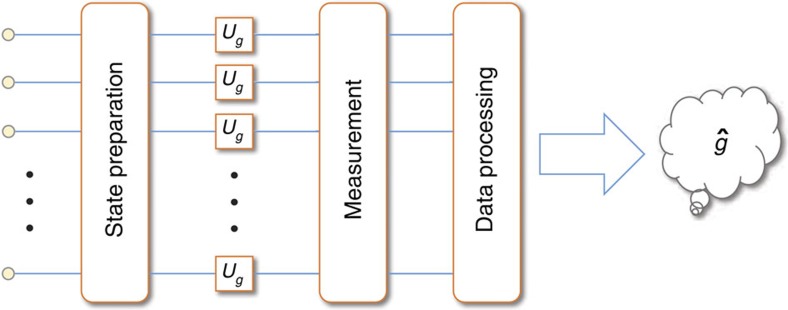
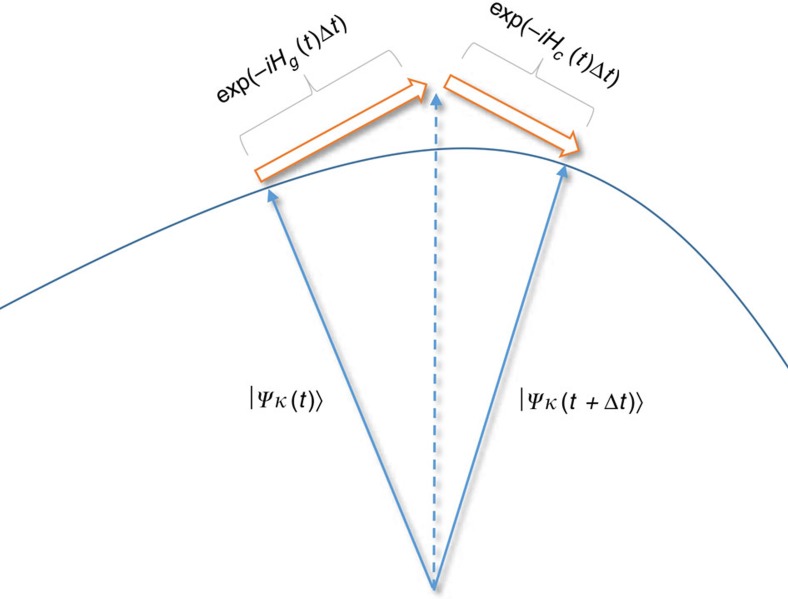
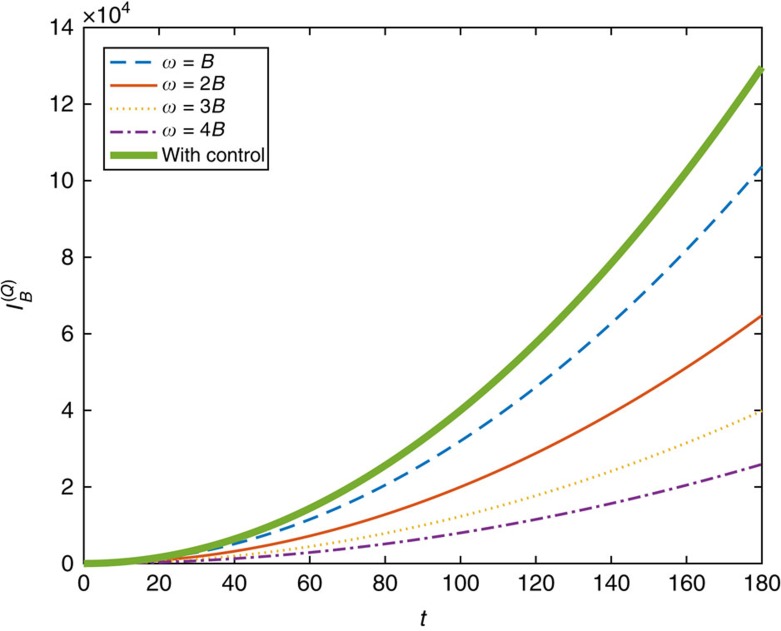
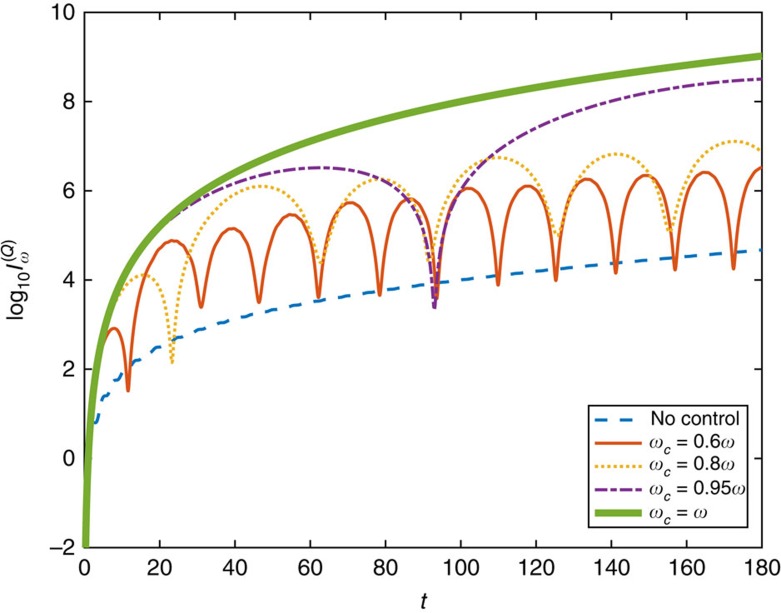
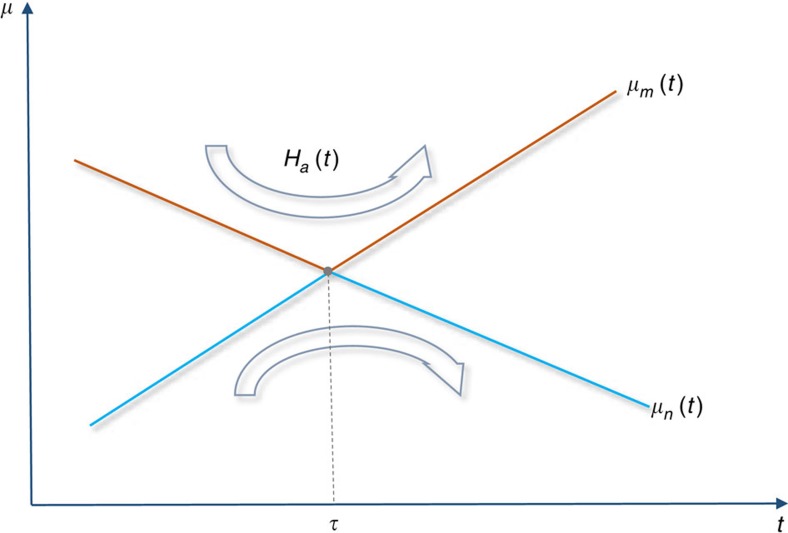
Abstract Quantum metrology has been studied for a wide range of systems with time-independent Hamiltonians. For systems with time-dependent Hamiltonians, however, due to the complexity of dynamics, little has been known about quantum metrology. Here we investigate quantum metrology with time-dependent Hamiltonians to bridge this gap. We obtain the optimal quantum Fisher information for parameters in time-dependent Hamiltonians, and show proper Hamiltonian control is generally necessary to optimize the Fisher information. We derive the optimal Hamiltonian control, which is generally adaptive, and the measurement scheme to attain the optimal Fisher information. In a minimal example of a qubit in a rotating magnetic field, we find a surprising result that the fundamental limit of T2 time scaling of quantum Fisher information can be broken with time-dependent Hamiltonians, which reaches T4 in estimating the rotation frequency of the field. We conclude by considering level crossings in the derivatives of the Hamiltonians, and point out additional control is necessary for that case.
Overview
The claims and statistics of this paper haven’t been checked yet.
Free: it reads the open-access text and checks the first 5 claims that cite a source we can check. Create a free account to check every claim.
Integrity signals
Registry
Cites
Statistics
Figures
Verification
Claims the paper makes
The claims and statistics of this paper haven’t been checked yet.
Free: it reads the open-access text and checks the first 5 claims that cite a source we can check. Create a free account to check every claim.
Claims other papers make about this one
Each is checked against this paper’s own text: does it say what the citing paper says it does?
The cited source says what the claim attributes to it.
In the citing paper
“An alternative operator that can be used to characterize the precision limit of unitary process is [50,53,54]”
From Quantum Fisher information matrix and multiparameter estimation (2020) · cites this paper as [54]
Self-check
Percentages, sums and reported differences re-computed from the paper’s own numbers.
The self-check needs the paper’s full text.
Citations
Cites
Mathematical Methods of Statistics.
Geary, R. C., & Cramer, H. (1947) · The Economic Journal · doi:10.2307/2226151 · Cited by 5,927
Aspelmeyer, M., Kippenberg, T. J., & Marquardt, F. (2014) · Reviews of Modern Physics · doi:10.1103/revmodphys.86.1391 · Cited by 5,501 · cited 2×
“Since its birth, quantum metrology has been applied in many areas, ranging from gravitational wave detection 7–9 , quantum clocks 10,11 , quantum imaging 12–14 , to optomechanics 15 , quantum biology 16 and so on.”
Giovannetti, V., Lloyd, S., & Maccone, L. (2011) · Nature Photonics · doi:10.1038/nphoton.2011.35 · Cited by 3,894 · cited 1×
“These have given rise to the wide interest in quantum parameter estimation 3,4 and quantum metrology 5,6 .”
Quantum detection and estimation theory
Helstrom, C. W. (1969) · Journal of Statistical Physics · doi:10.1007/bf01007479 · Cited by 3,776 · cited 2×
“In this case, if a quantum systems undergoes the unitary evolution Ug1⁄4 exp( igH0T) for some time T, the quantum Fisher information (3) that determines the estimation precision of g is Ig 1⁄4 4T2Var H0 1⁄2 cg j i, where Var[ ] represents variance and jcgi is the final state of the system.”
Quantum-mechanical noise in an interferometer
Caves, C. M. (1981) · Physical Review D · doi:10.1103/physrevd.23.1693 · Cited by 3,202 · cited 1×
“On the other hand, quantum mechanics also opens new possibilities for improving measurement sensitivities by utilizing non-classical resources, such as quantum entanglement and squeezing 2 .”
Statistical distance and the geometry of quantum states
Braunstein, S. L., & Caves, C. M. (1994) · Physical Review Letters · doi:10.1103/physrevlett.72.3439 · Cited by 3,176 · cited 1×
“It is shown by refs 59,60 that the maximum Fisher information for a parameter g in a quantum state j c g i over all possible generalized quantum measurements is This is called quantum Fisher information, and is closely related to the Bures distance d s g d g 2 between two adjacent states j c g i…”
Quantum-Enhanced Measurements: Beating the Standard Quantum Limit
Giovannetti, V., Lloyd, S., & Maccone, L. (2004) · Science · doi:10.1126/science.1104149 · Cited by 3,038 · cited 2×
“These have given rise to the wide interest in quantum parameter estimation 3,4 and quantum metrology 5,6 .”
Theory of Statistical Estimation
Fisher, R. A. (1925) · Mathematical Proceedings of the Cambridge Philosophical Society · doi:10.1017/s0305004100009580 · Cited by 2,869 · cited 2×
“:3) j j (cid:4) g Þ 2 is bounded by where n is the amount of data, I g is the Fisher information 57 , and d ^ g h i is the mean systematic error.”
Probabilistic and Statistical Aspects of Quantum Theory
Holevo, A. (2011) · doi:10.1007/978-88-7642-378-9 · Cited by 2,582
Giovannetti, V., Lloyd, S., & Maccone, L. (2006) · Physical Review Letters · doi:10.1103/physrevlett.96.010401 · Cited by 2,440 · cited 3×
“62), where H 0 is time-independent.”
Influential
Cited by
Shortcuts to adiabaticity: Concepts, methods, and applications
Guéry-Odelin, D., Ruschhaupt, A., Kiely, A., Torrontegui, E., Martínez-Garaot, S., & Muga, J. G. (2019) · Reviews of Modern Physics · doi:10.1103/revmodphys.91.045001 · Cited by 1,045
Quantum Fisher information matrix and multiparameter estimation
Liu, J., Yuan, H., Lu, X.-M., & Wang, X. (2020) · Journal of Physics A: Mathematical and Theoretical · doi:10.1088/1751-8121/ab5d4d · Cited by 802
Polino, E., Valeri, M., Spagnolo, N., & Sciarrino, F. (2020) · AVS Quantum Science · doi:10.1116/5.0007577 · Cited by 414
Koch, C. P., Boscain, U., Calarco, T., Dirr, G., Filipp, S., Glaser, S. J., Kosloff, R., Montangero, S., Schulte-Herbrüggen, T., Sugny, D., et al. (2022) · EPJ Quantum Technology · doi:10.1140/epjqt/s40507-022-00138-x · Cited by 405
“When using the quantum Fisher information as figure of merit for estimating the value of an unknown parameter of the Hamiltonian [384], upper bounds for time-dependent Hamiltonians have been established [454].”
MethodCritical Quantum Metrology with a Finite-Component Quantum Phase Transition
Garbe, L., Bina, M., Keller, A., Paris, M. G. A., & Felicetti, S. (2020) · Physical Review Letters · doi:10.1103/physrevlett.124.120504 · Cited by 235
Metadata
- Authors
- Pang, S., & Jordan, A. N.
- Affiliations
- University of Rochester (US)
- Chapman University (US)
- Corresponding author
- Pang, Shengshi
- Venue
- Nature Communications
- Published
- 2017-03-09
- Volume
- 8
- Issue
- 1
- Pages
- 14695-14695
- ISSN
- 2041-1723 (ISSN-L)
- PMC
- PMC5512879
- OpenAlex
- W2580685138
- Cited by
- 195
- References
- 79
- Citations by year
- 2026: 15 · 2025: 26 · 2024: 32 · 2023: 23 · 2022: 30 · 2021: 21 · 2020: 14 · 2019: 16 · 2018: 9 · 2017: 8
- FWCI
- 7.67
- Type
- journal article
- Language
- en
- Open access
- gold
- doi.org
- Licence
- cc-by
- creativecommons.org/licenses/by/4.0 (tdm)
- creativecommons.org/licenses/by/4.0 (vor)
- Locations
- Nature Communications (publishedVersion, cc-by)
- arXiv (Cornell University) (publishedVersion)
- PubMed Central (publishedVersion, cc-by)
- PubMed (publishedVersion)
- RePEc: Research Papers in Economics (submittedVersion)
- DOAJ (DOAJ: Directory of Open Access Journals) (submittedVersion, cc-by-sa)
- arXiv (Cornell University)
- Funders
- National Science Foundation (1506081, W911NF-13)
- Division of Materials Research
- Army Research Office (W911NF-13-1-, W911NF- 15-1-0496, W911NF-15-1-, W911NF-13, W911NF- 13-1-0402, W911NF)
- Topics
- Physical Sciences › Physics and Astronomy › Atomic and Molecular Physics, and Optics › Quantum Information and Cryptography
- Physical Sciences › Computer Science › Artificial Intelligence › Quantum Computing Algorithms and Architecture
- Physical Sciences › Physics and Astronomy › Atomic and Molecular Physics, and Optics › Quantum Mechanics and Applications
- Keywords
- quantum metrology, time-dependent Hamiltonian, adaptive control, Hamiltonian control, rotating magnetic field, qubits, level crossings, quantum parameter estimation
About these checks
Registry, retraction, Cites and statistics results are computed, not judged, with one exception: a printed reference that no index lists is read once by a model before it counts as a citation error. Claims are extracted by a model and kept only when their quote appears verbatim in the text; each cited source is then checked, with a model’s help, for whether it says what the claim relies on. Those verdicts can be wrong — read the claim’s quote and the cited source before relying on one.
Statistics and arithmetic are recomputed, not judged.
Confidence bands are shown only for fields calibrated on our annotated test set. None is calibrated yet, so no band is shown.
What counts as a claim ›How we measure confidence ›How we check this ›
Are you an author, or do you see a problem with this page? Request a review
How to cite
Cite CoChat for the checks on this page, and the paper for its own findings.
- This page
- CoChat. (2026). Citation check: Optimal adaptive control for quantum metrology with time-dependent Hamiltonians. https://app.cochat.ai/papers/10.1038/ncomms14695
- The paper
- Pang, S., & Jordan, A. N. (2017). Optimal adaptive control for quantum metrology with time-dependent Hamiltonians. Nature Communications. https://doi.org/10.1038/ncomms14695
Data sources
Bibliographic data: Semantic Scholar, OpenAlex, Crossref.
Contains information from the Semantic Scholar Academic Graph Datasets, made available under the ODC Attribution License (ODC-BY 1.0).
Semantic Scholar’s data is described in: Kinney, R., et al. (2023). The Semantic Scholar Open Data Platform. arXiv:2301.10140.
