

Quantum Fisher information matrix and multiparameter estimation
Open accessThe DOI matches its Crossref record; 198 of the 198 references it cites were found in a registry or an index; 63 of the 161 sources its claims cite were checked for support.
Abstract
Quantum Fisher information matrix (QFIM) is a core concept in theoretical quantum metrology due to the significant importance of quantum Cramér–Rao bound in quantum parameter estimation. However, studies in recent years have revealed wide connections between QFIM and other aspects of quantum mechanics, including quantum thermodynamics, quantum phase transition, entanglement witness, quantum speed limit and non-Markovianity. These connections indicate that QFIM is more than a concept in quantum metrology, but rather a fundamental quantity in quantum mechanics. In this paper, we summarize the properties and existing calculation techniques of QFIM for various cases, and review the development of QFIM in some aspects of quantum mechanics apart from quantum metrology. On the other hand, as the main application of QFIM, the second part of this paper reviews the quantum multiparameter Cramér–Rao bound, its attainability condition and the associated optimal measurements. Moreover, recent developments in a few typical scenarios of quantum multiparameter estimation and the quantum advantages are also thoroughly discussed in this part.
Overview
CoChat Summary
TL;DR
This topical review presents the quantum Fisher information matrix (QFIM) as both the core quantity of quantum multiparameter estimation and a fundamental quantity in quantum mechanics connected to thermodynamics, phase transitions, entanglement, speed limits, and non-Markovianity. It surveys QFIM properties and calculation techniques, then reviews the quantum multiparameter Cramér-Rao bound, its attainability conditions, optimal measurements, and representative estimation scenarios.
Key findings
- The QFIM is defined via the symmetric logarithmic derivative, \(F_{ab}=\frac12\mathrm{Tr}(\rho\{L_a,L_b\})\), and its diagonal entries are the single-parameter QFIs, \(F_{aa}=\mathrm{Tr}(\rho L_a^2)\).
- The quantum multiparameter Cramér-Rao bound is generally not attainable; the necessary and sufficient saturation condition is \(\mathrm{Tr}(\rho[L_a,L_b])=0\) for all \(a,b\), reducing for pure states to \(\mathrm{Im}(\partial_a\psi|\partial_b\psi)=0\), equivalently zero Berry curvature.
- The review reports calculation methods for full-rank and arbitrary-rank density matrices, pure states, few-qubit states, unitary processes, and Gaussian states, including Bloch-representation and Liouville-space formulas.
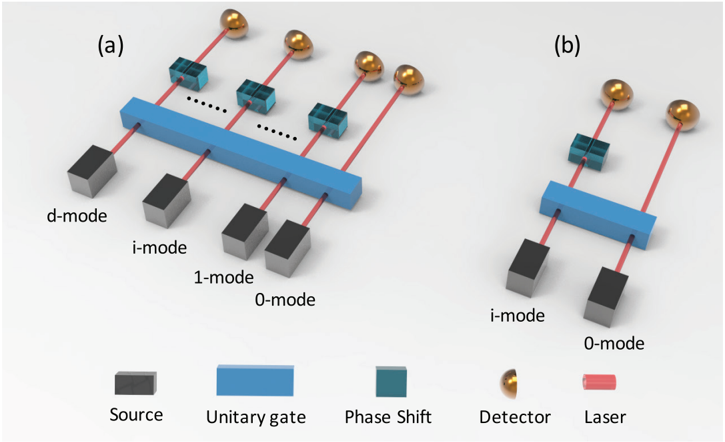
- In multiphase estimation examples, a generalized \((d+1)\)-mode N00N state gives \(\min_{c_1}\mathrm{Tr}(F^{-1})=(1+\sqrt d)^2/(4N^2)\), while a generalized entangled coherent state gives \(\min_{c_1}\mathrm{Tr}(F^{-1})=(1+\sqrt d)^2/[4(1+|\alpha|^2)^2]\), indicating better performance for the latter for most \(d\) and \(|\alpha|\); simultaneous estimation shows an \(O(d)\) advantage over independent estimation in the absence of noise.
Methods
- Design: topical review/textbook-style synthesis of QFIM theory and quantum multiparameter estimation, with technical derivations placed in appendices.
- Data or sample: no experimental sample or primary dataset; the paper reviews mathematical results and literature across quantum metrology, open systems, thermodynamics, quantum dynamics, interferometry, waveform estimation, control-enhanced estimation, and magnetic-field estimation.
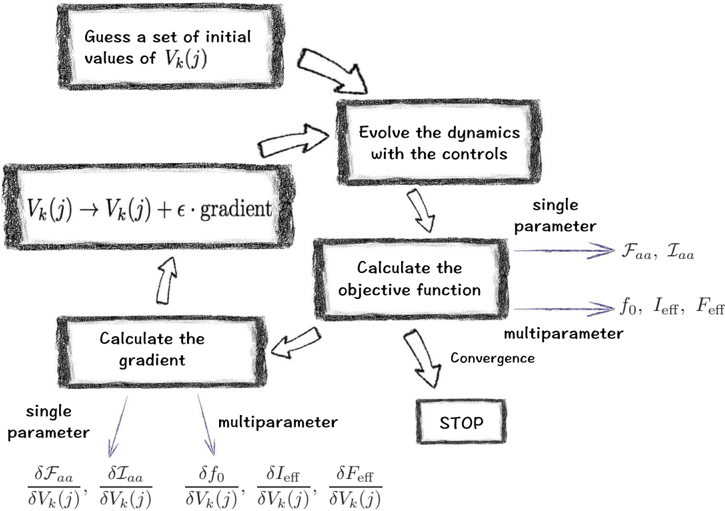
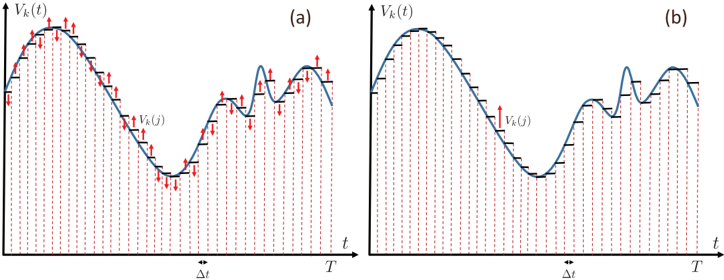
- Main analysis: mathematical derivation and organization of QFIM formulas, properties, attainability conditions, optimal-measurement constructions, and scenario-specific bounds, including Mach-Zehnder interferometry, multiphase estimation, Gaussian states, and GRAPE/Krotov control methods.
Limitations
- The paper states open problems including the design of optimal measurements, especially simple and practical measurements independent of unknown parameters, and the robustness of precision limits against noise and imperfect controls.
- The paper explicitly does not discuss mathematical tools beyond the Cramér-Rao bound, such as Bayesian, Ziv-Zakai, Weiss-Weinstein, and Holevo bounds, referring readers to another review; it also refers nuisance-parameter estimation to a separate review.
- Evident from the text: this is a broad topical review rather than a systematic review or primary study, so coverage is selective and no new experimental validation is provided.
Model-written summary. Check it against the paper before relying on it.
Integrity signals
Registry
Cites
Statistics
Figures
Verification
Claims the paper makes
34 Valid · 11 Not valid · 73 Not checked · 81 Own results and interpretations
The cited sources support only part of this claim — read each source’s verdict below.
In the paper
“An alternative operator that can be used to characterize the precision limit of unitary process is [50,53,54]”
§ Quantum Fisher information matrix and multiparameter estimation > 2.3.4. Unitary processes.
What the sources say
- Partly supportedcites [50] Boixo S, Flammia S T, Caves C M and Geremia J M 2007 Generalized limits for single-parameter quantum estimation Phys. Rev. Lett. 98 090401 sourceExperimental — accuracy not yet measured
On p. 2, the paper identifies Kγ(t) as the Hermitian generator of parameter displacements and relates its variance to Fisher information. On p. 3, it uses Kγ(t) to bound estimation precision. Our copy does not decode the displayed formula defining Kγ(t), so it cannot verify the specific derivative identity in the claim. (LLM, conf=0.82)
- Supportedcites [53] Pang S and Brun T A 2014 Quantum metrology for a general Hamiltonian parameter Phys. Rev. A 90 022117 source
Section III (p. 3) introduces the local parameter-translation generator h_g for unitary evolution and uses it to obtain the quantum Fisher information. Section IV (p. 4) explicitly calls h_g the key to that information, which characterizes the precision limit. The displayed definition in Eq. (9) is not decoded in our copy, but the surrounding text identifies its role and links it to the derivative of U_g. (LLM, conf=0.88)
- Supportedcites [54] Pang S and Jordan A N 2017 Optimal adaptive control for quantum metrology with time-dependent Hamiltonians Nat. Commun. 8 14695 source
In Results > Time-dependent quantum metrology (page unavailable), the paper defines a derivative-based operator for the unitary evolution and says that its eigenvalue gap determines the maximum quantum Fisher information, hence the optimal estimation precision. This supports the cited use of an alternative operator to characterize the precision limit; the mathematical formatting of the operator is incomplete in our copy. (LLM, conf=0.84)
plainstates an association- Asserted: passes — The authors put it forward as true.
- Checkable: passes — It can be checked against evidence.
- Load-bearing: unclear — It is unclear whether the paper’s conclusions depend on it.
- Based: passes — The paper gives a reason why it holds.
- Partly supported
The cited sources support only part of this claim — read each source’s verdict below.
In the paper
“In this case, the H operator for θ can be analytically calculated via equation (51), which is [48]”
§ Quantum Fisher information matrix and multiparameter estimation > 2.3.4. Unitary processes.
What the sources say
- Partly supportedcites [48] Liu J, Jing X-X and Wang X 2015 Quantum metrology with unitary parametrization processes Sci. Rep. 5 8565 sourceExperimental — accuracy not yet measured
The Results section 'Quantum Fisher information with operator' does set up exactly this system — 'the interaction Hamiltonian of a collective spin system in a magnetic field' with n0 = (cos θ, 0, sin θ)T, J = (Jx, Jy, Jz)T, B the field amplitude, θ the parameter under estimation — and states that the operator is obtained analytically from Eq. (9), with the result expressed through a normalized vector n1 and µ = sgn(sin(Bt/2)); the Methods section 'Collective spin system in a magnetic field' repeats the derivation for Hamiltonian (12). So the physical content attributed here (analytic H-operator for θ along J_{n1} with a sin(Bt/2) dependence) is in our copy. However, the inline equations are stripped in our text, so the precise closed form '−2 sin(½Bt) J_{n1}' — its numerical prefactor and overall sign — cannot be checked verbatim; the only sign visible anywhere is the spin-half parametrization 'Hθ = Bn0 · σ/2' (Results, Exponential form initial state), which is positive rather than the citing sentence's H = −B J_{n0}. (LLM, conf=0.70)
plainstates a cause- Asserted: passes — The authors put it forward as true.
- Checkable: passes — It can be checked against evidence.
- Load-bearing: unclear — It is unclear whether the paper’s conclusions depend on it.
- Based: passes — The paper gives a reason why it holds.
- Partly supported
Every source the paper cites for this claim was checked and supports it.
In the paper
“Recently, it has been rigorously proved that the QFIM for a finite dimensional density matrix can be expressed with the support of the density matrix [31].”
§ Quantum Fisher information matrix and multiparameter estimation > 2.3.1. General methods.
What the sources say
- Supportedcites [31] Liu J, Xiong H-N, Song F and Wang X 2014 Fidelity susceptibility and quantum Fisher information for density operators with arbitrary ranks Physica A 410 167-73 source
Section 3 states that the authors calculate the QFIM for a density matrix of arbitrary rank and show it is determined by the matrix’s support (p. 7). Section 3.1 explicitly identifies this as a property of their QFIM expression (p. 8). (LLM, conf=0.94)
boostedstates an association- Asserted: passes — The authors put it forward as true.
- Checkable: passes — It can be checked against evidence.
- Load-bearing: unclear — It is unclear whether the paper’s conclusions depend on it.
- Based: passes — The paper gives a reason why it holds.
- Supported
The sources with a verdict support this claim; the rest weren’t checked yet, have no full text we could read, or their verdicts aren’t rated yet.
In the paper
“In the eigenbasis of the density matrix ρ, g µν takes the form as [91][92][93] g µν = 1 4 i λ i |dρ|λ i 2 λ i + 1 2 i<j | λ i |dρ|λ j | 2 λ j h(λ i /λ j ) ,(78”
§ Quantum Fisher information matrix and multiparameter estimation > 2.4.2. Fidelity and Bures metric.
What the sources say
- Not checked yetcites [91] Bengtsson I and Zyczkowski K 2006 Geometry of Quantum States: an Introduction to Quantum Entanglement (Cambridge: Cambridge University Press)
- Supportedcites [92] Sommers H J and Źyczkowski K 2003 Bures volume of the set of mixed quantum states J. Phys. A: Math. Gen. 36 10083-100 source
Section 3.2, equation (3.6), gives the Bures metric in the eigenbasis with the claimed diagonal term and an off-diagonal term proportional to 1/(λ_i+λ_j). Section 2, equations (2.16)–(2.18), expresses the off-diagonal part of a monotone metric using a Morozova–Chentsov function; its Bures choice gives the stated form under the paper’s metric normalization. (LLM, conf=0.88)
- Supportedcites [93] Pires D P, Cianciaruso M, Céleri L C, Adesso G and Soares-Pinto D O 2016 Generalized geometric quantum speed limits Phys. Rev. X 6 021031 source
Section II, Eq. (3) defines the eigenvalue factor as 1/[y f(x/y)], with f a Morozova–Čencov function. Section III, Eqs. (13)–(16) give the metric tensor as a diagonal term with coefficient 1/4 and an off-diagonal term with coefficient 1/2, matching the claimed eigenbasis form. Page numbers are unavailable in our copy. (LLM, conf=0.90)
plainstates an association- Asserted: passes — The authors put it forward as true.
- Checkable: passes — It can be checked against evidence.
- Load-bearing: unclear — It is unclear whether the paper’s conclusions depend on it.
- Based: passes — The paper gives a reason why it holds.
The cited sources support only part of this claim — read each source’s verdict below.
In the paper
“Theorem 2.10.For a continuous variable bosonic m-mode Gaussian state with the displacement vector (first moment) R and the covariance matrix (second moment) C, the entry of QFIM can be expressed by [64][65][66] F ab = Tr (G a ∂ b C) + (∂ a R T )C -1 ∂ b R , (68”
§ Quantum Fisher information matrix and multiparameter estimation > 2.3.5. Gaussian states.
What the sources say
- Partly supportedcites [64] Gao Y and Lee H 2014 Bounds on quantum multiple-parameter estimation with Gaussian state Eur. Phys. J. D 68 347 sourceExperimental — accuracy not yet measured
The Conclusion (p. 6) says the Gaussian-state QFI matrices can be fully expressed in terms of mean displacement and covariance. Section III (p. 3) identifies an SLD QFI result, but the equations in our copy are undecoded, so it does not verify the specific trace-and-inverse formula or its coefficients. (LLM, conf=0.82)
- Partly supportedcites [65] Nichols R, Liuzzo-Scorpo P, Knott P A and Adesso G 2018 Multiparameter Gaussian quantum metrology Phys. Rev. A 98 012114 sourceExperimental — accuracy not yet measured
Theorem 1 (Section III, p. 3) covers the QFI matrix of an arbitrary m-mode Gaussian state in terms of its first and second moments. The exact expression in Eq. (20) is marked “formula-not-decoded” in our copy, so the stated trace term and displacement term cannot be checked against it. (LLM, conf=0.75)
- Supportedcites [66] Šafránek D 2018 Estimation of Gaussian quantum states J. Phys. A: Math. Theor. 52 035304 source
Appendix A, equation (A.3), gives the QFIM for an N-mode Gaussian state as a covariance-derivative term plus ∂ᵢλᵀΣ⁻¹∂ⱼλ. The claim’s trace term is an equivalent way to write that covariance term with an appropriately defined Gₐ; the paper uses λ and Σ rather than R and C. Section 2.4, equation (23), specifies a limiting prescription when pure modes make the direct inverse ill-defined. (LLM, conf=0.88)
plainstates a cause- Asserted: passes — The authors put it forward as true.
- Checkable: passes — It can be checked against evidence.
- Load-bearing: passes — The paper’s conclusions depend on it.
- Based: passes — The paper gives a reason why it holds.
- Partly supported
97 more claims · 17 with their cited sources checked
Create a free account to see all 199 claims and to verify the 98 references still open.
- Probably not a substantial claim. 59
- It may state two separate claims as one. 48
- The quote only partly states this claim. 4
Claims other papers make about this one
Each is checked against this paper’s own text: does it say what the citing paper says it does?
The check wasn’t confident either way, so it gives no verdict — never disputed.
In the citing paper
“The class of variational quantum circuits specified by Eqs. (3) and (4) are commonly used and there exists a simple parameter-shift rule to evaluate their gradients [10-13].”
From Estimating the gradient and higher-order derivatives on quantum hardware (2021) · cites this paper as [13]
Experimental — accuracy not yet measuredThe check wasn’t confident either way, so it gives no verdict — never disputed.
In the citing paper
“This rule provides the gradient analytically by evaluating the circuit with fixed shifts of π/ 2 in the parameters θ .”
From Estimating the gradient and higher-order derivatives on quantum hardware (2021) · cites this paper as [13]
Experimental — accuracy not yet measuredThe check wasn’t confident either way, so it gives no verdict — never disputed.
In the citing paper
“which allows implementation of all gradientbased optimizers such as gradient descent.”
From Estimating the gradient and higher-order derivatives on quantum hardware (2021) · cites this paper as [13]
Experimental — accuracy not yet measuredThe check wasn’t confident either way, so it gives no verdict — never disputed.
In the citing paper
“The analytic gradient of a quantum circuit can be experimentally evaluated using the so called parameter-shift rule [10-13]”
From Estimating the gradient and higher-order derivatives on quantum hardware (2021) · cites this paper as [13]
Experimental — accuracy not yet measuredThe check wasn’t confident either way, so it gives no verdict — never disputed.
In the citing paper
“For s = π/ 2, we get an analytic parameter-shift rule which is similar to the gradient formula used in Refs. [10-13], but extended to the Hessian.”
From Estimating the gradient and higher-order derivatives on quantum hardware (2021) · cites this paper as [13]
Experimental — accuracy not yet measured
1 more claim about this paper
Create a free account to see every claim other papers make about this one.
Self-check
Percentages, sums and reported differences re-computed from the paper’s own numbers.
Each contradiction between two passages listed here was confirmed by an independent check.
Rated minor: it would not touch a result — a value no result rests on, a p-value that stays on the same side of the significance level, or a conflict that is clerical, resolved elsewhere in the paper, or outside its own findings.
In the paper
§ Quantum Fisher information matrix and multiparameter estimation > E.1. SLD operator for multimode Gaussian states
“S = 1 √ c √ C 00 sin φ √ C 00 cos φ √ C 11 cos φ √ C 11 cos φ , (E.42)”
§ Quantum Fisher information matrix and multiparameter estimation > E.1. SLD operator for multimode Gaussian states
“S 10 = C 11 c cos φ, S 11 = C 11 c sin φ. (E.40)”
Rated minor: it would not touch a result — a value no result rests on, a p-value that stays on the same side of the significance level, or a conflict that is clerical, resolved elsewhere in the paper, or outside its own findings.
In the paper
§ Quantum Fisher information matrix and multiparameter estimation > Appendix F. QFIM and Bures metric
“D B (ρ( x), ρ( x + d x)) = ab 1 4 F ab dx a x b . (F.17)”
§ Quantum Fisher information matrix and multiparameter estimation > 2.4.2. Fidelity and Bures metric.
“D 2 B (ρ( x), ρ( x + d x)) = 1 4 µν F µν dx µ dx ν .(77)”
Rated minor: it would not touch a result — a value no result rests on, a p-value that stays on the same side of the significance level, or a conflict that is clerical, resolved elsewhere in the paper, or outside its own findings.
In the paper
§ Quantum Fisher information matrix and multiparameter estimation > 3.2. Phase estimation in the Mach-Zehnder interferometer
“If the input state is a pure state |ψ 0 , the QFI for θ is just the variance of J y with respect to |ψ 0 , i.e. var |ψ0 (J y ).”
§ Quantum Fisher information matrix and multiparameter estimation > 2.3.4. Unitary processes.
“F ab = 4cov |ψ0 (H a , H b ), (43 ) where cov |ψ0 (H a , H b ) is defined by equation (28) and the QFI for x a can then be obtained as F aa = 4var |ψ0 (H a ).”
Rated minor: it would not touch a result — a value no result rests on, a p-value that stays on the same side of the significance level, or a conflict that is clerical, resolved elsewhere in the paper, or outside its own findings.
In the paper
§ Quantum Fisher information matrix and multiparameter estimation > Corollary 2.2.1.
“L a = 2 ∞ 0 e -ρs (∂ a ρ) e ρs ds,(16)”
§ Quantum Fisher information matrix and multiparameter estimation > 2.1. Definition
“∂ a ρ = 1 2 (ρL a + L a ρ) .(2)”
Citations
Cites
Quantal phase factors accompanying adiabatic changes
Berry, M. V. (1984) · Proceedings of the Royal Society of London. A. Mathematical and Physical Sciences · doi:10.1098/rspa.1984.0023 · Cited by 9,252 · cited 1×
“The geometric phase can then be obtained as [97]”
BackgroundDegen, C. L., Reinhard, F., & Cappellaro, P. (2017) · Reviews of Modern Physics · doi:10.1103/revmodphys.89.035002 · Cited by 4,045
Giovannetti, V., Lloyd, S., & Maccone, L. (2011) · Nature Photonics · doi:10.1038/nphoton.2011.35 · Cited by 3,894
Quantum information with continuous variables
Braunstein, S. L., & van Loock, P. (2005) · Reviews of Modern Physics · doi:10.1103/revmodphys.77.513 · Cited by 3,858
Weedbrook, C., Pirandola, S., García-Patrón, R., Cerf, N. J., Ralph, T. C., Shapiro, J. H., & Lloyd, S. (2012) · Reviews of Modern Physics · doi:10.1103/revmodphys.84.621 · Cited by 3,664
Quantum-mechanical noise in an interferometer
Caves, C. M. (1981) · Physical Review D · doi:10.1103/physrevd.23.1693 · Cited by 3,202 · cited 5×
“In 1981, Caves [142] showed that there exists an unused port in the MZI due to quantum mechanics and the vacuum fluctuation in that port actually affects the phase precision and limit it to the standard quantum limit (also known as shot-noise limit), which is the ultimate limit for a classical apparatus.”
BackgroundInfluentialStatistical distance and the geometry of quantum states
Braunstein, S. L., & Caves, C. M. (1994) · Physical Review Letters · doi:10.1103/physrevlett.72.3439 · Cited by 3,176 · cited 2×
“Recently, Yang et al [138] provided the attainable conditions for the CFIM to attain this bound by generalizing the approach in [30].”
BackgroundQuantum-Enhanced Measurements: Beating the Standard Quantum Limit
Giovannetti, V., Lloyd, S., & Maccone, L. (2004) · Science · doi:10.1126/science.1104149 · Cited by 3,038 · cited 1×
“on the quantum-enhanced measurement [4] and the advances in quantum metrology [5], the ones given by Paris [6] and Toth et al.”
MethodKhaneja, N., Reiss, T., Kehlet, C., Schulte-Herbrüggen, T., & Glaser, S. J. (2005) · Journal of Magnetic Resonance · doi:10.1016/j.jmr.2004.11.004 · Cited by 1,854 · cited 2×
“Gradient ascent pulse engineering (GRAPE) algorithm is a gradient-based algorithm, which was originally developed to search the optimal control for the design of nuclear magnetic resonance pulse sequences [173], and now is extended to the scenario of quantum parameter estimation [171, 172].”
BackgroundMethodQuantum metrology with nonclassical states of atomic ensembles
Pezzè, L., Smerzi, A., Oberthaler, M. K., Schmied, R., & Treutlein, P. (2018) · Reviews of Modern Physics · doi:10.1103/revmodphys.90.035005 · Cited by 1,682 · cited 3×
“In recent years, several outstanding reviews on quantum metrology and quantum parameter estimation have been provided from different perspectives and at different time, including the ones given by Giovannetti et al on the quantum-enhanced measurement [3] and the advances in quantum metrology [4], the ones given by Par…”
Background
Research works printed but not linked: 13
- Petz D 2008 Quantum Information Theory and Quantum Statistics (Theoretical and Mathematical Physics) (Berlin: Springer)
- Watanabe Y 2014 Formulation of Uncertainty Relation Between Error and Disturbance in Quantum Measurement by Using Quantum Estimation Theory (Berlin: Springer)
- Scully M O and Zubairy M S 1997 Quantum Optics (Cambridge: Cambridge University Press)
- Serafini A 2017 Quantum Continuous Variables: a Primer of Theoretical Methods (Oxford: Taylor and Francis)
- Nielsen M A and Chuang I L 2000 Quantum Computation and Quantum Information (Cambridge: Cambridge University Press)
- Hayashi M (ed) 2005 Asymptotic Theory of Quantum Statistical Inference: Selected Papers (Singapore: World Scientific)
- Bengtsson I and Zyczkowski K 2006 Geometry of Quantum States: an Introduction to Quantum Entanglement (Cambridge: Cambridge University Press)
- Shapere A and and Wilczek F (ed) 1989 Geometric Phases in Physics (Singapore: World Scientific)
- Kubo R, Toda M and Hashitsume N 1991 Statistical Physics II, Nonequilibrium Statistical Mechanics (Springer Series on Solid State Sciences) (Berlin: Springer)
- Shirane G, Shapiro S M and Tranquada J M 2002 Neutron Scattering with a Triple-Axis Spectrometer, Basic Techniques (Cambridge: Cambridge University Press)
- Lu X-M, Ma Z and Zhang C 2004 Generalized-mean Cramér-Rao bound for multiparameter quantum metrology (arXiv:1010.06035)
- Eberhart R and Kennedy J 1995 Proc. 6th Int. Symp. on Micro Machine and Human Science (New York: IEEE)
- Guţă M et al 2019 Multiparameter estimation beyond quantum Fisher information J. Phys. A: Math. Theor. (submitted)
Cited by
The Variational Quantum Eigensolver: A review of methods and best practices
Tilly, J., Chen, H., Cao, S., Picozzi, D., Setia, K., Li, Y., Grant, E., Wossnig, L., Rungger, I., Booth, G. H., et al. (2022) · Physics Reports · doi:10.1016/j.physrep.2022.08.003 · Cited by 1,031
Polino, E., Valeri, M., Spagnolo, N., & Sciarrino, F. (2020) · AVS Quantum Science · doi:10.1116/5.0007577 · Cited by 414
Review: Quantum metrology and sensing with many-body systems
Montenegro, V., Mukhopadhyay, C., Yousefjani, R., Sarkar, S., Mishra, U., Paris, M. G. A., & Bayat, A. (2025) · Physics Reports · doi:10.1016/j.physrep.2025.05.005 · Cited by 249
Albarelli, F., Barbieri, M., Genoni, M. G., & Gianani, I. (2020) · Physics Letters A · doi:10.1016/j.physleta.2020.126311 · Cited by 217
Five Open Problems in Quantum Information Theory
Horodecki, P., Rudnicki, Ł., & Życzkowski, K. (2022) · PRX Quantum · doi:10.1103/prxquantum.3.010101 · Cited by 211
Metadata
- Authors
- Liu, J., Yuan, H., Lu, X.-M., & Wang, X.
- Affiliations
- Huazhong University of Science and Technology (CN)
- Chinese University of Hong Kong (HK)
- Hangzhou Dianzi University (CN)
- Zhejiang University (CN)
- Corresponding author
- Liu, Jing
- Yuan, Haidong
- Lu, Xiao-Ming
- Wang, Xiaoguang
- Venue
- Journal of Physics A: Mathematical and Theoretical
- Publisher
- IOP Publishing
- Published
- 2019-12-18
- Volume
- 53
- Issue
- 2
- Pages
- 023001
- ISSN
- 1751-8113 (ISSN-L)
- 1751-8121
- OpenAlex
- W2959466714
- Semantic Scholar
- 9bb5bf567d8bcef47326edb29bdd28a4b742327f
- Cited by
- 802
- References
- 196
- Citations by year
- 2026: 138 · 2025: 182 · 2024: 143 · 2023: 101 · 2022: 102 · 2021: 82 · 2020: 51 · 2019: 3
- FWCI
- 27.15
- Type
- journal article
- Language
- en
- Open access
- hybrid
- doi.org
- Licence
- cc-by
- creativecommons.org/licenses/by/3.0/ (vor)
- iopscience.iop.org/info/page/text-and-data-mining (tdm)
- Locations
- Journal of Physics A Mathematical and Theoretical (publishedVersion, cc-by)
- arXiv (Cornell University) (publishedVersion)
- arXiv (Cornell University) (cc-by)
- Funders
- Fundamental Research Funds for the Central Universities (2017FZA3005)
- Research Grants Council of Hong Kong (14207717)
- National Natural Science Foundation of China (11805073)
- National Key Research and Development Program of China (2017YFA0304202)
- Zhejiang Provincial Natural Science Foundation of China (LY18A050003)
- Topics
- Physical Sciences › Physics and Astronomy › Atomic and Molecular Physics, and Optics › Quantum Information and Cryptography
- Physical Sciences › Computer Science › Artificial Intelligence › Quantum Computing Algorithms and Architecture
- Physical Sciences › Physics and Astronomy › Atomic and Molecular Physics, and Optics › Quantum Mechanics and Applications
- Keywords
- quantum Fisher information matrix, multiparameter estimation, quantum Cramér-Rao bound, quantum metrology, optimal quantum measurement, quantum thermodynamics, quantum phase transitions, entanglement witnesses, quantum speed limit, non-Markovianity
About these checks
Registry, retraction, Cites and statistics results are computed, not judged, with one exception: a printed reference that no index lists is read once by a model before it counts as a citation error. Claims are extracted by a model and kept only when their quote appears verbatim in the text; each cited source is then checked, with a model’s help, for whether it says what the claim relies on. Those verdicts can be wrong — read the claim’s quote and the cited source before relying on one.
The claim verdicts this report counts are experimental: their accuracy is not yet measured.
A language model drew the claims from the paper on 2026-10-08, under version 3 of the claim definition (model deepseek-v4.1-flash, prompt extract-v3).
A second model labelled each claim on 2026-10-08 (model jev-1.13-20260917, definition revision gold-guideline-v0.2).
Cited sources are checked with a language model’s help (gpt-6-sol and qwen3.8-omni-flash).
Statistics and arithmetic are recomputed, not judged.
Confidence bands are shown only for fields calibrated on our annotated test set. None is calibrated yet, so no band is shown.
What counts as a claim ›How we measure confidence ›How we check this ›
Are you an author, or do you see a problem with this page? Request a review
How to cite
Cite CoChat for the checks on this page, and the paper for its own findings.
- This page
- CoChat. (2026). Citation check: Quantum Fisher information matrix and multiparameter estimation. https://app.cochat.ai/papers/10.1088/1751-8121/ab5d4d
- The paper
- Liu, J., Yuan, H., Lu, X.-M., & Wang, X. (2020). Quantum Fisher information matrix and multiparameter estimation. Journal of Physics A: Mathematical and Theoretical. https://doi.org/10.1088/1751-8121/ab5d4d
Data sources
Bibliographic data: Semantic Scholar, OpenAlex, Crossref.
Contains information from the Semantic Scholar Academic Graph Datasets, made available under the ODC Attribution License (ODC-BY 1.0).
Semantic Scholar’s data is described in: Kinney, R., et al. (2023). The Semantic Scholar Open Data Platform. arXiv:2301.10140.
