

Experimental violation of local causality in a quantum network
Open accessThe DOI matches its Crossref record; 52 of the 52 references it cites were found in a registry or an index; 13 of the 13 sources its claims cite were checked for support.
Abstract
Bell’s theorem plays a crucial role in quantum information processing and thus several experimental investigations of Bell inequalities violations have been carried out over the years. Despite their fundamental relevance, however, previous experiments did not consider an ingredient of relevance for quantum networks: the fact that correlations between distant parties are mediated by several, typically independent sources. Here, using a photonic setup, we investigate a quantum network consisting of three spatially separated nodes whose correlations are mediated by two distinct sources. This scenario allows for the emergence of the so-called non-bilocal correlations, incompatible with any local model involving two independent hidden variables. We experimentally witness the emergence of this kind of quantum correlations by violating a Bell-like inequality under the fair-sampling assumption. Our results provide a proof-of-principle experiment of generalizations of Bell’s theorem for networks, which could represent a potential resource for quantum communication protocols.
Overview
CoChat Summary
TL;DR
The paper reports a photonic three-node quantum network with two independent entanglement sources, violating a bilocal causality inequality under the fair-sampling assumption. The observed correlations are non-bilocal while remaining compatible with standard local hidden-variable models that ignore source independence.
Key findings
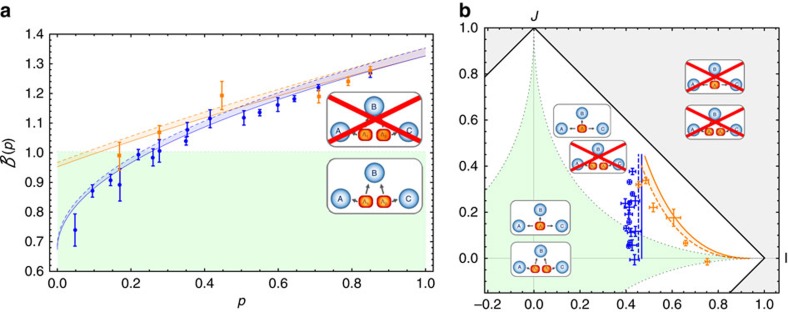
- The experiment violated the bilocal causality inequality (equation (3)) with a maximum violation of almost 20 sigmas; the numerical value itself is omitted in the provided text.
- Tuning noise in Bob’s Bell-state measurement via a delay line showed that violation decreases with noise, while optimizing Alice’s and Charlie’s measurement bases increases both the degree and the region of bilocal causality violation.
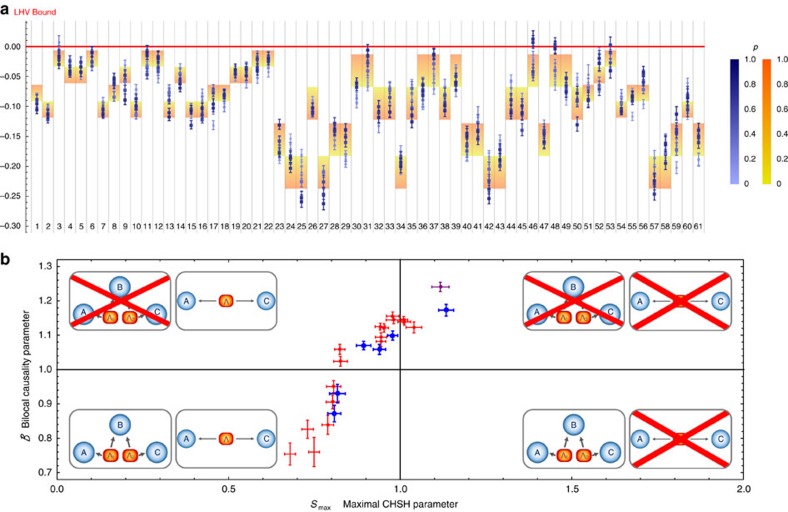
- The authors derived all Bell inequalities constraining the observed distribution \(p(a,b_0,b_1,c|x,z)\) compatible with standard LHV models: apart from trivial ones, there are 61 such inequalities, and none of the collected data showed significant violation of any of them.
- They found quantum states that violate bilocal causality even without settings optimization but cannot violate the CHSH inequality, making CHSH-based protocols unfeasible in those regimes.
Methods
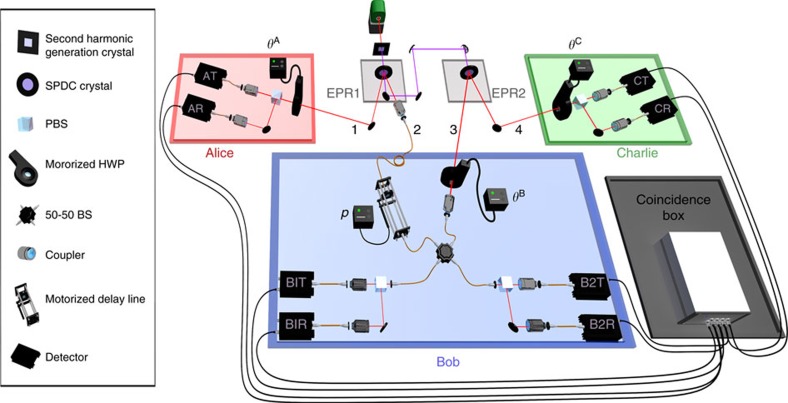
- Entangled photon pairs were generated by type-II spontaneous parametric down-conversion in two separated BBO crystals pumped by a pulsed field at \(\lambda=392.5\) nm; Alice and Charlie performed polarization analysis, while Bob used an in-fibre 50/50 beam splitter followed by polarizing beam splitters for a probabilistic Bell-state measurement.
- A delay line before one input of Bob’s beam splitter controlled the temporal overlap between photons 2 and 3, defining a noise parameter \(p\) equal to 1 for an ideal Bell-state measurement and 0 when the success probability is 1/2.
- Under fair sampling, the probability distribution \(p(a,b_0,b_1,c|x,z)\) was reconstructed to compute the quantities \(I\) and \(J\) in the bilocal inequality; the authors also derived and checked all LHV Bell inequalities and performed tomography of the swapped Alice–Charlie state conditioned on Bob’s outcome to compare with CHSH.
- Experimental details: 1.5 mm-thick BBO crystals were used for Figs 3 and 4a and the purple point in Fig. 4b, while 2 mm-thick crystals were used for the red and blue points in Fig. 4b; Alice’s and Charlie’s measurement angles were \(A_0=C_0=11.25^\circ\) and \(A_1=C_1=78.75^\circ\).
Limitations
- The paper states that the violation is subject to loopholes, in particular the locality and detection-efficiency loopholes, because the parties are not space-like separated and the fair-sampling assumption is used.
- The paper states that a new loophole—similar to the measurement-independence loophole in Bell’s theorem—is introduced if the sources of states cannot be guaranteed to be truly independent.
- Evident from the text: the Bell-state measurement is probabilistic and, with linear optics, only two out of four Bell-state outcomes can be unambiguously identified, so the experiment is not a loophole-free Bell test.
Model-written summary. Check it against the paper before relying on it.
Integrity signals
Registry
Cites
Statistics
Figures
Verification
Claims the paper makes
6 Valid · 0 Not valid · 0 Not checked · 19 Own results and interpretations
Every source the paper cites for this claim was checked and supports it.
In the paper
“This scheme allows us to observe Bell non-bilocal correlations by violating the Bell-like inequality proposed in refs 19, 20.”
§ Experimental violation of local causality in a quantum network > Abstract
What the sources say
- Supportedcites [19] Branciard C., Gisin N. & Pironio S. Characterizing the nonlocal correlations created via entanglement swapping. Phys. Rev. Lett. 104, 170401 (2010). 20482092 source
The paper introduces a quadratic Bell inequality for bilocal correlations (p. 1). On p. 3, it states that all bilocal correlations satisfy the inequality while the quantum correlations violate it. The citing authors' observation using their scheme is their own claim; this source supports the attribution of the inequality. (LLM, conf=0.92)
- Supportedcites [20] Branciard C., Rosset D., Gisin N. & Pironio S. Bilocal versus nonbilocal correlations in entanglement-swapping experiments. Phys. Rev. A 85, 032119 (2012). source
The Structure of the paper (p. 2) describes a three-party network with two independent sources and says the authors derive Bell-like bilocal inequalities. Section II D (p. 6) states that violating these inequalities establishes non-bilocality and that they are directly implementable in experimental demonstrations. The citation supports the proposed inequality and its use as a test; it does not attribute the citing authors’ implementation to this paper. (LLM, conf=0.92)
plainstates a cause- Asserted: passes — The authors put it forward as true.
- Checkable: passes — It can be checked against evidence.
- Load-bearing: passes — The paper’s conclusions depend on it.
- Based: passes — The paper gives a reason why it holds.
- Supported
Every source the paper cites for this claim was checked and supports it.
In the paper
“As expected, the violation decreases with increasing noise1920.”
§ Experimental violation of local causality in a quantum network > Results > Violation of the bilocal causality inequality
What the sources say
- Supportedcites [19] Branciard C., Gisin N. & Pironio S. Characterizing the nonlocal correlations created via entanglement swapping. Phys. Rev. Lett. 104, 170401 (2010). 20482092 source
On p. 3, the paper defines visibility v for a mixture with white noise and reports I(v) = 2v and E(v) = 0. As noise increases, v falls, so the violation of its bilocality inequality decreases; the paper reports violation only when v > 1/2. (LLM, conf=0.92)
- Supportedcites [20] Branciard C., Rosset D., Gisin N. & Pironio S. Bilocal versus nonbilocal correlations in entanglement-swapping experiments. Phys. Rev. A 85, 032119 (2012). source
In “Resistance to noise” (p. 10), the paper states that the quantities used in its bilocal inequality scale with visibility V, which decreases as noise increases. It also reports that the correlation violates the inequality for V > 50% and becomes bilocal at or below that threshold. (LLM, conf=0.92)
plainstates a cause- Asserted: passes — The authors put it forward as true.
- Checkable: passes — It can be checked against evidence.
- Load-bearing: unclear — It is unclear whether the paper’s conclusions depend on it.
- Based: passes — The paper gives a reason why it holds.
- Rests on an assumption not shown here.
- Supported
Every source the paper cites for this claim was checked and supports it.
In the paper
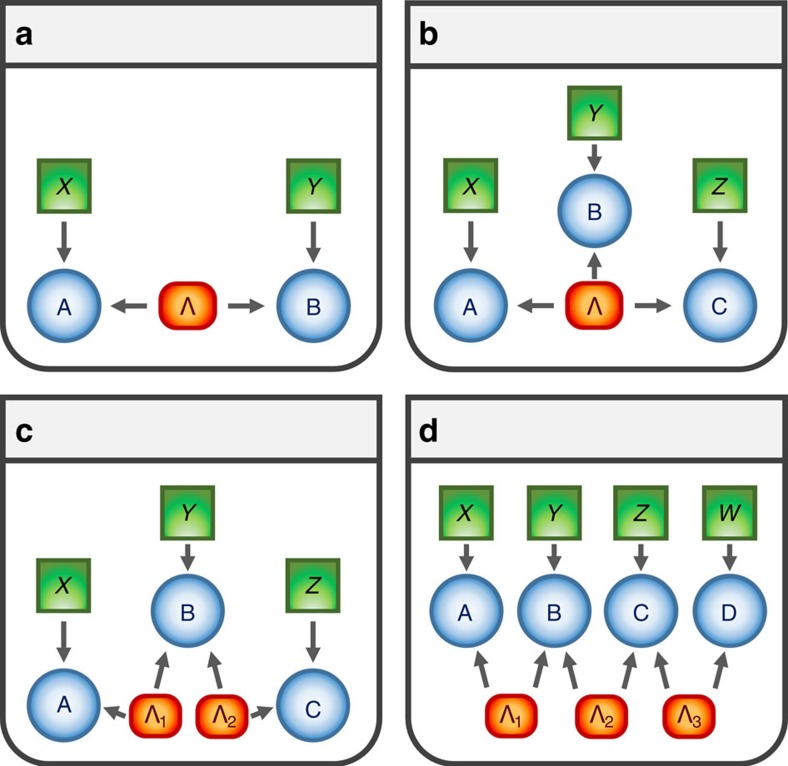
“In fact, there are quantum correlations that can emerge in networks that, while admitting a LHV description, are incompatible with any classical description where the independence of the sources is considered19202122232425.”
§ Experimental violation of local causality in a quantum network > Abstract
What the sources say
- Supportedcites [19] Branciard C., Gisin N. & Pironio S. Characterizing the nonlocal correlations created via entanglement swapping. Phys. Rev. Lett. 104, 170401 (2010). 20482092 source
The discussion of the bilocal set (p. 2) distinguishes ordinary local models from bilocal models, which additionally require independent source variables. The entanglement-swapping analysis (p. 3) shows quantum correlations violating the bilocal inequality for visibility above 50%, and Figure 1 (p. 4) identifies correlations in that region that remain local. Thus the paper supports the existence of quantum correlations with a local-hidden-variable description but no description respecting source independence. (LLM, conf=0.93)
- Supportedcites [20] Branciard C., Rosset D., Gisin N. & Pironio S. Bilocal versus nonbilocal correlations in entanglement-swapping experiments. Phys. Rev. A 85, 032119 (2012). source
The paper defines bilocal correlations as those describable by independent hidden states from the two sources (Structure of the paper, p. 2). It then states that its exhibited quantum correlations are not bilocal, although they are local (Section IV.A, p. 13). This directly supports the distinction between admitting a local hidden-variable description and admitting one that preserves source independence. (LLM, conf=0.94)
- Supportedcites [21] Fritz T. Beyond Bell's theorem: correlation scenarios. New J. Phys. 14, 103001 (2012). source
Corollary 2.5 states that non-classical quantum correlations exist in the P4 network. Section 1.1 defines source independence as a product distribution of hidden variables, while Section 2.1 says that observations can still be explained by a theory that does not satisfy that independence requirement. Together, these support the distinction the citing sentence makes between a hidden-variable description and a classical network description with independent sources. (LLM, conf=0.88)
plainstates an association- Asserted: passes — The authors put it forward as true.
- Checkable: passes — It can be checked against evidence.
- Load-bearing: passes — The paper’s conclusions depend on it.
- Based: passes — The paper gives a reason why it holds.
- Supported
Every source the paper cites for this claim was checked and supports it.
In the paper
“For instance, a network with two independent sources allow for the emergence of a different kind of non-local correlations violating the so-called bilocal causality assumption1920.”
§ Experimental violation of local causality in a quantum network > Abstract
What the sources say
- Supportedcites [19] Branciard C., Gisin N. & Pironio S. Characterizing the nonlocal correlations created via entanglement swapping. Phys. Rev. Lett. 104, 170401 (2010). 20482092 source
Our copy defines exactly this scenario: two independent, uncorrelated sources S1 and S2 whose local variables factorize, i.e. 'bilocal' models (p. 1, passage 3). It then states that although λ1 and λ2 are initially independent, conditioning on Bob's joint measurement yields correlations between Alice's and Charles's systems, and introduces a (quadratic) Bell inequality satisfied by all bilocal correlations but violated by quantum correlations (p. 1, passage 2); the abstract (p. 1, passage 4) likewise reports violation under this assumption for visibilities as low as 50%. The claim's paraphrase — a two-independent-source network admitting nonlocal correlations that violate bilocal causality — is thus directly stated. (LLM, conf=0.90)
- Supportedcites [20] Branciard C., Rosset D., Gisin N. & Pironio S. Bilocal versus nonbilocal correlations in entanglement-swapping experiments. Phys. Rev. A 85, 032119 (2012). source
The paper defines exactly this setting: three parties on a line fed by two independent sources of hidden states, with bilocal correlations those describable by the two independent hidden states and 'non-bilocal' otherwise (Structure of the paper, p. 2; Section II A, p. 3, eq. (2) factorization). Section III (p. 9) states that the bilocality assumption 'can a fortiori also be falsified quantum mechanically' and that the authors 'show now that this is indeed the case', with explicit quantum violations of the derived bilocal inequalities in the two-source entanglement-swapping network (e.g. p. 15, |I14| + |J14| > 1 proving the correlation is nonbilocal; p. 13-14 bilocal visibility thresholds below 1). Thus our copy supports that a network with two independent sources admits correlations violating the bilocal causality assumption; the citing sentence's 'non-local' is the paper's 'non-bilocal'. (LLM, conf=0.90)
plainstates a cause- Asserted: passes — The authors put it forward as true.
- Checkable: passes — It can be checked against evidence.
- Load-bearing: passes — The paper’s conclusions depend on it.
- Based: passes — The paper gives a reason why it holds.
- Supported
The cited sources support only part of this claim — read each source’s verdict below.
In the paper
“This scenario allows for the emergence of the so-called non-bilocal correlations, incompatible with any local model involving two independent hidden variables.”
§ Experimental violation of local causality in a quantum network > Abstract
What the sources say
- Supportedcites [19] Branciard C., Gisin N. & Pironio S. Characterizing the nonlocal correlations created via entanglement swapping. Phys. Rev. Lett. 104, 170401 (2010). 20482092 source
Our copy defines exactly this scenario (p. 1): a source S1 sending particles to Alice and Bob and an independent source S2 sending to Charles and Bob, with local models using two independent hidden variables λ1, λ2 whose joint distribution must factorize ('bilocal' models, eqs. 4-5). The introduction (p. 1) states they 'introduce below a (quadratic) Bell inequality that is satisfied by all bilocal correlations, but which is violated by quantum correlations,' and the Results (p. 3) show the quantum point P_Q violates (10) while all bilocal correlations satisfy it; p. 4 also gives an explicit example of correlations that 'are non-bilocal.' Hence the scenario does admit correlations incompatible with any two-independent-hidden-variable local model. (LLM, conf=0.90)
- Supportedcites [20] Branciard C., Rosset D., Gisin N. & Pironio S. Bilocal versus nonbilocal correlations in entanglement-swapping experiments. Phys. Rev. A 85, 032119 (2012). source
The 'Structure of the paper' passage (p. 2) fixes exactly this scenario and terminology: three partners on a line with two independent sources of entangled qubits, with 'bilocal' meaning describable via two independent hidden states λ1, λ2 (one per source) and 'non-bilocal' meaning not so describable; the bilocality assumption with the factorizing distribution ρ(λ1,λ2)=ρ1(λ1)ρ2(λ2) is formalized in Section II A (p. 3, eq. around (6)). That the scenario actually permits such correlations is demonstrated in Section III (p. 9, 'our bilocal inequalities ... sufficient to demonstrate the nonbilocality of the quantum correlations thus obtained') and restated in Section IV A (p. 13), where the exhibited quantum correlations are stated to be non-bilocal. The paraphrase therefore attributes to this paper content it states, at the same level of generality. (LLM, conf=0.92)
- Partly supportedcites [21] Fritz T. Beyond Bell's theorem: correlation scenarios. New J. Phys. 14, 103001 (2012). sourceExperimental — accuracy not yet measured
Section 2.2 (page unavailable) describes the three-party BGP bilocal scenario and gives its classical model using two independent hidden variables. The paper relates that model to quantum correlations, but the passages found do not establish that the two-source scenario produces correlations incompatible with it; the explicit three-party non-classical example in section 2.3 uses three sources. (LLM, conf=0.79)
plainstates an association- Asserted: passes — The authors put it forward as true.
- Checkable: passes — It can be checked against evidence.
- Load-bearing: passes — The paper’s conclusions depend on it.
- Based: passes — The paper gives a reason why it holds.
- Supported
11 more claims
Create a free account to see all 25 claims and every source verdict.
- It may state two separate claims as one. 8
- The quote only partly states this claim. 1
- Probably not a substantial claim. 1
Claims other papers make about this one
Each is checked against this paper’s own text: does it say what the citing paper says it does?
The cited source says what the claim attributes to it.
In the citing paper
“Carvacho et al. 57 measured the emergence of special quantum correlations, named non-bilocal, correlating distant qubits by means of several intermediate, typically independent, sources, and providing evidence for violation of local causality in a quantum network.”
From Complex networks from classical to quantum (2019) · cites this paper as [57]
Citations
Cites
On the Einstein Podolsky Rosen paradox
Bell, J. S. (1964) · Physics Physique Fizika · doi:10.1103/physicsphysiquefizika.1.195 · Cited by 12,252
Causality: Models, Reasoning, and Inference
Pearl, J. (2009) · doi:10.1017/cbo9780511803161 · Cited by 11,653
Quantum cryptography based on Bell’s theorem
Ekert, A. K. (1991) · Physical Review Letters · doi:10.1103/physrevlett.67.661 · Cited by 10,777 · cited 2×
“Importantly, such long-distance entanglement can in principle also be used to violate a Bell inequality and thus establish a secure communication channel 10–12 .”
Proposed Experiment to Test Local Hidden-Variable Theories
Clauser, J. F., Horne, M. A., Shimony, A., & Holt, R. A. (1969) · Physical Review Letters · doi:10.1103/physrevlett.23.880 · Cited by 7,573 · cited 1×
“Finally,we addressed the question whether, in an entanglement swapping scenario, bilocal causality violation could represent a stronger test rather than the usual CHSH violation 29 , in order to certify non-local correlations in presence of experimental noise.”
Kimble, H. J. (2008) · Nature · doi:10.1038/nature07127 · Cited by 6,023
Separability Criterion for Density Matrices
Peres, A. (1996) · Physical Review Letters · doi:10.1103/physrevlett.77.1413 · Cited by 5,191 · cited 1×
“Circles (squares) represent entangled (separable) quantum states, where the degree of entanglement was computed via the partial transpose [28].”
Loophole-free Bell inequality violation using electron spins separated by 1.3 kilometres
Hensen, B., Bernien, H., Dréau, A. E., Reiserer, A., Kalb, N., Blok, M. S., Ruitenberg, J., Vermeulen, R. F. L., Schouten, R. N., Abellán, C., et al. (2015) · Nature · doi:10.1038/nature15759 · Cited by 2,852 · cited 2×
“A bilocal model (defined by equation (2)) must respect the inequality ffiffiffiffiffi I j j p þ ffiffiffiffiffi J j j p 1, while a standard LHV model (defined by equation (1)) in turn fulfils I j j þ J j j 1.”
Brunner, N., Cavalcanti, D., Pironio, S., Scarani, V., & Wehner, S. (2014) · Reviews of Modern Physics · doi:10.1103/revmodphys.86.419 · Cited by 2,688
‘‘Event-ready-detectors’’ Bell experiment via entanglement swapping
Żukowski, M., Zeilinger, A., Horne, M. A., & Ekert, A. K. (1993) · Physical Review Letters · doi:10.1103/physrevlett.71.4287 · Cited by 2,045
Quantum repeaters based on atomic ensembles and linear optics
Sangouard, N., Simon, C., de Riedmatten, H., & Gisin, N. (2011) · Reviews of Modern Physics · doi:10.1103/revmodphys.83.33 · Cited by 1,888 · cited 1×
“Apart from their profound implications in our understanding of nature, such experiments provide a proof-of-principle for practical applications of non-local correlations, most notably in the context of quantum networks 5–7 .”
Cited by
Challenging local realism with human choices
The BIG Bell Test Collaboration (2018) · Nature · doi:10.1038/s41586-018-0085-3 · Cited by 280
“To run faster than the Bellster input rate, experiments (12) and (13) operated in burst mode, accumulating bits for a specific time and then rapidly using them.”
BackgroundMethodInfluentialSelf-citationQuantum theory based on real numbers can be experimentally falsified
Renou, M.-O., Trillo, D., Weilenmann, M., Le, T. P., Tavakoli, A., Gisin, N., Acín, A., & Navascués, M. (2021) · Nature · doi:10.1038/s41586-021-04160-4 · Cited by 215
Tavakoli, A., Pozas-Kerstjens, A., Luo, M.-X., & Renou, M.-O. (2022) · Reports on Progress in Physics · doi:10.1088/1361-6633/ac41bb · Cited by 202
Complex networks from classical to quantum
Biamonte, J., Faccin, M., & De Domenico, M. (2019) · Communications Physics · doi:10.1038/s42005-019-0152-6 · Cited by 149
Computationally Efficient Nonlinear Bell Inequalities for Quantum Networks
Luo, M. (2018) · Physical Review Letters · doi:10.1103/physrevlett.120.140402 · Cited by 114
Metadata
- Authors
- Carvacho, G., Andreoli, F., Santodonato, L., Bentivegna, M., Chaves, R., & Sciarrino, F.
- Affiliations
- Sapienza University of Rome (IT)
- University of Cologne (DE)
- Corresponding author
- Sciarrino, Fabio
- Venue
- Nature Communications
- Published
- 2017-03-16
- Volume
- 8
- Issue
- 1
- Pages
- 14775-14775
- ISSN
- 2041-1723 (ISSN-L)
- PMC
- PMC5356073
- OpenAlex
- W2531741860
- Semantic Scholar
- 1c721e5a3ec1a35ebcf425f1bebf44c2b6b4749c
- Cited by
- 81
- References
- 50
- Citations by year
- 2026: 6 · 2025: 6 · 2024: 9 · 2023: 15 · 2022: 10 · 2021: 11 · 2020: 5 · 2019: 8 · 2018: 5 · 2017: 6
- FWCI
- 3.22
- Type
- journal article
- Language
- en
- Open access
- gold
- doi.org
- Licence
- cc-by
- creativecommons.org/licenses/by/4.0 (tdm)
- creativecommons.org/licenses/by/4.0 (vor)
- Locations
- Nature Communications (publishedVersion, cc-by)
- PubMed Central (publishedVersion, cc-by)
- PubMed (publishedVersion)
- Kölner Universitäts PublikationsServer (Universität zu Köln) (publishedVersion)
- LA Referencia (Red Federada de Repositorios Institucionales de Publicaciones Científicas) (publishedVersion, cc-by)
- arXiv (Cornell University) (submittedVersion)
- IRIS Research product catalog (Sapienza University of Rome) (submittedVersion, cc-by-nc-nd)
- RePEc: Research Papers in Economics (submittedVersion)
- DOAJ (DOAJ: Directory of Open Access Journals) (submittedVersion, cc-by-sa)
- LA Referencia (Red Federada de Repositorios Institucionales de Publicaciones Científicas) (submittedVersion, cc-by)
- arXiv (Cornell University)
- Greater South Information System
- Funders
- Foundational Questions Institute (W911NF-14-1-0098, W911NF-14-1-0133)
- Deutsche Forschungsgemeinschaft (GRO 4334, SPP 1798)
- Ministerio de Economía y Competitividad
- Ministério da Ciência, Tecnologia, Inovações e Comunicações
- Army Research Office (W911NF-14-1, W911NF-14-1-0133, W911NF, W911NF-14-1-0098)
- FP7 Ideas: European Research Council (307783)
- Topics
- Physical Sciences › Physics and Astronomy › Atomic and Molecular Physics, and Optics › Quantum Mechanics and Applications
- Physical Sciences › Physics and Astronomy › Atomic and Molecular Physics, and Optics › Quantum Information and Cryptography
- Physical Sciences › Physics and Astronomy › Atomic and Molecular Physics, and Optics › Quantum optics and atomic interactions
- Keywords
- Bell's theorem, Bell inequalities, quantum networks, local causality, hidden variables, fair sampling assumption, multipartite quantum correlations, quantum communication
About these checks
Registry, retraction, Cites and statistics results are computed, not judged, with one exception: a printed reference that no index lists is read once by a model before it counts as a citation error. Claims are extracted by a model and kept only when their quote appears verbatim in the text; each cited source is then checked, with a model’s help, for whether it says what the claim relies on. Those verdicts can be wrong — read the claim’s quote and the cited source before relying on one.
The claim verdicts this report counts are experimental: their accuracy is not yet measured.
A language model drew the claims from the paper on 2026-10-08, under version 3 of the claim definition (model deepseek-v4.1-flash, prompt extract-v3).
A second model labelled each claim on 2026-10-08 (model jev-1.13-20260917, definition revision gold-guideline-v0.2).
Cited sources are checked with a language model’s help (gpt-6-sol and qwen3.8-omni-flash).
Statistics and arithmetic are recomputed, not judged.
Confidence bands are shown only for fields calibrated on our annotated test set. None is calibrated yet, so no band is shown.
What counts as a claim ›How we measure confidence ›How we check this ›
Are you an author, or do you see a problem with this page? Request a review
How to cite
Cite CoChat for the checks on this page, and the paper for its own findings.
- This page
- CoChat. (2026). Citation check: Experimental violation of local causality in a quantum network. https://app.cochat.ai/papers/10.1038/ncomms14775
- The paper
- Carvacho, G., Andreoli, F., Santodonato, L., Bentivegna, M., Chaves, R., & Sciarrino, F. (2017). Experimental violation of local causality in a quantum network. Nature Communications. https://doi.org/10.1038/ncomms14775
Data sources
Bibliographic data: Semantic Scholar, OpenAlex, Crossref.
Contains information from the Semantic Scholar Academic Graph Datasets, made available under the ODC Attribution License (ODC-BY 1.0).
Semantic Scholar’s data is described in: Kinney, R., et al. (2023). The Semantic Scholar Open Data Platform. arXiv:2301.10140.
