

Beyond Bell's theorem: correlation scenarios
Open accessThe DOI matches its Crossref record; 47 of the 47 references it cites were found in a registry or an index.
Abstract
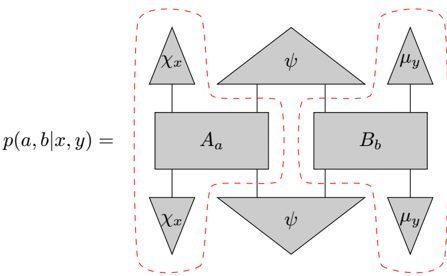
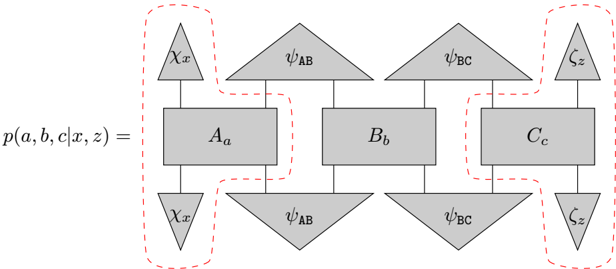
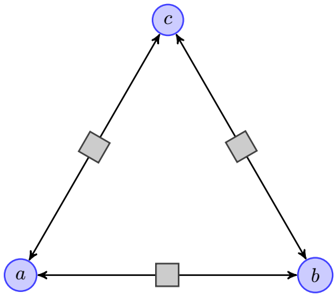
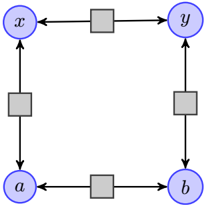
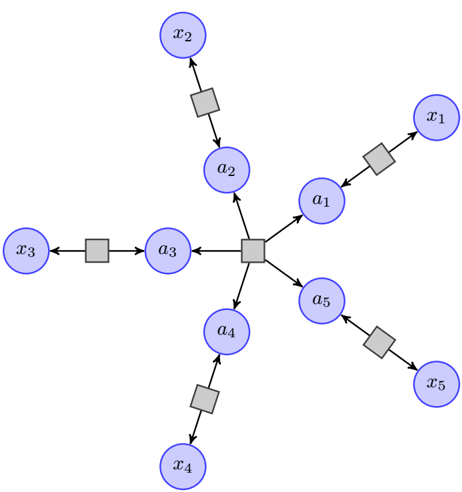
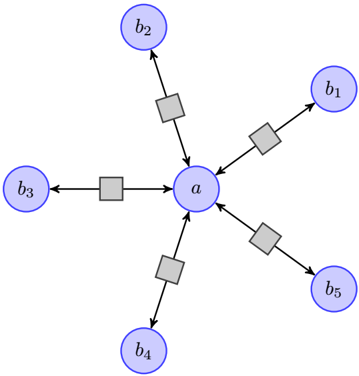
Bell's theorem witnesses that the predictions of quantum theory cannot be reproduced by theories of local hidden variables in which observers can choose their measurements independently of the source. Working out an idea of Branciard, Rosset, Gisin and Pironio, we consider scenarios which feature several sources, but no choice of measurement for the observers. Every Bell scenario can be mapped into such a correlation scenario , and Bell's theorem then discards those local hidden variable theories in which the sources are independent. However, most correlation scenarios do not arise from Bell scenarios, and we describe examples of (quantum) non-locality in some of these scenarios, while posing many open problems along the way. Some of our scenarios have been considered before by mathematicians in the context of causal inference.
Overview
The claims and statistics of this paper haven’t been checked yet.
Free: it reads the open-access text and checks the first 5 claims that cite a source we can check. Create a free account to check every claim.
Integrity signals
Registry
Cites
Statistics
Figures





Verification
Claims the paper makes
The claims and statistics of this paper haven’t been checked yet.
Free: it reads the open-access text and checks the first 5 claims that cite a source we can check. Create a free account to check every claim.
Claims other papers make about this one
Each is checked against this paper’s own text: does it say what the citing paper says it does?
The source backs part of the claim, not all of it — or backs it for a different population, condition or comparison.
In the citing paper
“This scenario allows for the emergence of the so-called non-bilocal correlations, incompatible with any local model involving two independent hidden variables.”
From Experimental violation of local causality in a quantum network (2017) · cites this paper as [21]
Experimental — accuracy not yet measuredThe cited source says what the claim attributes to it.
In the citing paper
“In fact, there are quantum correlations that can emerge in networks that, while admitting a LHV description, are incompatible with any classical description where the independence of the sources is considered19202122232425.”
From Experimental violation of local causality in a quantum network (2017) · cites this paper as [21]
Self-check
Percentages, sums and reported differences re-computed from the paper’s own numbers.
The self-check needs the paper’s full text.
Citations
Cites
Elements of Information Theory
Cover, T. M., & Thomas, J. A. (2001) · Wiley eBooks · doi:10.1002/0471200611 · Cited by 36,808
Can Quantum-Mechanical Description of Physical Reality Be Considered Complete?
Einstein, A., Podolsky, B., & Rosen, N. (1935) · Physical Review · doi:10.1103/physrev.47.777 · Cited by 16,654
Elements of Information Theory
Cover, T. M., & Thomas, J. A. (2005) · doi:10.1002/047174882x · Cited by 13,791
On the Einstein Podolsky Rosen paradox
Bell, J. S. (1964) · Physics Physique Fizika · doi:10.1103/physicsphysiquefizika.1.195 · Cited by 12,252
Causality: Models, Reasoning, and Inference
Pearl, J. (2009) · doi:10.1017/cbo9780511803161 · Cited by 11,653
Quantum cryptography based on Bell’s theorem
Ekert, A. K. (1991) · Physical Review Letters · doi:10.1103/physrevlett.67.661 · Cited by 10,777 · cited 1×
“we hope for the development of quantum information protocols utilizing them in ways similar to those taking advantage of quantum correlations in standard Bell scenarios, e.g. quantum key distribution [Eke91] or certified randomness generation [PAM+10]. Another interesting direction might be to consider analogs of the a…”
MethodProposed Experiment to Test Local Hidden-Variable Theories
Clauser, J. F., Horne, M. A., Shimony, A., & Holt, R. A. (1969) · Physical Review Letters · doi:10.1103/physrevlett.23.880 · Cited by 7,573
Koller, D., & Friedman, N. (2009) · The MIT Press eBooks · Cited by 7,544
(2009) · Cited by 6,153
Speakable and Unspeakable in Quatum Mechanics
Bell, J. S., & Mermin, N. D. (1988) · Physics Today · doi:10.1063/1.2811599 · Cited by 2,985
Research works printed but not linked: 1
- Reichenbach H and Reichenbach M 1956 The Direction of Time (Los Angeles, CA: University of California Press)
Cited by
Wood, C. J., & Spekkens, R. W. (2015) · New Journal of Physics · doi:10.1088/1367-2630/17/3/033002 · Cited by 335
Challenging local realism with human choices
The BIG Bell Test Collaboration (2018) · Nature · doi:10.1038/s41586-018-0085-3 · Cited by 280
Quantum theory based on real numbers can be experimentally falsified
Renou, M.-O., Trillo, D., Weilenmann, M., Le, T. P., Tavakoli, A., Gisin, N., Acín, A., & Navascués, M. (2021) · Nature · doi:10.1038/s41586-021-04160-4 · Cited by 215
Quantum Common Causes and Quantum Causal Models
Allen, J.-M. A., Barrett, J., Horsman, D. C., Lee, C. M., & Spekkens, R. W. (2017) · Physical Review X · doi:10.1103/physrevx.7.031021 · Cited by 209
“Preliminary work more directly pertaining to quantum causal models took the form of explorations of Bell-type inequalities (and whether they admit quantum violations) for novel causal scenarios [60,61].”
BackgroundTavakoli, A., Pozas-Kerstjens, A., Luo, M.-X., & Renou, M.-O. (2022) · Reports on Progress in Physics · doi:10.1088/1361-6633/ac41bb · Cited by 202
Metadata
- Authors
- Fritz, T.
- Affiliations
- Institute of Photonic Sciences (ES)
- Corresponding author
- Fritz, Tobias
- Venue
- New Journal of Physics
- Publisher
- IOP Publishing
- Published
- 2012-10-01
- Volume
- 14
- Issue
- 10
- Pages
- 103001
- ISSN
- 1367-2630 (ISSN-L)
- OpenAlex
- W2163464259
- Cited by
- 243
- References
- 47
- Citations by year
- 2026: 11 · 2025: 21 · 2024: 24 · 2023: 33 · 2022: 26 · 2021: 28 · 2020: 15 · 2019: 15 · 2018: 15 · 2017: 19 · 2016: 14 · 2015: 10 · 2014: 9 · 2013: 2 · 2012: 1
- FWCI
- 3.64
- Type
- journal article
- Language
- en
- Open access
- gold
- doi.org
- Licence
- cc-by-nc-sa
- Locations
- New Journal of Physics (publishedVersion, cc-by-nc-sa)
- arXiv (Cornell University) (submittedVersion)
- DOAJ (DOAJ: Directory of Open Access Journals) (submittedVersion)
- arXiv (Cornell University)
- Topics
- Physical Sciences › Physics and Astronomy › Atomic and Molecular Physics, and Optics › Quantum Mechanics and Applications
- Physical Sciences › Physics and Astronomy › Atomic and Molecular Physics, and Optics › Quantum Information and Cryptography
- Physical Sciences › Physics and Astronomy › Nuclear and High Energy Physics › Noncommutative and Quantum Gravity Theories
- Keywords
- Bell's theorem, Bell nonlocality, local hidden variable theories, measurement independence, quantum correlations, causal inference
About these checks
Registry, retraction, Cites and statistics results are computed, not judged, with one exception: a printed reference that no index lists is read once by a model before it counts as a citation error. Claims are extracted by a model and kept only when their quote appears verbatim in the text; each cited source is then checked, with a model’s help, for whether it says what the claim relies on. Those verdicts can be wrong — read the claim’s quote and the cited source before relying on one.
Statistics and arithmetic are recomputed, not judged.
Confidence bands are shown only for fields calibrated on our annotated test set. None is calibrated yet, so no band is shown.
What counts as a claim ›How we measure confidence ›How we check this ›
Are you an author, or do you see a problem with this page? Request a review
How to cite
Cite CoChat for the checks on this page, and the paper for its own findings.
- This page
- CoChat. (2026). Citation check: Beyond Bell's theorem: correlation scenarios. https://app.cochat.ai/papers/10.1088/1367-2630/14/10/103001
- The paper
- Fritz, T. (2012). Beyond Bell's theorem: correlation scenarios. New Journal of Physics. https://doi.org/10.1088/1367-2630/14/10/103001
Data sources
Bibliographic data: Semantic Scholar, OpenAlex, Crossref.
Contains information from the Semantic Scholar Academic Graph Datasets, made available under the ODC Attribution License (ODC-BY 1.0).
Semantic Scholar’s data is described in: Kinney, R., et al. (2023). The Semantic Scholar Open Data Platform. arXiv:2301.10140.
