

The links between ecosystem multifunctionality and above- and belowground biodiversity are mediated by climate
Open accessThe DOI matches its Crossref record; 72 of the 72 references it cites were found in a registry or an index; 4 of the 24 sources its claims cite were checked for support.
Abstract
Plant biodiversity is often correlated with ecosystem functioning in terrestrial ecosystems. However, we know little about the relative and combined effects of above- and belowground biodiversity on multiple ecosystem functions (for example, ecosystem multifunctionality, EMF) or how climate might mediate those relationships. Here we tease apart the effects of biotic and abiotic factors, both above- and belowground, on EMF on the Tibetan Plateau, China. We found that a suite of biotic and abiotic variables account for up to 86% of the variation in EMF, with the combined effects of above- and belowground biodiversity accounting for 45% of the variation in EMF. Our results have two important implications: first, including belowground biodiversity in models can improve the ability to explain and predict EMF. Second, regional-scale variation in climate, and perhaps climate change, can determine, or at least modify, the effects of biodiversity on EMF in natural ecosystems.
Overview
CoChat Summary
TL;DR
Across 60 Tibetan Plateau alpine grassland sites, above- and belowground biodiversity together explained 45% of variation in ecosystem multifunctionality (EMF), while models including climate and soil factors explained up to 86%. Climate and soil variables mediated biodiversity–EMF relationships, with soil moisture the strongest driver.
Key findings
- Plant species richness and belowground biodiversity were positively correlated with EMF; plant richness explained 42% of EMF variation versus 32% for soil biodiversity in OLS regressions. Among belowground groups, bacteria and fauna were positively related to EMF, whereas archaea and arbuscular mycorrhizal fungi were not.
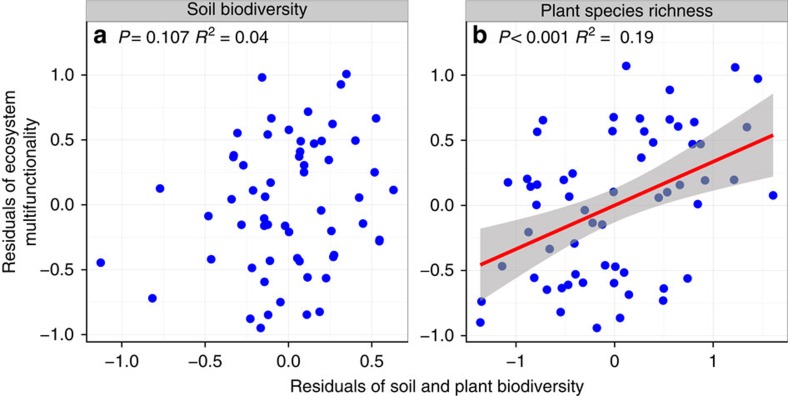
- Combined above- and belowground biodiversity accounted for 45% of EMF variation. In partial linear regression, plant species richness accounted for 19%, soil biodiversity 4% (not statistically significant, P=0.107), and their combined effects 22%.
- A full model with seven PCA components accounted for 86% of EMF variation; the best-fit two-component model accounted for 84%. Soil moisture was the most important single driver, accounting for 65% of EMF variation; MAP explained 43%, soil pH 30%, and soil CaCO3 33%. MAT had no isolated relationship with EMF but improved models when combined with other factors.
- Piecewise SEM showed soil moisture had the strongest influence on EMF (β=0.62), MAP was strongly related to belowground biodiversity (β=0.79), MAT directly affected EMF (β=0.16) and indirectly through soil pH (β=−0.27), and soil pH was negatively related to EMF (β=−0.11).
Methods
- Observational survey of 60 sites spanning >1,000,000 km² in Tibetan Plateau alpine grasslands during July–August 2011; 180 soil samples/plots were collected across alpine meadow, alpine steppe, and desert steppe vegetation types.
- Biodiversity measures included plant species richness, bacterial and archaeal OTUs, AM fungal virtual taxa, and soil faunal richness at order level. EMF was calculated as an averaging index from Z-scores of eight ecosystem functions: aboveground biomass, root biomass, soil organic carbon, soil nitrogen, soil available nitrogen, soil phosphorus, plant nitrogen, and plant phosphorus.
- Analyses used site means (n=60) and included OLS regressions, general linear models, partial linear regression, PCA, and piecewise structural equation modeling; climate data were compiled from 1951–2010 records from 716 stations.
Limitations
- Stated: belowground biodiversity is only a rough estimate because sequencing methods did not detect all taxa; future studies should use higher-resolution sequencing and target active communities. Soil moisture came from a single measurement and was not integrated across the season. The EMF index is not a single best metric of multifunctionality, and the measured functions were often correlated.
- Stated: the observational design cannot fully disentangle causal factors; the authors note that experimental work is needed to further disentangle these relationships.
- Evident: the study is correlational and relies on SEM for inferred direct and indirect effects, so causal claims about climate mediation remain model-based rather than experimentally tested.
Model-written summary. Check it against the paper before relying on it.
Integrity signals
Registry
Cites
Statistics
Figures


Verification
Claims the paper makes
2 Valid · 0 Not valid · 16 Not checked · 60 Own results and interpretations
A result the paper reports from its own data — it cites no other source for it, so there is none to check. The quote shows it is in the paper.
In the paper
“We found that a suite of biotic and abiotic variables account for up to 86% of the variation in EMF”
- Also stated in: § The effects of biodiversity and abiotic factors on EMF · plain
“The full model, with the seven components, accounted for 86% of the variation in EMF”
- Also stated in: § Discussion · plain
“The best-fitting models accounted for 86% of the variation in EMF and included soil moisture, soil pH, above- and belowground biodiversity as well as climatic variables (MAT).”
§ The links between ecosystem multifunctionality and above- and belowground biodiversity are mediated by climate > Abstract
plainstates an association- Asserted: passes — The authors put it forward as true.
- Checkable: passes — It can be checked against evidence.
- Load-bearing: passes — The paper’s conclusions depend on it.
- Based: passes — The paper gives a reason why it holds.
- Also stated in: § The effects of biodiversity and abiotic factors on EMF · plain
A result the paper reports from its own data — it cites no other source for it, so there is none to check. The quote shows it is in the paper.
In the paper
“Plant species richness accounted for 19% of the variation in EMF.”
§ The links between ecosystem multifunctionality and above- and belowground biodiversity are mediated by climate > Results > The effects of above- and belowground biodiversity on EMF
plainstates an association- Asserted: passes — The authors put it forward as true.
- Checkable: passes — It can be checked against evidence.
- Load-bearing: passes — The paper’s conclusions depend on it.
- Based: passes — The paper gives a reason why it holds.
A result the paper reports from its own data — it cites no other source for it, so there is none to check. The quote shows it is in the paper.
In the paper
“We found that soil moisture was the most important driver, accounting for 65% of the variation in EMF (Supplementary Fig. 9).”
§ The links between ecosystem multifunctionality and above- and belowground biodiversity are mediated by climate > Results > The effects of biodiversity and abiotic factors on EMF
plainstates a cause- Asserted: passes — The authors put it forward as true.
- Checkable: passes — It can be checked against evidence.
- Load-bearing: passes — The paper’s conclusions depend on it.
- Based: passes — The paper gives a reason why it holds.
A result the paper reports from its own data — it cites no other source for it, so there is none to check. The quote shows it is in the paper.
In the paper
“the best-fit model with two components (PC1 and PC4) accounted for 84% of the variation in EMF.”
§ The links between ecosystem multifunctionality and above- and belowground biodiversity are mediated by climate > Results > The effects of biodiversity and abiotic factors on EMF
plainstates an association- Asserted: passes — The authors put it forward as true.
- Checkable: passes — It can be checked against evidence.
- Load-bearing: passes — The paper’s conclusions depend on it.
- Based: passes — The paper gives a reason why it holds.
A result the paper reports from its own data — it cites no other source for it, so there is none to check. The quote shows it is in the paper.
In the paper
“PC4 represented MAT, soil moisture and soil CaCO3 (Supplementary Fig. 11).”
§ The links between ecosystem multifunctionality and above- and belowground biodiversity are mediated by climate > Results > The effects of biodiversity and abiotic factors on EMF
plain- Asserted: passes — The authors put it forward as true.
- Checkable: passes — It can be checked against evidence.
- Load-bearing: passes — The paper’s conclusions depend on it.
- Based: passes — The paper gives a reason why it holds.
27 more claims
Create a free account to see all 78 claims and to verify the 20 references still open.
- Probably not a substantial claim. 28
- It may state two separate claims as one. 29
Claims other papers make about this one
Each is checked against this paper’s own text: does it say what the citing paper says it does?
The source backs part of the claim, not all of it — or backs it for a different population, condition or comparison.
In the citing paper
“diversity effects of plants and microbes are complementary, maximising rates of nutrient cycling 11”
From Biodiversity at multiple trophic levels is needed for ecosystem multifunctionality (2016) · cites this paper as [11]
Experimental — accuracy not yet measuredThe cited source says what the claim attributes to it.
In the citing paper
“Consequently, we know very little about the relative effect of changes in the diversity of different trophic groups on the provision of individual 2,5,6,9,13,14 or multiple (multifunctionality) 11,15 ecosystem services.”
From Biodiversity at multiple trophic levels is needed for ecosystem multifunctionality (2016) · cites this paper as [11]
The cited source says what the claim attributes to it.
In the citing paper
“These results agree with other studies that have identified plants and soil microorganisms as key drivers of ecosystem functioning 11,14,15,29 , extending these findings to the richness and abundance of different trophic groups, including primary producers and consumers both above-and belowground.”
From Biodiversity at multiple trophic levels is needed for ecosystem multifunctionality (2016) · cites this paper as [11]
Self-check
Percentages, sums and reported differences re-computed from the paper’s own numbers.
Each contradiction between two passages listed here was confirmed by an independent check.
Rated major: it would touch a result — a value a result rests on, reported and recomputed p-values on opposite sides of the significance level, two passages that conflict with no sign which is right, or a cited work retracted before this paper was published.
In the paper
§ The links between ecosystem multifunctionality and above- and belowground biodiversity are mediated by climate > Results > The effects of biodiversity and abiotic factors on EMF
“the best-fit model with two components (PC1 and PC4) accounted for 84% of the variation in EMF.”
§ The links between ecosystem multifunctionality and above- and belowground biodiversity are mediated by climate > Methods > Statistical analyses
“the other one is a reduced model with two components (PC1 and PC2) (Supplementary Fig. 11).”
Citations
Cites
QIIME allows analysis of high-throughput community sequencing data
Caporaso, J. G., Kuczynski, J., Stombaugh, J., Bittinger, K., Bushman, F. D., Costello, E. K., Fierer, N., Peña, A. G., Goodrich, J. K., Gordon, J. I., et al. (2010) · Nature Methods · doi:10.1038/nmeth.f.303 · Cited by 34,887
Search and clustering orders of magnitude faster than BLAST
Edgar, R. C. (2010) · Bioinformatics · doi:10.1093/bioinformatics/btq461 · Cited by 20,826
Schloss, P. D., Westcott, S. L., Ryabin, T., Hall, J. R., Hartmann, M., Hollister, E. B., Lesniewski, R. A., Oakley, B. B., Parks, D. H., Robinson, C. J., et al. (2009) · Applied and Environmental Microbiology · doi:10.1128/aem.01541-09 · Cited by 19,549
UCHIME improves sensitivity and speed of chimera detection
Edgar, R. C., Haas, B. J., Clemente, J. C., Quince, C., & Knight, R. (2011) · Bioinformatics · doi:10.1093/bioinformatics/btr381 · Cited by 15,114
Experimental Design and Data Analysis for Biologists
Quinn, G. P., & Keough, M. J. (2002) · doi:10.1017/cbo9780511806384 · Cited by 10,674
Global patterns of 16S rRNA diversity at a depth of millions of sequences per sample
Caporaso, J. G., Lauber, C. L., Walters, W. A., Berg-Lyons, D., Lozupone, C. A., Turnbaugh, P. J., Fierer, N., & Knight, R. (2011) · Proceedings of the National Academy of Sciences · doi:10.1073/pnas.1000080107 · Cited by 9,711
EFFECTS OF BIODIVERSITY ON ECOSYSTEM FUNCTIONING: A CONSENSUS OF CURRENT KNOWLEDGE
Hooper, D. U., Chapin, F. S., Ewel, J. J., Hector, A., Inchausti, P., Lavorel, S., Lawton, J. H., Lodge, D. M., Loreau, M., Naeem, S., et al. (2005) · Ecological Monographs · doi:10.1890/04-0922 · Cited by 8,046
Biodiversity loss and its impact on humanity
Cardinale, B. J., Duffy, J. E., Gonzalez, A., Hooper, D. U., Perrings, C., Venail, P., Narwani, A., Mace, G. M., Tilman, D., Wardle, D. A., et al. (2012) · Nature · doi:10.1038/nature11148 · Cited by 7,457
Pruesse, E., Quast, C., Knittel, K., Fuchs, B. M., Ludwig, W., Peplies, J., & Glockner, F. O. (2007) · Nucleic Acids Research · doi:10.1093/nar/gkm864 · Cited by 6,668
The diversity and biogeography of soil bacterial communities
Fierer, N., & Jackson, R. B. (2006) · Proceedings of the National Academy of Sciences · doi:10.1073/pnas.0507535103 · Cited by 5,711
Research works printed but not linked: 1
- Smith, S. E. & Read, D. J. Mycorrhizal Symbiosis Academic Press (2010).
Cited by
piecewiseSEM: Piecewise structural equation modelling in r for ecology, evolution, and systematics
Lefcheck, J. S. (2016) · Methods in Ecology and Evolution · doi:10.1111/2041-210x.12512 · Cited by 4,845
“…drivers of ecosystem functioning in eelgrass beds (Duffy et al. 2015), disentangle the influence of functional diversity across trophic levels in experimental estuarine mesocosms (Lefcheck & Duffy 2015), and quantify the biotic and abiotic drivers of grassland multifunctionality (Jing et al. 2015).”
BackgroundMicrobial diversity drives multifunctionality in terrestrial ecosystems
Delgado-Baquerizo, M., Maestre, F. T., Reich, P. B., Jeffries, T. C., Gaitan, J. J., Encinar, D., Berdugo, M., Campbell, C. D., & Singh, B. K. (2016) · Nature Communications · doi:10.1038/ncomms10541 · Cited by 2,624
Scientists’ warning to humanity: microorganisms and climate change
Cavicchioli, R., Ripple, W. J., Timmis, K. N., Azam, F., Bakken, L. R., Baylis, M., Behrenfeld, M. J., Boetius, A., Boyd, P. W., Classen, A. T., et al. (2019) · Nature Reviews Microbiology · doi:10.1038/s41579-019-0222-5 · Cited by 2,028
“Soil microbial diversity influences plant diversity and is important for ecosystem functions, including carbon cycling 173,174 .”
Self-citationFungal-bacterial diversity and microbiome complexity predict ecosystem functioning
Wagg, C., Schlaeppi, K., Banerjee, S., Kuramae, E. E., & van der Heijden, M. G. A. (2019) · Nature Communications · doi:10.1038/s41467-019-12798-y · Cited by 1,836
Biodiversity at multiple trophic levels is needed for ecosystem multifunctionality
Soliveres, S., van der Plas, F., Manning, P., Prati, D., Gossner, M. M., Renner, S. C., Alt, F., Arndt, H., Baumgartner, V., Binkenstein, J., et al. (2016) · Nature · doi:10.1038/nature19092 · Cited by 867
Metadata
- Authors
- Jing, X., Sanders, N. J., Shi, Y., Chu, H., Classen, A. T., Zhao, K., Chen, L., Shi, Y., Jiang, Y., & He, J.-S.
- Affiliations
- Peking University (CN)
- University of Copenhagen (DK)
- Chinese Academy of Sciences (CN)
- Northwest Institute of Plateau Biology (CN)
- Chinese Academy of Forestry (CN)
- Corresponding author
- He, Jin-Sheng
- Venue
- Nature Communications
- Published
- 2015-09-02
- Volume
- 6
- Issue
- 1
- Pages
- 8159-8159
- ISSN
- 2041-1723 (ISSN-L)
- PMC
- PMC4569729
- OpenAlex
- W2263248977
- Cited by
- 895
- References
- 72
- Citations by year
- 2026: 122 · 2025: 142 · 2024: 145 · 2023: 124 · 2022: 87 · 2021: 87 · 2020: 57 · 2019: 45 · 2018: 37 · 2017: 29 · 2016: 15 · 2015: 3
- FWCI
- 29.02
- Type
- journal article
- Language
- en
- Open access
- gold
- doi.org
- Licence
- cc-by
- creativecommons.org/licenses/by/4.0 (tdm)
- creativecommons.org/licenses/by/4.0 (vor)
- Locations
- Nature Communications (publishedVersion, cc-by)
- Europe PMC (PubMed Central) (publishedVersion, cc-by)
- PubMed Central (publishedVersion, cc-by)
- PubMed (publishedVersion)
- Research at the University of Copenhagen (University of Copenhagen) (publishedVersion, cc-by)
- OSTI OAI (U.S. Department of Energy Office of Scientific and Technical Information) (submittedVersion)
- RePEc: Research Papers in Economics (submittedVersion)
- Institute of Botany, CAS Institutional Repository (submittedVersion)
- Greater South Information System
- Funders
- National Science Foundation (1136703)
- U.S. Department of Energy (DESC0010562)
- National Research Foundation
- Danmarks Grundforskningsfond
- National Natural Science Foundation of China (31321061, 111 Project, XDB03030403, 41071167, 2014CB954004, 31025005)
- Chinese Academy of Sciences (XDA05050404, 31321061, XDB03030403)
- Higher Education Discipline Innovation Project
- Office of Science (DESC0010562)
- Center for Makroøkologi, Evolution og Klima
- National Key Research and Development Program of China (2014CB954004, #2014CB954002, 111 project)
- Biological and Environmental Research (DE-SC0010562)
- Topics
- Physical Sciences › Environmental Science › Nature and Landscape Conservation › Ecology and Vegetation Dynamics Studies
- Life Sciences › Agricultural and Biological Sciences › Soil Science › Soil Carbon and Nitrogen Dynamics
- Physical Sciences › Environmental Science › Global and Planetary Change › Land Use and Ecosystem Services
- Keywords
- ecosystem multifunctionality, soil biodiversity, plant diversity, ecosystem functioning, Tibetan Plateau, biotic and abiotic factors
- MeSH terms
- Bacteria, Climate, Fungi, Plants, Soil Microbiology, Ecosystem, Tibet, Biodiversity, Climate Change, Biota, Grassland
About these checks
Registry, retraction, Cites and statistics results are computed, not judged, with one exception: a printed reference that no index lists is read once by a model before it counts as a citation error. Claims are extracted by a model and kept only when their quote appears verbatim in the text; each cited source is then checked, with a model’s help, for whether it says what the claim relies on. Those verdicts can be wrong — read the claim’s quote and the cited source before relying on one.
The claim verdicts this report counts are experimental: their accuracy is not yet measured.
A language model drew the claims from the paper on 2026-10-07, under version 3 of the claim definition (model deepseek-v4.1-flash, prompt extract-v3).
A second model labelled each claim on 2026-10-07 (model jev-1.13-20260917, definition revision gold-guideline-v0.2).
Statistics and arithmetic are recomputed, not judged.
Confidence bands are shown only for fields calibrated on our annotated test set. None is calibrated yet, so no band is shown.
What counts as a claim ›How we measure confidence ›How we check this ›
Are you an author, or do you see a problem with this page? Request a review
Data sources
Bibliographic data: Semantic Scholar, OpenAlex, Crossref.
Contains information from the Semantic Scholar Academic Graph Datasets, made available under the ODC Attribution License (ODC-BY 1.0).
Semantic Scholar’s data is described in: Kinney, R., et al. (2023). The Semantic Scholar Open Data Platform. arXiv:2301.10140.
