

The DOI matches its Crossref record; 72 of the 72 references it cites were found in a registry or an index; 4 of the 24 sources its claims cite were checked for support.
The links between ecosystem multifunctionality and above- and belowground biodiversity are mediated by climate
Open accessAbstract
Plant biodiversity is often correlated with ecosystem functioning in terrestrial ecosystems. However, we know little about the relative and combined effects of above- and belowground biodiversity on multiple ecosystem functions (for example, ecosystem multifunctionality, EMF) or how climate might mediate those relationships. Here we tease apart the effects of biotic and abiotic factors, both above- and belowground, on EMF on the Tibetan Plateau, China. We found that a suite of biotic and abiotic variables account for up to 86% of the variation in EMF, with the combined effects of above- and belowground biodiversity accounting for 45% of the variation in EMF. Our results have two important implications: first, including belowground biodiversity in models can improve the ability to explain and predict EMF. Second, regional-scale variation in climate, and perhaps climate change, can determine, or at least modify, the effects of biodiversity on EMF in natural ecosystems.
Overview
CoChat Summary
TL;DR
Across 60 Tibetan Plateau alpine grassland sites, above- and belowground biodiversity together explained 45% of variation in ecosystem multifunctionality (EMF), while models including climate and soil factors explained up to 86%. Climate and soil variables mediated biodiversity–EMF relationships, with soil moisture the strongest driver.
Key findings
- Plant species richness and belowground biodiversity were positively correlated with EMF; plant richness explained 42% of EMF variation versus 32% for soil biodiversity in OLS regressions. Among belowground groups, bacteria and fauna were positively related to EMF, whereas archaea and arbuscular mycorrhizal fungi were not.
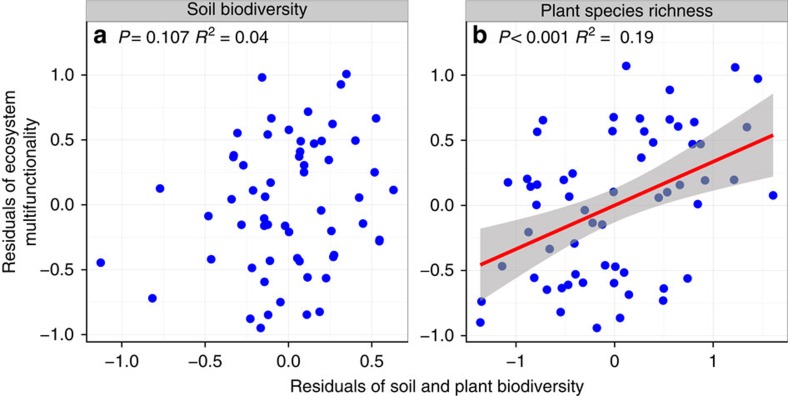
- Combined above- and belowground biodiversity accounted for 45% of EMF variation. In partial linear regression, plant species richness accounted for 19%, soil biodiversity 4% (not statistically significant, P=0.107), and their combined effects 22%.
- A full model with seven PCA components accounted for 86% of EMF variation; the best-fit two-component model accounted for 84%. Soil moisture was the most important single driver, accounting for 65% of EMF variation; MAP explained 43%, soil pH 30%, and soil CaCO3 33%. MAT had no isolated relationship with EMF but improved models when combined with other factors.
- Piecewise SEM showed soil moisture had the strongest influence on EMF (β=0.62), MAP was strongly related to belowground biodiversity (β=0.79), MAT directly affected EMF (β=0.16) and indirectly through soil pH (β=−0.27), and soil pH was negatively related to EMF (β=−0.11).
Methods
- Observational survey of 60 sites spanning >1,000,000 km² in Tibetan Plateau alpine grasslands during July–August 2011; 180 soil samples/plots were collected across alpine meadow, alpine steppe, and desert steppe vegetation types.
- Biodiversity measures included plant species richness, bacterial and archaeal OTUs, AM fungal virtual taxa, and soil faunal richness at order level. EMF was calculated as an averaging index from Z-scores of eight ecosystem functions: aboveground biomass, root biomass, soil organic carbon, soil nitrogen, soil available nitrogen, soil phosphorus, plant nitrogen, and plant phosphorus.
- Analyses used site means (n=60) and included OLS regressions, general linear models, partial linear regression, PCA, and piecewise structural equation modeling; climate data were compiled from 1951–2010 records from 716 stations.
Limitations
- Stated: belowground biodiversity is only a rough estimate because sequencing methods did not detect all taxa; future studies should use higher-resolution sequencing and target active communities. Soil moisture came from a single measurement and was not integrated across the season. The EMF index is not a single best metric of multifunctionality, and the measured functions were often correlated.
- Stated: the observational design cannot fully disentangle causal factors; the authors note that experimental work is needed to further disentangle these relationships.
- Evident: the study is correlational and relies on SEM for inferred direct and indirect effects, so causal claims about climate mediation remain model-based rather than experimentally tested.
Model-written summary. Check it against the paper before relying on it.
Integrity signals
Registry
Cites
Statistics
Figures


Verification
Claims the paper makes
2 Valid · 0 Not valid · 16 Not checked · 60 Own results and interpretations
A result the paper reports from its own data — it cites no other source for it, so there is none to check. The quote shows it is in the paper.
In the paper
“We found that a suite of biotic and abiotic variables account for up to 86% of the variation in EMF”
- Also stated in: § The effects of biodiversity and abiotic factors on EMF · plain
“The full model, with the seven components, accounted for 86% of the variation in EMF”
- Also stated in: § Discussion · plain
“The best-fitting models accounted for 86% of the variation in EMF and included soil moisture, soil pH, above- and belowground biodiversity as well as climatic variables (MAT).”
§ The links between ecosystem multifunctionality and above- and belowground biodiversity are mediated by climate > Abstract
plainstates an association- Asserted: passes — The authors put it forward as true.
- Checkable: passes — It can be checked against evidence.
- Load-bearing: passes — The paper’s conclusions depend on it.
- Based: passes — The paper gives a reason why it holds.
- Also stated in: § The effects of biodiversity and abiotic factors on EMF · plain
A result the paper reports from its own data — it cites no other source for it, so there is none to check. The quote shows it is in the paper.
In the paper
“Plant species richness accounted for 19% of the variation in EMF.”
§ The links between ecosystem multifunctionality and above- and belowground biodiversity are mediated by climate > Results > The effects of above- and belowground biodiversity on EMF
plainstates an association- Asserted: passes — The authors put it forward as true.
- Checkable: passes — It can be checked against evidence.
- Load-bearing: passes — The paper’s conclusions depend on it.
- Based: passes — The paper gives a reason why it holds.
A result the paper reports from its own data — it cites no other source for it, so there is none to check. The quote shows it is in the paper.
In the paper
“We found that soil moisture was the most important driver, accounting for 65% of the variation in EMF (Supplementary Fig. 9).”
§ The links between ecosystem multifunctionality and above- and belowground biodiversity are mediated by climate > Results > The effects of biodiversity and abiotic factors on EMF
plainstates a cause- Asserted: passes — The authors put it forward as true.
- Checkable: passes — It can be checked against evidence.
- Load-bearing: passes — The paper’s conclusions depend on it.
- Based: passes — The paper gives a reason why it holds.
A result the paper reports from its own data — it cites no other source for it, so there is none to check. The quote shows it is in the paper.
In the paper
“the best-fit model with two components (PC1 and PC4) accounted for 84% of the variation in EMF.”
§ The links between ecosystem multifunctionality and above- and belowground biodiversity are mediated by climate > Results > The effects of biodiversity and abiotic factors on EMF
plainstates an association- Asserted: passes — The authors put it forward as true.
- Checkable: passes — It can be checked against evidence.
- Load-bearing: passes — The paper’s conclusions depend on it.
- Based: passes — The paper gives a reason why it holds.
A result the paper reports from its own data — it cites no other source for it, so there is none to check. The quote shows it is in the paper.
In the paper
“PC4 represented MAT, soil moisture and soil CaCO3 (Supplementary Fig. 11).”
§ The links between ecosystem multifunctionality and above- and belowground biodiversity are mediated by climate > Results > The effects of biodiversity and abiotic factors on EMF
plain- Asserted: passes — The authors put it forward as true.
- Checkable: passes — It can be checked against evidence.
- Load-bearing: passes — The paper’s conclusions depend on it.
- Based: passes — The paper gives a reason why it holds.
27 more claims
Create a free account to see all 78 claims and to verify the 20 references still open.
- Probably not a substantial claim. 28
- It may state two separate claims as one. 29
Claims other papers make about this one
Each is checked against this paper’s own text: does it say what the citing paper says it does?
The source backs part of the claim, not all of it — or backs it for a different population, condition or comparison.
In the citing paper
“diversity effects of plants and microbes are complementary, maximising rates of nutrient cycling 11”
From Biodiversity at multiple trophic levels is needed for ecosystem multifunctionality (2016) · cites this paper as [11]
Experimental — accuracy not yet measuredThe cited source says what the claim attributes to it.
In the citing paper
“Consequently, we know very little about the relative effect of changes in the diversity of different trophic groups on the provision of individual 2,5,6,9,13,14 or multiple (multifunctionality) 11,15 ecosystem services.”
From Biodiversity at multiple trophic levels is needed for ecosystem multifunctionality (2016) · cites this paper as [11]
The cited source says what the claim attributes to it.
In the citing paper
“These results agree with other studies that have identified plants and soil microorganisms as key drivers of ecosystem functioning 11,14,15,29 , extending these findings to the richness and abundance of different trophic groups, including primary producers and consumers both above-and belowground.”
From Biodiversity at multiple trophic levels is needed for ecosystem multifunctionality (2016) · cites this paper as [11]
Self-check
Percentages, sums and reported differences re-computed from the paper’s own numbers.
Each contradiction between two passages listed here was confirmed by an independent check.
Rated major: it would touch a result — a value a result rests on, reported and recomputed p-values on opposite sides of the significance level, two passages that conflict with no sign which is right, or a cited work retracted before this paper was published.
In the paper
§ The links between ecosystem multifunctionality and above- and belowground biodiversity are mediated by climate > Results > The effects of biodiversity and abiotic factors on EMF
“the best-fit model with two components (PC1 and PC4) accounted for 84% of the variation in EMF.”
§ The links between ecosystem multifunctionality and above- and belowground biodiversity are mediated by climate > Methods > Statistical analyses
“the other one is a reduced model with two components (PC1 and PC2) (Supplementary Fig. 11).”
Citations
Cites
QIIME allows analysis of high-throughput community sequencing data
Caporaso, J. G., Kuczynski, J., Stombaugh, J., Bittinger, K., Bushman, F. D., Costello, E. K., Fierer, N., Peña, A. G., Goodrich, J. K., Gordon, J. I., et al. (2010) · Nature Methods · doi:10.1038/nmeth.f.303 · Cited by 34,887
Search and clustering orders of magnitude faster than BLAST
Edgar, R. C. (2010) · Bioinformatics · doi:10.1093/bioinformatics/btq461 · Cited by 20,826
Schloss, P. D., Westcott, S. L., Ryabin, T., Hall, J. R., Hartmann, M., Hollister, E. B., Lesniewski, R. A., Oakley, B. B., Parks, D. H., Robinson, C. J., et al. (2009) · Applied and Environmental Microbiology · doi:10.1128/aem.01541-09 · Cited by 19,549
UCHIME improves sensitivity and speed of chimera detection
Edgar, R. C., Haas, B. J., Clemente, J. C., Quince, C., & Knight, R. (2011) · Bioinformatics · doi:10.1093/bioinformatics/btr381 · Cited by 15,114
Experimental Design and Data Analysis for Biologists
Quinn, G. P., & Keough, M. J. (2002) · doi:10.1017/cbo9780511806384 · Cited by 10,674
Global patterns of 16S rRNA diversity at a depth of millions of sequences per sample
Caporaso, J. G., Lauber, C. L., Walters, W. A., Berg-Lyons, D., Lozupone, C. A., Turnbaugh, P. J., Fierer, N., & Knight, R. (2011) · Proceedings of the National Academy of Sciences · doi:10.1073/pnas.1000080107 · Cited by 9,711
EFFECTS OF BIODIVERSITY ON ECOSYSTEM FUNCTIONING: A CONSENSUS OF CURRENT KNOWLEDGE
Hooper, D. U., Chapin, F. S., Ewel, J. J., Hector, A., Inchausti, P., Lavorel, S., Lawton, J. H., Lodge, D. M., Loreau, M., Naeem, S., et al. (2005) · Ecological Monographs · doi:10.1890/04-0922 · Cited by 8,046
Biodiversity loss and its impact on humanity
Cardinale, B. J., Duffy, J. E., Gonzalez, A., Hooper, D. U., Perrings, C., Venail, P., Narwani, A., Mace, G. M., Tilman, D., Wardle, D. A., et al. (2012) · Nature · doi:10.1038/nature11148 · Cited by 7,457
Pruesse, E., Quast, C., Knittel, K., Fuchs, B. M., Ludwig, W., Peplies, J., & Glockner, F. O. (2007) · Nucleic Acids Research · doi:10.1093/nar/gkm864 · Cited by 6,668
The diversity and biogeography of soil bacterial communities
Fierer, N., & Jackson, R. B. (2006) · Proceedings of the National Academy of Sciences · doi:10.1073/pnas.0507535103 · Cited by 5,711
Research works printed but not linked: 1
- Smith, S. E. & Read, D. J. Mycorrhizal Symbiosis Academic Press (2010).
Cited by
piecewiseSEM: Piecewise structural equation modelling in r for ecology, evolution, and systematics
Lefcheck, J. S. (2016) · Methods in Ecology and Evolution · doi:10.1111/2041-210x.12512 · Cited by 4,845
“…drivers of ecosystem functioning in eelgrass beds (Duffy et al. 2015), disentangle the influence of functional diversity across trophic levels in experimental estuarine mesocosms (Lefcheck & Duffy 2015), and quantify the biotic and abiotic drivers of grassland multifunctionality (Jing et al. 2015).”
BackgroundMicrobial diversity drives multifunctionality in terrestrial ecosystems
Delgado-Baquerizo, M., Maestre, F. T., Reich, P. B., Jeffries, T. C., Gaitan, J. J., Encinar, D., Berdugo, M., Campbell, C. D., & Singh, B. K. (2016) · Nature Communications · doi:10.1038/ncomms10541 · Cited by 2,624
Scientists’ warning to humanity: microorganisms and climate change
Cavicchioli, R., Ripple, W. J., Timmis, K. N., Azam, F., Bakken, L. R., Baylis, M., Behrenfeld, M. J., Boetius, A., Boyd, P. W., Classen, A. T., et al. (2019) · Nature Reviews Microbiology · doi:10.1038/s41579-019-0222-5 · Cited by 2,028
“Soil microbial diversity influences plant diversity and is important for ecosystem functions, including carbon cycling 173,174 .”
Self-citationFungal-bacterial diversity and microbiome complexity predict ecosystem functioning
Wagg, C., Schlaeppi, K., Banerjee, S., Kuramae, E. E., & van der Heijden, M. G. A. (2019) · Nature Communications · doi:10.1038/s41467-019-12798-y · Cited by 1,836
Biodiversity at multiple trophic levels is needed for ecosystem multifunctionality
Soliveres, S., van der Plas, F., Manning, P., Prati, D., Gossner, M. M., Renner, S. C., Alt, F., Arndt, H., Baumgartner, V., Binkenstein, J., et al. (2016) · Nature · doi:10.1038/nature19092 · Cited by 867
Biodiversity and ecosystem functioning in naturally assembled communities
van der Plas, F. (2019) · Biological Reviews · doi:10.1111/brv.12499 · Cited by 805
“While positive relationships (N = 34, e.g. Maestre et al., 2012; Jing et al., 2015; Ratcliffe et al., 2017) between biodiversity and ecosystem multifunctionality outnumber negative ones (N = 13, e.”
BackgroundJiao, S., Chen, W., Wang, J., Du, N., Li, Q., & Wei, G. (2018) · Microbiome · doi:10.1186/s40168-018-0526-0 · Cited by 759
“A recent study investigating biotic and abiotic factors on the Tibetan Plateau demonstrated positive associations between aboveground and belowground biodiversity and ecosystem multifunctionality, which was mediated by climate [35].”
BackgroundMethodInfluentialBiodiversity effects in the wild are common and as strong as key drivers of productivity
Duffy, J. E., Godwin, C. M., & Cardinale, B. J. (2017) · Nature · doi:10.1038/nature23886 · Cited by 723
Aridity-driven shift in biodiversity–soil multifunctionality relationships
Hu, W., Ran, J., Dong, L., Du, Q., Ji, M., Yao, S., Sun, Y., Gong, C., Hou, Q., Gong, H., et al. (2021) · Nature Communications · doi:10.1038/s41467-021-25641-0 · Cited by 645
Self-citationChen, Q.-L., Ding, J., Zhu, D., Hu, H.-W., Delgado-Baquerizo, M., Ma, Y.-B., He, J.-Z., & Zhu, Y.-G. (2020) · Soil Biology and Biochemistry · doi:10.1016/j.soilbio.2019.107686 · Cited by 570
“– V5 hypervariable regions of the bacterial 16 S rRNA gene and fungal ITS2 region using the primers F515/R907 (Jing et al., 2015) and gITS7/ITS4 (Ihrmark et al.”
BackgroundMethodInfluentialSelf-citationPedotransfer Functions in Earth System Science: Challenges and Perspectives
Van Looy, K., Bouma, J., Herbst, M., Koestel, J., Minasny, B., Mishra, U., Montzka, C., Nemes, A., Pachepsky, Y. A., Padarian, J., et al. (2017) · Reviews of Geophysics · doi:10.1002/2017rg000581 · Cited by 567
“The biodiversity ecosystem function relationship is underlying most actual soil biodiversity study (Bender et al., 2016; Bradford et al., 2014; He et al., 2009; Jing et al., 2015; Ramirez et al., 2015), and some authors even go as far as stating that soil quality is primarily determined by soil biodiversity (Gardi et…”
BackgroundStructure and Functioning of Dryland Ecosystems in a Changing World
Maestre, F. T., Eldridge, D. J., Soliveres, S., Kéfi, S., Delgado-Baquerizo, M., Bowker, M. A., García-Palacios, P., Gaitán, J., Gallardo, A., Lázaro, R., et al. (2016) · Annual Review of Ecology, Evolution, and Systematics · doi:10.1146/annurev-ecolsys-121415-032311 · Cited by 561
“Similar results have been observed by studies focusing on biocrusts (Maestre et al. 2012b, Bowker et al. 2013) and soil microbial communities ( Jing et al. 2015, Delgado-Baquerizo et al. 2016a).”
BackgroundResultInfluentialClimate warming reduces the temporal stability of plant community biomass production
Ma, Z., Liu, H., Mi, Z., Zhang, Z., Wang, Y., Xu, W., Jiang, L., & He, J.-S. (2017) · Nature Communications · doi:10.1038/ncomms15378 · Cited by 550
Self-citationJiao, S., Lu, Y., & Wei, G. (2022) · Global Change Biology · doi:10.1111/gcb.15917 · Cited by 485
“…biodiversity loss across many trophic groups (Allan et al., 2014; Newbold et al., 2015), with potential effects on multiple ecosystem functions and services (Delgado- Baquerizo, Giaramida, et al., 2016; Delgado- Baquerizo et al., 2020; Jing et al., 2015; Naeem et al., 2012; Wagg et al., 2014).”
BackgroundInfluentialChen, W., Wang, J., Chen, X., Meng, Z., Xu, R., Duoji, D., Zhang, J., He, J., Wang, Z., Chen, J., et al. (2022) · Soil Biology and Biochemistry · doi:10.1016/j.soilbio.2022.108766 · Cited by 462
Self-citationShi, Y., Li, Y., Xiang, X., Sun, R., Yang, T., He, D., Zhang, K., Ni, Y., Zhu, Y.-G., Adams, J. M., et al. (2018) · Microbiome · doi:10.1186/s40168-018-0409-4 · Cited by 446
Self-citationJiao, S., & Lu, Y. (2020) · Environmental Microbiology · doi:10.1111/1462-2920.14815 · Cited by 442
It is elemental: soil nutrient stoichiometry drives bacterial diversity
Delgado‐Baquerizo, M., Reich, P. B., Khachane, A. N., Campbell, C. D., Thomas, N., Freitag, T. E., Abu Al‐Soud, W., Sørensen, S., Bardgett, R. D., & Singh, B. K. (2017) · Environmental Microbiology · doi:10.1111/1462-2920.13642 · Cited by 407
Diversifying livestock promotes multidiversity and multifunctionality in managed grasslands
Wang, L., Delgado-Baquerizo, M., Wang, D., Isbell, F., Liu, J., Feng, C., Liu, J., Zhong, Z., Zhu, H., Yuan, X., et al. (2019) · Proceedings of the National Academy of Sciences · doi:10.1073/pnas.1807354116 · Cited by 395
“The empirical evidence for a strong link between soil biodiversity and multiple ecosystem functions is growing (5, 7, 37).”
BackgroundBiodiversity across trophic levels drives multifunctionality in highly diverse forests
Schuldt, A., Assmann, T., Brezzi, M., Buscot, F., Eichenberg, D., Gutknecht, J., Härdtle, W., He, J.-S., Klein, A.-M., Kühn, P., et al. (2018) · Nature Communications · doi:10.1038/s41467-018-05421-z · Cited by 343
Self-citationYang, T., Adams, J. M., Shi, Y., He, J., Jing, X., Chen, L., Tedersoo, L., & Chu, H. (2017) · New Phytologist · doi:10.1111/nph.14606 · Cited by 320
“Data were compiled by interpolating data of annual mean temperature and annual precipitation records (1951–2010) from 716 climate stations across China (http://cdc.cma.gov.cn), which was previously used by Jing et al. (2015).”
MethodSelf-citationLiang, Y., Xiao, X., Nuccio, E. E., Yuan, M., Zhang, N., Xue, K., Cohan, F. M., Zhou, J., & Sun, B. (2020) · Environmental Microbiology · doi:10.1111/1462-2920.14945 · Cited by 316
Core Microbiota in Agricultural Soils and Their Potential Associations with Nutrient Cycling
Jiao, S., Xu, Y., Zhang, J., Hao, X., & Lu, Y. (2019) · mSystems · doi:10.1128/msystems.00313-18 · Cited by 296
“differ geographically due to spatial variation in abiotic factors (9).”
InfluentialLocal loss and spatial homogenization of plant diversity reduce ecosystem multifunctionality
Hautier, Y., Isbell, F., Borer, E. T., Seabloom, E. W., Harpole, W. S., Lind, E. M., MacDougall, A. S., Stevens, C. J., Adler, P. B., Alberti, J., et al. (2017) · Nature Ecology & Evolution · doi:10.1038/s41559-017-0395-0 · Cited by 297
Ullah, A., Bano, A., & Khan, N. (2021) · Frontiers in Sustainable Food Systems · doi:10.3389/fsufs.2021.618092 · Cited by 295
Consistent effects of biodiversity loss on multifunctionality across contrasting ecosystems
Fanin, N., Gundale, M. J., Farrell, M., Ciobanu, M., Baldock, J. A., Nilsson, M.-C., Kardol, P., & Wardle, D. A. (2017) · Nature Ecology & Evolution · doi:10.1038/s41559-017-0415-0 · Cited by 294
Microbial richness and composition independently drive soil multifunctionality
Delgado‐Baquerizo, M., Trivedi, P., Trivedi, C., Eldridge, D. J., Reich, P. B., Jeffries, T. C., & Singh, B. K. (2017) · Functional Ecology · doi:10.1111/1365-2435.12924 · Cited by 289
“Our results were maintained after controlling for spatial structure (in observational data) and microbial abundance using partial correlations and ANCOVA analyses, and provided experimental support to previous observational studies showing positive relationships between soil microbial diversity and multiple soil funct…”
BackgroundResultInfluentialNutrient-induced acidification modulates soil biodiversity-function relationships
Hu, Z., Delgado-Baquerizo, M., Fanin, N., Chen, X., Zhou, Y., Du, G., Hu, F., Jiang, L., Hu, S., & Liu, M. (2024) · Nature Communications · doi:10.1038/s41467-024-47323-3 · Cited by 284
“Then, their average wascalculated to obtain an multifunctionality index 6,44 .”
Diversity and asynchrony in soil microbial communities stabilizes ecosystem functioning
Wagg, C., Hautier, Y., Pellkofer, S., Banerjee, S., Schmid, B., & van der Heijden, M. G. (2021) · eLife · doi:10.7554/elife.62813 · Cited by 276
Linking Bacterial-Fungal Relationships to Microbial Diversity and Soil Nutrient Cycling
Jiao, S., Peng, Z., Qi, J., Gao, J., & Wei, G. (2021) · mSystems · doi:10.1128/msystems.01052-20 · Cited by 255
“This method was used to quantify soil multinutrient cycling because it is a straightforward and interpretable measure of a community’s ability to sustain multiple functions simultaneously (33, 34, 84).”
BackgroundMethodInfluentialLuo, G., Rensing, C., Chen, H., Liu, M., Wang, M., Guo, S., Ling, N., & Shen, Q. (2018) · Functional Ecology · doi:10.1111/1365-2435.13039 · Cited by 256
“While a large body of published literature used the multiple threshold approach to calculate multifunctionality (Bradford et al., 2014; Mori et al., 2016), the result of this computation was similar to the averaging approach (Jing et al., 2015).”
BackgroundMethodResultInfluentialTang, S., Ma, Q., Marsden, K. A., Chadwick, D. R., Luo, Y., Kuzyakov, Y., Wu, L., & Jones, D. L. (2023) · Soil Biology and Biochemistry · doi:10.1016/j.soilbio.2023.109019 · Cited by 236
Revisiting the biodiversity–ecosystem multifunctionality relationship
Gamfeldt, L., & Roger, F. (2017) · Nature Ecology & Evolution · doi:10.1038/s41559-017-0168 · Cited by 235
Li, H.-Y., Wang, H., Wang, H.-T., Xin, P.-Y., Xu, X.-H., Ma, Y., Liu, W.-P., Teng, C.-Y., Jiang, C.-L., Lou, L.-P., et al. (2018) · Microbiome · doi:10.1186/s40168-018-0561-x · Cited by 235
“Briefly, the V4-V5 region of the 16S rRNA gene from each soil sample was amplified using the F515/R907 primer set with a unique 6-nt barcode at the 5′ of the forward primer [64].”
MethodMa, X., Geng, Q., Zhang, H., Bian, C., Chen, H. Y. H., Jiang, D., & Xu, X. (2021) · New Phytologist · doi:10.1111/nph.17077 · Cited by 234
Han, S., Delgado-Baquerizo, M., Luo, X., Liu, Y., Van Nostrand, J. D., Chen, W., Zhou, J., & Huang, Q. (2021) · Soil Biology and Biochemistry · doi:10.1016/j.soilbio.2021.108143 · Cited by 233
“However, most of these previous studies focused on larger scales (Jing et al., 2015; Delgado-Baquerizo et al., 2016a; Gross et al., 2017; Bagousse-Pingue et al., 2019) and there is limited information on the variations in soil multifunctionality at the micrometer-scale (e.”
BackgroundThe global significance of biodiversity science in China: an overview
Mi, X., Feng, G., Hu, Y., Zhang, J., Chen, L., Corlett, R. T., Hughes, A. C., Pimm, S., Schmid, B., Shi, S., et al. (2021) · National Science Review · doi:10.1093/nsr/nwab032 · Cited by 233
“Second, the orogeny of the Himalaya, the uplift of the Qinghai-Tibetan Plateau, and the subsequent development of the East Asian monsoon had huge impacts on China’s landforms, topography and climate [12].”
BackgroundInfluentialSelf-citationHow Soil Biota Drive Ecosystem Stability
Yang, G., Wagg, C., Veresoglou, S. D., Hempel, S., & Rillig, M. C. (2018) · Trends in Plant Science · doi:10.1016/j.tplants.2018.09.007 · Cited by 226
Jiang, C., Jin, W., Tao, X., Zhang, Q., Zhu, J., Feng, S., Xu, X., Li, H., Wang, Z., & Zhang, Z. (2019) · Microbial Biotechnology · doi:10.1111/1751-7915.13393 · Cited by 218
“The V4–V5 region of the 16S rRNA gene was amplified in triplicate using the F515/R907 primer set (Jing et al., 2015).”
MethodFungal richness contributes to multifunctionality in boreal forest soil
Li, J., Delgado-Baquerizo, M., Wang, J.-T., Hu, H.-W., Cai, Z.-J., Zhu, Y.-N., & Singh, B. K. (2019) · Soil Biology and Biochemistry · doi:10.1016/j.soilbio.2019.107526 · Cited by 217
Barrios, E., Valencia, V., Jonsson, M., Brauman, A., Hairiah, K., Mortimer, P. E., & Okubo, S. (2018) · International Journal of Biodiversity Science, Ecosystem Services & Management · doi:10.1080/21513732.2017.1399167 · Cited by 211
“More recently, Jing et al. (2015) reported that the combined effects of above- and belowground biodiversity contributed to 45% of the variation in ecosystem multifunctionality.”
BackgroundAshworth, A. J., DeBruyn, J. M., Allen, F. L., Radosevich, M., & Owens, P. R. (2017) · Soil Biology and Biochemistry · doi:10.1016/j.soilbio.2017.07.019 · Cited by 209
Jia, R., Zhou, J., Chu, J., Shahbaz, M., Yang, Y., Jones, D. L., Zang, H., Razavi, B. S., & Zeng, Z. (2022) · Journal of Cleaner Production · doi:10.1016/j.jclepro.2022.132265 · Cited by 200
Soil biodiversity supports the delivery of multiple ecosystem functions in urban greenspaces
Fan, K., Chu, H., Eldridge, D. J., Gaitan, J. J., Liu, Y.-R., Sokoya, B., Wang, J.-T., Hu, H.-W., He, J.-Z., Sun, W., et al. (2023) · Nature Ecology & Evolution · doi:10.1038/s41559-022-01935-4 · Cited by 197
Self-citationJiao, S., Qi, J., Jin, C., Liu, Y., Wang, Y., Pan, H., Chen, S., Liang, C., Peng, Z., Chen, B., et al. (2022) · Global Change Biology · doi:10.1111/gcb.16387 · Cited by 195
“…environmental changes, which could cause biodiversity loss across many trophic groups (Allan et al., 2014; Newbold et al., 2015), with potential effects on multiple ecosystem functions and services (DelgadoBaquerizo et al., 2016, 2020; Jing et al., 2015; Naeem et al., 2012; Wagg et al., 2014).”
BackgroundMethodEarthworms Coordinate Soil Biota to Improve Multiple Ecosystem Functions
Liu, T., Chen, X., Gong, X., Lubbers, I. M., Jiang, Y., Feng, W., Li, X., Whalen, J. K., Bonkowski, M., Griffiths, B. S., et al. (2019) · Current Biology · doi:10.1016/j.cub.2019.08.045 · Cited by 193
“Biodiversity losswas often accompanied by a decrease in ecosystemmultifunctionality [21, 30], especially when the species diversity loss was caused by strong disturbances, such as global change drivers [8, 20, 31, 32] or landuse intensification [33].”
BackgroundSelf-citationLuo, S., Png, G. K., Ostle, N. J., Zhou, H., Hou, X., Luo, C., Quinton, J. N., Schaffner, U., Sweeney, C., Wang, D., et al. (2023) · Soil Biology and Biochemistry · doi:10.1016/j.soilbio.2022.108865 · Cited by 192
Delgado‐Baquerizo, M., Grinyer, J., Reich, P. B., & Singh, B. K. (2016) · Functional Ecology · doi:10.1111/1365-2435.12674 · Cited by 186
“…functioning (Colman & Schimel 2013; Wieder, Boehnert & Bonan 2014), including broad (e.g. microbial respiration; Strickland et al. 2009), special- ized (e.g. denitrification; Philippot et al. 2013) and multiple ecosystems functions simultaneously (Jing et al. 2015; Del- gado-Baquerizo et al. 2016).”
Experimental impacts of grazing on grassland biodiversity and function are explained by aridity
Zhang, M., Delgado-Baquerizo, M., Li, G., Isbell, F., Wang, Y., Hautier, Y., Wang, Y., Xiao, Y., Cai, J., Pan, X., et al. (2023) · Nature Communications · doi:10.1038/s41467-023-40809-6 · Cited by 180
Valencia, E., Gross, N., Quero, J. L., Carmona, C. P., Ochoa, V., Gozalo, B., Delgado‐Baquerizo, M., Dumack, K., Hamonts, K., Singh, B. K., et al. (2018) · Global Change Biology · doi:10.1111/gcb.14440 · Cited by 184
Yuan, Z., Ali, A., Ruiz‐Benito, P., Jucker, T., Mori, A. S., Wang, S., Zhang, X., Li, H., Hao, Z., Wang, X., et al. (2020) · Journal of Ecology · doi:10.1111/1365-2745.13378 · Cited by 177
“Nevertheless, nutrient cycling can be maximized only if the effects of above- and below-ground biodiversity are complementary (Jing et al., 2015), otherwise, they may have opposing effects on ecosystem functions (Schuldt et al., 2018).”
BackgroundCrop rotations alter bacterial and fungal diversity in paddy soils across East Asia
Jiang, Y., Liang, Y., Li, C., Wang, F., Sui, Y., Suvannang, N., Zhou, J., & Sun, B. (2016) · Soil Biology and Biochemistry · doi:10.1016/j.soilbio.2016.01.007 · Cited by 174
Self-citationClimate change and its implications for food safety and spoilage
Misiou, O., & Koutsoumanis, K. (2022) · Trends in Food Science & Technology · doi:10.1016/j.tifs.2021.03.031 · Cited by 168
Luo, J., Liao, G., Banerjee, S., Gu, S., Liang, J., Guo, X., Zhao, H., Liang, Y., & Li, T. (2023) · Soil Biology and Biochemistry · doi:10.1016/j.soilbio.2022.108922 · Cited by 172
Yao, Q., Liu, J., Yu, Z., Li, Y., Jin, J., Liu, X., & Wang, G. (2017) · Applied Soil Ecology · doi:10.1016/j.apsoil.2017.01.007 · Cited by 170
Locally rare species influence grassland ecosystem multifunctionality
Soliveres, S., Manning, P., Prati, D., Gossner, M. M., Alt, F., Arndt, H., Baumgartner, V., Binkenstein, J., Birkhofer, K., Blaser, S., et al. (2016) · Philosophical Transactions of the Royal Society B: Biological Sciences · doi:10.1098/rstb.2015.0269 · Cited by 168
Global vulnerability of soil ecosystems to erosion
Guerra, C. A., Rosa, I. M. D., Valentini, E., Wolf, F., Filipponi, F., Karger, D. N., Nguyen Xuan, A., Mathieu, J., Lavelle, P., & Eisenhauer, N. (2020) · Landscape Ecology · doi:10.1007/s10980-020-00984-z · Cited by 166
Soil Microbial Biogeography in a Changing World: Recent Advances and Future Perspectives
Chu, H., Gao, G.-F., Ma, Y., Fan, K., & Delgado-Baquerizo, M. (2020) · mSystems · doi:10.1128/msystems.00803-19 · Cited by 165
“Furthermore, the relationships between soil microbial biodiversity and ecosystem multifunctionality are mediated by climate in the alpine grasslands of the Tibetan Plateau (63).”
BackgroundSelf-citationYang, G., Ryo, M., Roy, J., Lammel, D. R., Ballhausen, M.-B., Jing, X., Zhu, X., & Rillig, M. C. (2022) · Nature Communications · doi:10.1038/s41467-022-31936-7 · Cited by 164
Self-citationLiu, L., Zhu, K., Krause, S. M. B., Li, S., Wang, X., Zhang, Z., Shen, M., Yang, Q., Lian, J., Wang, X., et al. (2021) · Soil Biology and Biochemistry · doi:10.1016/j.soilbio.2021.108144 · Cited by 162
Consistently inconsistent drivers of microbial diversity and abundance at macroecological scales
Hendershot, J. N., Read, Q. D., Henning, J. A., Sanders, N. J., & Classen, A. T. (2017) · Ecology · doi:10.1002/ecy.1829 · Cited by 161
Self-citationLiu, Y.-R., Delgado-Baquerizo, M., Bi, L., Zhu, J., & He, J.-Z. (2018) · Microbiome · doi:10.1186/s40168-018-0572-7 · Cited by 160
Self-citationZhu, L., Luan, L., Chen, Y., Wang, X., Zhou, S., Zou, W., Han, X., Duan, Y., Zhu, B., Li, Y., et al. (2024) · Global Change Biology · doi:10.1111/gcb.17160 · Cited by 173
Self-citationLi, D., Ni, H., Jiao, S., Lu, Y., Zhou, J. Z., Sun, B., & Liang, Y. (2021) · Microbiome · doi:10.1186/s40168-020-00978-8 · Cited by 159
“For example, previous study revealed that the regional-scale variation of climate change can determine the effects of biodiversity on ecosystem multifunctionality in natural ecosystems [58].”
BackgroundEldridge, D. J., Delgado‐Baquerizo, M., Travers, S. K., Val, J., Oliver, I., Hamonts, K., & Singh, B. K. (2017) · Ecology · doi:10.1002/ecy.1879 · Cited by 152
Polyethylene microplastics alter soil microbial community assembly and ecosystem multifunctionality
Liu, Z., Wen, J., Liu, Z., Wei, H., & Zhang, J. (2023) · Environment International · doi:10.1016/j.envint.2023.108360 · Cited by 154
The Serendipitous Value of Soil Fauna in Ecosystem Functioning: The Unexplained Explained
Briones, M. J. I. (2018) · Frontiers in Environmental Science · doi:10.3389/fenvs.2018.00149 · Cited by 169
Hu, A., Wang, J., Sun, H., Niu, B., Si, G., Wang, J., Yeh, C.-F., Zhu, X., Lu, X., Zhou, J. Z., et al. (2020) · The ISME Journal · doi:10.1038/s41396-019-0574-x · Cited by 164
A global meta-analyses of the response of multi-taxa diversity to grazing intensity in grasslands
Wang, C., & Tang, Y. (2019) · Environmental Research Letters · doi:10.1088/1748-9326/ab4932 · Cited by 154
“Our metaanalyses is among the first to find microbial diversity significantly increased after grazing, which may closely related to the changes of plant diversity and soil properties (Fierer and Jackson 2006, Jing et al 2015).”
BackgroundMechanism Underlying Microbial Community Assembly in the Qinling Secondary Forest Ecosystem
Huo, X., Ren, C., Wang, D., Wu, R., Wang, Y., Li, Z., Huang, D., & Qi, H. (2022) · Soil Biology and Biochemistry · doi:10.1016/j.soilbio.2023.109075 · Cited by 147
Global effects on soil respiration and its temperature sensitivity depend on nitrogen addition rate
Yang, Y., Li, T., Pokharel, P., Liu, L., Qiao, J., Wang, Y., An, S., & Chang, S. X. (2022) · Soil Biology and Biochemistry · doi:10.1016/j.soilbio.2022.108814 · Cited by 144
Tang, W., Liu, Y., Guan, W., Zhong, H., Qu, X.-M., & Zhang, T. (2020) · The Science of The Total Environment · doi:10.1016/j.scitotenv.2020.136827 · Cited by 146
Crop rotational diversity enhances soil microbiome network complexity and multifunctionality
Yang, X. Q., Hu, H., Yang, G., Cui, Z., & Chen, Y. (2023) · Geoderma · doi:10.1016/j.geoderma.2023.116562 · Cited by 145
Chen, Q., Ding, J., Li, C., Yan, Z., He, J., & Hu, H. (2020) · The Science of The Total Environment · doi:10.1016/j.scitotenv.2020.139479 · Cited by 135
Self-citationZhang, Z., Lu, Y., Wei, G., & Jiao, S. (2022) · mBio · doi:10.1128/mbio.00449-22 · Cited by 153
“The relationships between biodiversity and ecosystem functioning have been shown to change with abiotic conditions, land use intensification (3, 30–33), the identity and number of functions (34, 35), and the type of organism being considered (3, 4, 30).”
BackgroundSingh, A. K., Liu, W., Zakari, S., Wu, J., Yang, B., Jiang, X., Zhu, X., Zou, X., Zhang, W., Chen, C., et al. (2021) · The Science of The Total Environment · doi:10.1016/j.scitotenv.2021.148948 · Cited by 140
Yang, Y., Qiu, K., Xie, Y., Li, X., Zhang, S., Liu, W., Huang, Y., Cui, L., Wang, S., & Bao, P. (2023) · The Science of The Total Environment · doi:10.1016/j.scitotenv.2023.166932 · Cited by 128
Grazing practices affect the soil microbial community composition in a Tibetan alpine meadow
Yang, F., Niu, K., Collins, C. G., Yan, X., Ji, Y., Ling, N., Zhou, X., Du, G., Guo, H. J., & Hu, S. (2018) · Land Degradation and Development · doi:10.1002/ldr.3189 · Cited by 127
“The taxonomic identity of each sequence was determined using Greengene database (http://greengenes.lbl.gov/; DeSantis et al., 2006; Jing et al., 2015) and Silva database (http://www.”
MethodLuo, G., Jin, T., Zhang, H., Peng, J., Zuo, N., Huang, Y., Han, Y., Tian, C., Yang, Y., Peng, K., et al. (2021) · Journal of Hazardous Materials · doi:10.1016/j.jhazmat.2021.126865 · Cited by 126
Zhou, L., Zhou, X., He, Y., Fu, Y., Du, Z., Lu, M., Sun, X., Li, C., Lu, C., Liu, R., et al. (2022) · Nature Communications · doi:10.1038/s41467-022-32671-9 · Cited by 151
Warming and top predator loss drive ecosystem multifunctionality
Antiqueira, P. A. P., Petchey, O. L., & Romero, G. Q. (2017) · Ecology Letters · doi:10.1111/ele.12873 · Cited by 129
“If individual ecosystem functions can have a particular response to an environmental driver (Jing et al. 2015; Perkins et al. 2015), multiple environmental drivers may cause stronger impacts to multiple ecosystem functions simultaneously.”
BackgroundGuo, Y., Xu, T., Cheng, J., Wei, G., & Lin, Y. (2021) · The Science of The Total Environment · doi:10.1016/j.scitotenv.2021.145010 · Cited by 119
Wan, B., Liu, T., Gong, X., Zhang, Y., Li, C., Chen, X., Hu, F., Griffiths, B. S., & Liu, M. (2022) · Soil Biology and Biochemistry · doi:10.1016/j.soilbio.2022.108656 · Cited by 120
Livestock grazing regulates ecosystem multifunctionality in semi‐arid grassland
Ren, H., Eviner, V. T., Gui, W., Wilson, G. W. T., Cobb, A. B., Yang, G., Zhang, Y., Hu, S., & Bai, Y. (2018) · Functional Ecology · doi:10.1111/1365-2435.13215 · Cited by 120
Liu, Y., Delgado‐Baquerizo, M., Trivedi, P., He, J., Wang, J., & Singh, B. K. (2017) · Soil Biology and Biochemistry · doi:10.1016/j.soilbio.2016.12.003 · Cited by 120
Self-citationChen, L., Jiang, L., Jing, X., Wang, J., Shi, Y., Chu, H., & He, J. (2021) · Global Ecology and Biogeography · doi:10.1111/geb.13307 · Cited by 114
Self-citationCrop rotation history constrains soil biodiversity and multifunctionality relationships
Li, M., Guo, J., Ren, T., Luo, G., Shen, Q., Lü, J., Guo, S., & Ling, N. (2021) · Agriculture Ecosystems & Environment · doi:10.1016/j.agee.2021.107550 · Cited by 119
Litter and soil biodiversity jointly drive ecosystem functions
Liu, S., Plaza, C., Ochoa‐Hueso, R., Trivedi, C., Wang, J., Trivedi, P., Zhou, G., Piñeiro, J., Martins, C. S. C., Singh, B. K., et al. (2023) · Global Change Biology · doi:10.1111/gcb.16913 · Cited by 117
“…biodiversity are widely recognized to support multiple ecosystem functions from local (Bradford, 2014 ; Craven et al., 2016; Hautier et al., 2018; Jing et al., 2015; Tilman et al., 1996 ; Wagg et al., 2014) to global scale (Delgado-Baquerizo et al., 2020; Eisenhauer, 2022 ; Eldridge et al., 2023…”
BackgroundHuman pressure drives biodiversity–multifunctionality relationships in large Neotropical wetlands
Moi, D. A., Lansac‐Tôha, F. M., Romero, G. Q., Sobral‐Souza, T., Cardinale, B. J., Kratina, P., Perkins, D. M., de Mello, F. T., Jeppesen, E., Heino, J., et al. (2022) · Nature Ecology & Evolution · doi:10.1038/s41559-022-01827-7 · Cited by 120
Jia, J., Zhang, J., Li, Y., Koziol, L., Podzikowski, L. Y., Delgado‐Baquerizo, M., Wang, G., & Zhang, J. (2022) · Geoderma · doi:10.1016/j.geoderma.2022.116273 · Cited by 119
“Soil microbial diversity is positively correlated with SMF in both natural and agricultural ecosystems (Jing et al. 2015; Mori et al., 2016; Delgado-Baquerizo et al., 2017; Chen et al., 2020a; Li et al., 2021a,b; Luo et al., 2018).”
Zheng, J., Zhao, J., Shi, Z., & Wang, L. (2020) · Agriculture Ecosystems & Environment · doi:10.1016/j.agee.2020.107254 · Cited by 115
Zhang, R., Wang, Z., Niu, S., Tian, D., Wu, Q., Gao, X., Schellenberg, M. P., & Han, G. (2021) · The Science of The Total Environment · doi:10.1016/j.scitotenv.2021.145730 · Cited by 113
Ma, H.-Y., Zhou, J., Ge, J., Nie, J., Zhao, J., Xue, Z., Hu, Y., Yang, Y., Peixoto, L., Zang, H., et al. (2022) · Plant and Soil · doi:10.1007/s11104-022-05554-7 · Cited by 109
“, performing multiple functions simultaneously) is increasingly applied in agroecosystems to offer a quantitative way to assess the functional roles of soil biodiversity (Allan et al. 2015; Jing et al. 2015).”
BackgroundWu, J., Zhao, Y., Yu, C., Luo, L., & Pan, Y. J. (2017) · Journal of Environmental Management · doi:10.1016/j.jenvman.2017.02.008 · Cited by 108
Wang, X., Li, F. Y., Wang, Y., Liu, X., Cheng, J., Zhang, J., Baoyin, T., & Bardgett, R. D. (2020) · Plant and Soil · doi:10.1007/s11104-020-04430-6 · Cited by 104
He, M., Pan, Y., Zhou, G., Barry, K. E., Fu, Y., & Zhou, X. (2022) · Global Change Biology · doi:10.1111/gcb.16305 · Cited by 107
Cross-Biome Drivers of Soil Bacterial Alpha Diversity on a Worldwide Scale
Delgado‐Baquerizo, M., & Eldridge, D. J. (2019) · Ecosystems · doi:10.1007/s10021-018-0333-2 · Cited by 111
Crop production correlates with soil multitrophic communities at the large spatial scale
Fan, K., Delgado‐Baquerizo, M., Zhu, Y., & Chu, H. (2020) · Soil Biology and Biochemistry · doi:10.1016/j.soilbio.2020.108047 · Cited by 103
Self-citationLiu, H., Liu, Y., Chen, Y., Fan, M., Chen, Y., Gang, C., You, Y., & Wang, Z. (2023) · Agricultural and Forest Meteorology · doi:10.1016/j.agrformet.2023.109327 · Cited by 113
Birkhofer, K., Andersson, G. K. S., Bengtsson, J., Bommarco, R., Dänhardt, J., Ekbom, B., Ekroos, J., Hahn, T., Hedlund, K., Jönsson, A. M., et al. (2018) · Biological Conservation · doi:10.1016/j.biocon.2017.12.027 · Cited by 119
“Empirical studies that address the relationships between multi-taxon biodiversity (hereafter multidiversity) and the simultaneous provision of multiple ES (hereafter multifunctionality) in a land-use context are rare (Allan et al., 2015; Jing et al., 2015).”
Background
Metadata
- Authors
- Jing, X., Sanders, N. J., Shi, Y., Chu, H., Classen, A. T., Zhao, K., Chen, L., Shi, Y., Jiang, Y., & He, J.-S.
- Affiliations
- Peking University (CN)
- University of Copenhagen (DK)
- Chinese Academy of Sciences (CN)
- Northwest Institute of Plateau Biology (CN)
- Chinese Academy of Forestry (CN)
- Corresponding author
- He, Jin-Sheng
- Venue
- Nature Communications
- Published
- 2015-09-02
- Volume
- 6
- Issue
- 1
- Pages
- 8159-8159
- ISSN
- 2041-1723 (ISSN-L)
- PMC
- PMC4569729
- OpenAlex
- W2263248977
- Cited by
- 895
- References
- 72
- Citations by year
- 2026: 122 · 2025: 142 · 2024: 145 · 2023: 124 · 2022: 87 · 2021: 87 · 2020: 57 · 2019: 45 · 2018: 37 · 2017: 29 · 2016: 15 · 2015: 3
- FWCI
- 29.02
- Type
- journal article
- Language
- en
- Open access
- gold
- doi.org
- Licence
- cc-by
- creativecommons.org/licenses/by/4.0 (tdm)
- creativecommons.org/licenses/by/4.0 (vor)
- Locations
- Nature Communications (publishedVersion, cc-by)
- Europe PMC (PubMed Central) (publishedVersion, cc-by)
- PubMed Central (publishedVersion, cc-by)
- PubMed (publishedVersion)
- Research at the University of Copenhagen (University of Copenhagen) (publishedVersion, cc-by)
- OSTI OAI (U.S. Department of Energy Office of Scientific and Technical Information) (submittedVersion)
- RePEc: Research Papers in Economics (submittedVersion)
- Institute of Botany, CAS Institutional Repository (submittedVersion)
- Greater South Information System
- Funders
- National Science Foundation (1136703)
- U.S. Department of Energy (DESC0010562)
- National Research Foundation
- Danmarks Grundforskningsfond
- National Natural Science Foundation of China (31321061, 111 Project, XDB03030403, 41071167, 2014CB954004, 31025005)
- Chinese Academy of Sciences (XDA05050404, 31321061, XDB03030403)
- Higher Education Discipline Innovation Project
- Office of Science (DESC0010562)
- Center for Makroøkologi, Evolution og Klima
- National Key Research and Development Program of China (2014CB954004, #2014CB954002, 111 project)
- Biological and Environmental Research (DE-SC0010562)
- Topics
- Physical Sciences › Environmental Science › Nature and Landscape Conservation › Ecology and Vegetation Dynamics Studies
- Life Sciences › Agricultural and Biological Sciences › Soil Science › Soil Carbon and Nitrogen Dynamics
- Physical Sciences › Environmental Science › Global and Planetary Change › Land Use and Ecosystem Services
- Keywords
- ecosystem multifunctionality, soil biodiversity, plant diversity, ecosystem functioning, Tibetan Plateau, biotic and abiotic factors
- MeSH terms
- Bacteria, Climate, Fungi, Plants, Soil Microbiology, Ecosystem, Tibet, Biodiversity, Climate Change, Biota, Grassland
About these checks
Registry, retraction, Cites and statistics results are computed, not judged, with one exception: a printed reference that no index lists is read once by a model before it counts as a citation error. Claims are extracted by a model and kept only when their quote appears verbatim in the text; each cited source is then checked, with a model’s help, for whether it says what the claim relies on. Those verdicts can be wrong — read the claim’s quote and the cited source before relying on one.
The claim verdicts this report counts are experimental: their accuracy is not yet measured.
A language model drew the claims from the paper on 2026-10-07, under version 3 of the claim definition (model deepseek-v4.1-flash, prompt extract-v3).
A second model labelled each claim on 2026-10-07 (model jev-1.13-20260917, definition revision gold-guideline-v0.2).
Statistics and arithmetic are recomputed, not judged.
Confidence bands are shown only for fields calibrated on our annotated test set. None is calibrated yet, so no band is shown.
What counts as a claim ›How we measure confidence ›How we check this ›
Are you an author, or do you see a problem with this page? Request a review
Data sources
Bibliographic data: Semantic Scholar, OpenAlex, Crossref.
Contains information from the Semantic Scholar Academic Graph Datasets, made available under the ODC Attribution License (ODC-BY 1.0).
Semantic Scholar’s data is described in: Kinney, R., et al. (2023). The Semantic Scholar Open Data Platform. arXiv:2301.10140.
