

The DOI matches its Crossref record; 54 of the 55 references it cites were found in a registry or an index.
An insula-frontostriatal network mediates flexible cognitive control by adaptively predicting changing control demands
Open accessAbstract
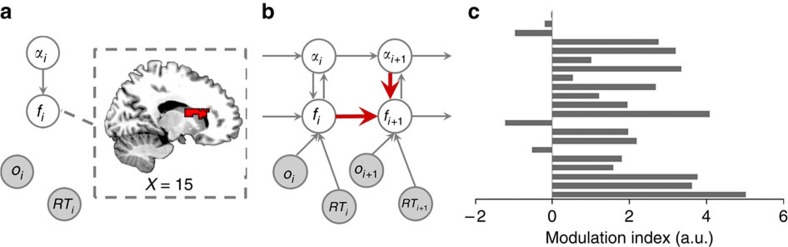
The anterior cingulate and lateral prefrontal cortices have been implicated in implementing context-appropriate attentional control, but the learning mechanisms underlying our ability to flexibly adapt the control settings to changing environments remain poorly understood. Here we show that human adjustments to varying control demands are captured by a reinforcement learner with a flexible, volatility-driven learning rate. Using model-based functional magnetic resonance imaging, we demonstrate that volatility of control demand is estimated by the anterior insula, which in turn optimizes the prediction of forthcoming demand in the caudate nucleus. The caudate’s prediction of control demand subsequently guides the implementation of proactive and reactive attentional control in dorsal anterior cingulate and dorsolateral prefrontal cortices. These data enhance our understanding of the neuro-computational mechanisms of adaptive behaviour by connecting the classic cingulate-prefrontal cognitive control network to a subcortical control-learning mechanism that infers future demands by flexibly integrating remote and recent past experiences.
Overview
The claims and statistics of this paper haven’t been checked yet.
Free: it reads the open-access text and checks the first 5 claims that cite a source we can check. Create a free account to check every claim.
Integrity signals
Registry
Cites
Statistics
Figures



Verification
Claims the paper makes
The claims and statistics of this paper haven’t been checked yet.
Free: it reads the open-access text and checks the first 5 claims that cite a source we can check. Create a free account to check every claim.
Claims other papers make about this one
Each is checked against this paper’s own text: does it say what the citing paper says it does?
In the citing paper
“In addition to emotional perception, the AI is proposed to estimate changing environmental demands to modulate flexible cognitive control (Jiang et al., 2015).”
From Cortico-striatal-thalamic loop circuits of the salience network: A central pathway in psychiatric disease and treatment (2016) · cites this paper as Jiang et al., 2015
Self-check
Percentages, sums and reported differences re-computed from the paper’s own numbers.
The self-check needs the paper’s full text.
Citations
Cites
An Integrative Theory of Prefrontal Cortex Function
Miller, E. K., & Cohen, J. D. (2001) · Annual Review of Neuroscience · doi:10.1146/annurev.neuro.24.1.167 · Cited by 12,803
Conflict monitoring and cognitive control
Botvinick, M. M., Braver, T. S., Barch, D. M., Carter, C. S., & Cohen, J. D. (2001) · Psychological Review · doi:10.1037/0033-295x.108.3.624 · Cited by 7,351
Spectral Analysis and Time Series
Preston, D. B. (1983) · Technometrics · doi:10.1080/00401706.1983.10487866 · Cited by 5,011
Functional architecture of basal ganglia circuits: neural substrates of parallel processing
Alexander, G. E., & Crutcher, M. D. (1990) · Trends in Neurosciences · doi:10.1016/0166-2236(90)90107-l · Cited by 4,131
Conflict monitoring and anterior cingulate cortex: an update
Botvinick, M. M., Cohen, J. D., & Carter, C. S. (2004) · Trends in Cognitive Sciences · doi:10.1016/j.tics.2004.10.003 · Cited by 3,623
Anterior Cingulate Conflict Monitoring and Adjustments in Control
Kerns, J. G., Cohen, J. D., MacDonald, A. W., Cho, R. Y., Stenger, V. A., & Carter, C. S. (2004) · Science · doi:10.1126/science.1089910 · Cited by 2,891
Distinct brain networks for adaptive and stable task control in humans
Dosenbach, N. U. F., Fair, D. A., Miezin, F. M., Cohen, A. L., Wenger, K. K., Dosenbach, R. A. T., Fox, M. D., Snyder, A. Z., Vincent, J. L., Raichle, M. E., et al. (2007) · Proceedings of the National Academy of Sciences · doi:10.1073/pnas.0704320104 · Cited by 2,632
Common regions of the human frontal lobe recruited by diverse cognitive demands
Duncan, J., & Owen, A. M. (2000) · Trends in Neurosciences · doi:10.1016/s0166-2236(00)01633-7 · Cited by 2,498
The variable nature of cognitive control: a dual mechanisms framework
Braver, T. S. (2012) · Trends in Cognitive Sciences · doi:10.1016/j.tics.2011.12.010 · Cited by 2,482
Information-based functional brain mapping
Kriegeskorte, N., Goebel, R., & Bandettini, P. (2006) · Proceedings of the National Academy of Sciences · doi:10.1073/pnas.0600244103 · Cited by 2,113
Cited by
McTeague, L. M., Huemer, J., Carreon, D. M., Jiang, Y., Eickhoff, S. B., & Etkin, A. (2017) · American Journal of Psychiatry · doi:10.1176/appi.ajp.2017.16040400 · Cited by 635
Peters, S. K., Dunlop, K., & Downar, J. (2016) · Frontiers in Systems Neuroscience · doi:10.3389/fnsys.2016.00104 · Cited by 611
“For example, functional links between the insula, which predicts changing cognitive control demand, and ‘‘classic’’ cognitive control circuits rooted in the dACC and dlPFC, allow for reactive attentional control (Jiang et al., 2015).”
BackgroundInfluentialTransdiagnostic impairment of cognitive control in mental illness
McTeague, L. M., Goodkind, M. S., & Etkin, A. (2016) · Journal of Psychiatric Research · doi:10.1016/j.jpsychires.2016.08.001 · Cited by 368
“Increased midcingulate/pre-SMA among patients relative to control participants may reflect a compensatory process for maintaining intact performance amidst deficiencies in other multiple demand network nodes (i.e., adaptively balancing proactive versus reactive control; Jiang et al., 2015).”
BackgroundInfluentialPrinciples of cognitive control over task focus and task switching
Egner, T. (2023) · Nature Reviews Psychology · doi:10.1038/s44159-023-00234-4 · Cited by 178
Self-citationPrefrontal connectomics: From anatomy to human imaging
Haber, S. N., Liu, H., Seidlitz, J., & Bullmore, E. (2022) · Neuropsychopharmacology · doi:10.1038/s41386-021-01156-6 · Cited by 129
Metadata
- Authors
- Jiang, J., Beck, J., Heller, K., & Egner, T.
- Affiliations
- Duke University (US)
- Corresponding author
- Jiang, Jiefeng
- Venue
- Nature Communications
- Published
- 2015-09-22
- Volume
- 6
- Issue
- 1
- Pages
- 8165-8165
- ISSN
- 2041-1723 (ISSN-L)
- PMC
- PMC4595591
- OpenAlex
- W2259098601
- Cited by
- 160
- References
- 55
- Citations by year
- 2026: 10 · 2025: 16 · 2024: 22 · 2023: 20 · 2022: 18 · 2021: 19 · 2020: 15 · 2019: 16 · 2018: 7 · 2017: 9 · 2016: 7 · 2015: 1
- FWCI
- 4.81
- Type
- journal article
- Language
- en
- Open access
- gold
- doi.org
- Licence
- cc-by
- creativecommons.org/licenses/by/4.0 (tdm)
- creativecommons.org/licenses/by/4.0 (vor)
- Locations
- Nature Communications (publishedVersion, cc-by)
- Europe PMC (PubMed Central) (publishedVersion, cc-by)
- PubMed Central (publishedVersion, cc-by)
- PubMed (publishedVersion)
- RePEc: Research Papers in Economics (submittedVersion)
- Funders
- National Institute of Mental Health (R01MH087610)
- Topics
- Life Sciences › Neuroscience › Cognitive Neuroscience › Neural and Behavioral Psychology Studies
- Life Sciences › Neuroscience › Cellular and Molecular Neuroscience › Neurotransmitter Receptor Influence on Behavior
- Life Sciences › Neuroscience › Cognitive Neuroscience › Neural dynamics and brain function
- Keywords
- cognitive control, flexible control, anterior insula, caudate nucleus, anterior cingulate cortex, dorsolateral prefrontal cortex, reinforcement learning, prediction, adaptive behavior, model-based fMRI
- MeSH terms
- Facial Recognition, Adult, Cerebral Cortex, Cognition, Female, Humans, Male, Nerve Net
About these checks
Registry, retraction, Cites and statistics results are computed, not judged, with one exception: a printed reference that no index lists is read once by a model before it counts as a citation error. Claims are extracted by a model and kept only when their quote appears verbatim in the text; each cited source is then checked, with a model’s help, for whether it says what the claim relies on. Those verdicts can be wrong — read the claim’s quote and the cited source before relying on one.
Statistics and arithmetic are recomputed, not judged.
Confidence bands are shown only for fields calibrated on our annotated test set. None is calibrated yet, so no band is shown.
What counts as a claim ›How we measure confidence ›How we check this ›
Are you an author, or do you see a problem with this page? Request a review
Data sources
Bibliographic data: Semantic Scholar, OpenAlex, Crossref.
Contains information from the Semantic Scholar Academic Graph Datasets, made available under the ODC Attribution License (ODC-BY 1.0).
Semantic Scholar’s data is described in: Kinney, R., et al. (2023). The Semantic Scholar Open Data Platform. arXiv:2301.10140.
