

The DOI matches its Crossref record; 85 of the 85 references it cites were found in a registry or an index.
The Modulatory Role of the Lateral Septum on Neuroendocrine and Behavioral Stress Responses
Open accessAbstract
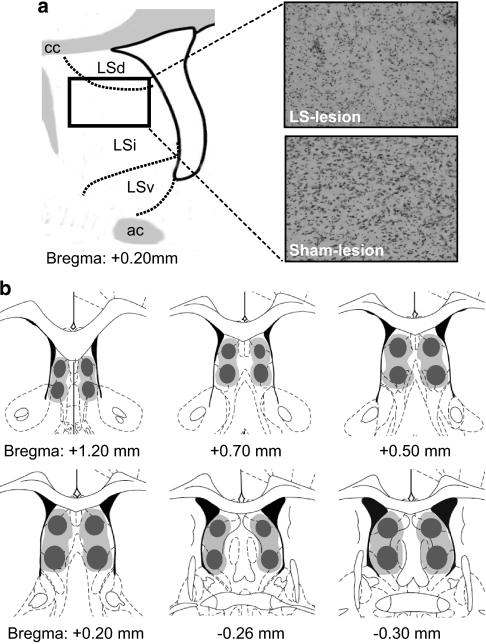
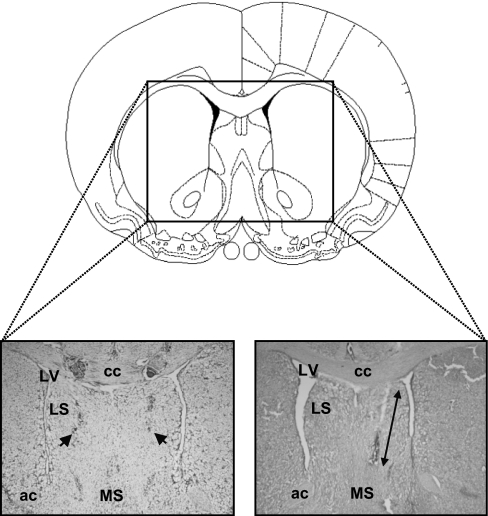
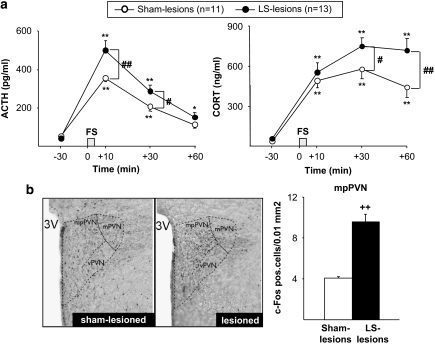
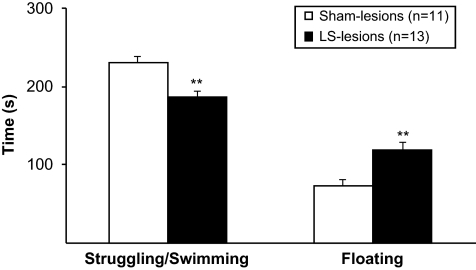
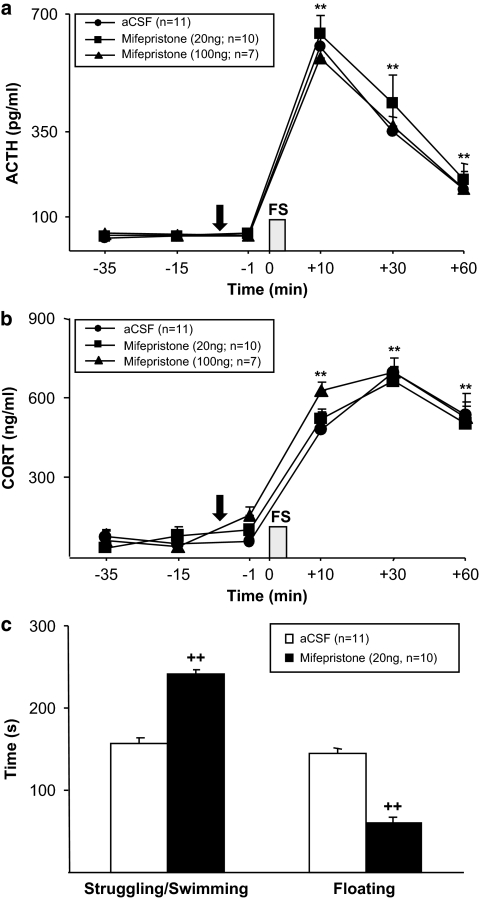
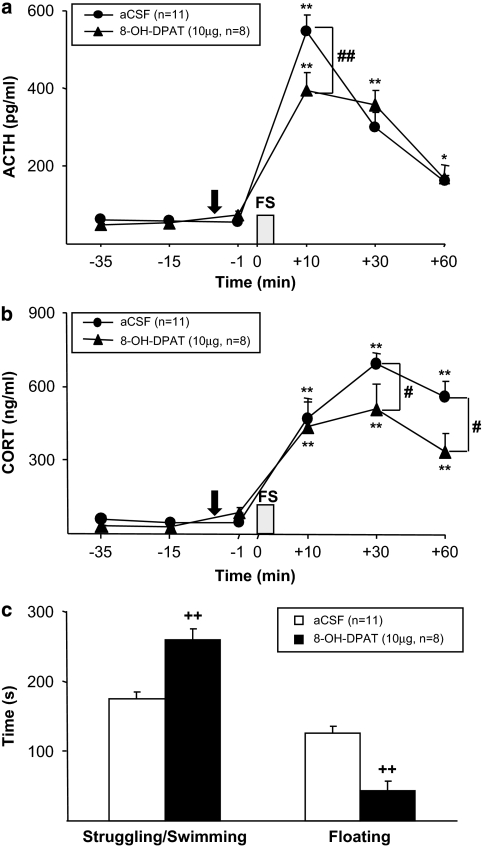
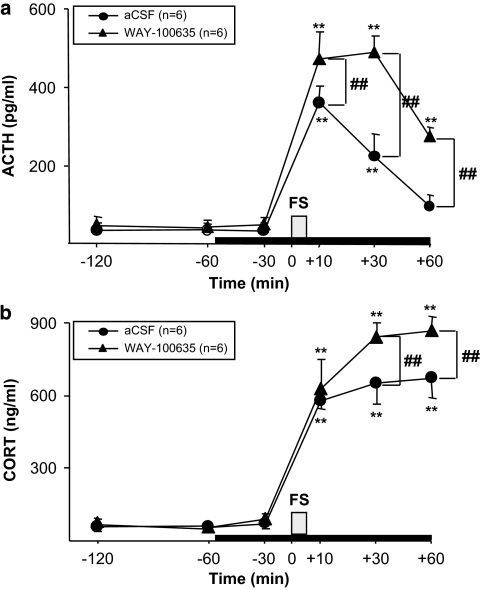
The lateral septum (LS) has been shown to have a key role in emotional processes and stress responses. However, the exact role of the LS on stress modulation is not clear, as previous lesion studies mostly used electrolytic lesions, thereby destroying the whole septal area, including medial components and/or fibers of passage. The aim of the present study was therefore, to investigate the effects of selective excitotoxic ablation of the LS on neuroendocrine and behavioral stress responses in rats. Bilateral ibotenic acid lesions of the LS increased hypothalamo-pituitary-adrenocortical (HPA) axis responses to forced swim stress indicated by enhanced plasma ACTH and corticosterone responses and higher stress-induced c-Fos-like immunoreactivity in the paraventricular hypothalamic nucleus. Moreover, LS-lesioned animals showed a more passive coping style in the forced swim test indicated by increased floating and reduced struggling/swimming behavior compared with sham-lesioned controls. Interestingly, intraseptal corticosteroid receptor blockade modulated behavioral stress coping but failed to change HPA axis stress responses. Further experiments aimed at elucidating underlying neurochemical mechanisms revealed that intraseptal administration of the selective 5-HT(1A) receptor antagonist WAY-100635 increased and prolonged stress-induced ACTH and corticosterone levels mimicking lesion effects, while the agonist 8-OH-DPAT suppressed HPA axis activity facilitating the inhibitory role of the LS. In addition, 8-OH-DPAT-injected animals showed increased active and decreased passive coping strategies during forced swimming suggesting antidepressant efficacy. Taken together, our data suggest that the LS promotes active stress coping behavior and is involved in a HPA-inhibitory mechanism that is at least in part mediated by septal 5-HT(1A) receptors and does not involve a glucocorticoid mediated feedback mechanism.
Overview
The claims and statistics of this paper haven’t been checked yet.
Run the check — free, no account needed. It reads the open-access text and checks the sources it cites.
Integrity signals
Registry
Cites
Statistics
Figures
Verification
Claims the paper makes
The claims and statistics of this paper haven’t been checked yet.
Run the check — free, no account needed. It reads the open-access text and checks the sources it cites.
Claims other papers make about this one
Each is checked against this paper’s own text: does it say what the citing paper says it does?
In the citing paper
“The existence of anxiolytic neurons is supported by the observation that excitotoxic LS lesions can enhance stress-induced activation of the HPA axis (Singewald et al., 2011).”
From Control of Stress-Induced Persistent Anxiety by an Extra-Amygdala Septohypothalamic Circuit (2014) · cites this paper as Singewald et al., 2011
Self-check
Percentages, sums and reported differences re-computed from the paper’s own numbers.
The self-check needs the paper’s full text.
Citations
Cites
The Rat Brain in Stereotaxic Coordinates
Paxinos, G., & Watson, C. (1983) · Elsevier eBooks · doi:10.1016/c2009-0-63235-9 · Cited by 28,585
Physiology and neurobiology of stress and adaptation: central role of the brain
McEwen, B. S. (2007) · Physiological Reviews · doi:10.1152/physrev.00041.2006 · Cited by 5,429 · cited 2×
“The release of stress hormones, such as glucocorticoids, is regulated mainly by the hypothalamo–pituitary–adrenocortical (HPA) axis, and it is well documented that glucocorticoids have an important role in the adaptation of the organism to stress, including the coordination of appropriate behavioral response to stress…”
BackgroundStress and the brain: from adaptation to disease
de Kloet, E. R., Joëls, M., & Holsboer, F. (2005) · Nature Reviews Neuroscience · doi:10.1038/nrn1683 · Cited by 4,621
Paxinos, G. (1985) · Cited by 3,715
The molecular neurobiology of depression
Krishnan, V., & Nestler, E. J. (2008) · Nature · doi:10.1038/nature07455 · Cited by 2,889
Brain corticosteroid receptor balance in health and disease
de Kloet, E. R., Vreugdenhil, E., Oitzl, M. S., & Joëls, M. (1998) · Endocrine Reviews · doi:10.1210/edrv.19.3.0331 · Cited by 2,614
Herman, J. P., Figueiredo, H., Mueller, N. K., Ulrich-Lai, Y., Ostrander, M. M., Choi, D. C., & Cullinan, W. E. (2003) · Frontiers in Neuroendocrinology · doi:10.1016/j.yfrne.2003.07.001 · Cited by 1,586
Detke, M. J., Rickels, M. R., & Lucki, I. (1995) · Psychopharmacology · doi:10.1007/bf02245592 · Cited by 1,466
Limbic system mechanisms of stress regulation: Hypothalamo-pituitary-adrenocortical axis
Herman, J. P., Ostrander, M. M., Mueller, N. K., & Figueiredo, H. (2005) · Progress in Neuro-Psychopharmacology and Biological Psychiatry · doi:10.1016/j.pnpbp.2005.08.006 · Cited by 1,322
Corticosteroid inhibition of acth secretion
KELLER-WOOD, M. E., & DALLMAN, M. F. (1984) · Endocrine Reviews · doi:10.1210/edrv-5-1-1 · Cited by 1,219
Cited by
Sorted by citations
Hill, M. N., & Tasker, J. G. (2011) · Neuroscience · doi:10.1016/j.neuroscience.2011.12.030 · Cited by 346
Control of Stress-Induced Persistent Anxiety by an Extra-Amygdala Septohypothalamic Circuit
Anthony, T. E., Dee, N., Bernard, A., Lerchner, W., Heintz, N., & Anderson, D. J. (2014) · Cell · doi:10.1016/j.cell.2013.12.040 · Cited by 310
“The existence of anxiolytic neurons is supported by the observation that excitotoxic LS lesions can enhance stress-induced activation of the HPA axis (Singewald et al., 2011).”
Badaut, J., Fukuda, A. M., Jullienne, A., & Petry, K. G. (2013) · Biochimica et Biophysica Acta (BBA) - General Subjects · doi:10.1016/j.bbagen.2013.10.032 · Cited by 223
Puglisi‐Allegra, S., & Andolina, D. (2014) · Behavioural Brain Research · doi:10.1016/j.bbr.2014.07.052 · Cited by 213
Neural Regulation of the Stress Response: The Many Faces of Feedback
Myers, B., McKlveen, J. M., & Herman, J. P. (2012) · Cellular and Molecular Neurobiology · doi:10.1007/s10571-012-9801-y · Cited by 175
“The lateral septum inhibits HPA axis stress responses, and the anatomy of the septal region suggests interactions with hypothalamic and brainstem regions projecting to the PVN (Staiger and Nurnberger 1991; Singewald et al. 2011).”
Metadata
- Authors
- Singewald, G. M., Rjabokon, A., Singewald, N., & Ebner, K.
- Affiliations
- Universität Innsbruck (AT)
- Corresponding author
- Ebner, Karl
- Venue
- Neuropsychopharmacology
- Published
- 2010-12-15
- Volume
- 36
- Issue
- 4
- Pages
- 793-804
- ISSN
- 0893-133X (ISSN-L)
- 1740-634X
- PMC
- PMC3055728
- OpenAlex
- W1987515936
- Cited by
- 149
- References
- 84
- Citations by year
- 2026: 5 · 2025: 7 · 2024: 9 · 2023: 4 · 2022: 17 · 2021: 9 · 2020: 10 · 2019: 12 · 2018: 9 · 2017: 11 · 2016: 8 · 2015: 9 · 2014: 16 · 2013: 6 · 2012: 10
- FWCI
- 3.03
- Type
- journal article
- Language
- en
- Open access
- hybrid
- doi.org
- Licence
- cc-by-nc-nd
- www.springer.com/tdm (unspecified)
- Locations
- Neuropsychopharmacology (publishedVersion, cc-by-nc-nd)
- Europe PMC (PubMed Central) (publishedVersion, cc-by-nc-nd)
- PubMed Central (publishedVersion, cc-by-nc-nd)
- PubMed (publishedVersion)
- HAL (submittedVersion, other-oa)
- Trinity's Access to Research Output (TARA) (Trinity College Dublin) (submittedVersion)
- Funders
- Austrian Science Fund
- Topics
- Life Sciences › Neuroscience › Behavioral Neuroscience › Stress Responses and Cortisol
- Life Sciences › Neuroscience › Cellular and Molecular Neuroscience › Neuropeptides and Animal Physiology
- Life Sciences › Neuroscience › Cellular and Molecular Neuroscience › Neurotransmitter Receptor Influence on Behavior
- Keywords
- lateral septum, stress response, hypothalamic-pituitary-adrenal axis, forced swim test, passive coping, active coping, ACTH, corticosterone, paraventricular nucleus, c-fos, 5-HT1A receptor, 8-OH-DPAT, WAY-100635, excitotoxic lesions, antidepressant efficacy, glucocorticoid feedback
- MeSH terms
- Adaptation, Psychological, Adrenocorticotropic Hormone, Animals, Corticosterone, Male, Neurosecretory Systems, Stress, Psychological, Rats, Sprague-Dawley, Septum of Brain, Rats
About these checks
Registry, retraction, Cites and statistics results are computed, not judged, with one exception: a printed reference that no index lists is read once by a model before it counts as a citation error. Claims are extracted by a model and kept only when their quote appears verbatim in the text; each cited source is then checked, with a model’s help, for whether it says what the claim relies on. Those verdicts can be wrong — read the claim’s quote and the cited source before relying on one.
Statistics and arithmetic are recomputed, not judged.
Confidence bands are shown only for fields calibrated on our annotated test set. None is calibrated yet, so no band is shown.
What counts as a claim ›How we measure confidence ›How we check this ›
Are you an author, or do you see a problem with this page? Request a review
