

Bandwidth limits of luminescent solar concentrators as detectors in free-space optical communication systems
Open accessThe DOI matches its Crossref record; 45 of the 46 references it cites were found in a registry or an index.
Abstract
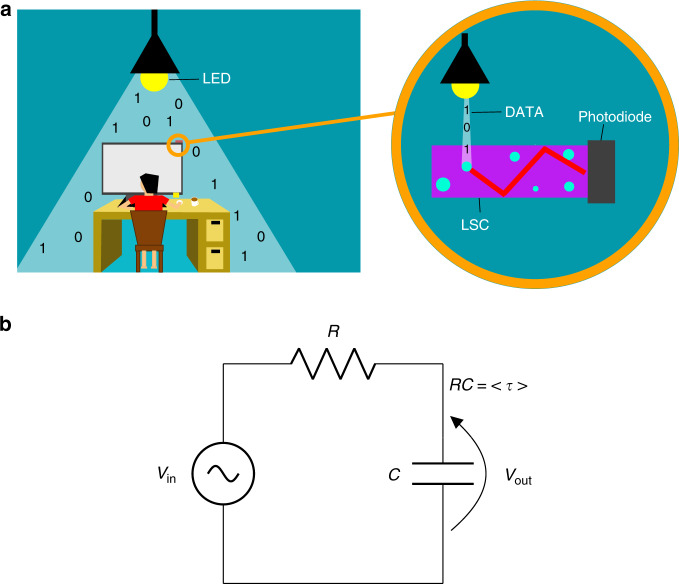
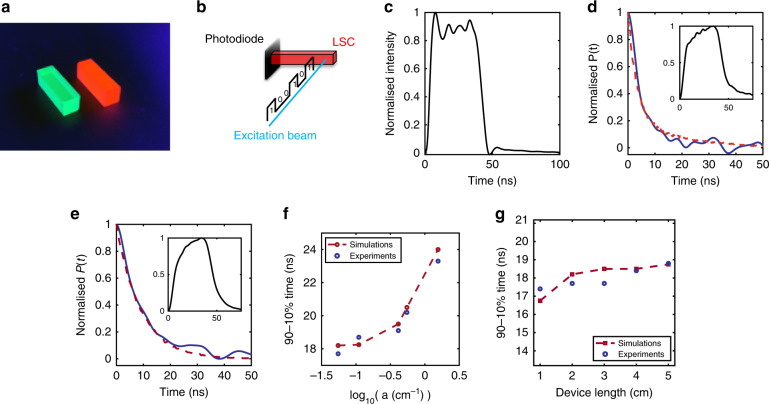
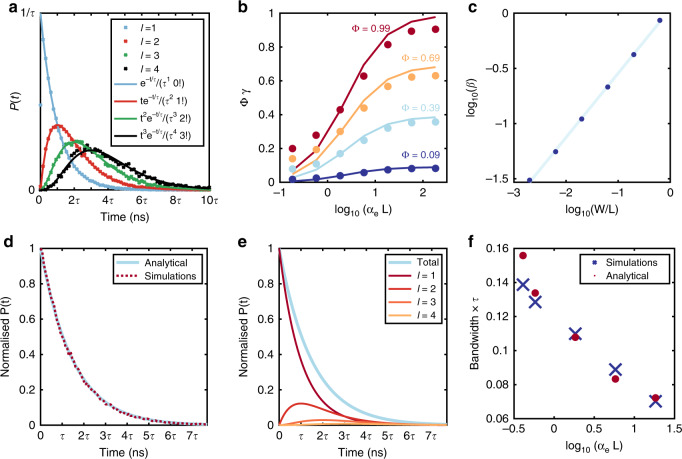
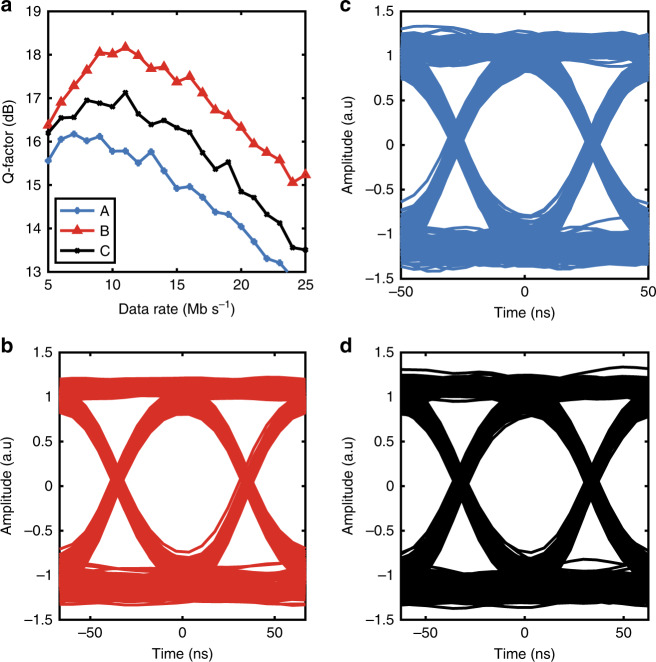
Luminescent solar concentrators (LSCs) have recently emerged as a promising receiver technology in free-space optical communications due to their inherent ability to collect light from a wide field-of-view and concentrate it into small areas, thus leading to high optical gains. Several high-speed communication systems integrating LSCs in their detector blocks have already been demonstrated, with the majority of efforts so far being devoted to maximising the received optical power and the system’s field-of-view. However, LSCs may pose a severe bottleneck on the bandwidth of such communication channels due to the comparably slow timescale of the fluorescence events involved, a situation further aggravated by the inherent reabsorption in these systems, and yet, an in-depth study into such dynamic effects remains absent in the field. To fill this gap, we have developed a comprehensive analytical solution that delineates the fundamental bandwidth limits of LSCs as optical detectors in arbitrary free-space optical links, and establishes their equivalence with simple RC low-pass electrical circuits. Furthermore, we demonstrate a time-domain Monte Carlo simulation platform, an indispensable tool in the multiparameter optimisation of LSC-based receiver systems. Our work offers vital insight into LSC system dynamic behaviour and paves the way to evaluate the technology for a wide range of applications, including visible light communications, high-speed video recording, and real-time biological imaging, to name a few.
Overview
The claims and statistics of this paper haven’t been checked yet.
Free: it reads the open-access text and checks the first 5 claims that cite a source we can check. Create a free account to check every claim.
Integrity signals
Registry
Cites
Statistics
Figures
Verification
Claims the paper makes
The claims and statistics of this paper haven’t been checked yet.
Free: it reads the open-access text and checks the first 5 claims that cite a source we can check. Create a free account to check every claim.
Claims other papers make about this one
Each is checked against this paper’s own text: does it say what the citing paper says it does?
The source backs part of the claim, not all of it — or backs it for a different population, condition or comparison.
In the citing paper
“The frequency bandwidth of the aforementioned luminescent concentrators is governed by the radiative recombination lifetime () of the luminescent particles, i.e., [23,24].”
From All-inorganic halide-perovskite polymer-fiber-photodetector for high-speed optical wireless communication (2022) · cites this paper as [23]
Experimental — accuracy not yet measured
Self-check
Percentages, sums and reported differences re-computed from the paper’s own numbers.
The self-check needs the paper’s full text.
Citations
Cites
Principles of Fluorescence Spectroscopy
Lakowicz, J. R. (1999) · Springer eBooks · doi:10.1007/978-1-4757-3061-6 · Cited by 26,947
Principles of Fluorescence Spectroscopy
(2006) · Springer eBooks · doi:10.1007/978-0-387-46312-4 · Cited by 19,339
Protesescu, L., Yakunin, S., Bodnarchuk, M. I., Krieg, F., Caputo, R., Hendon, C. H., Yang, R. X., Walsh, A., & Kovalenko, M. V. (2015) · Nano Letters · doi:10.1021/nl5048779 · Cited by 9,209
Luminescent greenhouse collector for solar radiation
Weber, W. H., & Lambe, J. (1976) · Applied Optics · doi:10.1364/ao.15.002299 · Cited by 747 · cited 2×
“(1) can now be substituted by the effective time constant 〈τ〉= 1/ω3 dB.”
BackgroundReceiver Design for Digital Fiber Optic Communication Systems, I
Personick, S. D. (1973) · Bell System Technical Journal · doi:10.1002/j.1538-7305.1973.tb01993.x · Cited by 708
High-Efficiency Organic Solar Concentrators for Photovoltaics
Currie, M. J., Mapel, J. K., Heidel, T. D., Goffri, S., & Baldo, M. A. (2008) · Science · doi:10.1126/science.1158342 · Cited by 690 · cited 1×
“(5) has to be replaced by the successive application of the convolution function of a multiexponential pdf, which can easily be performed semianalytically.”
BackgroundMeinardi, F., Colombo, A., Velizhanin, K. A., Simonutti, R., Lorenzon, M., Beverina, L., Viswanatha, R., Klimov, V. I., & Brovelli, S. (2014) · Nature Photonics · doi:10.1038/nphoton.2014.54 · Cited by 683 · cited 4×
“(2) or (3) are interpreted as probability density functions (pdfs) and transformed so that a random number generator can be used to determine the delay introduced by a fluorescent event.”
BackgroundInfluentialMeinardi, F., McDaniel, H., Carulli, F., Colombo, A., Velizhanin, K. A., Makarov, N. S., Simonutti, R., Klimov, V. I., & Brovelli, S. (2015) · Nature Nanotechnology · doi:10.1038/nnano.2015.178 · Cited by 551 · cited 2×
“(2) or (3) are interpreted as probability density functions (pdfs) and transformed so that a random number generator can be used to determine the delay introduced by a fluorescent event.”
BackgroundMeinardi, F., Ehrenberg, S., Dhamo, L., Carulli, F., Mauri, M., Bruni, F., Simonutti, R., Kortshagen, U., & Brovelli, S. (2017) · Nature Photonics · doi:10.1038/nphoton.2017.5 · Cited by 410 · cited 1×
“(4), where X is a uniformly generated random number between 0 and 1.”
BackgroundReview of Monte Carlo modeling of light transport in tissues
Zhu, C., & Liu, Q. (2013) · Journal of Biomedical Optics · doi:10.1117/1.jbo.18.5.050902 · Cited by 352
Kang, C. H., Dursun, I., Liu, G., Sinatra, L., Sun, X., Kong, M., Pan, J., Maity, P., Ooi, E.-N., Ng, T. K., et al. (2019) · Light: Science & Applications · doi:10.1038/s41377-019-0204-4 · Cited by 329
15.73 Gb/s Visible Light Communication With Off-the-Shelf LEDs
Bian, R., Tavakkolnia, I., & Haas, H. (2019) · Journal of Lightwave Technology · doi:10.1109/jlt.2019.2906464 · Cited by 230
The thermodynamic limits of light concentrators
Smestad, G., Ries, H., Winston, R., & Yablonovitch, E. (1990) · Solar Energy Materials · doi:10.1016/0165-1633(90)90047-5 · Cited by 218 · cited 1×
“(8)–(11) are independent of the fluorescence characteristics and thus applicable for fluorophores of any decay characteristics.”
BackgroundWei, M., de Arquer, F. P. G., Walters, G., Yang, Z., Quan, L. N., Kim, Y., Sabatini, R., Quintero-Bermudez, R., Gao, L., Fan, J. Z., et al. (2019) · Nature Energy · doi:10.1038/s41560-018-0313-y · Cited by 190 · cited 2×
“Equation (6) is in agreement with the bandwidth for an RC-limited photodiode(36), represented by the circuit diagram shown in Fig.”
BackgroundKlimov, V. I., Baker, T. A., Lim, J., Velizhanin, K. A., & McDaniel, H. (2016) · ACS Photonics · doi:10.1021/acsphotonics.6b00307 · Cited by 189
Perovskite quantum dots integrated in large-area luminescent solar concentrators
Zhao, H., Zhou, Y., Benetti, D., Ma, D., & Rosei, F. (2017) · Nano Energy · doi:10.1016/j.nanoen.2017.05.030 · Cited by 189
Savarese, M., Aliberti, A., Santo, I. D., Battista, E., Causa, F., Netti, P. A., & Rega, N. (2012) · The Journal of Physical Chemistry A · doi:10.1021/jp3021485 · Cited by 154
Absorption Enhancement in “Giant” Core/Alloyed-Shell Quantum Dots for Luminescent Solar Concentrator
Zhao, H., Benetti, D., Jin, L., Zhou, Y., Rosei, F., & Vomiero, A. (2016) · Small · doi:10.1002/smll.201600945 · Cited by 137
Wide field-of-view fluorescent antenna for visible light communications beyond the étendue limit
Manousiadis, P. P., Rajbhandari, S., Mulyawan, R., Vithanage, D. A., Chun, H., Faulkner, G., O’Brien, D. C., Turnbull, G. A., Collins, S., & Samuel, I. D. W. (2016) · Optica · doi:10.1364/optica.3.000702 · Cited by 119
Losses in luminescent solar concentrators unveiled
Tummeltshammer, C., Taylor, A., Kenyon, A. J., & Papakonstantinou, I. (2015) · Solar Energy Materials and Solar Cells · doi:10.1016/j.solmat.2015.08.008 · Cited by 114
Self-citationLuminescent detector for free-space optical communication
Peyronel, T., Quirk, K. J., Wang, S. C., & Tiecke, T. G. (2016) · Optica · doi:10.1364/optica.3.000787 · Cited by 110
Scale-up of a Luminescent Solar Concentrator-Based Photomicroreactor via Numbering-up
Zhao, F., Cambié, D., Janse, J., Wieland, E. W., Kuijpers, K. P. L., Hessel, V., Debije, M. G., & Noël, T. (2017) · ACS Sustainable Chemistry & Engineering · doi:10.1021/acssuschemeng.7b02687 · Cited by 104
Tummeltshammer, C., Portnoi, M., Mitchell, S. A., Lee, A.-T., Kenyon, A. J., Tabor, A. B., & Papakonstantinou, I. (2016) · Nano Energy · doi:10.1016/j.nanoen.2016.11.058 · Cited by 82
Self-citationHigh gain, wide field of view concentrator for optical communications
Collins, S., O’Brien, D. C., & Watt, A. (2014) · Optics Letters · doi:10.1364/ol.39.001756 · Cited by 77
El-Bashir, S. M., Alharbi, F. F., Elburaih, H., Al-Faifi, F., & Yahia, I. S. (2015) · Renewable Energy · doi:10.1016/j.renene.2015.07.031 · Cited by 69 · cited 1×
“(8)–(11) are independent of the fluorescence characteristics and thus applicable for fluorophores of any decay characteristics.”
BackgroundLuminescent surfaces with tailored angular emission for compact dark-field imaging devices
Chazot, C. A. C., Nagelberg, S. N., Rowlands, C. J., Scherer, M. R. J., Coropceanu, I., Broderick, K. A., Kim, Y., Bawendi, M. G., So, P. T. C., & Kolle, M. (2020) · Nature Photonics · doi:10.1038/s41566-020-0593-1 · Cited by 67
Nanopatterned luminescent concentrators for visible light communications
Dong, Y., Shi, M., Yang, X., Zeng, P., Gong, J., Zheng, S., Zhang, M., Liang, R., Ou, Q., Chi, N., et al. (2017) · Optics Express · doi:10.1364/oe.25.021926 · Cited by 59
Papakonstantinou, I., & Tummeltshammer, C. (2015) · Optica · doi:10.1364/optica.2.000841 · Cited by 49
Self-citationManousiadis, P. P., Chun, H., Rajbhandari, S., Vithanage, D. A., Mulyawan, R., Faulkner, G., Haas, H., O'Brien, D. C., Collins, S., Turnbull, G. A., et al. (2020) · Advanced Optical Materials · doi:10.1002/adom.201901139 · Cited by 46
Ambrož, F., Xu, W., Gadipelli, S., Brett, D. J. L., Lin, C., Contini, C., McLachlan, M. A., Durrant, J. R., Parkin, I. P., & Macdonald, T. J. (2019) · Particle & Particle Systems Characterization · doi:10.1002/ppsc.201900391 · Cited by 42
Self-citationTummeltshammer, C., Taylor, A., Kenyon, A. J., & Papakonstantinou, I. (2014) · Journal of Applied Physics · doi:10.1063/1.4900986 · Cited by 38
Self-citationBandwidth and rise time calculations for digital multimode fiber-optic data links
Brown, G. D. (1992) · Journal of Lightwave Technology · doi:10.1109/50.136103 · Cited by 38
Analytical description of a luminescent solar concentrator
Sychugov, I. (2019) · Optica · doi:10.1364/optica.6.001046 · Cited by 38
A 20-Mb/s VLC Link With a Polymer LED and a Multilayer Perceptron Equalizer
Haigh, P. A., Bausi, F., Kanesan, T., Le, S. T., Rajbhandari, S., Ghassemlooy, Z. F., Papakonstantinou, I., Popoola, W. O., Burton, A., Minh, H. L., et al. (2014) · IEEE Photonics Technology Letters · doi:10.1109/lpt.2014.2343692 · Cited by 34
Self-citationEfficiency and loss mechanisms of plasmonic Luminescent Solar Concentrators
Tummeltshammer, C., Brown, M. S., Taylor, A., Kenyon, A. J., & Papakonstantinou, I. (2013) · Optics Express · doi:10.1364/oe.21.00a735 · Cited by 33
Self-citationIntroduction to Linear Circuit Analysis and Modelling
Luis, M., & Darwazeh, I. (2005) · Elsevier eBooks · doi:10.1016/b978-0-7506-5932-1.x5000-3 · Cited by 27
Self-citationClosed form expressions for baseline wander effectsinwireless IR applications
Street, A. M., Samaras, K., O'Brien, D. C., & Edwards, D. J. (1997) · Electronics Letters · doi:10.1049/el:19970739 · Cited by 26
Flexible Optical Amplifier for Visible-Light Communications Based on Organic–Inorganic Hybrids
Bastos, A. R. N., McKenna, B., Lima, M., André, P. S. D. B., Carlos, L. D., Evans, R. C., & Ferreira, R. A. S. (2018) · ACS Omega · doi:10.1021/acsomega.8b01726 · Cited by 24
Simulation of MIMO channel characteristics for indoor visible light communication with LEDs
Tan, J., Zou, C. Q., Du, S. H., & Tan, J. T. (2013) · Optik · doi:10.1016/j.ijleo.2013.06.071 · Cited by 22
An extension of pulse shaping filter theory
Kisel, A. (1999) · IEEE Transactions on Communications · doi:10.1109/26.768751 · Cited by 22
Impact of curvature on the optimal configuration of flexible luminescent solar concentrators
Portnoi, M., Sol, C., Tummeltshammer, C., & Papakonstantinou, I. (2017) · Optics Letters · doi:10.1364/ol.42.002695 · Cited by 19
Self-citationBartu, P., Koeppe, R. A., Arnold, N., Neulinger, A., Fallon, L., & Bauer, S. (2010) · Journal of Applied Physics · doi:10.1063/1.3431394 · Cited by 18
Nonimaging Optical Gain in Luminescent Concentration through Photonic Control of Emission Étendue
Shen, Y., Jia, Y., Sheng, X., Shen, L., Rogers, J. A., & Giebink, N. C. (2014) · ACS Photonics · doi:10.1021/ph500196r · Cited by 13
Toward a Flexible, Scalable, and Transparent Thin-Film Camera
Bimber, O., & Koppelhuber, A. (2017) · Proceedings of the IEEE · doi:10.1109/jproc.2016.2627535 · Cited by 9
Galatus, R. V., Petreuș, D. M., Moga, D., Mariţa, T., & Stroia, N. (2018) · IEEE International Instrumentation and Measurement Technology Conference · doi:10.1109/i2mtc.2018.8409560 · Cited by 6
Research works printed but not linked: 2
- DeGroot, M. H. & Schervish, M. J. Probability and Statistics 4th edn (Pearson Education, Upper Saddle River, NJ, 2013).
- Shinar, R. & Shinar, J. Organic Electronics in Sensors and Biotechnology (McGraw-Hill, New York, 2009).
Cited by
Ding, N., Wu, Y., Xu, W., Lyu, J., Wang, Y., Zi, L., Shao, L., Sun, R., Wang, N., Liu, S., et al. (2022) · Light: Science & Applications · doi:10.1038/s41377-022-00777-w · Cited by 181
Luminescence solar concentrators: A technology update
Castelletto, S., & Boretti, A. A. (2023) · Nano Energy · doi:10.1016/j.nanoen.2023.108269 · Cited by 162
Luminescent solar concentrators for building integrated photovoltaics: opportunities and challenges
Richards, B. S., & Howard, I. A. (2023) · Energy & Environmental Science · doi:10.1039/d3ee00331k · Cited by 145
Raza, E., Ahmad, Z., Aziz, F., Asif, M., Ahmed, A., Riaz, K., Bhadra, J., & Al-Thani, N. J. (2021) · Solar Energy · doi:10.1016/j.solener.2021.08.008 · Cited by 79
Ultraviolet graphene ultranarrow absorption engineered by lattice plasmon resonance
Yan, Z., Lu, X. F., Du, W., Lv, Z., Tang, C., Cai, P., Gu, P. D., Chen, J., & Yu, Z. (2021) · Nanotechnology · doi:10.1088/1361-6528/ac1af9 · Cited by 62
Metadata
- Authors
- Portnoi, M., Haigh, P. A., Macdonald, T. J., Ambroz, F., Parkin, I. P., Darwazeh, I., & Papakonstantinou, I.
- Affiliations
- University College London (GB)
- Newcastle University (GB)
- Corresponding author
- Papakonstantinou, Ioannis
- ORCID
- Venue
- Light: Science & Applications
- Published
- 2021-01-01
- Volume
- 10
- Issue
- 1
- Pages
- 3-3
- ISSN
- 2047-7538 (ISSN-L)
- PMC
- PMC7775919
- OpenAlex
- W3116847863
- Cited by
- 93
- References
- 46
- Citations by year
- 2026: 7 · 2025: 19 · 2024: 17 · 2023: 19 · 2022: 21 · 2021: 10
- FWCI
- 4.93
- Type
- journal article
- Language
- en
- Open access
- gold
- doi.org
- Licence
- cc-by
- creativecommons.org/licenses/by/4.0 (tdm)
- creativecommons.org/licenses/by/4.0 (vor)
- Locations
- Light Science & Applications (publishedVersion, cc-by)
- Europe PMC (PubMed Central) (publishedVersion, other-oa)
- PubMed Central (publishedVersion, cc-by)
- PubMed (publishedVersion)
- DOAJ (DOAJ: Directory of Open Access Journals) (submittedVersion, cc-by-sa)
- UCL Discovery (University College London) (submittedVersion)
- Spiral (Imperial College London) (submittedVersion, cc-by)
- Newcastle University ePrints (Newcastle Univesity) (cc-by)
- Funders
- Research Councils UK (EP/P006280/1, 1632762)
- Royal Commission for the Exhibition of 1851
- Horizon 2020 Framework Programme
- Engineering and Physical Sciences Research Council (EP/P006280/1, H2020, 1632762)
- H2020 European Research Council (679891, H2020)
- Topics
- Physical Sciences › Engineering › Electrical and Electronic Engineering › Optical Wireless Communication Technologies
- Physical Sciences › Chemistry › Physical and Theoretical Chemistry › Photochemistry and Electron Transfer Studies
- Physical Sciences › Physics and Astronomy › Atomic and Molecular Physics, and Optics › Random lasers and scattering media
- Keywords
- luminescent solar concentrators, free-space optical communication, fluorescence dynamics, reabsorption, visible light communication
About these checks
Registry, retraction, Cites and statistics results are computed, not judged, with one exception: a printed reference that no index lists is read once by a model before it counts as a citation error. Claims are extracted by a model and kept only when their quote appears verbatim in the text; each cited source is then checked, with a model’s help, for whether it says what the claim relies on. Those verdicts can be wrong — read the claim’s quote and the cited source before relying on one.
Statistics and arithmetic are recomputed, not judged.
Confidence bands are shown only for fields calibrated on our annotated test set. None is calibrated yet, so no band is shown.
What counts as a claim ›How we measure confidence ›How we check this ›
Are you an author, or do you see a problem with this page? Request a review
Data sources
Bibliographic data: Semantic Scholar, OpenAlex, Crossref.
Contains information from the Semantic Scholar Academic Graph Datasets, made available under the ODC Attribution License (ODC-BY 1.0).
Semantic Scholar’s data is described in: Kinney, R., et al. (2023). The Semantic Scholar Open Data Platform. arXiv:2301.10140.
