

Fundamentals and comprehensive insights on pulsed laser synthesis of advanced materials for diverse photo- and electrocatalytic applications
Open accessThe DOI matches its Crossref record; 265 of the 265 references it cites were found in a registry or an index; 30 of the 218 sources its claims cite were checked for support.
Abstract
The global energy crisis is increasing the demand for innovative materials with high purity and functionality for the development of clean energy production and storage. The development of novel photo- and electrocatalysts significantly depends on synthetic techniques that facilitate the production of tailored advanced nanomaterials. The emerging use of pulsed laser in liquid synthesis has attracted immense interest as an effective synthetic technology with several advantages over conventional chemical and physical synthetic routes, including the fine-tuning of size, composition, surface, and crystalline structures, and defect densities and is associated with the catalytic, electronic, thermal, optical, and mechanical properties of the produced nanomaterials. Herein, we present an overview of the fundamental understanding and importance of the pulsed laser process, namely various roles and mechanisms involved in the production of various types of nanomaterials, such as metal nanoparticles, oxides, non-oxides, and carbon-based materials. We mainly cover the advancement of photo- and electrocatalytic nanomaterials via pulsed laser-assisted technologies with detailed mechanistic insights and structural optimization along with effective catalytic performances in various energy and environmental remediation processes. Finally, the future directions and challenges of pulsed laser techniques are briefly underlined. This review can exert practical guidance for the future design and fabrication of innovative pulsed laser-induced nanomaterials with fascinating properties for advanced catalysis applications.
Overview
CoChat Summary
TL;DR
This review covers pulsed laser synthesis (PLA/PLI in liquid) of advanced nanomaterials and their use in photo- and electrocatalysis. It emphasizes how laser wavelength, pulse width, fluence, repetition rate, focusing, and solvent control nanoparticle size, phase, composition, and catalytic performance.
Key findings
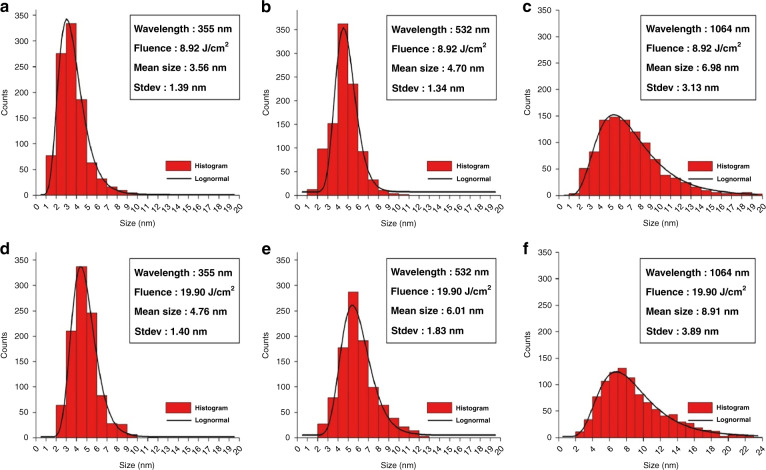
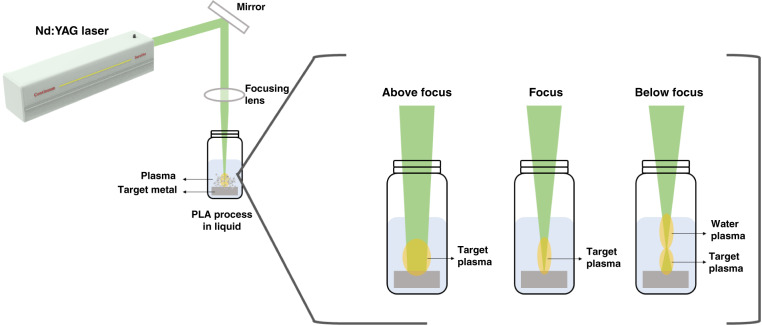
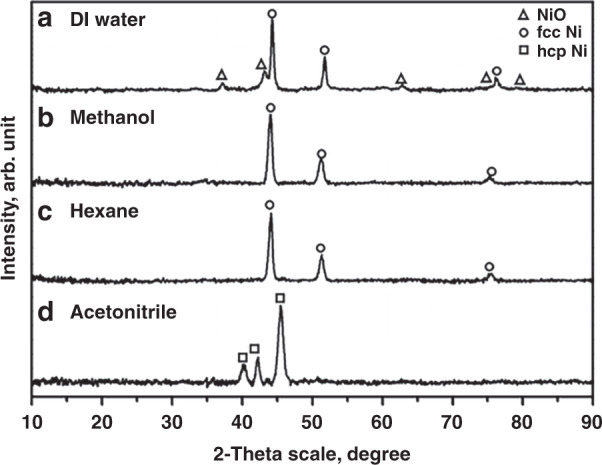
- Laser parameters strongly determine nanoparticle size and phase: Pd-NPs increased from 3.56 to 4.70 to 6.98 nm at 355, 532, and 1064 nm (19.90 J cm−2); Au-NPs were 8.6 nm above-focus, 8.9 nm at focus, and ~7.2 nm below-focus; Ni phase changed with solvent/LICB lifetime (e.g., fcc in methanol, hcp in ACN).
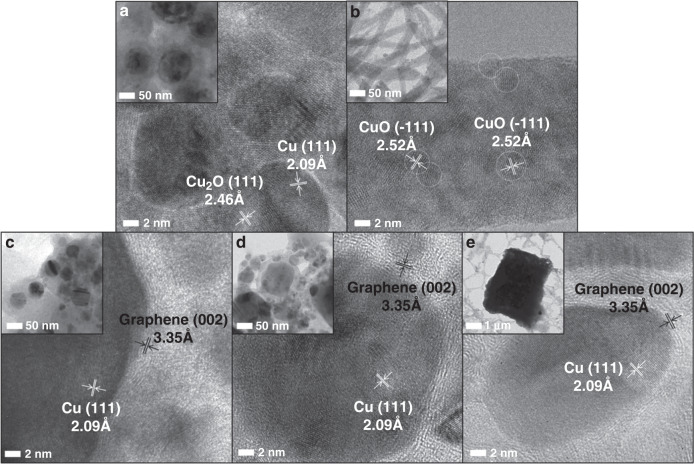
- Solvents can act as element sources: DMSO served as a sulfur source for ZnS; ACN served as a carbon/nitrogen source for Ni@NGC; Cu in ACN gave CuCN cubes, while ethanol/1-propanol/butanol/ethylene glycol gave fcc Cu-NPs and DI water/methanol gave Cu2O/CuO.
- Reported photocatalytic examples include TiO2/CdS DSSC efficiency 0.6%→4.3% and 82% MO degradation in 36 min; Cu2O-Cu 90% MB degradation in 50 min vs 51% for hydrothermal Cu2O-Cu; CdS/RGO 77% MB degradation (2.65× CdS); ZnO/rGO 86% RhB degradation vs ~40% for ZnO; ZnO/Au15/rGO5 95% MB degradation in 120 min.
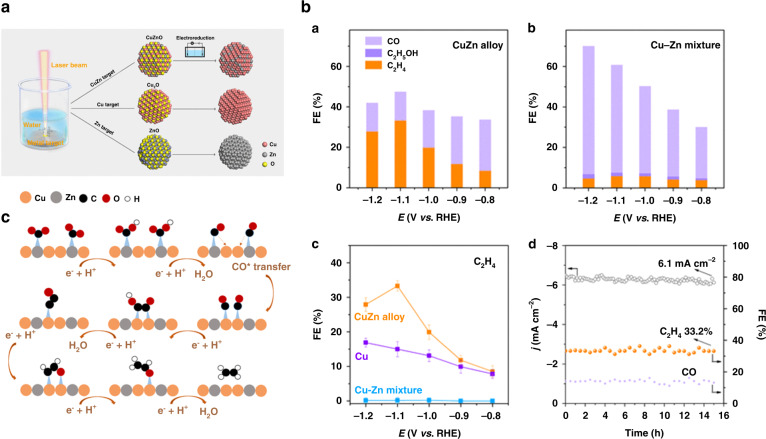
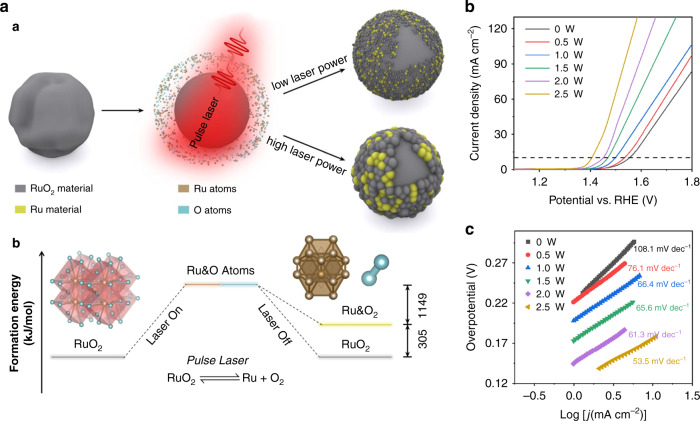
- Electrocatalysis examples include RuAu HER overpotential 24 mV@10 mA cm−2 vs Pt/C 46 mV; Ru@CN 11 mV vs Pt/C 37 mV; W@WS2 161 mV with Tafel slope 34.5 mV dec−1; RuO2 OER 172 mV in alkali and 219 mV in acid; CuZn CO2-to-ethylene Faradaic efficiency 33.3% at −1.1 V vs RHE; Ag-rGO CO2-to-CO 133.1 μmol g−1 h−1 in 6 h.
Methods
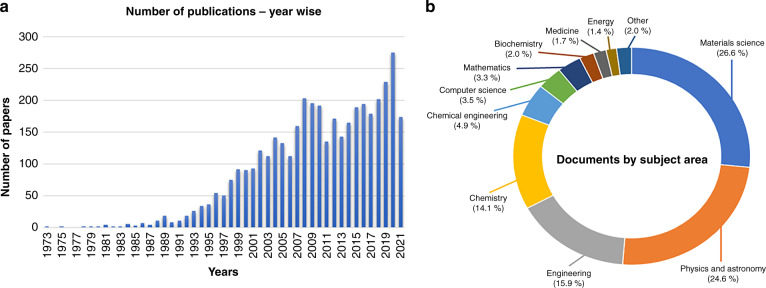
- Review article; a Scopus search for “pulsed laser synthesis” found 4074 publications from 1973 to 2021 (searched August 31, 2021).
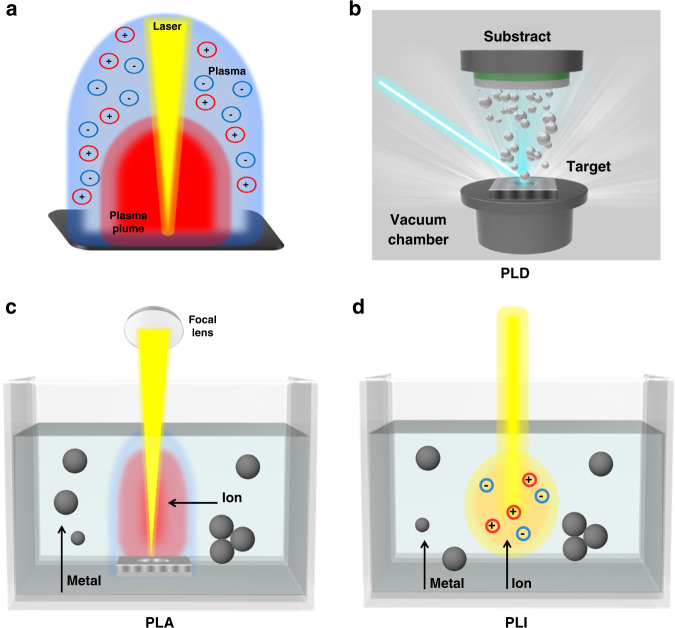
- Synthesizes reported PLAL/PLIL/PLD studies and tabulates laser sources, solvents, fluences, and irradiation times (Tables 3–7), with mechanistic discussion of thermal evaporation vs explosive ejection, cavitation, and solvent effects.
- No primary experimental dataset is reported; examples are drawn from cited literature.
Limitations
- Stated: pilot-scale production remains a limiting factor; more experimental-design advancement and automation are needed; real-time in-situ XRD/FT-IR/Raman/PL/UV-vis analysis should be performed; mechanistic aspects need more detail; extension to carbides, nitrides, and selenides is needed.
- Stated: long laser ablation can block laser energy/path by generated NPs, hindering the PLA rate.
- Evident: as a review, conclusions depend on cited studies; the provided text is a partial/fragmented version with some sections empty, so not all details are available.
Model-written summary. Check it against the paper before relying on it.
Integrity signals
Registry
Cites
Statistics
Figures
Verification
Claims the paper makes
26 Valid · 18 Not valid · 166 Not checked · 51 Own results and interpretations
Every source the paper cites for this claim was checked and supports it.
In the paper
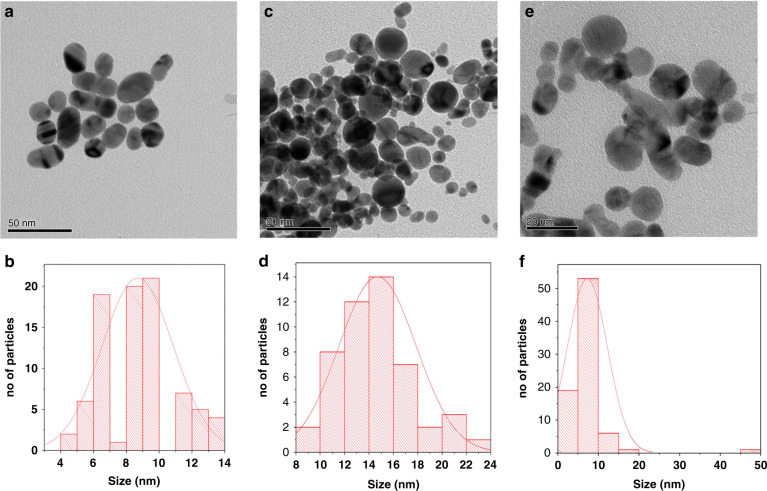
“On the contrary, Au-NPs obtained by below-focus ablation shows a smaller average particle size (~7.2 nm) than those produced at the defocus and focus conditions, as shown in Fig. 5e, f, likely because when the target was ablated at the below-focus condition, the maximum amount of energy was absorbed by the liquid (water) medium, reducing the energy that reaches the target.”
§ Fundamentals and comprehensive insights on pulsed laser synthesis of advanced materials for diverse photo- and electrocatalytic applications > Fundamentals of the pulsed laser process > Laser-focusing parameters
What the sources say
- Supportedcites [30] Imam, H. et al. Effect of experimental parameters on the fabrication of gold nanoparticles via laser ablation. Opt. Photonics J. 2, 73–84 (2012). source
Section 3.3 (pp. 6–7) reports average sizes of 8.6 nm above focus, 8.9 nm at focus, and 7.2 nm below focus. It also explains that, below focus, water absorbs much of the energy before it reaches the target. (LLM, conf=0.94)
hedgedstates an association- Asserted: passes — The authors put it forward as true.
- Checkable: passes — It can be checked against evidence.
- Load-bearing: unclear — It is unclear whether the paper’s conclusions depend on it.
- Based: passes — The paper gives a reason why it holds.
- Supported
Every source the paper cites for this claim was checked and supports it.
In the paper
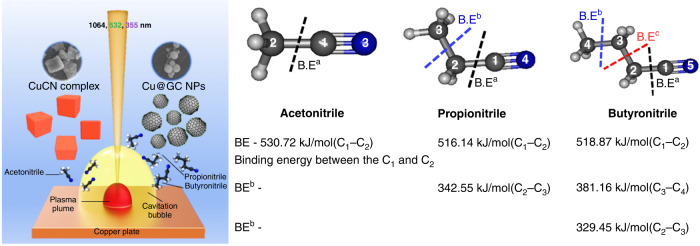
“The formation mechanism was also confirmed by the theoretical quantum chemical calculations on the binding energy of various nitrile solvents, as presented in Fig. 933.”
§ Fundamentals and comprehensive insights on pulsed laser synthesis of advanced materials for diverse photo- and electrocatalytic applications > Fundamentals of the pulsed laser process > Solvent medium
What the sources say
- Supportedcites [33] Begildayeva, T. et al. Facile one-pot synthesis of CuCN by pulsed laser ablation in nitrile solvents and mechanistic studies using quantum chemical calculations. Sci. Rep. 11, 14389 (2021). source
The Theoretical calculations section reports binding-energy calculations for acetonitrile, propionitrile, and butyronitrile (Tables 1–2). It says those calculations supported the experimental results and the proposed mechanism of CuCN formation in acetonitrile. (LLM, conf=0.93)
plainstates a cause- Asserted: passes — The authors put it forward as true.
- Checkable: passes — It can be checked against evidence.
- Load-bearing: unclear — It is unclear whether the paper’s conclusions depend on it.
- Based: passes — The paper gives a reason why it holds.
- Supported
The cited sources support only part of this claim — read each source’s verdict below.
In the paper
“Due to the excellent purity of the prepared single-layered MoS2 quantum dots, it finds plausible electrocatalytic application toward hydrogen evolution reaction.”
§ Fundamentals and comprehensive insights on pulsed laser synthesis of advanced materials for diverse photo- and electrocatalytic applications > Photo- and electrocatalytic materials: an overview > PLAL process
What the sources say
- Partly supportedcites [124] Li, B. et al. Preparation of monolayer MoS2 quantum dots using temporally shaped femtosecond laser ablation of bulk MoS2 targets in water. Sci. Rep. 7, 11182 (2017). sourceExperimental — accuracy not yet measured
The Results and Discussion section reports high-purity monolayer MoS2 quantum dots and supports their potential for hydrogen-evolution electrocatalysis. But it does not attribute that potential to purity; the Introduction points instead to active edge sites, surface area, conductivity, and hydrogen adsorption. The Methods specify that the hydrogen-evolution tests used composites containing nanosheets, nanoparticles, and quantum dots, not isolated quantum dots. (LLM, conf=0.88)
hedgedstates a possible cause- Asserted: passes — The authors put it forward as true.
- Checkable: passes — It can be checked against evidence.
- Load-bearing: unclear — It is unclear whether the paper’s conclusions depend on it.
- Based: passes — The paper gives a reason why it holds.
- Partly supported
Every source the paper cites for this claim was checked and supports it.
In the paper
“The Schottky barrier formed between the Au–Gr interface due to the higher work function of Au than Gr.”
§ Fundamentals and comprehensive insights on pulsed laser synthesis of advanced materials for diverse photo- and electrocatalytic applications > Applications of laser-assisted materials > Photocatalysis
What the sources say
- Supportedcites [191] Chen, L. H. et al. Photocatalytic properties of graphene/gold and graphene oxide/gold nanocomposites synthesized by pulsed laser induced photolysis. Nanomaterials (Basel) 10, 1985 (2020). source
Section 3.4, “Photocatalytic Activity of Synthesized Materials,” explicitly states that a Schottky barrier formed at the graphene–gold interface because Au has a higher work function than graphene. (LLM, conf=0.95)
plainstates a cause- Asserted: passes — The authors put it forward as true.
- Checkable: passes — It can be checked against evidence.
- Load-bearing: passes — The paper’s conclusions depend on it.
- Based: passes — The paper gives a reason why it holds.
- Supported
Every source the paper cites for this claim was checked and supports it.
In the paper
“Recently, PEDOT-derived conducting polymer nanowires were synthesized through PLI, which showed improved sensing suitable for ultrasensitive photosensors172.”
§ Fundamentals and comprehensive insights on pulsed laser synthesis of advanced materials for diverse photo- and electrocatalytic applications > Photo- and electrocatalytic materials: an overview > PLIL process
What the sources say
- Supportedcites [172] Sasaki, M. & Goto, M. A conductive polymer nanowire including functional quantum dots generated via pulsed laser irradiation for high-sensitivity sensor applications. Sci. Rep. 11, 11203 (2021). source
The Results and discussion report that quantum-dot-containing PEDOT-PEG nanowires made by pulsed laser irradiation responded strongly to light, unlike nanowires without quantum dots. The Conclusions identify ultrahigh-sensitivity photosensors as a prospective application; the paper does not claim to have built one. (LLM, conf=0.88)
plainstates a cause- Asserted: passes — The authors put it forward as true.
- Checkable: passes — It can be checked against evidence.
- Load-bearing: unclear — It is unclear whether the paper’s conclusions depend on it.
- Based: passes — The paper gives a reason why it holds.
- Supported
101 more claims · 4 with their cited sources checked
Create a free account to see all 261 claims and to verify the 14 references still open.
- Probably not a substantial claim. 46
- It may state two separate claims as one. 118
- The quote only partly states this claim. 4
Self-check
Percentages, sums and reported differences re-computed from the paper’s own numbers.
Each contradiction between two passages listed here was confirmed by an independent check.
Rated major: it would touch a result — a value a result rests on, reported and recomputed p-values on opposite sides of the significance level, two passages that conflict with no sign which is right, or a cited work retracted before this paper was published.
In the paper
§ Fundamentals and comprehensive insights on pulsed laser synthesis of advanced materials for diverse photo- and electrocatalytic applications > Fundamentals of the pulsed laser process > Solvent medium
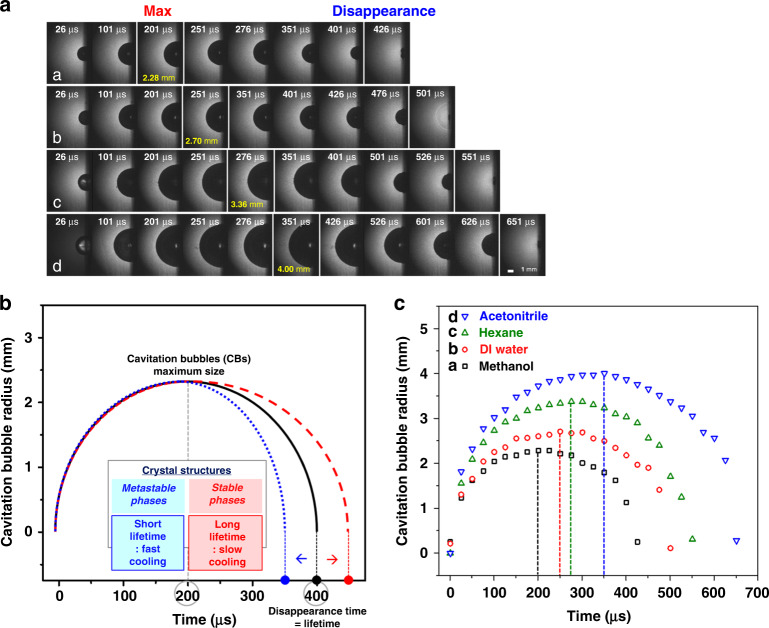
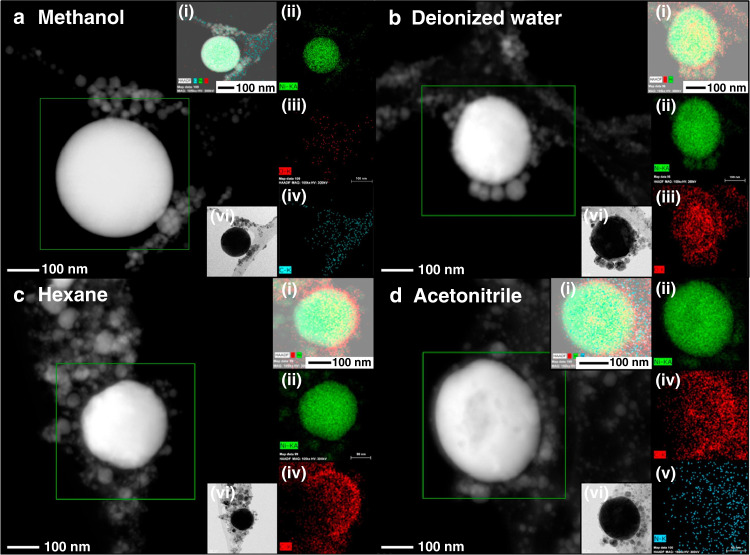
“Herein, the LICBs produced in the ACN medium showed a shorter lifetime, while the LICBs produced in methanol exhibited a larger longer lifetime.”
§ Fundamentals and comprehensive insights on pulsed laser synthesis of advanced materials for diverse photo- and electrocatalytic applications > Fundamentals of the pulsed laser process > Solvent medium
“the maximum size of LICBs (2.28, 2.70, 3.36, and 4.0 mm) reached at 201 μs (methanol), 251 μs (DI water), 276 μs (hexane), and 351 μs (ACN), respectively. Consequently, the LICBs began to collapse and disappeared completely at 426, 501, 551, and 651 μs, respectively”
Rated minor: it would not touch a result — a value no result rests on, a p-value that stays on the same side of the significance level, or a conflict that is clerical, resolved elsewhere in the paper, or outside its own findings.
In the paper
§ Fundamentals and comprehensive insights on pulsed laser synthesis of advanced materials for diverse photo- and electrocatalytic applications > Applications of laser-assisted materials > Electrocatalytic hydrogen evolution
“MoS2 QDs with ~4, 2.9, and 6 nm sizes were prepared by varying ablation duration (5, 10, and 20 min, respectively)”
§ Fundamentals and comprehensive insights on pulsed laser synthesis of advanced materials for diverse photo- and electrocatalytic applications > Applications of laser-assisted materials > Electrocatalytic hydrogen evolution
“at a constant laser energy of 40 mJ with an ablation duration of 5 min.”
Citations
Cites
Carbon Nanotubes: Present and Future Commercial Applications
De Volder, M. F. L., Tawfick, S. H., Baughman, R. H., & Hart, A. J. (2013) · Science · doi:10.1126/science.1222453 · Cited by 5,587
Stimulated Optical Radiation in Ruby
MAIMAN, T. H. (1960) · Nature · doi:10.1038/187493a0 · Cited by 5,121
Nanomaterials: a review of synthesis methods, properties, recent progress, and challenges
Baig, N., Kammakakam, I., & Falath, W. (2021) · Materials Advances · doi:10.1039/d0ma00807a · Cited by 3,262
Ajmal, A., Majeed, I., Malik, R. N., Idriss, H., & Nadeem, M. A. (2014) · RSC Adv. · doi:10.1039/c4ra06658h · Cited by 1,485
Laser Synthesis and Processing of Colloids: Fundamentals and Applications
Zhang, D., Gökce, B., & Barcikowski, S. (2017) · Chemical Reviews · doi:10.1021/acs.chemrev.6b00468 · Cited by 1,344
One-step synthesis of fluorescent carbon nanoparticles by laser irradiation
Hu, S.-L., Niu, K.-Y., Sun, J., Yang, J., Zhao, N.-Q., & Du, X.-W. (2009) · J. Mater. Chem. · doi:10.1039/b812943f · Cited by 968
Nanomaterials via Laser Ablation/Irradiation in Liquid: A Review
Zeng, H., Du, X., Singh, S. C., Kulinich, S. A., Yang, S., He, J., & Cai, W. (2012) · Advanced Functional Materials · doi:10.1002/adfm.201102295 · Cited by 966
Efficient solar water-splitting using a nanocrystalline CoO photocatalyst
Liao, L., Zhang, Q., Su, Z., Zhao, Z., Wang, Y., Li, Y., Lu, X., Wei, D., Feng, G., Yu, Q., et al. (2014) · Nature Nanotechnology · doi:10.1038/nnano.2013.272 · Cited by 852 · cited 2×
“Bao et al.210 prepared CoO nanoparticles for overall water splitting with an H2:O2 ratio of 2:1 and solar-tohydrogen efficiency of 5%.”
BackgroundConversion of carbohydrate into hydrogen fuel by a photocatalytic process
Kawai, T., & Sakata, T. (1980) · Nature · doi:10.1038/286474a0 · Cited by 682
Rana, A., Yadav, K., & Jagadevan, S. (2020) · Journal of Cleaner Production · doi:10.1016/j.jclepro.2020.122880 · Cited by 673
Cited by
Items 201–300 of 458
Song, L., Li, J., Li, J., et al. (2024) · Materials Today Communications · doi:10.1016/j.mtcomm.2024.110457 · Cited by 8
Geng, W.-C., Lou, A., Ma, S., Yao, K., Xue, Y., Yang, R., & Li, J. (2023) · Journal of Alloys and Compounds · doi:10.1016/j.jallcom.2023.172803 · Cited by 7
Attallah, A. H., Abdulwahid, F. S., Ali, Y. A., & Haider, A. J. (2025) · Lasers in Manufacturing and Materials Processing · doi:10.1007/s40516-025-00308-6 · Cited by 9
Sulfur vacancy riched pure 2H phase VS2 for efficient electrocatalytic hydrogen evolution
Zhan, W., Liu, G., Lang, L., Gao, X.-S., Zheng, B., Zhang, J., Luo, G., Hu, L., & Chen, W. (2024) · Journal of Electroanalytical Chemistry · doi:10.1016/j.jelechem.2024.118609 · Cited by 11
Surface Gold Atoms Determine Peroxidase Mimic Activity in Gold Alloy Nanoparticles
Spataro, G. M., Yang, J., Coviello, V., Agnoli, S., & Amendola, V. (2024) · ChemPhysChem · doi:10.1002/cphc.202400486 · Cited by 8
Khan, J. A., Gondal, M. A., & Ahmed, S. (2025) · Inorganic Chemistry Communications · doi:10.1016/j.inoche.2025.114717 · Cited by 8
Xue, R., Zhang, L., Gu, J., Zhou, Y., Wei, G., Yang, C., Huang, Z., & Xie, Z. (2024) · Journal of Water Process Engineering · doi:10.1016/j.jwpe.2024.104831 · Cited by 9
Khlaief, J. H., Nayef, U. M., & Hussien, A. M. A. (2025) · Plasmonics · doi:10.1007/s11468-025-03036-x · Cited by 10
Alabdulkarim, M. E., Maxwell, W. D., Thapliyal, V., & Maxwell, J. L. (2023) · Journal of Manufacturing and Materials Processing · doi:10.3390/jmmp7020057 · Cited by 10
Peckus, D., Mykolaitis, J., Tamulevičienė, A., Klimaitė, G., Khatmi, G., Juodėnas, M., Lazauskas, A., Tamulevičius, S., & Tamulevičius, T. (2025) · Optical Materials · doi:10.1016/j.optmat.2025.116796 · Cited by 8
Khlaief, J. H., Nayef, U. M., AbdulHussien, A. M., et al. (2026) · Nanotechnology for Environmental Engineering · doi:10.1007/s41204-026-00543-y · Cited by 8
Zhang, X., Su, Z., Zhang, C., Sun, Z., Jiang, L., Wang, Z., Lu, R., Zhu, Q., Shi, S., Luo, Y., et al. (2025) · Advanced Science · doi:10.1002/advs.202510123 · Cited by 7
Zhang, X., Chen, B., Wang, J., et al. (2024) · Journal of the Taiwan Institute of Chemical Engineers · doi:10.1016/j.jtice.2024.105934 · Cited by 7
Meng, C., Xie, C., Ren, Y., et al. (2026) · ACS Nano · doi:10.1021/acsnano.6c00158 · Cited by 7
Chen, X., Huang, H., Wu, Q., Xue, F., Zhao, Z., Liu, J., Duan, H., & Chen, H. (2023) · Analytica Chimica Acta · doi:10.1016/j.aca.2023.341940 · Cited by 7
Zhu, G. W., Han, M., Xiao, B., et al. (2023) · Processes · doi:10.3390/pr11061649 · Cited by 7
Hong, K., Elias, W. C., Heck, K. N., Terlier, T., Dimpel, D., Qian, W., Liu, B., Kurihara, T., & Wong, M. S. (2025) · Catalysis Today · doi:10.1016/j.cattod.2025.115254 · Cited by 7
Pawar, P. S., Koyale, P. A., Patil, S. S., et al. (2025) · Energy Advances · doi:10.1039/d4ya00553h · Cited by 7
Jiang, N., Zhu, L., Liu, P., Zhang, P., Gan, Y., Zhao, Y., & Jiang, Y. (2024) · Materials · doi:10.3390/ma17081876 · Cited by 7
Li, Y., Xiao, L., Zheng, Z., Yan, J., Sun, L., Huang, Z., & Li, X. (2023) · Nanomaterials · doi:10.3390/nano13192628 · Cited by 8
Radio frequency magnetron sputtering growth of Ni-doped ZnO thin films with nanocolumnar structures
Mazwan, M., Ng, S. S., Baharin, M. S. N. S., Pakhuruddin, M. Z., Bakar, A. S. A., Rahman, M. N. A., Omar, A., & Rahim, A. F. A. (2024) · Journal of Crystal Growth · doi:10.1016/j.jcrysgro.2024.127835 · Cited by 8
Garrido, M. D., Vie, D., Serrano‐Claumarchirant, J. F., Haskouri, J. E., Ros‐Lis, J. V., & Amorós, P. (2024) · Microporous and Mesoporous Materials · doi:10.1016/j.micromeso.2024.113244 · Cited by 7
Maqsood, M. F., Boltaev, G. S., El‐Kadri, O. M., et al. (2024) · Materials Chemistry and Physics · doi:10.1016/j.matchemphys.2024.130306 · Cited by 7
Impact of Tamm plasmon structures on fluorescence and optical nonlinearity of graphene quantum dots
Elamkulavan, H. J., Purayil, N. P., Subramaniam, S., & Keloth, C. (2024) · Scientific Reports · doi:10.1038/s41598-024-62694-9 · Cited by 8
Jian, J., Zhang, S., Chen, P., Liu, D., Wang, Y., Liu, L., Xiao, Z., Xu, Z., Pan, Y., Lv, W., et al. (2024) · Environmental Pollution · doi:10.1016/j.envpol.2024.125598 · Cited by 12
Energy partition in underwater nanosecond laser ablation
Nguyen, T. T. P., Tanabe, R., & Ito, Y. (2024) · Applied Physics A · doi:10.1007/s00339-024-07445-3 · Cited by 7
Koch, N. G., Poschmann, M., Heumann, S., Puthussery, A. J., Čolić, V., Barcikowski, S., & Reichenberger, S. (2025) · ChemCatChem · doi:10.1002/cctc.202500622 · Cited by 8
mcGFN-FF: an accurate force field for optimization and energetic screening of molecular crystals
Grimme, S., & Rose, T. (2024) · Zeitschrift für Naturforschung B · doi:10.1515/znb-2023-0088 · Cited by 8
Sindhu, N., Manani, S., Goyal, R. K., et al. (2025) · Journal of Materials Science · doi:10.1007/s10853-025-10901-x · Cited by 6
Femtosecond Laser Synthesis of Carbon Dots from Amino Acids for Fluorescent Bioimaging and Sensing
Astafiev, A. A., Shakhov, A. M., Tskhovrebov, A. G., Shatov, A., Syrchina, M. S., Shepel, D. V., & Nadtochenko, V. A. (2024) · ACS Applied Nano Materials · doi:10.1021/acsanm.4c04649 · Cited by 6
Jeong, Y., Theerthagiri, J., Lee, S. J., Chitumalla, R. K., Moon, C. J., Min, A., Kheawhom, S., Jang, J., & Choi, M. Y. (2024) · Electrochimica Acta · doi:10.1016/j.electacta.2024.144218 · Cited by 7
Self-citationPatra, A., Dutta, P., Das, M., Karim, G. M., Deb, S. K., Das, S., Mukherjee, P., Ghosh, S., & Maiti, U. (2024) · Carbon · doi:10.1016/j.carbon.2024.119485 · Cited by 6
Pò, C. L., Boscarino, S., Scalese, S., Boninelli, S., Grimaldi, M. G., & Ruffino, F. (2025) · Applied Surface Science Advances · doi:10.1016/j.apsadv.2025.100712 · Cited by 12
Kamal, M., Khan, Z., Muhammad, M. S., Suhaimin, N. S., Mir, F., Jaafar, J., Khan, A. A., Othman, M. H. D., Rahman, M. A., Puteh, M. H., et al. (2025) · Journal of Materials Science · doi:10.1007/s10853-025-11676-x · Cited by 8
Phukan, A., Kharphanbuh, S. M., & Nath, A. (2023) · Physical Chemistry Chemical Physics · doi:10.1039/d2cp05561a · Cited by 6
Synthesis of Nano CdZnS/SnS2/SnO2 Heterojunction for Photocatalytic Degradation of Rhodamine B
Li, L., Du, Y., Sun, H., Zhang, H., & Zhong, Z. (2023) · ChemCatChem · doi:10.1002/cctc.202201436 · Cited by 9
Kiteto, M. K., & Mecha, A. C. (2025) · Next research. · doi:10.1016/j.nexres.2025.100352 · Cited by 7
Strongly confined Te quantum dots as building blocks for single photon sources
Subedi, R., Ruiz‐Zepeda, F., Woli, Y. B., Hoang, T. B., Chaste, J., Herth, É., & Guisbiers, G. (2025) · Materials Today Quantum · doi:10.1016/j.mtquan.2025.100034 · Cited by 9
Lemm, P., Söder, J., Reichenberger, S., & Barcikowski, S. (2025) · Advanced Energy and Sustainability Research · doi:10.1002/aesr.202500242 · Cited by 8
Zhou, P., Zhang, L., Liu, Y., Zhou, Q., Zheng, J., Zhang, X., Fan, X., Xiao, X., & Chen, L. (2025) · Energy storage materials · doi:10.1016/j.ensm.2025.104562 · Cited by 21
Li, Z., Chen, F., Li, C., et al. (2024) · Dalton Transactions · doi:10.1039/d3dt04336c · Cited by 5
Mounika, P. M., Adike, N., Velpula, N., et al. (2025) · ACS Applied Energy Materials · doi:10.1021/acsaem.4c03238 · Cited by 5
Peng, C., Macher, J., Fuchs, P., Tao, Q., Krivec, T., & Antretter, T. (2025) · The International Journal of Advanced Manufacturing Technology · doi:10.1007/s00170-025-16896-8 · Cited by 6
Effect of femtosecond laser-induced internal stress adjustment zones on 4 H-SiC wafer warpage
Kuo, J.-F., Tsai, Y.-C., Cheng, C., et al. (2025) · Applied Physics A · doi:10.1007/s00339-025-08875-3 · Cited by 5
Ali, H. A., Abdulhadi, O. O., & Rzaij, J. M. (2025) · Lasers in Manufacturing and Materials Processing · doi:10.1007/s40516-024-00274-5 · Cited by 5
Shakir, A. K., Nurhafizah, M. D., Al‐Nafiey, A., et al. (2025) · Synthetic Metals · doi:10.1016/j.synthmet.2025.117862 · Cited by 5
Piatkowski, P. A., Abbasi, N. A., Awad, W. M., et al. (2024) · The Journal of Physical Chemistry C · doi:10.1021/acs.jpcc.4c04410 · Cited by 5
Mahapatra, S., Kumari, R., Dkhar, D. S., Singh, A., & Chandra, P. (2025) · TrAC Trends in Analytical Chemistry · doi:10.1016/j.trac.2025.118407 · Cited by 6
Park, J., Min, A., Naik, S. S., Moon, C. J., Theerthagiri, J., & Choi, M. Y. (2023) · Ultrasonics Sonochemistry · doi:10.1016/j.ultsonch.2023.106609 · Cited by 7
Self-citationTunable Photothermal Bubble Formation in Binary Liquids under Pulsed Laser Excitation
Huang, D., Lei, J., Zhang, N., Huang, X., Wu, S., Schiffbauer, J. E., & Yue, Y. (2025) · Langmuir · doi:10.1021/acs.langmuir.4c05379 · Cited by 5
Laser Processing of YSZ Ceramics without Cracking: The Impact of Solvent Selection on Performance
Usman, M., Katsumata, K., & Yamada, T. (2025) · ACS Omega · doi:10.1021/acsomega.4c10556 · Cited by 6
Preparation of Copper Oxide Film at Low Temperature in Basic Conditions on a Copper Substrate
Barbaccia, F. I., de, T., Federici, F., Mezzi, A., Sansone, L., Giordano, M., & Macchia, A. (2025) · Materials · doi:10.3390/ma18071487 · Cited by 6
Abdeta, A. B., Tilachew, G., Wedajo, F., Ayana, K., Mubiayi, P. K., Banda, M., Lin, J., & Chen, X. (2025) · Journal of Water Process Engineering · doi:10.1016/j.jwpe.2025.109064 · Cited by 8
Conversion of C4F8 via plasma catalysis over Al2O3/Zr/SO4-2 catalyst: Effects of H2O(g)
Machmud, A., & Chang, M. B. (2024) · Chemical Engineering Journal · doi:10.1016/j.cej.2024.157467 · Cited by 5
Creation of tungsten and platinum nanoparticles from nanosecond plasmas in water
Krettek, O., Pottkämper, P., Cignoni, P., Tschulik, K., & von Keudell, A. (2024) · Journal of Physics D Applied Physics · doi:10.1088/1361-6463/ad7301 · Cited by 5
Electrochemically responsive materials for energy-efficient water treatment and carbon capture
Shen, K. B., Mathur, A., Liu, Y., & Mao, X. (2023) · Applied Physics Reviews · doi:10.1063/5.0147071 · Cited by 5
Huang, K., Wang, M., Wang, Y., Wang, S., Wang, K., Jiang, T., & Wu, M. (2025) · Journal of Materials Chemistry A · doi:10.1039/d5ta01988e · Cited by 7
Laser trapping of cavitation bubbles in liquids
Kononenko, V. V., Zavedeev, E. V., Arutyunyan, N. R., Ashikkalieva, K. K., Kononenko, T. V., & Конов, В. И. (2023) · Optics & Laser Technology · doi:10.1016/j.optlastec.2023.110422 · Cited by 5
Wang, H., & Kim, H. S. (2025) · International Journal of Hydrogen Energy · doi:10.1016/j.ijhydene.2025.04.347 · Cited by 5
Self-citationShi, Y., Zhang, J., Lu, Z., Shi, H., Ye, J., Zhao, C., Li, Q., Ding, F., Zhang, B., & Li, C. (2024) · Journal of Water Process Engineering · doi:10.1016/j.jwpe.2023.104751 · Cited by 5
Rapid synthesis of nanomaterials by solvent-free laser irradiation for energy storage and conversion
Devina, W., Subiyanto, I., Dung, D. T., Han, S. O., Yoon, H. C., Lam, D. V., Lee, S., & Kim, H. (2023) · Chemical Physics Reviews · doi:10.1063/5.0150598 · Cited by 5
Self-citationWu, Y., Li, J., Ma, J., Song, X., Ding, J., & He, F. (2024) · Journal of Water Process Engineering · doi:10.1016/j.jwpe.2024.106089 · Cited by 3
Cheng, H., & Kim, H. S. (2025) · Energy & environment materials · doi:10.1002/eem2.70103 · Cited by 5
Self-citationAcid‐Free Upcycling of Spent LiCoO₂ into Bifunctional CoMoS₄ Catalyst for Alkaline Water Splitting
Sajeevan, A. S., Dileep, N. P., Sunny, S., & Shaijumon, M. M. (2025) · ChemCatChem · doi:10.1002/cctc.202500427 · Cited by 5
Zhou, W., Mo, X., Cheung, C. W., & Tse, E. C. M. (2024) · Chemical Engineering Journal · doi:10.1016/j.cej.2024.157129 · Cited by 5
HER performance of Ni3Se2/Fe, Ni3Se2/Co and Ni3Se2/Mo composite materials with multistage structure
Chen, G.-L., Wang, H.-Y., Liu, Y., Huang, X., & Yin, G.-M. (2023) · Solid State Sciences · doi:10.1016/j.solidstatesciences.2023.107148 · Cited by 4
Pulsed laser ablation of polymer-based magnetic nanocomposites for oil spill remediation
Gera, T., Kondász, B., Smausz, T., et al. (2024) · Cleaner Materials · doi:10.1016/j.clema.2024.100235 · Cited by 4
Clemente, J. A. C., Rodríguez‐García, I., Tolosana-Moranchel, A., de la Fuente, J. L. G., Ocón, P., Retuerto, M., & Rojas, S. (2024) · Nano Select · doi:10.1002/nano.202400051 · Cited by 4
Influence of MoS2/TiO2 on the behavior of heavy oil hydrogenation and coke generation
Zhang, X., Chen, B., Wang, J., Zhou, Y., Huang, X., & Huang, H. (2025) · Journal of the Energy Institute · doi:10.1016/j.joei.2025.101998 · Cited by 5
El‐Fattah, W. A., Guesmi, A., Hamadi, N. B., Subaihi, A., Shahat, A., Mubarak, M. F., & Ahmed, H. A. (2025) · International Journal of Environmental Research · doi:10.1007/s41742-025-00880-x · Cited by 7
Yang, C., Wang, T., Wang, T., Yuan, H., Li, H., He, H., Liu, D., & Huang, H. (2025) · Inorganic Chemistry Frontiers · doi:10.1039/d5qi00420a · Cited by 5
Ahtesham, A., Hussain, E., Shahadat, M., Anwer, A. H., Benamor, A., & Ahamad, N. (2025) · Journal of Solid State Electrochemistry · doi:10.1007/s10008-025-06372-4 · Cited by 5
Tang, S., Zhang, C., Luo, X., et al. (2026) · Corrosion Communications · doi:10.1016/j.corcom.2025.05.003 · Cited by 4
Gao, B.-B., Yu, X., Ye, J.-N., Qiu, J., & Peng, J. (2024) · Journal of Solid State Electrochemistry · doi:10.1007/s10008-024-05926-2 · Cited by 4
Creation of One- and Two-Dimensional Copper and Zinc Oxides Semiconductor Structures
Murzin, S. P., & Kazanskiy, N. L. (2023) · Applied Sciences · doi:10.3390/app132011459 · Cited by 6
Malik, A., Hussain, S., Al‐Ahmadi, A. N., et al. (2024) · Physica Scripta · doi:10.1088/1402-4896/ad5230 · Cited by 4
Feng, P., Ke, B., Wang, S., et al. (2025) · Angewandte Chemie · doi:10.1002/ange.202509834 · Cited by 4
High-Throughput Electrochemistry Using Scanning Electrochemical Cells
Przybysz, J. M., Jenewein, K. J., & Cherevko, S. (2026) · ACS electrochemistry. · doi:10.1021/acselectrochem.5c00440 · Cited by 7
Fu, B., Zhang, C., Zhang, Z., Ouyang, Z., Wang, G., Jing, X., Chen, W., Zhang, L., & Qiu, M. (2025) · Advanced Science · doi:10.1002/advs.202511572 · Cited by 6
Zhou, A. X., Song, D., Hui, Z., Yang, J., An, W., Zuo, X., Ye, X., & Jiang, M. (2024) · Results in Physics · doi:10.1016/j.rinp.2024.107611 · Cited by 5
Bayyoodh, A. A., Alfahed, R. K. F., & Zainulabdeen, F. S. (2024) · Journal of Materials Science Materials in Electronics · doi:10.1007/s10854-024-12821-z · Cited by 5
Filipescu, M., Dobrescu, S., Bercea, A. I., et al. (2023) · Polymers · doi:10.3390/polym16010079 · Cited by 4
Li, W., He, Y., Yang, S., Yu, W., & Liu, S. (2025) · The Journal of Physical Chemistry Letters · doi:10.1021/acs.jpclett.5c01309 · Cited by 4
Xu, S., Kong, T., Li, Z., Zhang, M., Miao, Y., Feng, Z., Qi, J., Wei, F., Meng, Q., Ren, Y., et al. (2024) · Materials Today Chemistry · doi:10.1016/j.mtchem.2024.102027 · Cited by 11
Li, Y., Guo, B., Liu, K., Li, K., Song, J., Wang, C., Wan, Y., Han, D., Duan, Q., & Yang, S. (2023) · Langmuir · doi:10.1021/acs.langmuir.3c02644 · Cited by 4
Park, J., Sahu, B. K., Moon, C. J., Theerthagiri, J., Min, A., Yun, S., & Choi, M. Y. (2024) · The Journal of Physical Chemistry C · doi:10.1021/acs.jpcc.4c04174 · Cited by 8
Self-citationArtificial Intelligence-Guided Pulsed Synthesis of Zinc Oxide Nanostructures on Thin Metal Shells
Murzin, S. P. (2025) · Processes · doi:10.3390/pr13113755 · Cited by 9
Carbon-encapsulated electrocatalysts for oxygen electrocatalysis
Wu, Q., Yao, Y., Wang, B., & Zou, Z. (2026) · Journal of Materials Chemistry A · doi:10.1039/d5ta08532b · Cited by 7
Malakul, P., & Wada, H. (2025) · Materials Chemistry and Physics · doi:10.1016/j.matchemphys.2025.131089 · Cited by 4
Boron-bridged AuPt/MBene interfaces enable selective PET electroreforming to formate and hydrogen
Lee, D. H., Theerthagiri, J., Yodsin, N., Junmon, P., Kumari, M. L. A., Limphirat, W., Song, J. K., & Choi, M. Y. (2026) · Chemical Engineering Journal · doi:10.1016/j.cej.2026.176739 · Cited by 3
Self-citationVacancy engineering of TiO 2 with low Pt content for efficient hydrogen generation
Gao, J., Shen, Y., Gao, J., Xin, L., Xiao, W., Xu, G., Chen, D., Wang, L., Liu, F., & Wu, Z. (2025) · Chemical Communications · doi:10.1039/d5cc02554k · Cited by 3
Effect of electron redistribution on H adsorption and hydrogen production efficiency
Ruan, W., Teng, Y., Zhang, H., Li, Z., Xu, T., Yang, Y., & Teng, F. (2024) · Materials Today Chemistry · doi:10.1016/j.mtchem.2024.102244 · Cited by 3
Lu, R., Han, J., Liu, J., et al. (2023) · Materials · doi:10.3390/ma16082970 · Cited by 3
Laser-Induced Melting and Coalescence of Nanoparticle Clusters Captured in Real Time
Freund, M., Jiang, S., & Ortalan, V. (2024) · ACS Applied Nano Materials · doi:10.1021/acsanm.4c02621 · Cited by 3
Mehmood, C. T., Dar, S. U., Chen, L., Waheed, H., Achmon, Y., Habimana, O., & Zhong, Z. (2024) · Journal of Water Process Engineering · doi:10.1016/j.jwpe.2024.105723 · Cited by 3
Zaikovskii, A. V., Yudin, I. B., Федосеев, А. В., Dmitrachkov, A. M., & Morozova, M. A. (2025) · Journal of Materials Science · doi:10.1007/s10853-025-10934-2 · Cited by 3
Unveiling Synergistic CuAuAg Nanoparticles on CuO for High‐Yield CO 2 Electroreduction
Park, C. E., Cherusseri, J., Kerkar, R. D., et al. (2026) · Carbon Energy · doi:10.1002/cey2.70242 · Cited by 3
Self-citationRawat, V., Gairola, V., Rawat, B., et al. (2025) · Next Materials · doi:10.1016/j.nxmate.2025.101520 · Cited by 3
Degradation of bisphenol F by peroxymonosulfate activated with palladium-based catalysts
Zhou, X., Li, M., Hou, J., Sun, J., Zheng, S., Chen, Y., & Guan, Q. (2024) · Journal of Environmental Sciences · doi:10.1016/j.jes.2024.02.034 · Cited by 3
Metadata
- Authors
- Theerthagiri, J., Karuppasamy, K., Lee, S. J., Shwetharani, R., Kim, H.-S., Pasha, S. K. K., Ashokkumar, M., & Choi, M. Y.
- Affiliations
- Gyeongsang National University (KR)
- Dongguk University (KR)
- Jain University (IN)
- Vellore Institute of Technology University (IN)
- The University of Melbourne (AU)
- Corresponding author
- Choi, Myong Yong
- ORCID
- Venue
- Light: Science & Applications
- Published
- 2022-08-10
- Volume
- 11
- Issue
- 1
- Pages
- 250-250
- ISSN
- 2047-7538 (ISSN-L)
- PMC
- PMC9363469
- OpenAlex
- W4291285610
- Semantic Scholar
- 2d5f596fdcb98ca7a934f5ab060cb2e57dafd882
- Cited by
- 461
- References
- 264
- Citations by year
- 2026: 88 · 2025: 126 · 2024: 142 · 2023: 87 · 2022: 18
- FWCI
- 8.31
- Type
- journal article
- Language
- en
- Open access
- gold
- doi.org
- Licence
- cc-by
- creativecommons.org/licenses/by/4.0 (tdm)
- creativecommons.org/licenses/by/4.0 (vor)
- Locations
- Light Science & Applications (publishedVersion, cc-by)
- PubMed Central (publishedVersion, cc-by)
- PubMed (publishedVersion)
- DOAJ (DOAJ: Directory of Open Access Journals) (submittedVersion, cc-by-sa)
- Minerva Access (University of Melbourne) (submittedVersion, cc-by)
- Greater South Information System
- Funders
- Korea Basic Science Institute (2019R1A6C1010042, 2021R1A6C103A427)
- National Research Foundation of Korea (2019H1D3A1A01071209, 2020K2A9A1A06103609, 2022R1A2C2010686, 2021R1I1A1A01060380, 2020R1I1A1A01065748)
- Topics
- Physical Sciences › Materials Science › Materials Chemistry › Laser-Ablation Synthesis of Nanoparticles
- Physical Sciences › Energy › Renewable Energy, Sustainability and the Environment › Advanced Photocatalysis Techniques
- Physical Sciences › Physics and Astronomy › Acoustics and Ultrasonics › Ultrasound and Cavitation Phenomena
- Keywords
- pulsed laser synthesis, nanomaterials, metal nanoparticles, metal oxides, carbon materials, synthesis mechanism, structural optimization, defect engineering, energy storage, clean energy generation, environmental remediation
About these checks
Registry, retraction, Cites and statistics results are computed, not judged, with one exception: a printed reference that no index lists is read once by a model before it counts as a citation error. Claims are extracted by a model and kept only when their quote appears verbatim in the text; each cited source is then checked, with a model’s help, for whether it says what the claim relies on. Those verdicts can be wrong — read the claim’s quote and the cited source before relying on one.
The claim verdicts this report counts are experimental: their accuracy is not yet measured.
A language model drew the claims from the paper on 2026-10-10, under version 3 of the claim definition (model deepseek-v4.1-flash, prompt extract-v3).
A second model labelled each claim on 2026-10-10 (model jev-1.13-20260917, definition revision gold-guideline-v0.2).
Cited sources are checked with a language model’s help (gpt-6-sol).
Statistics and arithmetic are recomputed, not judged.
Confidence bands are shown only for fields calibrated on our annotated test set. None is calibrated yet, so no band is shown.
What counts as a claim ›How we measure confidence ›How we check this ›
Are you an author, or do you see a problem with this page? Request a review
Data sources
Bibliographic data: Semantic Scholar, OpenAlex, Crossref.
Contains information from the Semantic Scholar Academic Graph Datasets, made available under the ODC Attribution License (ODC-BY 1.0).
Semantic Scholar’s data is described in: Kinney, R., et al. (2023). The Semantic Scholar Open Data Platform. arXiv:2301.10140.
