

Alzheimer’s disease profiled by fluid and imaging markers: tau PET best predicts cognitive decline
Open accessThe DOI matches its Crossref record; 34 of the 35 references it cites were found in a registry or an index.
Abstract
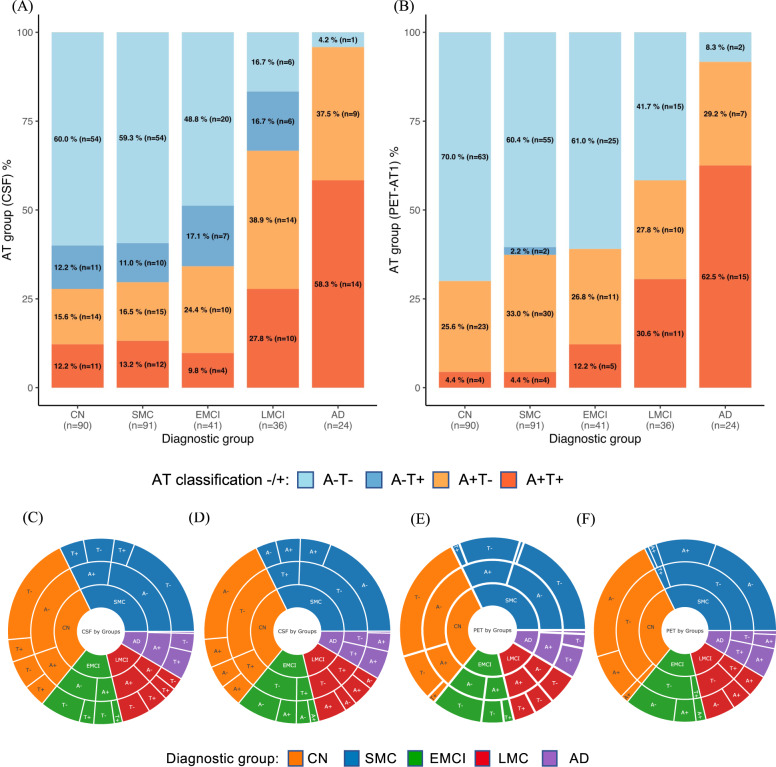
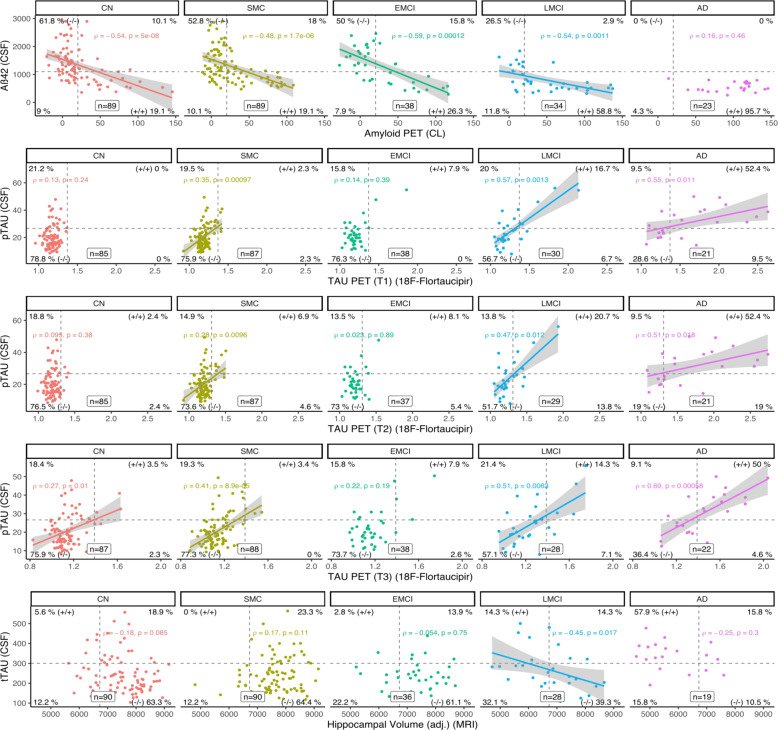
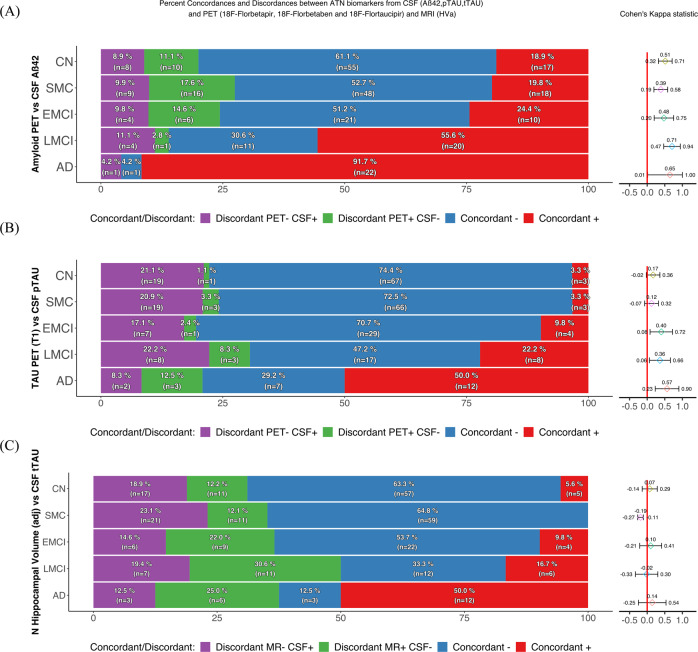
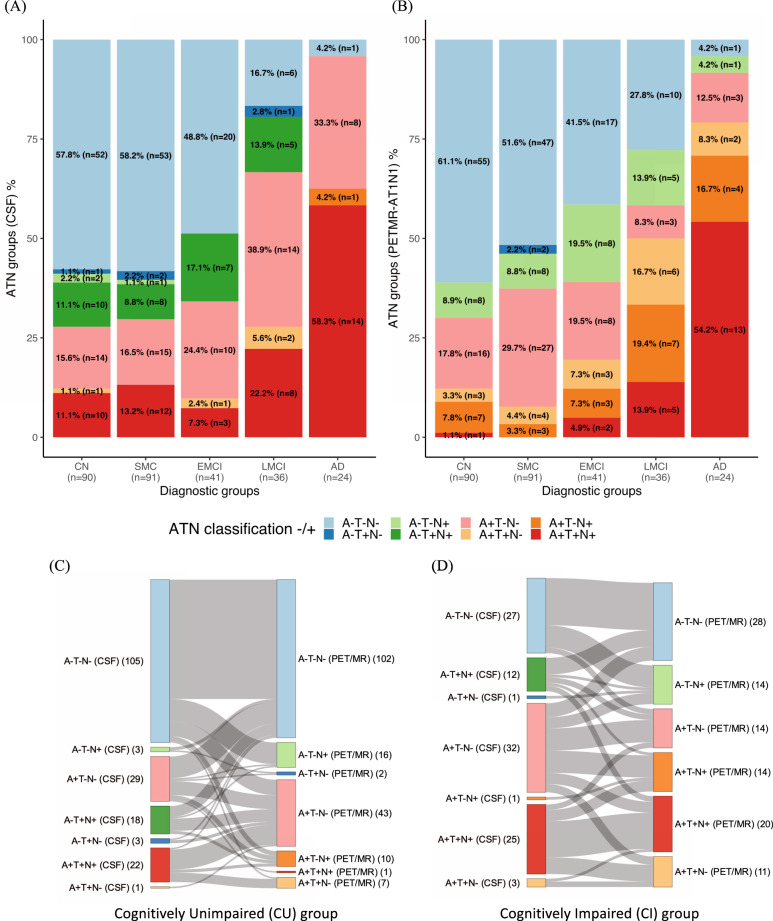
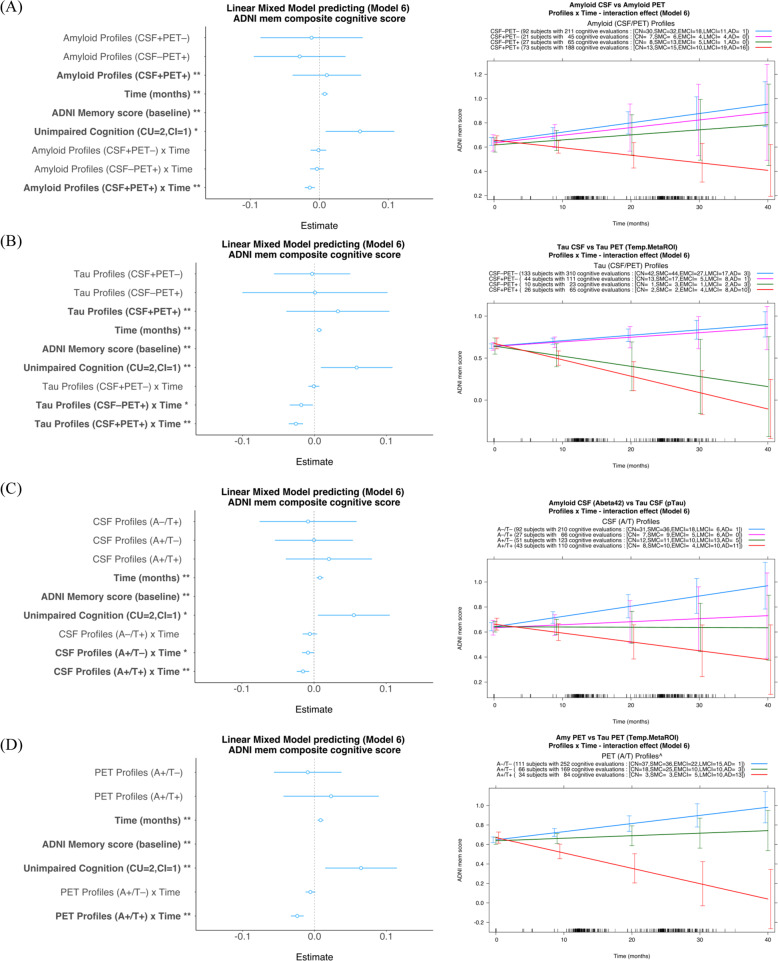
For early detection of Alzheimer’s disease, it is important to find biomarkers with predictive value for disease progression and clinical manifestations, such as cognitive decline. Individuals can now be profiled based on their biomarker status for Aβ42 (A) or tau (T) deposition and neurodegeneration (N). The aim of this study was to compare the cerebrospinal fluid (CSF) and imaging (PET/MR) biomarkers in each ATN category and to assess their ability to predict longitudinal cognitive decline. A subset of 282 patients, who had had at the same time PET investigations with amyloid-β and tau tracers, CSF sampling, and structural MRI (18% within 13 months), was selected from the ADNI dataset. The participants were grouped by clinical diagnosis at that time: cognitively normal, subjective memory concern, early or late mild cognitive impairment, or AD. Agreement between CSF (amyloid-β-1-42(A), phosphorylated-Tau181(T), total-Tau(N)), and imaging (amyloid-β PET (florbetaben and florbetapir)(A), tau PET (flortaucipir)(T), hippocampal volume (MRI)(N)) positivity in ATN was assessed with Cohen’s Kappa. Linear mixed-effects models were used to predict decline in the episodic memory. There was moderate agreement between PET and CSF for A biomarkers (Kappa = 0.39–0.71), while only fair agreement for T biomarkers (Kappa ≤ 0.40, except AD) and discordance for N biomarkers across all groups (Kappa ≤ 0.14) was found. Baseline PET tau predicted longitudinal decline in episodic memory irrespective of CSF p-Tau181 positivity ( p ≤ 0.02). Baseline PET tau and amyloid-β predicted decline in episodic memory ( p ≤ 0.0001), but isolated PET amyloid-β did not. Isolated PET Tau positivity was only observed in 2 participants (0.71% of the sample). While results for amyloid-β were similar using CSF or imaging, CSF and imaging results for tau and neurodegeneration were not interchangeable. PET tau positivity was superior to CSF p-Tau181 and PET amyloid-β in predicting cognitive decline in the AD continuum within 3 years of follow-up.
Overview
The claims and statistics of this paper haven’t been checked yet.
Free: it reads the open-access text and checks the first 5 claims that cite a source we can check. Create a free account to check every claim.
Integrity signals
Registry
Cites
Statistics
Figures
Verification
Claims the paper makes
The claims and statistics of this paper haven’t been checked yet.
Free: it reads the open-access text and checks the first 5 claims that cite a source we can check. Create a free account to check every claim.
Claims other papers make about this one
Each is checked against this paper’s own text: does it say what the citing paper says it does?
The source backs part of the claim, not all of it — or backs it for a different population, condition or comparison.
In the citing paper
“This discrepancy is related to their respective representations of PHFs formation and pathological tau deposition, with the latter’s higher correlation to cognitive abilities supporting tau PET as the most effective method for predicting cognitive decline in AD.365,374”
From Recent advances in Alzheimer's disease: Mechanisms, clinical trials and new drug development strategies. (2024) · cites this paper as [374]
Experimental — accuracy not yet measuredThe source backs part of the claim, not all of it — or backs it for a different population, condition or comparison.
In the citing paper
“Studies show a highly negative correlation between amyloid PET and CSF results, whereas CSF P-tau and tau PET findings are inconsistent.”
From Recent advances in Alzheimer's disease: Mechanisms, clinical trials and new drug development strategies. (2024) · cites this paper as [374]
Experimental — accuracy not yet measuredThe source backs part of the claim, not all of it — or backs it for a different population, condition or comparison.
In the citing paper
“This discrepancy is related to their respective representations of PHFs formation and pathological tau deposition, with the latter’s higher correlation to cognitive abilities supporting tau PET as the most effective method for predicting cognitive decline in AD.365,374”
From Recent advances in Alzheimer's disease: Mechanisms, clinical trials and new drug development strategies. (2024) · cites this paper as [374]
Experimental — accuracy not yet measured
Self-check
Percentages, sums and reported differences re-computed from the paper’s own numbers.
The self-check needs the paper’s full text.
Citations
Cites
R: A Language and Environment for Statistical Computing
R Core Team (2025) · doi:10.32614/r.manuals · Cited by 352,181
Interrater reliability: The kappa statistic
McHugh, M. L. (2012) · Biochemia Medica · doi:10.11613/bm.2012.031 · Cited by 19,877
NIA‐AA Research Framework: Toward a biological definition of Alzheimer's disease
Jack, C. R., Bennett, D. A., Blennow, K., Carrillo, M. C., Dunn, B., Haeberlein, S. B., Holtzman, D. M., Jagust, W., Jessen, F., Karlawish, J., et al. (2018) · Alzheimer's & Dementia · doi:10.1016/j.jalz.2018.02.018 · Cited by 10,537
Clinical diagnosis of Alzheimer’s disease: Recommendations of the International Working Group
Dubois, B., Villain, N., Frisoni, G. B., Rabinovici, G. D., Sabbagh, M., Cappa, S., Bejanin, A., Bombois, S., Epelbaum, S., Teichmann, M., et al. (2021) · The Lancet Neurology · doi:10.1016/s1474-4422(21)00066-1 · Cited by 1,051
Self-citationBrain atrophy in Alzheimer’s Disease and aging
Pini, L., Pievani, M., Bocchetta, M., Altomare, D., Bosco, P., Cavedo, E., Galluzzi, S., Marizzoni, M., & Frisoni, G. B. (2016) · Ageing Research Reviews · doi:10.1016/j.arr.2016.01.002 · Cited by 836
Initiative, F. T. A. D. N., Crane, P. K., Carle, A., Gibbons, L. E., Insel, P., Mackin, R. S., Gross, A., Jones, R. N., Mukherjee, S., Curtis, S. M., et al. (2012) · Brain Imaging and Behavior · doi:10.1007/s11682-012-9186-z · Cited by 621
Johnson, K. A., Minoshima, S., Bohnen, N. I., Donohoe, K. J., Foster, N. L., Herscovitch, P., Karlawish, J. H., Rowe, C. C., Carrillo, M. C., Hartley, D. M., et al. (2013) · Alzheimer's & Dementia · doi:10.1016/j.jalz.2013.01.002 · Cited by 603
Clinical core of the Alzheimer's disease neuroimaging initiative: Progress and plans
Aisen, P. S., Petersen, R. C., Donohue, M. C., Gamst, A., Raman, R., Thomas, R. G., Walter, S., Trojanowski, J. Q., Shaw, L. M., Beckett, L. A., et al. (2010) · Alzheimer's & Dementia · doi:10.1016/j.jalz.2010.03.006 · Cited by 517
Ossenkoppele, R., Rabinovici, G. D., Smith, R., Cho, H., Schöll, M., Strandberg, O., Palmqvist, S., Mattsson, N., Janelidze, S., Santillo, A., et al. (2018) · JAMA · doi:10.1001/jama.2018.12917 · Cited by 472
Palmqvist, S., Mattsson, N., Hansson, O., & Initiative, F. T. A. D. N. (2016) · Brain · doi:10.1093/brain/aww015 · Cited by 400
Cited by
Items 101–141 of 141
Prognostic Value of A/T/N Biomarkers: Comparing Plasma and Imaging Modalities in Alzheimer Disease
Yim, S., Gu, Y., Kang, H., Shin, D., Jang, H., Yoo, H., Zetterberg, H., Blennow, K., González‐Ortiz, F., Ashton, N. J., et al. (2025) · Clinical Nuclear Medicine · doi:10.1097/rlu.0000000000006088 · Cited by 2
Hemesath, A., Zhao, W., Robbins, C. B., Kundu, A., Allen, A., Joseph, S., Ma, J. P., Haystead, A., Bozoki, A., Johnson, K. G., et al. (2026) · Journal of VitreoRetinal Diseases · doi:10.1177/24741264261429294 · Cited by 1
Jiang, L., Chen, Y., He, Y., Liang, J., Zhao, X., & Guo, X. (2026) · Biosensors · doi:10.3390/bios16050258 · Cited by 2
“Currently, cerebrospinal fluid (CSF) biomarkers and positron emission tomography (PET) provide robust evidence of AD-related pathology [9,10].”
Wagemann, O., Brendel, M., Franzmeier, N., Nübling, G., Gnörich, J. S., Zaganjori, M., Prix, C., Stockbauer, A., Wlasich, E., Loosli, S. V., et al. (2025) · Frontiers in Neuroscience · doi:10.3389/fnins.2024.1505999 · Cited by 1
Petersen, K. K., Nallapu, B. T., Lipton, R. B., Grober, E. H., Davatzikos, C. A., Harvey, D. J., Nasrallah, I. M., Ezzati, A., Initiative, A. D. N., Petersen, K. K., et al. (2025) · The Journals of Gerontology Series B · doi:10.1093/geronb/gbaf085 · Cited by 1
Ferrari‐Souza, J. P., Lussier, F. Z., Leffa, D. T., Therriault, J., Tissot, C., Bellaver, B., Ferreira, P. C. L., Malpetti, M., Wang, Y.-T., Povala, G., et al. (2022) · medRxiv · doi:10.1101/2022.07.12.22277556 · Cited by 1
“Because CSF measures have been suggested to detect Aβ and tau accumulation earlier than PET (48, 54, 55), the fact we observed similar results using imaging ([18F]AZD4694 and [18F]MK6240) and fluid (CSF Aβ1-42 and p-tau181) biomarkers support the robustness of our findings.”
ResultTau-PET abnormality change along with Alzheimer’s disease: a topological perspectivePreprint
Ding, J., Shen, C., Wang, Z., Yang, Y., Fakhri, G. E., Lu, J., Liang, D., Zheng, H., Zhou, Y., & Sun, T. (2023) · Research Square · doi:10.21203/rs.3.rs-2756518/v1 · Cited by 1
Comprehensive evaluation of AT(N) imaging biomarkers for predicting cognitionPreprint
Earnest, T., Yang, B., Kothapalli, D., Sotiras, A., & Initiative, T. A. D. N. (2024) · medRxiv · doi:10.1101/2024.11.25.24317943 · Cited by 2
Andrews, D., Golchi, S., Collins, D. L., & Initiative, T. A. D. N. (2025) · medRxiv · doi:10.1101/2025.10.28.25338899 · Cited by 1
Sun, Y., Liu, Y., & Liu, B. (2022) · International Conference on Bioinformatics and Computational Biology (ICBCB) · doi:10.1109/icbcb55259.2022.9802479 · Cited by 1
Research progress of psychoradiology in geriatric neurodegenerative diseases
Suo, X., Li, Z., Zuo, C., Lan, H., Pan, N., Lui, S., & Gong, Q. (2022) · Scientia Sinica Vitae · doi:10.1360/ssv-2022-0168
Research on computer-aided diagnosis of Alzheimer's disease based on PET images
Yu, Z., Xu, G., Li, X., Zhu, Z., & Wang, F. (2022) · International Conference on Signal Image Processing and Communication (ICSIPC) · doi:10.1117/12.2643553
“This algorithm is a kind of transfer learning as the main idea, combined with cross-validation, adaptive cropping and data enhancement, to classify samples [5].”
MethodDynamic associations between tau aggregation, atrophy, and cognitive decline in Alzheimer’s diseasePreprint
Singleton, E. H., Mattsson, N., Binette, A. P., Stomrud, E., Strandberg, O. T., Palmqvist, S., Ossenkoppele, R., & Hansson, O. (2024) · medRxiv · doi:10.1101/2024.07.20.24310441
Paradigm Shift in AD Diagnostic Criteria: Applications and Challenges
张, 春. (2024) · Advances in Clinical Medicine · doi:10.12677/acm.2024.1482186
Alzheimer’s neuropathology and longitudinal change in subjective cognitive complaintsPreprint
Bannerjee, A., Elkins, W., Resnick, S. M., & Bilgel, M. (2024) · medRxiv · doi:10.1101/2024.09.25.24314211
Temporal modeling and AT profiles in the early phase of Alzheimer's disease
Platero, C. A. (2025) · Journal of Alzheimer s Disease Reports · doi:10.1177/25424823241306097 · Cited by 2
“6,7,47”
Novel Monoclonal Antibodies for the Treatment of Alzheimers Disease using KISUNLA Drug
Titare, V. P., Salve, M. S. K., & Kitukale, M. D. (2025) · International Journal of Advanced Research in Science Communication and Technology · doi:10.48175/ijarsct-23077
New Research on Biomarkers in Alzheimer’s Continuum
Vecchio, I., & Colica, C. (2025) · Reviews on Recent Clinical Trials · doi:10.2174/0115748871331138250114052615 · Cited by 3
Ricchi, I., Griffa, A., Jerez, R. A. C., Richiardi, J., Démonet, J., Allali, G., Maréchal, B., Rouaud, O., & Initiative, A. D. N. (2025) · Journal of Alzheimer s Disease · doi:10.1177/13872877251339840 · Cited by 1
Bitar, G. A., Alban, S., Beyene, K. M., Decourt, B., Harirchian, S., & Sabbagh, M. N. (2025) · Research Square · doi:10.21203/rs.3.rs-8168314/v1
Early detection of mild cognitive impairment utilizing ocular biomarker-based risk scoring nomogram
Hussen, M. S., Lam, B. Y., Gao, W., Zhou, L., Choi, K. Y., & Chan, H. H. (2025) · Frontiers in Aging Neuroscience · doi:10.3389/fnagi.2025.1669948
Moradi, E., Prakash, M., Hall, A., Solomon, A., Strange, B. A., & Tohka, J. (2024) · Figshare · doi:10.6084/m9.figshare.25303178
Moradi, E., Prakash, M., Hall, A., Solomon, A., Strange, B. A., & Tohka, J. (2024) · Figshare · doi:10.6084/m9.figshare.25302846
Byeon, J. H., Byun, M. S., Yi, D., Jung, J. H., Sohn, B. K., Chang, Y. Y., Kong, N., Jung, G., Ahn, H., Lee, J.-Y., et al. (2024) · Figshare · doi:10.6084/m9.figshare.26360905
Neuropathologically validated MRI to tau PET synthesis via Covariate-modulated attention networksPreprint
Borhi, M., Lyu, R.-K., Jagust, W. J., Wang, J., Giorgio, J., & Initiative, A. D. N. (2025) · bioRxiv (Cold Spring Harbor Laboratory) · doi:10.64898/2025.12.27.696668
“While CSF and plasma phosphorylated tau (e.g., p-tau217) are increasingly accurate for detecting abnormal Aβ and tau and for forecasting decline 13,14 , fluid biomarkers lack spatial specificity; by contrast, tau PET yields topographic information critical for image-based analyses, staging, and…”
Baghcheghi, Y., Razazpour, F., Mohammadi, M., Mashayekhi‐Sardoo, H., & Hedayati‐Moghadam, M. (2026) · Journal of Alzheimer s Disease Reports · doi:10.1177/25424823251412327
Boytsova, D. V., Dupik, A. N., Krivchenkova, E. V., Andryushchenko, A. V., Zakurazhnaya, V., Andreyuk, D. S., Kurmyshev, M. V., Kostyuk, G. P., & Vasenina, E. E. (2026) · Meditsinskiy sovet = Medical Council · doi:10.21518/ms2025-533
Wheatley, S., Ferreira, D., Nordberg, A., Mohanty, R., & Westman, E. (2026) · Research Square · doi:10.21203/rs.3.rs-8910160/v1
Self-citationSharma, S., Sharma, U., Sethiya, N. K., & Singh, L. (2026) · Current Aging Science · doi:10.2174/0118746098373086251201095903 · Cited by 1
The role of the α7 nicotinic acetylcholine receptor in a model of amyloid pathology
Santos, D. G. (2024) · theses.fr (ABES) · doi:10.70675/b3ed4de5zcd9ez4421za129z0a05130d86b9
Royall, D. R., Palmer, R. F., & Initiative, A. D. N. (2026) · Journal of Alzheimer s Disease · doi:10.1177/13872877261458678
Encoding Discordance in the Alzheimer’s Disease A/T/N FrameworkPreprint
DeLong, L. N., Salimi, Y., Balabin, H., Galdi, P., Fleuriot, J., Brennan, P. M., & Initiative, A. D. N. (2026) · medRxiv · doi:10.64898/2026.07.19.26358425
“To determine A and T positivity (A+ and T+, respectively), we extracted biomarkers from the CSF and PET uptake data, as described in Bucci et al. [20].”
Influential基于ATR-FTIR的阿尔茨海默病与轻度认知障碍的光谱智能诊断
Peng, 单. S., Yu, 刘. L., Zhigang, 李. L., Wang, Q., Zhihong, 石. S., & Yong, 纪. J. (2026) · Acta Optica Sinica · doi:10.3788/aos260747
Diagnosis of neurodegenerative diseases based on molecular imaging
Quan, L., Lang, M., Yue, J., Zhu, J., Xu, J., Wang, K., Huang, H., Song, Q., Zhao, Y., Zhu, Z., et al. (2026) · Chemical Engineering Journal · doi:10.1016/j.cej.2026.180865
Xu, L., Zhang, Y., Jiang, L., Xing, J. F., Hu, J., Lan, T., & Ta, G. (2026) · Frontiers in Cellular Neuroscience · doi:10.3389/fncel.2026.1902577
Li, Z., Li, Y., Liu, R., Zhu, Y. M., Wang, R., Lu, K. P., & Zhou, X. Z. (2026) · Cells · doi:10.3390/cells15181650
“Cognitive decline correlates more strongly with tau pathology than with amyloid burden [89,90], and anti-amyloid therapies have shown only modest clinical benefits in large-scale trials [87,91].”
Hybrid quaternion-based denoising and deep feature fusion for early Alzheimer’s prognosis
Subramani, S., & Priya, S. B. (2026) · Health Information Science and Systems · doi:10.1007/s13755-026-00481-8
“Under the assumption that most problems with noise in MRI and PET images can be improved using denoising [14, 15], this method relies on Quaternion Non-Local Means (QNLM) denoising.”
Brenner, M., Sharma, A., & Wang, P. (2026) · Frontiers in Immunology · doi:10.3389/fimmu.2026.1961728
Surhan, A., Oad, J., Kumar, B., Memon, S. N., Essrani, C., Muhammad, F., Kashif, S. N., Abbas, S. M. I., Ameen, T. B., Sauleh, A., et al. (2026) · The Egyptian Journal of Neurology Psychiatry and Neurosurgery · doi:10.1186/s41983-026-01263-5
“As discussed in this manuscript, amyloid-positive individuals may remain cognitively normal, whereas other patients progress despite less definitive biomarker patterns, indicating that bio-marker status alone is an imperfect surrogate of clinical response [209, 210].”
Zhu, Y., Jafari, Z., Kolb, B. E., & Mohajerani, M. H. (2026) · Neuroscience & Biobehavioral Reviews · doi:10.1016/j.neubiorev.2026.107004
Liu, X., de Boer, S. C. M., Tartaglia, M., & Initiative, F. T. A. D. N. (2026) · Alzheimer s & Dementia · doi:10.1002/alz.71913
Self-citation
Metadata
- Authors
- Bucci, M., Chiotis, K., Nordberg, A., & Initiative, F. T. A. D. N.
- Affiliations
- Karolinska Institutet (SE)
- Karolinska University Hospital (SE)
- Corresponding author
- Nordberg, Agneta
- Venue
- Molecular Psychiatry
- Published
- 2021-10
- Volume
- 26
- Issue
- 10
- Pages
- 5888-5898
- ISSN
- 1359-4184 (ISSN-L)
- 1476-5578
- PMC
- PMC8758489
- OpenAlex
- W3204314450
- Cited by
- 140
- References
- 35
- Citations by year
- 2026: 24 · 2025: 39 · 2024: 28 · 2023: 28 · 2022: 18 · 2021: 3
- FWCI
- 13.99
- Type
- journal article
- Language
- en
- Open access
- hybrid
- doi.org
- Licence
- cc-by
- creativecommons.org/licenses/by/4.0 (tdm)
- creativecommons.org/licenses/by/4.0 (vor)
- Locations
- Molecular Psychiatry (publishedVersion, cc-by)
- PubMed Central (publishedVersion, cc-by)
- PubMed (publishedVersion)
- Funders
- Stiftelsen för Strategisk Forskning (RB13-0192)
- Vetenskapsrådet (2017-06086, 2017-02965, 2020-01990)
- Hjärnfonden
- Karolinska Institutet
- Stockholm Region-Karolinska Institutet regional agreement on medical training and clinical research (ALF grant) Swedish Alzheimer’s Foundation Center for Innovative Medicine (CIMED) Stockholm Region
- Topics
- Health Sciences › Medicine › Psychiatry and Mental health › Dementia and Cognitive Impairment Research
- Life Sciences › Neuroscience › Cellular and Molecular Neuroscience › Alzheimer's disease research and treatments
- Health Sciences › Medicine › Oncology › Cancer-related cognitive impairment studies
- Keywords
- Alzheimer's disease, tau PET, amyloid PET, cerebrospinal fluid biomarkers, phosphorylated tau 181, hippocampal volume, episodic memory decline, early detection, florbetapir, florbetaben, flortaucipir, mild cognitive impairment
- MeSH terms
- Alzheimer Disease, Humans, Peptide Fragments, Biomarkers, Amyloid beta-Peptides, tau Proteins, Positron-Emission Tomography, Cognitive Dysfunction
About these checks
Registry, retraction, Cites and statistics results are computed, not judged, with one exception: a printed reference that no index lists is read once by a model before it counts as a citation error. Claims are extracted by a model and kept only when their quote appears verbatim in the text; each cited source is then checked, with a model’s help, for whether it says what the claim relies on. Those verdicts can be wrong — read the claim’s quote and the cited source before relying on one.
Statistics and arithmetic are recomputed, not judged.
Confidence bands are shown only for fields calibrated on our annotated test set. None is calibrated yet, so no band is shown.
What counts as a claim ›How we measure confidence ›How we check this ›
Are you an author, or do you see a problem with this page? Request a review
Data sources
Bibliographic data: Semantic Scholar, OpenAlex, Crossref.
Contains information from the Semantic Scholar Academic Graph Datasets, made available under the ODC Attribution License (ODC-BY 1.0).
Semantic Scholar’s data is described in: Kinney, R., et al. (2023). The Semantic Scholar Open Data Platform. arXiv:2301.10140.
