

The DOI matches its Crossref record; 102 of the 102 references it cites were found in a registry or an index.
Me, myself, bye: regional alterations in glutamate and the experience of ego dissolution with psilocybin
Open accessAbstract
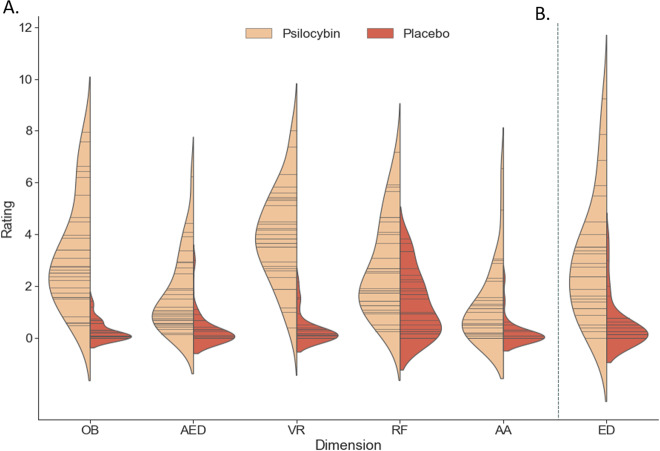
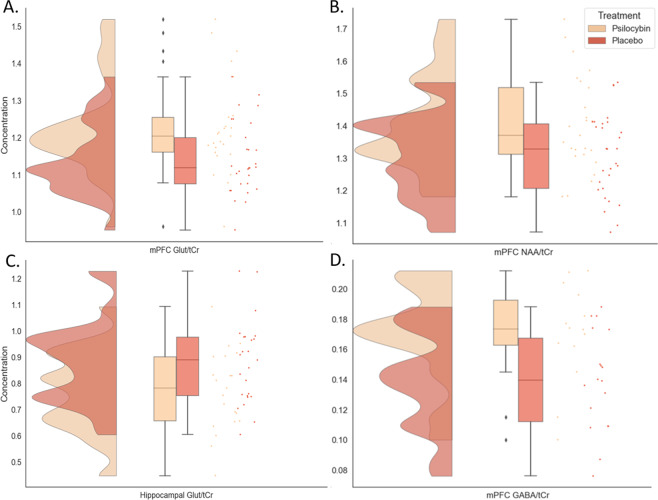
There is growing interest in the therapeutic utility of psychedelic substances, like psilocybin, for disorders characterized by distortions of the self-experience, like depression. Accumulating preclinical evidence emphasizes the role of the glutamate system in the acute action of the drug on brain and behavior; however this has never been tested in humans. Following a double-blind, placebo-controlled, parallel group design, we utilized an ultra-high field multimodal brain imaging approach and demonstrated that psilocybin (0.17 mg/kg) induced region-dependent alterations in glutamate, which predicted distortions in the subjective experience of one’s self (ego dissolution). Whereas higher levels of medial prefrontal cortical glutamate were associated with negatively experienced ego dissolution, lower levels in hippocampal glutamate were associated with positively experienced ego dissolution. Such findings provide further insights into the underlying neurobiological mechanisms of the psychedelic, as well as the baseline, state. Importantly, they may also provide a neurochemical basis for therapeutic effects as witnessed in ongoing clinical trials.
Overview
The claims and statistics of this paper haven’t been checked yet.
Run the check — free, no account needed. It reads the open-access text and checks the sources it cites.
Integrity signals
Registry
Cites
Statistics
Figures
Verification
Claims the paper makes
The claims and statistics of this paper haven’t been checked yet.
Run the check — free, no account needed. It reads the open-access text and checks the sources it cites.
Claims other papers make about this one
Each is checked against this paper’s own text: does it say what the citing paper says it does?
The source backs part of the claim, not all of it — or backs it for a different population, condition or comparison.
In the citing paper
“Consequently, in this state, individuals may more readily engage with their cognitive beliefs and emotional states with enhanced detachment and decentration, potentially leading to therapeutic outcomes [42, 43].”
From Mindfulness meditation and psychedelics: potential synergies and commonalities (2023) · cites this paper as [42]
Experimental — accuracy not yet measuredThe cited source says what the claim attributes to it.
In the citing paper
“The potential of classic psychedelics to alter glutamate in the human cortex, albeit in a region-dependent manner, has been demonstrated (92).”
From Psychedelics and Neuroplasticity: A Systematic Review Unraveling the Biological Underpinnings of Psychedelics. (2021) · cites this paper as [92]
Self-check
Percentages, sums and reported differences re-computed from the paper’s own numbers.
The self-check needs the paper’s full text.
Citations
Cites
A default mode of brain function
Raichle, M. E., MacLeod, A. M., Snyder, A. Z., Powers, W. J., Gusnard, D. A., & Shulman, G. L. (2001) · Proceedings of the National Academy of Sciences · doi:10.1073/pnas.98.2.676 · Cited by 12,190
Correspondence of the brain's functional architecture during activation and rest
Smith, S. M., Fox, P. T., Miller, K. L., Glahn, D. C., Fox, P. M., Mackay, C. E., Filippini, N., Watkins, K. E., Toro, R., Laird, A. R., et al. (2009) · Proceedings of the National Academy of Sciences · doi:10.1073/pnas.0905267106 · Cited by 5,150
Conn : A Functional Connectivity Toolbox for Correlated and Anticorrelated Brain Networks
Whitfield-Gabrieli, S., & Nieto-Castanon, A. (2012) · Brain Connectivity · doi:10.1089/brain.2012.0073 · Cited by 4,885
A method for making group inferences from functional MRI data using independent component analysis
Calhoun, V. D., Adali, T., Pearlson, G. D., & Pekar, J. J. (2001) · Human Brain Mapping · doi:10.1002/hbm.1048 · Cited by 2,994
Griffiths, R. R., Johnson, M. W., Carducci, M. A., Umbricht, A., Richards, W. A., Richards, B. D., Cosimano, M. P., & Klinedinst, M. A. (2016) · Journal of Psychopharmacology · doi:10.1177/0269881116675513 · Cited by 2,201 · cited 2×
“A paradoxical effect of serotonergic psychedelics is that acutely they have been found to increase feelings of anxiety [6, 78], whereas clinical trials with psychedelic drugs suggest long-term anxiety relief in patients [11, 12, 14].”
BackgroundNichols, D. E. (2016) · Pharmacological Reviews · doi:10.1124/pr.115.011478 · Cited by 1,762
Griffiths, R. R., Richards, W. A., McCann, U., & Jesse, R. (2006) · Psychopharmacology · doi:10.1007/s00213-006-0457-5 · Cited by 1,684
Carhart-Harris, R. L., Bolstridge, M., Rucker, J., Day, C. M. J., Erritzoe, D., Kaelen, M., Bloomfield, M., Rickard, J. A., Forbes, B., Feilding, A., et al. (2016) · The Lancet Psychiatry · doi:10.1016/s2215-0366(16)30065-7 · Cited by 1,540
Self-citationBunney, W. E., Hippius, H., Laakmann, G., & Schmauß, M. (1990) · Springer eBooks · doi:10.1007/978-3-642-74034-3 · Cited by 1,523
A Baseline for the Multivariate Comparison of Resting-State Networks
Allen, E. A., Erhardt, E. B., Damaraju, E., Gruner, W. E., Segall, J. M., Silva, R. F., Havlíček, M., Rachakonda, S., Fries, J. F., Kalyanam, R., et al. (2011) · Frontiers in Systems Neuroscience · doi:10.3389/fnsys.2011.00002 · Cited by 1,329
Cited by
Sorted by citations
Towards an understanding of psychedelic-induced neuroplasticity
Calder, A. E., & Hasler, G. (2023) · Neuropsychopharmacology · doi:10.1038/s41386-022-01389-z · Cited by 313
Neuroplasticity as a convergent mechanism of ketamine and classical psychedelics
Aleksandrova, L. R., & Phillips, A. G. (2021) · Trends in Pharmacological Sciences · doi:10.1016/j.tips.2021.08.003 · Cited by 276
Psilocybin desynchronizes the human brain
Siegel, J. S., Subramanian, S., Perry, D., Kay, B. P., Gordon, E. M., Laumann, T. O., Reneau, T. R., Metcalf, N. V., Chacko, R. V., Gratton, C., et al. (2024) · Nature · doi:10.1038/s41586-024-07624-5 · Cited by 308
de Vos, C. M. H., Mason, N. L., & Kuypers, K. P. C. (2021) · Frontiers in Psychiatry · doi:10.3389/fpsyt.2021.724606 · Cited by 269
Self-citationDefault Mode Network Modulation by Psychedelics: A Systematic Review
Gattuso, J. J., Perkins, D., Ruffell, S., Lawrence, A. J., Hoyer, D., Jacobson, L. H., Timmermann, C., Castle, D., Rossell, S. L., Downey, L. A., et al. (2023) · International Journal of Neuropsychopharmacology · doi:10.1093/ijnp/pyac074 · Cited by 256
Metadata
- Authors
- Mason, N. L., Kuypers, K. P. C., Müller, F., Reckweg, J., Tse, D. H. Y., Toennes, S. W., Hutten, N. R. P. W., Jansen, J. F. A., Stiers, P., Feilding, A., & Ramaekers, J. G.
- Affiliations
- Maastricht University (NL)
- University of Basel (CH)
- Goethe University Frankfurt (DE)
- Maastricht University Medical Centre (NL)
- Beckley Foundation (GB)
- Corresponding author
- Mason, N. L.
- Ramaekers, J. G.
- ORCID
- Venue
- Neuropsychopharmacology
- Published
- 2020-05-23
- Volume
- 45
- Issue
- 12
- Pages
- 2003-2011
- ISSN
- 0893-133X (ISSN-L)
- 1740-634X
- PMC
- PMC7547711
- OpenAlex
- W3027590463
- Cited by
- 258
- References
- 102
- Citations by year
- 2026: 36 · 2025: 41 · 2024: 40 · 2023: 62 · 2022: 42 · 2021: 32 · 2020: 5
- FWCI
- 14.08
- Type
- journal article
- Language
- en
- Open access
- hybrid
- doi.org
- Locations
- Neuropsychopharmacology (publishedVersion, cc-by)
- PubMed Central (publishedVersion, cc-by)
- PubMed (publishedVersion)
- Research Publications (Maastricht University) (submittedVersion, cc-by)
- Research Publications (Maastricht University) (submittedVersion, other-oa)
- Funders
- Beckley Foundation
- Topics
- Social Sciences › Psychology › Clinical Psychology › Psychedelics and Drug Studies
- Life Sciences › Neuroscience › Cellular and Molecular Neuroscience › Neurotransmitter Receptor Influence on Behavior
- Social Sciences › Psychology › Social Psychology › Paranormal Experiences and Beliefs
- Keywords
- psilocybin, glutamate, ego dissolution, self-experience, medial prefrontal cortex, hippocampus, subjective experience, psychedelics, depression, ultra-high field MRI
- MeSH terms
- Ego, Hallucinogens, Humans, Psilocybin, Solubility, Glutamic Acid
About these checks
Registry, retraction, Cites and statistics results are computed, not judged, with one exception: a printed reference that no index lists is read once by a model before it counts as a citation error. Claims are extracted by a model and kept only when their quote appears verbatim in the text; each cited source is then checked, with a model’s help, for whether it says what the claim relies on. Those verdicts can be wrong — read the claim’s quote and the cited source before relying on one.
Statistics and arithmetic are recomputed, not judged.
Confidence bands are shown only for fields calibrated on our annotated test set. None is calibrated yet, so no band is shown.
What counts as a claim ›How we measure confidence ›How we check this ›
Are you an author, or do you see a problem with this page? Request a review
