

Neural responses to reward anticipation and feedback in adult and adolescent cannabis users and controls
Open accessThe DOI matches its Crossref record; 64 of the 64 references it cites were found in a registry or an index.
Abstract
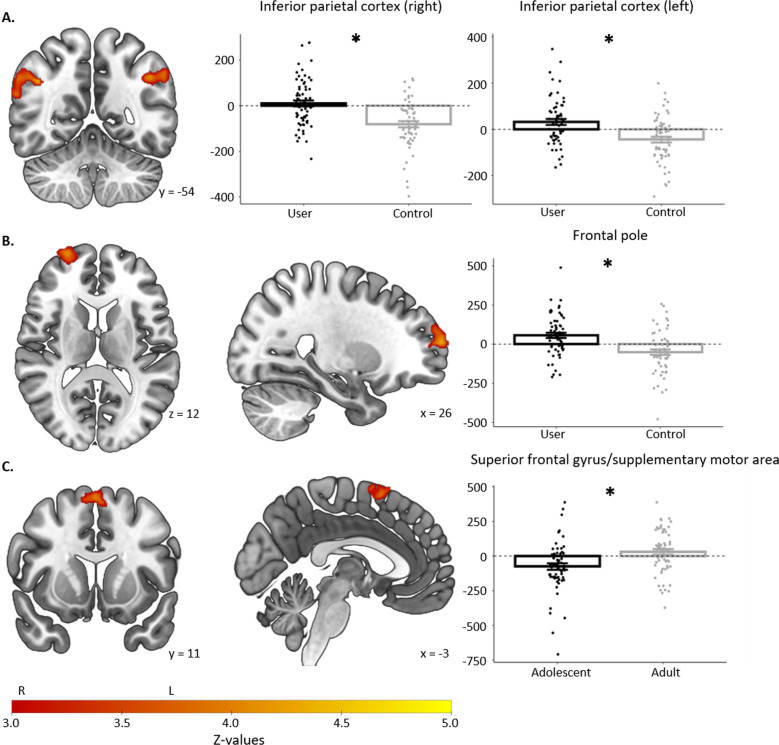
Chronic use of drugs may alter the brain’s reward system, though the extant literature concerning long-term cannabis use and neural correlates of reward processing has shown mixed results. Adolescents may be more vulnerable to the adverse effects of cannabis than adults; however, this has not been investigated for reward processing. As part of the ‘CannTeen’ study, in the largest functional magnetic resonance imaging study of reward processing and cannabis use to date, we investigated reward anticipation and feedback in 125 adult (26–29 years) and adolescent (16–17 years) cannabis users (1–7 days/week cannabis use) and gender- and age-matched controls, using the Monetary Incentive Delay task. Blood-oxygen-level-dependent responses were examined using region of interest (ROI) analyses in the bilateral ventral striatum for reward anticipation and right ventral striatum and left ventromedial prefrontal cortex for feedback, and exploratory whole-brain analyses. Results showed no User-Group or User-Group × Age-Group effects during reward anticipation or feedback in pre-defined ROIs. These null findings were supported by post hoc Bayesian analyses. However, in the whole-brain analysis, cannabis users had greater feedback activity in the prefrontal and inferior parietal cortex compared to controls. In conclusion, cannabis users and controls had similar neural responses during reward anticipation and in hypothesised reward-related regions during reward feedback. The whole-brain analysis revealed tentative evidence of greater fronto-parietal activity in cannabis users during feedback. Adolescents showed no increased vulnerability compared with adults. Overall, reward anticipation and feedback processing appear spared in adolescent and adult cannabis users, but future longitudinal studies are needed to corroborate this.
Overview
The claims and statistics of this paper haven’t been checked yet.
Free: it reads the open-access text and checks the first 5 claims that cite a source we can check. Create a free account to check every claim.
Integrity signals
Registry
Cites
Statistics
Figures
Verification
Claims the paper makes
The claims and statistics of this paper haven’t been checked yet.
Free: it reads the open-access text and checks the first 5 claims that cite a source we can check. Create a free account to check every claim.
Claims other papers make about this one
Each is checked against this paper’s own text: does it say what the citing paper says it does?
The cited source says what the claim attributes to it.
In the citing paper
“Another study found no effect of moderate adolescent cannabis use on ventral striatum activity in a test of reward anticipation [166]”
From Consequences of adolescent drug use (2023) · cites this paper as [166]
Self-check
Percentages, sums and reported differences re-computed from the paper’s own numbers.
The self-check needs the paper’s full text.
Citations
Cites
Advances in functional and structural MR image analysis and implementation as FSL
Smith, S. M., Jenkinson, M., Woolrich, M. W., Beckmann, C. F., Behrens, T. E. J., Johansen-Berg, H., Bannister, P. R., De Luca, M., Drobnjak, I., Flitney, D. E., et al. (2004) · NeuroImage · doi:10.1016/j.neuroimage.2004.07.051 · Cited by 13,630
Desikan, R. S., Ségonne, F., Fischl, B., Quinn, B. T., Dickerson, B. C., Blacker, D., Buckner, R. L., Dale, A. M., Maguire, R. P., Hyman, B. T., et al. (2006) · NeuroImage · doi:10.1016/j.neuroimage.2006.01.021 · Cited by 13,324
Jenkinson, M., Bannister, P., Brady, M., & Smith, S. (2002) · NeuroImage · doi:10.1006/nimg.2002.1132 · Cited by 11,888
Dynamic mapping of human cortical development during childhood through early adulthood
Gogtay, N., Giedd, J. N., Lusk, L., Hayashi, K. M., Greenstein, D., Vaituzis, A. C., Nugent, T. F., Herman, D. H., Clasen, L. S., Toga, A. W., et al. (2004) · Proceedings of the National Academy of Sciences · doi:10.1073/pnas.0402680101 · Cited by 5,604 · cited 1×
“Brain maturation during adolescence coincides temporally with key milestones in cognitive development [4, 10].”
BackgroundBrain development during childhood and adolescence: a longitudinal MRI study
Giedd, J. N., Blumenthal, J., Jeffries, N. O., Castellanos, F. X., Liu, H., Zijdenbos, A., Paus, T., Evans, A. C., & Rapoport, J. L. (1999) · Nature Neuroscience · doi:10.1038/13158 · Cited by 5,552 · cited 1×
“Adolescence is an important period of neurodevelopment, during which neural connections are selectively pruned and strengthened in an experience-driven manner [4, 5].”
BackgroundThe Alzheimer’s disease neuroimaging initiative (ADNI): MRI methods
Jack, C. R., Bernstein, M. A., Fox, N. C., Thompson, P., Alexander, G., Harvey, D., Borowski, B., Britson, P. J., L. Whitwell, J., Ward, C., et al. (2008) · Journal of Magnetic Resonance Imaging · doi:10.1002/jmri.21049 · Cited by 4,347
Casey, B. J., Jones, R. M., & Hare, T. A. (2008) · Annals of the New York Academy of Sciences · doi:10.1196/annals.1440.010 · Cited by 3,345 · cited 1×
“Alternatively, it may be that the striatal reward system has matured by age 16–17 and is therefore not sensitive to disruption at this age [15, 62].”
BackgroundTemporal Autocorrelation in Univariate Linear Modeling of FMRI Data
Woolrich, M. W., Ripley, B. D., Brady, M., & Smith, S. M. (2001) · NeuroImage · doi:10.1006/nimg.2001.0931 · Cited by 2,852 · cited 1×
“Pre-processing and first- and second-level fMRI analyses were performed in FSL [43], with the fMRI Expert Analysis Tool [44, 45].”
MethodGoldstein, R. Z., & Volkow, N. D. (2002) · American Journal of Psychiatry · doi:10.1176/appi.ajp.159.10.1642 · Cited by 2,667 · cited 1×
“Our findings are inconsistent with models suggesting that cannabis dependence is subserved by blunted neural responsiveness to non-cannabis rewards [67, 68].”
ResultMultilevel linear modelling for FMRI group analysis using Bayesian inference
Woolrich, M. W., Behrens, T. E. J., Beckmann, C. F., Jenkinson, M., & Smith, S. M. (2004) · NeuroImage · doi:10.1016/j.neuroimage.2003.12.023 · Cited by 1,728 · cited 1×
“Pre-processing and first- and second-level fMRI analyses were performed in FSL [43], with the fMRI Expert Analysis Tool [44, 45].”
Method
Research works printed but not linked: 1
- Skumlien M, Mokrysz C, Wall MB, Freeman TP, Langley C, Sahakian BJ, et al. Neural response to reward anticipation and feedback in adult and adolescent cannabis users. 2020. https://osf.io/aehc9/. Accessed 22 Sept 2021. PMC9485226 35388175
Cited by
Consequences of adolescent drug use
Steinfeld, M. R., & Torregrossa, M. M. (2023) · Translational Psychiatry · doi:10.1038/s41398-023-02590-4 · Cited by 237
“Another study found no effect of moderate adolescent cannabis use on ventral striatum activity in a test of reward anticipation [166], again indicating the importance of considering dose in analyses of the effects of all drugs.”
BackgroundErtl, N., Freeman, T. P., Mokrysz, C., Ofori, S., Borissova, A., Petrilli, K., Curran, H. V., Lawn, W., & Wall, M. B. (2024) · Neuropsychopharmacology · doi:10.1038/s41386-024-01891-6 · Cited by 27
“…‘ CannTeen ’ study, and cross-sectional analyses, have shown that adolescents may not be as vulnerable as previously feared, and cannabis has similar effects on adolescents and adults in various clinical domains [8], cognitive functions [9], reward processes [10], and brain connectivity [11].”
BackgroundSelf-citationStriatal dopamine D2/D3 receptor regulation of human reward processing and behaviour
Osugo, M., Wall, M. B., Selvaggi, P., Zahid, U., Finelli, V., Chapman, G. E., Whitehurst, T., Onwordi, E. C., Statton, B. K., McCutcheon, R. A., et al. (2025) · Nature Communications · doi:10.1038/s41467-025-56663-7 · Cited by 26
“The 50% win rate used in our study has been extensively used in prior research, and studies using it have been shown to activate similar brain regions to versions of the MID with a 66% win rate 57 – 59 .”
Self-citationErtl, N., Lawn, W., Mokrysz, C., Freeman, T. P., Alnagger, N., Borissova, A., Fernandez‐Vinson, N., Lees, R., Ofori, S., Petrilli, K., et al. (2023) · Journal of Psychopharmacology · doi:10.1177/02698811231189441 · Cited by 24
Self-citationMultiband acquisition sequences for fMRI: Proceed with caution
Wall, M. B. (2023) · Aperture Neuro · doi:10.52294/001c.91292 · Cited by 24
Self-citationSkumlien, M., Mokrysz, C., Freeman, T. P., Valton, V., Wall, M. B., Bloomfield, M., Lees, R., Borissova, A., Petrilli, K., Giugliano, M., et al. (2023) · International Journal of Neuropsychopharmacology · doi:10.1093/ijnp/pyac056 · Cited by 20
“This could be because cannabis does not chronically compromise the reward system (Skumlien et al., 2022), perhaps because the reward system has matured enough by age 16 to not be sensitive to disruption (Casey et al., 2008).”
InfluentialSelf-citationColyer‐Patel, K., Romein, C., Kuhns, L., Cousijn, J., & Kroon, E. (2024) · Current Addiction Reports · doi:10.1007/s40429-024-00557-z · Cited by 20
Brain reward function in people who use cannabis: a systematic review
Beyer, E., Poudel, G. R., Antonopoulos, S., Thomson, H. M., & Lorenzetti, V. (2024) · Frontiers in Behavioral Neuroscience · doi:10.3389/fnbeh.2023.1323609 · Cited by 15
Skumlien, M., Freeman, T. P., Hall, D., Mokrysz, C., Wall, M. B., Ofori, S., Petrilli, K., Trinci, K., Borissova, A., Fernandez‐Vinson, N., et al. (2022) · Biological Psychiatry Cognitive Neuroscience and Neuroimaging · doi:10.1016/j.bpsc.2022.10.004 · Cited by 15
Self-citationParsons, C. E., Purves, K. L., Skelton, M., Peel, A. J., Davies, M. R., Rijsdijk, F. V., Bristow, S., Eley, T. C., Breen, G. D., Hirsch, C. R., et al. (2022) · Psychological Medicine · doi:10.1017/s0033291722003828 · Cited by 12
“…pleasure or interest in activities, is theorised as a transdiagnostic factor for psychopathology (Guineau et al., 2022), and potentially impacted by the opportunity to engage in rewarding activities (Skumlien et al., 2022) but has received little attention in the COVID-19 mental health literature.”
BackgroundMacedo, I., Paiva, T. O., Pasion, R., Daedelow, L. S., Heinz, A., Magalhães, A., Banaschewski, T., Bokde, A. L. W., Desrivières, S., Flor, H., et al. (2024) · Psychopharmacology · doi:10.1007/s00213-024-06575-z · Cited by 10
“…van Hell et al. 2010) and decreased (Nestor et al. 2010; van Hell et al. 2010; Yip et al. 2014) activity in PFC, limbic, and sensorimotor regions are reported, as well as non-significant results (Filbey and Yezhuvath 2013; Jager et al. 2013; Skumlien et al. 2022; Tong et al. 2020; Yip et al. 2014).”
BackgroundResultInfluentialShatalina, E., Ashok, A. H., Wall, M. B., Nour, M. M., Myers, J., Marques, T. R., Rabiner, E. A., & Howes, O. D. (2023) · NeuroImage Clinical · doi:10.1016/j.nicl.2023.103481 · Cited by 10
“In total there were 24 win trials and 48 neutral trials, the 2:1 ratio of win:neutral trials ensured win trials were perceived as more rewarding by participants and more money (£1) could be paid out per trial (Skumlien et al., 2023; Skumlien et al., 2022).”
Self-citationIs Cannabis Use Associated with Motivation? A Review of Recent Acute and Non-Acute Studies
Skumlien, M., Langley, C., & Sahakian, B. J. (2023) · Current Behavioral Neuroscience Reports · doi:10.1007/s40473-023-00268-1 · Cited by 10
Self-citationUnlocking the age-old secrets of reward and substance use
Liu, C., & Filbey, F. M. (2024) · Pharmacology Biochemistry and Behavior · doi:10.1016/j.pbb.2024.173766 · Cited by 8
Nosko, L., Crocker, C. E., & Tibbo, P. G. (2025) · Frontiers in Psychiatry · doi:10.3389/fpsyt.2025.1644105 · Cited by 6
Brassard, S. L., Dosanjh, J., Cooper, J. A., Weber, J., Zald, D. H., MacKillop, J., & Balodis, I. M. (2025) · Cognitive Affective & Behavioral Neuroscience · doi:10.3758/s13415-025-01308-x · Cited by 4
“Importantly, cannabis acts on many of these same regions (Cheer et al., 2000, 2003, 2004; Chen et al., 1991; French, 1997; French et al., 1997; Gessa et al., 1998; Luijten et al., 2017; Raymond et al., 2020; Skumlien et al., 2022; Vaidya et al., 2012; Wu & French, 2000).”
Lawn, W., Hao, X., Konova, A. B., Haney, M., Cooper, Z. D., Dam, N. T. V., Glimcher, P. W., & Bedi, G. (2025) · Psychopharmacology · doi:10.1007/s00213-025-06746-6 · Cited by 4
“Frequent recent cannabis use could, via downregulation of the CB1 receptor (D’Souza et al. 2016), alter neural reward processing, as has been shown in some (Skumlien et al. 2021), but not all (Skumlien et al. 2022), studies of people who regularly use cannabis.”
Self-citationMultisystem regulation of reward and addiction: beyond the dopaminergic system
Arias-Carrión, Ó., Ortega‐Robles, E., Treviño, M., Guerra‐Crespo, M., Manjarrez, E., & Pöppel, E. (2026) · Frontiers in Pharmacology · doi:10.3389/fphar.2026.1840096 · Cited by 3
“…revealing altered ventral striatal responses during reward anticipation, compensatory recruitment of prefrontal regions during decision-making, and disrupted functional connectivity among PFC, insula, and midbrain regions in chronic cannabis users (Zimmermann et al., 2019; Skumlien et al., 2022).”
Skumlien, M., Wang, S., Freeman, T. P., Eddison, M., Petrilli, K., Wall, M. B., Mokrysz, C., Curran, H. V., & Lawn, W. (2026) · Neuropsychopharmacology · doi:10.1038/s41386-026-02377-3 · Cited by 1
“We have previously published cross-sectional baseline results on the MID task from the CannTeen study [21].”
Self-citationPaige, K. J., Angstadt, M., Martz, M. E., Hyde, L. W., Heitzeg, M. M., Sripada, C., & Kardan, O. (2026) · Biological Psychiatry Cognitive Neuroscience and Neuroimaging · doi:10.1016/j.bpsc.2026.03.012 · Cited by 1
Skumlien, M., Greenwood, L., Arun, A. H., Goodwin, I., Paloubis, A., Rana, T. T., Quinones‐Valera, M., McTavish, E., Abbott, G., Dunsford, S., et al. (2026) · Addiction · doi:10.1111/add.70492 · Cited by 1
Self-citationCognitive Stimulants: from Caffeine to Cannabinoids - Current and Future Perspectives
Pandolfo, P., Speck, A. E., da Cunha-Rodrigues, M. C., & Moreira-Silva, D. (2025) · Frontiers research topics · doi:10.3389/978-2-8325-5972-7 · Cited by 1
Effects of Cannabis Use on Neurocognition: A Scoping Review of MRI Studies
Audi, D., Hajeer, S., Saab, M., Saab, L., Harati, H., Desoutter, A., Ahmar, E. A., & Estephan, E. (2024) · Journal of Psychoactive Drugs · doi:10.1080/02791072.2024.2372377
“…<.05) increased BOLD response activity in areas including the left caudate and the bilateral inferior frontal gyrus, ventral striatum (VS) (Enzi et al. 2015; Nestor, Hester, and Garavan 2010; Yip et al. 2014), prefrontal and inferior parietal cortices among cannabis users (Skumlien et al. 2022).”
Brassard, S. L. (2024) · MacSphere (McMaster University) · doi:10.71548/11989
Sullivan, R. M., Wallace, A. L., Tomas, C. W., Wirtz, H. G., Larson, C. L., & Lisdahl, K. M. (2026) · Frontiers in Adolescent Medicine · doi:10.3389/fradm.2026.1737529
“Functional responding in these reward regions are typically assessed through the Monetary Incentive Delay (MID) task (26, 27, 43), with pronounced striatal hypoactivation seen when anticipating reward (44–46) and striatal hyperactivation during reward appraisal (45, 46) [see, Luijten et al. (30)…”
Beyer, E., Skumlien, M., Poudel, G., Arun, A. H., McTavish, E., Thomson, H. M., Sehl, H., Segrave, R. A., Clemente, A., Labuschagne, I., et al. (2026) · Scientific Reports · doi:10.1038/s41598-026-50870-y
“This aligns with several previous studies 24–27, 47 , At the behaviour level, we also found no differences in RTs when responding to monetary cues, but faster RTs towards neutral cues, suggesting that at a behavioural level, there might have been a blunting of anticipation of rewards; and a…”
Self-citationMurphy, E., Suo, C., Poudel, G., Thomson, H. M., & Lorenzetti, V. (2026) · Substance Abuse and Rehabilitation · doi:10.2147/sar.s584766 · Cited by 1
“56 For example, a group of cannabis users (n = 11; M age = 22) administered 10 mg of inhaled THC vs placebo, demonstrated reduced frontal-striatal activity when receiving monetary rewards.”
Cannabis use and neurocognitive functioning in adolescents
(2026) · Frontiers research topics · doi:10.3389/978-2-8325-8161-2
Lombardi, G., Blest‐Hopley, G., Tarantini, M. M., O’Neill, A., Wilson, R. P., O’Daly, O., Giampietro, V., & Bhattacharyya, S. (2026) · Psychopharmacology · doi:10.1007/s00213-026-07183-9
Metadata
- Authors
- Skumlien, M., Mokrysz, C., Freeman, T. P., Wall, M. B., Bloomfield, M., Lees, R., Borissova, A., Petrilli, K., Carson, J., Coughlan, T., Ofori, S., Langley, C., Sahakian, B. J., Curran, H. V., & Lawn, W.
- Affiliations
- University of Cambridge (GB)
- University College London (GB)
- Invicro (United Kingdom) (GB)
- King's College London (GB)
- Corresponding author
- Skumlien, Martine
- ORCID
- Venue
- Neuropsychopharmacology
- Published
- 2022-04-06
- Volume
- 47
- Issue
- 11
- Pages
- 1976-1983
- ISSN
- 0893-133X (ISSN-L)
- 1740-634X
- PMC
- PMC9485226
- OpenAlex
- W4225768599
- Semantic Scholar
- 0213aea178811b6ca12775fdef650ab037c1375e
- Cited by
- 27
- References
- 64
- Citations by year
- 2026: 7 · 2025: 4 · 2024: 6 · 2023: 6 · 2022: 4
- FWCI
- 2.99
- Type
- journal article
- Language
- en
- Open access
- hybrid
- doi.org
- Licence
- cc-by
- creativecommons.org/licenses/by/4.0 (tdm)
- creativecommons.org/licenses/by/4.0 (vor)
- Locations
- Neuropsychopharmacology (publishedVersion, cc-by)
- PubMed Central (publishedVersion, cc-by)
- PubMed (publishedVersion)
- UCL Discovery (University College London) (submittedVersion)
- Research Portal (King's College London) (submittedVersion, cc-by)
- Apollo (University of Cambridge) (submittedVersion, cc-by)
- Apollo (cc-by)
- Apollo
- Funders
- Aker Foundation
- RCUK | Medical Research Council (MR/P012728/1)
- DH | National Institute for Health Research (N/A)
- Wellcome Trust (200181/Z//15/Z)
- Wallitt Foundation, Eton College
- Topics
- Health Sciences › Medicine › Pharmacology (medical) › Cannabis and Cannabinoid Research
- Life Sciences › Neuroscience › Cellular and Molecular Neuroscience › Neurotransmitter Receptor Influence on Behavior
- Life Sciences › Neuroscience › Cognitive Neuroscience › Neural and Behavioral Psychology Studies
- Keywords
- cannabis use, reward processing, reward anticipation, reward feedback, ventral striatum, ventromedial prefrontal cortex, monetary incentive delay task, adolescents, adults, inferior parietal cortex, brain reward system
- MeSH terms
- Adolescent, Adult, Bayes Theorem, Cannabis, Feedback, Humans, Magnetic Resonance Imaging, Motivation, Oxygen, Reward, Anticipation, Psychological
About these checks
Registry, retraction, Cites and statistics results are computed, not judged, with one exception: a printed reference that no index lists is read once by a model before it counts as a citation error. Claims are extracted by a model and kept only when their quote appears verbatim in the text; each cited source is then checked, with a model’s help, for whether it says what the claim relies on. Those verdicts can be wrong — read the claim’s quote and the cited source before relying on one.
Statistics and arithmetic are recomputed, not judged.
Confidence bands are shown only for fields calibrated on our annotated test set. None is calibrated yet, so no band is shown.
What counts as a claim ›How we measure confidence ›How we check this ›
Are you an author, or do you see a problem with this page? Request a review
Data sources
Bibliographic data: Semantic Scholar, OpenAlex, Crossref.
Contains information from the Semantic Scholar Academic Graph Datasets, made available under the ODC Attribution License (ODC-BY 1.0).
Semantic Scholar’s data is described in: Kinney, R., et al. (2023). The Semantic Scholar Open Data Platform. arXiv:2301.10140.
