

Neural responses to reward anticipation and feedback in adult and adolescent cannabis users and controls
Open accessThe DOI matches its Crossref record; 64 of the 64 references it cites were found in a registry or an index.
Abstract
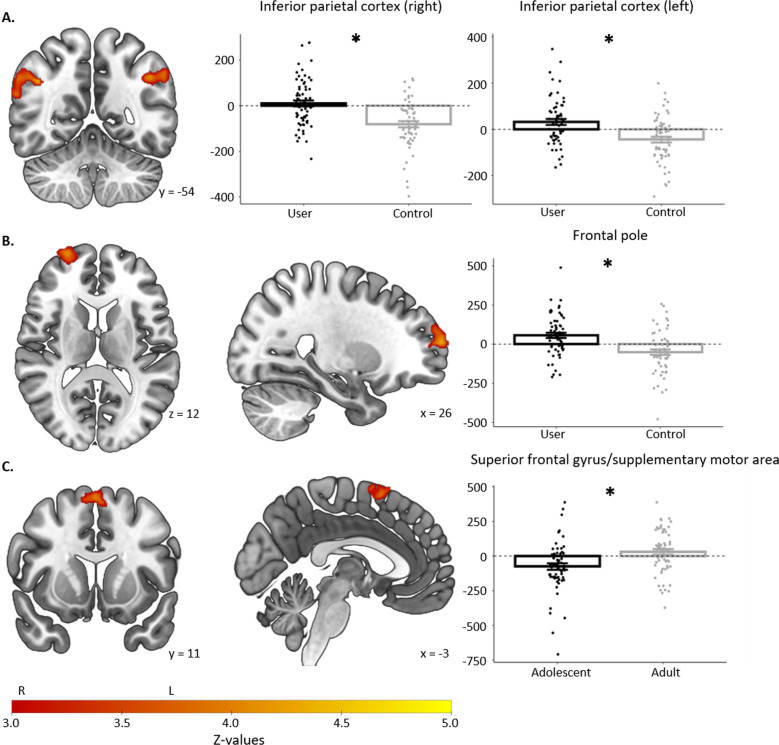
Chronic use of drugs may alter the brain’s reward system, though the extant literature concerning long-term cannabis use and neural correlates of reward processing has shown mixed results. Adolescents may be more vulnerable to the adverse effects of cannabis than adults; however, this has not been investigated for reward processing. As part of the ‘CannTeen’ study, in the largest functional magnetic resonance imaging study of reward processing and cannabis use to date, we investigated reward anticipation and feedback in 125 adult (26–29 years) and adolescent (16–17 years) cannabis users (1–7 days/week cannabis use) and gender- and age-matched controls, using the Monetary Incentive Delay task. Blood-oxygen-level-dependent responses were examined using region of interest (ROI) analyses in the bilateral ventral striatum for reward anticipation and right ventral striatum and left ventromedial prefrontal cortex for feedback, and exploratory whole-brain analyses. Results showed no User-Group or User-Group × Age-Group effects during reward anticipation or feedback in pre-defined ROIs. These null findings were supported by post hoc Bayesian analyses. However, in the whole-brain analysis, cannabis users had greater feedback activity in the prefrontal and inferior parietal cortex compared to controls. In conclusion, cannabis users and controls had similar neural responses during reward anticipation and in hypothesised reward-related regions during reward feedback. The whole-brain analysis revealed tentative evidence of greater fronto-parietal activity in cannabis users during feedback. Adolescents showed no increased vulnerability compared with adults. Overall, reward anticipation and feedback processing appear spared in adolescent and adult cannabis users, but future longitudinal studies are needed to corroborate this.
Overview
The claims and statistics of this paper haven’t been checked yet.
Free: it reads the open-access text and checks the first 5 claims that cite a source we can check. Create a free account to check every claim.
Integrity signals
Registry
Cites
Statistics
Figures
Verification
Claims the paper makes
The claims and statistics of this paper haven’t been checked yet.
Free: it reads the open-access text and checks the first 5 claims that cite a source we can check. Create a free account to check every claim.
Claims other papers make about this one
Each is checked against this paper’s own text: does it say what the citing paper says it does?
The cited source says what the claim attributes to it.
In the citing paper
“Another study found no effect of moderate adolescent cannabis use on ventral striatum activity in a test of reward anticipation [166]”
From Consequences of adolescent drug use (2023) · cites this paper as [166]
Self-check
Percentages, sums and reported differences re-computed from the paper’s own numbers.
The self-check needs the paper’s full text.
Citations
Cites
Advances in functional and structural MR image analysis and implementation as FSL
Smith, S. M., Jenkinson, M., Woolrich, M. W., Beckmann, C. F., Behrens, T. E. J., Johansen-Berg, H., Bannister, P. R., De Luca, M., Drobnjak, I., Flitney, D. E., et al. (2004) · NeuroImage · doi:10.1016/j.neuroimage.2004.07.051 · Cited by 13,630
Desikan, R. S., Ségonne, F., Fischl, B., Quinn, B. T., Dickerson, B. C., Blacker, D., Buckner, R. L., Dale, A. M., Maguire, R. P., Hyman, B. T., et al. (2006) · NeuroImage · doi:10.1016/j.neuroimage.2006.01.021 · Cited by 13,324
Jenkinson, M., Bannister, P., Brady, M., & Smith, S. (2002) · NeuroImage · doi:10.1006/nimg.2002.1132 · Cited by 11,888
Dynamic mapping of human cortical development during childhood through early adulthood
Gogtay, N., Giedd, J. N., Lusk, L., Hayashi, K. M., Greenstein, D., Vaituzis, A. C., Nugent, T. F., Herman, D. H., Clasen, L. S., Toga, A. W., et al. (2004) · Proceedings of the National Academy of Sciences · doi:10.1073/pnas.0402680101 · Cited by 5,604 · cited 1×
“Brain maturation during adolescence coincides temporally with key milestones in cognitive development [4, 10].”
BackgroundBrain development during childhood and adolescence: a longitudinal MRI study
Giedd, J. N., Blumenthal, J., Jeffries, N. O., Castellanos, F. X., Liu, H., Zijdenbos, A., Paus, T., Evans, A. C., & Rapoport, J. L. (1999) · Nature Neuroscience · doi:10.1038/13158 · Cited by 5,552 · cited 1×
“Adolescence is an important period of neurodevelopment, during which neural connections are selectively pruned and strengthened in an experience-driven manner [4, 5].”
BackgroundThe Alzheimer’s disease neuroimaging initiative (ADNI): MRI methods
Jack, C. R., Bernstein, M. A., Fox, N. C., Thompson, P., Alexander, G., Harvey, D., Borowski, B., Britson, P. J., L. Whitwell, J., Ward, C., et al. (2008) · Journal of Magnetic Resonance Imaging · doi:10.1002/jmri.21049 · Cited by 4,347
Casey, B. J., Jones, R. M., & Hare, T. A. (2008) · Annals of the New York Academy of Sciences · doi:10.1196/annals.1440.010 · Cited by 3,345 · cited 1×
“Alternatively, it may be that the striatal reward system has matured by age 16–17 and is therefore not sensitive to disruption at this age [15, 62].”
BackgroundTemporal Autocorrelation in Univariate Linear Modeling of FMRI Data
Woolrich, M. W., Ripley, B. D., Brady, M., & Smith, S. M. (2001) · NeuroImage · doi:10.1006/nimg.2001.0931 · Cited by 2,852 · cited 1×
“Pre-processing and first- and second-level fMRI analyses were performed in FSL [43], with the fMRI Expert Analysis Tool [44, 45].”
MethodGoldstein, R. Z., & Volkow, N. D. (2002) · American Journal of Psychiatry · doi:10.1176/appi.ajp.159.10.1642 · Cited by 2,667 · cited 1×
“Our findings are inconsistent with models suggesting that cannabis dependence is subserved by blunted neural responsiveness to non-cannabis rewards [67, 68].”
ResultMultilevel linear modelling for FMRI group analysis using Bayesian inference
Woolrich, M. W., Behrens, T. E. J., Beckmann, C. F., Jenkinson, M., & Smith, S. M. (2004) · NeuroImage · doi:10.1016/j.neuroimage.2003.12.023 · Cited by 1,728 · cited 1×
“Pre-processing and first- and second-level fMRI analyses were performed in FSL [43], with the fMRI Expert Analysis Tool [44, 45].”
MethodStructural magnetic resonance imaging of the adolescent brain
GIEDD, J. N. (2004) · Annals of the New York Academy of Sciences · doi:10.1196/annals.1308.009 · Cited by 1,610 · cited 2×
“Adolescence is an important period of neurodevelopment, during which neural connections are selectively pruned and strengthened in an experience-driven manner [4, 5].”
BackgroundIn vivo evidence for post-adolescent brain maturation in frontal and striatal regions
Sowell, E. R., Thompson, P. M., Holmes, C. J., Jernigan, T. L., & Toga, A. W. (1999) · Nature Neuroscience · doi:10.1038/13154 · Cited by 1,439 · cited 1×
“Anatomical differences between adult and adolescent samples are pronounced in frontal and striatal regions, which are important to reward and motivation [11].”
BackgroundFMRI visualization of brain activity during a monetary incentive delay task
Knutson, B., Westdorp, A., Kaiser, E., & Hommer, D. (2000) · NeuroImage · doi:10.1006/nimg.2000.0593 · Cited by 1,414 · cited 1×
“Reward processing was assessed with the Monetary Incentive Delay (MID) task which includes a reward anticipation phase and a reward outcome/feedback phase [33].”
MethodBayesFactor: Computation of Bayes Factors for Common Designs
Morey, R. D., & Rouder, J. N. (2012) · CRAN: Contributed Packages · doi:10.32614/cran.package.bayesfactor · Cited by 1,173
Cannabis use and mental health in young people: cohort study.
Patton, G. C., Coffey, C., Carlin, J. B., Degenhardt, L., Lynskey, M., & Hall, W. (2002) · BMJ · doi:10.1136/bmj.325.7374.1195 · Cited by 997
Wagenmakers, E.-J., Wetzels, R., Borsboom, D., & van der Maas, H. L. J. (2011) · Journal of Personality and Social Psychology · doi:10.1037/a0022790 · Cited by 977
Blum, K., Braverman, E. R., Holder, J. M., Lubar, J. F., Monastra, V. J., Miller, D., Lubar, J. O., Chen, T. J. H., & Comings, D. E. (2000) · Journal of Psychoactive Drugs · doi:10.1080/02791072.2000.10736099 · Cited by 973
Lee, S. S., Humphreys, K. L., Flory, K., Liu, R., & Glass, K. (2011) · Clinical Psychology Review · doi:10.1016/j.cpr.2011.01.006 · Cited by 875 · cited 1×
“The present differences in fronto-parietal activity may also reflect pre-existing vulnerabilities in cannabis users relative to controls, such as attentional disparities [60, 61].”
BackgroundFrazier, J. A., Chiu, S., Breeze, J. L., Makris, N., Lange, N., Kennedy, D. N., Herbert, M. R., Bent, E. K., Koneru, V. K., Dieterich, M. E., et al. (2005) · American Journal of Psychiatry · doi:10.1176/appi.ajp.162.7.1256 · Cited by 790
Decreased volume of left and total anterior insular lobule in schizophrenia
Makris, N., Goldstein, J. M., Kennedy, D., Hodge, S. M., Caviness, V. S., Faraone, S. V., Tsuang, M. T., & Seidman, L. J. (2006) · Schizophrenia Research · doi:10.1016/j.schres.2005.11.020 · Cited by 752
Reliability of the Timeline Followback for cocaine, cannabis, and cigarette use
Robinson, S. M., Sobell, L. C., Sobell, M. B., & Leo, G. I. (2014) · Psychology of Addictive Behaviors · doi:10.1037/a0030992 · Cited by 699 · cited 1×
“Drug use was assessed with the timeline followback [38].”
MethodAnticipatory affect: neural correlates and consequences for choice
Knutson, B., & Greer, S. M. (2008) · Philosophical Transactions of the Royal Society B: Biological Sciences · doi:10.1098/rstb.2008.0155 · Cited by 687 · cited 1×
“Anticipation of monetary reward has been linked with increased activity in the ventral striatum, thalamus, anterior insula, premotor cortex, and medial prefrontal cortex, and monetary reward outcome/feedback with the ventral striatum, orbitofrontal/ventromedial prefrontal cortex (vmPFC), amygdala, and posterior cingul…”
BackgroundThe co‐occurring use and misuse of cannabis and tobacco: a review
Agrawal, A., Budney, A. J., & Lynskey, M. T. (2012) · Addiction · doi:10.1111/j.1360-0443.2012.03837.x · Cited by 525 · cited 1×
“Co-use of cannabis and cigarettes is common, and many users consume cannabis together with tobacco in joints [36, 54].”
BackgroundAdolescent development of the reward system
Galvan (2010) · Frontiers in Human Neuroscience · doi:10.3389/neuro.09.006.2010 · Cited by 521
Cannabis use and other illicit drug use: testing the cannabis gateway hypothesis
Fergusson, D. M., Boden, J. M., & Horwood, L. J. (2006) · Addiction · doi:10.1111/j.1360-0443.2005.01322.x · Cited by 484
Oldham, S., Murawski, C., Fornito, A., Youssef, G., Yücel, M., & Lorenzetti, V. (2018) · Human Brain Mapping · doi:10.1002/hbm.24184 · Cited by 425
Luijten, M., Schellekens, A. F., Kühn, S., Machielse, M. W. J., & Sescousse, G. (2017) · JAMA Psychiatry · doi:10.1001/jamapsychiatry.2016.3084 · Cited by 402
Limbic-Striatal Memory Systems and Drug Addiction
Robbins, T. (2002) · Neurobiology of Learning and Memory · doi:10.1006/nlme.2002.4103 · Cited by 380 · cited 1×
“The ventral striatum is of particular interest due to its theoretical involvement in addiction [18], and”
BackgroundCannabis and adolescent brain development.
Lubman, D. I., Cheetham, A., & Yücel, M. (2015) · Pharmacology & Therapeutics · doi:10.1016/j.pharmthera.2014.11.009 · Cited by 360
Leung, J., Chan, G. C. K., Hides, L., & Hall, W. D. (2020) · Addictive Behaviors · doi:10.1016/j.addbeh.2020.106479 · Cited by 358
Bossong, M. G., & Niesink, R. J. M. (2010) · Progress in Neurobiology · doi:10.1016/j.pneurobio.2010.06.010 · Cited by 333
Puberty as a highly vulnerable developmental period for the consequences of cannabis exposure
Schneider, M. (2008) · Addiction Biology · doi:10.1111/j.1369-1600.2008.00110.x · Cited by 316
Silverman, M. H., Jedd, K., & Luciana, M. (2015) · NeuroImage · doi:10.1016/j.neuroimage.2015.07.083 · Cited by 277
Marijuana Dependence and Its Treatment
Budney, A., Roffman, R., Stephens, R., & Walker, D. (2007) · Addiction Science & Clinical Practice · doi:10.1151/ascp07414 · Cited by 275 · cited 1×
“This is not to say that treatment should ignore natural rewards, as contingency management and behavioural activation may have efficacy in the treatment of cannabis use disorder [69, 70].”
Anticipatory reward processing in addicted populations: a focus on the monetary incentive delay task
Balodis, I. M., & Potenza, M. N. (2015) · Biological Psychiatry · doi:10.1016/j.biopsych.2014.08.020 · Cited by 267 · cited 2×
“It is possible that previous differences between cannabis users and controls were confounded by concurrent use of tobacco/ nicotine [20].”
BackgroundChen, C.-Y., O’Brien, M. S., & Anthony, J. C. (2005) · Drug and Alcohol Dependence · doi:10.1016/j.drugalcdep.2004.11.014 · Cited by 260
The neuropsychopharmacology of cannabis: A review of human imaging studies
Bloomfield, M. A. P., Hindocha, C., Green, S. F., Wall, M. B., Lees, R., Petrilli, K., Costello, H., Ogunbiyi, M. O., Bossong, M. G., & Freeman, T. P. (2019) · Pharmacology & Therapeutics · doi:10.1016/j.pharmthera.2018.10.006 · Cited by 230 · cited 1×
“Several previous studies have found increased fronto-parietal activation in cannabis users during cognitive tasks [56], especially in adolescent users [57].”
BackgroundSelf-citationCarroll, K. M., Easton, C. J., Nich, C., Hunkele, K. A., Neavins, T. M., Sinha, R., Ford, H. L., Vitolo, S. A., Doebrick, C. A., & Rounsaville, B. J. (2006) · Journal of Consulting and Clinical Psychology · doi:10.1037/0022-006x.74.5.955 · Cited by 214 · cited 1×
“This is not to say that treatment should ignore natural rewards, as contingency management and behavioural activation may have efficacy in the treatment of cannabis use disorder [69, 70].”
BackgroundIncreased ventral striatal BOLD activity during non-drug reward anticipation in cannabis users
Nestor, L., Hester, R., & Garavan, H. (2010) · NeuroImage · doi:10.1016/j.neuroimage.2009.07.022 · Cited by 186
Richards, J. M., Plate, R. C., & Ernst, M. (2013) · Neuroscience & Biobehavioral Reviews · doi:10.1016/j.neubiorev.2013.03.004 · Cited by 174 · cited 1×
“Alternatively, it may be that the striatal reward system has matured by age 16–17 and is therefore not sensitive to disruption at this age [15, 62].”
BackgroundChronic effects of cannabis use on the human reward system: An fMRI study
van Hell, H. H., Vink, M., Ossewaarde, L., Jager, G., Kahn, R. S., & Ramsey, N. F. (2010) · European Neuropsychopharmacology · doi:10.1016/j.euroneuro.2009.11.010 · Cited by 174
Functional Connectivity in Brain Networks Underlying Cognitive Control in Chronic Cannabis Users
Harding, I. H., Solowij, N., Harrison, B. J., Takagi, M., Lorenzetti, V., Lubman, D. I., Seal, M. L., Pantelis, C., & Yücel, M. (2012) · Neuropsychopharmacology · doi:10.1038/npp.2012.39 · Cited by 128
Demetriou, L., Kowalczyk, O. S., Tyson, G., Bello, T., Newbould, R. D., & Wall, M. B. (2018) · NeuroImage · doi:10.1016/j.neuroimage.2018.05.011 · Cited by 125
Self-citationViveros, M., Llorente, R., Suarez, J., Llorente-Berzal, A., López-Gallardo, M., & Rodriguez de Fonseca, F. (2012) · Journal of Psychopharmacology · doi:10.1177/0269881111408956 · Cited by 124 · cited 1×
“The endocannabinoid system, the primary neurobiological target of cannabis, is thought to play a central role in this development, and is itself an important target of neuromaturation during adolescence [6].”
BackgroundLutz, K., & Widmer, M. (2014) · Neuroscience and Neuroeconomics · doi:10.2147/nan.s38864 · Cited by 113 · cited 1×
“The MID is the most commonly used task for assessing neural reward processing in humans [16, 34], and among cannabis users [28].”
BackgroundCao, Z., Bennett, M., Orr, C., Icke, I., Banaschewski, T., Barker, G. J., Bokde, A. L. W., Bromberg, U., Büchel, C., Quinlan, E. B., et al. (2019) · Human Brain Mapping · doi:10.1002/hbm.24370 · Cited by 104 · cited 1×
“Studies comparing neural reward processing in adults and adolescents suggest that while adolescents recruit a fronto-striatal network largely overlapping with that of adults [12], they may also show hyperactivity in limbic and striatal reward systems [13–15].”
BackgroundAssociation of Marijuana Use With Blunted Nucleus Accumbens Response to Reward Anticipation
Martz, M. E., Trucco, E. M., Cope, L. M., Hardee, J. E., Jester, J. M., Zucker, R. A., & Heitzeg, M. M. (2016) · JAMA Psychiatry · doi:10.1001/jamapsychiatry.2016.1161 · Cited by 102 · cited 2×
“[27], greater cannabis use predicted attenuated nucleus accumbens (NAc) responses during reward anticipation, while controlling for other substance use and family history of substance use disorder.”
BackgroundEhlers, C. L., Gizer, I. R., Vieten, C., Gilder, D. A., Stouffer, G. M., Lau, P., & Wilhelmsen, K. C. (2010) · Addictive Behaviors · doi:10.1016/j.addbeh.2009.09.009 · Cited by 100
Effects of Cannabis on Impulsivity: A Systematic Review of Neuroimaging Findings
Wrege, J., Schmidt, A., Walter, A., Smieskova, R., Bendfeldt, K., Radue, E.-W., Lang, U., & Borgwardt, S. (2014) · Current Pharmaceutical Design · doi:10.2174/13816128113199990428 · Cited by 95 · cited 1×
“This has been proposed to reflect a neural compensatory mechanism in cannabis users, such that greater activation helps to achieve normal levels of behavioural performance [58, 59].”
BackgroundfMRI study of neural sensitization to hedonic stimuli in long‐term, daily cannabis users
Filbey, F. M., Dunlop, J., Ketcherside, A., Baine, J., Rhinehardt, T., Kuhn, B., DeWitt, S., & Alvi, T. (2016) · Human Brain Mapping · doi:10.1002/hbm.23250 · Cited by 86
Impact of ADHD and cannabis use on executive functioning in young adults
Tamm, L., Epstein, J. N., Lisdahl, K. M., Molina, B., Tapert, S., Hinshaw, S. P., Arnold, L. E., Velanova, K., Abikoff, H., & Swanson, J. M. (2013) · Drug and Alcohol Dependence · doi:10.1016/j.drugalcdep.2013.08.001 · Cited by 73 · cited 1×
“The present differences in fronto-parietal activity may also reflect pre-existing vulnerabilities in cannabis users relative to controls, such as attentional disparities [60, 61].”
BackgroundJager, G., Block, R. I., Luijten, M., & Ramsey, N. F. (2013) · Journal of Psychoactive Drugs · doi:10.1080/02791072.2013.785837 · Cited by 66 · cited 1×
“Striatal hypoactivity has not typically been found in cross-sectional functional magnetic resonance imaging (fMRI) studies of cannabis users, either among adults [21–24], or adolescents [25, 26].”
BackgroundJansma, J. M., van Hell, H. H., Vanderschuren, L. J. M. J., Bossong, M. G., Jager, G., Kahn, R. S., & Ramsey, N. F. (2013) · Translational Psychiatry · doi:10.1038/tp.2013.6 · Cited by 58 · cited 1×
“The effects of acute cannabis on striatal reward processing have also been shown to differ depending on comorbid nicotine dependence [55].”
BackgroundKaroly, H. C., Bryan, A. D., Weiland, B. J., Mayer, A., Dodd, A., & Feldstein Ewing, S. W. (2015) · Developmental Cognitive Neuroscience · doi:10.1016/j.dcn.2015.05.005 · Cited by 58
Yip, S. W., DeVito, E. E., Kober, H., Worhunsky, P. D., Carroll, K. M., & Potenza, M. N. (2014) · Drug and Alcohol Dependence · doi:10.1016/j.drugalcdep.2014.03.031 · Cited by 58
Neural Effects of Positive and Negative Incentives during Marijuana Withdrawal
Filbey, F. M., Dunlop, J., & Myers, U. S. (2013) · PLoS ONE · doi:10.1371/journal.pone.0061470 · Cited by 56
Lichenstein, S. D., Musselman, S., Shaw, D. S., Sitnick, S., & Forbes, E. E. (2017) · Addiction · doi:10.1111/add.13882 · Cited by 43 · cited 1×
“The present sample had a lower frequency of cannabis use compared to some previous fMRI studies of reward processing in cannabis users [24, 29], though similar to others [23, 52, 53].”
ResultThe acute and non-acute effects of cannabis on reward processing: A systematic review
Skumlien, M., Langley, C., Lawn, W., Voon, V., Curran, H. V., Roiser, J. P., & Sahakian, B. J. (2021) · Neuroscience & Biobehavioral Reviews · doi:10.1016/j.neubiorev.2021.09.008 · Cited by 42 · cited 4×
“The MID is the most commonly used task for assessing neural reward processing in humans [16, 34], and among cannabis users [28].”
BackgroundInfluentialSelf-citationAlterations of Monetary Reward and Punishment Processing in Chronic Cannabis Users: An fMRI Study
Enzi, B., Lissek, S., Edel, M.-A., Tegenthoff, M., Nicolas, V., Scherbaum, N., Juckel, G., & Roser, P. (2015) · PLOS ONE · doi:10.1371/journal.pone.0119150 · Cited by 36 · cited 1×
“Some studies have shown an association between cannabis use and increased prefrontal and dorsal striatal activity during feedback [21, 29, 30], though this has not been consistently found [28].”
BackgroundCannabis Use in Adolescence: A Review of Neuroimaging Findings
Chye, Y., Christensen, E., & Yücel, M. (2020) · Journal of Dual Diagnosis · doi:10.1080/15504263.2019.1636171 · Cited by 34 · cited 1×
“Several previous studies have found increased fronto-parietal activation in cannabis users during cognitive tasks [56], especially in adolescent users [57].”
BackgroundAcheson, A., Ray, K. L., Hines, C. S., Li, K., Dawes, M. A., Mathias, C. W., Dougherty, D. M., & Laird, A. R. (2015) · Journal of Addiction · doi:10.1155/2015/783106 · Cited by 23
Do young-adult cannabis users show amotivation? An analysis of informant reports.
Meier, M. H., & White, M. (2018) · Translational Issues in Psychological Science · doi:10.1037/tps0000150 · Cited by 19 · cited 1×
“The present sample had a lower frequency of cannabis use compared to some previous fMRI studies of reward processing in cannabis users [24, 29], though similar to others [23, 52, 53].”
ResultMillar, S., Mongan, D., O’Dwyer, C., Long, J., Smyth, B. P., Perry, I. J., & Galvin, B. (2021) · European Journal of Public Health · doi:10.1093/eurpub/ckab007 · Cited by 19 · cited 1×
“Co-use of cannabis and cigarettes is common, and many users consume cannabis together with tobacco in joints [36, 54].”
BackgroundSkumlien, M., Langley, C., Lawn, W., Voon, V., & Sahakian, B. J. (2021) · The International Journal of Neuropsychopharmacology · doi:10.1093/ijnp/pyab033 · Cited by 16
Self-citation
Research works printed but not linked: 1
- Skumlien M, Mokrysz C, Wall MB, Freeman TP, Langley C, Sahakian BJ, et al. Neural response to reward anticipation and feedback in adult and adolescent cannabis users. 2020. https://osf.io/aehc9/. Accessed 22 Sept 2021. PMC9485226 35388175
Cited by
Consequences of adolescent drug use
Steinfeld, M. R., & Torregrossa, M. M. (2023) · Translational Psychiatry · doi:10.1038/s41398-023-02590-4 · Cited by 237
“Another study found no effect of moderate adolescent cannabis use on ventral striatum activity in a test of reward anticipation [166], again indicating the importance of considering dose in analyses of the effects of all drugs.”
BackgroundErtl, N., Freeman, T. P., Mokrysz, C., Ofori, S., Borissova, A., Petrilli, K., Curran, H. V., Lawn, W., & Wall, M. B. (2024) · Neuropsychopharmacology · doi:10.1038/s41386-024-01891-6 · Cited by 27
“…‘ CannTeen ’ study, and cross-sectional analyses, have shown that adolescents may not be as vulnerable as previously feared, and cannabis has similar effects on adolescents and adults in various clinical domains [8], cognitive functions [9], reward processes [10], and brain connectivity [11].”
BackgroundSelf-citationStriatal dopamine D2/D3 receptor regulation of human reward processing and behaviour
Osugo, M., Wall, M. B., Selvaggi, P., Zahid, U., Finelli, V., Chapman, G. E., Whitehurst, T., Onwordi, E. C., Statton, B. K., McCutcheon, R. A., et al. (2025) · Nature Communications · doi:10.1038/s41467-025-56663-7 · Cited by 26
“The 50% win rate used in our study has been extensively used in prior research, and studies using it have been shown to activate similar brain regions to versions of the MID with a 66% win rate 57 – 59 .”
Self-citationErtl, N., Lawn, W., Mokrysz, C., Freeman, T. P., Alnagger, N., Borissova, A., Fernandez‐Vinson, N., Lees, R., Ofori, S., Petrilli, K., et al. (2023) · Journal of Psychopharmacology · doi:10.1177/02698811231189441 · Cited by 24
Self-citationMultiband acquisition sequences for fMRI: Proceed with caution
Wall, M. B. (2023) · Aperture Neuro · doi:10.52294/001c.91292 · Cited by 24
Self-citation
Metadata
- Authors
- Skumlien, M., Mokrysz, C., Freeman, T. P., Wall, M. B., Bloomfield, M., Lees, R., Borissova, A., Petrilli, K., Carson, J., Coughlan, T., Ofori, S., Langley, C., Sahakian, B. J., Curran, H. V., & Lawn, W.
- Affiliations
- University of Cambridge (GB)
- University College London (GB)
- Invicro (United Kingdom) (GB)
- King's College London (GB)
- Corresponding author
- Skumlien, Martine
- ORCID
- Venue
- Neuropsychopharmacology
- Published
- 2022-04-06
- Volume
- 47
- Issue
- 11
- Pages
- 1976-1983
- ISSN
- 0893-133X (ISSN-L)
- 1740-634X
- PMC
- PMC9485226
- OpenAlex
- W4225768599
- Semantic Scholar
- 0213aea178811b6ca12775fdef650ab037c1375e
- Cited by
- 27
- References
- 64
- Citations by year
- 2026: 7 · 2025: 4 · 2024: 6 · 2023: 6 · 2022: 4
- FWCI
- 2.99
- Type
- journal article
- Language
- en
- Open access
- hybrid
- doi.org
- Licence
- cc-by
- creativecommons.org/licenses/by/4.0 (tdm)
- creativecommons.org/licenses/by/4.0 (vor)
- Locations
- Neuropsychopharmacology (publishedVersion, cc-by)
- PubMed Central (publishedVersion, cc-by)
- PubMed (publishedVersion)
- UCL Discovery (University College London) (submittedVersion)
- Research Portal (King's College London) (submittedVersion, cc-by)
- Apollo (University of Cambridge) (submittedVersion, cc-by)
- Apollo (cc-by)
- Apollo
- Funders
- Aker Foundation
- RCUK | Medical Research Council (MR/P012728/1)
- DH | National Institute for Health Research (N/A)
- Wellcome Trust (200181/Z//15/Z)
- Wallitt Foundation, Eton College
- Topics
- Health Sciences › Medicine › Pharmacology (medical) › Cannabis and Cannabinoid Research
- Life Sciences › Neuroscience › Cellular and Molecular Neuroscience › Neurotransmitter Receptor Influence on Behavior
- Life Sciences › Neuroscience › Cognitive Neuroscience › Neural and Behavioral Psychology Studies
- Keywords
- cannabis use, reward processing, reward anticipation, reward feedback, ventral striatum, ventromedial prefrontal cortex, monetary incentive delay task, adolescents, adults, inferior parietal cortex, brain reward system
- MeSH terms
- Adolescent, Adult, Bayes Theorem, Cannabis, Feedback, Humans, Magnetic Resonance Imaging, Motivation, Oxygen, Reward, Anticipation, Psychological
About these checks
Registry, retraction, Cites and statistics results are computed, not judged, with one exception: a printed reference that no index lists is read once by a model before it counts as a citation error. Claims are extracted by a model and kept only when their quote appears verbatim in the text; each cited source is then checked, with a model’s help, for whether it says what the claim relies on. Those verdicts can be wrong — read the claim’s quote and the cited source before relying on one.
Statistics and arithmetic are recomputed, not judged.
Confidence bands are shown only for fields calibrated on our annotated test set. None is calibrated yet, so no band is shown.
What counts as a claim ›How we measure confidence ›How we check this ›
Are you an author, or do you see a problem with this page? Request a review
Data sources
Bibliographic data: Semantic Scholar, OpenAlex, Crossref.
Contains information from the Semantic Scholar Academic Graph Datasets, made available under the ODC Attribution License (ODC-BY 1.0).
Semantic Scholar’s data is described in: Kinney, R., et al. (2023). The Semantic Scholar Open Data Platform. arXiv:2301.10140.
