

Synaptic changes in psychiatric and neurological disorders: state-of-the art of in vivo imaging
Open accessThe DOI matches its Crossref record; 160 of the 161 references it cites were found in a registry or an index.
Abstract
Synapses are implicated in many neuropsychiatric illnesses. Here, we provide an overview of in vivo techniques to index synaptic markers in patients. Several positron emission tomography (PET) tracers for synaptic vesicle glycoprotein 2 A (SV2A) show good reliability and selectivity. We review over 50 clinical studies including over 1700 participants, and compare findings in healthy ageing and across disorders, including addiction, schizophrenia, depression, posttraumatic stress disorder, and neurodegenerative disorders, including tauopathies, Huntington’s disease and α-synucleinopathies. These show lower SV2A measures in cortical brain regions across most of these disorders relative to healthy volunteers, with the most well-replicated findings in tauopathies, whilst changes in Huntington’s chorea, Parkinson’s disease, corticobasal degeneration and progressive supranuclear palsy are predominantly subcortical. SV2A PET measures are correlated with functional connectivity across brain networks, and a number of other measures of brain function, including glucose metabolism. However, the majority of studies found no relationship between grey matter volume measured with magnetic resonance imaging and SV2A PET measures. Cognitive dysfunction, in domains including working memory and executive function, show replicated inverse relationships with SV2A measures across diagnoses, and initial findings also suggest transdiagnostic relationships with mood and anxiety symptoms. This suggests that synaptic abnormalities could be a common pathophysiological substrate underlying cognitive and, potentially, affective symptoms. We consider limitations of evidence and future directions; highlighting the need to develop postsynaptic imaging markers and for longitudinal studies to test causal mechanisms.
Overview
The claims and statistics of this paper haven’t been checked yet.
Free: it reads the open-access text and checks the first 5 claims that cite a source we can check. Create a free account to check every claim.
Integrity signals
Registry
Cites
Statistics
Figures
Verification
Claims the paper makes
The claims and statistics of this paper haven’t been checked yet.
Free: it reads the open-access text and checks the first 5 claims that cite a source we can check. Create a free account to check every claim.
Claims other papers make about this one
Each is checked against this paper’s own text: does it say what the citing paper says it does?
The source backs part of the claim, not all of it — or backs it for a different population, condition or comparison.
In the citing paper
“Depression cohorts show lower binding with evidence that pharmacologic challenges can probe synaptogenesis in vivo [212].”
From Synaptic Plasticity—Intrinsic Excitability and Antidepressant Discovery (2026) · cites this paper as [212]
Experimental — accuracy not yet measuredThe source backs part of the claim, not all of it — or backs it for a different population, condition or comparison.
In the citing paper
“Across disorders, SV2A PET consistently reveals synaptic loss [210,211,212].”
From Synaptic Plasticity—Intrinsic Excitability and Antidepressant Discovery (2026) · cites this paper as [212]
Experimental — accuracy not yet measured
Self-check
Percentages, sums and reported differences re-computed from the paper’s own numbers.
The self-check needs the paper’s full text.
Citations
Cites
NODDI: Practical in vivo neurite orientation dispersion and density imaging of the human brain
Zhang, H., Schneider, T., Wheeler-Kingshott, C. A., & Alexander, D. C. (2012) · NeuroImage · doi:10.1016/j.neuroimage.2012.03.072 · Cited by 3,288 · cited 1×
“Neurite orientation dispersion and density imaging (NODDI) can provide measures of both the density and angular variation of neurites, with the signal dependent on factors such as dendritic arborisation [107].”
BackgroundThe Neural Basis of Addiction: A Pathology of Motivation and Choice
Kalivas, P. W., & Volkow, N. D. (2005) · American Journal of Psychiatry · doi:10.1176/appi.ajp.162.8.1403 · Cited by 2,757 · cited 1×
“While a general pathophysiology underlying different addictions has been proposed [73], evidence from these three studies does not suggest there is a common pattern of synaptic terminal loss in speci fi c brain regions based on the limited literature to date.”
BackgroundSynaptic Plasticity: Multiple Forms, Functions, and Mechanisms
Citri, A., & Malenka, R. C. (2008) · Neuropsychopharmacology · doi:10.1038/sj.npp.1301559 · Cited by 2,323 · cited 1×
“The binding of neurotransmitter can produce diverse effects, including excitation, inhibition and induction of synaptic plasticity [12].”
BackgroundSynapse Loss and Microglial Activation Precede Tangles in a P301S Tauopathy Mouse Model
Yoshiyama, Y., Higuchi, M., Zhang, B., Huang, S.-M., Iwata, N., Saido, T. C., Maeda, J., Suhara, T., Trojanowski, J. Q., & Lee, V. M.-Y. (2007) · Neuron · doi:10.1016/j.neuron.2007.01.010 · Cited by 2,208 · cited 1×
“These studies are therefore consistent with the theory suggesting that tau accumulation precedes and underlies synaptic pathology in tauopathies [112 – 115].”
ResultSimplified Reference Tissue Model for PET Receptor Studies
Lammertsma, A. A., & Hume, S. P. (1996) · NeuroImage · doi:10.1006/nimg.1996.0066 · Cited by 2,021 · cited 1×
“…major advantages of BP ND include its versatility, as it can be calculated both using an AIF from V T estimates, providing an outcome measure equalling DVR-1 [7], or using a simpli fi ed reference tissue model (SRTM) which is used to estimate the input function from the reference without ABS [161].”
MethodConsensus Nomenclature for in vivo Imaging of Reversibly Binding Radioligands
Innis, R. B., Cunningham, V. J., Delforge, J., Fujita, M., Gjedde, A., Gunn, R. N., Holden, J., Houle, S., Huang, S.-C., Ichise, M., et al. (2007) · Journal of Cerebral Blood Flow & Metabolism · doi:10.1038/sj.jcbfm.9600493 · Cited by 1,955 · cited 2×
“BP ND : BP ND is calculated using the ratio of speci fi c to nondisplaceable volume of distribution [21].”
BackgroundMethodSynaptic Energy Use and Supply
Harris, J. J., Jolivet, R., & Attwell, D. (2012) · Neuron · doi:10.1016/j.neuron.2012.08.019 · Cited by 1,747 · cited 2×
“However, it is important to note FDG changes could also re fl ect degeneration of the axons, glia and cell bodies, which make up the remaining half of brain ATP use [117].”
BackgroundChemical Nature of Synaptic Transmission in Vertebrates
Krnjević, K. (1974) · Physiological Reviews · doi:10.1152/physrev.1974.54.2.418 · Cited by 1,610 · cited 10×
“The two studies in patients with chronic illness, using V T [55] and BP ND , derived from V T estimates [58] respectively, both showed lower [ 11 C]UCB-J uptake in the cortex and hippocampus, with similar effect sizes.”
BackgroundMethodResultInfluentialThe synaptic vesicle protein SV2A is the binding site for the antiepileptic drug levetiracetam
Lynch, B. A., Lambeng, N., Nocka, K., Kensel-Hammes, P., Bajjalieh, S. M., Matagne, A., & Fuks, B. (2004) · Proceedings of the National Academy of Sciences · doi:10.1073/pnas.0308208101 · Cited by 1,610 · cited 2×
“One of the fi rst produced was [ 11 C]LEV, based on the SV2A modulator levetiracetam [22].”
BackgroundSynaptotagmin: a Calcium Sensor on the Synaptic Vesicle Surface
Brose, N., Petrenko, A. G., Südhof, T. C., & Jahn, R. (1992) · Science · doi:10.1126/science.1589771 · Cited by 979 · cited 1×
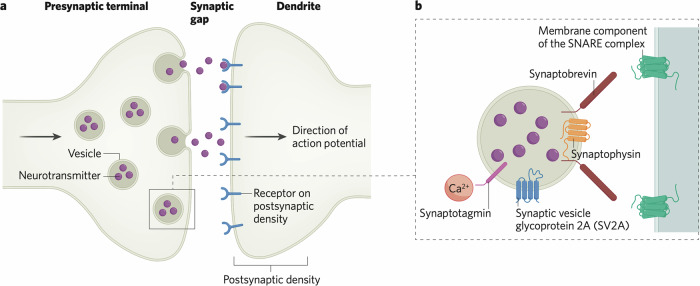
“…[14], responding to calcium in fl ux into the presynaptic terminal to initiate exocytosis, mediated by synaptotagmin, a calcium sensor [15], and for fusing with the synaptic terminal membrane, mediated by the soluble N -ethylamide-sensitive factor attachment protein receptor (SNARE)…”
Background
Research works printed but not linked: 4
- 23. Cai H, Mangner T, Muzik O, Chugani H. Radiosynthesis and preliminary eva- luation of 11C-levetiracetam for PET imaging of SV2A expression. Soc Nuclear Med. 2014; 55:1795.
- 30. Cai Z, Drake L, Naganawa M, Najafzadeh S, Pracitto R, Lindemann M. et al. First- in-human study of [18F] SynVesT-2, a novel SV2A radioligand with fast kinetics and high specific binding signals. Soc Nuclear Med. 2020;61:462 · DOI · Paper page
- 56. Onwordi EC, Whitehurst T, Shatalina E, Mansur A, Arumuham A, Osugo M, et al. Synaptic Terminal Density Early in the Course of Schizophrenia: an in vivo UCB-J Positron Emission Tomographic Imaging Study of Synaptic Vesicle Glycoprotein 2A (SV2A). Biol Psychiatry 2023;S0006-3223:01353-7.
- 146. Reichert JS. SV2A-just a synaptic vesicle protein? Unravelling the interaction of SV2A and mitochondria in the pathogenesis and therapy of Morbus Alzheimer. Dissertation, Mainz, Johannes Gutenberg-Universität Mainz, 2022;2022.
Cited by
Genetic Analysis of Retinal Cell Types in Neuropsychiatric Disorders
Boudriot, E., Stephan, M., Rabe, F., Smigielski, L., Schmitt, A., Falkai, P., Ziller, M. J., Rossner, M. J., Homan, P., Papiol, S., et al. (2025) · JAMA Psychiatry · doi:10.1001/jamapsychiatry.2024.4230 · Cited by 22
Bhujbal, S. P., & Hah, J. (2025) · Archives of Pharmacal Research · doi:10.1007/s12272-025-01566-w · Cited by 18
“By comparison, the main limitations of PROTACs in the CNS stem from challenges in brain penetration and dependence on neuronal E3 ligase biology, rather than on-target engagement itself (Bálint et al. 2024).”
InfluentialCopper-mediated radiochemistry: historical impact, current trends, and future possibilities
Bowden, G. D., Müller, M., Herth, M. M., Sanford, M. S., & Scott, P. J. H. (2025) · npj Imaging · doi:10.1038/s44303-025-00087-x · Cited by 18
Vano, L. J., McCutcheon, R. A., Sedlacik, J., Rutigliano, G., Kaar, S. J., Finelli, V., Lobo, M. C., Berry, A., Statton, B. K., Fazlollahi, A., et al. (2025) · Molecular Psychiatry · doi:10.1038/s41380-025-03195-7 · Cited by 17
“Eligible participants were aged 18 – 45 years, with the upper limit chosen to focus on individuals early in the illness course, given potential progressive brain changes in schizophrenia [29].”
Self-citationGupta, R., Jha, N. K., Kumar, N., Nagraik, R., & Ravi, K. (2026) · Frontiers in Cell and Developmental Biology · doi:10.3389/fcell.2026.1762930 · Cited by 16
“Genome-wide association studies (GWAS) have identified numerous susceptibility loci across disorders including SCZ, bipolar disorder, MDD, and ASD.”
InfluentialZhang, X., Hatoum, L., Ying, J., & Huang, C. (2025) · Psychoradiology · doi:10.1093/psyrad/kkaf031 · Cited by 15
“Historically, psychiatric disorders have been viewed primarily through neurotransmitter (Teleanu et al. , 2022 ) and synaptic dysfunction (Howes et al. , 2025 ).”
The retina across the psychiatric spectrum: a systematic review and meta-analysisPreprint
Kallen, N., Cecere, G., Palpella, D., Rabe, F., Georgiadis, F., Badstübner, P., Edkins, V., Trindade, M., Homan, S., Omlor, W., et al. (2024) · medRxiv · doi:10.1101/2024.11.07.24316925 · Cited by 6
“It is also possible that synaptic loss, rather than changes in neuronal or glial numbers might underlie these structural alterations [ 128-132 ].”
Redefining dopaminergic synapses beyond the classical paradigm
Fujise, K., Mishra, J., Karmali, N., & Rafiq, N. M. (2025) · Trends in Neurosciences · doi:10.1016/j.tins.2025.09.011 · Cited by 5
Das, T., Das, S., Das, S. R. C., Ghose, S., Das, A., Chowdhury, S., Chakraborty, P., Kar, K., & Sharma, N. (2025) · NeuroMarkers. · doi:10.1016/j.neumar.2025.100131 · Cited by 5
Network-centric perspectives on neurodegeneration: Mechanisms, biomarkers, and therapeutic pathways
Gupta, R. V. (2026) · Brain Network Disorders · doi:10.1016/j.bnd.2025.12.004 · Cited by 4
Fesharaki‐Zadeh, A., Çayır, S., Ibrahim, W., Yang, Y., Gallezot, J., Naganawa, M., Wu, Y., Toyonaga, T., Sadabad, F. E., O’Dell, R. S., et al. (2026) · Alzheimer s & Dementia · doi:10.1002/alz.71283 · Cited by 4
A Dynamic Spike Sorter for Multiscale Nanoelectrode Array Recordings
Shukla, S., Walsh, C., Bansal, S., Leugering, J., Uppal, A., Jaltare, V., Cauwenberghs, G., Chalasani, S. H., & Jahed, Z. (2025) · Advanced Materials Interfaces · doi:10.1002/admi.202500158 · Cited by 2
Synaptic density in the hippocampus of depressed patients: A quantitative electron microscopic study
Sebők-Tornai, A., Csabai, D., Szocsics, P., Gombás, P., Cobb, J. A., Mahajan, G., Stockmeier, C. A., & Czéh, B. (2026) · Progress in Neuro-Psychopharmacology and Biological Psychiatry · doi:10.1016/j.pnpbp.2026.111661 · Cited by 2
“This radioligand labels the synaptic vesicle glycoprotein 2 A (SV2A) and allows the in vivo imaging of nerve terminals, and by that it provides an indirect estimate of synaptic densities (Finnema et al., 2016; Howes et al., 2024).”
Higher level of [3H]UCB-J binding in ApoE Ɛ4 allele carriers with Alzheimer disease
Mikkelsen, J. D., Linde-Atkins, P., & Pazarlar, B. A. (2025) · Neuroscience Letters · doi:10.1016/j.neulet.2025.138135 · Cited by 2
Simone, G. D., Prisco, M. D., Oliva, V., Vellucci, L., Ciccarelli, M., Mazza, B., Fico, G., Fornaro, M., Iasevoli, F., Vieta, E., et al. (2025) · Molecular Psychiatry · doi:10.1038/s41380-025-03351-z · Cited by 2
“…fi cally, reduced levels of synaptic proteins, as measured by positron emission tomography (PET) detection of synaptic vesicle glycoprotein 2 A (SV2A), have been correlated to cognitive dysfunction, especially in working memory and executive function, as well as, to mood and anxiety symptoms [112].”
Synaptic editing of frontostriatal circuitry prevents excessive grooming in SAPAP3-deficient micePreprint
Walder-Christensen, K. K., Soliman, H. A., Calakos, N., & Dzirasa, K. (2025) · bioRxiv (Cold Spring Harbor Laboratory) · doi:10.1101/2025.03.27.645613 · Cited by 2
Corvo, C., Goutal, S., Mendez-David, I., Leterrier, S., Caille, F., Saba, W., Colle, R., Corruble, E., Lebon, V., Bottlaender, M., et al. (2026) · Molecular Psychiatry · doi:10.1038/s41380-025-03369-3 · Cited by 1
Nakano, Y., Tanaka, K. F., & Abe, Y. (2025) · Anatomical Science International · doi:10.1007/s12565-025-00862-1 · Cited by 1
“Screening approaches which focus on structural changes are better suited to identify target regions that reflect long-term, fixed alterations, such as those characteristic of psychiatric disorder pathology (Haroutu-nian et al. 2014; Howes et al. 2024; Segal et al. 2023).”
Onwordi, E. C., Whitehurst, T., Shatalina, E., Mansur, A., Arumuham, A., Osugo, M., Marques, T. R., Jauhar, S., Mehrotra, R., Ranger, M., et al. (2026) · Neuropsychopharmacology · doi:10.1038/s41386-026-02349-7 · Cited by 1
“One potential explanation for lower SV2A levels in schizophrenia is that these are due to a neurodevelopmental mechanism predating the fi rst psychotic episode, re fl ected in lower premorbid IQ [82].”
Self-citationFuxjäger, I. S., Antons, M. J., Marouane, E., Leschiutta, G., Oos, R., Palumbo, G., Steenken, D., Lindner, S., Ziegler, S., Bartenstein, P., et al. (2026) · NeuroImage · doi:10.1016/j.neuroimage.2026.121821 · Cited by 1
Argibay, U., Sancho‐Alonso, M., Yanes-Castilla, C., Jericó-Escolar, J., Paz, V., Ruiz‐Bronchal, E., Miquel-Rio, L., & Bortolozzi, A. A. (2026) · Biomedicines · doi:10.3390/biomedicines14061394 · Cited by 1
“Positron emission tomography (PET) using ligands for the synaptic vesicle glycoprotein 2A (SV2A), such as 11 C-UCB-J, has enabled the first in vivo quantification of synaptic density in clinical populations [123,124].”
Miles, N., McNamee, B., Soleman, S. I., Zadikoff, C., Boiser, J. C., Laplanche, L., Burton, R., Shebley, M., & Boinpally, R. (2026) · European Journal of Clinical Pharmacology · doi:10.1007/s00228-026-04078-8 · Cited by 1
Bambico, F. R., Nicoglou, A., Relente, J., Surget, A., & Belzung, C. (2026) · Molecular Psychiatry · doi:10.1038/s41380-026-03872-1 · Cited by 1
Synaptic Plasticity—Intrinsic Excitability and Antidepressant Discovery
Tanaka, M. (2026) · Biomedicines · doi:10.3390/biomedicines14061265
Developmental expression of risk genes implicates the age of onset for neuropsychiatric disordersPreprint
Xue, C., Yu, X., Ye, L., Luo, Y., Zhang, L., Tang, B., Gui, H., Jiang, L., & Li, M. (2025) · bioRxiv (Cold Spring Harbor Laboratory) · doi:10.1101/2025.08.27.672343
PET/MR in Pediatric Nonmalignant Nervous Disorders
Zou, Y. Q., Wang, H., & Tian, R. (2026) · PET Clinics · doi:10.1016/j.cpet.2025.12.002
Sleep Deprivation and Microglia-Dependent Synaptic Remodeling in Psychiatric Disorders
Liu, Y., Sun, Y., Wang, Y., Yu, H., & Huang, L. (2026) · Discovery Medicine · doi:10.24976/discov.med.202638207.82
Everix, L., Miranda, A., Akkermans, J., Khetarpal, V. K., Liu, L., Bard, J., Staelens, S. G., & Bertoglio, D. (2026) · Journal of Cerebral Blood Flow & Metabolism · doi:10.1177/0271678x261435323
“2,33 For example, the CSO is not entirely devoid of specific binding, potentially leading to underestimation of the BP ND .”
How Synaptic Plasticity Shapes Mental Health: The Role of Core Body Temperature
Grenno, G., Piarulli, A., Alfì, G., Caruso, V., Aquino, G., Lencioni, R. A., Palagini, L., & Gemignani, A. (2026) · Current Sleep Medicine Reports · doi:10.1007/s40675-026-00380-0
“In parallel, synaptic plasticity represents a core mechanism underlying learning, memory, and adaptive brain function, and its dysregulation is widely implicated in the pathophysiology of psychiatric disorders [7–9].”
Dixit, N., & Roy, S. (2026) · Scientific Reports · doi:10.1038/s41598-026-50423-3
“Efficient synaptic communication is fundamental to normal brain physiology, as it enables accurate information transfer and coordinated neural network activity 11 .”
Alvarez, J., Kurup, P., Kholsaat, L., Kanuru, S., Paredes, E., Gor, H. T., Bernardo, A. J., Tulegenova, B., Khoury, K. S., Herrera, M., et al. (2026) · eNeuro · doi:10.1523/eneuro.0016-26.2026
Basuli, F., Shi, J., Zhang, X., & Swenson, R. E. (2026) · Molecules · doi:10.3390/molecules31132396
Ma, J., Braun, A., Oskamp, A., Kricsfalussy-Hrabár, L., Hermes, N., Djakkani, S., Holz, U., Jakobs, S., Klein, S., Stüsgen, S., et al. (2026) · iScience · doi:10.1016/j.isci.2026.116676
Infectious vs. Sterile Neuroinflammation: Differential Consequences on Neuronal CircuitryPreprint
Talero-López, D. (2026) · Qeios · doi:10.32388/1h63qt.3
Alqahtani, S. M. (2026) · Discovery Medicine · doi:10.24976/discov.med.202638212.212
Patient-derived stem cell models of brain endothelial-neuron interactions in early course psychosis
Altunsu, D., Demirlek, C., Nicholson, J., Stiltner, B., Trotti, R. L., Raymond, N., Lee, Y., Rahman, R., Stone, W. S., Karmacharya, R., et al. (2026) · Frontiers in Psychiatry · doi:10.3389/fpsyt.2026.1873300
“Psychosis has traditionally been conceptualized as a disorder of synaptic function with converging genetic, postmortem and imaging evidence implicating alterations in glutamatergic signaling, dendritic spine density and cortical circuit organization (7 – 9).”
Synaptic density imaging associates with performance but not self-report in autismPreprint
Naples, A. J., Çayır, S., Cukar-Capizzi, C., Wolf, J. M., Mcclelland, J. E., Robertson, E. C., Sawant, S. S., Matuskey, D., & McPartland, J. C. (2026) · bioRxiv (Cold Spring Harbor Laboratory) · doi:10.64898/2026.10.05.755105
Xue, C., Yu, X., Ye, L., Luo, Y., Zhang, L., Tang, B., Gui, H., Jiang, L., & Li, M. (2026) · Research Square · doi:10.21203/rs.3.rs-10676073/v1
Interpreting Lower Synaptic Vesicle Glycoprotein 2A Availability in Bipolar Disorder
Frangou, S. (2026) · Biological Psychiatry · doi:10.1016/j.biopsych.2026.07.018
Wan, B., Du, P., Ferrari, A., Saberi, A., John, A., Yan, J., Liu, X., Hansen, J. Y., Liu, Z.-Q., Hong, S., et al. (2026) · bioRxiv (Cold Spring Harbor Laboratory) · doi:10.64898/2026.10.27.758642
Metadata
- Authors
- Howes, O., Marcinkowska, J., Turkheimer, F. E., & Carr, R.
- Affiliations
- King's College London (GB)
- Corresponding author
- Howes, Oliver
- Venue
- Neuropsychopharmacology
- Published
- 2024-08-12
- Volume
- 50
- Issue
- 1
- Pages
- 164-183
- ISSN
- 0893-133X (ISSN-L)
- 1740-634X
- PMC
- PMC11525650
- OpenAlex
- W4401527108
- Cited by
- 34
- References
- 161
- Citations by year
- 2026: 19 · 2025: 14 · 2024: 1
- FWCI
- 2.13
- Type
- journal article
- Language
- en
- Update notices
- correction (2025-03-19)
- Open access
- hybrid
- doi.org
- Licence
- cc-by
- creativecommons.org/licenses/by/4.0 (tdm)
- creativecommons.org/licenses/by/4.0 (vor)
- Locations
- Neuropsychopharmacology (publishedVersion, cc-by)
- PubMed Central (publishedVersion, cc-by)
- PubMed (publishedVersion)
- Research Portal (King's College London) (publishedVersion, cc-by)
- Funders
- RCUK | Medical Research Council (MC_U120097115, MR/W005557/1, MR/V013734/1)
- Wellcome Trust (094849/Z/10/Z)
- Topics
- Life Sciences › Neuroscience › Cellular and Molecular Neuroscience › Neuroscience and Neuropharmacology Research
- Health Sciences › Medicine › Radiology, Nuclear Medicine and Imaging › Medical Imaging Techniques and Applications
- Health Sciences › Medicine › Psychiatry and Mental health › Dementia and Cognitive Impairment Research
- Keywords
- synaptic markers, SV2A, mental illness, neurological disorders, tauopathy, Huntington's disease, synucleinopathies, Parkinson's disease, corticobasal degeneration, progressive supranuclear palsy, schizophrenia, depression, post-traumatic stress disorder, addiction, functional connectivity, glucose metabolism, cognitive impairment, transdiagnostic mechanisms, healthy aging
- MeSH terms
- Animals, Mental Disorders, Brain, Humans, Nervous System Diseases, Synapses, Positron-Emission Tomography, Neuroimaging
About these checks
Registry, retraction, Cites and statistics results are computed, not judged, with one exception: a printed reference that no index lists is read once by a model before it counts as a citation error. Claims are extracted by a model and kept only when their quote appears verbatim in the text; each cited source is then checked, with a model’s help, for whether it says what the claim relies on. Those verdicts can be wrong — read the claim’s quote and the cited source before relying on one.
Statistics and arithmetic are recomputed, not judged.
Confidence bands are shown only for fields calibrated on our annotated test set. None is calibrated yet, so no band is shown.
What counts as a claim ›How we measure confidence ›How we check this ›
Are you an author, or do you see a problem with this page? Request a review
Data sources
Bibliographic data: Semantic Scholar, OpenAlex, Crossref.
Contains information from the Semantic Scholar Academic Graph Datasets, made available under the ODC Attribution License (ODC-BY 1.0).
Semantic Scholar’s data is described in: Kinney, R., et al. (2023). The Semantic Scholar Open Data Platform. arXiv:2301.10140.
