

The DOI matches its Crossref record; 58 of the 58 references it cites were found in a registry or an index; none of the 84 sources its claims cite is checked for support yet.
Environmental roots of neonatal health: how social and structural exposures shape early-life outcomes
Open accessAbstract
Neonatal health in the United States is influenced by a combination of biological, social, environmental, nutritional, and healthcare factors, with structural exposures-such as historical redlining, air pollution, and neighborhood disadvantages-associated with differences in perinatal outcomes. This review synthesizes nearly a century of multidisciplinary evidence linking adverse exposures in utero to persistent disparities in neonatal survival and neurodevelopment. We outline biological mechanisms, notably stress-mediated alterations of the fetal HPA axis and epigenetic changes, that may mediate the effects of social and environmental adversity before birth. Historical and contemporary data highlight the enduring impact of discriminatory policies on neonatal outcomes, emphasizing how structural racism and environmental injustice have been linked to higher rates of preterm birth and low birth weight. In addition, disparities in prenatal care access, food insecurity, infection, and inflammatory conditions represent important pathways through which social conditions may affect fetal growth and neonatal outcomes. Advances in exposomics and biomarker science now allow more precise measurement of early-life exposures, while place-based policy interventions, including urban greening and zoning reform, show promise in mitigating harm. Integrating these scientific and policy approaches is essential to disrupt intergenerational cycles of risk and advance perinatal equity. Bridging socioeconomics, environmental, and biological research offers a path forward to ensuring that all infants- regardless of background- have the opportunity for a healthy start. IMPACT: Review linking social and structural exposures, especially in redlining, air pollution, and environmental injustice disparities in neonatal survival and neurodevelopment. Highlights novel advances in exposomics and place-based policy interventions that target root causes and offer promising strategies to improve perinatal equity. Provides an integrated biological, clinical, and policy framework for disrupting intergenerational cycles of risk and advancing neonatal health equity.
Overview
CoChat Summary
TL;DR
This review synthesizes nearly a century of evidence that social and structural exposures—such as historical redlining, air pollution, and neighborhood disadvantage—are linked to neonatal health disparities through stress-mediated HPA axis and epigenetic pathways. It highlights exposomics and place-based policy interventions as promising for perinatal equity, while emphasizing observational limits and cautious causal interpretation.
Key findings
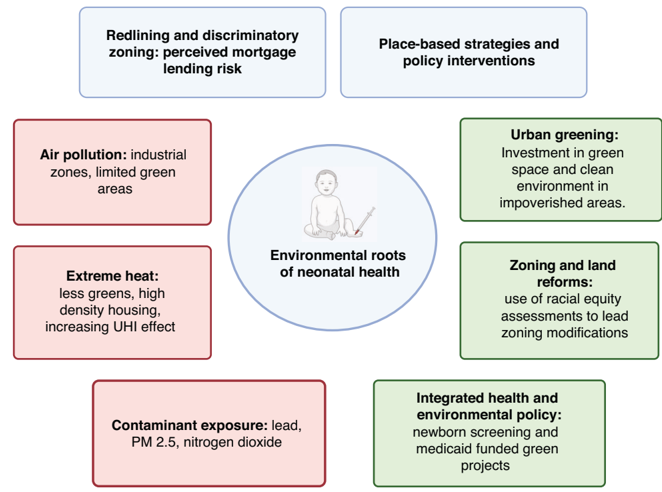
- Historical redlining and environmental injustice are linked to adverse birth outcomes: a 2022 systematic review found 86% of included studies reported worse outcomes, including higher preterm birth and low birth weight, among residents of historically redlined neighborhoods; New York City 2013–2017 data showed higher odds of preterm birth in grade D versus grade A tracts (OR 1.6; 95% CI 1.4–1.7).
- Social risk can rival medical risk: a NICHD Neonatal Research Network study of over 7,400 infants found a composite social risk measure—including race as a social construct, insurance status, and maternal education—was a stronger predictor of post-discharge mortality and neurodevelopmental impairment than many traditional medical risk factors.
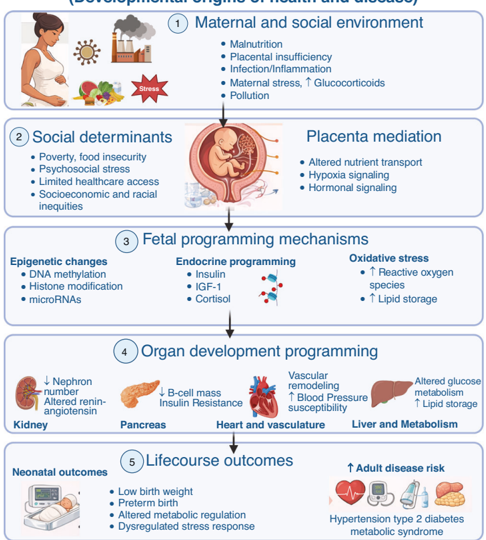
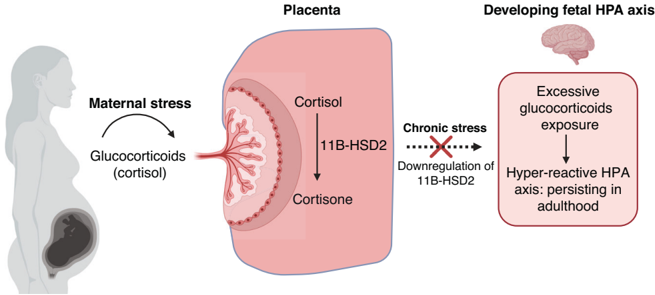
- Biological embedding is supported by stress-pathway evidence: maternal stress may downregulate placental 11β-HSD2, increasing fetal glucocorticoid exposure and programming a hyper-reactive HPA axis; a 2015 meta-analysis found a small but significant increase in NR3C1 promoter methylation with prenatal maternal stress, and natural experiments (Dutch Hunger Winter, Quebec ice storm, COVID-19) link prenatal stress to HPA dysregulation, DNA methylation changes, and neonatal brain alterations.
- Emerging exposomics and interventions show measurable signals: an NYC study identified 1,524 chemical features (36 novel) in maternal and cord sera; cord blood adductomics identified 51 oxidative stress-related adducts predicting bronchopulmonary dysplasia in preterm infants; and a 10% increase in tree canopy was associated with a 7% reduction in low birth weight risk in formerly redlined tracts.
Methods
- Narrative review synthesizing nearly a century—ninety years—of multidisciplinary evidence spanning biological, clinical, historical, and policy perspectives on socioenvironmental stressors and neonatal health in the United States.
- Draws on observational cohort studies, systematic reviews, meta-analyses, animal models, natural experiments, and emerging exposomics/neuroimaging methods; includes conceptual figures and tables summarizing evidence.
- No primary data collection or human participants; the authors state the article is a review based exclusively on previously published literature.
Limitations
- The authors state most available data are observational, subject to confounding, and cannot definitively establish causation; residual confounding and heterogeneity across studies limit strong causal inference.
- The authors note that identifying U.S.-based longitudinal cohorts from the 1930s to 1980s that capture molecular pathways remains difficult because epigenetic assays did not become available until the 1990s, so understanding of earlier periods relies on extrapolation.
- The authors state neuroimaging provides only a limited snapshot and does not reliably predict long-term outcomes, and that AI-based studies are largely observational with high-dimensional data requiring transparency, validation, and caution about prediction and clinical actionability; as evident from the text, no systematic search or quality appraisal is described for this narrative review.
Model-written summary. Check it against the paper before relying on it.
Integrity signals
Registry
Cites
Statistics
Figures
Verification
Claims the paper makes
0 Valid · 6 Not valid · 64 Not checked · 25 Own results and interpretations
A conclusion the paper draws from its own results — it cites no other source for it, so there is none to check. The quote shows it is in the paper.
In the paper
“We outline biological mechanisms, notably stressmediated alterations of the fetal HPA axis and epigenetic changes, that may mediate the effects of social and environmental adversity before birth.”
§ Environmental roots of neonatal health: how social and structural exposures shape early-life outcomes > Abstract
hedgedstates a possible cause- Asserted: passes — The authors put it forward as true.
- Checkable: passes — It can be checked against evidence.
- Load-bearing: passes — The paper’s conclusions depend on it.
- Based: passes — The paper gives a reason why it holds.
A check of a cited source is scheduled, or we don’t hold its full text yet; the claim is checked once it runs.
In the paper
“Each technological advance that improved neonatal survival initially led to a rise in disability prevalence, as more fragile infants survived.”
§ Environmental roots of neonatal health: how social and structural exposures shape early-life outcomes > KEY PATTERN OVER EIGHT DECADES The survival disability trade-off
What the sources say
- Not checked yetcites [13] Vincer, M. J., Allen, A. C., Allen, V. M., Baskett, T. F. & O’Connell, C. M. Trends in the prevalence of cerebral palsy among very preterm infants (<31 weeks’ gestational age). Paediatr. Child Health 19, 185–189 (2014). source
A check is scheduled.
plainstates a cause- Asserted: passes — The authors put it forward as true.
- Checkable: passes — It can be checked against evidence.
- Load-bearing: passes — The paper’s conclusions depend on it.
- Based: passes — The paper gives a reason why it holds.
- Not checked yet
A check of a cited source is scheduled, or we don’t hold its full text yet; the claim is checked once it runs.
In the paper
“Mounting evidence indicates that adverse exposures such as extreme weather, neighborhood poverty, chronic psychological stress, proximity to pollutants, and limited access to green spaces have been associated with disruption of fetal development through stress-mediated pathways, including maternal hypothalamic-pituitary-adrenal (HPA) axis activation and downstream epigenetic changes.4”
§ Environmental roots of neonatal health: how social and structural exposures shape early-life outcomes > INTRODUCTION
What the sources say
- Not checked yetcites [4] Gavin, A. R., Nurius, P. & Logan-Greene, P. Mediators of adverse birth outcomes among socially disadvantaged women. J. Women’s. Health (Larchmt.) 21, 634–642 (2012). source
A check is scheduled.
hedgedstates an association- Asserted: passes — The authors put it forward as true.
- Checkable: passes — It can be checked against evidence.
- Load-bearing: passes — The paper’s conclusions depend on it.
- Based: passes — The paper gives a reason why it holds.
- Not checked yet
In the paper
“Animal models provide powerful mechanistic evidence that prenatal stress induces hyper-methylation of the 11 B-HSD2 promoters in both the placenta and fetal brain, compromising the protective placental barrier.8”
§ Environmental roots of neonatal health: how social and structural exposures shape early-life outcomes > Placental and germ line changes
What the sources say
- Not checked yetcites [8] King, S. E. et al. Prenatal maternal stress in rats alters the epigenetic and transcriptomic landscape of the maternal-fetal interface across four generations. Commun. Biol. 8, 38 (2025). source
boostedstates a cause- Asserted: passes — The authors put it forward as true.
- Checkable: passes — It can be checked against evidence.
- Load-bearing: passes — The paper’s conclusions depend on it.
- Based: passes — The paper gives a reason why it holds.
A check of a cited source is scheduled, or we don’t hold its full text yet; the claim is checked once it runs.
In the paper
“Maternal anxiety and elevated cortisol levels during pregnancy have been associated with increased DNA methylation at the NR3C1 promoter in cord blood.10”
§ Environmental roots of neonatal health: how social and structural exposures shape early-life outcomes > Key genes
What the sources say
- Not checked yetcites [10] Palma-Gudiel, H., Córdova-Palomera, A., Eixarch, E., Deuschle, M. & Fañanás, L. Maternal psychosocial stress during pregnancy alters the epigenetic signature of the glucocorticoid receptor gene promoter in their offspring: A meta-analysis. Epigenetics 10, 893–902 (2015). source
A check is scheduled.
plainstates an association- Asserted: passes — The authors put it forward as true.
- Checkable: passes — It can be checked against evidence.
- Load-bearing: unclear — It is unclear whether the paper’s conclusions depend on it.
- Based: passes — The paper gives a reason why it holds.
- Not checked yet
44 more claims
Create a free account to see all 95 claims and to verify the 83 references still open.
- Probably not a substantial claim. 24
- It may state two separate claims as one. 33
Self-check
Percentages, sums and reported differences re-computed from the paper’s own numbers.
Each contradiction between two passages listed here was confirmed by an independent check.
Rated minor: it would not touch a result — a value no result rests on, a p-value that stays on the same side of the significance level, or a conflict that is clerical, resolved elsewhere in the paper, or outside its own findings.
In the paper
§ Environmental roots of neonatal health: how social and structural exposures shape early-life outcomes > Contaminant exposure
“A 2022 systematic review found that 86% of included studies reported worse outcomes-including higher rates of preterm births and low birth weight, among residents of historically redlined neighborhoods compared to those in higher-grade areas.22”
§ Environmental roots of neonatal health: how social and structural exposures shape early-life outcomes > References
“22. Kraus, N. T., Connor, S., Shoda, K., Moore, S. E. & Irani, E. Historic redlining and health outcomes: A systematic review. Public Health Nurs. 41, 287-296 (2024).”
Citations
Cites
Fetal origins of coronary heart disease
Barker, D. J. P. (1995) · BMJ · doi:10.1136/bmj.311.6998.171 · Cited by 3,570
Socioeconomic Disparities in Adverse Birth Outcomes
Blumenshine, P., Egerter, S., Barclay, C. J., Cubbin, C., & Braveman, P. A. (2010) · American Journal of Preventive Medicine · doi:10.1016/j.amepre.2010.05.012 · Cited by 688
Structural Racism, Historical Redlining, and Risk of Preterm Birth in New York City, 2013–2017
Krieger, N., Van Wye, G., Huynh, M., Waterman, P. D., Maduro, G., Li, W., Gwynn, R. C., Barbot, O., & Bassett, M. T. (2020) · American Journal of Public Health · doi:10.2105/ajph.2020.305656 · Cited by 389
The impact of a poverty reduction intervention on infant brain activity
Troller-Renfree, S. V., Costanzo, M. A., Duncan, G. J., Magnuson, K., Gennetian, L. A., Yoshikawa, H., Halpern-Meekin, S., Fox, N. A., & Noble, K. G. (2022) · Proceedings of the National Academy of Sciences · doi:10.1073/pnas.2115649119 · Cited by 300
Palma-Gudiel, H., Córdova-Palomera, A., Eixarch, E., Deuschle, M., & Fañanás, L. (2015) · Epigenetics · doi:10.1080/15592294.2015.1088630 · Cited by 240
Prenatal stress and epigenetics
Cao-Lei, L., de Rooij, S. R., King, S., Matthews, S. G., Metz, G. A. S., Roseboom, T. J., & Szyf, M. (2020) · Neuroscience & Biobehavioral Reviews · doi:10.1016/j.neubiorev.2017.05.016 · Cited by 178
Associations between historical redlining and birth outcomes from 2006 through 2015 in California
Nardone, A. L., Casey, J. A., Rudolph, K. E., Karasek, D., Mujahid, M., & Morello-Frosch, R. (2020) · PLOS ONE · doi:10.1371/journal.pone.0237241 · Cited by 135
Collins, J. W. (2002) · American Journal of Epidemiology · doi:10.1093/aje/155.3.210 · Cited by 115
The socio-exposome: advancing exposure science and environmental justice in a postgenomic era
Senier, L., Brown, P., Shostak, S., & Hanna, B. (2017) · Environmental Sociology · doi:10.1080/23251042.2016.1220848 · Cited by 108
The neuroscience of socioeconomic inequality
Noble, K. G., & Giebler, M. A. (2020) · Current Opinion in Behavioral Sciences · doi:10.1016/j.cobeha.2020.05.007 · Cited by 104
Cited by
Environmental Pollution, Maternal Mental Health, and Pregnancy Outcomes in Low-Resource Communities
Kim, D. (2026) · American journal of student research. · doi:10.70251/hyjr2348.44356363
Metadata
- Authors
- Nawaz, K., Babata, K., Scheid, L., Bitar, L., Ortiz, N. V., Kota, S., & Chalak, L. F.
- Affiliations
- Children's Medical Center (US)
- Corresponding author
- Chalak, Lina F.
- Venue
- Pediatric Research
- Published
- 2026-06-13
- Volume
- 100
- Issue
- 4
- Pages
- 1527-1533
- ISSN
- 0031-3998 (ISSN-L)
- 1530-0447
- OpenAlex
- W7164607221
- Cited by
- 1
- References
- 58
- Citations by year
- 2026: 1
- FWCI
- 1.26
- Type
- journal article
- Language
- en
- Open access
- hybrid
- doi.org
- Licence
- Locations
- Pediatric Research (publishedVersion, cc-by-nc-nd)
- PubMed (publishedVersion)
- Topics
- Health Sciences › Medicine › Pediatrics, Perinatology and Child Health › Maternal and Neonatal Healthcare
- Social Sciences › Sociology and Political Science › Environmental Justice and Health Disparities
- Health Sciences › Medicine › Pediatrics, Perinatology and Child Health › Birth, Development, and Health
- Keywords
- newborn health, perinatal outcomes, social determinants of health, structural racism, environmental injustice, historical redlining, air pollution, neighborhood disadvantage, preterm birth, low birth weight, neonatal survival, brain development, epigenetics, prenatal care access, food insecurity, exposomics, biomarkers, place-based policy, urban greening, zoning reform
About these checks
Registry, retraction, Cites and statistics results are computed, not judged, with one exception: a printed reference that no index lists is read once by a model before it counts as a citation error. Claims are extracted by a model and kept only when their quote appears verbatim in the text; each cited source is then checked, with a model’s help, for whether it says what the claim relies on. Those verdicts can be wrong — read the claim’s quote and the cited source before relying on one.
A language model drew the claims from the paper on 2026-11-13, under version 3 of the claim definition (model deepseek-v4.1-flash, prompt extract-v3).
A second model labelled each claim on 2026-11-13 (model jev-1.13-20260917, definition revision gold-guideline-v0.2).
Statistics and arithmetic are recomputed, not judged.
Confidence bands are shown only for fields calibrated on our annotated test set. None is calibrated yet, so no band is shown.
What counts as a claim ›How we measure confidence ›How we check this ›
Are you an author, or do you see a problem with this page? Request a review
How to cite
Cite CoChat for the checks on this page, and the paper for its own findings.
- This page
- CoChat. (2026). Citation check: Environmental roots of neonatal health: how social and structural exposures shape early-life outcomes. https://app.cochat.ai/papers/10.1038/s41390-026-05139-5
- The paper
- Nawaz, K., Babata, K., Scheid, L., Bitar, L., Ortiz, N. V., Kota, S., & Chalak, L. F. (2026). Environmental roots of neonatal health: how social and structural exposures shape early-life outcomes. Pediatric Research. https://doi.org/10.1038/s41390-026-05139-5
Data sources
Bibliographic data: Semantic Scholar, OpenAlex, Crossref.
Contains information from the Semantic Scholar Academic Graph Datasets, made available under the ODC Attribution License (ODC-BY 1.0).
Semantic Scholar’s data is described in: Kinney, R., et al. (2023). The Semantic Scholar Open Data Platform. arXiv:2301.10140.
