

The DOI matches its Crossref record; 57 of the 58 references it cites were found in a registry or an index, and 1 are not checked yet.
Predicting responses to platin chemotherapy agents with biochemically-inspired machine learning
Open accessPublished version of a preprint
Abstract
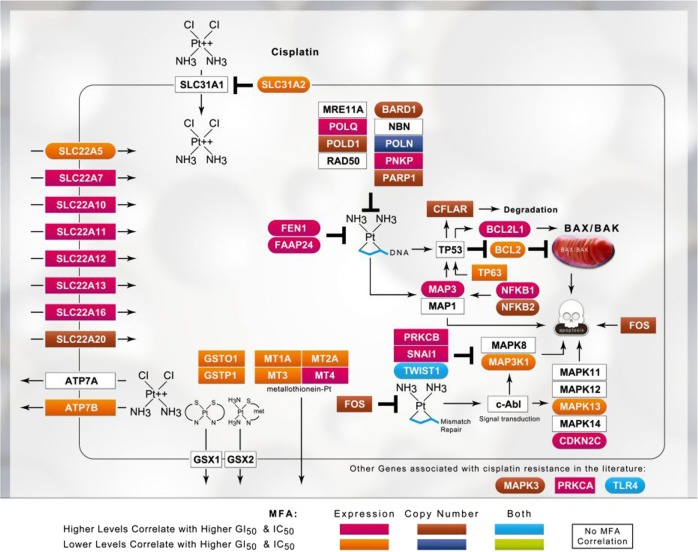
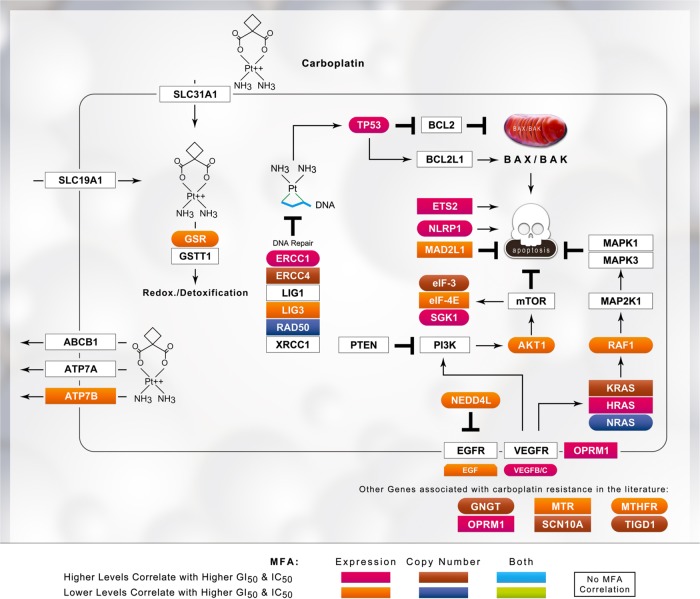
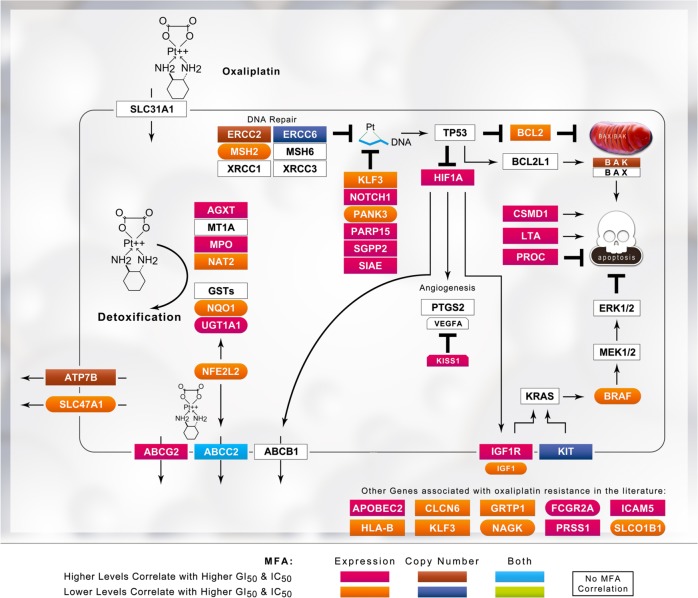
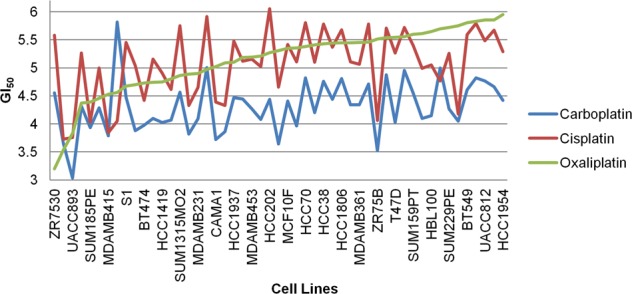
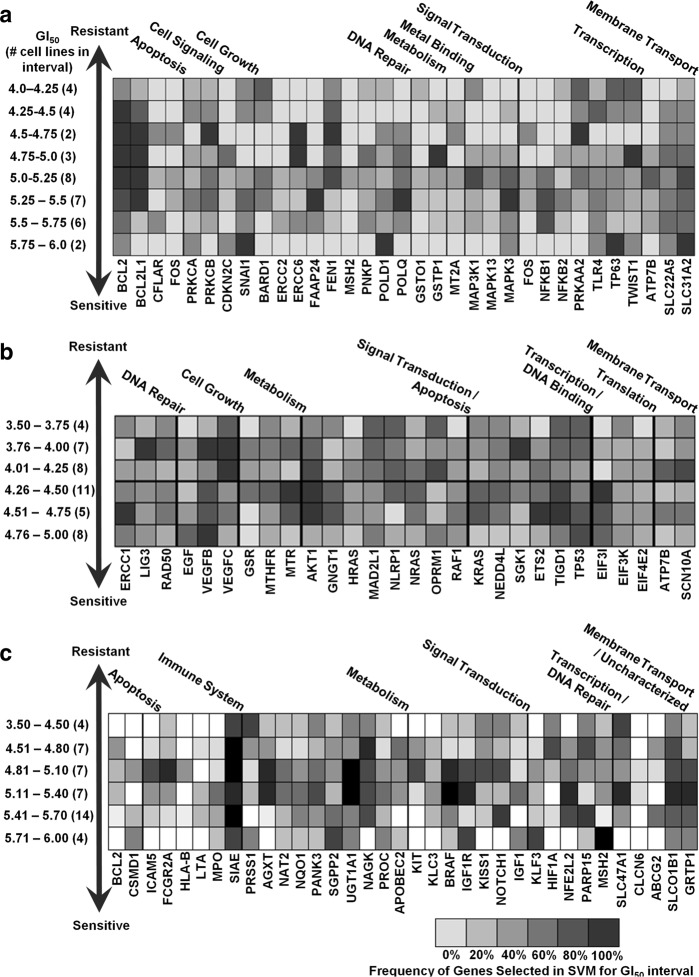
The selection of effective genes that accurately predict chemotherapy responses might improve cancer outcomes. We compare optimized gene signatures for cisplatin, carboplatin, and oxaliplatin responses in the same cell lines and validate each signature using data from patients with cancer. Supervised support vector machine learning is used to derive gene sets whose expression is related to the cell line GI 50 values by backwards feature selection with cross-validation. Specific genes and functional pathways distinguishing sensitive from resistant cell lines are identified by contrasting signatures obtained at extreme and median GI 50 thresholds. Ensembles of gene signatures at different thresholds are combined to reduce the dependence on specific GI 50 values for predicting drug responses. The most accurate gene signatures for each platin are: cisplatin: BARD1 , BCL2 , BCL2L1 , CDKN2C , FAAP24 , FEN1 , MAP3K1 , MAPK13 , MAPK3 , NFKB1 , NFKB2 , SLC22A5 , SLC31A2 , TLR4 , and TWIST1 ; carboplatin: AKT1 , EIF3K , ERCC1 , GNGT1 , GSR , MTHFR , NEDD4L , NLRP1 , NRAS , RAF1 , SGK1 , TIGD1 , TP53 , VEGFB , and VEGFC; and oxaliplatin: BRAF , FCGR2A , IGF1 , MSH2 , NAGK , NFE2L2 , NQO1 , PANK3 , SLC47A1 , SLCO1B1 , and UGT1A1 . Data from The Cancer Genome Atlas (TCGA) patients with bladder, ovarian, and colorectal cancer were used to test the cisplatin, carboplatin, and oxaliplatin signatures, resulting in 71.0%, 60.2%, and 54.5% accuracies in predicting disease recurrence and 59%, 61%, and 72% accuracies in predicting remission, respectively. One cisplatin signature predicted 100% of recurrence in non-smoking patients with bladder cancer (57% disease-free; N = 19), and 79% recurrence in smokers (62% disease-free; N = 35). This approach should be adaptable to other studies of chemotherapy responses, regardless of the drug or cancer types.
Overview
The claims and statistics of this paper haven’t been checked yet.
Run the check — free, no account needed. It reads the open-access text and checks the sources it cites.
Integrity signals
Registry
Cites
Statistics
Figures
Verification
Claims the paper makes
The claims and statistics of this paper haven’t been checked yet.
Run the check — free, no account needed. It reads the open-access text and checks the sources it cites.
Claims other papers make about this one
Each is checked against this paper’s own text: does it say what the citing paper says it does?
The source backs part of the claim, not all of it — or backs it for a different population, condition or comparison.
In the citing paper
“Given its widespread use, it comes as no surprise that prior work has assessed the utility of mutational and transcriptomic signatures in predicting response to this drug; yet, to the best knowledge of these authors, none of these advancements have been translated into routine clinical care15–19.”
From Exploiting convergent phenotypes to derive a pan-cancer cisplatin response gene expression signature (2023) · cites this paper as [16]
Experimental — accuracy not yet measuredThe source backs part of the claim, not all of it — or backs it for a different population, condition or comparison.
In the citing paper
“In a 2019 manuscript by Mucaki et al., the authors produce a cisplatin response signature from breast cancer cell lines in the GDSC dataset; however, their approach only includes genes with a known relationship to cisplatin response (none of which overlap with the genes in CisSig)16. Therefore, their final cisplatin response signature does not contain any CisSig genes.”
From Exploiting convergent phenotypes to derive a pan-cancer cisplatin response gene expression signature (2023) · cites this paper as [16]
Experimental — accuracy not yet measured
Self-check
Percentages, sums and reported differences re-computed from the paper’s own numbers.
The self-check needs the paper’s full text.
Citations
Cites
Cerami, E., Gao, J., Dogrusoz, U., Gross, B. E., Sumer, S. O., Aksoy, B. A., Jacobsen, A., Byrne, C. J., Heuer, M. L., Larsson, E., et al. (2012) · Cancer Discovery · doi:10.1158/2159-8290.cd-12-0095 · Cited by 17,455
Integrative Analysis of Complex Cancer Genomics and Clinical Profiles Using the cBioPortal
Gao, J., Aksoy, B. A., Dogrusoz, U., Dresdner, G., Gross, B., Sumer, S. O., Sun, Y., Jacobsen, A., Sinha, R., Larsson, E., et al. (2013) · Science Signaling · doi:10.1126/scisignal.2004088 · Cited by 15,160
Abdi, H., & Williams, L. J. (2010) · WIREs Computational Statistics · doi:10.1002/wics.101 · Cited by 11,104
Adjusting batch effects in microarray expression data using empirical Bayes methods
Johnson, W. E., Li, C., & Rabinovic, A. (2007) · Biostatistics · doi:10.1093/biostatistics/kxj037 · Cited by 8,658
Comprehensive molecular characterization of human colon and rectal cancer
The Cancer Genome Atlas Network (2012) · Nature · doi:10.1038/nature11252 · Cited by 8,499
Integrated genomic analyses of ovarian carcinoma
Perou, C. M. (2019) · Carolina Digital Repository (University of North Carolina at Chapel Hill) · doi:10.17615/hvp3-wg08 · Cited by 7,927
Yang, W., Soares, J., Greninger, P., Edelman, E. J., Lightfoot, H., Forbes, S., Bindal, N., Beare, D., Smith, J. A., Thompson, I. R., et al. (2012) · Nucleic Acids Research · doi:10.1093/nar/gks1111 · Cited by 4,051
Chen, L., Li, N., & Ye, H. (2012) · Hepatogastroenterology · doi:10.5754/hge12469 · Cited by 3,208
RNA-seq: An assessment of technical reproducibility and comparison with gene expression arrays
Marioni, J. C., Mason, C. E., Mane, S. M., Stephens, M., & Gilad, Y. (2008) · Genome Research · doi:10.1101/gr.079558.108 · Cited by 2,771
Comprehensive Molecular Characterization of Muscle-Invasive Bladder Cancer
Robertson, A. G., Kim, J., Al‐Ahmadie, H. A., Joaquim Bellmunt, B., Guo, G., Cherniack, A. D., Hinoue, T., Laird, P. W., Hoadley, K. A., Akbani, R., et al. (2017) · Cell · doi:10.1016/j.cell.2017.09.007 · Cited by 2,463
Research works printed but not linked: 1
- Airley, R. Cancer Chemotherapy (Wiley-Blackwell, Hoboken, New Jersey 2009).
Cited by
Sorted by citations
Items 201–201 of 201
Jammoul, D., Ajibuwa, F., Jammoul, M., Schlosser‐Hupf, S., Müller, M., & El‐Najjar, N. (2026) · Frontiers in Pharmacology · doi:10.3389/fphar.2026.1784272
Metadata
- Authors
- Mucaki, E. J., Zhao, J. Z. L., Lizotte, D. J., & Rogan, P. K.
- Affiliations
- Western University (CA)
- Corresponding author
- Rogan, Peter K.
- Venue
- Signal Transduction and Targeted Therapy
- Published
- 2019-01-11
- Volume
- 4
- Issue
- 1
- Pages
- 1-1
- ISSN
- 2059-3635 (ISSN-L)
- PMC
- PMC6329797
- OpenAlex
- W2950457484
- Cited by
- 200
- References
- 57
- Citations by year
- 2026: 8 · 2025: 15 · 2024: 21 · 2023: 44 · 2022: 32 · 2021: 38 · 2020: 31 · 2019: 9
- FWCI
- 9.10
- Type
- journal article
- Language
- en
- Open access
- gold
- doi.org
- Locations
- Signal Transduction and Targeted Therapy (publishedVersion, cc-by)
- bioRxiv (Cold Spring Harbor Laboratory) (acceptedVersion, cc-by-nc-nd)
- Europe PMC (PubMed Central) (publishedVersion, other-oa)
- PubMed Central (publishedVersion, cc-by)
- PubMed (publishedVersion)
- Scholarship@Western (Western University) (acceptedVersion)
- DOAJ (DOAJ: Directory of Open Access Journals) (submittedVersion)
- Scholarship@Western (Western University) (submittedVersion)
- Funders
- Compute Canada
- Canada Research Chairs
- Natural Sciences and Engineering Research Council of Canada (RGPIN-2015, RGPIN-2015-06290)
- Topics
- Life Sciences › Biochemistry, Genetics and Molecular Biology › Molecular Biology › Gene expression and cancer classification
- Life Sciences › Pharmacology, Toxicology and Pharmaceutics › Drug Discovery › Computational Drug Discovery Methods
- Life Sciences › Biochemistry, Genetics and Molecular Biology › Cancer Research › Breast Cancer Treatment Studies
- Keywords
- cisplatin, carboplatin, oxaliplatin, drug response prediction, gene expression signatures, drug resistance, support vector machine, feature selection, bladder cancer, ovarian cancer, colorectal cancer, disease recurrence prediction, remission prediction
About these checks
Registry, retraction, Cites and statistics results are computed, not judged, with one exception: a printed reference that no index lists is read once by a model before it counts as a citation error. Claims are extracted by a model and kept only when their quote appears verbatim in the text; each cited source is then checked, with a model’s help, for whether it says what the claim relies on. Those verdicts can be wrong — read the claim’s quote and the cited source before relying on one.
Statistics and arithmetic are recomputed, not judged.
Confidence bands are shown only for fields calibrated on our annotated test set. None is calibrated yet, so no band is shown.
What counts as a claim ›How we measure confidence ›How we check this ›
Are you an author, or do you see a problem with this page? Request a review
