

The DOI matches its Crossref record; 521 of the 522 references it cites were found in a registry or an index.
Regulating tumor suppressor genes: post-translational modifications
Open accessAbstract
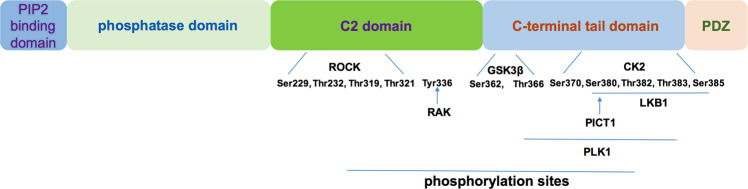
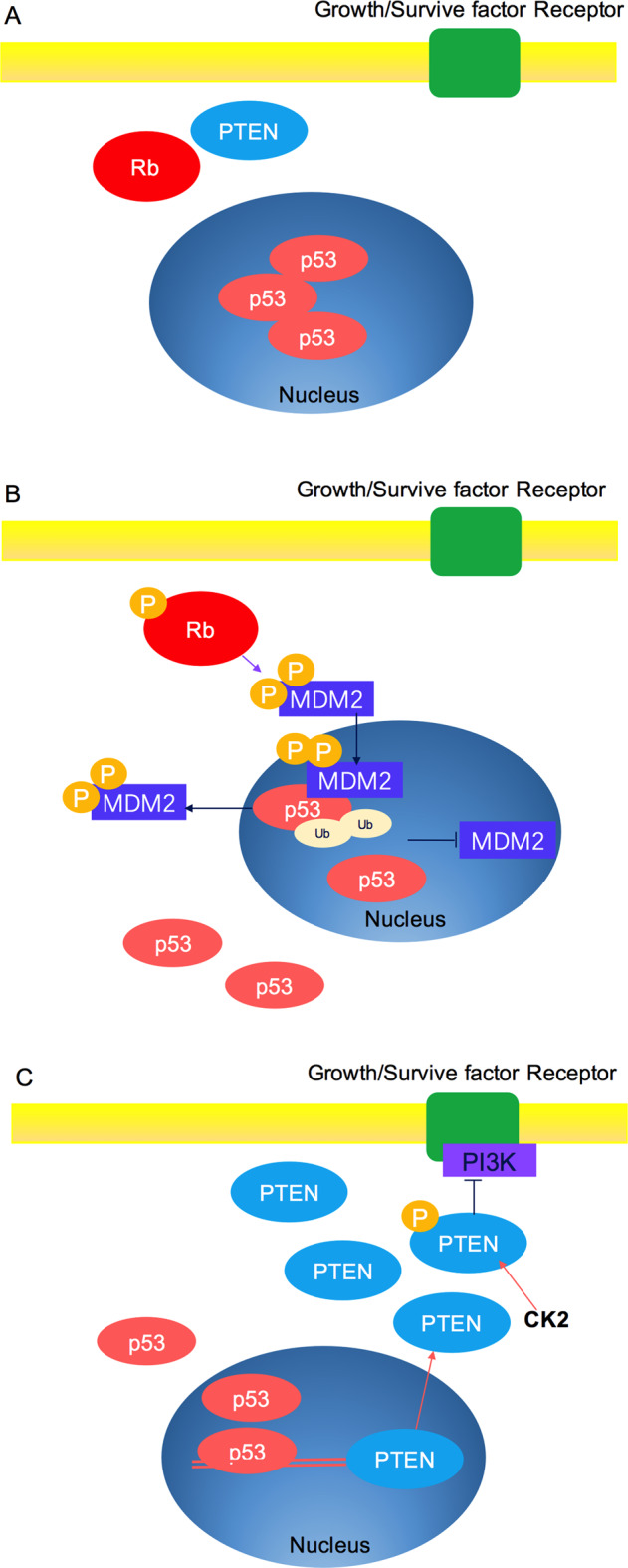
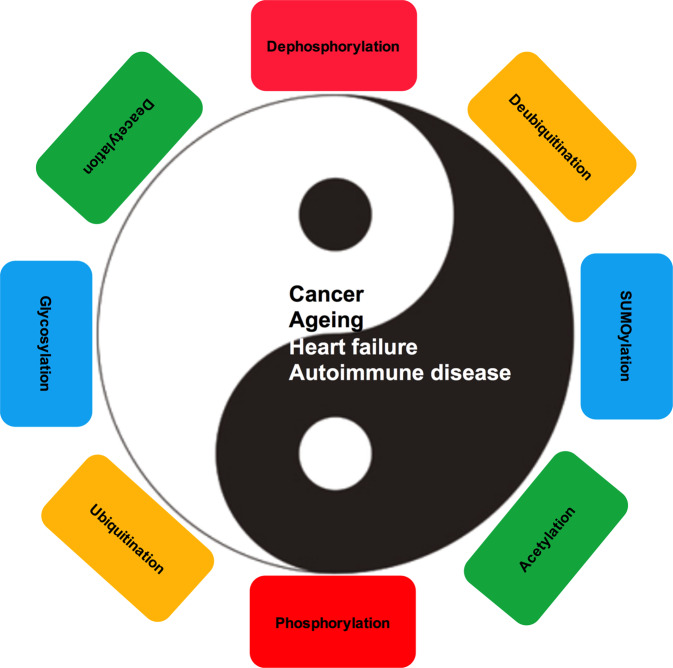
Tumor suppressor genes cooperate with each other in tumors. Three important tumor suppressor proteins, retinoblastoma (Rb), p53, phosphatase, and tensin homolog deleted on chromosome ten (PTEN) are functionally associated and they regulated by post-translational modification (PTMs) as well. PTMs include phosphorylation, SUMOylation, acetylation, and other novel modifications becoming growing appreciated. Because most of PTMs are reversible, normal cells use them as a switch to control the state of cells being the resting or proliferating, and PTMs also involve in cell survival and cell cycle, which may lead to abnormal proliferation and tumorigenesis. Although a lot of studies focus on the importance of each kind of PTM, further discoveries shows that tumor suppressor genes (TSGs) form a complex “network” by the interaction of modification. Recently, there are several promising strategies for TSGs for they change more frequently than carcinogenic genes in cancers. We here review the necessity, characteristics, and mechanisms of each kind of post-translational modification on Rb, p53, PTEN, and its influence on the precise and selective function. We also discuss the current antitumoral therapies of Rb, p53 and PTEN as predictive, prognostic, and therapeutic target in cancer.
Overview
The claims and statistics of this paper haven’t been checked yet.
Run the check — free, no account needed. It reads the open-access text and checks the sources it cites.
Integrity signals
Registry
Cites
Statistics
Figures

Verification
Claims the paper makes
The claims and statistics of this paper haven’t been checked yet.
Run the check — free, no account needed. It reads the open-access text and checks the sources it cites.
Claims other papers make about this one
Each is checked against this paper’s own text: does it say what the citing paper says it does?
The cited source says what the claim attributes to it.
In the citing paper
“PTMs are known to function as molecular switches by affecting protein-protein interactions (Chen, Liu et al., 2020, Nishi, Hashimoto et al., 2011).”
From SHARPIN S146 phosphorylation mediates ARP2/3 interaction, cancer cell invasion and metastasis (2022) · cites this paper as Chen, Liu et al., 2020
Self-check
Percentages, sums and reported differences re-computed from the paper’s own numbers.
The self-check needs the paper’s full text.
Citations
Cites
1 retracted
Song, P., Wu, Y., Xu, J., Xie, Z., Dong, Y., Zhang, M., & Zou, M. (2007) · Circulation · doi:10.1161/circulationaha.107.716498 · Cited by 144
RetractedHershko, A., & Ciechanover, A. (1998) · Annual Review of Biochemistry · doi:10.1146/annurev.biochem.67.1.425 · Cited by 8,840
p53 Mutations in Human Cancers
Hollstein, M., Sidransky, D., Vogelstein, B., & Harris, C. C. (1991) · Science · doi:10.1126/science.1905840 · Cited by 8,018
Comprehensive genomic characterization defines human glioblastoma genes and core pathways
The Cancer Genome Atlas Research Network (2008) · Nature · doi:10.1038/nature07385 · Cited by 7,735
p53, the cellular gatekeeper for growth and division
Levine, A. J. (1997) · Cell · doi:10.1016/s0092-8674(00)81871-1 · Cited by 7,693
Mutation and cancer: statistical study of retinoblastoma
Knudson, A. G. (1971) · Proceedings of the National Academy of Sciences · doi:10.1073/pnas.68.4.820 · Cited by 7,612
Nowell, P. C. (1976) · Science · doi:10.1126/science.959840 · Cited by 6,471
AKT/PKB signaling: navigating downstream
Manning, B. D., & Cantley, L. C. (2007) · Cell · doi:10.1016/j.cell.2007.06.009 · Cited by 6,115
An Integrated Genomic Analysis of Human Glioblastoma Multiforme
Parsons, D. W., Jones, S., Zhang, X., Lin, J. C.-H., Leary, R. J., Angenendt, P., Mankoo, P., Carter, H., Siu, I.-M., Gallia, G. L., et al. (2008) · Science · doi:10.1126/science.1164382 · Cited by 5,857
The retinoblastoma protein and cell cycle control
Weinberg, R. A. (1995) · Cell · doi:10.1016/0092-8674(95)90385-2 · Cited by 4,862
Cited by
Sorted by citations
Targeting p53 pathways: mechanisms, structures, and advances in therapy
Wang, H., Guo, M., Wei, H., & Chen, Y. (2023) · Signal Transduction and Targeted Therapy · doi:10.1038/s41392-023-01347-1 · Cited by 1,016
p53 signaling in cancer progression and therapy
Marei, H. E. S., Thani, A. A. A., Afifi, N. M., Hasan, A., Caceci, T., Pozzoli, G., Morrione, A., Giordano, A., & Cenciarelli, C. (2021) · Cancer Cell International · doi:10.1186/s12935-021-02396-8 · Cited by 628
Mutant p53 in cancer: from molecular mechanism to therapeutic modulation
Chen, X., Zhang, T., Su, W., Dou, Z., Zhao, D., Jin, X., Lei, H., Wang, J., Xie, X., Cheng, B., et al. (2022) · Cell Death & Disease · doi:10.1038/s41419-022-05408-1 · Cited by 494
Zhong, Q., Xiao, X., Qiu, Y., Xu, Z., Chen, C., Chong, B., Zhao, X., Hai, S., Li, S., An, Z., et al. (2023) · MedComm · doi:10.1002/mco2.261 · Cited by 442
Deubiquitinating enzymes (DUBs): Regulation, homeostasis, and oxidative stress response
Snyder, N. A., & Silva, G. M. (2021) · Journal of Biological Chemistry · doi:10.1016/j.jbc.2021.101077 · Cited by 371
Metadata
- Authors
- Chen, L., Liu, S., & Tao, Y.
- Affiliations
- Central South University (CN)
- Corresponding author
- Tao, Yongguang
- Venue
- Signal Transduction and Targeted Therapy
- Published
- 2020-06-10
- Volume
- 5
- Issue
- 1
- Pages
- 90-90
- ISSN
- 2059-3635 (ISSN-L)
- PMC
- PMC7293209
- OpenAlex
- W3035758066
- Cited by
- 449
- References
- 522
- Citations by year
- 2026: 52 · 2025: 89 · 2024: 110 · 2023: 87 · 2022: 65 · 2021: 38 · 2020: 3
- FWCI
- 5.23
- Type
- journal article
- Language
- en
- Open access
- gold
- doi.org
- Locations
- Signal Transduction and Targeted Therapy (publishedVersion, cc-by)
- PubMed Central (publishedVersion, cc-by)
- PubMed (publishedVersion)
- Funders
- National Natural Science Foundation of China (81672787, 111 Project, 81672991, 81874139)
- Higher Education Discipline Innovation Project
- Overseas Expertise Introduction Project for Discipline Innovation (“111” Project)
- Topics
- Health Sciences › Medicine › Oncology › Cancer-related Molecular Pathways
- Life Sciences › Biochemistry, Genetics and Molecular Biology › Molecular Biology › PI3K/AKT/mTOR signaling in cancer
- Life Sciences › Biochemistry, Genetics and Molecular Biology › Molecular Biology › Cancer-related gene regulation
- Keywords
- tumor suppressor, post-translational modification, retinoblastoma protein, p53, PTEN, phosphorylation, SUMOylation, acetylation, tumor suppressor network, cell cycle regulation, carcinogenesis, cancer therapy, therapeutic target
- MeSH terms
- Humans, Neoplasms, Protein Processing, Post-Translational, Genes, Tumor Suppressor, Tumor Suppressor Protein p53, Retinoblastoma Protein, PTEN Phosphohydrolase, Carcinogenesis
About these checks
Registry, retraction, Cites and statistics results are computed, not judged, with one exception: a printed reference that no index lists is read once by a model before it counts as a citation error. Claims are extracted by a model and kept only when their quote appears verbatim in the text; each cited source is then checked, with a model’s help, for whether it says what the claim relies on. Those verdicts can be wrong — read the claim’s quote and the cited source before relying on one.
Statistics and arithmetic are recomputed, not judged.
Confidence bands are shown only for fields calibrated on our annotated test set. None is calibrated yet, so no band is shown.
What counts as a claim ›How we measure confidence ›How we check this ›
Are you an author, or do you see a problem with this page? Request a review
