

Microbial ecology of the newly discovered serpentinite-hosted Old City hydrothermal field (southwest Indian ridge)
Open accessThe DOI matches its Crossref record; 72 of the 73 references it cites were found in a registry or an index.
Abstract
Lost City (mid-Atlantic ridge) is a unique oceanic hydrothermal field where carbonate-brucite chimneys are colonized by a single phylotype of archaeal Methanosarcinales, as well as sulfur- and methane-metabolizing bacteria. So far, only one submarine analog of Lost City has been characterized, the Prony Bay hydrothermal field (New Caledonia), which nonetheless shows more microbiological similarities with ecosystems associated with continental ophiolites. This study presents the microbial ecology of the ‘Lost City’-type Old City hydrothermal field, recently discovered along the southwest Indian ridge. Five carbonate-brucite chimneys were sampled and subjected to mineralogical and geochemical analyses, microimaging, as well as 16S rRNA-encoding gene and metagenomic sequencing. Dominant taxa and metabolisms vary between chimneys, in conjunction with the predicted redox state, while potential formate- and CO-metabolizing microorganisms as well as sulfur-metabolizing bacteria are always abundant. We hypothesize that the variable environmental conditions resulting from the slow and diffuse hydrothermal fluid discharge that currently characterizes Old City could lead to different microbial populations between chimneys that utilize CO and formate differently as carbon or electron sources. Old City discovery and this first description of its microbial ecology opens up attractive perspectives for understanding environmental factors shaping communities and metabolisms in oceanic serpentinite-hosted ecosystems.
Overview
The claims and statistics of this paper haven’t been checked yet.
Free: it reads the open-access text and checks the first 5 claims that cite a source we can check. Create a free account to check every claim.
Integrity signals
Registry
Cites
Statistics
Figures
Verification
Claims the paper makes
The claims and statistics of this paper haven’t been checked yet.
Free: it reads the open-access text and checks the first 5 claims that cite a source we can check. Create a free account to check every claim.
Self-check
Percentages, sums and reported differences re-computed from the paper’s own numbers.
The self-check needs the paper’s full text.
Citations
Cites
Fast gapped-read alignment with Bowtie 2
Langmead, B., & Salzberg, S. L. (2012) · Nature Methods · doi:10.1038/nmeth.1923 · Cited by 56,400 · cited 3×
“abundance of the corresponding encoding genes obtained with Bowtie2 [32].”
BackgroundMethodInfluentialRobinson, M. D., McCarthy, D. J., & Smyth, G. K. (2010) · Bioinformatics · doi:10.1093/bioinformatics/btp616 · Cited by 41,364 · cited 1×
“implemented in the R package edgeR [34].”
Wickham, H. (2016) · Use R! · doi:10.1007/978-3-319-24277-4 · Cited by 33,115
The SILVA ribosomal RNA gene database project: improved data processing and web-based tools
Quast, C., Pruesse, E., Yilmaz, P., Gerken, J., Schweer, T., Yarza, P., Peplies, J., & Glöckner, F. O. (2012) · Nucleic Acids Research · doi:10.1093/nar/gks1219 · Cited by 33,055 · cited 3×
“de/ngs/) for taxonomic assignment of ASVs against the SILVA database release 132 [26].”
BackgroundMethodInfluentialvegan: Community Ecology Package
Oksanen, J., Simpson, G. L., Blanchet, F. G., Kindt, R., Legendre, P., Minchin, P. R., O'Hara, R. B., Solymos, P., Stevens, M. H. H., Szoecs, E., et al. (2001) · CRAN: Contributed Packages · doi:10.32614/cran.package.vegan · Cited by 22,615
Prokka: rapid prokaryotic genome annotation
Seemann, T. (2014) · Bioinformatics · doi:10.1093/bioinformatics/btu153 · Cited by 18,818
ggplot2: Elegant Graphics for Data Analysis
Wickham, H. (2009) · doi:10.1007/978-0-387-98141-3 · Cited by 14,447
Fast and sensitive protein alignment using DIAMOND
Buchfink, B., Xie, C., & Huson, D. H. (2015) · Nature Methods · doi:10.1038/nmeth.3176 · Cited by 14,201 · cited 1×
“against the non-redundant NCBI database using Diamond blastp tool [35] with an e value cutoff of 10.”
MethodProdigal: prokaryotic gene recognition and translation initiation site identification
Hyatt, D., Chen, G.-L., LoCascio, P. F., Land, M. L., Larimer, F. W., & Hauser, L. J. (2010) · BMC Bioinformatics · doi:10.1186/1471-2105-11-119 · Cited by 12,587
Li, D., Liu, C.-M., Luo, R., Sadakane, K., & Lam, T.-W. (2015) · Bioinformatics · doi:10.1093/bioinformatics/btv033 · Cited by 9,893 · cited 1×
“13 [31] with a minimum contig length of 1,000 bp and default parameters.”
Background
Research works printed but not linked: 2
- Cannat M Agrinier P Martinez I Vitale Brovarone A Lecoeuvre A Corre M A forest of carbonate-brucite chimneys at the southwest Indian ridge: the ultramafic-hosted Old City hydrothermal field Goldschmidt Abstracts 2019 2019 463
- Lecoeuvre A Ménez B Lecourt L Gérard E Microbial ecology linked to serpentinization processes and related carbonation at the Old City hydrothermal field Goldschmidt Abstracts 2018 2018 1428
Cited by
Diversity of magmatism, hydrothermal processes and microbial interactions at mid-ocean ridges
Früh‐Green, G. L., Kelley, D. S., Lilley, M. D., Cannat, M., Chavagnac, V., & Baross, J. A. (2022) · Nature Reviews Earth & Environment · doi:10.1038/s43017-022-00364-y · Cited by 110
Self-citationAnaerobic thiosulfate oxidation by the Roseobacter group is prevalent in marine biofilms
Ding, W., Wang, S., Qin, P., Fan, S., Su, X., Cai, P., Lu, J., Cui, H., Wang, M., Shu, Y., et al. (2023) · Nature Communications · doi:10.1038/s41467-023-37759-4 · Cited by 88
Ruff, S. E., de Angelis, I. H., Mullis, M. M., Payet, J. P., Magnabosco, C., Lloyd, K. G., Sheik, C. S., Steen, A. D., Shipunova, A., Morozov, A., et al. (2024) · Science Advances · doi:10.1126/sciadv.adq0645 · Cited by 67
Schwander, L., Brabender, M., Mrnjavac, N., Wimmer, J. L. E., Preiner, M., & Martin, W. F. (2023) · Frontiers in Microbiology · doi:10.3389/fmicb.2023.1257597 · Cited by 65
German, C. R., Reeves, E. P., Türke, A., Diehl, A., Albers, E., Bach, W., Purser, A., Ramalho, S. P., Suman, S., Mertens, C., et al. (2022) · Nature Communications · doi:10.1038/s41467-022-34014-0 · Cited by 44
Metabolic strategies shared by basement residents of the lost City hydrothermal field
Brazelton, W. J., McGonigle, J. M., Motamedi, S., Pendleton, H. L., Twing, K. I., Miller, B. C., Lowe, W. J., Hoffman, A. M., Prator, C. A., Chadwick, G. L., et al. (2022) · Applied and Environmental Microbiology · doi:10.1128/aem.00929-22 · Cited by 36
“other sites of serpentinization where those taxa are abundant (5, 21, 22, 74).”
BackgroundInfluentialA review of abyssal serpentinite geochemistry and geodynamics
Debret, B. P. R., Andréani, M., & Godard, M. (2024) · Earth-Science Reviews · doi:10.1016/j.earscirev.2024.104910 · Cited by 36
Wang, Y., Bai, Y., Su, J., Xu, L., Ren, Y., Ren, M., Hou, C., & Cao, M. (2024) · Journal of Hazardous Materials · doi:10.1016/j.jhazmat.2024.134922 · Cited by 30
Microbial ecology of serpentinite-hosted ecosystems
Colman, D. R., Templeton, A. S., Spear, J. R., & Boyd, E. S. (2025) · The ISME Journal · doi:10.1093/ismejo/wraf029 · Cited by 24
“These includerepresentatives of the classes Nitrososphaeria [21,22, 59] that comprise ammonia-oxidizers typical of fresh-and sea-waters [60] and Thalassoar chaea typical of global marine waters [61] that have been detected in marine serpentinite communities [21, 46].”
InfluentialCoskun, Ö. K., Vuillemin, A., Schubotz, F., Klein, F., Sichel, S. E., Eisenreich, W., & Orsi, W. D. (2021) · The ISME Journal · doi:10.1038/s41396-021-01066-x · Cited by 28
“The peridotite-associated communities included taxa that are common to hydrothermal [51] and ultramafic rock habitats [52, 53] including Nitrospirae, Rokubacteria, Entotheonellaeota, Gemmatimonadetes, and Alphaproteobacteria (Fig.”
BackgroundWang, Y., Bi, H.-Y., Chen, H.-G., Zheng, P., Zhou, Y., & Li, J. (2022) · Frontiers in Microbiology · doi:10.3389/fmicb.2022.861795 · Cited by 24
Postec, A., Quéméneur, M., Lecoeuvre, A., Chabert, N., Joseph, M., & Erauso, G. (2020) · Systematic and Applied Microbiology · doi:10.1016/j.syapm.2020.126175 · Cited by 20
Self-citationA non-methanogenic archaeon within the order Methanocellales
Suzuki, S., Ishii, S., Chadwick, G. L., Tanaka, Y., Kouzuma, A., Watanabe, K., Inagaki, F., Albertsen, M., Nielsen, P. H., & Nealson, K. H. (2024) · Nature Communications · doi:10.1038/s41467-024-48185-5 · Cited by 17
“Changed the reaction to the enzyme.”
Twing, K. I., Ward, L. M., Kane, Z. K., Sanders, A., Price, R. E., Pendleton, H. L., Giovannelli, D., Brazelton, W. J., & McGlynn, S. E. (2022) · Frontiers in Microbiology · doi:10.3389/fmicb.2022.960335 · Cited by 17
“, 2015), and Old City hydrothermal fields (Lecoeuvre et al., 2021).”
BackgroundInfluentialGerman, C. R., Lang, S. Q., & Fitzsimmons, J. N. (2024) · Elsevier eBooks · doi:10.1016/b978-0-323-99762-1.00048-6 · Cited by 18
Namirimu, T., Kim, Y. J., Park, M.-J., Lim, D., Lee, J.-H., & Kwon, K. K. (2022) · Frontiers in Marine Science · doi:10.3389/fmars.2022.784807 · Cited by 16
Mid-Ocean Ridges and Their Geomorphological Features
Escartin, J., & Olive, J. (2021) · Elsevier eBooks · doi:10.1016/b978-0-12-818234-5.00193-0 · Cited by 15
Quéméneur, M., Mei, N., Monnin, C., Postec, A., Guasco, S., Jeanpert, J., Maurizot, P., Pelletier, B., & Erauso, G. (2023) · Frontiers in Microbiology · doi:10.3389/fmicb.2023.1196516 · Cited by 12
“, 2005), and the abyssal Old City hydrothermal field at 3,100 mbsl along the southwest Indian ridge (Lecoeuvre et al., 2021), or (ii) on-land, such as The Cedars spring system (CA, USA) (Suzuki et al.”
BackgroundGutiérrez‐Ariza, C. M., Barge, L. M., Ding, Y., Cardoso, S. S. S., McGlynn, S. E., Nakamura, R., Giovanelli, D., Price, R. E., Lee, H., Huertas, F. J., et al. (2024) · Progress in Earth and Planetary Science · doi:10.1186/s40645-023-00603-w · Cited by 13
“…et al. 1987); and lower-tem-perature (less than 100 °C) vents with chimneys of bru-cite and carbonates formed via serpentinization that can range from seawater pH to very alkaline (Okumura et al. 2016a, b; Kelley et al. 2005; Ludwig et al. 2006; Lecoeuvre et al. 2021; Monnin et al. 2014; 2021).”
BackgroundWee, S. Y., Edgcomb, V. P., Beaudoin, D., Yvon‐Lewis, S. A., & Sylvan, J. B. (2021) · Applied and Environmental Microbiology · doi:10.1128/aem.01519-21 · Cited by 12
Laugier, J. (2023) · FEMS Microbiology Ecology · doi:10.1093/femsec/fiad026 · Cited by 11
Evans, G. N., Charin, S., Seyfried, W. E., & Zheng, X. (2024) · Geochimica et Cosmochimica Acta · doi:10.1016/j.gca.2024.08.030 · Cited by 11
Zhu, Z., Tao, C., Zhou, J., Wilkens, R. H., Jin, X., Zhang, J., & Zhang, G. (2022) · IEEE Transactions on Geoscience and Remote Sensing · doi:10.1109/tgrs.2022.3178838 · Cited by 11
Evaluating Serpentinization as a Source of Phosphite to Microbial Communities in Hydrothermal Vents
Boden, J. S., Som, S. M., Brazelton, W. J., Anderson, R. E., & Stüeken, E. E. (2025) · Geobiology · doi:10.1111/gbi.70016 · Cited by 10
Huang, J., Chen, P., Zhu, Y., Wang, J., Song, L., Han, X., & Huang, Y. (2023) · Frontiers in Marine Science · doi:10.3389/fmars.2022.1072569 · Cited by 9
“were the major phyla in both HFSs and NHFSs; while Chloroflexi, Gemmatimonadetes, Nitrospirae, Thaumarchaeota, and Schekmanbacteria were dominant in HFSs but not in NHFSs (Li et al., 2013; Li et al., 2014; Yang et al., 2020a; Lecoeuvre et al., 2021).”
BackgroundResultNamirimu, T., Park, M.-J., Kim, Y. J., Lim, D., Lee, J.-H., Shin, A., Kim, D., & Kwon, K. K. (2023) · Ocean Science Journal · doi:10.1007/s12601-023-00106-1 · Cited by 10
Wang, Y., Li, W., Baker, B. J., Zhou, Y., He, L., Danchin, A., Li, Q., & Gao, Z. (2022) · Environmental Microbiology Reports · doi:10.1111/1758-2229.13052 · Cited by 10
Ruff, S. E., de Angelis, I. H., Mullis, M. M., Payet, J. P., Magnabosco, C., Lloyd, K. G., Sheik, C., Steen, A. D., Shipunova, A., Morozov, A., et al. (2023) · ARPHA Conference Abstracts · doi:10.3897/aca.6.e108531 · Cited by 9
Metabolic challenges and key players in serpentinite-hosted microbial ecosystems
Popall, R. M., Postec, A., Lecoeuvre, A., Quéméneur, M., & Erauso, G. (2023) · Frontiers in Microbiology · doi:10.3389/fmicb.2023.1197823 · Cited by 8
“A similar system, the Old City hydrothermal field, has recently been discovered along the Southwest Indian ridge (Lecoeuvre et al., 2021).”
BackgroundSelf-citationFluid Mixing and Spatial Geochemical Variability in the Lost City Hydrothermal Field Chimneys
Aquino, K. A., Früh‐Green, G. L., Bernasconi, S. M., Rickli, J., Lang, S. Q., & Lilley, M. D. (2024) · Geochemistry, Geophysics, Geosystems · doi:10.1029/2023gc011011 · Cited by 8
“Carbonate‐brucite deposits occur at or near slow‐ and ultraslow‐spreading mid‐oceanic ridges (Kelley et al., 2001; Lartaud et al., 2011; Lecoeuvre et al., 2020), in subduction forearc regions (Ohara et al., 2012; Okumura et al., 2016), in magma‐poor continental margins (Klein et al., 2015;…”
BackgroundSustaining Hydrothermal Circulation With Gravity Relevant to Ocean Worlds
Fisher, A. T., Dickerson, K. L., Blackman, D. K., Randolph‐Flagg, N. G., German, C. R., & Sotin, C. (2024) · Journal of Geophysical Research Planets · doi:10.1029/2023je008202 · Cited by 8
Ultramafic-influenced submarine venting on basaltic seafloor at the Polaris site, 87°N, Gakkel Ridge
Albers, E., Diehl, A., Fitzsimmons, J. N., Jensen, L. T., Klein, F., McDermott, J. M., Purser, A., Seewald, J. S., Walter, M., Wegener, G., et al. (2024) · Earth and Planetary Science Letters · doi:10.1016/j.epsl.2024.119166 · Cited by 8
Submarine Volcanic Eruptions and Their Impacts on Hydrothermal Systems and Biological Communities
Carey, R., Butterfield, D. A., & Clark, M. R. (2025) · Annual Review of Earth and Planetary Sciences · doi:10.1146/annurev-earth-040522-095654 · Cited by 8
Dick, J. M., & Tan, J. (2022) · Microbial Ecology · doi:10.1007/s00248-022-01988-9 · Cited by 8
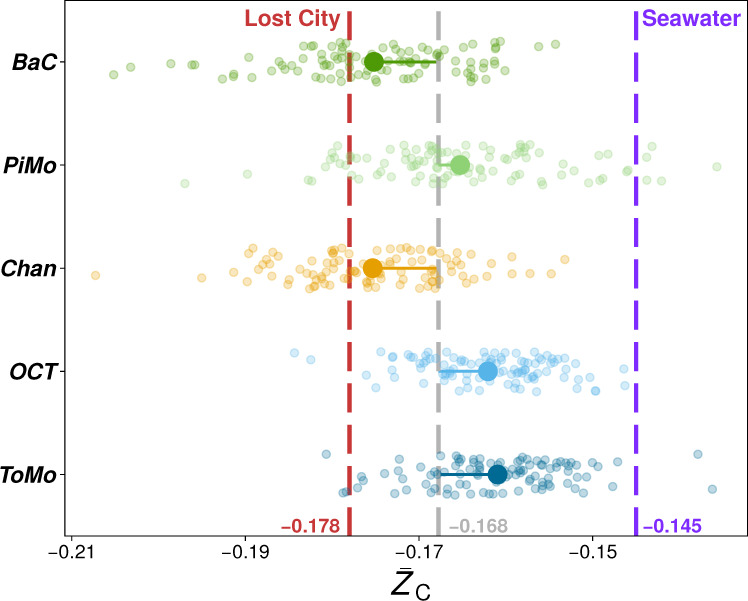
“Relatively low ZC of protein sequences inferred from metagenomes was also noted in a separate study of the Old City hydrothermal vent field [43].”
BackgroundUsing thermodynamics to obtain geochemical information from genomes
Dick, J. M., Boyer, G. M., Canovas, P. A., & Shock, E. L. (2022) · Geobiology · doi:10.1111/gbi.12532 · Cited by 8
“Lecoeuvre et al. (2021) reported that vent samples from the newly discovered Old City hydrothermal field on the Southwest Indian Ridge have metagenomically predicted proteins with lower ZC than those in ambient seawater.”
BackgroundAdam-Beyer, N., Laufer, K., Fuchs, S., Schippers, A., Indenbirken, D., Garbe‐Schönberg, D., Petersen, S., & Perner, M. (2023) · Frontiers in Microbiology · doi:10.3389/fmicb.2023.1173613 · Cited by 9
“…Old City hydrothermal fields at the ultraslow-spreading South-West Indian Ridge (SWIR) (Li et al., 2016; Ding et al., 2017; Yang et al., 2019; Lecoeuvre et al., 2021) as well as the recently discovered Pelagia vent site along the intermediate-spreading South-East Indian Ridge (SEIR) (Han et…”
BackgroundGlink, A., & Hasenclever, J. (2024) · Geochemistry Geophysics Geosystems · doi:10.1029/2023gc011331 · Cited by 7
“Direct observations of hydrothermal venting in amagmatic settings are limited to the recently discovered low temperature Old City hydrothermal field in the eastern magma‐poor corridor of the SWIR (Cannat, Agrinier, et al., 2019; Lecoeuvre et al., 2021).”
BackgroundRadziejewska, T., Błażewicz, M., Włodarska‐Kowalczuk, M., Jóźwiak, P., Pabis, K., & Węsławski, J. M. (2022) · Frontiers in Marine Science · doi:10.3389/fmars.2022.898828 · Cited by 7
“, 2015) and its being one of the few carbonate vent fields discovered so far (Lecoeuvre et al., 2021) resulted in the field becoming an important conservation target, recognised as an Ecologically”
BackgroundAn overview of experimental simulations of microbial activity in early Earth
Zhao, M., Zhao, Y., Lin, W., & Xiao, K. (2023) · Frontiers in Microbiology · doi:10.3389/fmicb.2022.1052831 · Cited by 8
“Interestingly, chemoautotrophy is found to be one of the dominant living strategies in many samples from these environments, either through oxidation of CO, reduced sulfur or H2 (Fortunato and Huber, 2016; Lecoeuvre et al., 2021; Nobu et al., 2022; Rogers et al., 2022), showing a slow lifestyle and adaption to the lim…”
BackgroundRoerdink, D. L., Vulcano, F., Landro, J.-K., Moltubakk, K. E., Babel, H. R., Jørgensen, S. L., Baumberger, T., Økland, I., Reeves, E. P., Thorseth, I. H., et al. (2024) · Frontiers in Marine Science · doi:10.3389/fmars.2023.1320655 · Cited by 7
Baudet, C., Bucciarelli, E., Sarthou, G., Boulart, C., Pelleter, E., Goddard‐Dwyer, M., Whitby, H., Zhang, R., Obernosterer, I., González-Santana, D., et al. (2024) · Marine Chemistry · doi:10.1016/j.marchem.2024.104401 · Cited by 8
Hydrothermal alteration of the oceanic lithosphere
Schwarzenbach, E. M., & Harris, M. (2023) · Elsevier eBooks · doi:10.1016/b978-0-323-99762-1.00016-4 · Cited by 5
Zhang, L., Zhou, W., Wang, Y., Liu, Y., Chen, J., Li, B., Su, B., & Song, H. (2024) · Frontiers in Marine Science · doi:10.3389/fmars.2023.1331680 · Cited by 5
Xu, X., Liao, S., Tao, C., & Liu, L. (2023) · Geoscience Frontiers · doi:10.1016/j.gsf.2023.101584 · Cited by 5
Extremophile hotspots linked to containerized industrial waste dumping in a deep-sea basin
Gutleben, J., Podell, S. B., Mizell, K., Sweeney, D., Neira, C., Levin, L. A., & Jensen, P. R. (2025) · PNAS Nexus · doi:10.1093/pnasnexus/pgaf260 · Cited by 6
“Upon contact with seawater, these hyperalka-line fluids precipitate calcium carbonates, forming large, strikingly white, calcite – brucite chimneys at active venting sites (51, 52).”
Taguchi, K., Kawagucci, S., Gilbert, A. R., Ueno, Y., Matsui, Y., Takano, Y., Tasumi, E., Miyazaki, M., Makabe, A., Miyazaki, J., et al. (2026) · Progress in Earth and Planetary Science · doi:10.1186/s40645-026-00806-x · Cited by 3
Redox Gradient Shapes the Chemical Composition of Peatland Microbial Communities
Milesi, V. (2024) · Geobiology · doi:10.1111/gbi.70001 · Cited by 3
“…be-tween the average carbon oxidation state of biomacromole-cules and redox potentials in low-energy environments have been accumulating, consistent with the minimization of bio-synthesis energy costs (Boyer et al. 2020; Lecoeuvre et al. 2021; Dick 2022; Dick and Meng 2023; Dick and Tan 2023).”
Mahato, S., & Cannat, M. (2025) · Geochemistry Geophysics Geosystems · doi:10.1029/2024gc011769 · Cited by 2
“Most active vents of the Old City hydrothermal field (Lecoeuvre et al., 2021) are located along scarp #8.”
Self-citationOsorio-Pando, L. S., Hernández‐Guzmán, M., Sidón-Ceseña, K., Ortega-Saad, Y., Camacho-Ibar, V. F., Chong‐Robles, J., & Lago‐Lestón, A. (2025) · Microorganisms · doi:10.3390/microorganisms13051106 · Cited by 2
“The MBG-A had previously been associated solely with marine sediments and hydrothermal vents [88–91], and it was similarly identified throughout the water column in the South China Sea by [92].”
Teece, B. L., Cannelli, S. M. C., Garibello, C. F., McGlynn, S. E., & Barge, L. M. (2025) · Earth-Science Reviews · doi:10.1016/j.earscirev.2025.105311 · Cited by 4
Mineral carbonation: Processes, mechanisms, and its role in the carbon–hydrogen cycle
Zhou, D., Cao, S., Li, X., Cheng, X., Liu, J., Dong, Y., Zhan, L., Wu, S., Jiang, S., & Shi, G. (2026) · Earth-Science Reviews · doi:10.1016/j.earscirev.2026.105549 · Cited by 2
Alian, O. M., Brazelton, W. J., Aquino, K. A., Twing, K. I., Pendleton, H. L., Früh‐Green, G. L., Lang, S. Q., & Schrenk, M. O. (2025) · Frontiers in Microbiomes · doi:10.3389/frmbi.2024.1401831 · Cited by 2
Biogeochemical Characteristics of Hydrothermal Systems in the Indian Ocean
Prakash, L. S., Fernandes, S. O., Ingole, B., & Kurian, P. J. (2022) · Wiley eBooks · doi:10.1002/9781119554356.ch14 · Cited by 2
Jangir, Y., & Dutta, S. (2026) · Frontiers in Astronomy and Space Sciences · doi:10.3389/fspas.2025.1712191 · Cited by 2
“Along the Southwest Indian Ridge (SWIR), key fields include Mount Jourdanne (Münch et al., 2001), Longqi (Tao et al., 2012), Duanqiao (Yang et al., 2017), Tiancheng (Zhou et al., 2018), Old City (Lecoeuvre et al., 2021), and Carlsberg ridge (Qiu et al., 2021; Liang et al., 2023; Cai et al., 2024).”
Lipid biomarkers reveal dominance of aerobic methanotrophy in a continental serpentinizing system
Collins, C., Parenteau, M. N., Jahnke, L. L., Kubo, M. D. Y., Moseman‐Valtierra, S. M., Young, K., & Cardace, D. (2026) · Frontiers in Microbiology · doi:10.3389/fmicb.2025.1694997 · Cited by 1
A modified Rock-Eval approach to track organics in (bio)carbonates
Perron, A., Ménèz, B., Baudin, F., & Stalport, F. (2025) · Chemical Geology · doi:10.1016/j.chemgeo.2025.122815
Glink, A., Hasenclever, J., Rüpke, L. H., Hort, M., & Petersen, S. (2025) · Geochemistry Geophysics Geosystems · doi:10.1029/2024gc012144
“Low‐temperature venting on top of the OCC, driven by residual mantle heat, late‐stage cooling of mafic intrusions (Evans et al., 2024) serpentinization and/or thermal cracking of deep hot rocks (for example, Lost City, Früh‐Green et al. (2003); Old City, Lecoeuvre et al. (2021)).”
Gutiérrez‐Ariza, C. M., Barge, L. M., Ding, Y., Cardoso, S. S. S., McGlynn, S. E., Nakamura, R., Giovanelli, D., Price, R. E., Lee, H. E., Huertas, F. J., et al. (2024) · Figshare · doi:10.6084/m9.figshare.26687046
Portholes into the deep: Exploring ocean memory of Lost City through art and science
Davidson, A. M., Brazelton, W. J., & Lang, S. Q. (2026) · Elementa Science of the Anthropocene · doi:10.1525/elementa.2025.00052
Contrôles biologiques, structurels et chimiques sur la minéralisation du manganèse
Dejean, C. (2022) · theses.fr (ABES) · doi:10.70675/36297789z60c3z48c8z805bz21badf34e301
Cycle biogéochimique du Fe et du Mn dans le secteur Indien de l'Océan Austral
Baudet, C. (2023) · theses.fr (ABES) · doi:10.70675/f309fd2azaf6bz4f2az956bz8c0e48a661ae
A hidden pattern? Common polyextremophilic microbial adaptations in Icy Moon analog environments
Gusi-Martínez, S., Fairén, A. G., & Fernández-Martínez, M. Á. (2026) · Frontiers in Astronomy and Space Sciences · doi:10.3389/fspas.2026.1786844
“Moreover, the presence of methanotrophic organisms like Methylococcales in deep environments could be related to methane generation on the seafloor by geochemical processes such as serpentinization (Lecoeuvre et al., 2020).”
Trenches, serpentinization, and the origin of life
Huang, R., Shang, X., & Sun, W. (2026) · Elsevier eBooks · doi:10.1016/b978-0-443-27610-1.00006-5
Corbalán, A., & Nedimović, M. R. (2026) · Geochemistry Geophysics Geosystems · doi:10.1029/2026gc013002
“…(Sauter et al., 2013) or hydrothermal alteration, and release large amounts of methane and hydrogen to the water column (e.g., Mével, 2003) capable of hosting hydrothermal fields supporting microbial life like the Old City at the Southwest Indian Ridge (SWIR; Lecoeuvre et al., 2021).”
Metadata
- Authors
- Lecoeuvre, A., Ménez, B., Cannat, M., Chavagnac, V., & Gérard, E.
- Affiliations
- Centre National de la Recherche Scientifique (FR)
- Université de Paris, Institut de physique du globe de Paris, CNRS UMR 7154 , Paris, France
- Corresponding author
- Lecoeuvre, Aurélien
- Venue
- The ISME Journal
- Publisher
- Oxford University Press (OUP)
- Published
- 2020-11-02
- Volume
- 15
- Issue
- 3
- Pages
- 818-832
- ISSN
- 1751-7362 (ISSN-L)
- 1751-7370
- PMC
- PMC8027613
- OpenAlex
- W3095001187
- Cited by
- 62
- References
- 73
- Citations by year
- 2026: 7 · 2025: 10 · 2024: 17 · 2023: 12 · 2022: 12 · 2021: 3 · 2020: 1
- FWCI
- 3.72
- Type
- journal article
- Language
- en
- Open access
- hybrid
- doi.org
- Licence
- cc-by-nc
- creativecommons.org/licenses/by/4.0/ (vor, 1164 d)
- creativecommons.org/licenses/by/4.0 (tdm)
- creativecommons.org/licenses/by/4.0 (vor)
- Locations
- The ISME Journal (publishedVersion, cc-by-nc)
- PubMed Central (publishedVersion, cc-by)
- PubMed (publishedVersion)
- HAL (submittedVersion, cc-by)
- Institutional Archive of Ifremer (French Research Institute for Exploitation of the Sea) (submittedVersion, other-oa)
- Funders
- Alfred P. Sloan Foundation
- Institut Français de Bioinformatique (ANR-11-INBS-0013)
- Agence Nationale de la Recherche (ANR-14-CE01-0008, ANR18, ANR-11-INBS, ANR-11-INBS-0013, 12015908, ANR-18-IDEX-0001, ANR-10-LABX-0023)
- Centre National de la Recherche Scientifique
- Institut de Physique du Globe de Paris (12015908)
- Université de Paris (ANR-18- IDEX-0001, 18-IDEX-0001)
- Labex UnivEarthS (12015908, ANR‐18‐IDEX‐0001)
- CHIST-ERA
- Topics
- Physical Sciences › Environmental Science › Ecology › Microbial Community Ecology and Physiology
- Physical Sciences › Environmental Science › Environmental Chemistry › Methane Hydrates and Related Phenomena
- Physical Sciences › Earth and Planetary Sciences › Geochemistry and Petrology › Geochemistry and Elemental Analysis
- Keywords
- lost cities, microbial ecology, Methanosarcinales, formate metabolism, carbon monoxide metabolism, redox conditions, Southwest Indian Ridge, microbial community structure
- MeSH terms
- Archaea, Carbon, Phylogeny, RNA, Ribosomal, 16S, Ecosystem, Metagenome, Hydrothermal Vents
About these checks
Registry, retraction, Cites and statistics results are computed, not judged, with one exception: a printed reference that no index lists is read once by a model before it counts as a citation error. Claims are extracted by a model and kept only when their quote appears verbatim in the text; each cited source is then checked, with a model’s help, for whether it says what the claim relies on. Those verdicts can be wrong — read the claim’s quote and the cited source before relying on one.
Statistics and arithmetic are recomputed, not judged.
Confidence bands are shown only for fields calibrated on our annotated test set. None is calibrated yet, so no band is shown.
What counts as a claim ›How we measure confidence ›How we check this ›
Are you an author, or do you see a problem with this page? Request a review
Data sources
Bibliographic data: Semantic Scholar, OpenAlex, Crossref.
Contains information from the Semantic Scholar Academic Graph Datasets, made available under the ODC Attribution License (ODC-BY 1.0).
Semantic Scholar’s data is described in: Kinney, R., et al. (2023). The Semantic Scholar Open Data Platform. arXiv:2301.10140.
