

Rapid neuroplasticity changes and response to intravenous ketamine: a randomized controlled trial in treatment-resistant depression
Open accessThe DOI matches its Crossref record; 64 of the 64 references it cites were found in a registry or an index.
Abstract
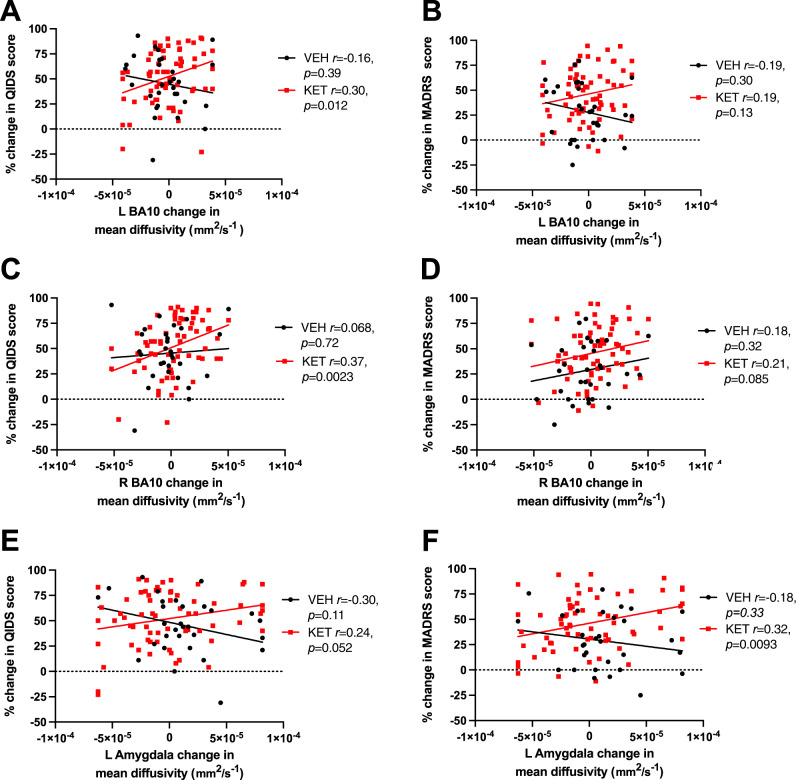
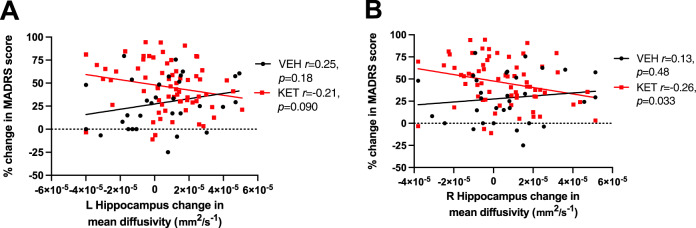
Intravenous ketamine is posited to rapidly reverse depression by rapidly enhancing neuroplasticity. In human patients, we quantified gray matter microstructural changes on a rapid (24-h) timescale within key regions where neuroplasticity enhancements post-ketamine have been implicated in animal models. In this study, 98 unipolar depressed adults who failed at least one antidepressant medication were randomized 2:1 to a single infusion of intravenous ketamine (0.5 mg/kg) or vehicle (saline) and completed diffusion tensor imaging (DTI) assessments at pre-infusion baseline and 24-h post-infusion. DTI mean diffusivity (DTI-MD), a putative marker of microstructural neuroplasticity in gray matter, was calculated for 7 regions of interest (left and right BA10, amygdala, and hippocampus; and ventral Anterior Cingulate Cortex) and compared to clinical response measured with the Montgomery-Asberg Depression Rating Scale (MADRS) and the Quick Inventory of Depressive Symptoms-Self-Report (QIDS-SR). Individual differences in DTI-MD change (greater decrease from baseline to 24-h post-infusion, indicative of more neuroplasticity enhancement) were associated with larger improvements in depression scores across several regions. In the left BA10 and left amygdala, these relationships were driven primarily by the ketamine group (group * DTI-MD interaction effects: p = 0.016–0.082). In the right BA10, these associations generalized to both infusion arms ( p = 0.007). In the left and right hippocampus, on the MADRS only, interaction effects were observed in the opposite direction, such that DTI-MD change was inversely associated with depression change in the ketamine arm specifically (group * DTI-MD interaction effects: p = 0.032–0.06). The acute effects of ketamine on depression may be mediated, in part, by acute changes in neuroplasticity quantifiable with DTI.
Overview
The claims and statistics of this paper haven’t been checked yet.
Free: it reads the open-access text and checks the first 5 claims that cite a source we can check. Create a free account to check every claim.
Integrity signals
Registry
Cites
Statistics
Figures
Verification
Claims the paper makes
The claims and statistics of this paper haven’t been checked yet.
Free: it reads the open-access text and checks the first 5 claims that cite a source we can check. Create a free account to check every claim.
Self-check
Percentages, sums and reported differences re-computed from the paper’s own numbers.
The self-check needs the paper’s full text.
Citations
Cites
A new depression scale designed to be sensitive to change
Montgomery, S. A., & Åsberg, M. (1979) · British Journal of Psychiatry · doi:10.1192/bjp.134.4.382 · Cited by 13,962
Molecular Mechanisms of Depression: Perspectives on New Treatment Strategies
Lang, U. E., & Borgwardt, S. (2013) · Cellular Physiology and Biochemistry · doi:10.1159/000350094 · Cited by 8,475
Rush, A. J., Trivedi, M. H., Wisniewski, S. R., Nierenberg, A. A., Stewart, J. W., Warden, D., Niederehe, G., Thase, M. E., Lavori, P. W., Lebowitz, B. D., et al. (2006) · American Journal of Psychiatry · doi:10.1176/ajp.2006.163.11.1905 · Cited by 5,643
Requirement of hippocampal neurogenesis for the behavioral effects of antidepressants
Santarelli, L., Saxe, M., Gross, C., Surget, A., Battaglia, F., Dulawa, S., Weisstaub, N., Lee, J., Duman, R., Arancio, O., et al. (2003) · Science · doi:10.1126/science.1083328 · Cited by 4,321
Antidepressant effects of ketamine in depressed patients
Berman, R. M., Cappiello, A., Anand, A., Oren, D. A., Heninger, G. R., Charney, D. S., & Krystal, J. H. (2000) · Biological Psychiatry · doi:10.1016/s0006-3223(99)00230-9 · Cited by 3,856
Rush, A. J., Trivedi, M. H., Ibrahim, H. M., Carmody, T. J., Arnow, B., Klein, D. N., Markowitz, J. C., Ninan, P. T., Kornstein, S., Manber, R., et al. (2003) · Biological Psychiatry · doi:10.1016/s0006-3223(02)01866-8 · Cited by 3,829 · cited 4×
“In the subset of patients with DTI neuroimaging data, ketamine significantly improved MADRS scores 24-h post-infusion (t(96)=−3.01, p= 0.003), while there was no significant effect of ketamine on change in QIDS-SR score 24-h post-infusion in this subset of patients (t(95)=−1.10, p= 0.28).”
MethodInfluentialChronic antidepressant treatment increases neurogenesis in adult rat hippocampus
Malberg, J. E., Eisch, A. J., Nestler, E. J., & Duman, R. S. (2000) · The Journal of Neuroscience · doi:10.1523/jneurosci.20-24-09104.2000 · Cited by 3,111
mTOR-Dependent Synapse Formation Underlies the Rapid Antidepressant Effects of NMDA Antagonists
Li, N., Lee, B., Liu, R.-J., Banasr, M., Dwyer, J. M., Iwata, M., Li, X.-Y., Aghajanian, G., & Duman, R. S. (2010) · Science · doi:10.1126/science.1190287 · Cited by 2,881 · cited 8×
“Activity in these regions has been shown to be altered in depressed subjects, with studies of BA10 (and nearby related PFC regions) showing hyperactivation to reward-related cues and hypoactivation to negative affective cues (e.g., negatively valanced faces) in depressed subjects relative to controls [46].”
BackgroundInfluentialSynaptic plasticity and depression: new insights from stress and rapid-acting antidepressants
Duman, R. S., Aghajanian, G. K., Sanacora, G., & Krystal, J. H. (2016) · Nature Medicine · doi:10.1038/nm.4050 · Cited by 1,750
Cited by
Agnorelli, C., Spriggs, M. J., Godfrey, K., Sawicka, G., Bohl, B., Douglass, H. M., Fagiolini, A. M., Hashemi, P., Carhart-Harris, R. L., Nutt, D. J., et al. (2025) · Neuroscience & Biobehavioral Reviews · doi:10.1016/j.neubiorev.2025.106132 · Cited by 69
Pardossi, S., Fagiolini, A., & Cuomo, A. (2024) · International Journal of Molecular Sciences · doi:10.3390/ijms252313098 · Cited by 51
Alcohol Use Disorder and Chronic Pain: An Overlooked Epidemic
Aquino, J. P. D., Sloan, M. E., Nunes, J. C., Costa, G. P. A., Katz, J. L., de Oliveira, D., Ra, J., Tang, V. M., & Petrakis, I. L. (2024) · American Journal of Psychiatry · doi:10.1176/appi.ajp.20230886 · Cited by 49
Paolini, M., Harrington, Y. A., Colombo, F., Bettonagli, V., Poletti, S., Carminati, M., Colombo, C., Benedetti, F., & Zanardi, R. (2023) · Journal of Psychopharmacology · doi:10.1177/02698811231190859 · Cited by 38
Storm on predictive brain: A neurocomputational account of ketamine antidepressant effect
Bottemanne, H., Berkovitch, L., Gauld, C., Balcerac, A., Schmidt, L., Mouchabac, S., & Fossati, P. (2023) · Neuroscience & Biobehavioral Reviews · doi:10.1016/j.neubiorev.2023.105410 · Cited by 33
An integrative view on the cell-type-specific mechanisms of ketamine's antidepressant actions
Lewis, V., Rurak, G. M., Salmaso, N., & Aguilar‐Valles, A. (2024) · Trends in Neurosciences · doi:10.1016/j.tins.2023.12.004 · Cited by 33
Calder, A. E., Hase, A., & Hasler, G. (2024) · Molecular Psychiatry · doi:10.1038/s41380-024-02830-z · Cited by 25
Constantino, J. L., Godschalk, M., van Dalfsen, J. H., Veraart, J. K. E., Spijker, J., van Exel, E. R., Schoevers, R. A., & Kamphuis, J. (2025) · Psychiatry Research · doi:10.1016/j.psychres.2025.116355 · Cited by 23
Antos, Z., Żukow, X., Bursztynowicz, L., & Jakubów, P. (2024) · International Journal of Molecular Sciences · doi:10.3390/ijms252413658 · Cited by 21
Jager, J. E. D., Boesjes, R., Roelandt, G. H. J., Koliaki, I., Sommer, I. E., Schoevers, R. A., & Nuninga, J. O. (2024) · Neuroscience & Biobehavioral Reviews · doi:10.1016/j.neubiorev.2024.105796 · Cited by 21
Colombo, F., Calesella, F., Bravi, B., Fortaner-Uyà, L., Monopoli, C., Tassi, E., Carminati, M., Zanardi, R., Bollettini, I., Poletti, S., et al. (2024) · European Neuropsychopharmacology · doi:10.1016/j.euroneuro.2024.05.015 · Cited by 20
Aepfelbacher, J., Panny, B., & Price, R. B. (2024) · Biological Psychiatry Global Open Science · doi:10.1016/j.bpsgos.2024.100316 · Cited by 18
Self-citationLiu, X., Wei, Z., Li, L., Li, J., Deng, Y., Liu, Y., Li, H., Peng, D., Wan, X., & Wu, G. (2024) · Journal of Affective Disorders · doi:10.1016/j.jad.2024.12.002 · Cited by 16
A review of diffusion MRI in mood disorders: mechanisms and predictors of treatment response
Al‐Sharif, N., Zavaliangos‐Petropulu, A., & Narr, K. L. (2024) · Neuropsychopharmacology · doi:10.1038/s41386-024-01894-3 · Cited by 15
Moore, T. M., Walker, K. C., Tung, E., Teed, A. R., Hell, F., Kinreich, S., Jung, R., Abdel, F., Hanson, R. W., & Ahmed, S. S. (2025) · Journal of Affective Disorders · doi:10.1016/j.jad.2025.04.041 · Cited by 15
Kirchberg, M. C., Pinson, C. K., & Frank, G. (2024) · Expert Opinion on Pharmacotherapy · doi:10.1080/14656566.2024.2424316 · Cited by 14
Sholevar, R., Kromka, W., & Beaussant, Y. (2025) · Journal of Palliative Medicine · doi:10.1089/jpm.2024.0346 · Cited by 13
Petrozzi, B. P., Spangemacher, M., Deicher, A., Drews, L., Defert, J., Silva-Colmenero, A. Y., Wein, P., Riedinger, E., Gründer, G., Gilles, M., et al. (2024) · Frontiers in Psychiatry · doi:10.3389/fpsyt.2024.1415505 · Cited by 12
Lv, S., Yang, N., Lu, Y., Zhang, G., Zhong, X., Cui, Y., Huang, Y., Jing, T., & Sai, Y. (2024) · Frontiers in Pharmacology · doi:10.3389/fphar.2024.1426769 · Cited by 11
Psychedelics and neural plasticity
Sumner, R. L., & Łukasiewicz, K. (2023) · BMC Neuroscience · doi:10.1186/s12868-023-00809-0 · Cited by 8
Le, G. H., Wong, S., Johnson, D. E., Lu, A., Orsini, D. K., Chisamore, N., Luch, S. D. D., Rosenblat, J. D., & McIntyre, R. S. (2025) · Journal of Affective Disorders · doi:10.1016/j.jad.2025.121081 · Cited by 7
Grice, A. B., Sloofman, L. G., Levy, T., Walker, H., Ganesh, G., Santos, M. R. D. L., Amini, P., Buxbaum, J. D., Kolevzon, A., Kostić, A., et al. (2024) · Translational Psychiatry · doi:10.1038/s41398-024-03005-8 · Cited by 7
Trimmel, M., Renner, A., & Kaltenboeck, A. (2024) · International Journal of Mental Health Nursing · doi:10.1111/inm.13425 · Cited by 7
Oliva, V., Possidente, C., Fanelli, G., Domschke, K., Minelli, A., Gennarelli, M., Martini, P. G. V., Bortolomasi, M., Squassina, A., Pisanu, C., et al. (2025) · European Neuropsychopharmacology · doi:10.1016/j.euroneuro.2025.05.004 · Cited by 7
Matar, D., Serhan, A., Bilani, S. E., Faraj, R. A., Hadi, B. A., & Fakhoury, M. (2024) · Advances in experimental medicine and biology · doi:10.1007/978-981-97-4402-2_2 · Cited by 7
Gao, Z., Lu, C., Zhu, Y., Liu, Y., Lin, Y., Gao, W., Tian, L., & Wu, L. (2023) · Brain Research · doi:10.1016/j.brainres.2023.148665 · Cited by 6
Chan, W.-L., Olbrich, S., Jiang, X., Zhang, H., Ip, C.-T., & Brunovský, M. (2025) · Journal of Affective Disorders · doi:10.1016/j.jad.2025.119477 · Cited by 5
Sevelius, J. M., Golden, R. L., Stott, B. L., Kozicz, N. O., Mukerjee, R., Cluesman, S. R., Jones, T., & Cornelius, T. M. (2026) · Frontiers in Psychiatry · doi:10.3389/fpsyt.2025.1727487 · Cited by 5
Simpson, R. J., & Juruena, M. F. (2026) · Psychopharmacology · doi:10.1007/s00213-026-07003-0 · Cited by 5
Garland, E. L., Lewis, B., Thielking, P. D., Odette, M. M., Pfeffer, H., & Shen, J. (2026) · Nature Mental Health · doi:10.1038/s44220-026-00625-5 · Cited by 5
A long, strange trip: Ketamine treatment in psychiatry
Nutt, D. J., Morgan, C. J. A., Erritzøe, D., Greenway, K. T., & Young, A. H. (2025) · Journal of Psychopharmacology · doi:10.1177/02698811251379393 · Cited by 5
Effects of Intravenous Ketamine on Posttraumatic Stress Disorder ( PTSD ): A Systematic Review
Yin, L., Lu, A., Le, G. H., Dri, C. E., Wong, S., Teopiz, K. M., Xu, H., Ho, R., Rhee, T. G., Lo, H. K. Y., et al. (2025) · Acta Psychiatrica Scandinavica · doi:10.1111/acps.70053 · Cited by 4
Donegan, K. R., Hossein, S., Panny, B., Brown, V. M., Lee, C. T., Harty, S., Lynch, K., Fox, C. A., Hanlon, A. K., O’Keane, V., et al. (2025) · Translational Psychiatry · doi:10.1038/s41398-025-03722-8 · Cited by 4
Self-citationMartínez-Torres, N. I., Cárdenas-Bedoya, J., & Torres-Mendoza, B. M. (2025) · Metabolic Brain Disease · doi:10.1007/s11011-025-01725-4 · Cited by 3
Abreu, C. C., Biorac, A., Baldessarini, R. J., & Vázquez, G. H. (2025) · Therapeutic Advances in Psychopharmacology · doi:10.1177/20451253251392429 · Cited by 3
Zhou, Y., Li, W., Lan, X., Wang, C., Chen, X., Luo, Z., Zhang, F., Liu, G., Wu, Z., Shen, J., et al. (2025) · Journal of the American Academy of Child & Adolescent Psychiatry · doi:10.1016/j.jaac.2025.12.011 · Cited by 3
Faisal, H., Le, G. H., Kwan, A. T. H., Wong, S., Cheung, W., Dri, C. E., Cao, B., Rhee, T. G., Bargiota, S. I., Lo, H. K. Y., et al. (2026) · CNS Spectrums · doi:10.1017/s109285292610087x · Cited by 3
A Perspective on Psychedelics as Treatments for Addictions
Nutt, D. J., Morgan, C. J. A., & Klaire, S. S. (2024) · Journal of Studies on Alcohol and Drugs · doi:10.15288/jsad.23-00032 · Cited by 2
Eken, H. N., Spotts, C., Panny, B., Griffo, A., Degutis, M., Cruz, N., Bell, E., Do-Nguyen, K., Wallace, M. L., Mathew, S. J., et al. (2024) · Molecular Psychiatry · doi:10.1038/s41380-024-02564-y · Cited by 2
Self-citationPharmacological interventions for alcohol use disorder: novel insights from recent clinical trials
McManus, K. R., & Ray, L. A. (2026) · Expert Review of Clinical Pharmacology · doi:10.1080/17512433.2026.2625341 · Cited by 2
León-Rojas, J. E., Mascialino, G., Vinueza, L., Hinojosa-Figueroa, M. S., Arias, C. F. N., Barberis, E. D. C., & Sacks-Zimmerman, A. L. (2026) · Frontiers in Neurology · doi:10.3389/fneur.2026.1786249 · Cited by 2
The collective lie in ketamine therapy: a call to realign clinical practice with neurobiology
Miller, C., Lopes, B., & McCurdy, A. (2025) · Frontiers in Psychiatry · doi:10.3389/fpsyt.2025.1610335 · Cited by 2
Mindfulness Meditation as an Adjunct to Esketamine Treatment for Major Depressive Disorder
Tustison, J. (2025) · eScholarship (California Digital Library) · Cited by 2
Wirkmechanismen antidepressiver Pharmakotherapie: Gehirn und Psyche – Körper und Umwelt
Spangemacher, M., Reinwald, J., Adolphi, H., Kärtner, L., Mertens, L. J., Schmitz, C. N., & Gründer, G. (2025) · Der Nervenarzt · doi:10.1007/s00115-024-01786-3 · Cited by 1
Weigner, D., Meiering, M. S., Weigand, A., Carstens, L., Keicher, C., Hertrampf, R., Beckmann, C. F., Mennes, M., Wunder, A., Gärtner, M., et al. (2025) · Journal of Psychopharmacology · doi:10.1177/02698811251346705 · Cited by 1
Strous, J. F. M., Roelandt, G. H. J., van Dalfsen, J. H., Kamphuis, J., Marijnissen, R. M., & Schoevers, R. A. (2025) · International Journal of Methods in Psychiatric Research · doi:10.1002/mpr.70044 · Cited by 1
Kosted, R., Waddell, A., Adolph, K., & Fonzo, G. A. (2026) · Journal of Affective Disorders · doi:10.1016/j.jad.2026.121350 · Cited by 1
Bonnet, U., Scherbaum, N., Juckel, G., & Bschor, T. (2026) · Fortschritte der Neurologie · Psychiatrie · doi:10.1055/a-2846-4275 · Cited by 1
Diffusion tensor imaging in chronic tension-type headache
Teepker, M., Vacik, L., Hermsen, A. M., Menzler, K., Mylius, V., Timmermann, L., Knake, S., & Belke, M. (2026) · Frontiers in Pain Research · doi:10.3389/fpain.2026.1850836 · Cited by 1
Novel pharmacotherapies for opioid use disorder and opioid withdrawal
Shen, M. R., Owusu-Boaitey, K. E., Murphy, Z., Rains, A., Wang, P. R., Zhou, D. W., & Suzuki, J. (2026) · Frontiers in Psychiatry · doi:10.3389/fpsyt.2026.1909149 · Cited by 1
Woody, M. L., Rohac, R., Cooper, I., Griffo, A., Mcdonald, N., Spotts, C., Fournier, J. C. J., Jones, N. P., Peciña, M., Young, K. D., et al. (2024) · Biological Psychiatry · doi:10.1016/j.biopsych.2024.10.024 · Cited by 1
Self-citationO USO DA CETAMINA/ESCETAMINA NO TRANSTORNO DEPRESSIVO MAIOR
de Mendonça, J. C., LOUVEM, R. M., RECLA, B. M. F., & de Mendonça, T. C. (2024) · Editora Pasteur eBooks · doi:10.59290/978-65-6029-075-4.14
Advancement In Neuroplasticity Trainings in Multiple Fields Since 2018
Yang, J. (2023) · Highlights in Science Engineering and Technology · doi:10.54097/2r7be810
Lamela, A. W., Chambó, L. T., Chacon, L. M., Fazoli, B. G. D. N., & de Andrade, M. C. (2024) · doi:10.22533/at.ed.0762412063
Basic aspects of ketamine therapy for treatment-resistant depression - a review paper
Szafrańska, W., Poborowska, D., Gańko, T., Kahan, W., Bąk, E., Fordymacki, J., Wojaczek, M., Polańska, K., & Najjar, O. (2024) · Quality in Sport · doi:10.12775/qs.2024.19.53331
Mehta, M. A. (2024) · Springer eBooks · doi:10.1007/978-3-031-61992-2_14
Ketamine - mechanisms of action as an antidepressant
Gębik, B., Bliźniewska-Kowalska, K. M., & Gałecki, P. (2026) · Psychiatria Polska · doi:10.12740/pp/onlinefirst/202128
Investing in Group Psychedelic Therapy for Latinx Immigrants
Zambrano, J., Forcén, F. E., Hidalgo, J., & King, F. (2025) · Journal of Immigrant and Minority Health · doi:10.1007/s10903-025-01702-0
da Silva, C. H. S., & da Costa, P. M. (2025) · Editora Científica Digital eBooks · doi:10.37885/250419254
Ciências da Saúde: Abordagens Interdisciplinares e Inovações Científicas - Vol. 2
Praxedes, M. F. D. S., Junior, F. F. D. C., & Pereira, W. F. (2025) · Editora Científica Digital eBooks · doi:10.37885/978-65-5360-974-7
Skowron, C. S., Miłkowska, U., Piech, G. M., Lis, I., & Kurzyna, P. F. (2025) · Biuletyn Głównej Biblioteki Lekarskiej · doi:10.2478/bgbl-2025-0011
Alsari, N. Z., Mubarak, N. A., & Al-Sabbagh, A. I. (2025) · Al-Rafidain Journal of Medical Sciences · doi:10.54133/ajms.v9i1.2063
O USO DA QUETAMINA INTRAVENOSA NO TRATAMENTO DA DEPRESSÃO RECORRENTE: UMA REVISÃO DE LITERATURA
Ramos, B. P. C., Moreira, A. C. B., Gama, J. D., Teixeira, I. L. A., Presta, V. S., & Lima, R. F. D. S. (2025) · Revista Ibero-Americana de Humanidades, Ciências e Educação · doi:10.51891/rease.v11i8.20600
Landwehr, A., Ewart, T., Bobotis, B. C., & Tremblay, M. (2025) · Preprints.org · doi:10.20944/preprints202509.1761.v1
Rodrigues, S. S., Bosco, G. B. D., Martins, C. R. G., Dias, A. J. E. A., & Neves, R. A. (2025) · DELOS Desarrollo Local Sostenible · doi:10.55905/rdelosv18.n72espec-017
Wellington, N. J., Quigley, B. L., Bouças, A. P., Dutton, M., Can, A., Lagopoulos, J., & Kuballa, A. (2025) · Journal of Affective Disorders · doi:10.1016/j.jad.2025.120791
Ketamine-assisted psychotherapy in real-world setting: A retrospective observational cohort study
Galo, M. S. R. L. (2025) · Portuguese National Funding Agency for Science, Research and Technology (RCAAP Project by FCT)
Eckert, D., & Kasper, S. F. (2026) · International Journal of Psychiatry in Clinical Practice · doi:10.1080/13651501.2026.2663307
Severance, T. (2026) · Digital Commons at National Lewis University (National Lewis University)
Gomez, S. G. (2026) · Scholars Archive - University at Albany (University at Albany, State University of New York)
Hardy, M. S., Li, S. W., & Wilkinson, S. T. (2026) · FOCUS The Journal of Lifelong Learning in Psychiatry · doi:10.1176/appi.focus.20260001
Yin, Y., Sun, S., Zhang, H., Bi, P.-W., Zhao, J.-N., Cheng, H., & Li, Y. (2026) · Translational Psychiatry · doi:10.1038/s41398-026-04242-9
Srividya, K., Unnikrishnan, S., & -, A. S. (2026) · International Journal of Indian Psychology · doi:10.25215/1403.024
Goel, A., Diep, C., Zahin, A., Rosenblat, J. D., Pereira, S. M., Teja, B. J., Rao, K., Pritlove, C., Hodwitz, K., Clarke, H. A., et al. (2026) · Med · doi:10.1016/j.medj.2026.101259
Veleanu, M., Schuberth, L. E., Kilias, A., Weber, J., Warneke, J., Würz, L. M., Schwär, T., Heck, R., Müller, J., Sarrazin, D. H., et al. (2026) · Nature Communications · doi:10.1038/s41467-026-77248-y · Cited by 1
Malewska-Kasprzak, M., Rybakowski, F., & Dmitrzak‐Węglarz, M. (2026) · CNS Spectrums · doi:10.1017/s1092852926101187
Liou, Y., Cheng, L., Lin, W.-C., Su, T.-P., Chen, L.-F., Tu, P., Li, C.-T., Bai, Y.-M., Tsai, S., & Chen, M.-H. (2026) · Journal of Affective Disorders · doi:10.1016/j.jad.2026.122673
Fijtman, A., Lally, N., Evans, J. W., Jones, G. H., Roiser, J. P., & Zarate, C. A. (2026) · Psychiatry Research Neuroimaging · doi:10.1016/j.pscychresns.2026.112367
Vestring, S., Veleanu, M., Weber, J., Schwär, T., Schuberth, L., Sarrazin, D., Anselin, M., Rutke, L., Suarez-Marchi, G. J., Zimmermann, S., et al. (2025) · doi:10.21203/rs.3.rs-6348176/v1
Metadata
- Authors
- Kopelman, J., Keller, T. A., Panny, B., Griffo, A., Degutis, M., Spotts, C., Cruz, N., Bell, E., Do-Nguyen, K., Wallace, M. L., Mathew, S. J., Howland, R. H., & Price, R. B.
- Affiliations
- University of California San Diego (US)
- Carnegie Mellon University (US)
- University of Pittsburgh (US)
- Michael E. DeBakey VA Medical Center (US)
- Corresponding author
- Price, Rebecca B.
- ORCID
- Venue
- Translational Psychiatry
- Published
- 2023-05-09
- Volume
- 13
- Issue
- 1
- Pages
- 159-159
- ISSN
- 2158-3188 (ISSN-L)
- PMC
- PMC10170140
- OpenAlex
- W4376132496
- Cited by
- 60
- References
- 64
- Citations by year
- 2026: 15 · 2025: 20 · 2024: 21 · 2023: 4
- FWCI
- 9.31
- Type
- journal article
- Language
- en
- Open access
- gold
- doi.org
- Licence
- cc-by
- creativecommons.org/licenses/by/4.0 (tdm)
- creativecommons.org/licenses/by/4.0 (vor)
- Locations
- Translational Psychiatry (publishedVersion, cc-by)
- PubMed Central (publishedVersion, cc-by)
- PubMed (publishedVersion)
- Digital Commons-TMC (Texas Medical Center) (submittedVersion)
- DOAJ (DOAJ: Directory of Open Access Journals) (submittedVersion, cc-by-sa)
- Funders
- U.S. Department of Health & Human Services | NIH | National Institute of Mental Health (R01MH113857)
- Topics
- Health Sciences › Medicine › Pharmacology (medical) › Treatment of Major Depression
- Health Sciences › Medicine › Psychiatry and Mental health › Electroconvulsive Therapy Studies
- Life Sciences › Neuroscience › Neurology › Transcranial Magnetic Stimulation Studies
- Keywords
- intravenous ketamine, treatment-resistant depression, neuroplasticity, gray matter microstructure, mean diffusivity, diffusion tensor imaging, rapid-acting antidepressants, anterior cingulate cortex, amygdala, hippocampus, individual differences in treatment response
- MeSH terms
- Adult, Animals, Cerebral Cortex, Depression, Humans, Ketamine, Neuronal Plasticity, Diffusion Tensor Imaging
About these checks
Registry, retraction, Cites and statistics results are computed, not judged, with one exception: a printed reference that no index lists is read once by a model before it counts as a citation error. Claims are extracted by a model and kept only when their quote appears verbatim in the text; each cited source is then checked, with a model’s help, for whether it says what the claim relies on. Those verdicts can be wrong — read the claim’s quote and the cited source before relying on one.
Statistics and arithmetic are recomputed, not judged.
Confidence bands are shown only for fields calibrated on our annotated test set. None is calibrated yet, so no band is shown.
What counts as a claim ›How we measure confidence ›How we check this ›
Are you an author, or do you see a problem with this page? Request a review
Data sources
Bibliographic data: Semantic Scholar, OpenAlex, Crossref.
Contains information from the Semantic Scholar Academic Graph Datasets, made available under the ODC Attribution License (ODC-BY 1.0).
Semantic Scholar’s data is described in: Kinney, R., et al. (2023). The Semantic Scholar Open Data Platform. arXiv:2301.10140.
