

Rapid neuroplasticity changes and response to intravenous ketamine: a randomized controlled trial in treatment-resistant depression
Open accessThe DOI matches its Crossref record; 64 of the 64 references it cites were found in a registry or an index.
Abstract
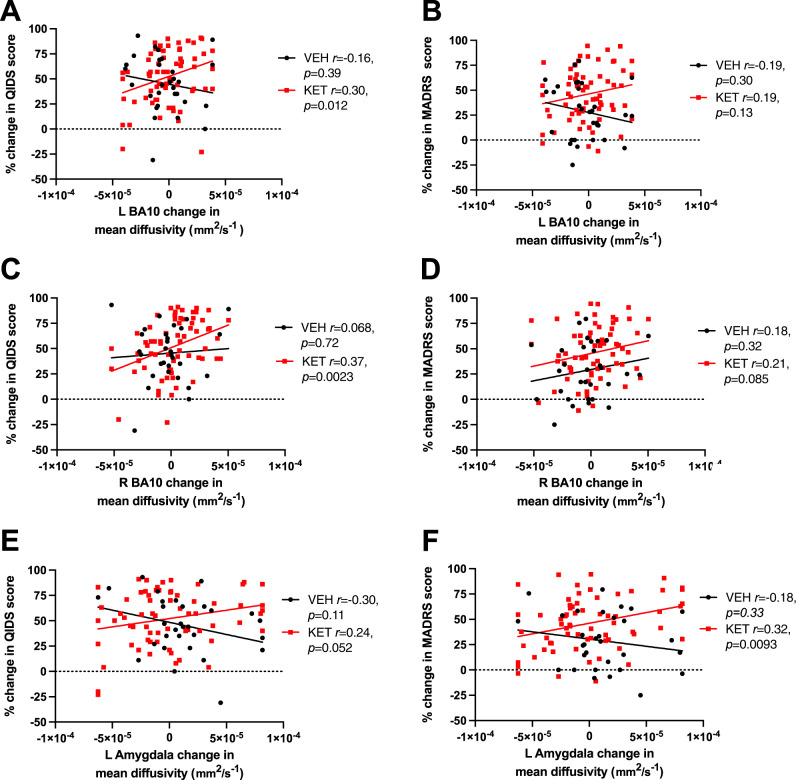
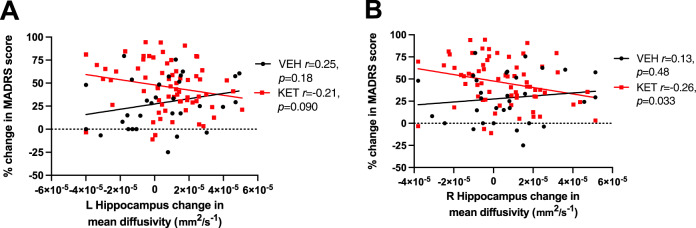
Intravenous ketamine is posited to rapidly reverse depression by rapidly enhancing neuroplasticity. In human patients, we quantified gray matter microstructural changes on a rapid (24-h) timescale within key regions where neuroplasticity enhancements post-ketamine have been implicated in animal models. In this study, 98 unipolar depressed adults who failed at least one antidepressant medication were randomized 2:1 to a single infusion of intravenous ketamine (0.5 mg/kg) or vehicle (saline) and completed diffusion tensor imaging (DTI) assessments at pre-infusion baseline and 24-h post-infusion. DTI mean diffusivity (DTI-MD), a putative marker of microstructural neuroplasticity in gray matter, was calculated for 7 regions of interest (left and right BA10, amygdala, and hippocampus; and ventral Anterior Cingulate Cortex) and compared to clinical response measured with the Montgomery-Asberg Depression Rating Scale (MADRS) and the Quick Inventory of Depressive Symptoms-Self-Report (QIDS-SR). Individual differences in DTI-MD change (greater decrease from baseline to 24-h post-infusion, indicative of more neuroplasticity enhancement) were associated with larger improvements in depression scores across several regions. In the left BA10 and left amygdala, these relationships were driven primarily by the ketamine group (group * DTI-MD interaction effects: p = 0.016–0.082). In the right BA10, these associations generalized to both infusion arms ( p = 0.007). In the left and right hippocampus, on the MADRS only, interaction effects were observed in the opposite direction, such that DTI-MD change was inversely associated with depression change in the ketamine arm specifically (group * DTI-MD interaction effects: p = 0.032–0.06). The acute effects of ketamine on depression may be mediated, in part, by acute changes in neuroplasticity quantifiable with DTI.
Overview
The claims and statistics of this paper haven’t been checked yet.
Free: it reads the open-access text and checks the first 5 claims that cite a source we can check. Create a free account to check every claim.
Integrity signals
Registry
Cites
Statistics
Figures
Verification
Claims the paper makes
The claims and statistics of this paper haven’t been checked yet.
Free: it reads the open-access text and checks the first 5 claims that cite a source we can check. Create a free account to check every claim.
Self-check
Percentages, sums and reported differences re-computed from the paper’s own numbers.
The self-check needs the paper’s full text.
Citations
Cites
A new depression scale designed to be sensitive to change
Montgomery, S. A., & Åsberg, M. (1979) · British Journal of Psychiatry · doi:10.1192/bjp.134.4.382 · Cited by 13,962
Molecular Mechanisms of Depression: Perspectives on New Treatment Strategies
Lang, U. E., & Borgwardt, S. (2013) · Cellular Physiology and Biochemistry · doi:10.1159/000350094 · Cited by 8,475
Rush, A. J., Trivedi, M. H., Wisniewski, S. R., Nierenberg, A. A., Stewart, J. W., Warden, D., Niederehe, G., Thase, M. E., Lavori, P. W., Lebowitz, B. D., et al. (2006) · American Journal of Psychiatry · doi:10.1176/ajp.2006.163.11.1905 · Cited by 5,643
Requirement of hippocampal neurogenesis for the behavioral effects of antidepressants
Santarelli, L., Saxe, M., Gross, C., Surget, A., Battaglia, F., Dulawa, S., Weisstaub, N., Lee, J., Duman, R., Arancio, O., et al. (2003) · Science · doi:10.1126/science.1083328 · Cited by 4,321
Antidepressant effects of ketamine in depressed patients
Berman, R. M., Cappiello, A., Anand, A., Oren, D. A., Heninger, G. R., Charney, D. S., & Krystal, J. H. (2000) · Biological Psychiatry · doi:10.1016/s0006-3223(99)00230-9 · Cited by 3,856
Rush, A. J., Trivedi, M. H., Ibrahim, H. M., Carmody, T. J., Arnow, B., Klein, D. N., Markowitz, J. C., Ninan, P. T., Kornstein, S., Manber, R., et al. (2003) · Biological Psychiatry · doi:10.1016/s0006-3223(02)01866-8 · Cited by 3,829 · cited 4×
“In the subset of patients with DTI neuroimaging data, ketamine significantly improved MADRS scores 24-h post-infusion (t(96)=−3.01, p= 0.003), while there was no significant effect of ketamine on change in QIDS-SR score 24-h post-infusion in this subset of patients (t(95)=−1.10, p= 0.28).”
MethodInfluentialChronic antidepressant treatment increases neurogenesis in adult rat hippocampus
Malberg, J. E., Eisch, A. J., Nestler, E. J., & Duman, R. S. (2000) · The Journal of Neuroscience · doi:10.1523/jneurosci.20-24-09104.2000 · Cited by 3,111
mTOR-Dependent Synapse Formation Underlies the Rapid Antidepressant Effects of NMDA Antagonists
Li, N., Lee, B., Liu, R.-J., Banasr, M., Dwyer, J. M., Iwata, M., Li, X.-Y., Aghajanian, G., & Duman, R. S. (2010) · Science · doi:10.1126/science.1190287 · Cited by 2,881 · cited 8×
“Activity in these regions has been shown to be altered in depressed subjects, with studies of BA10 (and nearby related PFC regions) showing hyperactivation to reward-related cues and hypoactivation to negative affective cues (e.g., negatively valanced faces) in depressed subjects relative to controls [46].”
BackgroundInfluentialSynaptic plasticity and depression: new insights from stress and rapid-acting antidepressants
Duman, R. S., Aghajanian, G. K., Sanacora, G., & Krystal, J. H. (2016) · Nature Medicine · doi:10.1038/nm.4050 · Cited by 1,750
Neural mechanisms of the cognitive model of depression.
Disner, S. G., Beevers, C. G., Haigh, E. A. P., & Beck, A. T. (2011) · Nature Reviews Neuroscience · doi:10.1038/nrn3027 · Cited by 1,718 · cited 1×
“These neural network alterations are hypothesized to result in deficits in flexible cognition and affective processing that manifest in depressed patients as rigid, maladaptive behavioral responses [15, 16].”
BackgroundSen, S., Duman, R., & Sanacora, G. (2008) · Biological Psychiatry · doi:10.1016/j.biopsych.2008.05.005 · Cited by 1,232 · cited 1×
“While functional neuroplasticity cannot be directly tested in the living human brain, post-mortem studies of depression show reductions in markers of neuroplasticity, including reduced BDNF and decreased synapses and synapse-related gene expression [13, 14].”
BackgroundMurrough, J. W., Iosifescu, D. V., Chang, L. C., Al Jurdi, R. K., Green, C. E., Perez, A. M., Iqbal, S., Pillemer, S., Foulkes, A., Shah, A., et al. (2013) · American Journal of Psychiatry · doi:10.1176/appi.ajp.2013.13030392 · Cited by 1,205
Self-citationDuman, R. S., Sanacora, G., & Krystal, J. H. (2019) · Neuron · doi:10.1016/j.neuron.2019.03.013 · Cited by 1,026 · cited 9×
“Activity in these regions has been shown to be altered in depressed subjects, with studies of BA10 (and nearby related PFC regions) showing hyperactivation to reward-related cues and hypoactivation to negative affective cues (e.g., negatively valanced faces) in depressed subjects relative to controls [46].”
BackgroundInfluentialTRIVEDI, M. H., RUSH, A. J., IBRAHIM, H. M., CARMODY, T. J., BIGGS, M. M., SUPPES, T., CRISMON, M. L., SHORES-WILSON, K., TOPRAC, M. G., DENNEHY, E. B., et al. (2004) · Psychological Medicine · doi:10.1017/s0033291703001107 · Cited by 968 · cited 4×
“In the subset of patients with DTI neuroimaging data, ketamine significantly improved MADRS scores 24-h post-infusion (t(96)=−3.01, p= 0.003), while there was no significant effect of ketamine on change in QIDS-SR score 24-h post-infusion in this subset of patients (t(95)=−1.10, p= 0.28).”
MethodInfluentialSiegle, G. J., Thompson, W., Carter, C. S., Steinhauer, S. R., & Thase, M. E. (2007) · Biological Psychiatry · doi:10.1016/j.biopsych.2006.05.048 · Cited by 857 · cited 1×
“These neural network alterations are hypothesized to result in deficits in flexible cognition and affective processing that manifest in depressed patients as rigid, maladaptive behavioral responses [15, 16].”
BackgroundDecreased expression of synapse-related genes and loss of synapses in major depressive disorder
Kang, H. J., Voleti, B., Hajszan, T., Rajkowska, G., Stockmeier, C. A., Licznerski, P., Lepack, A., Majik, M. S., Jeong, L. S., Banasr, M., et al. (2012) · Nature Medicine · doi:10.1038/nm.2886 · Cited by 808 · cited 1×
“While functional neuroplasticity cannot be directly tested in the living human brain, post-mortem studies of depression show reductions in markers of neuroplasticity, including reduced BDNF and decreased synapses and synapse-related gene expression [13, 14].”
Background(2001) · PubMed · Cited by 780
Neuroplasticity in cognitive and psychological mechanisms of depression: an integrative model
Price, R. B., & Duman, R. (2020) · Molecular Psychiatry · doi:10.1038/s41380-019-0615-x · Cited by 739 · cited 2×
“These specific regions were selected for analysis based on a priori hypotheses about the role of these regions in both the antidepressant response to ketamine (which has particularly implicated hippocampus and medial PFC areas, including bilateral BA10 and vACC; see [2]) and in depression pathophysiology at large, whi…”
BackgroundMethodSelf-citationPrefrontal cortex and depression
Pizzagalli, D. A., & Roberts, A. C. (2022) · Neuropsychopharmacology · doi:10.1038/s41386-021-01101-7 · Cited by 667 · cited 1×
“, negatively valanced faces) in depressed subjects relative to controls [46].”
BackgroundSustained rescue of prefrontal circuit dysfunction by antidepressant-induced spine formation
Moda-Sava, R. N., Murdock, M. H., Parekh, P. K., Fetcho, R. N., Huang, B. S., Huynh, T. N., Witztum, J., Shaver, D. C., Rosenthal, D. L., Alway, E. J., et al. (2019) · Science · doi:10.1126/science.aat8078 · Cited by 643 · cited 2×
“Collectively, these findings in animals and humans specifically tie acute DTI-MD changes to neuroplasticity processes including those involved in synaptogenesis—a prominent mechanism implicated in ketamine’s mechanism of antidepressant action [12, 24].”
BackgroundPrice, R. B., Nock, M. K., Charney, D. S., & Mathew, S. J. (2009) · Biological Psychiatry · doi:10.1016/j.biopsych.2009.04.029 · Cited by 600
Self-citationCastrén, E. (2005) · Nature Reviews Neuroscience · doi:10.1038/nrn1629 · Cited by 563
Brain-Derived Neurotrophic Factor Signaling in Depression and Antidepressant Action
Castrén, E., & Monteggia, L. M. (2021) · Biological Psychiatry · doi:10.1016/j.biopsych.2021.05.008 · Cited by 540
Learning in the fast lane: new insights into neuroplasticity
Sagi, Y., Tavor, I., Hofstetter, S., Tzur-Moryosef, S., Blumenfeld-Katzir, T., & Assaf, Y. (2012) · Neuron · doi:10.1016/j.neuron.2012.01.025 · Cited by 517 · cited 9×
“A higher Δ-MD score corresponds to lower mean diffusivity following the infusion, and putatively greater plasticity/ synaptogenesis [30].”
BackgroundInfluentialFacial emotion processing in major depression: a systematic review of neuroimaging findings
Stuhrmann, A., Suslow, T., & Dannlowski, U. (2011) · Biology of Mood & Anxiety Disorders · doi:10.1186/2045-5380-1-10 · Cited by 440 · cited 1×
“, positively valanced faces) relative to controls [47].”
BackgroundAbdallah, C. G., Sanacora, G., Duman, R. S., & Krystal, J. H. (2015) · Annual Review of Medicine · doi:10.1146/annurev-med-053013-062946 · Cited by 422
McGirr, A., Berlim, M. T., Bond, D. J., Fleck, M. P., Yatham, L. N., & Lam, R. W. (2015) · Psychological Medicine · doi:10.1017/s0033291714001603 · Cited by 373
The recent progress in animal models of depression
Wang, Q., Timberlake, M. A., Prall, K., & Dwivedi, Y. (2017) · Progress in Neuro-Psychopharmacology and Biological Psychiatry · doi:10.1016/j.pnpbp.2017.04.008 · Cited by 370 · cited 1×
“, anhedonia-like behavior, tested via the sucrose preference test; anxiety-like behavior, indexed by the noveltysuppressed feeding test; and despair-like behavior, observed during the forced swim test) [3].”
MethodPrice, R. B., Iosifescu, D. V., Murrough, J. W., Chang, L. C., Al Jurdi, R. K., Iqbal, S. Z., Soleimani, L., Charney, D. S., Foulkes, A. L., & Mathew, S. J. (2014) · Depression and Anxiety · doi:10.1002/da.22253 · Cited by 345
Self-citationEmpirical recommendations for improving the stability of the dot-probe task in clinical research.
Price, R. B., Kuckertz, J. M., Siegle, G. J., Ladouceur, C. D., Silk, J. S., Ryan, N. D., Dahl, R. E., & Amir, N. (2015) · Psychological Assessment · doi:10.1037/pas0000036 · Cited by 312 · cited 1×
“A Winsorizing procedure was used to rescale extreme Δ-MD values prior to analysis, as described previously [45].”
MethodSelf-citationKetamine for rapid reduction of suicidal ideation: a randomized controlled trial
Murrough, J. W., Soleimani, L., DeWilde, K. E., Collins, K. A., Lapidus, K. A., Iacoviello, B. M., Lener, M., Kautz, M., Kim, J., Stern, J. B., et al. (2015) · Psychological Medicine · doi:10.1017/s0033291715001506 · Cited by 297
Self-citationNeuropsychological mechanism underlying antidepressant effect: a systematic meta-analysis
Ma, Y. (2015) · Molecular Psychiatry · doi:10.1038/mp.2014.24 · Cited by 270 · cited 2×
“Antidepressants may also change activity in these regions, with a meta-analysis showing that the neural biases in emotional processing in depressed subjects in the PFC and amygdala were normalized following the administration of an SSRI [48].”
ResultDe Gregorio, D., Aguilar-Valles, A., Preller, K. H., Heifets, B. D., Hibicke, M., Mitchell, J., & Gobbi, G. (2021) · The Journal of Neuroscience · doi:10.1523/jneurosci.1659-20.2020 · Cited by 259
Ketamine has distinct electrophysiological and behavioral effects in depressed and healthy subjects
Nugent, A. C., Ballard, E. D., Gould, T. D., Park, L. T., Moaddel, R., Brutsche, N. E., & Zarate, C. A. (2019) · Molecular Psychiatry · doi:10.1038/s41380-018-0028-2 · Cited by 250 · cited 1×
“Ketamine rapidly alters neural and behavioral responses to incoming stimuli, with changes in how brain regions respond to emotional stimuli and accompanying changes in behavioral output [29, 49, 50, 52].”
BackgroundFrom Serotonin to Neuroplasticity: Evolvement of Theories for Major Depressive Disorder
Liu, B., Liu, J., Wang, M., Zhang, Y., & Li, L. (2017) · Frontiers in Cellular Neuroscience · doi:10.3389/fncel.2017.00305 · Cited by 249
Xu, Y., Hackett, M., Carter, G., Loo, C., Gálvez, V., Glozier, N., Glue, P., Lapidus, K., McGirr, A., Somogyi, A. A., et al. (2016) · International Journal of Neuropsychopharmacology · doi:10.1093/ijnp/pyv124 · Cited by 226
Evans, J. W., Szczepanik, J., Brutsché, N., Park, L. T., Nugent, A. C., & Zarate, C. A. (2018) · Biological Psychiatry · doi:10.1016/j.biopsych.2018.01.027 · Cited by 173
Chandler, G. M., Iosifescu, D. V., Pollack, M. H., Targum, S. D., & Fava, M. (2010) · CNS Neuroscience & Therapeutics · doi:10.1111/j.1755-5949.2009.00102.x · Cited by 158 · cited 1×
“In the full trial, 154 adult subjects (age 18–60) with moderate to severe depression [Montgomery-Asberg Depression Rating Scale (MADRS [35]) score ≥25] and at least one adequate, failed trial of an FDA-approved antidepressant medication in the current depressive episode (assessed via Antidepressant Treatment Response…”
MethodRivolta, D., Heidegger, T., Scheller, B., Sauer, A., Schaum, M., Birkner, K., Singer, W., Wibral, M., & Uhlhaas, P. J. (2015) · Schizophrenia Bulletin · doi:10.1093/schbul/sbv051 · Cited by 147
Caddy, C., Giaroli, G., White, T. P., Shergill, S. S., & Tracy, D. K. (2014) · Therapeutic Advances in Psychopharmacology · doi:10.1177/2045125313507739 · Cited by 138
Ketamine amplifies induced gamma frequency oscillations in the human cerebral cortex
Shaw, A. D., Saxena, N., E. Jackson, L., Hall, J. E., Singh, K. D., & Muthukumaraswamy, S. D. (2015) · European Neuropsychopharmacology · doi:10.1016/j.euroneuro.2015.04.012 · Cited by 122
Aleksandrova, L. R., Wang, Y. T., & Phillips, A. G. (2019) · Neuroscience & Biobehavioral Reviews · doi:10.1016/j.neubiorev.2019.07.007 · Cited by 114
Murrough, J. W., Collins, K. A., Fields, J., DeWilde, K. E., Phillips, M. L., Mathew, S. J., Wong, E., Tang, C. Y., Charney, D. S., & Iosifescu, D. V. (2015) · Translational Psychiatry · doi:10.1038/tp.2015.10 · Cited by 109 · cited 1×
“In humans, ketamine also alters neural response to emotional stimuli [25] and EEG gamma power [26–29], a putative marker of activity-dependent plasticity.”
BackgroundSelf-citationSackeim, H. A., Aaronson, S. T., Bunker, M. T., Conway, C. R., Demitrack, M. A., George, M. S., Prudic, J., Thase, M. E., & Rush, A. J. (2019) · Journal of Psychiatric Research · doi:10.1016/j.jpsychires.2019.03.021 · Cited by 109
Farmer, C. A., Gilbert, J. R., Moaddel, R., George, J., Adeojo, L., Lovett, J., Nugent, A. C., Kadriu, B., Yuan, P., Gould, T. D., et al. (2020) · Neuropsychopharmacology · doi:10.1038/s41386-020-0663-6 · Cited by 85
Price, R. B., Spotts, C., Panny, B., Griffo, A., Degutis, M., Cruz, N., Bell, E., Do-Nguyen, K., Wallace, M. L., Mathew, S. J., et al. (2022) · American Journal of Psychiatry · doi:10.1176/appi.ajp.20220216 · Cited by 85
Self-citationStructural and functional neuroplasticity in human learning of spatial routes
Keller, T. A., & Just, M. A. (2015) · NeuroImage · doi:10.1016/j.neuroimage.2015.10.015 · Cited by 84
Self-citationChen, M.-H., Lin, W.-C., Tu, P.-C., Li, C.-T., Bai, Y.-M., Tsai, S.-J., & Su, T.-P. (2019) · Journal of Affective Disorders · doi:10.1016/j.jad.2019.08.022 · Cited by 78
Tavor, I., Botvinik‐Nezer, R., Bernstein‐Eliav, M., Tsarfaty, G., & Assaf, Y. (2019) · Human Brain Mapping · doi:10.1002/hbm.24814 · Cited by 71
Ketamine normalizes brain activity during emotionally valenced attentional processing in depression
Reed, J. L., Nugent, A. C., Furey, M. L., Szczepanik, J. E., Evans, J. W., & Zarate, C. A. (2018) · NeuroImage: Clinical · doi:10.1016/j.nicl.2018.07.006 · Cited by 67 · cited 1×
“Ketamine rapidly alters neural and behavioral responses to incoming stimuli, with changes in how brain regions respond to emotional stimuli and accompanying changes in behavioral output [29, 49, 50, 52].”
BackgroundModulation of amygdala reactivity following rapidly acting interventions for major depression
Loureiro, J. R. A., Leaver, A., Vasavada, M., Sahib, A. K., Kubicki, A., Joshi, S., Woods, R. P., Wade, B., Congdon, E., Espinoza, R., et al. (2020) · Human Brain Mapping · doi:10.1002/hbm.24895 · Cited by 64
Song, A. W., Woldorff, M. G., Gangstead, S. L., Mangun, G. R., & McCarthy, G. (2002) · NeuroImage · doi:10.1006/nimg.2002.1217 · Cited by 59
Jin, T., & Kim, S. (2008) · NeuroImage · doi:10.1016/j.neuroimage.2008.03.014 · Cited by 53
Habenula Connectivity and Intravenous Ketamine in Treatment-Resistant Depression
Rivas-Grajales, A. M., Salas, R., Robinson, M. E., Qi, K., Murrough, J. W., & Mathew, S. J. (2021) · International Journal of Neuropsychopharmacology · doi:10.1093/ijnp/pyaa089 · Cited by 51
Self-citationNugent, A. C., Farmer, C., Evans, J. W., Snider, S. L., Banerjee, D., & Zarate, C. A. (2019) · Human Brain Mapping · doi:10.1002/hbm.24679 · Cited by 44
Working memory training impacts the mean diffusivity in the dopaminergic system
Takeuchi, H., Taki, Y., Nouchi, R., Hashizume, H., Sekiguchi, A., Kotozaki, Y., Nakagawa, S., Miyauchi, C. M., Sassa, Y., & Kawashima, R. (2015) · Brain Structure and Function · doi:10.1007/s00429-014-0845-2 · Cited by 35
Sydnor, V. J., Lyall, A. E., Karayumak, S. C., Cheung, J. C., Felicione, J. M., Akeju, O., Shenton, M. E., Deckersbach, T., Ionescu, D. F., Pasternak, O., et al. (2020) · Translational Psychiatry · doi:10.1038/s41398-020-01122-8 · Cited by 32
Nakamura, T., Tomita, M., Horikawa, N., Ishibashi, M., Uematsu, K., Hiraki, T., Abe, T., & Uchimura, N. (2021) · Neuropsychopharmacology Reports · doi:10.1002/npr2.12165 · Cited by 28
Alario, A. A., & Niciu, M. J. (2021) · Chronic Stress · doi:10.1177/24705470211014210 · Cited by 26 · cited 2×
“Interestingly, the laterality of regions involved in ketamine response in human neuroimaging research varies from study-to-study, with the exception of the left amygdala, which, as in our current study, is consistently implicated more commonly than the right amygdala [50].”
BackgroundTaraku, B., Woods, R. P., Boucher, M., Espinoza, R. T., Jog, M., Al‐Sharif, N., Narr, K. L., & Zavaliangos‐Petropulu, A. (2023) · Human Brain Mapping · doi:10.1002/hbm.26217 · Cited by 25
Empathizing associates with mean diffusivity
Takeuchi, H., Taki, Y., Nouchi, R., Yokoyama, R., Kotozaki, Y., Nakagawa, S., Sekiguchi, A., Iizuka, K., Yamamoto, Y., Hanawa, S., et al. (2019) · Scientific Reports · doi:10.1038/s41598-019-45106-1 · Cited by 22
Xu, X., Wang, Q., Zhong, J., & Zhang, M. (2015) · Neuroradiology · doi:10.1007/s00234-015-1579-4 · Cited by 21
Just, M. A., & Keller, T. A. (2019) · Brain Structure and Function · doi:10.1007/s00429-019-01838-4 · Cited by 7
Self-citation
Cited by
Agnorelli, C., Spriggs, M. J., Godfrey, K., Sawicka, G., Bohl, B., Douglass, H. M., Fagiolini, A. M., Hashemi, P., Carhart-Harris, R. L., Nutt, D. J., et al. (2025) · Neuroscience & Biobehavioral Reviews · doi:10.1016/j.neubiorev.2025.106132 · Cited by 69
Pardossi, S., Fagiolini, A., & Cuomo, A. (2024) · International Journal of Molecular Sciences · doi:10.3390/ijms252313098 · Cited by 51
Alcohol Use Disorder and Chronic Pain: An Overlooked Epidemic
Aquino, J. P. D., Sloan, M. E., Nunes, J. C., Costa, G. P. A., Katz, J. L., de Oliveira, D., Ra, J., Tang, V. M., & Petrakis, I. L. (2024) · American Journal of Psychiatry · doi:10.1176/appi.ajp.20230886 · Cited by 49
Paolini, M., Harrington, Y. A., Colombo, F., Bettonagli, V., Poletti, S., Carminati, M., Colombo, C., Benedetti, F., & Zanardi, R. (2023) · Journal of Psychopharmacology · doi:10.1177/02698811231190859 · Cited by 38
Storm on predictive brain: A neurocomputational account of ketamine antidepressant effect
Bottemanne, H., Berkovitch, L., Gauld, C., Balcerac, A., Schmidt, L., Mouchabac, S., & Fossati, P. (2023) · Neuroscience & Biobehavioral Reviews · doi:10.1016/j.neubiorev.2023.105410 · Cited by 33
Metadata
- Authors
- Kopelman, J., Keller, T. A., Panny, B., Griffo, A., Degutis, M., Spotts, C., Cruz, N., Bell, E., Do-Nguyen, K., Wallace, M. L., Mathew, S. J., Howland, R. H., & Price, R. B.
- Affiliations
- University of California San Diego (US)
- Carnegie Mellon University (US)
- University of Pittsburgh (US)
- Michael E. DeBakey VA Medical Center (US)
- Corresponding author
- Price, Rebecca B.
- ORCID
- Venue
- Translational Psychiatry
- Published
- 2023-05-09
- Volume
- 13
- Issue
- 1
- Pages
- 159-159
- ISSN
- 2158-3188 (ISSN-L)
- PMC
- PMC10170140
- OpenAlex
- W4376132496
- Cited by
- 60
- References
- 64
- Citations by year
- 2026: 15 · 2025: 20 · 2024: 21 · 2023: 4
- FWCI
- 9.31
- Type
- journal article
- Language
- en
- Open access
- gold
- doi.org
- Licence
- cc-by
- creativecommons.org/licenses/by/4.0 (tdm)
- creativecommons.org/licenses/by/4.0 (vor)
- Locations
- Translational Psychiatry (publishedVersion, cc-by)
- PubMed Central (publishedVersion, cc-by)
- PubMed (publishedVersion)
- Digital Commons-TMC (Texas Medical Center) (submittedVersion)
- DOAJ (DOAJ: Directory of Open Access Journals) (submittedVersion, cc-by-sa)
- Funders
- U.S. Department of Health & Human Services | NIH | National Institute of Mental Health (R01MH113857)
- Topics
- Health Sciences › Medicine › Pharmacology (medical) › Treatment of Major Depression
- Health Sciences › Medicine › Psychiatry and Mental health › Electroconvulsive Therapy Studies
- Life Sciences › Neuroscience › Neurology › Transcranial Magnetic Stimulation Studies
- Keywords
- intravenous ketamine, treatment-resistant depression, neuroplasticity, gray matter microstructure, mean diffusivity, diffusion tensor imaging, rapid-acting antidepressants, anterior cingulate cortex, amygdala, hippocampus, individual differences in treatment response
- MeSH terms
- Adult, Animals, Cerebral Cortex, Depression, Humans, Ketamine, Neuronal Plasticity, Diffusion Tensor Imaging
About these checks
Registry, retraction, Cites and statistics results are computed, not judged, with one exception: a printed reference that no index lists is read once by a model before it counts as a citation error. Claims are extracted by a model and kept only when their quote appears verbatim in the text; each cited source is then checked, with a model’s help, for whether it says what the claim relies on. Those verdicts can be wrong — read the claim’s quote and the cited source before relying on one.
Statistics and arithmetic are recomputed, not judged.
Confidence bands are shown only for fields calibrated on our annotated test set. None is calibrated yet, so no band is shown.
What counts as a claim ›How we measure confidence ›How we check this ›
Are you an author, or do you see a problem with this page? Request a review
Data sources
Bibliographic data: Semantic Scholar, OpenAlex, Crossref.
Contains information from the Semantic Scholar Academic Graph Datasets, made available under the ODC Attribution License (ODC-BY 1.0).
Semantic Scholar’s data is described in: Kinney, R., et al. (2023). The Semantic Scholar Open Data Platform. arXiv:2301.10140.
