

Epcoritamab induces potent anti-tumor activity against malignant B-cells from patients with DLBCL, FL and MCL, irrespective of prior CD20 monoclonal antibody treatment
Open accessThe DOI matches its Crossref record; 20 of the 20 references it cites were found in a registry or an index.
Abstract
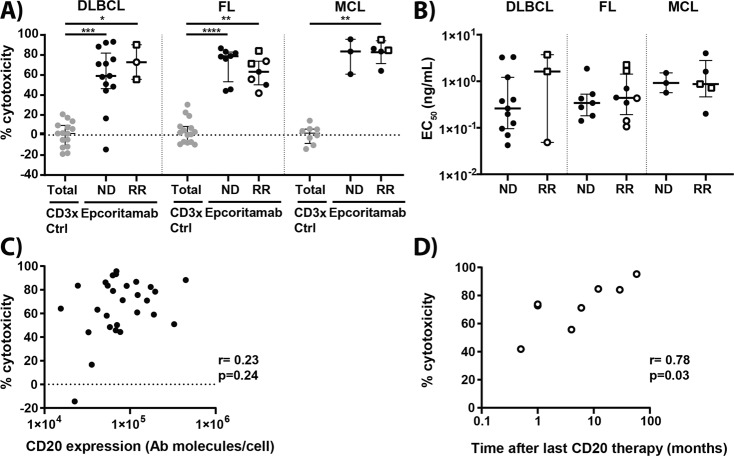
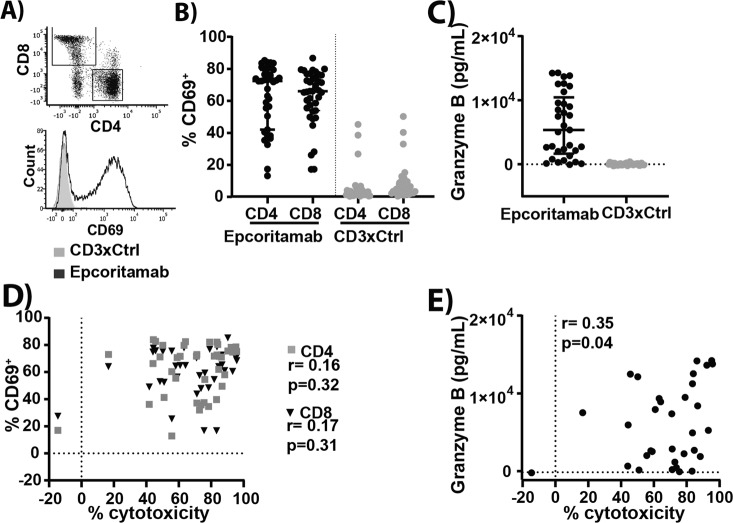
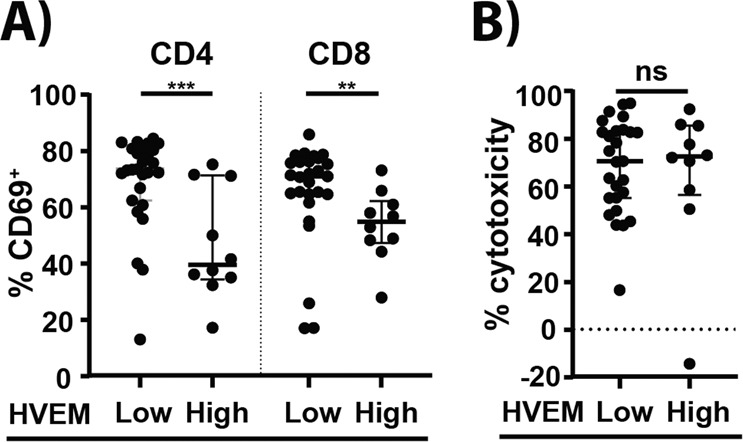
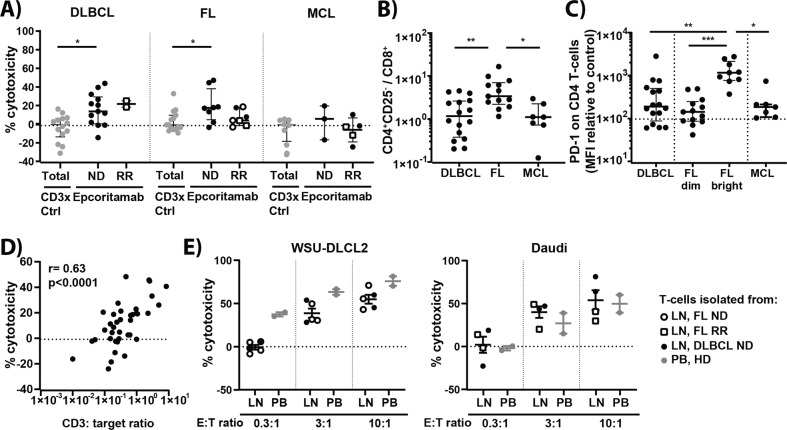
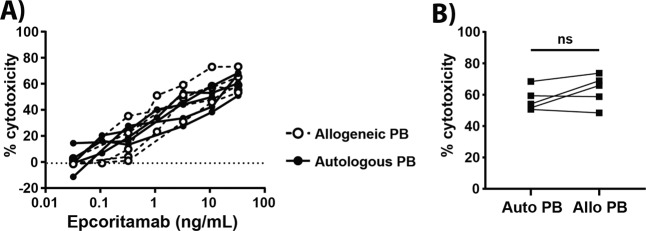
Epcoritamab (DuoBody-CD3xCD20, GEN3013) is a novel bispecific IgG1 antibody redirecting T-cells toward CD20+ tumor cells. Here, we assessed the preclinical efficacy of epcoritamab against primary tumor cells present in the lymph node biopsies from newly diagnosed (ND) and relapsed/refractory (RR) B-NHL patients. In the presence of T-cells from a healthy donor, epcoritamab demonstrated potent activity against primary tumor cells, irrespective of prior treatments, including CD20 mAbs. Median lysis of 65, 74, and 84% were achieved in diffuse large B-cell lymphoma (n = 16), follicular lymphoma (n = 15), and mantle cell lymphoma (n = 8), respectively. Furthermore, in this allogeneic setting, we discovered that the capacity of B-cell tumors to activate T-cells was heterogeneous and showed an inverse association with their surface expression levels of the immune checkpoint molecule Herpesvirus Entry Mediator (HVEM). In the autologous setting, when lymph node (LN)-residing T-cells were the only source of effector cells, the epcoritamab-dependent cytotoxicity strongly correlated with local effector cell-to-target cell ratios. Further analyses revealed that LN-residing-derived or peripheral blood-derived T-cells of B-NHL patients, as well as heathy donor T-cells equally mediated epcoritamab-dependent cytotoxicity. These results show the promise of epcoritamab for treatment of newly-diagnosed or relapsed/refractory B-NHL patients, including those who became refractory to previous CD20-directed therapies.
Overview
The claims and statistics of this paper haven’t been checked yet.
Free: it reads the open-access text and checks the first 5 claims that cite a source we can check. Create a free account to check every claim.
Integrity signals
Registry
Cites
Statistics
Figures
Verification
Claims the paper makes
The claims and statistics of this paper haven’t been checked yet.
Free: it reads the open-access text and checks the first 5 claims that cite a source we can check. Create a free account to check every claim.
Claims other papers make about this one
Each is checked against this paper’s own text: does it say what the citing paper says it does?
The cited source says what the claim attributes to it.
In the citing paper
“Robust preclinical T‐cell–mediated cytotoxicity against tumor cell‐line models and cells from patients with B‐cell non‐Hodgkin's lymphoma (B‐NHL), including diffuse large B‐cell lymphoma (DLBCL), follicular lymphoma (FL), and mantle cell lymphoma, has been demonstrated. 2 , 3”
From Semimechanistic Physiologically‐Based Pharmacokinetic/Pharmacodynamic Model Informing Epcoritamab Dose Selection for Patients With B‐Cell Lymphomas (2022) · cites this paper as [3]
The cited source says what the claim attributes to it.
In the citing paper
“In an ex vivo study, peripheral or tumor‐resident T cells from patients with B‐NHL showed excellent capacity to induce T‐cell–mediated cytotoxicity in the presence of epcoritamab. 3”
From Semimechanistic Physiologically‐Based Pharmacokinetic/Pharmacodynamic Model Informing Epcoritamab Dose Selection for Patients With B‐Cell Lymphomas (2022) · cites this paper as [3]
Self-check
Percentages, sums and reported differences re-computed from the paper’s own numbers.
The self-check needs the paper’s full text.
Citations
Cites
Till, B. G., Jensen, M. C., Wang, J., Qian, X., Gopal, A. K., Maloney, D. G., Lindgren, C. G., Lin, Y., Pagel, J. M., Budde, L. E., et al. (2012) · Blood · doi:10.1182/blood-2011-10-387969 · Cited by 529
Bispecific T‐cell engagers for cancer immunotherapy
Huehls, A. M., Coupet, T. A., & Sentman, C. L. (2015) · Immunology & Cell Biology · doi:10.1038/icb.2014.93 · Cited by 466
A unique cell surface antigen identifying lymphoid malignancies of B cell origin.
Nadler, L. M., Ritz, J., Hardy, R., Pesando, J. M., Schlossman, S. F., & Stashenko, P. (1981) · Journal of Clinical Investigation · doi:10.1172/jci110005 · Cited by 399
Efficient generation of stable bispecific IgG1 by controlled Fab-arm exchange
Labrijn, A. F., Meesters, J. I., de Goeij, B. E. C. G., van den Bremer, E. T. J., Neijssen, J., van Kampen, M. D., Strumane, K., Verploegen, S., Kundu, A., Gramer, M. J., et al. (2013) · Proceedings of the National Academy of Sciences · doi:10.1073/pnas.1220145110 · Cited by 339
Anti-CD20/CD3 T cell–dependent bispecific antibody for the treatment of B cell malignancies
Sun, L. L., Ellerman, D., Mathieu, M., Hristopoulos, M., Chen, X., Li, Y., Yan, X., Clark, R., Reyes, A., Stefanich, E., et al. (2015) · Science Translational Medicine · doi:10.1126/scitranslmed.aaa4802 · Cited by 275
Hiraga, J., Tomita, A., Sugimoto, T., Shimada, K., Ito, M., Nakamura, S., Kiyoi, H., Kinoshita, T., & Naoe, T. (2009) · Blood · doi:10.1182/blood-2008-08-175208 · Cited by 257
CD20-TCB with Obinutuzumab Pretreatment as Next-Generation Treatment of Hematologic Malignancies
Bacac, M., Colombetti, S., Herter, S., Sam, J., Perro, M., Chen, S., Bianchi, R., Richard, M., Schoenle, A., Nicolini, V., et al. (2018) · Clinical Cancer Research · doi:10.1158/1078-0432.ccr-18-0455 · Cited by 249
Engelberts, P. J., Hiemstra, I. H., de Jong, B., Schuurhuis, D. H., Meesters, J., Beltran Hernandez, I., Oostindie, S. C., Neijssen, J., van den Brink, E. N., Horbach, G. J., et al. (2020) · EBioMedicine · doi:10.1016/j.ebiom.2019.102625 · Cited by 172
Self-citationSmith, E. J., Olson, K., Haber, L. J., Varghese, B., Duramad, P., Tustian, A. D., Oyejide, A., Kirshner, J. R., Canova, L., Menon, J., et al. (2015) · Scientific Reports · doi:10.1038/srep17943 · Cited by 167
Controlled Fab-arm exchange for the generation of stable bispecific IgG1
Labrijn, A. F., Meesters, J. I., Priem, P., de Jong, R. N., van den Bremer, E. T. J., van Kampen, M. D., Gerritsen, A. F., Schuurman, J., & Parren, P. W. H. I. (2014) · Nature Protocols · doi:10.1038/nprot.2014.169 · Cited by 150
Cited by
Thieblemont, C., Phillips, T., Ghesquieres, H., Cheah, C. Y., Clausen, M. R., Cunningham, D., Do, Y. R., Feldman, T., Gasiorowski, R., Jurczak, W., et al. (2023) · Journal of Clinical Oncology · doi:10.1200/jco.22.01725 · Cited by 584
Hutchings, M., Mous, R., Clausen, M. R., Johnson, P., Linton, K. M., Chamuleau, M. E. D., Lewis, D. J., Sureda Balari, A., Cunningham, D., Oliveri, R. S., et al. (2021) · The Lancet · doi:10.1016/s0140-6736(21)00889-8 · Cited by 337
Self-citationBispecific antibodies for the treatment of B-cell lymphoma: promises, unknowns, and opportunities
Falchi, L., Vardhana, S. A., & Salles, G. A. (2023) · Blood · doi:10.1182/blood.2021011994 · Cited by 208
Bispecific and multispecific antibodies in oncology: opportunities and challenges
Goebeler, M.-E., Stuhler, G., & Bargou, R. (2024) · Nature Reviews Clinical Oncology · doi:10.1038/s41571-024-00905-y · Cited by 177
“Epcoritamab, a CD20 × CD3 duobody, is a subcutaneously administered IgG-like bispecific antibody 92 .”
Linton, K. M., Vitolo, U., Jurczak, W., Lugtenburg, P. J., Gyan, E., Sureda, A., Christensen, J. H., Hess, B., Tilly, H., Cordoba, R., et al. (2024) · The Lancet Haematology · doi:10.1016/s2352-3026(24)00166-2 · Cited by 171
Self-citationThiéblemont, C., Karimi, Y. H., Ghesquières, H., Cheah, C. Y., Clausen, M. R., Cunningham, D., Jurczak, W. J., Do, Y. R., Gasiorowski, R., Lewis, D. J., et al. (2024) · Leukemia · doi:10.1038/s41375-024-02410-8 · Cited by 184
“1 In preclinical studies, epcoritamab demonstrated potent T-cell-mediated cytotoxic activity against CD20 + malignant B cells [21, 22] and higher potency compared with three other CD3xCD20 bispeci fi c antibody constructs [21].”
The state of the art of bispecific antibodies for treating human malignancies
Wang, S., Chen, K., Lei, Q., Ma, P., Yuan, A. Q., Zhao, Y. J., Jiang, Y., Hong, F., Xing, S., Fang, Y., et al. (2021) · EMBO Molecular Medicine · doi:10.15252/emmm.202114291 · Cited by 86
Brody, J., Jørgensen, J. M., Belada, D., Costello, R. T., Trněný, M., Vitolo, U., Lewis, D. J., Karimi, Y. H., Sureda, A. M., André, M. P. E., et al. (2025) · Blood · doi:10.1182/blood.2024026830 · Cited by 79
Dąbkowska, A., Domka, K., & Firczuk, M. (2024) · Frontiers in Immunology · doi:10.3389/fimmu.2024.1363102 · Cited by 62
Frampton, J. E. (2023) · Drugs · doi:10.1007/s40265-023-01930-4 · Cited by 52
Mhibik, M., Gaglione, E. M., Eik, D., Herrick, J., Le, J., Ahn, I. E., Chiu, C., Wielgos-Bonvallet, M., Hiemstra, I. H., Breij, E. C. W., et al. (2023) · Blood Advances · doi:10.1182/bloodadvances.2022009517 · Cited by 43
“37,38 In an ongoing phase 1/2a clinical trial (NCT03625 037), subcutaneous administration of epcoritamab showed ef fi - cient antitumor activity as a single agent, achieving 68% and 90% overall response rates and 45% and 50% complete responses in R/R DLBCL and follicular lymphoma, respectively.”
Self-citationPrimary Mediastinal B-Cell Lymphoma: A 2021 Update on Genetics, Diagnosis, and Novel Therapeutics
Ahmed, Z., Afridi, S. S., Shahid, Z., Zamani, Z., Rehman, S., Aiman, W., Khan, M. I., Mir, M. A., Awan, F. T., Anwer, F., et al. (2021) · Clinical Lymphoma Myeloma & Leukemia · doi:10.1016/j.clml.2021.06.012 · Cited by 46
Li, T., Hiemstra, I. H., Chiu, C., Oliveri, R. S., Elliott, B., DeMarco, D., Salcedo, T., Egerod, F. L., Sasser, K., Ahmadi, T., et al. (2022) · Clinical Pharmacology & Therapeutics · doi:10.1002/cpt.2729 · Cited by 34
“CLINICAL PHARMACOLOGY & THERAPEUTICS | VOLUME 112 NUMBER 5 | November 2022 1109 peripheral or tumorresident T cells from patients with BNHL showed excellent capacity to induce T- cell– mediated cytotoxicity in the presence of epcoritamab.(3) In cynomolgus monkeys, subcutaneous administration led to lower peak cytokine…”
BackgroundSelf-citationMak, J. W. Y., Law, A. W. H., Law, K. W. T., Ho, R., Cheung, C. K. M., & Law, M. F. (2023) · World Journal of Gastroenterology · doi:10.3748/wjg.v29.i33.4942 · Cited by 43
Watanabe, T. (2021) · International Journal of Molecular Sciences · doi:10.3390/ijms22105352 · Cited by 31
“[87] found no association between T-cell activation and tumor expression of CD20, PD-L1, or HLA-DR.”
BackgroundGuo, X., Wu, Y., Ying, X., Xie, N., & Shen, G. (2023) · Frontiers in Immunology · doi:10.3389/fimmu.2023.1291836 · Cited by 29
Primary Mediastinal B-Cell Lymphoma: Novel Precision Therapies and Future Directions
Chen, H., Pan, T., He, Y., Zeng, R., Li, Y., Yi, L., Zang, H., Chen, S., Duan, Q., Xiao, L., et al. (2021) · Frontiers in Oncology · doi:10.3389/fonc.2021.654854 · Cited by 29
“The results of this study allow us to speculate that epcoritamab may be used for the treatment of newly diagnosed or rrB-NHL patients (105).”
ResultDecombis, S., Bellanger, C., Bris, Y. L., Madiot, C., Jardine, J., Santos, J. C., Boulet, D., Dousset, C., Ménard, A., Kervoëlen, C., et al. (2023) · Blood · doi:10.1182/blood.2023020211 · Cited by 25
Kusowska, A., Kubacz, M., Krawczyk, M., Ślusarczyk, A., Winiarska, M., & Bobrowicz, M. (2022) · International Journal of Molecular Sciences · doi:10.3390/ijms23031501 · Cited by 29
Solution structure and synaptic analyses reveal determinants of bispecific T cell engager potency
Leithner, A., Staufer, O., Mitra, T., Liberta, F., Valvo, S., Kutuzov, M., Dada, H., Spaeth, J., Zhou, W., Schiele, F., et al. (2025) · Proceedings of the National Academy of Sciences · doi:10.1073/pnas.2425781122 · Cited by 22
“Our pipeline could be applied to the analysis of Format C - like TcEs like Epcoritamab ( 64 ), Mosunetuzumab ( 65 ), and Odronextamab ( 66 ), as well as BCMA - targeting Teclistamab ( 67 ), potentially even using detergent micelles or nanodiscs.”
Solution structure and synaptic analyses reveal determinants of bispecific T cell engager potency
Leithner, A., Staufer, O., Mitra, T., Liberta, F., Valvo, S., Kutuzov, M., Dada, H., Spaeth, J., Zhou, S., Schiele, F., et al. (2022) · doi:10.1101/2022.06.15.496334 · Cited by 21
Designing Multivalent and Multispecific Biologics
Kang, J. J., Ohoka, A., & Sarkar, C. A. (2023) · Annual Review of Chemical and Biomolecular Engineering · doi:10.1146/annurev-chembioeng-100722-112440 · Cited by 23
Iovino, L., Wu, Q. V., Voutsinas, J. M., Panaite, L., Mullane, E., Lynch, R. C., Ujjani, C. S., Smith, S. D., Gopal, A. K., Till, B. G., et al. (2022) · Journal of Cellular and Molecular Medicine · doi:10.1111/jcmm.17550 · Cited by 16
Hsu, Y., Wu, S., Kao, H., Hsiao, S., Liao, C., Chen, T., & Wang, M. (2024) · Cancer · doi:10.1002/cncr.35217 · Cited by 17
Rampotas, A., Sangha, G., & Collins, G. P. (2021) · Therapeutic Advances in Hematology · doi:10.1177/20406207211053120 · Cited by 14
Current Status of Novel Agents for the Treatment of B Cell Malignancies: What’s Coming Next?
Tannoury, M., Garnier, D., Susín, S. A., & Bauvois, B. (2022) · Cancers · doi:10.3390/cancers14246026 · Cited by 14
Li, T. R., Gibiansky, L. V., Parikh, A., van der Linden, M., Sanghavi, K., Putnins, M., Sacchi, M., Feng, H., Ahmadi, T., Gupta, M., et al. (2024) · Clinical Pharmacokinetics · doi:10.1007/s40262-024-01464-2 · Cited by 15
Multi-targeted immunotherapeutics to treat B cell malignancies
Gambles, M. T., Yang, J., & Kopec̆ek, J. (2023) · Journal of Controlled Release · doi:10.1016/j.jconrel.2023.04.048 · Cited by 12
Kater, A. P., Janssens, A. M., Eradat, H. A., Offner, F. C., Sandoval-Sus, J. D., Shadman, M. S., Poulsen, C. B., Christensen, J. H., Thompson, M. C., Guan, M., et al. (2025) · The Lancet Haematology · doi:10.1016/s2352-3026(25)00327-8 · Cited by 14
Targeted Therapy in Follicular Lymphoma: Towards a Chemotherapy-Free Approach
Chen, C.-J. J., Choi, M. Y., & Heyman, B. M. (2023) · Cancers · doi:10.3390/cancers15184483 · Cited by 12
“Epcoritamab is an IgG1 CD3xCD20 BiTE antibody that can be administered subcutaneously (compared to intravenous administration for other BiTE options) and has demonstrated activity in DLBCL, FL, and MCL [32].”
Taking a BiTE out of the CAR T space race
Patel, A., Oluwole, O. O., Savani, B. N., & Dholaria, B. (2021) · British Journal of Haematology · doi:10.1111/bjh.17622 · Cited by 12
Roemer, M. G. M., van de Brug, T., Bosch, E., Berry, D. R. A. I., Hijmering, N. J., Stathi, P., Weijers, K., Doorduijn, J. K., Bromberg, J. E. C., van de Wiel, M. A., et al. (2023) · iScience · doi:10.1016/j.isci.2023.107331 · Cited by 10
Self-citationImmunotherapies in Non-Hodgkin’s Lymphoma
Bezombes, C., & Pérez‐Galán, P. (2021) · Cancers · doi:10.3390/cancers13143625 · Cited by 12
“Finally, epcoritamab (DuoBody- CD3 × CD20) induces potent T-cell-mediated killing in NHL (FL, MCL and DLCBL) pre-clinical models irrespective of prior treatments and provides opportunities for subcutaneous dosing [12].”
BackgroundAdvances in the multi-omics landscape of follicular lymphoma
Xu, T., Zheng, Z., & Zhao, W. (2023) · International Journal of Biological Sciences · doi:10.7150/ijbs.80401 · Cited by 12
Li, T., Gibiansky, L., Parikh, A., Putnins, M., Chiu, C. W., Sacchi, M., Feng, H., Ahmadi, T., Gupta, M., & Xu, S. (2025) · Clinical Pharmacology & Therapeutics · doi:10.1002/cpt.3588 · Cited by 7
“10,11 Epcoritamab activates T cells, directing them to kill malignant CD20-expressing B cells.”
InfluentialBispecific Antibodies for Lymphoid Malignancy Treatment
Bisio, M., Legato, L., Fasano, F., Savelli, C. B., Boccomini, C., Nicolosi, M., Santambrogio, E., Freilone, R., Novo, M., & Botto, B. (2024) · Cancers · doi:10.3390/cancers17010094 · Cited by 9
Emerging biomarkers for CD3×CD20 bispecific antibodies in lymphoma
Lewis, C., Barraclough, A., & Hawkes, E. A. (2025) · Blood · doi:10.1182/blood.2024025772 · Cited by 8
Amitai, I., Roos, K., Rashedi, I., Jiang, Y., Mangoff, K., Klein, G., Forward, N. A., Stewart, D. A., Laneuville, P., Bence‐Bruckler, I., et al. (2023) · European Journal Of Haematology · doi:10.1111/ejh.13982 · Cited by 9
“Immunotherapies, including chimeric antigen receptor (CAR) T cell therapy(9) and bispecific monoclonal antibodies such as glofitamab, and epcoritamab, have shown the potential of immune-stimulating approaches.(10,11) However, less than half of the patients receiving these new therapies achieve long-term remissions and…”
BackgroundSequencing bispecific antibodies and CAR T cells for FL
Russler‐Germain, D. A., & Bartlett, N. L. (2024) · Hematology · doi:10.1182/hematology.2024000667 · Cited by 11
Qualls, D. A., Kumar, A. A., & Epstein-Peterson, Z. D. (2022) · Leukemia & lymphoma/Leukemia and lymphoma · doi:10.1080/10428194.2022.2086244 · Cited by 7
Bennett, R., & Dickinson, M. J. (2024) · Clinical Lymphoma Myeloma & Leukemia · doi:10.1016/j.clml.2024.05.010 · Cited by 6
Dandamudi, D. B., Konieczna, I. M., Calabrese, K. M., Wielgos-Bonvallet, M., Kweekel, C., Gresnigt-van den Heuvel, E., Iyer, R., Ellis, P., Rodriguez, L., Parikh, A., et al. (2025) · Leukemia & Lymphoma · doi:10.1080/10428194.2025.2504719 · Cited by 5
Treatment with epcoritamab in 10 patients in real-world clinical practice
Sekiguchi, Y., Tsutsumi, H., Kudo, M., Maseki, N., Iizaki, Y., Kawamura, M., Kobayashi, K., Nishimura, Y., Kanda, H., Takei, D., et al. (2024) · Journal of the Japan Society of the Reticuloendothelial System · doi:10.3960/jslrt.24054 · Cited by 6
McIlroy, G., Lax, S., Gaskell, C., Jackson, A. E., Rhodes, M., Seale, T., Fox, S., Hopkins, L., Okosun, J., Barrington, S. F., et al. (2024) · BMC Cancer · doi:10.1186/s12885-024-12112-0 · Cited by 5
Management of relapsed/refractory mantle cell lymphoma
Alzahrani, M. F., & Villa, D. R. (2024) · Leukemia & lymphoma/Leukemia and lymphoma · doi:10.1080/10428194.2024.2338851 · Cited by 4
“Neutropenia and infections were common [42]. longer follow-up will be required to determine whether the cR will be durable. epcoritamab and mosunetuzumab are other cD20xcD3 bsAbs being investigated in R/R Mcl. limited data suggest these agents are also highly active in R/R Mcl [43,44].”
Pei, Q., Li, Z., Zhao, J., Zhang, H., Qin, T., & Zhao, J. (2024) · BMC Biotechnology · doi:10.1186/s12896-024-00879-w · Cited by 4
Harnessing the Immune System: An Effective Way to Manage Diffuse Large B-Cell Lymphoma
Visweshwar, N., Rico, J. F., Killeen, R., & Manoharan, A. (2023) · Journal of Hematology · doi:10.14740/jh1112 · Cited by 5
“No grade 3 CRS events or cases of febrile neutropenia were reported [56].”
BackgroundKyvsgaard, E. R., Riley, C. H., Clausen, M. R., Harsløf, M., Heftdal, L. D., Niemann, C. U., Grønbæk, K., Hutchings, M., & Husby, S. (2023) · British Journal of Haematology · doi:10.1111/bjh.19156 · Cited by 5
Sequencing of Novel Therapies for Mantle Cell Lymphoma
Romancik, J. T., & Cohen, J. B. (2021) · Current Treatment Options in Oncology · doi:10.1007/s11864-021-00907-3 · Cited by 4
Incorporating Immunotherapy with Radiotherapy for Lymphomas
Strati, P., & Spiotto, M. T. (2023) · Lymphatics · doi:10.3390/lymphatics1030018 · Cited by 5
“…exhausted T-cells and extra-nodal non-exhausted T-cells can be engaged and redirected to the CD20 + lymphomatous B-cells with the use of BsAbs, including mo-Lymphatics sunetuzumab, epcoritamab and glofitamab (see above), the latter through a IFN γ /CXCL10-dependent recruitment mechanism [21,22].”
BackgroundCurrent landscape of frontline and relapsed follicular lymphoma trials
Ng, L. C. K., & Casulo, C. (2025) · Blood Neoplasia · doi:10.1016/j.bneo.2025.100131 · Cited by 3
Ip, A., Pia, A. D., & Goy, A. H. (2024) · Clinical Lymphoma Myeloma & Leukemia · doi:10.1016/j.clml.2024.02.010 · Cited by 4
Epcoritamab in B-cell malignancies: current status and prospects
Molica, S., Rossi, M., & Allsup, D. J. (2024) · Expert Opinion on Biological Therapy · doi:10.1080/14712598.2024.2310148 · Cited by 2
“Preclinical studies have demonstrated in-vitro cytotoxicity of epcoritamab in CD20 expressing malig-nant-B cells derived from lymph node (LN) or bone marrow (BM) biopsies obtained from patients with diffuse large B-cell lymphoma (DLBCL), follicular lymphoma (FL), and mantle cell lymphoma (MCL) [11].”
BackgroundMyeloid CD93 binds to CD69 on T cells to drive resistance to T-cell engager therapy
Yu, H., Qian, Y., Huang, Y., Peng, R., Zou, M., Liu, D., Yang, T., Liu, W., Zhang, W., Cao, J., et al. (2026) · Vita · doi:10.15302/vita.2026.08.0064 · Cited by 2
Raghani, N. R., Shah, D. D., Shah, T. S., Chorawala, M. R., & Patel, R. B. (2023) · Critical Reviews in Oncology/Hematology · doi:10.1016/j.critrevonc.2023.104085 · Cited by 3
New Frontiers in Monoclonal Antibodies for Relapsed/Refractory Diffuse Large B-Cell Lymphoma
Schipani, M., Rivolta, G. M., Margiotta‐Casaluci, G., Mahmoud, A. M., Essa, W. A., Gaïdano, G., & Bruna, R. (2023) · Cancers · doi:10.3390/cancers16010187 · Cited by 3
A diffúz nagy B-sejtes limfóma osztályozása és kezelési lehetőségei
Gergely, L., & Nagy, Z. (2024) · Hematológia–Transzfuziológia · doi:10.1556/2068.2024.10004 · Cited by 2
Development and biomarkers of CD20/CD3 bispecific antibodies in diffuse large B-cell lymphoma
Iriyama, C. (2025) · Journal of the Japan Society of the Reticuloendothelial System · doi:10.3960/jslrt.25055 · Cited by 4
Current and emerging investigational venetoclax-based therapies in chronic lymphocytic leukemia
Molica, S., Allsup, D. J., Gianfelici, V., Levato, L., Aiello, V., Bailey, J. R., & Polliack, A. (2021) · Expert Opinion on Investigational Drugs · doi:10.1080/13543784.2021.1924669 · Cited by 3
Targeted drug delivery systems in Lymphoma treatment: Advances and clinical perspectives
Guo, Q., Luo, Y., Wang, X., & Hu, S. (2025) · Biochimica et Biophysica Acta (BBA) - Reviews on Cancer · doi:10.1016/j.bbcan.2025.189429 · Cited by 3
Jiao, G., Peng, H., Yang, Y., Liu, Y., Liu, X., Hu, Y., Dai, Y., Li, Z., & Zhao, Q. (2026) · Molecular Cancer · doi:10.1186/s12943-026-02685-8 · Cited by 1
“Preclinically, this antibody demonstrated potent cytotoxicity against a range of patient-derived lymphoma cells [39].”
Vitolo, U., Falchi, L., Andersson, P., Nijland, M., Offner, F. C., Snauwaert, S., Christensen, J. H., Clausen, M. R., Fosså, A., Gómez‐Prieto, P., et al. (2026) · HemaSphere · doi:10.1002/hem3.70443 · Cited by 1
Smarter combos, stronger T cells in lymphoma
Vardhana, S. A. (2025) · Blood · doi:10.1182/blood.2025030331 · Cited by 1
Novel Treatment Approaches in Relapsed/Refractory Mantle Cell Lymphoma: Highlights From SOHO 2021
Valla, K. (2022) · Journal of the Advanced Practitioner in Oncology · doi:10.6004/jadpro.2022.13.1.18
“Redirecting T cells to tumor cell surface markers, in this case CD20, harnesses a cytotoxicity mechanism that can produce results in patients even after failure of traditional monoclonal antibodies targeting this prominent feature of B-cell malignancies (van der Horst et al., 2021).”
BackgroundLi, Q., Zhang, K., Yao, Y., Yu, Z., Xu, J., Shen, W. D., Zhang, L., Qu, A., & Liang, H. (2024) · PLoS ONE · doi:10.1371/journal.pone.0310889
Rosiecki, J., Wallace, N., Kammers, K., Cheng, A.-C., Wyckoff, T., & Liu, S. H. (2025) · Case Reports in Oncology · doi:10.1159/000545372
An evaluation of epcoritamab as a treatment for relapsed or refractory follicular lymphoma
Bonello, F., Frascione, P. M. M., Faraci, D., & Vitolo, U. (2025) · Expert Review of Anticancer Therapy · doi:10.1080/14737140.2025.2492787
“Nevertheless, these data show that autologous T cells from FL patients possess adequate fitness to induce cytotoxicity in the presence of epcoritamab [22].”
EXABS-221-IBCL: Novel Immunotherapy Combinations in Indolent Lymphoma
Geva, M., & Falchi, L. (2025) · Clinical Lymphoma Myeloma & Leukemia · doi:10.1016/s2152-2650(25)00356-8
Sekiguchi, Y., Hamano, S., Arai, K., Tsutsumi, H., Kudo, M., Maseki, N., Iizaki, Y., Kawamura, M., Kobayashi, K., Nishimura, Y., et al. (2025) · Internal Medicine · doi:10.2169/internalmedicine.6396-25
Zhang, S., Qian, J., Chen, Y., & Jin, L. (2025) · Scientific Reports · doi:10.1038/s41598-025-31890-6
“There is also evidence that activated B lymphocytes can directly lyse tumor cells 11 .”
McIlroy, G., Lax, S., Gaskell, C., Jackson, A. E., Rhodes, M., Seale, T., Fox, S., Hopkins, L., Okosun, J., Barrington, S. F., et al. (2024) · Figshare · doi:10.6084/m9.figshare.26697308
McIlroy, G., Lax, S., Gaskell, C., Jackson, A. E., Rhodes, M., Seale, T., Fox, S., Hopkins, L., Okosun, J., Barrington, S. F., et al. (2024) · Figshare · doi:10.6084/m9.figshare.26697296
McIlroy, G., Lax, S., Gaskell, C., Jackson, A. E., Rhodes, M., Seale, T., Fox, S., Hopkins, L., Okosun, J., Barrington, S. F., et al. (2024) · Figshare · doi:10.6084/m9.figshare.26697284
McIlroy, G., Lax, S., Gaskell, C., Jackson, A. E., Rhodes, M., Seale, T., Fox, S., Hopkins, L., Okosun, J., Barrington, S. F., et al. (2024) · Figshare · doi:10.6084/m9.figshare.25478799
McIlroy, G., Lax, S., Gaskell, C., Jackson, A. E., Rhodes, M., Seale, T., Fox, S., Hopkins, L., Okosun, J., Barrington, S. F., et al. (2024) · Figshare · doi:10.6084/m9.figshare.25479077
McIlroy, G., Lax, S., Gaskell, C., Jackson, A. E., Rhodes, M., Seale, T., Fox, S., Hopkins, L., Okosun, J., Barrington, S. F., et al. (2024) · Figshare · doi:10.6084/m9.figshare.26697314
McIlroy, G., Lax, S., Gaskell, C., Jackson, A. E., Rhodes, M., Seale, T., Fox, S., Hopkins, L., Okosun, J., Barrington, S. F., et al. (2024) · Figshare · doi:10.6084/m9.figshare.26697293
McIlroy, G., Lax, S., Gaskell, C., Jackson, A. E., Rhodes, M., Seale, T., Fox, S., Hopkins, L., Okosun, J., Barrington, S. F., et al. (2024) · Figshare · doi:10.6084/m9.figshare.26697311
McIlroy, G., Lax, S., Gaskell, C., Jackson, A. E., Rhodes, M., Seale, T., Fox, S., Hopkins, L., Okosun, J., Barrington, S. F., et al. (2024) · Figshare · doi:10.6084/m9.figshare.26697290
McIlroy, G., Lax, S., Gaskell, C., Jackson, A. E., Rhodes, M., Seale, T., Fox, S., Hopkins, L., Okosun, J., Barrington, S. F., et al. (2024) · Figshare · doi:10.6084/m9.figshare.26697302
McIlroy, G., Lax, S., Gaskell, C., Jackson, A. E., Rhodes, M., Seale, T., Fox, S., Hopkins, L., Okosun, J., Barrington, S. F., et al. (2024) · Figshare · doi:10.6084/m9.figshare.26697287
McIlroy, G., Lax, S., Gaskell, C., Jackson, A. E., Rhodes, M., Seale, T., Fox, S., Hopkins, L., Okosun, J., Barrington, S. F., et al. (2024) · Figshare · doi:10.6084/m9.figshare.26697299
Bispecific Antibodies and Immune Cell Engagers
Hays, P. V. (2026) · Springer eBooks · doi:10.1007/978-3-032-14437-9_7
Bellout, H. (2026) · Investigational New Drugs · doi:10.1007/s10637-026-01624-0
Botto, B., Boccomini, C., Evangelista, A., Zilioli, V. R., Anastasia, A., Cavallo, F., Merli, F., Zanni, M., Tani, M., Chiarenza, A., et al. (2026) · Blood Advances · doi:10.1182/bloodadvances.2025018732
Cheng, M., Li, W., Liu, M., & Zou, L. (2026) · International Journal of Cancer · doi:10.1002/ijc.70602
“Chronic T-cell stimulation by the BsAbs can induce T-cell exhaustion characterized by upregulation of inhibitory receptors (PD-1, TIM-3, LAG-3, etc.) and reduced cytokine production [39, 40].”
Falchi, L., Vermaat, J. S. P., Brody, J., Leslie, L. A., Offner, F., Christensen, J. H., Nijland, M., Belada, D., Wahlin, B. E., Drott, K., et al. (2026) · The Lancet Haematology · doi:10.1016/s2352-3026(26)00198-5 · Cited by 1
Metadata
- Authors
- van der Horst, H. J., de Jonge, A. V., Hiemstra, I. H., Gelderloos, A. T., Berry, D. R. A. I., Hijmering, N. J., van Essen, H. F., de Jong, D., Chamuleau, M. E. D., Zweegman, S., Breij, E. C. W., Roemer, M. G. M., & Mutis, T.
- Affiliations
- Genmab (Netherlands) (NL)
- Amsterdam University Medical Centers (NL)
- Corresponding author
- Mutis, Tuna
- ORCID
- Venue
- Blood Cancer Journal
- Published
- 2021-02-18
- Volume
- 11
- Issue
- 2
- Pages
- 38-38
- ISSN
- 2044-5385 (ISSN-L)
- PMC
- PMC7892878
- OpenAlex
- W3131466578
- Semantic Scholar
- 57447d2bd5996c80db1d89b05d26b364dcdf965e
- Cited by
- 86
- References
- 20
- Citations by year
- 2026: 8 · 2025: 15 · 2024: 29 · 2023: 16 · 2022: 8 · 2021: 10
- FWCI
- 10.49
- Type
- journal article
- Language
- en
- Open access
- gold
- doi.org
- Licence
- cc-by
- creativecommons.org/licenses/by/4.0 (tdm)
- creativecommons.org/licenses/by/4.0 (vor)
- Locations
- Blood Cancer Journal (publishedVersion, cc-by)
- PubMed Central (publishedVersion, cc-by)
- PubMed (publishedVersion)
- DOAJ (DOAJ: Directory of Open Access Journals) (submittedVersion, cc-by-sa)
- Amsterdam UMC (VU Amsterdam) - Institutional Repository (submittedVersion, other-oa)
- Data Archiving and Networked Services (DANS) (submittedVersion, other-oa)
- Topics
- Health Sciences › Medicine › Pathology and Forensic Medicine › Lymphoma Diagnosis and Treatment
- Health Sciences › Medicine › Oncology › CAR-T cell therapy research
- Health Sciences › Medicine › Hematology › Chronic Lymphocytic Leukemia Research
- Keywords
- epcoritamab, B-cell non-Hodgkin lymphoma, diffuse large B-cell lymphoma, follicular lymphoma, mantle cell lymphoma, anti-CD20 monoclonal antibody, relapsed/refractory lymphoma, T cell cytotoxicity, HVEM, T cell activation, allogeneic T cells, autologous T cells
- MeSH terms
- Antineoplastic Agents, Immunological, B-Lymphocytes, Humans, Lymphocyte Activation, Lymphoma, Follicular, Tumor Cells, Cultured, Lymphoma, Large B-Cell, Diffuse, Antibodies, Bispecific, Antigens, CD20, Lymphoma, Mantle-Cell, Cell Line, Tumor
About these checks
Registry, retraction, Cites and statistics results are computed, not judged, with one exception: a printed reference that no index lists is read once by a model before it counts as a citation error. Claims are extracted by a model and kept only when their quote appears verbatim in the text; each cited source is then checked, with a model’s help, for whether it says what the claim relies on. Those verdicts can be wrong — read the claim’s quote and the cited source before relying on one.
Statistics and arithmetic are recomputed, not judged.
Confidence bands are shown only for fields calibrated on our annotated test set. None is calibrated yet, so no band is shown.
What counts as a claim ›How we measure confidence ›How we check this ›
Are you an author, or do you see a problem with this page? Request a review
Data sources
Bibliographic data: Semantic Scholar, OpenAlex, Crossref.
Contains information from the Semantic Scholar Academic Graph Datasets, made available under the ODC Attribution License (ODC-BY 1.0).
Semantic Scholar’s data is described in: Kinney, R., et al. (2023). The Semantic Scholar Open Data Platform. arXiv:2301.10140.
