

Fasting blood glucose, glycaemic control and prostate cancer risk in the Finnish Randomized Study of Screening for Prostate Cancer
Open accessThe DOI matches its Crossref record; 30 of the 31 references it cites were found in a registry or an index.
Abstract
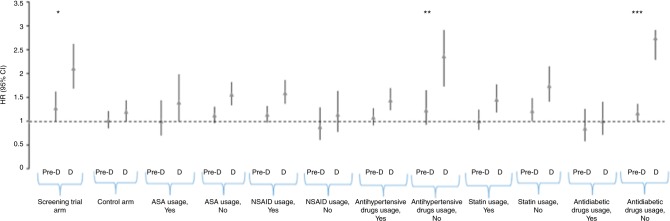
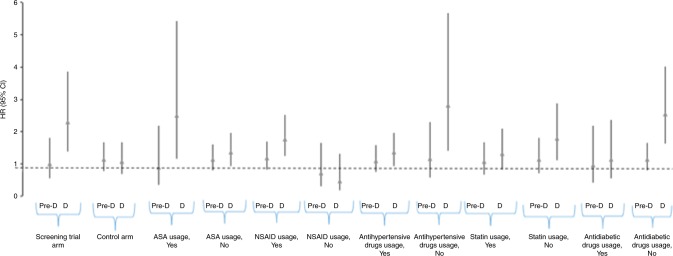
BACKGROUND: Diabetic men have lowered overall risk of prostate cancer (PCa), but the role of hyperglycaemia is unclear. In this cohort study, we estimated PCa risk among men with diabetic fasting blood glucose level. METHODS: Participants of the Finnish Randomized Study of Screening for Prostate Cancer (FinRSPC) were linked to laboratory database for information on glucose measurements since 1978. The data were available for 17,860 men. Based on the average yearly level, the men were categorised as normoglycaemic, prediabetic, or diabetic. Median follow-up was 14.7 years. Multivariable-adjusted Cox regression was used to calculate hazard ratios (HRs) and 95% confidence intervals (95% CIs) for prostate cancer overall and separately by Gleason grade and metastatic stage. RESULTS: In total 1,663 PCa cases were diagnosed. Compared to normoglycaemic men, those men with diabetic blood glucose level had increased risk of PCa (HR 1.52; 95% CI 1.31-1.75). The risk increase was observed for all tumour grades, and persisted for a decade afterwards. Antidiabetic drug use removed the risk association. Limitations include absence of information on lifestyle factors and limited information on BMI. CONCLUSIONS: Untreated diabetic fasting blood glucose level may be a prostate cancer risk factor.
Overview
The claims and statistics of this paper haven’t been checked yet.
Free: it reads the open-access text and checks the first 5 claims that cite a source we can check. Create a free account to check every claim.
Integrity signals
Registry
Cites
Statistics
Figures
Verification
Claims the paper makes
The claims and statistics of this paper haven’t been checked yet.
Free: it reads the open-access text and checks the first 5 claims that cite a source we can check. Create a free account to check every claim.
Claims other papers make about this one
Each is checked against this paper’s own text: does it say what the citing paper says it does?
The check wasn’t confident either way, so it gives no verdict — never disputed.
In the citing paper
“There is evidence of an association of obesity and high-grade aggressive prostate cancers.1758”
From American Association of Clinical Endocrinology Clinical Practice Guideline: Developing a Diabetes Mellitus Comprehensive Care Plan-2022 Update. (2022) · cites this paper as [1758]
Experimental — accuracy not yet measured
Self-check
Percentages, sums and reported differences re-computed from the paper’s own numbers.
The self-check needs the paper’s full text.
Citations
Cites
Schröder, F. H., Hugosson, J., Roobol, M. J., Tammela, T. L. J., Zappa, M., Nelen, V., Kwiatkowski, M., Lujan, M., Määttänen, L., Lilja, H., et al. (2014) · The Lancet · doi:10.1016/s0140-6736(14)60525-0 · Cited by 1,566
Self-citationData Quality and Quality Control of a Population-Based Cancer Registry: Experience in Finland
Teppo, L., Pukkala, E., & Lehtonen, M. (1994) · Acta Oncologica · doi:10.3109/02841869409098430 · Cited by 642
Metformin as an adjuvant treatment for cancer: a systematic review and meta-analysis
Coyle, C., Cafferty, F. H., Vale, C., & Langley, R. E. (2016) · Annals of Oncology · doi:10.1093/annonc/mdw410 · Cited by 452
Diabetes mellitus and risk of prostate cancer: a meta-analysis
Bonovas, S., Filioussi, K., & Tsantes, A. (2004) · Diabetologia · doi:10.1007/s00125-004-1415-6 · Cited by 327
Prospective Study of Fruit and Vegetable Intake and Risk of Prostate Cancer
Kirsh, V. A., Peters, U., Mayne, S. T., Subar, A. F., Chatterjee, N., Johnson, C. C., & Hayes, R. B. (2007) · JNCI Journal of the National Cancer Institute · doi:10.1093/jnci/djm065 · Cited by 286
Hyperinsulinaemia: A prospective risk factor for lethal clinical prostate cancer
Hammarsten, J., & Högstedt, B. (2005) · European Journal of Cancer · doi:10.1016/j.ejca.2005.09.003 · Cited by 214
Serum Insulin, Glucose, Indices of Insulin Resistance, and Risk of Prostate Cancer
Albanes, D., Weinstein, S. J., Wright, M. E., Männistö, S., Limburg, P. J., Snyder, K., & Virtamo, J. R. K. (2009) · JNCI Journal of the National Cancer Institute · doi:10.1093/jnci/djp260 · Cited by 155
Bylsma, L. C., & Alexander, D. D. (2015) · Nutrition Journal · doi:10.1186/s12937-015-0111-3 · Cited by 130
Does cancer risk increase with HbA1c, independent of diabetes?
de Beer, J. C., & Liebenberg, L. (2014) · British Journal of Cancer · doi:10.1038/bjc.2014.150 · Cited by 125
Prostate Cancer Mortality in the Finnish Randomized Screening Trial
Kilpeläinen, T. P., Tammela, T. L. J., Malila, N. K., Hakama, M., Santti, H., Määttänen, L., Stenman, U., Kujala, P. M., & Auvinen, A. P. (2013) · JNCI Journal of the National Cancer Institute · doi:10.1093/jnci/djt038 · Cited by 112
Self-citation
Cited by
Blonde, L., Umpierrez, G. E., Reddy, S. S., McGill, J. B., Berga, S. L., Bush, M., Chandrasekaran, S., DeFronzo, R. A., Einhorn, D., Galindo, R. J., et al. (2022) · Endocrine Practice · doi:10.1016/j.eprac.2022.08.002 · Cited by 507
Application of support vector machine algorithm for early differential diagnosis of prostate cancer
Akinnuwesi, B. A., Olayanju, K. A., Aribisala, B. S., Fashoto, S. G., Mbunge, E., Okpeku, M., & Owate, P. (2022) · Data Science and Management · doi:10.1016/j.dsm.2022.10.001 · Cited by 70
Cancer Progress and Priorities: Prostate Cancer
Kensler, K. H., & Rebbeck, T. R. (2020) · Cancer Epidemiology Biomarkers & Prevention · doi:10.1158/1055-9965.epi-19-0412 · Cited by 75
Energy Restriction and Colorectal Cancer: A Call for Additional Research
Castejón, M., Plaza, A., Martinez-Romero, J., Fernandez-Marcos, P. J., de Cabo, R., & Diaz-Ruiz, A. (2020) · Nutrients · doi:10.3390/nu12010114 · Cited by 51
“In turn, high fasting blood glucose levels are associated with increased risk of prostate [106], pancreas [107], lung [108], or stomach [109] cancers.”
BackgroundMetabolic syndrome biomarkers and prostate cancer risk in the UK Biobank
Monroy‐Iglesias, M. J., Russell, B. A., Crawley, D., Allen, N. E., Travis, R. C., Perez‐Cornago, A., Hemelrijck, M. V., & Beckmann, K. (2020) · International Journal of Cancer · doi:10.1002/ijc.33255 · Cited by 48
Ziglioli, F., Patera, A., Isgrò, G., Campobasso, D., Guarino, G. G., & Maestroni, U. V. (2023) · Frontiers in Oncology · doi:10.3389/fonc.2023.1203791 · Cited by 32
“(23) evaluated prostate cancer risk in relation to normal and elevated serum glucose levels in diabetic patients.”
BackgroundLee, Y. H. A., Zhou, J., Hui, J. M. H., Liu, X., Lee, T. T. L., Hui, K., Chan, J. S. K., Wai, A. K. C., Wong, W. T., Liu, T., et al. (2022) · Journal of the National Comprehensive Cancer Network · doi:10.6004/jnccn.2022.7010 · Cited by 27
Sharma, N., Khatib, M. N., Balaraman, A. K., Roopashree, R., Kaur, M., Srivastava, M., Barwal, A., Prasad, G. V. S., Rajput, P., Syed, R., et al. (2024) · International Urology and Nephrology · doi:10.1007/s11255-024-04266-4 · Cited by 21
“Some studies indicate that men with diabetes have an increased risk of developing prostate cancer, with a hazard ratio of 1.52 for all tumor grades compared to normoglycemic men, suggesting a significant elevation in risk [25].”
InfluentialPrediagnostic markers of insulin resistance and prostate cancer risk and death: A pooled study
Jochems, S. H. J., Fritz, J., Häggström, C., Stattin, P. E., & Stocks, T. (2023) · Cancer Medicine · doi:10.1002/cam4.6004 · Cited by 19
“9) Year of birth, n (%) <1940 5549 (11) 821 (31) 1615 (72) 9447 (63) 1940– 1949 11,354 (23) 572 (22) 614 (28) 5458 (37) 1950– 1959 12,453 (27) 513 (19) — — ≥1960 19,015 (39) 736 (28) — — Markers of insulin resistanceb Glucose, mmol/L, mean (SD) 5.”
Fasting blood glucose and risk of incident pancreatic cancer
Kim, Y. J., Oh, C., Park, S. K., Jung, J. Y., Kim, M. H., Ha, E., Nam, D. J., Kim, Y., Yang, E. H., Lee, H. C., et al. (2022) · PLoS ONE · doi:10.1371/journal.pone.0274195 · Cited by 16
“The elevated blood glucose has been reported to be associated with various cancers of pancreas, esophagus, liver, colon, cervix, prostate and others [7, 15, 16].”
BackgroundLutz, S., Hennenlotter, J., Frankó, A., Dannecker, C., Fritsche, L., Kantartzis, K., Wagner, R. J., Peter, A., Stefan, N., Fritsche, A., et al. (2022) · Journal of Clinical Medicine · doi:10.3390/jcm11226762 · Cited by 18
“7 years, increased fasting glucose was identified as a predictor of PCa development [13].”
BackgroundReduced risk of prostate cancer in a cohort of Lithuanian diabetes mellitus patients
Kinčius, M., Patašius, A., Linkevičiūtė-Ulinskienė, D., Zabulienė, L., & Smailytė, G. (2020) · The Aging Male · doi:10.1080/13685538.2020.1766013 · Cited by 12
“developing prostate cancer, supporting the risk lowering effect of this antidiabetic drug [39].”
BackgroundJiménez‐Vacas, J. M., Montero‐Hidalgo, A. J., Gómez‐Gómez, E., Fuentes-Fayos, A. C., Ruíz-Pino, F., Guler, I., Camargo, A., Anglada, F. J., Carrasco‐Valiente, J., Tena‐Sempere, M., et al. (2021) · The Journal of Clinical Endocrinology & Metabolism · doi:10.1210/clinem/dgab516 · Cited by 14
Linkage of Clinical Trial Data to Routinely Collected Data Sources: A Scoping Review
Najafzadeh, M., Oromendia, A. B., Burcu, M., McConnochie, B., Kim, E., Vaccaro, T. P., & Patorno, E. (2025) · JAMA Network Open · doi:10.1001/jamanetworkopen.2025.7797 · Cited by 10
Antidiabetic Drugs and Prostate Cancer Prognosis in a Finnish Population-Based Cohort
Vihervuori, V., Talala, K. M., Taari, K., Lahtela, J. T., Tammela, T. L. J., Auvinen, A. P., Raittinen, P. V. H., & Murtola, T. J. (2021) · Cancer Epidemiology Biomarkers & Prevention · doi:10.1158/1055-9965.epi-19-0580 · Cited by 7
“We have shown earlier that diabetic blood glucose level is associated with higher prostate cancer risk and worse prostate cancer survival compared with normoglycemia (22, 31, 32).”
BackgroundSelf-citationAlboghobeish, Z., Balam, F. H., Askari, F., & Rashidkhani, B. (2021) · Nutrition and Cancer · doi:10.1080/01635581.2021.1933100 · Cited by 7
“Numerous studies have shown that high blood sugar levels cause high insulin secretion and thus increase the risk of PC (38).”
BackgroundHyperglycemia and microRNAs in prostate cancer
Russo, V., Tamburrino, L., Morselli, S., Sani, C., Baldi, E., Sebastianelli, A., Raspollini, M. R., Mongia, A., Carradori, V., Lallo, E., et al. (2024) · Prostate Cancer and Prostatic Diseases · doi:10.1038/s41391-024-00809-z · Cited by 6
Hu, D., Peng, F., Lin, X., Zhang, H., Xia, Y., Lin, J., Zheng, X., & Niu, W. (2019) · Journal of Cancer · doi:10.7150/jca.31184 · Cited by 4
“The observations that elevated blood glucose is associated with high risk or poor prognosis of cancer at many sites have been widely made in the medical literature [22-25].”
BackgroundPoor Glycemic Control Affecting Screening of Prostate Carcinoma
Bharti, A., Shekhar, R., Prakash, P., Kumari, S., & Kumar, S. (2024) · Cureus · doi:10.7759/cureus.58680 · Cited by 3
“In contrast, higher insulin levels have been associated with a higher rate of prostate cancer [11].”
BackgroundCorrelation between metformin intake and prostate cancer
Kim, R., Song, M., Shinn, J., & Kim, H. (2023) · Cardiovascular Prevention and Pharmacotherapy · doi:10.36011/cpp.2023.5.e12 · Cited by 2
“However, as the duration of a diabetes diagnosis increases [15], the incidence rate of prostate cancer has been observed to decline [16].”
BackgroundOutcomes of prostate cancer screening among men using antidiabetic medication
Vettenranta, A., Murtola, T. J., Talala, K. M., Taari, K., Stenman, U., Tammela, T. L. J., & Auvinen, A. P. (2021) · Scientific Reports · doi:10.1038/s41598-021-86534-2
Self-citationReduced risk of prostate cancer in a cohort of Lithuanian diabetes patientsPreprint
Kinčius, M., Patašius, A., Linkevičiūtė-Ulinskienė, D., Stukas, R., Zabulienė, L., & Smailytė, G. (2019) · doi:10.21203/rs.2.16841/v1
“Recent data coming from Finland confirm that patients with T2DM and a normo glycemic status have a lower risk for developing prostate cancer, supporting the risk lowering effect of this antidiabetic drug[27].”
BackgroundYADALAM, A. K., Razavi, A. C., Patel, S. A., Liu, C., Sun, Y. V., & Mandawat, A. (2025) · Cardio-Oncology · doi:10.1186/s40959-025-00330-9
“Participants with HbA1c ≥ 6.5% exhibit the highest risk for adverse cardiovascular outcomes when compared to those with HbA1c 5.7% and 5.7–6.4% significant association between hyperglycemia, as measured by fasting blood glucose, and incident PCa risk [10].”
InfluentialKhan, A. A., Sarkar, E., Chandra, A., RAZA, T., Mahdi, A. A., Agarwal, P., Sankhwar, S., & Gupta, A. K. (2025) · SSRN Electronic Journal · doi:10.2139/ssrn.5385346
Laborey, M., Lajoinie, A., Freilich, J., Samalin, E., Bouché, O., Piessen, G., Stoelzel, M., & Chilelli, A. (2025) · PLoS ONE · doi:10.1371/journal.pone.0333667
Khan, A. A., Chandra, A., Agarwal, P., Raza, S. T., Gupta, A. K., Mahdi, A. A., & Sankhwar, S. (2025) · Cureus · doi:10.7759/cureus.96338
“Some epidemiological studies reported decreased risk [2,3], whereas some reported increased risk [4,5] of prostate cancer with coincidental diabetes.”
Özkan, S., & Börekoğlu, A. (2026) · BMC Urology · doi:10.1186/s12894-025-02015-y
“Similarly, a positive correlation has been reported between fasting blood glucose (FBG) levels and prostate volume [19]; however, some studies have indicated that high FBG and HbA1c levels may be associated with a lower risk of localized-stage PCa [20, 21].”
Body mass index and prostate cancer incidence: a comprehensive systematic review
Myers, D., Lagos, D. C., Zapata, I., & Hwang, C. (2026) · Frontiers in Oncology · doi:10.3389/fonc.2026.1766743 · Cited by 1
Metadata
- Authors
- Murtola, T. J., Vihervuori, V. J., Lahtela, J., Talala, K., Taari, K., Tammela, T. L., & Auvinen, A.
- Affiliations
- Tampere University (FI)
- Tampere University Hospital (FI)
- Finnish Cancer Registry (FI)
- Helsinki University Hospital (FI)
- University of Tampere (FI)
- Corresponding author
- Murtola, Teemu J.
- ORCID
- Venue
- British Journal of Cancer
- Published
- 2018-03-22
- Volume
- 118
- Issue
- 9
- Pages
- 1248-1254
- ISSN
- 0007-0920 (ISSN-L)
- 1532-1827
- PMC
- PMC5943324
- OpenAlex
- W2792056645
- Cited by
- 28
- References
- 31
- Citations by year
- 2026: 2 · 2025: 5 · 2024: 3 · 2023: 3 · 2022: 5 · 2021: 4 · 2020: 4 · 2019: 2
- FWCI
- 0.89
- Type
- journal article
- Language
- en
- Open access
- hybrid
- doi.org
- Licence
- cc-by
- creativecommons.org/licenses/by/4.0 (tdm)
- Locations
- British Journal of Cancer (publishedVersion, cc-by)
- Europe PMC (PubMed Central) (publishedVersion, cc-by)
- PubMed Central (publishedVersion, cc-by)
- PubMed (publishedVersion)
- Tampere University Institutional Repository (Tampere University) (acceptedVersion)
- Työväentutkimus Vuosikirja (submittedVersion, other-oa)
- Tampere University Institutional Repository (Tampere University) (submittedVersion)
- Funders
- Pirkanmaan Sairaanhoitopiiri (150640)
- Topics
- Life Sciences › Biochemistry, Genetics and Molecular Biology › Molecular Biology › Metabolism, Diabetes, and Cancer
- Health Sciences › Medicine › Urology › Prostate Cancer Diagnosis and Treatment
- Health Sciences › Medicine › Oncology › Cancer Risks and Factors
- Keywords
- prostate cancer, fasting blood glucose, hyperglycemia, diabetes mellitus, glycemic control, prediabetes, prostate cancer risk factors, Gleason grade, metastatic prostate cancer, antidiabetic drug use
- MeSH terms
- Aged, Blood Glucose, Diabetes Mellitus, Type 2, Fasting, Finland, Humans, Hyperglycemia, Hypoglycemic Agents, Male, Mass Screening, Middle Aged, Prostatic Neoplasms, Registries, Risk Factors, Early Detection of Cancer
About these checks
Registry, retraction, Cites and statistics results are computed, not judged, with one exception: a printed reference that no index lists is read once by a model before it counts as a citation error. Claims are extracted by a model and kept only when their quote appears verbatim in the text; each cited source is then checked, with a model’s help, for whether it says what the claim relies on. Those verdicts can be wrong — read the claim’s quote and the cited source before relying on one.
Statistics and arithmetic are recomputed, not judged.
Confidence bands are shown only for fields calibrated on our annotated test set. None is calibrated yet, so no band is shown.
What counts as a claim ›How we measure confidence ›How we check this ›
Are you an author, or do you see a problem with this page? Request a review
Data sources
Bibliographic data: Semantic Scholar, OpenAlex, Crossref.
Contains information from the Semantic Scholar Academic Graph Datasets, made available under the ODC Attribution License (ODC-BY 1.0).
Semantic Scholar’s data is described in: Kinney, R., et al. (2023). The Semantic Scholar Open Data Platform. arXiv:2301.10140.
