

Endogenous hormones and risk of invasive breast cancer in pre- and post-menopausal women: findings from the UK Biobank
Open accessThe DOI matches its Crossref record; 38 of the 38 references it cites were found in a registry or an index.
Abstract
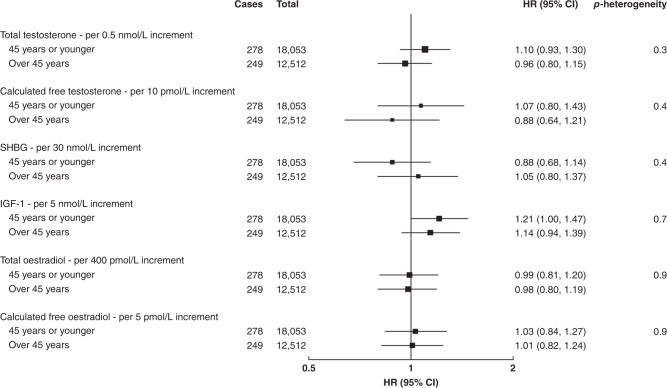
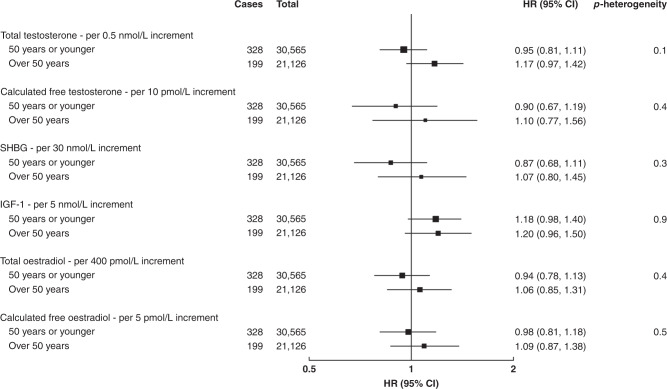
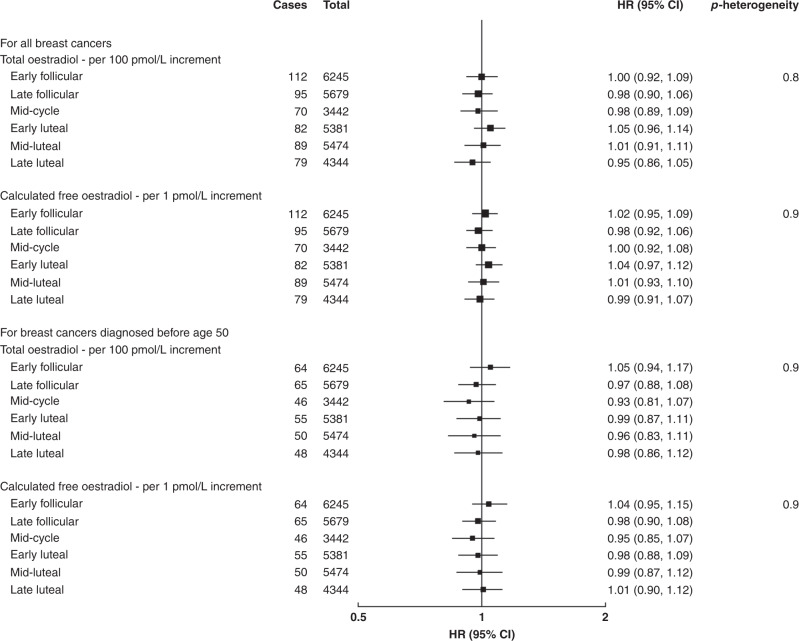
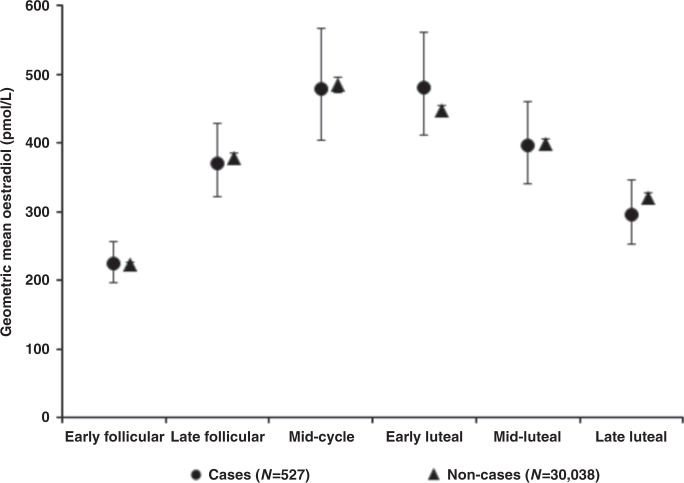
Background: Some endogenous hormones have been associated with breast cancer risk, but the nature of these relationships is not fully understood. Methods: UK Biobank was used. Hormone concentrations were measured in serum collected in 2006–2010, and in a repeat subsample ( N ~ 5000) in 2012–13. Incident cancers were identified through data linkage. Cox regression models were used, and hazard ratios (HRs) corrected for regression dilution bias. Results: Among 30,565 pre-menopausal and 133,294 post-menopausal women, 527 and 2,997, respectively, were diagnosed with invasive breast cancer during a median follow-up of 7.1 years. Cancer risk was positively associated with testosterone in post-menopausal women (HR per 0.5 nmol/L increment: 1.18; 95% CI: 1.14, 1.23) but not in pre-menopausal women ( p heterogeneity = 0.03), and with IGF-1 (insulin-like growth factor-1) (HR per 5 nmol/L increment: 1.18; 1.02, 1.35 (pre-menopausal) and 1.07; 1.01, 1.12 (post-menopausal); p heterogeneity = 0.2), and inversely associated with SHBG (sex hormone-binding globulin) (HR per 30 nmol/L increment: 0.96; 0.79, 1.15 (pre-menopausal) and 0.89; 0.84, 0.94 (post-menopausal); p heterogeneity = 0.4). Oestradiol, assessed only in pre-menopausal women, was not associated with risk, but there were study limitations for this hormone. Conclusions: This study confirms associations of testosterone, IGF-1 and SHBG with breast cancer risk, with heterogeneity by menopausal status for testosterone.
Overview
The claims and statistics of this paper haven’t been checked yet.
Free: it reads the open-access text and checks the first 5 claims that cite a source we can check. Create a free account to check every claim.
Integrity signals
Registry
Cites
Statistics
Figures
Verification
Claims the paper makes
The claims and statistics of this paper haven’t been checked yet.
Free: it reads the open-access text and checks the first 5 claims that cite a source we can check. Create a free account to check every claim.
Claims other papers make about this one
Each is checked against this paper’s own text: does it say what the citing paper says it does?
The cited source says what the claim attributes to it.
In the citing paper
“Because circulating estrogens are associated to an increased breast cancer risk in women, [123][124][125] and this cancer is related to alcohol intake, 126,127”
From The chronic alcohol consumption influences the gonadal axis in men: Results from a meta‐analysis (2024) · cites this paper as [125]
Self-check
Percentages, sums and reported differences re-computed from the paper’s own numbers.
The self-check needs the paper’s full text.
Citations
Cites
Bray, F., Ferlay, J., Soerjomataram, I., Siegel, R. L., Torre, L. A., & Jemal, A. (2018) · CA: A Cancer Journal for Clinicians · doi:10.3322/caac.21492 · Cited by 84,109
Blood pressure, stroke, and coronary heart disease
Collins, R., Peto, R., MacMahon, S., Godwin, J., Qizilbash, N., Collins, R., MacMahon, S., Hebert, P., Eberlein, K. A., Taylor, J. O., et al. (1990) · The Lancet · doi:10.1016/0140-6736(90)90944-z · Cited by 4,491
Insulin and insulin-like growth factor signalling in neoplasia
Pollak, M. (2008) · Nature Reviews Cancer · doi:10.1038/nrc2536 · Cited by 2,059 · cited 1×
“It may increase the risk of breast cancer by stimulating cell proliferation and inhibiting apoptosis.(17) The effects of IGF-1 on breast cells may be enhanced by oestrogens(18) as it has been proposed that IGF-1 interacts with oestrogen signalling pathways to regulate mitosis, apoptosis, adhesion, migration and differ…”
BackgroundThe Endogenous Hormones and Breast Cancer Collaborative Group (2002) · CancerSpectrum Knowledge Environment · doi:10.1093/jnci/94.8.606 · Cited by 1,793
(2012) · The Lancet Oncology · doi:10.1016/s1470-2045(12)70425-4 · Cited by 1,160
Clarke, R., Shipley, M., Lewington, S., Youngman, L., Collins, R., Marmot, M., & Peto, R. (1999) · American Journal of Epidemiology · doi:10.1093/oxfordjournals.aje.a010013 · Cited by 877
Henderson, B. E., & Feigelson, H. S. (2000) · Carcinogenesis · doi:10.1093/carcin/21.3.427 · Cited by 821 · cited 2×
“Total and calculated free oestradiol in pre-menopausal women Endogenous oestrogens may increase the risk of breast cancer by promoting cell proliferation and decreasing apoptosis.(1) Higher oestradiol concentrations have been consistently associated with an increased risk of post-menopausal breast cancer.”
BackgroundUsing human genetics to understand the disease impacts of testosterone in men and women
The Endometrial Cancer Association Consortium, Ruth, K. S., Day, F. R., Tyrrell, J., Thompson, D. J., Wood, A. R., Mahajan, A., Beaumont, R. N., Wittemans, L., Martin, S., et al. (2020) · Nature Medicine · doi:10.1038/s41591-020-0751-5 · Cited by 720
Cited by
Prospective study design and data analysis in UK Biobank
Allen, N. E., Lacey, B., Lawlor, D. A., Pell, J. P., Gallacher, J., Smeeth, L., Elliott, P., Matthews, P. M., Lyons, R. A., Whetton, A. D., et al. (2024) · Science Translational Medicine · doi:10.1126/scitranslmed.adf4428 · Cited by 279
Watling, C. Z., Schmidt, J. A., Dunneram, Y., Tong, T. Y. N., Kelly, R. K., Knüppel, A., Travis, R. C., Key, T. J., & Perez‐Cornago, A. (2022) · BMC Medicine · doi:10.1186/s12916-022-02256-w · Cited by 125
Self-citationSex steroid hormones and risk of breast cancer: a two-sample Mendelian randomization study
Nounu, A., Kar, S., Relton, C. L., & Richmond, R. C. (2022) · Breast Cancer Research · doi:10.1186/s13058-022-01553-9 · Cited by 72
“Positive associations with premenopausal BC were also found for estradiol, androstenedione, DHEAS and testosterone in a pooled analysis of seven prospective studies including 767 women with BC and 1699 controls [12]; however, a much larger study conducted in UK Biobank among 30,565 premenopausal women and 133,294 post…”
ResultRutter, C. E., Millard, L. A. C., Borges, M. C., & Lawlor, D. A. (2023) · International Journal of Epidemiology · doi:10.1093/ije/dyad082 · Cited by 50
Ingebriktsen, L. M., Finne, K., Akslen, L. A., & Wik, E. (2022) · British Journal of Cancer · doi:10.1038/s41416-022-01953-w · Cited by 36
“To speculate, the increased levels of endogenous oestrogen in premenopausal women may promote cell proliferation and concurrently less apoptosis, also contributing to the increased tumour cell proliferation seen in the young [48, 49].”
BackgroundImmunomodulatory effects of exercise in cancer prevention and adjuvant therapy: a narrative review
Lyu, D.-W. (2024) · Frontiers in Physiology · doi:10.3389/fphys.2023.1292580 · Cited by 36
“Increased levels of estrogens and androgens in women cause an increase in breast cancer risk (Tin Tin et al., 2021).”
BackgroundCuzick, J. M., Chu, K., Keevil, B. G., Brentnall, A. R., Howell, A., Zdenkowski, N., Bonanni, B., Loibl, S., Holli, K., Evans, D. G., et al. (2023) · The Lancet Oncology · doi:10.1016/s1470-2045(23)00578-8 · Cited by 35
Liu, X., Morelli, D., Littlejohns, T. J., Clifton, D. A., & Clifton, L. (2023) · Scientific Reports · doi:10.1038/s41598-023-36214-0 · Cited by 29
Tin, S. T., Key, T. J., & REEVES, G. K. (2021) · Cancer Epidemiology Biomarkers & Prevention · doi:10.1158/1055-9965.epi-21-0789 · Cited by 27
“In this analysis, we found positive associations between alcohol intake and testosterone concentrations, but on the basis of the results from our previous analysis of the UK Biobank data (10), the difference in total testosterone concentrations between women who consumed ≥40 g/day of alcohol and those who consumed <1…”
ResultSelf-citationHereditary Breast Cancer: Comprehensive Risk Assessment and Prevention Strategies
Manna, E. D. F., Serrano, D., Cazzaniga, L., Mannucci, S., Zanzottera, C., Fava, F., Aurilio, G., Guerrieri‐Gonzaga, A., Risti, M., Calvello, M., et al. (2025) · Genes · doi:10.3390/genes16010082 · Cited by 25
“Higher concentrations of sex hormone-binding globulin (SHBG) have been associated with a reduced risk of breast cancer [118].”
Bae, K., Lamoury, G., Carroll, S., Morgia, M., Lim, S. H.-S., Baron-Hay, S. E., Shin, I., Park, S.-J., & Oh, B. (2022) · Critical Reviews in Oncology/Hematology · doi:10.1016/j.critrevonc.2022.103898 · Cited by 22
Drummond, A. E., Swain, C. T. V., Milne, R. L., English, D. R., Brown, K. A., Skinner, T. L., Lay, J., van Roekel, E. H., Moore, M. M., Gaunt, T. R., et al. (2022) · Cancer Epidemiology Biomarkers & Prevention · doi:10.1158/1055-9965.epi-22-0505 · Cited by 22
Ultra-processed Plant Foods: Are They Worse than their Unprocessed Animal-Based Counterparts?
Jiménez, M. D. C. F.-F., & López‐Moreno, M. (2025) · Current Nutrition Reports · doi:10.1007/s13668-025-00704-6 · Cited by 22
Albers, F. E. M., Lou, M. W. C., Dashti, S. G., Swain, C. T. V., Rinaldi, S., Viallon, V., Karahalios, A., Brown, K. A., Gunter, M. J., Milne, R. L., et al. (2024) · Cancer Causes & Control · doi:10.1007/s10552-024-01856-6 · Cited by 21
“Another study from the UK Biobank presented results for total testosterone with and without adjustment for SHBG and IGF-1 that were not appreciably different [41].”
Understanding the role of sex hormones in cancer for the transgender community
Jackson, S. S., Nambiar, K. Z., O’Callaghan, S., & Berner, A. (2022) · Trends in cancer · doi:10.1016/j.trecan.2022.01.005 · Cited by 21
Berner, A., & Atkinson, S. E. (2024) · Best Practice & Research Clinical Endocrinology & Metabolism · doi:10.1016/j.beem.2024.101909 · Cited by 21
Sex-Hormone-Binding Globulin Gene Polymorphisms and Breast Cancer Risk in Caucasian Women of Russia
Ponomarenko, I., Николаевич, П. К., Churnosova, M., Николаевна, С. И., Aristova, I., Churnosov, V., Сергеевна, П. М., Reshetnikov, E., & Churnosov, M. I. (2024) · International Journal of Molecular Sciences · doi:10.3390/ijms25042182 · Cited by 19
“Firstly, testosterone under the action of aromatase can be converted into estradiol in adipose tissue and other organs, including breast tumor cells, and thus realize its BC risk effects through estrogen-mediated pathophysiological mechanisms that are risky for BC [13].”
BackgroundResultInfluentialНиколаевич, П. К. (2024) · RESEARCH RESULTS IN BIOMEDICINE · doi:10.18413/2658-6533-2024-10-1-0-4 · Cited by 24
Agrawal, P. M., Singh, S. M., Hsueh, J. Y., Grutman, A. J., An, C., Able, C. A., Choi, U., Kohn, J. R., Clifton, M. M., & Kohn, T. P. (2024) · The Journal of Sexual Medicine · doi:10.1093/jsxmed/qdae032 · Cited by 18
The chronic alcohol consumption influences the gonadal axis in men: Results from a meta‐analysis
Santi, D., Cignarelli, A., Baldi, M., Sansone, A., Spaggiari, G., Simoni, M., & Corona, G. (2024) · Andrology · doi:10.1111/andr.13526 · Cited by 17
Obesity-Dependent Association of the rs10454142 PPP1R21 with Breast Cancer
Ponomarenko, I., Николаевич, П. К., Churnosova, M., Николаевна, С. И., Aristova, I., Churnosov, V., Сергеевна, П. М., Reshetnikova, Y., Reshetnikov, E., & Churnosov, M. I. (2024) · Biomedicines · doi:10.3390/biomedicines12040818 · Cited by 17
“…variant C rs10454142 PPP1R21 [20] apparently led to a more pronounced decrease in the level of BC-protective circulating SHBG in the organism [13,14,21,75,91] and, accordingly, to a more significant increase in BC-risk SHBG-related sex hormones (including their free forms) such as estrogens…”
BackgroundResultInfluentialShukla, N., Shah, K., Rathore, D., Soni, K., Shah, J., Vora, H., & Dave, H. V. (2024) · Life Sciences · doi:10.1016/j.lfs.2024.122697 · Cited by 17
Breast cancer status, grading system, etiology, and challenges in Asia: an updated review
Tan, X. J., Cheor, W. L., Cheng, E. M., Rahman, K. S. A., Muhamad, W. Z. A. W., & Leow, W. Z. (2023) · ONCOLOGIE · doi:10.1515/oncologie-2022-1011 · Cited by 17
Michou, V., Zervoudis, S., Eskitzis, P., Tsamos, G., Vasdeki, D., Vouxinou, A., Markja, A., & Iatrakis, G. M. (2025) · Medicina · doi:10.3390/medicina61071167 · Cited by 15
“In premenopausal women, SHBG concentrations do not appear to be associated with BC risk [66].”
Breast and cervical cancer in transgender men: literature review and a case report
Lisa, F. S. D., Villa, A., Filomeno, L., Arcuri, T., Chiofalo, B., Sanguineti, G., Pizzuti, L., Krasniqi, E., Barba, M., Sergi, D., et al. (2024) · Therapeutic Advances in Medical Oncology · doi:10.1177/17588359241259466 · Cited by 14
“35 In 36–38 Conversely, some in vitro cultures and in vivo studies that testosterone has antiproliferative and pro-apoptotic effects on breast tissue, without any change in mammographic breast density, 39,40 thus apparently reducing breast cancer risk.”
BackgroundZhang, Y., Huang, X., Yu, X., He, W., Czene, K., & Yang, H. (2023) · The Breast · doi:10.1016/j.breast.2023.103603 · Cited by 13
Wan, B., Ma, N., Zhou, Z., & Lv, C. (2023) · PeerJ · doi:10.7717/peerj.15760 · Cited by 12
Zhao, S., Gu, J., Tian, Y., Wang, R., & Li, W. (2024) · Open Life Sciences · doi:10.1515/biol-2022-0822 · Cited by 12
Li, Z., Zhao, Z., Zhang, T., Yang, X., Chen, H., Yin, X., Bai, H., Liu, X., Chang, T., Zhang, Y., et al. (2025) · BMC Cancer · doi:10.1186/s12885-025-13970-y · Cited by 10
“The sex steroid biomarkers sex hormone-binding globulin (SHBG) and testosterone [26, 27], inflammatory biomarker C-reactive protein (CRP) [28, 29], as well as glycemic marker glycated haemoglobin (HbA1c) [30] are breast cancer risk factors that have also been associated with IR [31–33].”
Role of a Whole Plant Foods Diet in Breast Cancer Prevention and Survival
Jiménez, M. D. C. F.-F. (2025) · Journal of the American Nutrition Association · doi:10.1080/27697061.2024.2442631 · Cited by 10
Variation Analysis in Premenopausal and Postmenopausal Breast Cancer Cases
Erdoğdu, İ. H., Örenay-Boyacıoğlu, S., Boyacıoğlu, O., Gürel, D., Akdeniz, N., & Meteoğlu, İ. (2024) · Journal of Personalized Medicine · doi:10.3390/jpm14040434 · Cited by 9
“Eventually, the outcomes of BCa in women vary between younger and older patients, indicating differences in disease progression, treatment response, and overall prognosis based on age [3,4].”
BackgroundRodríguez‐Valentín, R., Torres-Mejía, G., Martínez-Matsushita, L., Ángeles-Llerenas, A., Gómez‐Flores‐Ramos, L., Wolff, R. K., Baumgartner, K. B., Hines, L. M., Ziv, E., Flores‐Luna, L., et al. (2022) · Scientific Reports · doi:10.1038/s41598-022-05496-1 · Cited by 9
Relationship Between Obesity, Menopausal Status and Breast Cancer Risks - A Review
Mehmood, S., Yasin, A., Ahmad, I., Rabab, S. A., & Soomar, A. M. (2022) · Pakistan Journal of Health Sciences · doi:10.54393/pjhs.v3i07.432 · Cited by 6
Agrawal, P. M., Lee, Y. S., Grutman, A. J., Dumas, K., Kohn, T. P., Kohn, J. R., Yee, A. M., & Clifton, M. M. (2024) · The Journal of Sexual Medicine · doi:10.1093/jsxmed/qdae013 · Cited by 6
Non-occupational exposure to cadmium and breast cancer: A comprehensive and critical review
Aničić, R., Zeković, M., Kocić, M., Gluvic, Z. M., Manojlović, D., Ščančar, J., & Stojsavljević, A. (2025) · Ecotoxicology and Environmental Safety · doi:10.1016/j.ecoenv.2025.118331 · Cited by 5
Machine learning-driven drug repurposing for HER2-positive breast cancer
Dinesh, B. G. H., Ganjipete, S., Kumar, B. S., Ammunje, D. N., Kunjiappan, S., Seetharaman, P., Ramar, M., Chidambaram, K., & Pavadai, P. (2026) · Scientific Reports · doi:10.1038/s41598-026-45361-z · Cited by 4
“Hormone replacement therapy, late menopause, and early menarche can increase the risk of hormone-related cancers like breast and endometrial carcinoma 8 .”
Role of physical activity in cancer prevention: An update
Dhamnetiya, D., & Sharma, A. (2025) · World Journal of Clinical Oncology · doi:10.5306/wjco.v16.i8.107765 · Cited by 4
Feng, J. F., Qi, X., Chen, C., Li, B., Wang, M., Xie, X., Yang, K., Liu, X., Chen, R. M., Guo, T., et al. (2025) · Scientific Reports · doi:10.1038/s41598-025-90447-9 · Cited by 4
“While some argue that the association between SHBG levels and BC risk may not be causal 17 , a wealth of literature supports the significance of SHBG in the course of BC 54,56–63 .”
Analysis of Breast Cancer Receptors Status and Molecular Subtypes Among Female Population
Naz, S., Siddiqui, M., Memon, A. I., Bhatti, A. M., Hussain, Z. I., & Iqra, I. (2023) · Pakistan Journal of Medical and Health Sciences · doi:10.53350/pjmhs2023171656 · Cited by 4
Oestradiol and breast cancer prevention: a 40 year history and contemporary perspective
Cuzick, J. M., & Dowsett, M. (2025) · British Journal of Cancer · doi:10.1038/s41416-025-03115-0 · Cited by 3
Stress and risk of breast cancer; findings from a large population-based incident case-control study
Yazdi, M., Khosravi, O., Javanmard, S. H., Zendehdel, K., Houssami, N., & Abdollahpour, I. (2026) · Scientific Reports · doi:10.1038/s41598-026-58016-w · Cited by 3
“In addition, breast cancer risk is influenced by endogenous ovarian hormones, particularly oestrogen and progesterone 42 , and longer or higher exposure to these hormones has been linked to increased breast cancer risk 43,44 .”
Zhang, H., Zhu, X., Xin, M., Wang, R., Wang, T., Nie, G., Zhang, H., Yan, J., & Liu, C. (2025) · BMC Public Health · doi:10.1186/s12889-025-25590-z · Cited by 3
“Recent epidemiological studies have also reported that low SHBG levels predict increased BC risk [74], seemingly contradicting our findings.”
Jiménez, M. D. C. F.-F., López-Gil, J. F., Marrero‐Fernández, P., & López‐Moreno, M. (2025) · Nutrition Reviews · doi:10.1093/nutrit/nuaf315 · Cited by 3
Serum hormone levels and normal breast histology among premenopausal women
Sherman, M. E., de Bel, T., Heckman, M. G., White, L. J., Ogony, J. W., Stallings‐Mann, M. L., Hilton, T. W., Degnim, A. C., Vierkant, R. A., Hoskin, T. L., et al. (2022) · Breast Cancer Research and Treatment · doi:10.1007/s10549-022-06600-9 · Cited by 3
“, peri-ovulatory estrogen spike and fluctuation in levels of luteal progesterone), even small errors may impact analyses (challenges reviewed [16]).”
BackgroundResultHemati, A., Amini, L., Haghani, S., & Hashemi, E. (2024) · BMC Women s Health · doi:10.1186/s12905-024-03421-4 · Cited by 3
“Studies have shown an inverse and significant relationship between serum SHBG levels and breast cancer risk [17].”
Study of HER2 in Breast Cancer Disease
Mhmood, B. R., & Allwsh, T. A. (2021) · Egyptian Journal of Chemistry · doi:10.21608/ejchem.2021.80147.3955 · Cited by 3
Song, N., Yang, K., & Li, Y. (2025) · Breast Cancer · doi:10.1007/s12282-025-01696-5 · Cited by 1
Spiegelmer Aptamers: Innovative Approach in Breast Cancer
Hezave, Y. A., Najafi, R., Amini, R., & Shojaeian, A. (2026) · Breast Cancer Basic and Clinical Research · doi:10.1177/11782234261456036 · Cited by 1
Wang, C., & Liu, Z. (2026) · Nutrients · doi:10.3390/nu18122011 · Cited by 1
“…onward, cyclic ovarian estradiol and estrone exposures, particularly when menarche occurs early, and the interval to first full-term pregnancy is prolonged, extend the years in which proliferative estrogen signaling can promote malignant transformation in young mammary epithelium [38,47,160,161].”
An interplay between genes SLCO1B1, NR2F2, JMJD1C and obesity in developing breast cancer
Николаевич, П. К., Ponomarenko, I., & Churnosov, M. I. (2023) · Obstetrics Gynecology and Reproduction · doi:10.17749/2313-7347/ob.gyn.rep.2023.463 · Cited by 1
Person-centered cancer genetic counseling for transgender and gender diverse patients
Giblin, J., Berner, A., & Coad, B. (2023) · Principles of Gender-Specific Medicine · doi:10.1016/b978-0-323-88534-8.00008-0 · Cited by 1
Iqbal, M. U. N., Ali, R., Maqbool, S. A., & Khan, T. A. (2022) · Advances in basic medical sciences. · doi:10.35845/abms.2022.2.236 · Cited by 1
“19 Hormones exposure 20 also influences the BC among which estrogen which is the most potent mammogen has a principal role in the BC development and progression.”
BackgroundElnour, A. A. M. (2025) · Springer eBooks · doi:10.1007/978-981-97-8518-6_5 · Cited by 1
Gardezi, S. S., Shakeel, M., Ullah, M. S., Nisar, B., Asif, M., & Ashraf, M. (2025) · Pakistan Journal of Health Sciences · doi:10.54393/pjhs.v6i5.2915 · Cited by 1
Novelli, I. R. (2022) · Digital Library of Theses and Dissertations (Universidade de São Paulo) · doi:10.11606/t.6.2022.tde-10032023-144402 · Cited by 1
Николаевич, П. К., Ponomarenko, I., & Churnosov, M. I. (2023) · Obstetrics Gynecology and Reproduction · doi:10.17749/2313-7347/ob.gyn.rep.2023.455
Николаевич, П. К., Ponomarenko, I., & Churnosov, M. I. (2024) · Сибирский журнал клинической и экспериментальной медицины · doi:10.29001/2073-8552-2024-39-1-156-162
Николаевич, П. К., Ponomarenko, I., & Churnosov, M. I. (2024) · GYNECOLOGY · doi:10.26442/20795696.2024.1.202644
The Emerging Role of the Microbiome in Carcinogenesis
Gates, T. J., Dietz, M. A., Martell, M., Balbo, S., Subramanian, S., & Staley, C. M. (2024) · Elsevier eBooks · doi:10.1016/b978-0-323-95488-4.00093-0
Николаевич, П. К., Ponomarenko, I., & Churnosov, M. I. (2024) · GYNECOLOGY · doi:10.26442/20795696.2024.3.202828
Hormone-associated dietary patterns and premenopausal breast cancer risk
Fest, S. N., Farland, L. V., Doody, D. R., Eliassen, A. H., ROSNER, B. A., Fung, T. T., Hankinson, S. E., Kensler, T. W., Willett, W. C., & Harris, H. R. (2025) · Breast Cancer Research and Treatment · doi:10.1007/s10549-025-07689-4
Namugenyi, A. F., & Akapo, O. O. (2025) · International Journal of Innovative Research and Scientific Studies · doi:10.53894/ijirss.v8i7.10482
“However, a woman's hormonal environment, menopausal state, and general reproductive history may all affect the direction and extent of these links [10, 11].”
Vitamin D Supplementation and Testosterone Levels in Breast Cancer Survivors
Minopoli, A., Gennaro, P. D., Porciello, G., Palumbo, E., Vitale, S., Grimaldi, M., Pica, R., Falzone, L., Montagnese, C., de Falco, R., et al. (2025) · International Journal of Molecular Sciences · doi:10.3390/ijms262010030
Damböck, A. T. (2023) · University of Regensburg Publication Server (University of Regensburg) · doi:10.5283/epub.53269
Glushkov, A. N., Поленок, Е. Г., Гордеева, Л. А., Kostyanko, M. V., Zakharov, V. N., Antonov, A. V., Валерьевич, Б. П., Verzhbitskaya, N. Е., & Kolpinskiy, G. I. (2026) · Russian Journal of Immunology · doi:10.46235/1028-7221-17000-aab
Cao, B., Xie, Z., Chen, Y., Zhang, Y., Lin, Y. Y., Wang, Y., & Yang, H. (2026) · Global Health · doi:10.1155/ghe3/5977465
The impact of sex and gender on nonreproductive cancers
Jackson, S. S., Berner, A., Waite, K. A., & Barnholtz‐Sloan, J. S. (2026) · Elsevier eBooks · doi:10.1016/b978-0-443-45863-7.00066-4
The Intersection of Androgens and Cardiovascular Disease in Postmenopausal Women
Dew, M. L., Olubi, O. M., Wang-Crocker, C., Prince, E. L., Lowe, A., & Le, D. E. (2026) · Current Cardiology Reports · doi:10.1007/s11886-026-02400-5
Ren, N., Yang, M., Zhou, F., Ma, J., Ji, W., & Ren, X. (2026) · Medicine · doi:10.1097/md.0000000000050317
Zhang, Y., Suo, C., & Sun, L. (2026) · Chinese Medical Journal · doi:10.1097/cm9.0000000000004174
Serrano, D., Rizzo, R., Johansson, H. A., Macis, D., Aristarco, V., Guerrieri‐Gonzaga, A., Lazzeroni, M., Aurilio, G., Carbone, A., Ramalho, S., et al. (2026) · JNCI Journal of the National Cancer Institute · doi:10.1093/jnci/djag318 · Cited by 1
Yongue, G., Nash, Z., Manley, K., Davies, M. C., & Nicum, S. (2026) · Reproduction and Fertility · doi:10.1530/raf-26-0082
HERNÁNDEZ, Á., Madrid, J. N., Sánchez, C., Sanz, A., Young, W. J., Munroe, P. B., Mincholé, A., & Ramírez, J. (2026) · medRxiv · doi:10.64898/2026.09.11.26362818
Serrano, D., Lazzeroni, M., Rizzo, R., Gnagnarella, P., Aurilio, G., Colombo, E., Guerrieri‐Gonzaga, A., Johansson, H. A., Zovato, S., Nardi, M., et al. (2026) · European Journal of Cancer · doi:10.1016/j.ejca.2026.117784
Metadata
- Authors
- Tin Tin, S., Reeves, G. K., & Key, T. J.
- Affiliations
- University of Oxford (GB)
- Venue
- British Journal of Cancer
- Published
- 2021-04-16
- Volume
- 125
- Issue
- 1
- Pages
- 126-134
- ISSN
- 0007-0920 (ISSN-L)
- 1532-1827
- PMC
- PMC8257641
- OpenAlex
- W3155385278
- Semantic Scholar
- 5a375d8f93905f7934dcc53b3112a01694b04e68
- Cited by
- 71
- References
- 38
- Citations by year
- 2026: 11 · 2025: 16 · 2024: 19 · 2023: 11 · 2022: 12 · 2021: 2
- FWCI
- 4.01
- Type
- journal article
- Language
- en
- Open access
- hybrid
- doi.org
- Licence
- cc-by
- creativecommons.org/licenses/by/4.0 (tdm)
- creativecommons.org/licenses/by/4.0 (vor)
- Locations
- British Journal of Cancer (publishedVersion, cc-by)
- PubMed Central (publishedVersion, cc-by)
- PubMed (publishedVersion)
- ResearchSpace (University of Auckland) (submittedVersion, cc-by)
- Funders
- Manatu Hauora | Health Research Council of New Zealand (19/031)
- Cancer Research UK (C570/A16491)
- Topics
- Health Sciences › Medicine › Oncology › Cancer Risks and Factors
- Life Sciences › Biochemistry, Genetics and Molecular Biology › Endocrinology › Estrogen and related hormone effects
- Health Sciences › Medicine › Endocrinology, Diabetes and Metabolism › Menopause: Health Impacts and Treatments
- Keywords
- invasive breast cancer, endogenous hormones, testosterone, insulin-like growth factor I, sex hormone-binding globulin, estradiol, menopausal status, premenopausal women, postmenopausal women, breast cancer risk
- MeSH terms
- Adult, Aged, Breast Neoplasms, Female, United Kingdom, Humans, Insulin-Like Growth Factor I, Middle Aged, Regression Analysis, Sex Hormone-Binding Globulin, Testosterone, Premenopause, Postmenopause, Biological Specimen Banks
About these checks
Registry, retraction, Cites and statistics results are computed, not judged, with one exception: a printed reference that no index lists is read once by a model before it counts as a citation error. Claims are extracted by a model and kept only when their quote appears verbatim in the text; each cited source is then checked, with a model’s help, for whether it says what the claim relies on. Those verdicts can be wrong — read the claim’s quote and the cited source before relying on one.
Statistics and arithmetic are recomputed, not judged.
Confidence bands are shown only for fields calibrated on our annotated test set. None is calibrated yet, so no band is shown.
What counts as a claim ›How we measure confidence ›How we check this ›
Are you an author, or do you see a problem with this page? Request a review
Data sources
Bibliographic data: Semantic Scholar, OpenAlex, Crossref.
Contains information from the Semantic Scholar Academic Graph Datasets, made available under the ODC Attribution License (ODC-BY 1.0).
Semantic Scholar’s data is described in: Kinney, R., et al. (2023). The Semantic Scholar Open Data Platform. arXiv:2301.10140.
