

SARS-CoV-2 Spike protein S2 subunit modulates γ-secretase and enhances amyloid-β production in COVID-19 neuropathy
Open accessThe DOI matches its Crossref record; 15 of the 15 references it cites were found in a registry or an index.
Abstract
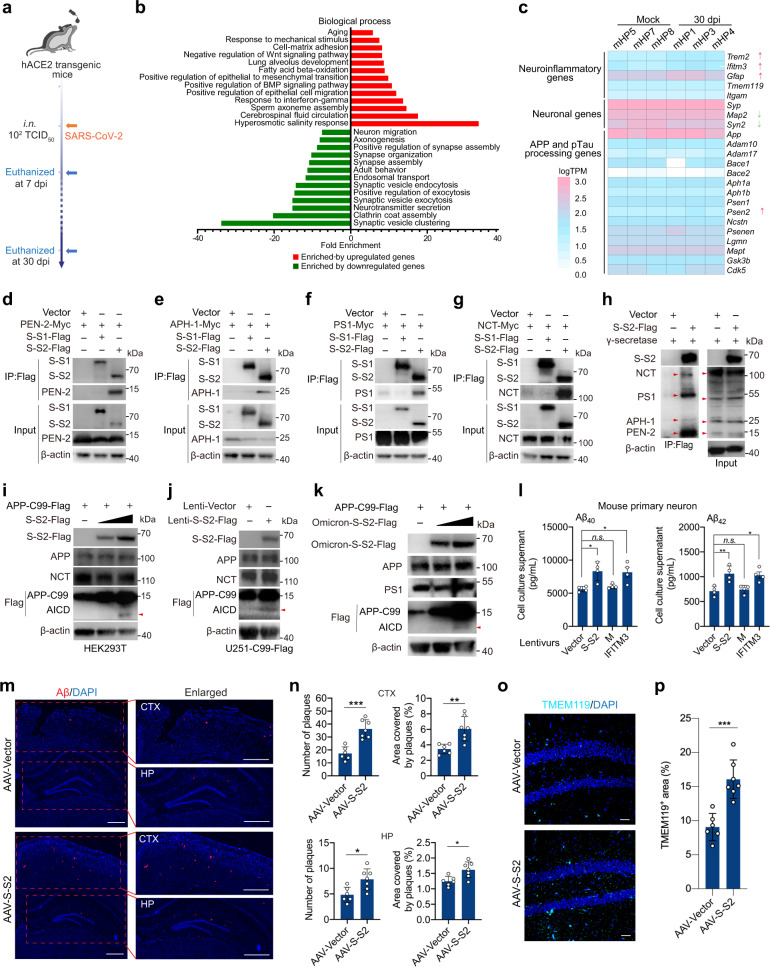
SARS-CoV-2-induced multi-lineage neural cell dysregulation has been documented 1 . SARS-CoV-2 infection elevates neuroinflammation 2 , alters brain structure 3 leads to abnormal accumulation of neurodegenerative amyloid-β (Aβ) and phosphorylated tau 4 , 5 , and increases the risk of cognitive impairment 6 in COVID-19 patients. However, the mechanism underlying neurological dysfunctions following SARS-CoV-2 infection remains largely unknown.
Overview
The claims and statistics of this paper haven’t been checked yet.
Free: it reads the open-access text and checks the first 5 claims that cite a source we can check. Create a free account to check every claim.
Integrity signals
Registry
Cites
Statistics
Figures
Verification
Claims the paper makes
The claims and statistics of this paper haven’t been checked yet.
Free: it reads the open-access text and checks the first 5 claims that cite a source we can check. Create a free account to check every claim.
Claims other papers make about this one
Each is checked against this paper’s own text: does it say what the citing paper says it does?
The cited source says what the claim attributes to it.
In the citing paper
“SARS-CoV-2 affects key pathological changes, such as Aβ, tau, and neuroinflammation, promoting cognitive impairment.”
From Recent advances in Alzheimer's disease: Mechanisms, clinical trials and new drug development strategies. (2024) · cites this paper as [607]
The cited source says what the claim attributes to it.
In the citing paper
“Interaction between the SARS-CoV-2 Spike S2 subunit and γ-secretase could regulate γ-secretase cleavage of APP and increase Aβ production.607”
From Recent advances in Alzheimer's disease: Mechanisms, clinical trials and new drug development strategies. (2024) · cites this paper as [607]
The cited source says what the claim attributes to it.
In the citing paper
“Moreover, similar to that found with the HSV-1 US7 protein [33], the SARS-CoV-2 spike protein has also been found to interact with γ-secretase, thereby enhancing Aβ production [81].”
From What would it take to prove that a chronic infection is a causal agent in Alzheimer’s disease? (2025) · cites this paper as [81]
Self-check
Percentages, sums and reported differences re-computed from the paper’s own numbers.
The self-check needs the paper’s full text.
Citations
Cites
Knopman, D. S., Amieva, H., Petersen, R. C., Chételat, G., Holtzman, D. M., Hyman, B. T., Nixon, R. A., & Jones, D. T. (2021) · Nature Reviews Disease Primers · doi:10.1038/s41572-021-00269-y · Cited by 2,606
Amyloid Precursor Protein Processing and Alzheimer's Disease
O'Brien, R. J., & Wong, P. C. (2011) · Annual Review of Neuroscience · doi:10.1146/annurev-neuro-061010-113613 · Cited by 2,061
SARS-CoV-2 is associated with changes in brain structure in UK Biobank
Douaud, G., Lee, S., Alfaro-Almagro, F., Arthofer, C., Wang, C., McCarthy, P., Lange, F., Andersson, J. L. R., Griffanti, L., Duff, E., et al. (2022) · Nature · doi:10.1038/s41586-022-04569-5 · Cited by 1,646
Jankowsky, J. L., Fadale, D. J., Anderson, J., Xu, G. M., Gonzales, V., Jenkins, N. A., Copeland, N. G., Lee, M. K., Younkin, L. H., Wagner, S. L., et al. (2004) · Human Molecular Genetics · doi:10.1093/hmg/ddh019 · Cited by 1,575
SARS-CoV-2 Omicron variant: Antibody evasion and cryo-EM structure of spike protein–ACE2 complex
Mannar, D., Saville, J. W., Zhu, X., Srivastava, S. S., Berezuk, A. M., Tuttle, K. S., Marquez, A. C., Sekirov, I., & Subramaniam, S. (2022) · Science · doi:10.1126/science.abn7760 · Cited by 630
Dysregulation of brain and choroid plexus cell types in severe COVID-19
Yang, A. C., Kern, F., Losada, P. M., Agam, M. R., Maat, C. A., Schmartz, G. P., Fehlmann, T., Stein, J. A., Schaum, N., Lee, D. P., et al. (2021) · Nature · doi:10.1038/s41586-021-03710-0 · Cited by 620
Mild respiratory COVID can cause multi-lineage neural cell and myelin dysregulation
Fernández-Castañeda, A., Lu, P., Geraghty, A. C., Song, E., Lee, M.-H., Wood, J., O’Dea, M. R., Dutton, S., Shamardani, K., Nwangwu, K., et al. (2022) · Cell · doi:10.1016/j.cell.2022.06.008 · Cited by 521
γ-Secretase, notch, Aβ and alzheimer's disease: Where do the presenilins fit in?
Sisodia, S. S., & St George-Hyslop, P. H. (2002) · Nature Reviews Neuroscience · doi:10.1038/nrn785 · Cited by 512
Microglial activation and tau propagate jointly across Braak stages
Pascoal, T. A., Benedet, A. L., Ashton, N. J., Kang, M. S., Therriault, J., Chamoun, M., Savard, M., Lussier, F. Z., Tissot, C., Karikari, T. K., et al. (2021) · Nature Medicine · doi:10.1038/s41591-021-01456-w · Cited by 490
The innate immunity protein IFITM3 modulates γ-secretase in Alzheimer’s disease
Hur, J.-Y., Frost, G. R., Wu, X., Crump, C., Pan, S. J., Wong, E., Barros, M., Li, T., Nie, P., Zhai, Y., et al. (2020) · Nature · doi:10.1038/s41586-020-2681-2 · Cited by 382
Cited by
Zhang, J., Zhang, Y., Wang, J., Xia, Y., Zhang, J., & Chen, L. (2024) · Signal Transduction and Targeted Therapy · doi:10.1038/s41392-024-01911-3 · Cited by 1,138
Vascular Dysfunctions Contribute to the Long-Term Cognitive Deficits Following COVID-19
Shabani, Z., Liu, J., & Su, H. (2023) · Biology · doi:10.3390/biology12081106 · Cited by 46
Chen, J., Chen, J., Lei, Z., Zhang, F., Zeng, L., Wu, X., Li, S., & Tan, J. (2023) · Translational Psychiatry · doi:10.1038/s41398-023-02692-z · Cited by 34
Amadoro, G., Latina, V., Stigliano, E., & Micera, A. (2023) · Cells · doi:10.3390/cells12222601 · Cited by 22
“…Angiotensin-Converting Enzyme 2 (hACE2) suggest novel insights by showing, for the first time, that the SARS-CoV-2 spike protein S2 subunit is able per se to enhance the A β production via direct binding to and the modulation of the processing enzymatic activity of the γ -secretase complex [191].”
BackgroundZhao, M., Ma, G., Yan, X., Li, X., Wang, E., Xu, X.-X., Zhao, J.-B., Ma, X., & Zeng, J. (2024) · Molecular Psychiatry · doi:10.1038/s41380-024-02428-5 · Cited by 21
Self-citationMiller, S., Dhodapkar, R. M., Sutova, H. E., Yao, X., Lee, S., Logan, R., Ran, C., Bhatta, S., Gomm, A., Ju, I. G., et al. (2025) · Science Advances · doi:10.1126/sciadv.ads5006 · Cited by 18
“SARS- CoV-2 Spike protein has been reported to up-regulate amyloid-β through modulating γ - secretase ( 22 ).”
The role of inflammatory gene polymorphisms in severe COVID-19: a review
Yip, J. Q., Oo, A., Ng, Y. L., Chin, K. L., Tan, K., Chu, J. J. H., AbuBakar, S., & Zainal, N. (2024) · Virology Journal · doi:10.1186/s12985-024-02597-3 · Cited by 18
Наволокин, Н. А., Adushkina, V., Zlatogorskaya, D., Telnova, V., Evsukova, A., Vodovozova, E. L., Anna, E., Dosadina, E. E., Diduk, S., & Semyachkina-Glushkovskaya, O. V. (2024) · Pharmaceuticals · doi:10.3390/ph17060788 · Cited by 14
Vavougios, G. D., Tseriotis, V., Liampas, A., Mavridis, T., de Erausquin, G. A., & Hadjigeorgiou, G. M. (2024) · Frontiers in Human Neuroscience · doi:10.3389/fnhum.2024.1352118 · Cited by 13
Impacts of the SARS-CoV-2 Spike Protein on the Innate Immune System: A Review
Bocquet-Garçon, A. (2024) · Cureus · doi:10.7759/cureus.57008 · Cited by 10
“Here, too, the interaction S2/ γ - secretase raises questions [88,178].”
BackgroundHuang, T., Jiang, N., Song, Y., Pan, H., Bai, J., Yu, B., Li, X., He, J., Yuan, K., & Wang, Z. (2023) · Frontiers in Molecular Biosciences · doi:10.3389/fmolb.2023.1274463 · Cited by 10
Self-citationSARS-CoV-2 amyloid, is COVID-19-exacerbated dementia an amyloid disorder in the making?
Milton, N. G. N. (2023) · Frontiers in Dementia · doi:10.3389/frdem.2023.1233340 · Cited by 8
Yan, X., Wang, E., Zhao, M. L., Ma, G., Xu, X.-X., Zhao, J.-B., Li, X., Zeng, J., & Ma, X. (2025) · Neuroscience · doi:10.1016/j.neuroscience.2025.03.019 · Cited by 8
Self-citationCoupling of Alzheimer’s Disease Genetic Risk Factors with Viral Susceptibility and Inflammation
Cao, C., Fu, G., Xu, R., & Li, N. (2023) · Aging and Disease · doi:10.14336/ad.2023.1017 · Cited by 8
“It has been reported that in APP/PS1 transgenic mice, the S2 subunit of the SARS-CoV-2 S protein can interact with the γ-secretase complex, enhancing γ-secretase cleavage of APP to accelerate the production of Aβ, thereby promoting the emergence of COVID-19 neuropathological changes [77] (Fig.”
BackgroundRahman, M. R., Akter, R., Neelotpol, S., Mayesha, I. I., & Afrose, A. (2023) · American Journal of Alzheimer s Disease & Other Dementias® · doi:10.1177/15333175231214974 · Cited by 8
“42,43”
Xiang, X., Feng, Z., Wang, L., Wang, D., Li, T., Yang, J., Wang, S., Xiao, F., & Zhang, W. (2025) · International Immunopharmacology · doi:10.1016/j.intimp.2025.114628 · Cited by 7
The European Academy of Neurology N euro COVID ‐19 Task Force: A lesson for the future
Cavallieri, F., Sellner, J., Akhvlediani, T., Bassetti, C. L., Bereczki, D., Fanciulli, A., Filipović, S. R., Guekht, A. B., Helbok, R., Hochmeister, S., et al. (2024) · European Journal of Neurology · doi:10.1111/ene.16321 · Cited by 6
Wang, E., Yang, Q., Xu, X., Zou, Q., Long, Y., Ma, G., Deng, Z., Zhao, J., Li, M., & Zeng, J. (2024) · Journal of Medical Virology · doi:10.1002/jmv.29357 · Cited by 6
“40 In this study, we used the amyloid precursor protein (APP) intracellular domain (AICD) generated from C ‐ terminal amino acids (C99) domain of the APP through γ ‐ secretase cleavage to evaluate the effect of different Spike protein on γ ‐ secretase activity.”
BackgroundMethodInfluentialSelf-citationACE2: Friend or Foe in Post-COVID-19 Neurodegeneration?
Kononova, S., Бобкова, Н. В., Полтавцева, Р. А., Leonov, S. V., & Sukhikh, G. T. (2025) · International Journal of Molecular Sciences · doi:10.3390/ijms262211104 · Cited by 5
“The S2 subunit of the S protein can enhance γ -secretase activity and increase A β production, as demonstrated in HeLa cells and infected mice brains [213].”
Primate-specific BTN3A2 protects against SARS-CoV-2 infection by interacting with and reducing ACE2
Xu, L., Yu, D., Xu, M., Liu, Y., Yang, L.-X., Zou, Q., Feng, X., Li, M., Sheng, N., & Yao, Y. (2024) · EBioMedicine · doi:10.1016/j.ebiom.2024.105281 · Cited by 4
“All antibodies have been validated in our previous studies 27,28,33,34 or using the Western blot assays in this study.”
Self-citationSaikarthik, J., Ilango, S., Padhi, B. K., Shamim, M. A., Alzerwi, N. A. N., Alarifi, A., & Gandhi, A. P. (2025) · PeerJ · doi:10.7717/peerj.19575 · Cited by 4
“Large-scale studies corroborate these findings, indicating significant grey matter loss in the hippocampus of COVID-19 patients compared to controls ( Douaud et al., 2022 ; Ma et al., 2022 ; Shan et al., 2022 ).”
A mouse xenograft long‐term replication yields a SARS‐CoV‐2 Delta mutant with increased lethality
Kim, D., Kim, M., Kim, J.-S., Baek, K., Park, H., Park, S., Kang, B. M., Kim, S., Kim, M., Mostafa, M. N., et al. (2024) · Journal of Medical Virology · doi:10.1002/jmv.29459 · Cited by 4
“57 The extent of pathological changes and cytokine expression induced in the brains of K18 ‐ hACE2 transgenic mice varies depending on the SARS ‐ CoV ‐ 2 variant.”
BackgroundWhat would it take to prove that a chronic infection is a causal agent in Alzheimer’s disease?
Brutkiewicz, R. R., Cao, W., Morgan, D., Reis, R. S. D., Suryadevara, V., Willette, A. A., Willette, S. A., Wyatt-Johnson, S. K., & Duggan, M. R. (2025) · Trends in Neurosciences · doi:10.1016/j.tins.2025.05.009 · Cited by 3
Zhou, S., Xu, J., Liu, X., Li, A., Zhao, B., Geng, C., Wei, T., Liu, Y., Wang, Z., & Tang, Y. (2024) · International Journal of Neuroscience · doi:10.1080/00207454.2024.2398616 · Cited by 3
“COVID-19-associated brain fog has been reported as a risk factor for Alzheimer’s disease and related dementias [42,43] as well as to exacerbate cognitive decline in individuals with Alzheimer’s disease [44].”
Ghosh, S., & Sarma, J. D. (2025) · Biogerontology · doi:10.1007/s10522-025-10252-9 · Cited by 3
“A research group demonstrated that the spike protein S2 subunit functions as a γ-secretase modulatory protein enhancing Aβ peptide accumulation (Ma et al. 2022).”
Animal Models for Long COVID: Current Advances, Limitations, and Future Directions
Zhang, Y., Chen, H., Li, Y., Luo, C., Zhu, Y., Zhou, X., Wang, R., He, J., Guo, H., Xu, X.-F., et al. (2025) · Journal of Medical Virology · doi:10.1002/jmv.70237 · Cited by 3
“More-over, the virus can breach the central nervous system but is undetectable after extended periods [73, 79].”
Post Pandemic Problem, is there an animal model suitable to investigate PASC
van der Bie, J., Coléon, A., Visser, D., Bogers, W. M. J. M., den Dunnen, J., Spronk, H. M. H., Langermans, J. A. M., Willemen, H. L. D. M., de Melo, G. D., Middeldorp, J., et al. (2025) · npj Imaging · doi:10.1038/s44303-025-00101-2 · Cited by 2
Stigliano, E., Tocci, A., Florio, R., Arena, V., & Amadoro, G. (2026) · Cells · doi:10.3390/cells15020176 · Cited by 2
“…a boost in cerebral amyloidosis by accelerating in mice the Amyloid Precursor Protein (APP)/A β metabolism because of an upregulation of β / γ secretase processing complex and/or an interference with its intracellular trafficking and clearance and/or a promotion of its seeding property [169–171].”
Barros‐Aragão, F. G. Q., Pinheiro, T., Pinto, T. P., Vanderborgh, B., Braga, N., de Freitas, G. B., de Freitas, G. R., Bozza, F. A., de Souza, A. S., Rodrigues, É. C., et al. (2025) · Brain Behavior & Immunity - Health · doi:10.1016/j.bbih.2025.101007 · Cited by 2
Coupling of SARS-CoV-2 to Amyloid Fibrils and Liquid-Liquid Phase Separation
Nguyen, H. L., & Li, M. S. (2025) · Current Protein and Peptide Science · doi:10.2174/0113892037354482250414045355 · Cited by 2
Self-citationKhan, J. Q., Rajamanickam, K., Vizeacoumar, F. S., Balouchi, M., Zhang, Y., Elhasasna, H., Rohamare, M., Dong, H., Glover, K. K. M., Anderson-Woodsworth, T., et al. (2026) · npj Viruses · doi:10.1038/s44298-026-00213-5
A comprehensive review on investigations of chronic neurogenetical impact of SARS-COV-2
Samrat, M. I. (2023) · BRAC University Institutional Repository (BRAC University)
Oh, S. J., Shin, O. S., & Hur, J. (2026) · Frontiers in Immunology · doi:10.3389/fimmu.2026.1839357
“Notably, S2 domain of the spike protein interacts with the g -secretase complex, leading to increased A b levels in hippocampal and cortical tissues (91).”
Huang, T., Jiang, N., Song, Y., Pan, H., Du, A., Yu, B., Li, X., He, J., Yuan, K., & Wang, Z. (2023) · doi:10.3389/fmolb.2023.1274463.s003
Self-citation
Metadata
- Authors
- Ma, G., Zhang, D.-F., Zou, Q.-C., Xie, X., Xu, L., Feng, X.-L., Li, X., Han, J.-B., Yu, D., Deng, Z.-H., Qu, W., Long, J., Li, M.-H., Yao, Y.-G., & Zeng, J.
- Affiliations
- Kunming Institute of Zoology (CN)
- Corresponding author
- Yao, Yong-Gang
- Zeng, Jianxiong
- ORCID
- Venue
- Cell Discovery
- Published
- 2022-09-30
- Volume
- 8
- Issue
- 1
- Pages
- 99-99
- ISSN
- 2056-5968 (ISSN-L)
- PMC
- PMC9524330
- OpenAlex
- W4298140211
- Semantic Scholar
- 542fd40b2c24950c1b49577a2415824cd88ae933
- Cited by
- 30
- References
- 15
- Citations by year
- 2026: 2 · 2025: 10 · 2024: 11 · 2023: 7
- FWCI
- 4.33
- Type
- journal article
- Language
- en
- Open access
- gold
- doi.org
- Licence
- cc-by
- creativecommons.org/licenses/by/4.0 (tdm)
- creativecommons.org/licenses/by/4.0 (vor)
- Locations
- Cell Discovery (publishedVersion, cc-by)
- PubMed Central (publishedVersion, cc-by)
- PubMed (publishedVersion)
- DOAJ (DOAJ: Directory of Open Access Journals) (submittedVersion, cc-by-sa)
- Funders
- Yunnan Fundamental Research Projects
- the Ministry of Science and Technology of China
- the Bureau of Frontier Sciences and Education, CAS
- Topics
- Life Sciences › Neuroscience › Cellular and Molecular Neuroscience › Alzheimer's disease research and treatments
- Health Sciences › Medicine › Clinical Neurology › Long-Term Effects of COVID-19
- Health Sciences › Medicine › Infectious Diseases › SARS-CoV-2 and COVID-19 Research
- Keywords
- SARS-CoV-2, gamma-secretase, amyloid-beta production, neuroinflammation, tau phosphorylation, neurodegeneration, cognitive impairment
About these checks
Registry, retraction, Cites and statistics results are computed, not judged, with one exception: a printed reference that no index lists is read once by a model before it counts as a citation error. Claims are extracted by a model and kept only when their quote appears verbatim in the text; each cited source is then checked, with a model’s help, for whether it says what the claim relies on. Those verdicts can be wrong — read the claim’s quote and the cited source before relying on one.
Statistics and arithmetic are recomputed, not judged.
Confidence bands are shown only for fields calibrated on our annotated test set. None is calibrated yet, so no band is shown.
What counts as a claim ›How we measure confidence ›How we check this ›
Are you an author, or do you see a problem with this page? Request a review
Data sources
Bibliographic data: Semantic Scholar, OpenAlex, Crossref.
Contains information from the Semantic Scholar Academic Graph Datasets, made available under the ODC Attribution License (ODC-BY 1.0).
Semantic Scholar’s data is described in: Kinney, R., et al. (2023). The Semantic Scholar Open Data Platform. arXiv:2301.10140.
