

The DOI matches its Crossref record; 5 of the 5 references it cites were found in a registry or an index.
Rapid development of an updated mRNA vaccine against the SARS-CoV-2 Omicron variant
Overview
The claims and statistics of this paper haven’t been checked yet.
Run the check — free, no account needed. It reads the open-access text and checks the sources it cites.
Integrity signals
Registry
Cites
Statistics
Figures
Verification
Claims the paper makes
The claims and statistics of this paper haven’t been checked yet.
Run the check — free, no account needed. It reads the open-access text and checks the sources it cites.
Claims other papers make about this one
Each is checked against this paper’s own text: does it say what the citing paper says it does?
The source backs part of the claim, not all of it — or backs it for a different population, condition or comparison.
In the citing paper
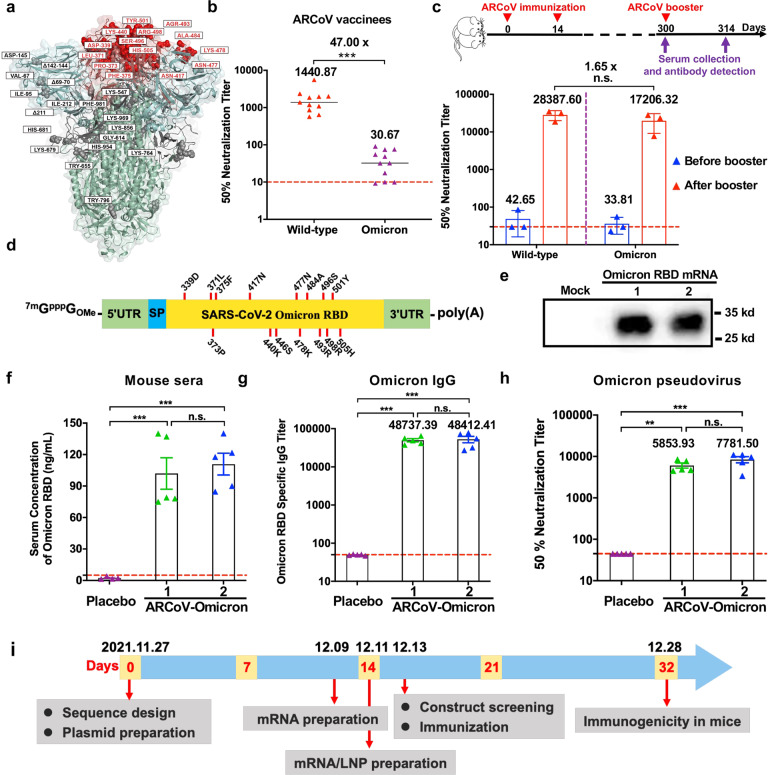
“Notably, our previous work revealed a 47-fold reduction in the neutralizing activity against Omicron subvariants induced by ARCoV [47].”
From Systemic profiling of immune responses in healthy adults vaccinated with an RBD-targeting COVID-19 mRNA vaccine (2025) · cites this paper as [47]
Experimental — accuracy not yet measured
Self-check
Percentages, sums and reported differences re-computed from the paper’s own numbers.
The self-check needs the paper’s full text.
Citations
Cites
Striking antibody evasion manifested by the Omicron variant of SARS-CoV-2
Liu, L., Iketani, S., Guo, Y., Chan, J. F.-W., Wang, M., Liu, L., Luo, Y., Chu, H., Huang, Y., Nair, M. S., et al. (2022) · Nature · doi:10.1038/s41586-021-04388-0 · Cited by 1,290
A thermostable mRNA vaccine against COVID-19
Zhang, N.-N., Li, X.-F., Deng, Y.-Q., Zhao, H., Huang, Y.-J., Yang, G., Huang, W.-J., Gao, P., Zhou, C., Zhang, R.-R., et al. (2020) · Cell · doi:10.1016/j.cell.2020.07.024 · Cited by 671
Self-citationWrobel, A. G., Benton, D. J., Xu, P., Roustan, C., Martin, S. R., Rosenthal, P. B., Skehel, J. J., & Gamblin, S. J. (2020) · Nature Structural & Molecular Biology · doi:10.1038/s41594-020-0468-7 · Cited by 544
Chen, G.-L., Li, X.-F., Dai, X.-H., Li, N., Cheng, M.-L., Huang, Z., Shen, J., Ge, Y.-H., Shen, Z.-W., Deng, Y.-Q., et al. (2022) · The Lancet Microbe · doi:10.1016/s2666-5247(21)00280-9 · Cited by 82
Self-citationZhao, H., Wang, T.-C., Li, X.-F., Zhang, N.-N., Li, L., Zhou, C., Deng, Y.-Q., Cao, T.-S., Yang, G., Li, R.-T., et al. (2021) · Signal Transduction and Targeted Therapy · doi:10.1038/s41392-021-00861-4 · Cited by 60
Self-citation
Research works printed but not linked: 11
- Plante, J. A. et al. Cell Host Microbe 29, 508–515 (2021). · DOI · Paper page
- He, X., Hong, W., Pan, X., Lu, G. & Wei, X. Med. Commun. 2, 838–845 (2021).
- Cao, Y. et al. Nature https://doi.org/10.1038/d41586-021-03796-6 (2021). · DOI
- Planas, D. et al. Nature https://doi.org/10.1038/d41586-021-03827-2 (2021). · DOI
- Liu, L. et al. Nature https://doi.org/10.1038/d41586-021-03826-3 (2021). · DOI · Paper page
- Cele, S. et al. Nature https://doi.org/10.1038/d41586-021-03824-5 (2021). · DOI
- Cameroni, E. et al. Nature https://doi.org/10.1038/d41586-021-03825-4 (2021). · DOI
- Saciuk, Y., Kertes, J., Shamir Stein, N. & Ekka Zohar, A. J. Infect. Dis. 225, 30–33 (2022). · DOI
- Ai, J. et al. Cell Res. 32, 103–106 (2022). · DOI
- Corbett, K.S. et al. bioRxiv, https://doi.org/10.1101/2021.08.11.456015 (2021). · DOI
- Waterhouse, A. et al. Nucleic Acids Res. 46, W296–W303 (2018). · DOI
Cited by
Sorted by citations
Zhou, C., Sun, M., Huang, X., Liu, P., Ouyang, Z., Wu, M., Yuan, L., Chen, J., Shu, W., Cao, T., et al. (2025) · hLife · doi:10.1016/j.hlife.2025.04.008 · Cited by 5
Self-citation
Metadata
- Authors
- Zhang, N.-N., Zhang, R.-R., Zhang, Y.-F., Ji, K., Xiong, X.-C., Qin, Q.-S., Gao, P., Lu, X.-S., Zhou, H.-Y., Song, H.-F., Ying, B., & Qin, C.-F.
- ORCID
- Qin, Cheng-Feng
- Venue
- Cell Research
- Published
- 2022-02-14
- Volume
- 32
- Issue
- 4
- Pages
- 401-403
- ISSN
- 1001-0602
- 1748-7838
- PMC
- PMC8853430
- Cited by
- 47
- References
- 5
- Language
- en
- Funders
- National Natural Science Foundation of China (32000663)
About these checks
Registry, retraction, Cites and statistics results are computed, not judged, with one exception: a printed reference that no index lists is read once by a model before it counts as a citation error. Claims are extracted by a model and kept only when their quote appears verbatim in the text; each cited source is then checked, with a model’s help, for whether it says what the claim relies on. Those verdicts can be wrong — read the claim’s quote and the cited source before relying on one.
Statistics and arithmetic are recomputed, not judged.
Confidence bands are shown only for fields calibrated on our annotated test set. None is calibrated yet, so no band is shown.
What counts as a claim ›How we measure confidence ›How we check this ›
Are you an author, or do you see a problem with this page? Request a review
