

Comparing saliva and blood for the detection of mosaic genomic abnormalities that cause syndromic intellectual disability
Open accessPublished version of a preprint
The DOI matches its Crossref record; 15 of the 15 references it cites were found in a registry or an index.
Abstract
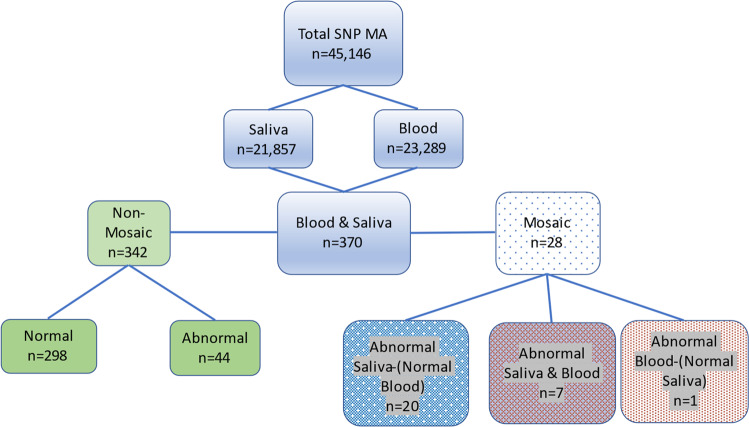
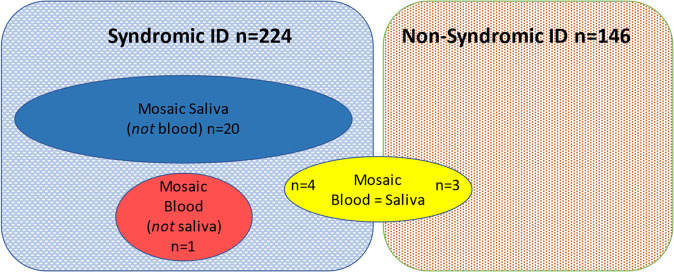
We aimed to determine whether SNP-microarray genomic testing of saliva had a greater diagnostic yield than blood for pathogenic copy number variants (CNVs). We selected patients who underwent CMA testing of both blood and saliva from 23,289 blood and 21,857 saliva samples. Our cohort comprised 370 individuals who had testing of both, 224 with syndromic intellectual disability (ID) and 146 with isolated ID. Mosaic pathogenic CNVs or aneuploidy were detected in saliva but not in blood in 20/370 (4.4%). All 20 individuals had syndromic ID, accounting for 9.1% of the syndromic ID sub-cohort. Pathogenic CNVs were large in size (median of 46 Mb), and terminal in nature, with median mosaicism of 27.5% (not exceeding 40%). By contrast, non-mosaic pathogenic CNVs were 100% concordant between blood and saliva, considerably smaller in size (median of 0.65 Mb), and predominantly interstitial in location. Given that salivary microarray testing has increased diagnostic utility over blood in individuals with syndromic ID, we recommend it as a first-tier testing in this group.
Overview
The claims and statistics of this paper haven’t been checked yet.
Free: it reads the open-access text and checks the first 5 claims that cite a source we can check. Create a free account to check every claim.
Integrity signals
Registry
Cites
Statistics
Figures
Verification
Claims the paper makes
The claims and statistics of this paper haven’t been checked yet.
Free: it reads the open-access text and checks the first 5 claims that cite a source we can check. Create a free account to check every claim.
Claims other papers make about this one
Each is checked against this paper’s own text: does it say what the citing paper says it does?
The source backs part of the claim, not all of it — or backs it for a different population, condition or comparison.
In the citing paper
“Mosaic pathogenic CNVs are increasingly identified, with a greater yield from salivary DNA than from blood-derived DNA, as salivary epithelial cells are embryologically closer to neural cells, deriving from ectoderm, compared with lymphocytes 173 .”
From Developmental and epileptic encephalopathies (2024) · cites this paper as [173]
Experimental — accuracy not yet measured
Self-check
Percentages, sums and reported differences re-computed from the paper’s own numbers.
The self-check needs the paper’s full text.
Citations
Cites
Miller, D. T., Adam, M. P., Aradhya, S., Biesecker, L. G., Brothman, A. R., Carter, N. P., Church, D. M., Crolla, J. A., Eichler, E. E., Epstein, C. J., et al. (2010) · The American Journal of Human Genetics · doi:10.1016/j.ajhg.2010.04.006 · Cited by 2,882 · cited 1×
“In the last 15 years, whole-genome microarray testing has superseded conventional G-banded chromosomal analysis and broadened the detection limits to include cryptic unbalanced chromosome abnormalities and copy number variants (CNVs) (> 50 kb) [1].”
BackgroundClinGen — The Clinical Genome Resource
Rehm, H. L., Berg, J. S., Brooks, L. D., Bustamante, C. D., Evans, J. P., Landrum, M. J., Ledbetter, D. H., Maglott, D. R., Martin, C. L., Nussbaum, R. L., et al. (2015) · New England Journal of Medicine · doi:10.1056/nejmsr1406261 · Cited by 1,496 · cited 1×
“2(189666512–190937862)×1 that was reported as a VUS because it was small and without genes that were pathogenic for haploinsufficiency by ClinGen [11].”
BackgroundChromosome Abnormalities and Genetic Counseling
Gardner, R. J. M., Sutherland, G. R., & Shaffer, L. G. (2011) · Oxford University Press eBooks · doi:10.1093/med/9780195375336.001.0001 · Cited by 857 · cited 2×
“Non-mosaic deletions and duplications were predominantly interstitial (83%) which is consistent with a meiotic, non-allelic homologous recombination (NHR) mechanism, aligning with the non-mosaic nature of the CNV [12].”
BackgroundSomatic mutation, genomic variation, and neurological disease
Poduri, A., Evrony, G. D., Cai, X., & Walsh, C. A. (2013) · Science · doi:10.1126/science.1237758 · Cited by 584 · cited 1×
“This likely explains the higher yield in saliva testing in patients with ID than mesoderm-derived blood cells [13].”
BackgroundThe physiology of salivary secretion
Proctor, G. B. (2016) · Periodontology 2000 · doi:10.1111/prd.12116 · Cited by 583 · cited 1×
“, detection of infectious agents, metabolites, drug and alcohol levels), proving to be a cost-effective and convenient way of sampling that provides equivalent diagnostic yield to blood [5, 6].”
BackgroundConlin, L. K., Thiel, B. D., Bonnemann, C. G., Medne, L., Ernst, L. M., Zackai, E. H., Deardorff, M. A., Krantz, I. D., Hakonarson, H., & Spinner, N. B. (2010) · Human Molecular Genetics · doi:10.1093/hmg/ddq003 · Cited by 475 · cited 1×
“0% of affected individuals tested [2, 3, 4].”
Saliva diagnostics – Current views and directions
Kaczor-Urbanowicz, K. E., Martin Carreras-Presas, C., Aro, K., Tu, M., Garcia-Godoy, F., & Wong, D. T. (2017) · Experimental Biology and Medicine · doi:10.1177/1535370216681550 · Cited by 472 · cited 1×
“, detection of infectious agents, metabolites, drug and alcohol levels), proving to be a cost-effective and convenient way of sampling that provides equivalent diagnostic yield to blood [5, 6].”
BackgroundCai, X., Evrony, G. D., Lehmann, H. S., Elhosary, P. C., Mehta, B. K., Poduri, A., & Walsh, C. A. (2014) · Cell Reports · doi:10.1016/j.celrep.2014.07.043 · Cited by 318
Somatic mosaicism: implications for disease and transmission genetics
Campbell, I. M., Shaw, C. A., Stankiewicz, P., & Lupski, J. R. (2015) · Trends in Genetics · doi:10.1016/j.tig.2015.03.013 · Cited by 296
Quantitation of the cellular content of saliva and buccal swab samples
Theda, C., Hwang, S. H., Czajko, A., Loke, Y. J., Leong, P., & Craig, J. M. (2018) · Scientific Reports · doi:10.1038/s41598-018-25311-0 · Cited by 269 · cited 1×
“In particular, buccal or fibroblast cells, that are present in saliva in variable amounts/ quantities [8], are the best tissue for the detection of mosaicism for aneuploidy or CNVs.”
Background
Cited by
2023 in the European Journal of Human Genetics
McNeill, A. (2024) · European Journal of Human Genetics · doi:10.1038/s41431-024-01540-y · Cited by 185
“Francis and colleagues report that saliva samples can have greater diagnostic yield for detection of mosaic copy number variants than blood [19].”
Developmental and epileptic encephalopathies
Scheffer, I. E., Zuberi, S., Mefford, H. C., Guerrini, R., & McTague, A. (2024) · Nature Reviews Disease Primers · doi:10.1038/s41572-024-00546-6 · Cited by 158
“Mosaic pathogenic CNVs are increasingly identified, with a greater yield from salivary DNA than from blood-derived DNA, as salivary epithelial cells are embryologically closer to neural cells, deriving from ectoderm, compared with lymphocytes 173 .”
Self-citationGenomic technologies and the diagnosis of 46, XY differences of sex development
Idris, F. P., Sinclair, A. H., & Ayers, K. L. (2024) · Andrology · doi:10.1111/andr.13708 · Cited by 10
“211 Increasing sequencing depth can also improve sensitivity in detecting mosaic SNVs and InDels with WGS data found to be superior in detecting mosaic SNVs and CNVs due to its higher and more consistent coverage across the genome.”
Thomson, G., Filser, M., Guerrini‐Rousseau, L., Tauziède‐Espariat, A., Bourneix, C., Gauthier‐Villars, M., Simaga, F., Beccaria, K., Faure‐Conter, C., Maureille, A., et al. (2024) · Neuro-Oncology · doi:10.1093/neuonc/noae122 · Cited by 8
Granata, P., Zito, A., Cocciadiferro, D., Novelli, A., Pessina, C., Mazza, T., Ferri, M., Piccinelli, P., Luoni, C., Termine, C., et al. (2024) · BMC Genomics · doi:10.1186/s12864-024-11077-5 · Cited by 10
“As a matter of fact, even if limited tissue mosaicism has been associated to syndromic neurodevelopmental disorders, it has not been confirmed in ASD affected patients [17, 18].”
Metadata
- Authors
- Francis, D. I., Stark, Z., Scheffer, I. E., Tan, T. Y., Murali, K., Gallacher, L., Amor, D. J., Goel, H., Downie, L., Stutterd, C. A., Krzesinski, E. I., Vasudevan, A., Oertel, R., Petrovic, V., Boys, A., Wei, V., Burgess, T., Dun, K., Oliver, K. L., Baxter, A., Hackett, A., Ayres, S., Lunke, S., Kalitsis, P., & Wall, M.
- Affiliations
- Victorian Clinical Genetics Services (AU)
- The University of Melbourne (AU)
- Royal Children's Hospital (AU)
- Hunter Genetics (AU)
- Monash Medical Centre (AU)
- Royal Women's Hospital (AU)
- St Vincent's Hospital Melbourne (AU)
- Florey Institute of Neuroscience and Mental Health (AU)
- Corresponding author
- Kalitsis, Paul
- Wall, Meaghan
- ORCID
- Venue
- European Journal of Human Genetics
- Published
- 2022-11-29
- Volume
- 31
- Issue
- 5
- Pages
- 521-525
- ISSN
- 1018-4813 (ISSN-L)
- 1476-5438
- PMC
- PMC10172398
- OpenAlex
- W4310189428
- Cited by
- 16
- References
- 15
- Citations by year
- 2026: 5 · 2025: 4 · 2024: 5 · 2023: 2
- FWCI
- 1.66
- Type
- journal article
- Language
- en
- Open access
- hybrid
- doi.org
- Licence
- cc-by
- creativecommons.org/licenses/by/4.0 (tdm)
- creativecommons.org/licenses/by/4.0 (vor)
- Locations
- European Journal of Human Genetics (publishedVersion, cc-by)
- Research Square (acceptedVersion, cc-by)
- PubMed Central (publishedVersion, cc-by)
- PubMed (publishedVersion)
- Minerva Access (University of Melbourne) (submittedVersion, cc-by)
- NOVA (University of Newcastle Australia) (submittedVersion)
- Topics
- Life Sciences › Biochemistry, Genetics and Molecular Biology › Genetics › Genomic variations and chromosomal abnormalities
- Life Sciences › Biochemistry, Genetics and Molecular Biology › Genetics › Genomics and Rare Diseases
- Health Sciences › Medicine › Pediatrics, Perinatology and Child Health › Prenatal Screening and Diagnostics
- Keywords
- saliva, blood, genetic mosaicism, copy number variation, syndromic intellectual disability, SNP array, aneuploidy, diagnostic yield, sample type comparison
- MeSH terms
- Child, Developmental Disabilities, Chromosome Aberrations, Humans, Intellectual Disability, Mosaicism, Saliva, Genomics, DNA Copy Number Variations
About these checks
Registry, retraction, Cites and statistics results are computed, not judged, with one exception: a printed reference that no index lists is read once by a model before it counts as a citation error. Claims are extracted by a model and kept only when their quote appears verbatim in the text; each cited source is then checked, with a model’s help, for whether it says what the claim relies on. Those verdicts can be wrong — read the claim’s quote and the cited source before relying on one.
Statistics and arithmetic are recomputed, not judged.
Confidence bands are shown only for fields calibrated on our annotated test set. None is calibrated yet, so no band is shown.
What counts as a claim ›How we measure confidence ›How we check this ›
Are you an author, or do you see a problem with this page? Request a review
How to cite
Cite CoChat for the checks on this page, and the paper for its own findings.
- This page
- CoChat. (2026). Citation check: Comparing saliva and blood for the detection of mosaic genomic abnormalities that cause syndromic intellectual disability. https://app.cochat.ai/papers/10.1038/s41431-022-01232-5
- The paper
- Francis, D. I., Stark, Z., Scheffer, I. E., Tan, T. Y., Murali, K., Gallacher, L., Amor, D. J., Goel, H., Downie, L., Stutterd, C. A., Krzesinski, E. I., Vasudevan, A., Oertel, R., Petrovic, V., Boys, A., Wei, V., Burgess, T., Dun, K., Oliver, K. L., . . . Wall, M. (2023). Comparing saliva and blood for the detection of mosaic genomic abnormalities that cause syndromic intellectual disability. European Journal of Human Genetics. https://doi.org/10.1038/s41431-022-01232-5
Data sources
Bibliographic data: Semantic Scholar, OpenAlex, Crossref.
Contains information from the Semantic Scholar Academic Graph Datasets, made available under the ODC Attribution License (ODC-BY 1.0).
Semantic Scholar’s data is described in: Kinney, R., et al. (2023). The Semantic Scholar Open Data Platform. arXiv:2301.10140.
