

Intravitreal injections: past trends and future projections within a UK tertiary hospital
Open accessThe DOI matches its Crossref record; 26 of the 26 references it cites were found in a registry or an index.
Abstract
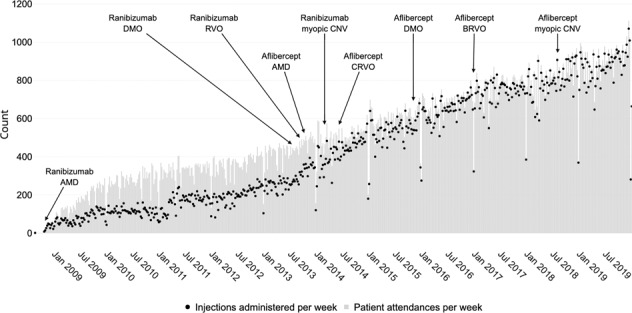
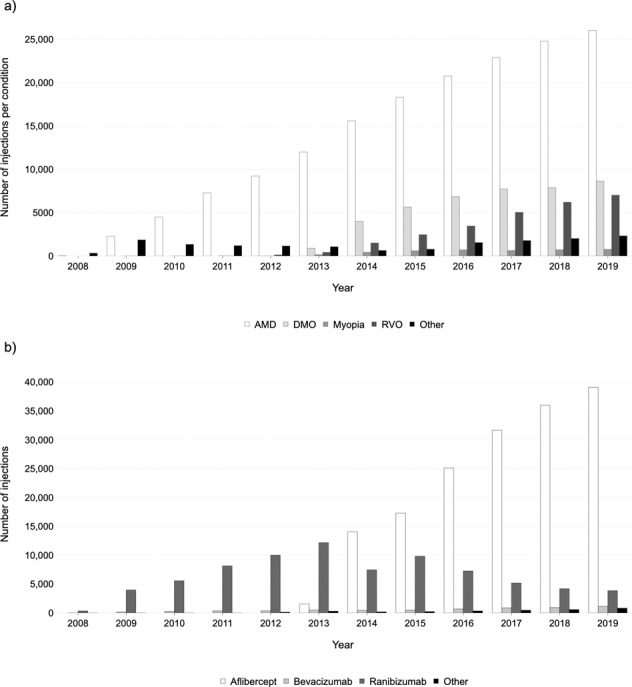
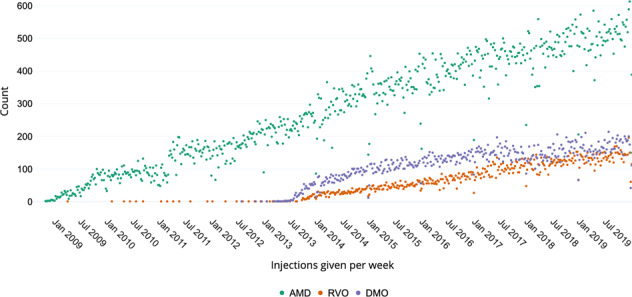
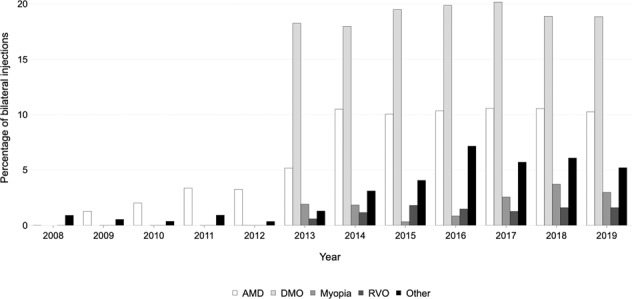
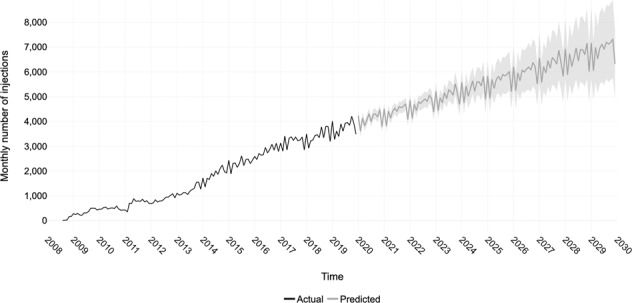
Aims: To describe past trends and future projections for the number of intravitreal injections being administered at a large tertiary hospital in London, United Kingdom. Methods: Retrospective data from Moorfields Eye Hospital were collected using the electronic medical record system. Descriptive statistics were used to visualise overall trends. Time series forecasting was used to predict the number of injections that will be administered up to and including the year 2029. Results: The number of injections has increased nearly 11-fold from 2009 to 2019, with a total of 44,924 injections delivered in 2019. The majority of injections were given for the treatment of neovascular age-related macular degeneration. Aflibercept formed 87% of injections administered in 2019. The number of injections is predicted to continue to increase every year, with nearly 83,000 injections forecasted in the year 2029. Conclusion: The demand for intravitreal injections has increased substantially over the last decade and is predicted to further increase. Healthcare systems will need to adapt to accommodate the high demand. Other solutions may include longer-acting therapies to reduce the treatment burden.
Overview
The claims and statistics of this paper haven’t been checked yet.
Free: it reads the open-access text and checks the first 5 claims that cite a source we can check. Create a free account to check every claim.
Integrity signals
Registry
Cites
Statistics
Figures
Verification
Claims the paper makes
The claims and statistics of this paper haven’t been checked yet.
Free: it reads the open-access text and checks the first 5 claims that cite a source we can check. Create a free account to check every claim.
Claims other papers make about this one
Each is checked against this paper’s own text: does it say what the citing paper says it does?
The source backs part of the claim, not all of it — or backs it for a different population, condition or comparison.
In the citing paper
“Research has suggested that the delivery of anti-VEGF injections is a major cost-driver and is expected to increase over time [12, 50, 67, 68].”
From The economic impact of retinal diseases for which gene therapy is emerging: a systematic literature review (2025) · cites this paper as [68]
Experimental — accuracy not yet measuredThe cited source says what the claim attributes to it.
In the citing paper
“Other studies showed a similar trend regarding the increase in the number of anti-VEGF injections, which is projected to become even greater in the future [12, 68].”
From The economic impact of retinal diseases for which gene therapy is emerging: a systematic literature review (2025) · cites this paper as [68]
Self-check
Percentages, sums and reported differences re-computed from the paper’s own numbers.
The self-check needs the paper’s full text.
Citations
Cites
De Cillà, S. D., Farruggio, S., Vujosevic, S., Raina, G., Filippini, D., Gatti, V., Clemente, N., Mary, D., Vezzola, D., Casini, G., et al. (2017) · Cellular Physiology and Biochemistry · doi:10.1159/000479441 · Cited by 5,136
Taylor, S. J., & Letham, B. (2018) · The American Statistician · doi:10.1080/00031305.2017.1380080 · Cited by 2,737
Intravitreal aflibercept (VEGF trap-eye) in wet age-related macular degeneration
Heier, J. S., Brown, D. M., Chong, V., Korobelnik, J.-F., Kaiser, P. K., Nguyen, Q. D., Kirchhof, B., Ho, A., Ogura, Y., Yancopoulos, G. D., et al. (2012) · Ophthalmology · doi:10.1016/j.ophtha.2012.09.006 · Cited by 2,485
Dugel, P. U., Koh, A., Ogura, Y., Jaffe, G. J., Schmidt-Erfurth, U., Brown, D. M., Gomes, A. V., Warburton, J., Weichselberger, A., & Holz, F. G. (2020) · Ophthalmology · doi:10.1016/j.ophtha.2019.04.017 · Cited by 931
Chakravarthy, U., Harding, S. P., Rogers, C. A., Downes, S. M., Lotery, A. J., Culliford, L. A., & Reeves, B. C. (2013) · The Lancet · doi:10.1016/s0140-6736(13)61501-9 · Cited by 748
Maguire, M. G., Martin, D. F., Ying, G.-S., Jaffe, G. J., Daniel, E., Grunwald, J. E., Toth, C. A., Ferris, F. L., & Fine, S. L. (2016) · Ophthalmology · doi:10.1016/j.ophtha.2016.03.045 · Cited by 708
Liao, D. S., Grossi, F. V., El Mehdi, D., Gerber, M. R., Brown, D. M., Heier, J. S., Wykoff, C. C., Singerman, L. J., Abraham, P., Grassmann, F., et al. (2020) · Ophthalmology · doi:10.1016/j.ophtha.2019.07.011 · Cited by 519
C5 Inhibitor Avacincaptad Pegol for Geographic Atrophy Due to Age-Related Macular Degeneration
Jaffe, G. J., Westby, K., Csaky, K. G., Monés, J., Pearlman, J. A., Patel, S. S., Joondeph, B. C., Randolph, J., Masonson, H., & Rezaei, K. A. (2021) · Ophthalmology · doi:10.1016/j.ophtha.2020.08.027 · Cited by 469
Sivaprasad, S., Prevost, A. T., Vasconcelos, J. C., Riddell, A., Murphy, C., Kelly, J., Bainbridge, J., Tudor-Edwards, R., Hopkins, D., Hykin, P., et al. (2017) · The Lancet · doi:10.1016/s0140-6736(17)31193-5 · Cited by 390
Li, J. Q., Welchowski, T., Schmid, M., Mauschitz, M. M., Holz, F. G., & Finger, R. P. (2020) · British Journal of Ophthalmology · doi:10.1136/bjophthalmol-2019-314422 · Cited by 381
Research works printed but not linked: 4
- National Institute for Health and Care Excellence. Age-related macular degeneration. 2018. Available at: https://www.nice.org.uk/guidance/ng82/ [Accessed April 30, 2020]. 29400919
- National Institute for Health and Care Excellence (NICE).Ranibizumab for treating visual impairment caused by macular oedema secondary to retinal vein occlusion.; 2013. 39883821
- National Institute for Health and Care Excellence (NICE).Aflibercept for treating visual impairment caused by macular oedema secondary to central retinal vein occlusion.; 2014. 39883821
- National Institute for Health and Care Excellence (NICE).Aflibercept for treating visual impairment caused by macular oedema after branch retinal vein occlusion; 2016. 39883821
Cited by
Liberski, S., Wichrowska, M., & Kocięcki, J. (2022) · International Journal of Molecular Sciences · doi:10.3390/ijms23169424 · Cited by 140
“Another widely used anti-VEGF drug, bevacizumab, is used intravitreally as an off-label drug [6].”
BackgroundRaimondi, R., Felfeli, T., Bogdanova-Bennet, A., Varma, D., Habib, M., Kotagiri, A. K., STEEL, D. H., & Grinton, M. E. (2023) · Ophthalmology Retina · doi:10.1016/j.oret.2023.11.015 · Cited by 62
Risk of Endophthalmitis Based on Cumulative Number of Anti-VEGF Intravitreal Injections
Israilevich, R. N., Mansour, H. A., PATEL, S. N., Garg, S. J., Klufas, M. A., Yonekawa, Y., Regillo, C. D., & Hsu, J. (2024) · Ophthalmology · doi:10.1016/j.ophtha.2023.12.033 · Cited by 53
Wang, R., McClard, C. K., Laswell, S. M., Mahmoudzadeh, R., Salabati, M., Ammar, M. J., Vannavong, J., Aziz, A. A., Ewald, A., Calvanese, A. V., et al. (2022) · BMJ Open Ophthalmology · doi:10.1136/bmjophth-2022-001188 · Cited by 51
Hashimoto, Y., Okada, A., Matsui, H., Yasunaga, H., Aihara, M., & Obata, R. (2022) · Japanese Journal of Ophthalmology · doi:10.1007/s10384-022-00969-2 · Cited by 46
“Trends in the use of anti-VEGF are reported in various countries, the US [14, 15], the UK [16], and Italy [17].”
BackgroundAlrawashdeh, H. M., Naser, A. Y., Alwafi, H. H., Alhommos, A. K., Jalal, Z., Paudyal, V., Abdulmannan, D., Hassanin, F. F., Hemmo, S. I., & Sarireh, F. A. (2022) · International Journal of General Medicine · doi:10.2147/ijgm.s344380 · Cited by 37
“The majority of injections were delivered for wet AMD treatment.(37) The second-highest rate was observed in disorders of the optic nerve and visual 0 20 40 60 80 100 120 140 160 fo sreosidrof nissi mdaipsohfo staR 00,0 0 1rptibro na msysl a irc a l,dil e ye pe rs on s”
BackgroundYoon, C. K., Oh, J., Bae, K., Park, U. C., Yu, K., & Yu, H. G. (2022) · PLoS ONE · doi:10.1371/journal.pone.0275611 · Cited by 24
“As a result, the clinical demand for anti-VEGF agents is increasing [8].”
BackgroundAI in the clinical management of GA: A novel therapeutic universe requires novel tools
Reiter, G. S., Mai, J., Riedl, S., Birner, K., Frank‐Publig, S., Bogunović, H., & Schmidt-Erfurth, U. M. (2024) · Progress in Retinal and Eye Research · doi:10.1016/j.preteyeres.2024.101305 · Cited by 24
Clinical and Socioeconomic Burden of Retinal Diseases: Can Biosimilars Add Value? A Narrative Review
Hariprasad, S. M., Holz, F. G., Asche, C. V., Issa, A., Mora, O., Keady, S., Rezk, M. F., Sarocco, P. W., & Simoens, S. (2025) · Ophthalmology and Therapy · doi:10.1007/s40123-025-01104-3 · Cited by 29
“Additionally, as new drugs receive approval for more common conditions, such as dry AMD, the number of patients requiring treatment is expected to further increase [98].”
Associations between Serial Intravitreal Injections and Dry Eye
Malmin, A., Thomseth, V. M., Førland, P. T., Khan, A. Z., Hetland, H. B., Chen, X., Haugen, I. K., Utheim, T. P., & Forsaa, V. A. (2023) · Ophthalmology · doi:10.1016/j.ophtha.2023.01.009 · Cited by 21
Reiter, G. S., & Schmidt-Erfurth, U. M. (2022) · Therapeutic Advances in Ophthalmology · doi:10.1177/25158414221083363 · Cited by 20
Greener intravitreal injections: a narrative review
Ong, A. Y., Birtel, J., & Issa, P. C. (2024) · Eye · doi:10.1038/s41433-024-03185-z · Cited by 19
“1) [7].”
Sivaprasad, S., Bailey, C., Downey, L., Gilbert, R., Gale, R., Kotagiri, A., Mahmood, S., Morgan-Warren, P., Napier, J., Narendran, N., et al. (2024) · Current Medical Research and Opinion · doi:10.1080/03007995.2024.2362278 · Cited by 15
“…treatment and monitoring visit burden by increasing durability; given the projected escalation in per-patient burden of nAMD service delivery, translation of these benefits to clinical practice could be key in reducing demand to manageable levels alongside effective workforce planning 10,27–29 .”
BackgroundResultFu, D. J., Mishra, A. V., Quek, C., Balaskas, K., Pontikos, N., Sim, D., Sivaprasad, S., & Faes, L. (2025) · Eye · doi:10.1038/s41433-024-03529-9 · Cited by 14
“Statistically significant associations were detected between likelihood of this undesirable treatment event and baseline age (hazard ratio [HR], 1.19 per 10 years of age; 95% CI 1.13–1.24; P < 0.001), baseline VA (HR 1.10 per 5 ETDRS letter score; 95% CI 11–1.12; P < 0.001), baseline IRF (HR 1.05…”
InfluentialSelf-citationAsani, B., Holmberg, O., Schiefelbein, J. B., Hafner, M., Herold, T., Spitzer, H., Siedlecki, J., Kern, C., Kortuem, K., Frishberg, A., et al. (2024) · Eye · doi:10.1038/s41433-024-03264-1 · Cited by 17
“…therapy intensity with monthly to bimonthly injections over several years, posing a major challenge for both patients and the healthcare system: A recent study by Chopra et al. shows an 11-fold increase in annual intravitreal injections from 2009 to 2019 and is projected to continue to rise [6].”
BackgroundGale, R. P., Cox, O., Keenan, C., & Chakravarthy, U. (2022) · Eye · doi:10.1038/s41433-022-02149-5 · Cited by 13
“The increasing prevalence of key retinal conditions [1–5] and increasing utilisation of resource intensive treatments for these conditions [6–8], have led to concerns regarding the current and future resource burden on retinal services [9].”
BackgroundUzzan, J., Mapani, A., Cox, O., Bagijn, M. P., & Saffar, I. (2024) · Ophthalmology and Therapy · doi:10.1007/s40123-024-01002-0 · Cited by 16
Loewenstein, A., Berger, A. R., Daly, A., Creuzot-Garcher, C. P., Gale, R. P., Ricci, F., Zarranz‐Ventura, J., & Guymer, R. H. (2023) · Eye · doi:10.1038/s41433-023-02540-w · Cited by 15
“Between 2009 and 2019, a single tertiary care hospital in the UK saw the number of annual anti-VEGF injections administered increase nearly 11-fold from 4143 to 44,924 and is forecasted to double again by the end of the decade [26].”
BackgroundChorev, M., Haderlein, J., Chandra, S., Menon, G., Burton, B., Pearce, I., McKibbin, M., Thottarath, S., Karatsai, E., Chandak, S., et al. (2023) · Journal of Clinical Medicine · doi:10.3390/jcm12083013 · Cited by 14
“Aflibercept is a commonly used anti-VEGF agent globally [8].”
BackgroundSelf-citationGao, M., Xia, F., Wang, P., Feng, Z., & Wang, X. (2024) · Contact Lens and Anterior Eye · doi:10.1016/j.clae.2024.102127 · Cited by 10
Intravitreal therapy—success stories and challenges
Egger, D., Heger, K. A., Bolz, M., Brinkmann, M. P., Krepler, K., Vécsei‐Marlovits, P. V., Wedrich, A., & Waldstein, S. M. (2025) · Wiener Medizinische Wochenschrift · doi:10.1007/s10354-024-01070-8 · Cited by 13
“Neovascular AMD was the leading indication and aflibercept, with 87%, was the most commonly administered drug [87].”
Pyruvate-conjugation of PEGylated liposomes for targeted drug delivery to retinal photoreceptors
Christensen, G., Chen, Y., Urimi, D., Zizmare, L., Trautwein, C., Schipper, N. G. M., & Paquet‐Durand, F. (2023) · Biomedicine & Pharmacotherapy · doi:10.1016/j.biopha.2023.114717 · Cited by 9
Li, T., Berdunov, V., HAMILTON, R. D., Gil-Rojas, Y., Bührer, C., Cox, O., Postema, R., & Bagijn, M. P. (2024) · Ophthalmology and Therapy · doi:10.1007/s40123-024-00999-8 · Cited by 11
“It was assumed that 77.6% injection capacity was offered to patients with wAMD and DMO at this hypothetical NHS eye hospital to allow for capacity use for other health conditions [13].”
BackgroundInfluentialSelf-citationHuang, R. S., Balas, M., Jhaveri, A., Popovic, M. M., Kertes, P. J., & Muni, R. H. (2024) · American Journal of Ophthalmology · doi:10.1016/j.ajo.2024.12.023 · Cited by 10
Teh, B. L., Ong, A. Y., Mehta, A., Hoang, V., Settle, C. D., Lotery, A. J., Issa, P. C., Smith, J., & STEEL, D. H. (2025) · Eye · doi:10.1038/s41433-025-03673-w · Cited by 8
“However, at the same time, with the success of anti-vascular endothelial growth factor (VEGF) treatments for a range of common retinal diseases, there has been a rapid increase in the number of intravitreal injections delivered over the past two decades [7, 8].”
Towards greener intravitreal injections: the Oxford Eye Hospital experience
Ong, A. Y., Buckley, T. M. W., Birtel, J., Silva, S. R. D., Stone, N., & Issa, P. C. (2025) · Eye · doi:10.1038/s41433-025-03899-8 · Cited by 6
“Intravitreal injections (IVIs) have become a cornerstone of eye care services, and are increasing in number year on year [1].”
Bolme, S., Austeng, D., Morken, T. S., Follestad, T., & Halsteinli, V. (2023) · BMC Health Services Research · doi:10.1186/s12913-023-09186-0 · Cited by 8
“However, we chose to use the more modest estimate of two per cent because the UK hospital [27] reported that the growth factor appeared to be declining.”
MethodTear cytokine levels are reduced in patients treated with intravitreal injections
Malmin, A., Thomseth, V. M., Førland, P. T., Aass, H. C. D., Reppe, S., Olsen, M. V. T., Lindtjørn, B., Chen, X., Haugen, I. K., Utheim, T. P., et al. (2024) · The Ocular Surface · doi:10.1016/j.jtos.2024.03.004 · Cited by 6
The value of handholding during intravitreal injections
Shaughnessy, D., Powell, S., & O’Toole, L. (2022) · Irish Journal of Medical Science (1971 -) · doi:10.1007/s11845-022-02986-z · Cited by 8
“The number of anti-VEGF injections administered worldwide has increased dramatically in the last decade, a UK tertiary referral hospital reporting an 11-fold increase in the number of IVIs performed between 2009 and 2019 and a projected further increase secondary to population growth and increased life expectancy [5].”
BackgroundBiomimetic Hydrogel Microneedle Patch for Treating Corneal Injury‐Associated Bacterial Keratitis
Chen, J., Jiang, X., Zhang, A., Meng, W., Xin, X., Zhu, J., & Li, W. (2026) · Advanced Functional Materials · doi:10.1002/adfm.202532033 · Cited by 9
Cost Comparisons in NICE Technology Appraisals: An External Assessment Group Perspective
Poley, M. J., Armstrong, N., Yang, H., Patel, M., Stirk, L., Al, M., & Ramos, I. C. (2025) · PharmacoEconomics · doi:10.1007/s40273-025-01522-y · Cited by 4
“Frequent appointments and injections (on average, 7–15 anti–vascular endothelial growth factor [anti-VEGF] injections across 3 years of treatment [8, 9]) place a considerable burden on patients, caregivers, and the healthcare system [10–13].”
Travel-associated emissions of intravitreal injections
Yang-Seeger, D., Schellstede, A., Pauleikhoff, L. J. B., Spitzer, M. S., & Birtel, J. (2025) · Graefe s Archive for Clinical and Experimental Ophthalmology · doi:10.1007/s00417-025-06963-x · Cited by 5
“The number of IVIs has increased significantly over the last decades; considering an aging popu - lation and novel therapeutic approaches, a further growth is forecasted [1–3].”
InfluentialEffect of Repeated Intravitreal Injections in Glaucoma Spectrum Diseases
Vilares-Morgado, R., Correia, V., Ferreira, A. M., Alves, F., Melo, A., Estrela‐Silva, S., Araújo, J., Tavares-Ferreira, J., Silva, M., Rocha‐Sousa, A., et al. (2023) · Clinical ophthalmology · doi:10.2147/opth.s441500 · Cited by 4
Hibsh, A., Barak, A., Fleissig, E., Regenbogen, M., & Klein, A. (2024) · AJO International · doi:10.1016/j.ajoint.2024.100001 · Cited by 5
Bilici, S., Selçuk, N., Küçük, N., & Uğurbaş, S. H. (2024) · BMC Ophthalmology · doi:10.1186/s12886-024-03727-9 · Cited by 3
Gale, R. P., Awad, M. H., Bailey, C., Cackett, P., Chhabra, R., Downey, L., Ghanchi, F. D., Kotagiri, A. K., Narendran, N., Pearce, I., et al. (2026) · Eye · doi:10.1038/s41433-025-04180-8 · Cited by 3
“A report from Moorfields Eye Hospital, a large tertiary hospital in the UK, predicted that its retinal care unit will need to accommodate the administration of ~83,000 intravitreal injections in 2029, a significant rise from ~45,000 in 2019 [4].”
Lee, J. C. C., Razavi, H., Nejatian, M. M., Drinkwater, J. J., & Turner, A. W. (2024) · Clinical and Experimental Ophthalmology · doi:10.1111/ceo.14421 · Cited by 3
Transforming ophthalmology in the digital century—new care models with added value for patients
Faes, L., Maloca, P. M., Hatz, K. B., Wolfensberger, T. J., Munk, M. R., Sim, D. A., Bachmann, L. M., & Schmid, M. (2022) · Eye · doi:10.1038/s41433-022-02313-x · Cited by 6
“In recent years, the market for intravitreal injections has grown by about 17 percentage points per year [28].”
BackgroundControversies and Disparities in the Management of Age-Related Macular Degeneration
Fairbanks, A. M., & Husain, D. (2023) · Seminars in Ophthalmology · doi:10.1080/08820538.2022.2152705 · Cited by 3
“At Moorfields Eye Hospital in the United Kingdom, the number of intravitreal injections increased 11-fold from 2009 to 2019 with nearly 45,000 injections administered and this number is projected to increase to 83,000 per year by 2029.(51) With the number of patients living with exudative AMD and other retinal vascula…”
BackgroundKim, M.-H., Kang, J. E., & Park, Y. G. (2024) · Journal of Clinical Medicine · doi:10.3390/jcm13123434 · Cited by 3
“We also achieved a favorable prognosis by alleviating the treatment burden on refractory patients.”
BackgroundFiore, T., Santi, N. D., Pietrella, D., Barcaccia, M., Palmieri, M. I., Lupidi, M., Mariotti, C., & Cagini, C. (2024) · International Ophthalmology · doi:10.1007/s10792-024-03376-3 · Cited by 3
He, X., Luo, H., Feng, Y., Wu, X., & Diao, Y. (2022) · Electronics · doi:10.3390/electronics11244184 · Cited by 4
Lo, J. M. Y., Li, V. Y. Y., Cheung, R. K. Y., Chow, S. C., Shih, K. C., Fung, N. S. K., & Lam, W. (2025) · International Journal of Retina and Vitreous · doi:10.1186/s40942-025-00649-6 · Cited by 2
“Patient aged above 18 2.”
InfluentialPatients’ Perception of Robot-Driven Technology in the Management of Retinal Diseases
Aw, K. L., Suepiantham, S., Rodríguez, A., Bruce, A., Borooah, S., & Cackett, P. (2023) · Ophthalmology and Therapy · doi:10.1007/s40123-023-00762-5 · Cited by 3
“A recent study has demonstrated that the number of intravitreal injections has increased nearly 11-fold from the year 2009 to 2019 in a UK tertiary hospital [6].”
BackgroundShah, V., Jackson, T. L., Edwards, R. T., Attlee, J., & Kailani, O. (2024) · BMJ Open Ophthalmology · doi:10.1136/bmjophth-2024-001800 · Cited by 2
“14 The realisation that patients’ attendance time should not be excessive, and consultant-contact time must be reserved for those who most need it, has led to several innovative solutions in how providers deliver services.”
Cruz, M. R. B., Amaral, D. C., Gonçalves, O. R., Cyrino, L. G., Nascimento, L. M., Barroso, F. V. C., Louzada, R. N., Rassi, T. N. D. O., Mora-Paez, D. J., Guedes, J., et al. (2025) · Journal of Ocular Pharmacology and Therapeutics · doi:10.1089/jop.2024.0141 · Cited by 2
“3 Complications related to IVIs include retinal detachment, intraocular pressure elevation, cataract formation, vitreous hemorrhage, and endophthalmitis.”
Improving Clinic Capacity with Faricimab
Wong, D. T., Chhabra, R., Ruiz‐Medrano, J., & HAMILTON, R. D. (2025) · EMJ Innovation · doi:10.33590/emjinnov/rfjb6600 · Cited by 4
Self-citationChambers, J. D., Beinfeld, M. T., Richardson, T., & Pangrace, M. (2025) · Journal of Managed Care & Specialty Pharmacy · doi:10.18553/jmcp.2025.24340 · Cited by 2
Caspers, S., Abramowicz, S., Pasteels, B., & Postelmans, L. D. (2023) · Journal Français d Ophtalmologie · doi:10.1016/j.jfo.2023.04.010 · Cited by 1
Wang, T., Chen, H., Du, X., Qiu, M., Li, N., & Min, H. (2024) · BMC Ophthalmology · doi:10.1186/s12886-024-03292-1 · Cited by 1
“This approach facilitates targeted VEGF blockade by direct delivery of the drug into the eye, thereby minimizing systemic side effects and presenting a promising avenue for effective treatment of DR [1, 2].”
BackgroundBalas, M., Jhaveri, A., Khalid, F., Abdelaal, A., Popovic, M. M., Kertes, P. J., & Muni, R. H. (2025) · Canadian Journal of Ophthalmology · doi:10.1016/j.jcjo.2025.05.014 · Cited by 2
Mares, V., Reiter, G. S., Feitosa, A., Gumpinger, M., Bogunović, H., Schmidt-Erfurth, U. M., & Nehemy, M. B. (2025) · International Journal of Retina and Vitreous · doi:10.1186/s40942-025-00695-0 · Cited by 1
“The ageing population has continuously increased AMD prevalence and, consequently also increased anti-VEGF intravitreal injections demand [6].”
Kim, W., Park, C. M., Kim, D. H., Eom, Y., & Song, J. S. (2026) · Ophthalmic Epidemiology · doi:10.1080/09286586.2026.2621409 · Cited by 1
“29 The steady increase in the proportion of APE patients with AMD ( p for trend 0.0001) likely reflects the growing number of patients receiving IVI for AMD and may have contributed to this trend.”
InfluentialKabata, Y., Terauchi, R., & Nakano, T. (2026) · PLoS ONE · doi:10.1371/journal.pone.0348087 · Cited by 1
Willmington, C., Kirby, A., & Murphy, A. (2025) · Health Economics Review · doi:10.1186/s13561-025-00707-7
“Other studies showed a similar trend regarding the increase in the number of anti-VEGF injections, which is projected to become even greater in the future [12, 68].”
Chorev, M., Haderlein, J., Chandra, S., Menon, G., Burton, B., Pearce, I., McKibbin, M., Thottarath, S., Karatsai, E., Chandak, S., et al. (2022) · Research Square · doi:10.21203/rs.3.rs-2114436/v1
Self-citationChristensen, G., Chen, Y., Urimi, D., Schipper, N. G. M., & Paquet‐Durand, F. (2022) · bioRxiv (Cold Spring Harbor Laboratory) · doi:10.1101/2022.11.18.517040
“498 This in turn is especially relevant for IVT injections that carry a range of potential complications 499 [40, 43-45].”
BackgroundThe environmental impact of treating macular disease
Irwin, C., & Williams, M. A. (2023) · Eye · doi:10.1038/s41433-023-02486-z
“Firstly, there is less demand on the service: that capacity is valuable and under pressure in the UK is familiar to everyone involved in macular care [4].”
BackgroundTopical anesthetics oxybuprocaine versus bupivacaine 0.5% in intravitreal injections
Mohamed, D. M., El-Sayeh, S. M., Salem, A. S., Mahmoud, S. R., Abuelela, M. H., Fouly, M. A. K., & Mansour, M. A. E. B. (2023) · Research and Opinion in Anesthesia and Intensive Care · doi:10.4103/roaic.roaic_1_23
Increasing trends in the use of the Precivia® intravitreal injection assist device across the UK
Ahmed, I., Maghsoudlou, P., & Shah, N. (2024) · European Journal of Ophthalmology · doi:10.1177/11206721241232453
Terheyden, J. H., Mauschitz, M. M., Wintergerst, M. W. M., Chang, P., Herrmann, P., Liegl, R. G.-H., Ach, T., Finger, R. P., & Holz, F. G. (2024) · Die Ophthalmologie · doi:10.1007/s00347-024-02109-2
Therapeutic Evaluation of the Suprachoroidal Space for Stem Cell Delivery in Retinal Degeneration
Hyunhee, S. E. O., Lee, E., Kim, Y. Y., Ku, S., Yoon, C. K., & Park, K. H. (2026) · Stem Cells International · doi:10.1155/sci/1374159 · Cited by 1
“Speci fi cally, IVT injections have gained popularity following the introduction of antivascular endothelial growth factor therapies for age-related macular degeneration [16].”
Elmohamady, M. N., Bayoumy, A. S. M., Khater, A. A., & Faramawi, H. M. (2025) · BMC Ophthalmology · doi:10.1186/s12886-025-04124-6
Blepharoptosis After Intravitreal Anti-VEGF Injections: A Prospective Study
Bermudez-Castellanos, I., Velasco, A. C., Garcia, D. M., Montañana, M. R. D. H., Gonzalez, A. G. V., Sánchez-Tocino, H., Portillo, E. C., & Galindo‐Ferreiro, A. (2025) · Ophthalmic Plastic and Reconstructive Surgery · doi:10.1097/iop.0000000000003085
Intravitreal injection delivered volume under different environmental and training conditions
dos Santos, M. L., Santos, L., Cardoso, A. L., Agra, L. L. D. M., Coelho, J. A. P. D. M., & Melo, G. B. (2025) · Graefe s Archive for Clinical and Experimental Ophthalmology · doi:10.1007/s00417-025-07005-2
Wang, T., Chen, H., Du, X., Qiu, B., Li, N., & Min, H. (2024) · Figshare · doi:10.6084/m9.figshare.25045414
Wang, T., Chen, H., Du, X., Qiu, B., Li, N., & Min, H. (2024) · Figshare · doi:10.6084/m9.figshare.25045664
Szabó, Á., Thury, G., Baranyi, N., Rárosi, F., Szabó, D. J., Gale, A. G., Tóth‐Molnár, E., & Kovács, A. (2026) · Scientific Reports · doi:10.1038/s41598-026-38455-1
“Even the recently published evidence-based guidelines on IVIs in SiO-filled eyes marginally discuss IOP changes due to limited data and a myriad of confounding factors 11 .”
InfluentialCrutchfield, E. C. T., Rolfe, O., & Chong, E. W. T. (2026) · Clinical and Experimental Ophthalmology · doi:10.1111/ceo.70091
Uy, H. S., Artiaga, J. C. M., Bromeo, A. J., Chan, P. S., Cruz, F. M., Lorenzo, K. P. L., Manas-Lim, K. B., Onghanseng, N., SAKURAI, Y., Salongcay, R. P., et al. (2026) · Clinical ophthalmology · doi:10.2147/opth.s580678
Gil-Rojas, Y., Nicholson, L., Eymere, S., Cox, O., & Bagijn, M. P. (2026) · Ophthalmology and Therapy · doi:10.1007/s40123-026-01346-9
“With a single practitioner managing 16 patients per session [30], this results in a total capacity of 272 patient slots per week; 58.1% of this total capacity was allocated to nAMD patients [10].”
InfluentialMobile Laminar Airflow for Intravitreal Injections: Reducing Microbial Load at the Instrument Field
Satriani, V., Boccia, G., Santella, B., Cione, F., Donato, A., Santoro, E., Rosa, A. D., Bernardo, M. D., & Rosa, N. (2026) · Journal of Clinical Medicine · doi:10.3390/jcm15062362
“The availability of intravitreal therapies has expanded dramatically in recent years, establishing them as first-line treatments for neovascular macular diseases and foveal macular edema [15].”
Encuesta sobre la situación actual de la terapia intravítrea en España
Garay‐Aramburu, G., Zarranz‐Ventura, J., Escobar-Barranco, J. J., García‐Layana, A., Neila, E. R., Donate-López, J., Cervera-Taulet, E., Calvo-Perez, P., Gómez-Resa, M., Lopez-Galvez, M. I., et al. (2026) · Archivos de la Sociedad Española de Oftalmología · doi:10.1016/j.oftal.2026.502532
Alhazimi, A. (2026) · Frontiers in Medicine · doi:10.3389/fmed.2026.1778281
“In light of an aging population and the advent of novel therapeutic modalities, the prevalence of IVI is projected to continue increasing (3, 4).”
Survey of the current state of intravitreal therapy in Spain
Garay‐Aramburu, G., Zarranz‐Ventura, J., Escobar-Barranco, J. J., García‐Layana, A., Neila, E. R., Donate-López, J., Cervera-Taulet, E., Calvo-Perez, P., Gómez-Resa, M., Lopez-Galvez, M. I., et al. (2026) · Archivos de la Sociedad Española de Oftalmología (English Edition) · doi:10.1016/j.oftale.2026.502532
Son, S. M., Lee, J. H., Kim, Y. J., Kwak, H. D., Yang, J., & Kim, D. G. (2026) · Diagnostics · doi:10.3390/diagnostics16091331
“[7 ,8] distinguishing between exogenous and endogenous endoph-thalmitis has become more complex, particularly in elderly patients receiving long-term treatment.”
Gene therapy development for retinal diseases
Reichel, F. F., Bellingrath, J.-S., Király, P., & FISCHER, M. D. (2026) · Handbook of clinical neurology · doi:10.1016/b978-0-443-22212-2.00016-1
Longitudinal Trends of Intraocular Lens Dislocation in a Federated Electronic Health Record Network
Lin, J. B., Wai, K. M., Alsoudi, A. F., Adam, M. K., Mruthyunjaya, P., & Rahimy, E. (2026) · Ophthalmic surgery, lasers & imaging retina · doi:10.3928/23258160-20260511-01
Advancing anti-VEGF care: strategies to improve outcomes and reduce patient burden
Arrigo, A., Aragona, E., & Bandello, F. M. (2026) · Expert Review of Ophthalmology · doi:10.1080/17469899.2026.2708362
Cagini, C., Santi, N. D., Solito, C., Giugliano, M., Mirabella, G., Ottaviani, M. M., Sari, G., Varzaneh, G. E., & Pietrella, D. (2026) · Journal of Ocular Pharmacology and Therapeutics · doi:10.1177/10807683261472086
Gale, R. P., Bailey, C., Devonport, H., Dinah, C., Downey, L., Grinton, M. E., Mitra, A., Nicholson, L., Rennie, C. A., & Habib, M. (2026) · BMJ Open Ophthalmology · doi:10.1136/bmjophth-2026-002787
Bellanda, V. C. F., Bala, S., Barbosa, G. C. S., Mohan, N., Schulgit, M. J., Babiuch, A. S., Yuan, A., Sastry, A., Talcott, K. E., McOwen, D. C., et al. (2026) · Journal of VitreoRetinal Diseases · doi:10.1177/24741264261477369
Postoperative endophthalmitis: A ten-year series
O'Riordan, M. M., Ellard, R., Houlihan, E., Nevrov, D. V., Neary, S., Knowles, S., & Horgan, N. (2026) · European Journal of Ophthalmology · doi:10.1177/11206721261481555
Nachhaltigkeit intravitrealer Injektionen
Yang-Seeger, D., Ong, A. Y., Issa, P. C., & Birtel, J. (2026) · SDG - Forschung, Konzepte, Lösungsansätze zur Nachhaltigkeit · doi:10.1007/978-3-662-71322-8_10
Metadata
- Authors
- Chopra, R., Preston, G. C., Keenan, T. D. L., Mulholland, P., Patel, P. J., Balaskas, K., Hamilton, R. D., & Keane, P. A.
- Affiliations
- Moorfields Eye Hospital NHS Foundation Trust (GB)
- Corresponding author
- Keane, Pearse A.
- ORCID
- Venue
- Eye
- Published
- 2021-06-25
- Volume
- 36
- Issue
- 7
- Pages
- 1373-1378
- ISSN
- 0078-5334 (ISSN-L)
- 0950-222X
- 1476-5454
- PMC
- PMC8227364
- OpenAlex
- W3173934490
- Cited by
- 83
- References
- 26
- Citations by year
- 2026: 22 · 2025: 16 · 2024: 21 · 2023: 12 · 2022: 12
- FWCI
- 10.30
- Type
- journal article
- Language
- en
- Open access
- hybrid
- doi.org
- Licence
- cc-by
- creativecommons.org/licenses/by/4.0 (tdm)
- creativecommons.org/licenses/by/4.0 (vor)
- Locations
- Eye (publishedVersion, cc-by)
- PubMed Central (publishedVersion, cc-by)
- PubMed (publishedVersion)
- UCL Discovery (University College London) (submittedVersion)
- Ulster University Research Portal (Ulster University) (submittedVersion, cc-by)
- Funders
- College of Optometrists
- U.S. Department of Health & Human Services | National Institutes of Health
- Topics
- Health Sciences › Medicine › Ophthalmology › Retinal Diseases and Treatments
- Health Sciences › Medicine › Ophthalmology › Retinal and Macular Surgery
- Health Sciences › Medicine › Ophthalmology › Ocular Diseases and Behçet’s Syndrome
- Keywords
- intravitreal injection, neovascular age-related macular degeneration, aflibercept, time series forecasting, healthcare resource planning, Moorfields Eye Hospital
- MeSH terms
- Ranibizumab, Follow-Up Studies, Humans, Population Growth, Recombinant Fusion Proteins, Retrospective Studies, Visual Acuity, Treatment Outcome, Angiogenesis Inhibitors, Receptors, Vascular Endothelial Growth Factor, Intravitreal Injections, Tertiary Care Centers
About these checks
Registry, retraction, Cites and statistics results are computed, not judged, with one exception: a printed reference that no index lists is read once by a model before it counts as a citation error. Claims are extracted by a model and kept only when their quote appears verbatim in the text; each cited source is then checked, with a model’s help, for whether it says what the claim relies on. Those verdicts can be wrong — read the claim’s quote and the cited source before relying on one.
Statistics and arithmetic are recomputed, not judged.
Confidence bands are shown only for fields calibrated on our annotated test set. None is calibrated yet, so no band is shown.
What counts as a claim ›How we measure confidence ›How we check this ›
Are you an author, or do you see a problem with this page? Request a review
Data sources
Bibliographic data: Semantic Scholar, OpenAlex, Crossref.
Contains information from the Semantic Scholar Academic Graph Datasets, made available under the ODC Attribution License (ODC-BY 1.0).
Semantic Scholar’s data is described in: Kinney, R., et al. (2023). The Semantic Scholar Open Data Platform. arXiv:2301.10140.
