

Self-measurement of blood pressure at home using a cuff device for change in blood pressure levels: systematic review and meta-analysis
Open accessThe DOI matches its Crossref record; 83 of the 84 references it cites were found in a registry or an index; 17 of the 29 sources its claims cite were checked for support.
Abstract
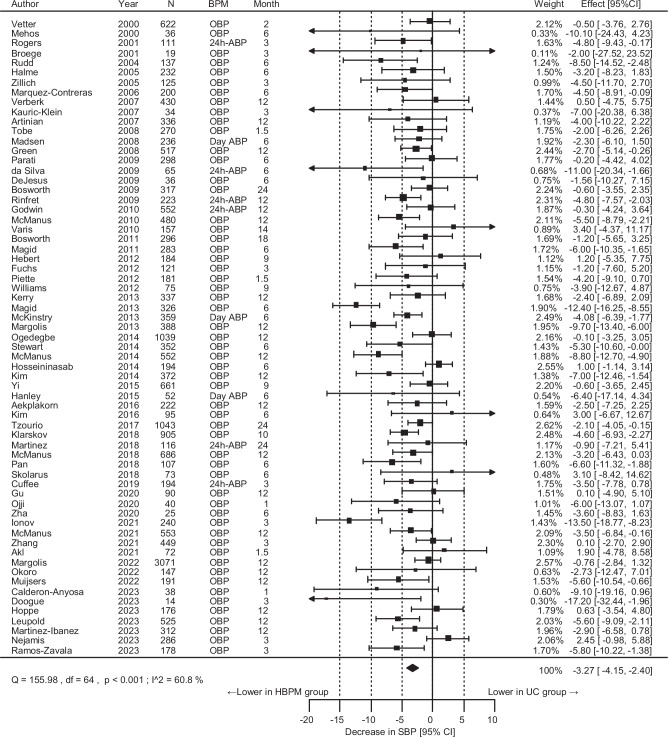
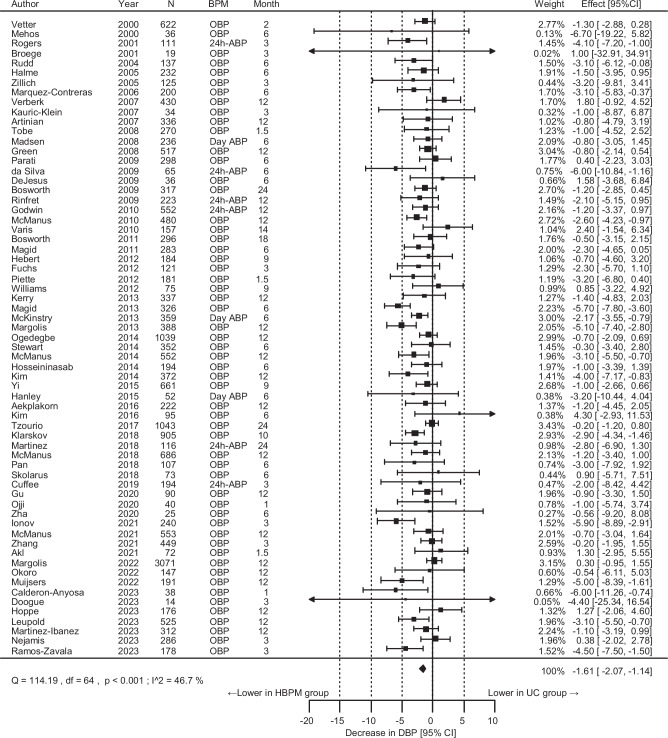
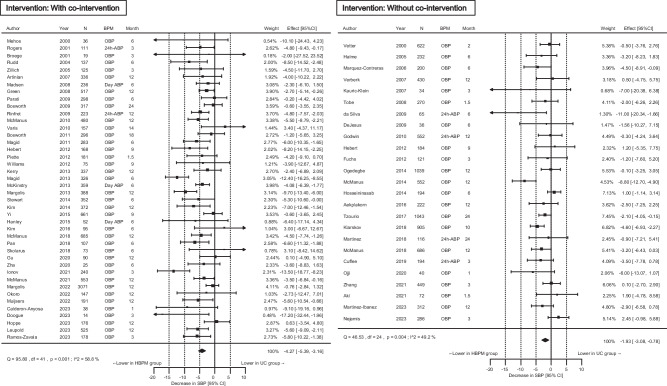
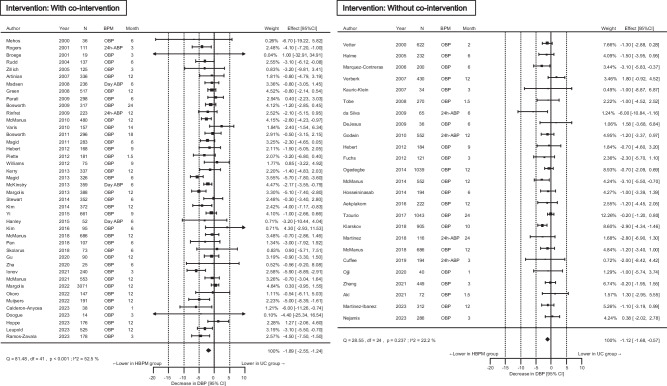
The effect of self-measurement of blood pressure (BP) at home (home BP measurement, HBPM) has been evaluated over the past decade. This meta-analysis included the latest studies to determine whether HBPM reduced BP (PROSPERO ID: CRD42023442225). PubMed, Cochrane Library Database, and IchuShi-Web were searched for randomized controlled trials after the year 2000 which demonstrated the effect of HBPM on BP change compared with usual care (UC). Overall, 65 articles (n = 21,053; 63 based on patients with hypertension) were included. The systolic/diastolic BP reduction was significantly greater in the HBPM than in the UC group by 3.27/1.61 mmHg (95% confidence intervals: 2.40–4.15/1.14–2.07) at the end of the intervention, and I 2 values ≥ 46.7% suggested moderate-to-high heterogeneity. The funnel plots exhibited no notable publication bias (Egger’s test p ≥ 0.16). HBPM with co-interventions (such as telemonitoring) showed a stronger BP-lowering effect than without co-interventions while the effect of HBPM on BP change remained significant in the absence of co-interventions. HBPM was not associated with systolic BP changes when we combined the four studies that used a wrist cuff device for HBPM. The number of antihypertensive medications increased by 0.17 medications in the HBPM group compared with that in the UC group. There were no significant differences in body mass index changes or risk of severe adverse outcomes between the groups. Our results demonstrated a beneficial effect of HBPM in reducing BP, particularly when used in conjunction with telemonitoring or additional medical support and when employing upper-arm cuff devices.
Overview
CoChat Summary
TL;DR
This systematic review and meta-analysis found that home blood pressure measurement (HBPM) with a cuff device reduced systolic/diastolic blood pressure by 3.27/1.61 mmHg more than usual care. The benefit was stronger with co-interventions such as telemonitoring or medical support and with upper-arm cuff devices, but not clearly present with wrist cuff devices.
Key findings
- Across 65 randomized controlled trials (n = 21,053; 63 studies in patients with hypertension), HBPM reduced SBP by 3.27 mmHg (95% CI 2.40–4.15) and DBP by 1.61 mmHg (95% CI 1.14–2.07) versus usual care at the end of intervention.
- Heterogeneity was moderate-to-high (I² ≥ 46.7%), with no notable publication bias on funnel plots or Egger’s test (p = 0.16 for SBP, p = 0.63 for DBP).
- HBPM with co-interventions such as telemonitoring showed a stronger BP-lowering effect, but the effect remained significant without co-interventions.
- In four studies using a wrist cuff device, HBPM was not associated with SBP change (−0.06 mmHg, 95% CI −1.53 to 1.40). Antihypertensive medications increased by 0.17 medications in the HBPM group; BMI change and severe adverse outcomes did not differ significantly.
Methods
- Systematic review and meta-analysis registered in PROSPERO (CRD42023442225), reported according to PRISMA, and conducted for the Japanese Society of Hypertension task force on BP control using digital technologies.
- Searched PubMed, Cochrane Library Database, and IchuShi-Web on August 1, 2023 for randomized controlled trials published after 2000 that compared HBPM using a cuff device with usual care; 65 articles were included.
- Random-effects models using restricted maximum likelihood estimated group differences and 95% CIs; heterogeneity was assessed with Q-statistics and I², with leave-one-out, funnel plot, Egger’s/Begg’s tests, subgroup, and meta-regression analyses.
Limitations
- The paper states heterogeneity was high in most analyses, possibly due to variations in inclusion criteria, HBPM intervention methods, outcome measures, and follow-up period.
- The paper states it could not evaluate long-term effects beyond 1.5 years because of limited trials, and that Hawthorne effect bias is difficult to distinguish from HBPM effects.
- The paper states it could not analyze health behavioral changes, adherence to HBPM, or quality of life due to inconsistent outcomes or missing values; most studies included participants under antihypertensive treatment or mixed treated/untreated populations.
- Evident from the text: several key analyses relied on few studies, including only three trials with interventions longer than 20 months, four wrist-cuff studies, 11 studies reporting medication changes, four BMI studies, three death studies, and five cardiovascular disease studies.
Model-written summary. Check it against the paper before relying on it.
Integrity signals
Registry
Cites
Statistics
Figures
Verification
Claims the paper makes
11 Valid · 1 Not valid · 5 Not checked · 64 Own results and interpretations
At least one cited source doesn’t support this claim or points to a different paper, and none confirmed it — see the verdicts below.
In the paper
“This IPD meta-analysis did not include studies with small sample sizes (n < 200).”
§ Self-measurement of blood pressure at home using a cuff device for change in blood pressure levels: systematic review and meta-analysis > Discussion
What the sources say
- Disputedcites [5] Tucker KL, Sheppard JP, Stevens R, Bosworth HB, Bove A, Bray EP, et al. Self-monitoring of blood pressure in hypertension: a systematic review and individual patient data meta-analysis. PLoS Med. 2017;14:e1002389. 28926573 PMC5604965 sourceExperimental — accuracy not yet measured
The Study selection section says included studies needed at least 100 patients, not 200. Table 1 lists an included study by Earle with 137 patients randomised and data available for 126, directly contradicting the claim. (LLM, conf=0.95)
Checked by a reasoning model — may be wrong.
plain- Asserted: passes — The authors put it forward as true.
- Checkable: passes — It can be checked against evidence.
- Load-bearing: unclear — It is unclear whether the paper’s conclusions depend on it.
- Based: passes — The paper gives a reason why it holds.
- Disputed
Every source the paper cites for this claim was checked and supports it.
In the paper
“The latest individual participant data meta-analysis (IPD) suggested that HBPM alone was not associated with lower BP in the absence of co-interventions [5].”
§ Self-measurement of blood pressure at home using a cuff device for change in blood pressure levels: systematic review and meta-analysis > Discussion
What the sources say
- Supportedcites [5] Tucker KL, Sheppard JP, Stevens R, Bosworth HB, Bove A, Bray EP, et al. Self-monitoring of blood pressure in hypertension: a systematic review and individual patient data meta-analysis. PLoS Med. 2017;14:e1002389. 28926573 PMC5604965 source
The Abstract Conclusions state that self-monitoring alone is not associated with lower BP. The Results section reports that, without a co-intervention, the estimated clinic systolic BP reduction was −1.0 mmHg (95% CI −3.3 to 1.2), consistent with the citing sentence’s hedged summary. (LLM, conf=0.95)
hedgedstates an association- Asserted: passes — The authors put it forward as true.
- Checkable: passes — It can be checked against evidence.
- Load-bearing: passes — The paper’s conclusions depend on it.
- Based: passes — The paper gives a reason why it holds.
- Supported
The cited sources support only part of this claim — read each source’s verdict below.
In the paper
“A previous study based on patients treated with antihypertensive medications estimated that reducing systolic BP by 5 mmHg led to a 9% risk reduction of cardiovascular diseases [79].”
§ Self-measurement of blood pressure at home using a cuff device for change in blood pressure levels: systematic review and meta-analysis > Discussion
What the sources say
- Partly supportedcites [79] Blood Pressure Lowering Treatment Trialists Collaboration. Pharmacological blood pressure lowering for primary and secondary prevention of cardiovascular disease across different levels of blood pressure: an individual participant-level data meta-analysis. Lancet. 2021;397:1625–36. 33933205 PMC8102467 sourceExperimental — accuracy not yet measured
The Abstract Findings report a 9% reduction in major cardiovascular events per 5 mm Hg lower systolic blood pressure, but specifically among participants without previous cardiovascular disease (HR 0.91). The Discussion gives the average reduction across participants as about 10%, so the citing sentence omits the subgroup qualifier attached to its 9% estimate. No page number is available in our copy. (LLM, conf=0.85)
hedgedstates a cause- Asserted: passes — The authors put it forward as true.
- Checkable: passes — It can be checked against evidence.
- Load-bearing: passes — The paper’s conclusions depend on it.
- Based: passes — The paper gives a reason why it holds.
- Partly supported
Every source the paper cites for this claim was checked and supports it.
In the paper
“The results of the meta-analyses imply that HBPM alone does not have a large effect [5, 6]”
§ Self-measurement of blood pressure at home using a cuff device for change in blood pressure levels: systematic review and meta-analysis > Introduction
What the sources say
- Supportedcites [5] Tucker KL, Sheppard JP, Stevens R, Bosworth HB, Bove A, Bray EP, et al. Self-monitoring of blood pressure in hypertension: a systematic review and individual patient data meta-analysis. PLoS Med. 2017;14:e1002389. 28926573 PMC5604965 source
The Discussion’s Main findings state that self-monitoring alone had little or no effect on blood-pressure lowering. The Results (Intensity of co-intervention) report a small estimated reduction in clinic systolic blood pressure with no co-intervention (−1.0 mmHg; 95% CI −3.3 to 1.2), supporting the paraphrase. (LLM, conf=0.95)
- Supportedcites [6] Bray EP, Holder R, Mant J, McManus RJ. Does self-monitoring reduce blood pressure? Meta-analysis with meta-regression of randomized controlled trials. Ann Med. 2010;42:371–86. 20504241 source
The Conclusion (page unavailable) says self-monitoring produces a small reduction in office blood pressure compared with usual care. The Discussion (page unavailable) also notes that additional co-interventions can enhance its effect, consistent with the claim that home blood-pressure monitoring alone does not have a large effect. (LLM, conf=0.88)
hedged- Asserted: passes — The authors put it forward as true.
- Checkable: passes — It can be checked against evidence.
- Load-bearing: passes — The paper’s conclusions depend on it.
- Based: passes — The paper gives a reason why it holds.
- Supported
The sources with a verdict support this claim; the rest weren’t checked yet, have no full text we could read, or their verdicts aren’t rated yet.
In the paper
“Previous meta-analyses have revealed that HBPM can lower BP [5–8].”
§ Self-measurement of blood pressure at home using a cuff device for change in blood pressure levels: systematic review and meta-analysis > Introduction
What the sources say
- Supportedcites [5] Tucker KL, Sheppard JP, Stevens R, Bosworth HB, Bove A, Bray EP, et al. Self-monitoring of blood pressure in hypertension: a systematic review and individual patient data meta-analysis. PLoS Med. 2017;14:e1002389. 28926573 PMC5604965 source
The Introduction states that previous meta-analyses found self-monitoring reduced clinic blood pressure by a small but significant amount compared with conventional care. It defines self-monitoring as measuring one's own blood pressure, usually at home, which supports the claim about HBPM. (LLM, conf=0.94)
- Supportedcites [6] Bray EP, Holder R, Mant J, McManus RJ. Does self-monitoring reduce blood pressure? Meta-analysis with meta-regression of randomized controlled trials. Ann Med. 2010;42:371–86. 20504241 source
The Abstract reports that this meta-analysis of randomized trials found significantly lower office systolic and diastolic blood pressure with self-monitoring than with usual care. The Key messages likewise describe small reductions in office blood pressure. (LLM, conf=0.94)
- Not checked — no full text of the sourcecites [7] Agarwal R, Bills JE, Hecht TJ, Light RP. Role of home blood pressure monitoring in overcoming therapeutic inertia and improving hypertension control: a systematic review and meta-analysis. Hypertension. 2011;57:29–38. 21115879 source
- Not checked — no full text of the sourcecites [8] Uhlig K, Patel K, Ip S, Kitsios GD, Balk EM. Self-measured blood pressure monitoring in the management of hypertension: a systematic review and meta-analysis. Ann Intern Med. 2013;159:185–94. 23922064 source
plainstates a cause- Asserted: passes — The authors put it forward as true.
- Checkable: passes — It can be checked against evidence.
- Load-bearing: passes — The paper’s conclusions depend on it.
- Based: passes — The paper gives a reason why it holds.
- Supported
44 more claims · 3 with their cited sources checked
Create a free account to see all 81 claims and to verify the 3 references still open.
- Probably not a substantial claim. 17
- It may state two separate claims as one. 19
- The quote only partly states this claim. 1
Self-check
Percentages, sums and reported differences re-computed from the paper’s own numbers.
Each contradiction between two passages listed here was confirmed by an independent check.
Rated minor: it would not touch a result — a value no result rests on, a p-value that stays on the same side of the significance level, or a conflict that is clerical, resolved elsewhere in the paper, or outside its own findings.
In the paper
§ Self-measurement of blood pressure at home using a cuff device for change in blood pressure levels: systematic review and meta-analysis > Results > Study overview
“Twenty-four studies were assessed as having a high bias risk because at least one of the risks was high.”
§ Self-measurement of blood pressure at home using a cuff device for change in blood pressure levels: systematic review and meta-analysis > Results > Sensitivity analysis regarding the BP outcome
“After excluding the 23 studies with a high risk of bias, the result was similar and there was no change in heterogeneity”
Rated minor: it would not touch a result — a value no result rests on, a p-value that stays on the same side of the significance level, or a conflict that is clerical, resolved elsewhere in the paper, or outside its own findings.
In the paper
§ Self-measurement of blood pressure at home using a cuff device for change in blood pressure levels: systematic review and meta-analysis > Methods > Search strategy
“Studies were included if (1) were reported after the year 2000”
§ Self-measurement of blood pressure at home using a cuff device for change in blood pressure levels: systematic review and meta-analysis > Results > Study overview
“| Vetter et al. [11] | 2000 | Switzerland | Hypertension”
Citations
Cites
Measuring inconsistency in meta-analyses
Higgins, J. P. T., Thompson, S. G., Deeks, J. J., & Altman, D. G. (2003) · BMJ · doi:10.1136/bmj.327.7414.557 · Cited by 63,139
Whelton, P. K., Carey, R. M., Aronow, W. S., Casey, D. E., Collins, K. J., Dennison Himmelfarb, C., DePalma, S. M., Gidding, S., Jamerson, K. A., Jones, D. W., et al. (2018) · Hypertension · doi:10.1161/hyp.0000000000000065 · Cited by 7,391
Mancia, G., Kreutz, R., Brunström, M., Burnier, M., Grassi, G., Januszewicz, A., Muiesan, M. L., Tsioufis, K., Agabiti-Rosei, E., Algharably, E. A. E., et al. (2023) · Journal of Hypertension · doi:10.1097/hjh.0000000000003480 · Cited by 3,473
The Japanese Society of Hypertension Guidelines for the Management of Hypertension (JSH 2019)
Umemura, S., Arima, H., Arima, S., Asayama, K., Dohi, Y., Hirooka, Y., Horio, T., Hoshide, S., Ikeda, S., Ishimitsu, T., et al. (2019) · Hypertension Research · doi:10.1038/s41440-019-0284-9 · Cited by 1,880 · cited 4×
“High blood pressure (BP) is a known risk factor for cardiovascular diseases [1 – 4].”
InfluentialSelf-citationRahimi, K., Bidel, Z., Nazarzadeh, M., Copland, E., Canoy, D., Ramakrishnan, R., Pinho-Gomes, A.-C., Woodward, M., Adler, A., Agodoa, L., et al. (2021) · The Lancet · doi:10.1016/s0140-6736(21)00590-0 · Cited by 1,074
Self-citationWhelton, P. K., Carey, R. M., Aronow, W. S., Casey, D. E., Collins, K. J., Dennison Himmelfarb, C., DePalma, S. M., Gidding, S., Jamerson, K. A., Jones, D. W., et al. (2018) · Journal of the American College of Cardiology · doi:10.1016/j.jacc.2017.11.005 · Cited by 920
Green, B. B. (2008) · JAMA · doi:10.1001/jama.299.24.2857 · Cited by 659
Tucker, K. L., Sheppard, J. P., Stevens, R., Bosworth, H. B., Bove, A., Bray, E. P., Earle, K., George, J., Godwin, M., Green, B. B., et al. (2017) · PLOS Medicine · doi:10.1371/journal.pmed.1002389 · Cited by 658
McManus, R. J., Mant, J., Bray, E. P., Holder, R., Jones, M. I., Greenfield, S., Kaambwa, B., Banting, M., Bryan, S., Little, P., et al. (2010) · The Lancet · doi:10.1016/s0140-6736(10)60964-6 · Cited by 597
Margolis, K. L., Asche, S. E., Bergdall, A. R., Dehmer, S. P., Groen, S. E., Kadrmas, H. M., Kerby, T. J., Klotzle, K. J., Maciosek, M. V., Michels, R. D., et al. (2013) · JAMA · doi:10.1001/jama.2013.6549 · Cited by 591
Cited by
Ohya, Y., Arakawa, K., Arata, N., Arima, S., Arima, H., Asayama, K., Dohi, Y., Fukami, A., Furuhashi, M., Goto, K., et al. (2026) · Hypertension Research · doi:10.1038/s41440-025-02462-y · Cited by 107
Self-citationOhya, Y., Sakima, A., Arima, H., Fukami, A., Furuhashi, M., Ishida, M., Ishimitsu, T., Kai, H., Matsumura, K., Miura, K., et al. (2025) · Hypertension Research · doi:10.1038/s41440-025-02331-8 · Cited by 50
“However, further evidence is warranted to establish the long-term effectiveness and sustainability of these digital interventions [2, 5, 13, 18, 19].”
Self-citationDigital hypertension – what we need for the high-quality management of hypertension in the new era
Kario, K., Asayama, K., Arima, H., Matsumoto, C., Nakagawa, N., Nomura, A., Satoh, M., Shinohara, K., Tomitani, N., Yamamoto, K. I., et al. (2025) · Hypertension Research · doi:10.1038/s41440-025-02307-8 · Cited by 17
“According to systematic review and meta-analysis for Healthcare Question 1, the reduction in systolic BP during an intervention was – 3.27 mmHg (95% con fi dence interval – 4.15, – 2.40), indicating a signi fi cant BP-lowering effect [95, 97].”
InfluentialSelf-citationSatoh, M., Nakayama, S., Nobayashi, H., Iwabe, Y., Izumi, S., Murakami, T., Hirose, T., & Metoki, H. (2026) · Hypertension Research · doi:10.1038/s41440-025-02532-1 · Cited by 17
“Also given that home BP measurements themselves can reduce BP [93 – 96], making home BP measurement devices more accessible would be bene fi cial.”
Self-citationAdvances in cardiac devices and bioelectronics augmented with artificial intelligence
Stark, C. J., Rytkin, E., Mircea, A. A., & Efimov, I. R. (2025) · The Journal of Physiology · doi:10.1113/jp287135 · Cited by 6
“Today, digital sphygmomanometers are available direct-to-consumer and are an essential tool in managing hypertension (Satoh et al., 2024).”
Metrics for Evaluating Telemedicine in Randomized Controlled Trials: Scoping Review
Sugawara, Y., Hirakawa, Y., Iwagami, M., Inokuchi, R., Wakimizu, R., & Nangaku, M. (2025) · Journal of Medical Internet Research · doi:10.2196/67929 · Cited by 8
“Ease of access to medical care provided by telemedicine may also improve disease management and clinical outcomes [5].”
Cold-Induced Hypertension as Life-Environment Disease in Winter: Focus on Data From Japan
Kario, K. (2026) · Hypertension · doi:10.1161/hypertensionaha.125.26518 · Cited by 9
Satoh, M., Nobayashi, H., & Iwabe, Y. (2025) · Hypertension Research · doi:10.1038/s41440-025-02320-x · Cited by 3
“In fact, the previous meta-analysis showed that home BP measurement itself reduced BP [7].”
Self-citationCavalcante, F. M. L., Brito, O. D., Estácio, A. C. D. S., Oliveira, A. R. D. S., Chaves, A. C. P., Neto, N. M. G., & Barros, L. M. (2025) · Blood Pressure Monitoring · doi:10.1097/mbp.0000000000000778 · Cited by 3
Ota, Y., Kuwabara, M., & Kario, K. (2026) · Hypertension Research · doi:10.1038/s41440-026-02676-8 · Cited by 2
“Furthermore, daily BP measurement in hypertensive patients has been reported to increase awareness of their health status, which may in turn improve medication adherence and ultimately BP control [7].”
Hypertensive disorders of pregnancy: risk stratification and management
Cerdeira, A. S., Sarma, A., Hirst, J. E., Henry, A., Muñoz-Ortiz, E., Saad, A., Scott, N. S., Sharma, G. V., Brazile, T. L., Conrad, N., et al. (2026) · The Lancet Obstetrics Gynaecology & Women s Health · doi:10.1016/s3050-5038(26)00190-1 · Cited by 4
Tabara, Y. (2024) · Hypertension Research · doi:10.1038/s41440-024-02041-7
“…BP-lowering effect of HBPM may primarily stem from intensi fi ed antihypertensive therapy, factors such as improved medication adherence and unfavorable lifestyle habits could also contribute to the BP-lowering effect, given a reduction in BP during HBPM without changing the treatment regimen [2].”
Sakima, A. (2025) · Hypertension Research · doi:10.1038/s41440-025-02140-z
“A recent meta-analysis revealed that the effectiveness of HBPM in risk ratios for death and cardiovascular outcomes was comparable between HBPM-based treatment and conventional care in patients with hypertension [19].”
Self-citationSatoh, M., Nobayashi, H., Nakayama, S., & Metoki, H. (2025) · Hypertension Research · doi:10.1038/s41440-025-02159-2 · Cited by 1
“Home BP measurement has an established clinical value in BP management [3, 15].”
Self-citationEvaluation and Treatment of Essential and Secondary Hypertension
Lyas, C., & Maxson, R. (2025) · Nephrology Self-Assessment Program · doi:10.58483/nsap.00052025
Know Your Blood Pressure: A Call for Awareness on World Hypertension Day 2025: Letter to Editor
Mehdezadeh, F., Bady, S. A. M., & Azdaki, N. (2025) · Journal of Translational Medical Research · doi:10.61882/jbums.32.2.174
What It Takes for Food to Be Medicine: Lessons From the Rice Diet Era
Steichen, O. (2025) · Hypertension · doi:10.1161/hypertensionaha.125.26151
Kitaoka, K., Morimoto, S., Minegishi, S., Hiroshi, K. A. T. O., Kitahara, Y., Shioyama, W., Shiga, T., Tajiri, K., Shoji, M., Fukata, M., et al. (2026) · Hypertension Research · doi:10.1038/s41440-025-02524-1
Satoh, M., & Ohkubo, T. (2026) · Hypertension Research · doi:10.1038/s41440-025-02526-z · Cited by 1
Self-citationArima, H., Itoh, H., Ohkubo, T., Ohya, Y., Kabayama, M., Kishi, T., Hirawa, N., Miura, K., Miura, S.-I., Yamamoto, K., et al. (2026) · Hypertension Research · doi:10.1038/s41440-025-02509-0 · Cited by 2
Self-citationIwabe, Y., Satoh, M., & Metoki, H. (2026) · Hypertension Research · doi:10.1038/s41440-026-02583-y
Self-citationArabiat, A. M., Owida, H. A., & Altayeb, M. (2026) · Journal of Advances in Information Technology · doi:10.12720/jait.17.5.846-856 · Cited by 3
“At the clinical level, timely identification of individuals with elevated risk allows for targeted interventions, ranging from lifestyle counseling and structured physical-activity programs to pharmacological prevention in selected high-risk cases [8].”
Gandjour, A. (2026) · PLoS ONE · doi:10.1371/journal.pone.0350175
“A 65-trial meta-analysis involving 21,053 participants reported that HBPM reduces office systolic/diastolic blood pressure by –3.27/–1.61 mm Hg compared with usual care, even without telemonitoring co-interventions [36].”
InfluentialTelemonitoring in the era of digital hypertension: beyond remote blood pressure monitoring
Tomitani, N., & Kario, K. (2026) · Hypertension Research · doi:10.1038/s41440-026-02827-x
Metadata
- Authors
- Satoh, M., Tatsumi, Y., Nakayama, S., Shinohara, Y., Kawazoe, M., Nozato, Y., Kunimura, A., Murakami, T., Toyama, M., Muroya, T., Yagihashi, T., Sakima, A., Abe, M., Arima, H., & Ohkubo, T.
- Affiliations
- Tohoku University (JP)
- Teikyo University (JP)
- Tohoku Medical and Pharmaceutical University (JP)
- Fukuoka University (JP)
- The University of Osaka (JP)
- Aichi Medical University (JP)
- University of the Ryukyus (JP)
- Corresponding author
- Satoh, Michihiro
- ORCID
- Venue
- Hypertension Research
- Published
- 2024-11-21
- Volume
- 48
- Issue
- 2
- Pages
- 574-591
- ISSN
- 0916-9636 (ISSN-L)
- 1348-4214
- PMC
- PMC11794135
- OpenAlex
- W4404593494
- Cited by
- 25
- References
- 84
- Citations by year
- 2026: 13 · 2025: 11 · 2024: 1
- FWCI
- 1.98
- Type
- journal article
- Language
- en
- Open access
- hybrid
- doi.org
- Licence
- cc-by
- creativecommons.org/licenses/by/4.0 (tdm)
- creativecommons.org/licenses/by/4.0 (vor)
- Locations
- Hypertension Research (publishedVersion, cc-by)
- PubMed Central (publishedVersion, cc-by)
- PubMed (publishedVersion)
- Institutional Repositories DataBase (IRDB) (submittedVersion)
- Funders
- Japan Agency for Medical Research and Development
- Topics
- Health Sciences › Medicine › Cardiology and Cardiovascular Medicine › Blood Pressure and Hypertension Studies
- Physical Sciences › Engineering › Biomedical Engineering › Non-Invasive Vital Sign Monitoring
- Health Sciences › Medicine › Cardiology and Cardiovascular Medicine › Cardiovascular Health and Disease Prevention
- Keywords
- home blood pressure monitoring, hypertension, blood pressure reduction, remote patient monitoring, antihypertensive medication use, upper arm cuff, usual care comparison
- MeSH terms
- Blood Pressure, Blood Pressure Determination, Humans, Hypertension, Blood Pressure Monitoring, Ambulatory
About these checks
Registry, retraction, Cites and statistics results are computed, not judged, with one exception: a printed reference that no index lists is read once by a model before it counts as a citation error. Claims are extracted by a model and kept only when their quote appears verbatim in the text; each cited source is then checked, with a model’s help, for whether it says what the claim relies on. Those verdicts can be wrong — read the claim’s quote and the cited source before relying on one.
The claim verdicts this report counts are experimental: their accuracy is not yet measured.
A language model drew the claims from the paper on 2026-10-10, under version 3 of the claim definition (model deepseek-v4.1-flash, prompt extract-v3).
A second model labelled each claim on 2026-10-10 (model jev-1.13-20260917, definition revision gold-guideline-v0.2).
Cited sources are checked with a language model’s help (gpt-6-sol).
Statistics and arithmetic are recomputed, not judged.
Confidence bands are shown only for fields calibrated on our annotated test set. None is calibrated yet, so no band is shown.
What counts as a claim ›How we measure confidence ›How we check this ›
Are you an author, or do you see a problem with this page? Request a review
Data sources
Bibliographic data: Semantic Scholar, OpenAlex, Crossref.
Contains information from the Semantic Scholar Academic Graph Datasets, made available under the ODC Attribution License (ODC-BY 1.0).
Semantic Scholar’s data is described in: Kinney, R., et al. (2023). The Semantic Scholar Open Data Platform. arXiv:2301.10140.
