

The DOI matches its Crossref record; 64 of the 65 references it cites were found in a registry or an index.
Volcanic suppression of Nile summer flooding triggers revolt and constrains interstate conflict in ancient Egypt
Open accessAbstract
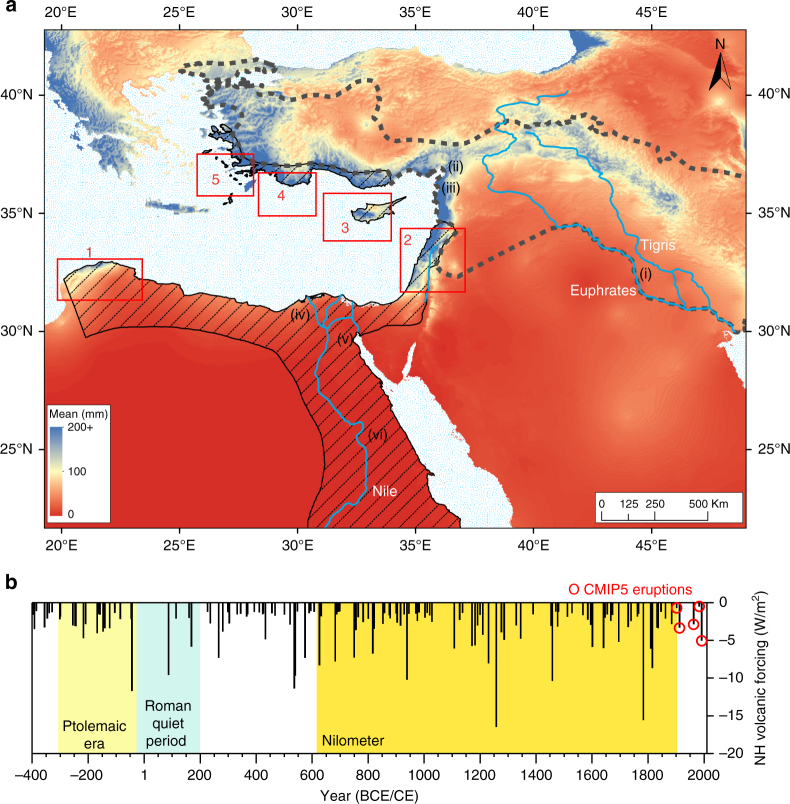
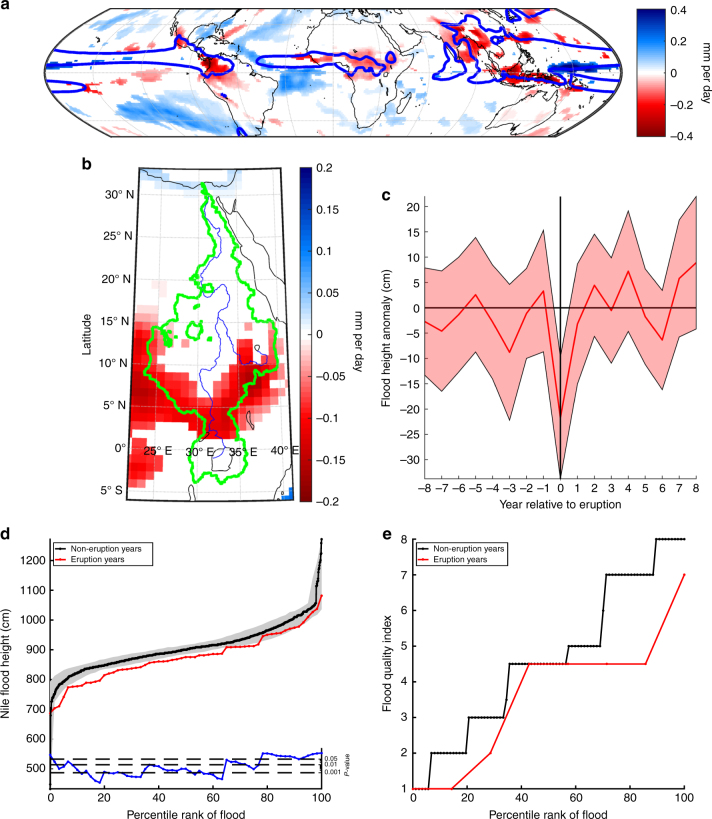
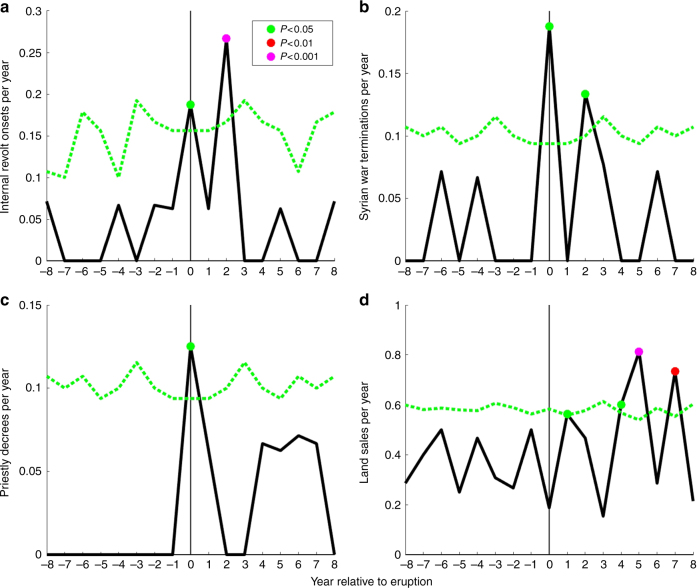
Volcanic eruptions provide tests of human and natural system sensitivity to abrupt shocks because their repeated occurrence allows the identification of systematic relationships in the presence of random variability. Here we show a suppression of Nile summer flooding via the radiative and dynamical impacts of explosive volcanism on the African monsoon, using climate model output, ice-core-based volcanic forcing data, Nilometer measurements, and ancient Egyptian writings. We then examine the response of Ptolemaic Egypt (305–30 BCE), one of the best-documented ancient superpowers, to volcanically induced Nile suppression. Eruptions are associated with revolt onset against elite rule, and the cessation of Ptolemaic state warfare with their great rival, the Seleukid Empire. Eruptions are also followed by socioeconomic stress with increased hereditary land sales, and the issuance of priestly decrees to reinforce elite authority. Ptolemaic vulnerability to volcanic eruptions offers a caution for all monsoon-dependent agricultural regions, presently including 70% of world population.
Overview
The claims and statistics of this paper haven’t been checked yet.
Run the check — free, no account needed. It reads the open-access text and checks the sources it cites.
Integrity signals
Registry
Cites
Statistics
Figures
Verification
Claims the paper makes
The claims and statistics of this paper haven’t been checked yet.
Run the check — free, no account needed. It reads the open-access text and checks the sources it cites.
Claims other papers make about this one
Each is checked against this paper’s own text: does it say what the citing paper says it does?
The source backs part of the claim, not all of it — or backs it for a different population, condition or comparison.
In the citing paper
“The climatic impacts associated with the Hrafnkatla event (the stratospheric eruption which marks the end of Hrafnkatla episode in 762 CE) are generally comparable to other large Icelandic volcanic eruptions such as Eldgjá 939 CE and Laki 1783 CE, with strong winter cooling anomalies across Europe 28,56,57 and perturbations to the hydrological cycle 56,[58][59][60] .”
From Decadal-to-centennial increases of volcanic aerosols from Iceland challenge the concept of a Medieval Quiet Period (2024) · cites this paper as [58]
Experimental — accuracy not yet measured
Self-check
Percentages, sums and reported differences re-computed from the paper’s own numbers.
The self-check needs the paper’s full text.
Citations
Cites
Very high resolution interpolated climate surfaces for global land areas
Hijmans, R. J., Cameron, S. E., Parra, J. L., Jones, P. G., & Jarvis, A. (2005) · International Journal of Climatology · doi:10.1002/joc.1276 · Cited by 19,860
Robust Responses of the Hydrological Cycle to Global Warming
Held, I. M., & Soden, B. J. (2006) · Journal of Climate · doi:10.1175/jcli3990.1 · Cited by 5,052
Volcanic eruptions and climate
Robock, A. (2000) · Reviews of Geophysics · doi:10.1029/1998rg000054 · Cited by 2,806
Timing and climate forcing of volcanic eruptions for the past 2,500 years
Sigl, M., Winstrup, M., McConnell, J. R., Welten, K. C., Plunkett, G., Ludlow, F., Büntgen, U., Caffee, M., Chellman, N., Dahl-Jensen, D., et al. (2015) · Nature · doi:10.1038/nature14565 · Cited by 1,325
Self-citationClimate-Controlled Holocene Occupation in the Sahara: Motor of Africa's Evolution
Kuper, R., & Kröpelin, S. (2006) · Science · doi:10.1126/science.1130989 · Cited by 958
Kang, S. M., Held, I. M., Frierson, D. M. W., & Zhao, M. (2008) · Journal of Climate · doi:10.1175/2007jcli2146.1 · Cited by 669
McCormick, M., Büntgen, U., Cane, M. A., Cook, E. R., Harper, K., Huybers, P., Litt, T., Manning, S. W., Mayewski, P. A., More, A., et al. (2012) · The Journal of Interdisciplinary History · doi:10.1162/jinh_a_00379 · Cited by 578
Effects of Mount Pinatubo volcanic eruption on the hydrological cycle as an analog of geoengineering
Trenberth, K. E., & Dai, A. (2007) · Geophysical Research Letters · doi:10.1029/2007gl030524 · Cited by 511
Land and Power in Ptolemaic Egypt
Manning, J. G. (2003) · Cambridge University Press eBooks · doi:10.1017/cbo9780511482847 · Cited by 369
Self-citationAsymmetric forcing from stratospheric aerosols impacts Sahelian rainfall
Haywood, J. M., Jones, A., Bellouin, N., & Stephenson, D. (2013) · Nature Climate Change · doi:10.1038/nclimate1857 · Cited by 367
Research works printed but not linked: 8
- Butzer, K. Early Hydraulic Civilization in Egypt (University of Chicago Press, 1976).
- Lewis, M. J. T. Millstone and Hammer: The Origins of Water Power (University of Hull Press, 1997).
- Mayerson, P., Three pharaonic crops in Ptolemaic Egypt: Ólura (Emmer wheat) and maslins of krithópuron and olurókrithon. Z. Papyrologie Epigraphik 141, 210-213 (2002).
- Christensen, J. H. et al. in Climate change 2013: The physical science basis. Contribution of Working Group I to the Fifth Assessment Report of the Intergovernmental Panel on Climate Change (eds Stocker, T.F., D. Qin, G.-K. Plattner, M. Tignor, S.K. Allen, J. Boschung, A. Nauels, Y. Xia, V. Bex & P.M. Midgley) (Cambridge University Press, 2013).
- Hölbl, G. A History of the Ptolemaic Empire (Routledge, 2001).
- Holdaway, S. & Phillips, R. in Oxford Research Encyclopedia of Agriculture and the Environment (ed. Hazlett, R.) 1–34 (Oxford University Press, 2016).
- Hassan, F. in Historical Ecology: Cultural Knowledge and Changing Landscapes (ed. Crumley, C. L.) 155–181 (School of American Research Press, 1994).
- Thompson, D. J. in Agriculture in Egypt: From Pharaonic to Modern Times (eds Bowman, A. K. & Rogan, E.) (Oxford University Press, 1999).
Cited by
Sorted by citations
Items 101–184 of 184
Warm Soil, Westerly Wind, and Wet Feet: Feeling and Measuring Ecological Time in the Roman World
Tally‐Schumacher, K. J. (2022) · GeoHealth · doi:10.1029/2022gh000720 · Cited by 2
Stevens, K. (2022) · doi:10.1093/oso/9780192863478.003.0005 · Cited by 1
The Nile Basin and Water Stress
Abtew, W. (2025) · Springer geography · doi:10.1007/978-3-031-78657-0_2 · Cited by 1
The Hellenistic and Roman Near East
Seland, E. H. (2025) · Oxford University Press eBooks · doi:10.1093/oxfordhb/9780190858155.013.61 · Cited by 1
The Nile and Climate History, 3000 BCE to 30 BCE
Manning, J. G. (2025) · Heritage · doi:10.3390/heritage8120509 · Cited by 1
Self-citationGao, M., Li, Y., Xi, T., Zhao, J., Zhang, Z., Duan, J., Xue, Y., Shang, H., & Liu, S. (2026) · Anthropocene · doi:10.1016/j.ancene.2026.100527 · Cited by 1
Storminess in North West Europe and volcanic activity during the Holocene
Orme, L. C., Ludlow, F., Langton, N., Sjöström, J., Kylander, M. E., Murphy, C., Pyne-O’Donnell, S., Turner, J., Li, N., Davies, S., et al. (2026) · Climate of the past · doi:10.5194/cp-22-287-2026 · Cited by 3
Self-citationSingh, R., Koch, A., LeGrande, A. N., Tsigaridis, K., Ramos, R. D., Ludlow, F., Aleinov, I., Ruedy, R. A., & Kaplan, J. O. (2026) · Geoscientific model development · doi:10.5194/gmd-19-1405-2026 · Cited by 1
Self-citationHolocene Nile dynamics shaped the physical and cultural landscape of ancient Nubia
Peeters, J., Winkels, T. G., Wolf, P., Skuldbøl, T. B. B., Chamberlain, E. L., Büchner-Matthews, S., Elamin, S. M., Mohamed, E. H. A., & Emberling, G. (2026) · Proceedings of the National Academy of Sciences · doi:10.1073/pnas.2529986123 · Cited by 1
Schulz, M., & McConnell, J. R. (2022) · Elsevier eBooks · doi:10.1016/b978-0-12-819766-0.00010-9 · Cited by 1
Teaching Propaganda: Water, Food, and Power in the Livre d’Écolier
Meccariello, C. (2024) · De Gruyter eBooks · doi:10.1515/9783111334646-013 · Cited by 1
A letter to my climate change skeptical neighbor: some thoughts about the coastal zone
Neves, C. F. (2019) · Geo-Marine Letters · doi:10.1007/s00367-019-00586-y · Cited by 1
Las estacas de madera de Haraga y la pesca en el-Fayum durante el Reino Medio
(España), U. D. C., & Soria-Trastoy, M. T. (2020) · Trabajos de Egiptología Papers on Ancient Egypt · doi:10.25145/j.tde.2020.11.20 · Cited by 1
Clancier, P., & Gorre, G. (2021) · Cambridge University Press eBooks · doi:10.1017/9781108782890.005 · Cited by 1
Monetary Policies, Coin Production, and Currency Supply in the Seleucid and Ptolemaic Empires
Iossif, P. P., & Lorber, C. C. (2021) · Cambridge University Press eBooks · doi:10.1017/9781108782890.009 · Cited by 1
Legitimizing the Foreign King in the Ptolemaic and Seleucid Empires
Pfeiffer, S., & Klinkott, H. (2021) · Cambridge University Press eBooks · doi:10.1017/9781108782890.010 · Cited by 1
Food Crises Management in the Pharaonic and the Ptolemaic Periods
Bayoumy, T. F., & Moussa, W. I. (2021) · Journal of Tourism, Hotels and Heritage · doi:10.21608/sis.2021.106460.1026 · Cited by 1
Social Tensions in the Ancient Near East
Robertson, J. (2020) · Wiley eBooks · doi:10.1002/9781119362500.ch12 · Cited by 1
Kleemann, K. (2023) · De Gruyter eBooks · doi:10.1515/9783110731927-007 · Cited by 1
Higgins, M. D. (2023) · doi:10.1093/oso/9780197648148.003.0007 · Cited by 1
Climate Change, State-Building and Societal Resilience in Bronze Age Egypt. *Preprint
Guerriero, C., Gholami, A. A. O., & Loktionov, A. (2025) · SSRN Electronic Journal · doi:10.2139/ssrn.5068155 · Cited by 1
Agriculture in the Hellenistic Kingdoms
Manning, J. G. (2020) · doi:10.1002/9781118970959.ch16
Self-citation(2021) · Climate of the past · doi:10.5194/cp-2021-63-rc2
Imperial and Indigenous Temporalities in the Ptolemaic and Seleucid Dynasties
Kosmin, P. J., & Moyer, I. S. (2021) · Cambridge University Press eBooks · doi:10.1017/9781108782890.007
Imperialmetropoleisand Foundation Myths
von Reden, S., & Strootman, R. (2021) · Cambridge University Press eBooks · doi:10.1017/9781108782890.003
Antiochus III, Ptolemy IV, and Local Elites
Dreyer, B., & Gerardin, F. (2021) · Cambridge University Press eBooks · doi:10.1017/9781108782890.011
Fischer‐Bovet, C., & von Reden, S. (2021) · Cambridge University Press eBooks · doi:10.1017/9781108782890.014
(2021) · Cambridge University Press eBooks · doi:10.1017/9781108782890.013
Fischer‐Bovet, C., & von Reden, S. (2021) · doi:10.1017/9781108782890.001
Plunkett, G. M. (2021) · Climate of the past · doi:10.5194/cp-2021-63-ac1
Fischer‐Bovet, C., & von Reden, S. (2021) · Cambridge University Press eBooks · doi:10.1017/9781108782890.002
Comment on cp-2021-63: a well written and significant paper
(2021) · Climate of the past · doi:10.5194/cp-2021-63-cc1
Mackay, H., Plunkett, G., Jensen, B. J. L., et al. (2022) · Climate of the past · doi:10.5194/cp-2021-170-cc1
Stoffel, M. (2022) · Climate of the past · doi:10.5194/cp-2021-148-ac1
(2022) · Climate of the past · doi:10.5194/cp-2021-148-rc2
Stoffel, M. (2022) · Climate of the past · doi:10.5194/cp-2021-148-ac2
Mackay, H. (2022) · Climate of the past · doi:10.5194/cp-2021-170-ac2
Mackay, H. (2022) · Climate of the past · doi:10.5194/cp-2021-170-ac1
Mackay, H. (2022) · Climate of the past · doi:10.5194/cp-2021-170-ac3
Review of the manuscript by by Ram Singh et al.
(2022) · Climate of the past · doi:10.5194/cp-2022-25-rc2
HISTORICAL VOLCANIC ERUPTIONS & SOCIO-ECONOMIC RESULTSPreprint
Bayraktar, M. (2021) · SSRN Electronic Journal · doi:10.2139/ssrn.3958468
Diverging Memories, Not Resistance Literature
Honigman, S. (2022) · doi:10.1093/oso/9780192863478.003.0006
The ‘Great Theban Revolt’, 206–186 bce
Veïsse, A. (2022) · doi:10.1093/oso/9780192863478.003.0003
‘Herakles is stronger, Seleucus’
Tober, D. (2022) · doi:10.1093/oso/9780192863478.003.0009
Gruen, E. S. (2022) · doi:10.1093/oso/9780192863478.003.0002
Woodman, N., Ikram, S., & Rowland, J. (2022) · BMC Ecology and Evolution · doi:10.1186/s12862-022-02101-x
Ice Core and Marine Sediment Records of Quaternary Environmental Change
McConnell, J. R., Brugger, S. O., & Chellman, N. J. (2023) · Wiley eBooks · doi:10.1002/9781119592112.ch9
Higgins, M. D. (2023) · doi:10.1093/oso/9780197648148.003.0009
Higgins, M. D. (2023) · doi:10.1093/oso/9780197648148.003.0001
Higgins, M. D. (2023) · doi:10.1093/oso/9780197648148.003.0004
Higgins, M. D. (2023) · doi:10.1093/oso/9780197648148.003.0002
Higgins, M. D. (2023) · doi:10.1093/oso/9780197648148.002.0003
Higgins, M. D. (2023) · doi:10.1093/oso/9780197648148.002.0004
Higgins, M. D. (2023) · doi:10.1093/oso/9780197648148.003.0008
Higgins, M. D. (2023) · doi:10.1093/oso/9780197648148.003.0003
The Temple of Artemis at Ephesus
Higgins, M. D. (2023) · doi:10.1093/oso/9780197648148.003.0006
CAUSOS, VISAGENS E ENCANTARIAS: O CASO DAS APARIÇÕES NA ILHA DE COTIJUBA - PARÁ
Santos, M. R. S., & da Cruz, R. B. (2023) · doi:10.22533/at.ed.7882307127
da Silva, F. H., & Henning, L. M. P. (2023) · doi:10.22533/at.ed.7882307122
A ARTE NA EXPRESSÃO DO BELO NO CANTO DO HINO BATISMAL EM GÁLATAS 3,28
Franco, J. F. S. (2023) · doi:10.22533/at.ed.7882307121
Machado, R. D. O., & Klanovicz, L. R. F. (2023) · doi:10.22533/at.ed.7882307128
CANTORAS IMPROVISADORAS: ONDE ESTÃO AS MULHERES? VOZES, ESPAÇOS E LUGARES NA MÚSICA
Oliveira, P. A. N. (2023) · doi:10.22533/at.ed.7882307126
COVID-19: UNA MIRADA A LA PERCEPCIÓN SOCIAL DEL RIESGO Y EL COMPORTAMIENTO. GUANTÁNAMO, CUBA
Padilla, A. M., Pérez, K. V., Castellanos, E. G. L., Ocaña, L. L., Cardona, D. R., & Basquerote, A. T. (2023) · doi:10.22533/at.ed.78823071214
HISTÓRIA DA CONSERVAÇÃO DO SOLO E A PROTEÇÃO DO NOSSO FUTURO
Oliveira, M. T. (2023) · doi:10.22533/at.ed.78823071211
O IMAGINÁRIO PANDÊMICO NO CINEMA HOLLYWOODIANO
Faenello, D., Bueno, G. D. B., Felix, I. S. I., & da Silva, E. M. B. (2023) · doi:10.22533/at.ed.78823071213
Espinel, A. D. (2023) · The Encyclopedia of Ancient History · doi:10.1002/9781444338386.wbeah15212.pub2
Zhang, M. (2024) · doi:10.5194/cp-2023-77-ac2
McGraw, Z. S., & Polvani, L. M. (2024) · doi:10.22541/essoar.171286339.98809285/v1
Imperial Responses to the Food Crisis that Began under Claudius
Graham, D. (2024) · Mouseion Journal of the Classical Association of Canada · doi:10.3138/mous.20.1.02
van Dijk, E. J. C., Raible, C. C., Sigl, M., et al. (2024) · Climate of the Past Discussions · doi:10.5194/cp-2024-79-rc1
Guillet, S., Corona, C., Yang, Z., Oppenheimer, C., Lavigne, F., Ludlow, F., & Stoffel, M. (2025) · Climatic Change · doi:10.1007/s10584-025-03867-x
Self-citationEnvironmental Change and Imperial Governance
Huebner, S. R. (2025) · Journal for the History of Environment and Society · doi:10.1484/j.jhes.5.153988
Kostick, C., Singh, R., & Medenieks, S. (2026) · doi:10.1093/9780198945239.003.0019
Myhrvold, D. S., Etchells, D. D. S., & Dugmore, A. (2026) · doi:10.1093/9780198945239.003.0087
Nasser, N., Hamdan, M. A., Gatto, M. C., Curci, A., Sayed, M. I. H. E., & Badawy, H. S. (2026) · Journal of African Earth Sciences · doi:10.1016/j.jafrearsci.2026.106406
Metadata
- Authors
- Manning, J. G., Ludlow, F., Stine, A. R., Boos, W. R., Sigl, M., & Marlon, J. R.
- Affiliations
- Yale University (US)
- Trinity College Dublin (IE)
- San Francisco State University (US)
- Lawrence Berkeley National Laboratory (US)
- University of Bern (CH)
- Corresponding author
- Ludlow, Francis
- ORCID
- Venue
- Nature Communications
- Published
- 2017-10-17
- Volume
- 8
- Issue
- 1
- Pages
- 900-900
- ISSN
- 2041-1723 (ISSN-L)
- PMC
- PMC5645420
- OpenAlex
- W2761620976
- Cited by
- 184
- References
- 65
- Citations by year
- 2026: 8 · 2025: 13 · 2024: 13 · 2023: 39 · 2022: 35 · 2021: 36 · 2020: 17 · 2019: 10 · 2018: 13
- FWCI
- 6.34
- Type
- journal article
- Language
- en
- Open access
- gold
- doi.org
- Locations
- Nature Communications (publishedVersion, cc-by)
- Europe PMC (PubMed Central) (publishedVersion, cc-by)
- PubMed Central (publishedVersion, cc-by)
- PubMed (publishedVersion)
- Arrow@dit (Dublin Institute of Technology) (acceptedVersion)
- DORA PSI (Paul Scherrer Institute) (submittedVersion, cc-by)
- OSTI OAI (U.S. Department of Energy Office of Scientific and Technical Information) (submittedVersion)
- RePEc: Research Papers in Economics (submittedVersion)
- DOAJ (DOAJ: Directory of Open Access Journals) (submittedVersion)
- DOAJ (DOAJ: Directory of Open Access Journals) (submittedVersion, cc-by-sa)
- eScholarship (California Digital Library) (submittedVersion)
- Trinity's Access to Research Output (TARA) (Trinity College Dublin) (submittedVersion, cc-by-nc-sa)
- Funders
- National Science Foundation (1437074, 1405053)
- Yale University
- Past Global Changes
- Trinity College Dublin
- Topics
- Physical Sciences › Earth and Planetary Sciences › Atmospheric Science › Geology and Paleoclimatology Research
- Social Sciences › Arts and Humanities › Archeology (arts and humanities) › Ancient Egypt and Archaeology
- Social Sciences › Archeology › Archaeology and ancient environmental studies
- Keywords
- volcanic eruptions, African monsoon, Ptolemaic Egypt, interstate conflict, abrupt climate change, ancient Egypt
- MeSH terms
- Egypt, Ancient, Climate, Conflict, Psychological, Geography, Humans, Models, Theoretical, Rain, Seasons, Warfare, Volcanic Eruptions, Rivers, History, Ancient, Floods
About these checks
Registry, retraction, Cites and statistics results are computed, not judged, with one exception: a printed reference that no index lists is read once by a model before it counts as a citation error. Claims are extracted by a model and kept only when their quote appears verbatim in the text; each cited source is then checked, with a model’s help, for whether it says what the claim relies on. Those verdicts can be wrong — read the claim’s quote and the cited source before relying on one.
Statistics and arithmetic are recomputed, not judged.
Confidence bands are shown only for fields calibrated on our annotated test set. None is calibrated yet, so no band is shown.
What counts as a claim ›How we measure confidence ›How we check this ›
Are you an author, or do you see a problem with this page? Request a review
