

Cisplatin is retained in the cochlea indefinitely following chemotherapy
Open accessThe DOI matches its Crossref record; 52 of the 52 references it cites were found in a registry or an index.
Abstract
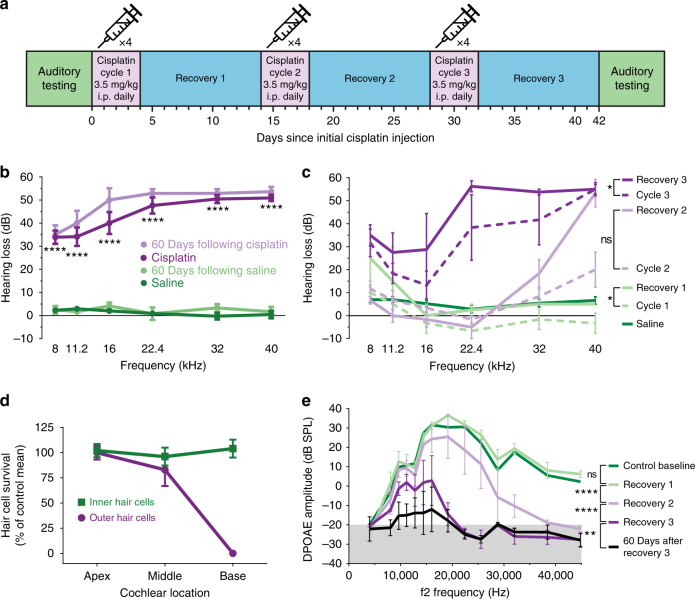
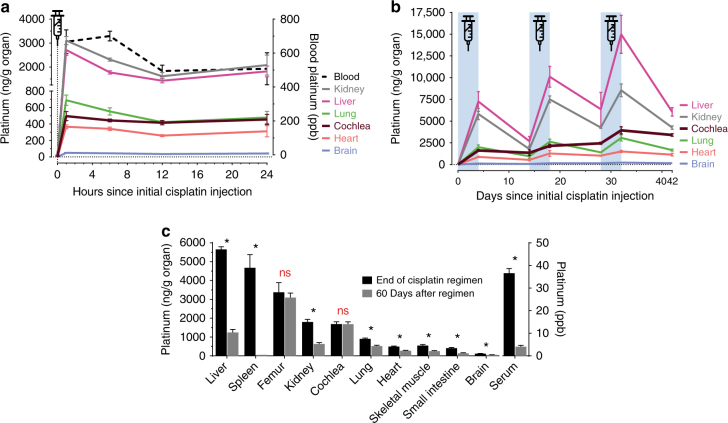
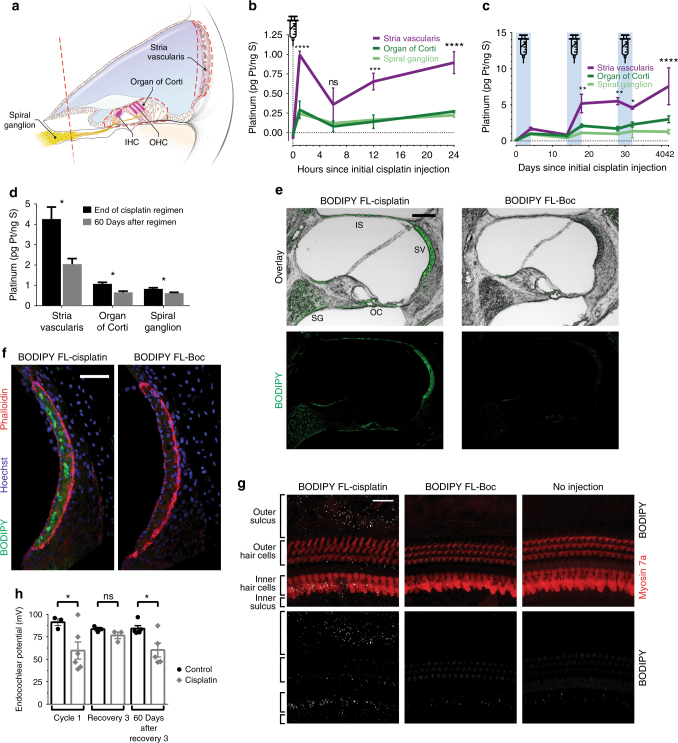
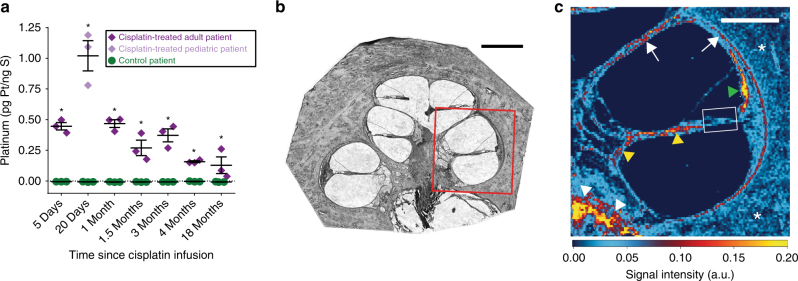
Cisplatin chemotherapy causes permanent hearing loss in 40–80% of treated patients. It is unclear whether the cochlea has unique sensitivity to cisplatin or is exposed to higher levels of the drug. Here we use inductively coupled plasma mass spectrometry (ICP-MS) to examine cisplatin pharmacokinetics in the cochleae of mice and humans. In most organs cisplatin is detected within one hour after injection, and is eliminated over the following days to weeks. In contrast, the cochlea retains cisplatin for months to years after treatment in both mice and humans. Using laser ablation coupled to ICP-MS, we map cisplatin distribution within the human cochlea. Cisplatin accumulation is consistently high in the stria vascularis, the region of the cochlea that maintains the ionic composition of endolymph. Our results demonstrate long-term retention of cisplatin in the human cochlea, and they point to the stria vascularis as an important therapeutic target for preventing cisplatin ototoxicity.
Overview
The claims and statistics of this paper haven’t been checked yet.
Free: it reads the open-access text and checks the first 5 claims that cite a source we can check. Create a free account to check every claim.
Integrity signals
Registry
Cites
Statistics
Figures
Verification
Claims the paper makes
The claims and statistics of this paper haven’t been checked yet.
Free: it reads the open-access text and checks the first 5 claims that cite a source we can check. Create a free account to check every claim.
Claims other papers make about this one
Each is checked against this paper’s own text: does it say what the citing paper says it does?
The source backs part of the claim, not all of it — or backs it for a different population, condition or comparison.
In the citing paper
“Certain antibiotics, DNA-crosslinking anti-cancer drugs, or intense sound trigger •NO, O2•−, and ONOO– as well as reduction in strial blood flow, detachment of melanocytes from capillaries, loss of the endolymphatic potential, elevated melanogenesis, Cox-2, and prostaglandins – killing strial melanocytes and hair cells for days afterward and resulting in deafness (185, 179–183, 194, 195).”
From Chemiexcitation: Mammalian Photochemistry in the Dark† (2023) · cites this paper as [194]
Experimental — accuracy not yet measured
Self-check
Percentages, sums and reported differences re-computed from the paper’s own numbers.
The self-check needs the paper’s full text.
Citations
Cites
Cancer treatment and survivorship statistics, 2016
Miller, K. D., Siegel, R. L., Lin, C. C., Mariotto, A. B., Kramer, J. L., Rowland, J. H., Stein, K. D., Alteri, R., & Jemal, A. (2016) · CA: A Cancer Journal for Clinicians · doi:10.3322/caac.21349 · Cited by 6,066
Cisplatin in cancer therapy: Molecular mechanisms of action
Dasari, S., & Bernard Tchounwou, P. (2014) · European Journal of Pharmacology · doi:10.1016/j.ejphar.2014.07.025 · Cited by 5,537
Cancer treatment and survivorship statistics, 2012
Siegel, R., DeSantis, C., Virgo, K., Stein, K., Mariotto, A., Smith, T., Cooper, D., Gansler, T., Lerro, C., Fedewa, S., et al. (2012) · CA: A Cancer Journal for Clinicians · doi:10.3322/caac.21149 · Cited by 2,928
The ImageJ ecosystem: An open platform for biomedical image analysis
Schindelin, J., Rueden, C. T., Hiner, M. C., & Eliceiri, K. W. (2015) · Molecular Reproduction and Development · doi:10.1002/mrd.22489 · Cited by 2,636
Mechanisms of cisplatin-induced ototoxicity and prevention
Rybak, L. P., Whitworth, C. A., Mukherjea, D., & Ramkumar, V. (2007) · Hearing Research · doi:10.1016/j.heares.2006.09.015 · Cited by 563
Knight, K. R. G., Kraemer, D. F., & Neuwelt, E. A. (2005) · Journal of Clinical Oncology · doi:10.1200/jco.2004.00.5355 · Cited by 542
An integrated view of cisplatin-induced nephrotoxicity and ototoxicity
Karasawa, T., & Steyger, P. S. (2015) · Toxicology Letters · doi:10.1016/j.toxlet.2015.06.012 · Cited by 475
K+ cycling and the endocochlear potential
Wangemann, P. (2002) · Hearing Research · doi:10.1016/s0378-5955(02)00279-4 · Cited by 450 · cited 1×
“Of those mice that received the entire cisplatin regimen, 100% (27) survived the regimen, and 85.”
Bone lead as a biological marker in epidemiologic studies of chronic toxicity: conceptual paradigms.
Hu, H., Rabinowitz, M., & Smith, D. (1998) · Environmental Health Perspectives · doi:10.1289/ehp.981061 · Cited by 435
Predicting cisplatin ototoxicity in children: the influence of age and the cumulative dose
Li, Y., Womer, R. B., & Silber, J. H. (2004) · European Journal of Cancer · doi:10.1016/j.ejca.2003.08.009 · Cited by 358
Cited by
Items 201–300 of 415
Lee, D. S., Schrader, A. D., Zou, J., Ang, W. H., Warchol, M. E., & Sheets, L. (2024) · iScience · doi:10.1016/j.isci.2024.110975 · Cited by 13
“Preferential ototoxicity to hair cellsat thebase of thecochleacould bedue to unequal distribution of cisplatinwithinthecochlea, with higher accumulation of chemotherapy at the base than apex, 1,47,48 and/or intrinsic vulnerability of high-frequency outer hair cells to cisplatin.”
BackgroundRodent models in sensorineural hearing loss research: A comprehensive review
Li, W., Xu, B., Huang, Y., Wang, X., & Yu, D. (2024) · Life Sciences · doi:10.1016/j.lfs.2024.123156 · Cited by 10
The Role of Genetic and Non-Genetic Factors in the Occurrence of Cisplatin-Associated Ototoxicity
Iațentiuc, A., Iațentiuc, I. M., Frăsinariu, O. E., Cozma, S. R., Bitere-Popa, O. R., Olariu, R., Radulescu, L. M., Ioniuc, I. K., Cuciureanu, M. D., Alecsa, M., et al. (2025) · International Journal of Molecular Sciences · doi:10.3390/ijms26104787 · Cited by 12
Ai, J., Zhang, S., Dai, M., Jiang, P., Huang, J., Xiao, H., Lin, Y., Tang, X., Tong, W., He, J., et al. (2025) · Advanced Science · doi:10.1002/advs.202502627 · Cited by 12
Karayay, B., Olze, H., & Szczepek, A. J. (2023) · International Journal of Molecular Sciences · doi:10.3390/ijms24054620 · Cited by 9
Pierstorff, E. D., Yang, W.-W., Chen, Y.-J. A., Cheung, S., Kalinec, F., & Slattery, W. H. (2019) · International Journal of Pediatric Otorhinolaryngology · doi:10.1016/j.ijporl.2019.03.021 · Cited by 9
da Veiga, M. G. A., Kuhweide, R., Demaerel, V., Pauw, R. D., Foer, B. D., & Casselman, J. W. (2020) · Neuroradiology · doi:10.1007/s00234-020-02504-x · Cited by 9
Cisplatin ototoxicity and role of antioxidant on its prevention
Fetoni, A. R., & Astolfi, L. (2020) · Hearing Balance and Communication · doi:10.1080/21695717.2020.1810962 · Cited by 9
Qu, Y., Zong, S., Wang, Z., Du, P., Wen, Y., Li, H., Wu, N., & Xiao, H. (2022) · Drug and Chemical Toxicology · doi:10.1080/01480545.2022.2039181 · Cited by 11
“However, it has been reported that 40%–80% of adults and >50% of children treated with platinum-based chemotherapy experience varying degrees of irreversible hearing loss (Breglio et al. 2017).”
BackgroundX-ray fluorescence microscopy: A method of measuring ion concentrations in the ear
Brister, E. Y., Vasi, Z., Antipova, O. A., Robinson, A. M., Tan, X., Agarwal, A., Stock, S. R., Carriero, A., & Richter, C. (2020) · Hearing Research · doi:10.1016/j.heares.2020.107948 · Cited by 9
Implantable Drug Reservoir Devices for Inner Ear Delivery of Pharmacotherapeutics
Kita, A. E., Saldate, J. J., Courtney, C., Chellappa, N., Jong, J., Matsuda, R., Schmidt, A., Shih, B., Shafqat, I., Schoettler, K., et al. (2020) · Otolaryngology · doi:10.1177/0194599820930229 · Cited by 10
“This could be advantageous, as cisplatin has been found to persist in the perilymph for up to years after treatment, which may have prolonged effects on inner ear function.(46) In the Transwell experiments, we observed a roughly 10% decrease in medication elution as compared with solution alone.”
BackgroundCarles, L., Gibaja, A., Scheper, V., Alvarado, J. C., Almodovar, C., Lenarz, T., & Juiz, J. M. (2024) · Antioxidants · doi:10.3390/antiox13070761 · Cited by 9
Cisplatin vestibulotoxicity: a current review
Fleihan, T., Nader, M., & Dickman, J. D. (2024) · Frontiers in Surgery · doi:10.3389/fsurg.2024.1437468 · Cited by 8
Štěpka, P., Kratochvílová, M., Kuchynka, M., Raudenská, M., Polanska, H. H., Vičar, T., Vaculovič, T., Vaculovičová, M., & Masařík, M. (2021) · BioMed Research International · doi:10.1155/2021/6800294 · Cited by 8
Strepay, D., Olszewski, R. T., Nixon, S., Korrapati, S., Adadey, S. M., Griffith, A. J., Su, Y. P., Liu, J., Vishwasrao, H. D., Gu, S., et al. (2024) · Scientific Reports · doi:10.1038/s41598-024-52663-7 · Cited by 8
“…type-specific effects of pharmacologic interventions on intermediate cells, particularly as they relate to intermediate cell morphology and viability beyond cell death could be ascertained utilizing this mouse model for agents including furosemide 35–37 , aminoglycosides 37 , and cisplatin 38–40 .”
BackgroundEstradiol protects hair cells from cisplatin-induced ototoxicity via Nrf2 activation
Adachi, M., Yanagizono, K., Okano, Y., Koizumi, H., Uemaetomari, I., & Tabuchi, K. (2023) · Redox Report · doi:10.1080/13510002.2022.2161224 · Cited by 9
“Over 40% of the patients who receive cisplatin administration are left with permanent hearing loss [1].”
BackgroundThulasiram, M. R., Yamamoto, R., Olszewski, R. T., Gu, S., Morell, R. J., Hoa, M., & Dabdoub, A. (2025) · iScience · doi:10.1016/j.isci.2025.111832 · Cited by 8
“…we identified was much smaller and showed an upregulation of genes involved in metabolic processes, such as Idh3B (isocitrate dehydrogenase [NAD(+)] 3 non-catalytic subunit beta), Urod (uroporphyrinogen decarboxylase), Acot13 (acyl-CoA thio-esterase 13), and Rhoa (Ras homolog family member A).”
Investigation of the Ototoxic Effect of Pembrolizumab Using a Rat Model
Kuzucu, İ., Baklacı, D., Guler, İ., Özhamam, E. U., Kum, R. O., & Özcan, M. (2019) · Cureus · doi:10.7759/cureus.6057 · Cited by 7
Bai, H., Shi, J. D., Guo, Q., Wang, W., Zhang, Z., Li, Y., Vennampalli, M., Zhao, X., & Wang, H. (2022) · Frontiers in Chemistry · doi:10.3389/fchem.2022.888693 · Cited by 7
“Platinum-based drugs have been successfully used in the treatment of various types of cancer in clinic (Breglio et al., 2017; Shaili et al., 2019; Karmakar et al., 2020; Tham et al., 2020; Wan et al., 2021).”
BackgroundWang, Z., Yang, Z., Qu, C., Jin-min, L., & Wang, X. (2023) · International Urology and Nephrology · doi:10.1007/s11255-023-03650-w · Cited by 8
“5 mg/kg) for 4 days followed by 10 days of recovery was used in some studies [35, 36].”
MethodSkin platinum deposition in colorectal cancer patients following oxaliplatin-based therapy
Cao, Y., Chang, Q., Zhang, W., Ornatsky, O., Hedley, D. W., & Chen, E. X. (2019) · Cancer Chemotherapy and Pharmacology · doi:10.1007/s00280-019-03956-6 · Cited by 9
Skalleberg, J., Myhrum, M., Småstuen, M. C., Osnes, T., Fosså, S. D., & Bunne, M. (2021) · Acta Oncologica · doi:10.1080/0284186x.2021.1887514 · Cited by 7
Detection and Characterization of Single Cisplatin Adducts on DNA by Nanopore Sequencing
Zhao, X., Liu, Y., Chen, X., Mi, Z., Li, W., Wang, P., Shan, X., & Lu, X. (2021) · ACS Omega · doi:10.1021/acsomega.1c02106 · Cited by 8
Amelioration of Cisplatin-induced Liver Injury by Extract Ethanol of Pometia pinnata
Adrian, A., Syahputra, R. A., Lie, S., & Nugraha, S. E. (2021) · Open Access Macedonian Journal of Medical Sciences · doi:10.3889/oamjms.2021.6785 · Cited by 7
“The increase in serum indicators indicates the possibility of liver injury when Cisplatin is used [1], [2], [3], [4], [5].”
BackgroundScobioala, S., Parfitt, R., Matulat, P., Byrne, J., Langer, T., Troschel, F. M., Hesping, A. E., Clemens, E., Kaatsch, P., Grabow, D., et al. (2023) · International Journal of Cancer · doi:10.1002/ijc.34732 · Cited by 6
“One possible mechanism to explain an increase in HL after prior irradiation is the development of hyperemia after irradiation, which may increase the permeability of the inner ear and/or CNS barriers, thereby decreasing the normal tolerance of inner ear tissue to cisplatin.(27,28)”
BackgroundRoadmap to a Global Template for Implementation of Ototoxicity Management for Cancer Treatment
Fernandez, K. A., Hoetink, A. E., Konrad‐Martin, D., Berndtson, D., Clark, K. D., Dreisbach, L. E., Geller, J. I., Goffi-Gómez, M. V. S., Grosnik, A., Jamis, C., et al. (2024) · Ear and Hearing · doi:10.1097/aud.0000000000001592 · Cited by 9
Self-citationYu, M., Jiang, W., Yu, M., Zhou, Z., Wang, M., & Li, L. (2025) · Journal of Inflammation Research · doi:10.2147/jir.s492292 · Cited by 7
“10 The SV, highly vascularized tissue, maintaining cochlear homeostasis, is guarded by the blood– labyrinth barrier (BLB), akin to the blood–brain barrier (BBB).”
Noble, K. V., Reyzer, M. L., Barth, J. L., McDonald, W. H., Tuck, M., Schey, K. L., Krug, E. L., & Lang, H. (2018) · Frontiers in Molecular Neuroscience · doi:10.3389/fnmol.2018.00243 · Cited by 6
“Notably recent advances in understanding the localization of cisplatin accumulation in the cochlea were made using a form of imaging mass spectrometry (IMS) that detects metals (Brouwers et al., 2008; Breglio et al., 2017).”
MethodPrevention of cisplatin‐induced hearing‐loss by sodium thiosulfate in medulloblastoma
Harao, T., Yamada, A. Y., Kinoshita, M., Kamimura, S., & Moritake, H. (2020) · Pediatrics International · doi:10.1111/ped.14271 · Cited by 6
Voruz, F., Vuilleumier, A., Migliorini, D., Nacher-Soler, G., Rousset, F., Maesschalck, T. D., & Senn, P. (2023) · Frontiers in Audiology and Otology · doi:10.3389/fauot.2023.1239119 · Cited by 7
Ototoxicity among cisplatin, carboplatin, and oxaliplatin in zebrafish model
Li, K.-H., Zhao, Y., Cheng, H.-L., Yang, J., & Chien, C. (2024) · Environmental Toxicology · doi:10.1002/tox.24285 · Cited by 6
“Second, Breglio et al 29 reported that the stria vascularis regulates ion concentration and cisplatin reflux in hair cells.”
BackgroundOtotoxicity: The Radical Drum Beat and Rhythm of Cochlear Hair Cell Life and Death
Gauvin, D. V., Yoder, J. D., Zimmermann, Z. J., & Tapp, R. L. (2018) · International Journal of Toxicology · doi:10.1177/1091581818761128 · Cited by 7
Generation of a Spiral Ganglion Neuron Degeneration Mouse Model
Hu, Z., Komal, F., Singh, A., & Deng, M. (2021) · Frontiers in Cell and Developmental Biology · doi:10.3389/fcell.2021.761847 · Cited by 7
“For instance, ototoxic drugs, including aminoglycoside and cisplatin, cause hair cell damage, which leads to secondary damage to SGNs (Dallos and Harris, 1978; Breglio et al., 2017).”
BackgroundRed Blood Cell Membrane-Camouflaged Gold Nanoparticles for Treatment of Melanoma
Zhao, L., Xie, H., & Li, J. (2022) · Journal of Oncology · doi:10.1155/2022/3514984 · Cited by 6
RetractedCochlear Implantation in Radiation-Induced Hearing Loss: A Systematic Review
Alahmadi, A., Abdelsamad, Y., Alzuraiqi, B., Alghamdi, S., Hagr, A. A., & Saleh, E. (2023) · Otology & Neurotology · doi:10.1097/mao.0000000000003953 · Cited by 6
Lu, J., Liu, H., Lin, S., Li, C., & Wu, H. (2019) · Neuroscience Letters · doi:10.1016/j.neulet.2019.134536 · Cited by 6
Mortui vivos docent: a modern revival of temporal bone plug harvests
Sagi, V., Kosaraju, N., Moore, L. S., Mulders, J. Y., Solyali, M., Ma, X., Regula, D. P., Hooper, J. E., & Stanković, K. M. (2023) · Frontiers in Neuroscience · doi:10.3389/fnins.2023.1242831 · Cited by 5
“Coupling this approach with laser ablation revealed localized cisplatin accumulation in the stria vascularis, suggesting that the drug’s ototoxic effects are due to hyperaccumulation as opposed to hypersensitization (Breglio et al., 2017).”
BackgroundPlane, J., Cabral, T. D. D., Knoll, R. M., Conrado, J. E. P., Vendramini, B. D. V., & Jung, D. H. (2025) · Otolaryngology · doi:10.1002/ohn.1272 · Cited by 6
Fibroblast Activation Protein as a Molecular Handle in Cancer Phototheranostics: Recent Advances
Basak, S., Satapathy, S., Shukla, A., Srivastava, N., & Meher, N. (2025) · Molecular Pharmaceutics · doi:10.1021/acs.molpharmaceut.5c00482 · Cited by 5
Yu, M., Li, J., & Zeng, X. (2025) · Frontiers in Molecular Biosciences · doi:10.3389/fmolb.2025.1694131 · Cited by 8
“The cochlea uniquely retains platinum-based drugs for months to years after systemic exposure in both murine models and humans (Breglio et al., 2017).”
BRCA1 Promotes Repair of DNA Damage in Cochlear Hair Cells and Prevents Hearing Loss
Jiang, W., Wang, G., Bai, F., Hu, B., Xu, Y., Xu, X., Nie, G., Zhu, W., Chen, F., & Pei, X. (2024) · Journal of Neuroscience · doi:10.1523/jneurosci.0132-24.2024 · Cited by 6
Zeng, Z., Han, L., Dong, D., Tang, H., Gao, Z., Hu, S., Zhu, B., Zhang, S., Shu, Y., & Yu, Y. (2025) · Toxicology Letters · doi:10.1016/j.toxlet.2025.05.011 · Cited by 5
Lee, D. S., Mahal, R. S., Tharakan, T., Collopy, C., Kallogjeri, D., Thorstad, W. L., Adkins, D. R., Oppelt, P., Ley, J. C., Wick, C. C., et al. (2023) · Otolaryngology · doi:10.1002/ohn.182 · Cited by 5
Zhao, Y., Huang, S., Xie, R., & Liu, J. (2023) · Cellular Signalling · doi:10.1016/j.cellsig.2023.110732 · Cited by 5
Ishaniya, W., Sumithaa, C., Muthuraman, S., Karanath‐Anilkumar, A., Munuswamy‐Ramanujam, G., Arumugam, M. K., Rajendran, S., & Ganeshpandian, M. (2024) · Dalton Transactions · doi:10.1039/d3dt02940a · Cited by 7
Fujikawa, T., Ito, T., Okada, R., Sawada, M., Mohri, K., Tateishi, Y., Takahashi, R., Asakage, T., & Tsutsumi, T. (2024) · Hearing Research · doi:10.1016/j.heares.2024.108995 · Cited by 5
Shih, J., Li, I., Pan, K., Wang, C., Chen, H., Fann, L.-Y., Tseng, J.-H., & Kao, L. (2020) · International Journal of Environmental Research and Public Health · doi:10.3390/ijerph17113916 · Cited by 6
Fuentes, I. A. C., Burotto, M., Retamal, M. A., Frelinghuysen, M., Caglevic, C., & Gormaz, J. G. (2020) · Free Radical Biology and Medicine · doi:10.1016/j.freeradbiomed.2020.07.035 · Cited by 5
Knockdown of sorcin increases HEI-OC1 cell damage induced by cisplatin in vitro
Wang, D., Shi, S., Hsieh, Y., Wang, J., Wang, H., & Wang, W. (2021) · Archives of Biochemistry and Biophysics · doi:10.1016/j.abb.2021.108752 · Cited by 5
Cisplatin Ototoxicity in Children
Brock, P. R., Rajput, K. M., Edwards, L. C., Meijer, A. J. M., Simpkin, P., Hoetink, A. E., Kruger, M., Sullivan, M. J., & van den Heuvel‐Eibrink, M. M. (2021) · IntechOpen eBooks · doi:10.5772/intechopen.96744 · Cited by 5
“Glutathione reductase (GR) reduces GSSR to GSH by using the reduced form of nicotinamide adenine dinucleotide phosphate (NADP+) NADPH, as cofactor [24].”
BackgroundMethodInfluentialSpectrométrie de masse en plasma induit : principe, appareillage et intérêt en biologie clinique
Poupon, J. (2021) · Revue Francophone des Laboratoires · doi:10.1016/s1773-035x(21)00171-4 · Cited by 5
Risk factors associated with cisplatin‐induced ototoxicity in Japanese patients with solid tumors
Okada, H., & Kitagawa, K. (2022) · Cancer Medicine · doi:10.1002/cam4.5565 · Cited by 5
Alsaikhan, F., Jasim, S. A., Margiana, R., Opulencia, M. J. C., Yasin, G., Hammid, A. T., Nasretdinova, M. T., Mahdi, A. B., Farhood, B., Abedi‐Firouzjah, R., et al. (2023) · Current Medicinal Chemistry · doi:10.2174/0929867331666230724124013 · Cited by 6
Dhanjal, C. R., Lingamsetty, R., Pareddy, A., Kim, S., & Raval, R. (2022) · Marine Drugs · doi:10.3390/md20070452 · Cited by 5
DNA repair drives cisplatin-induced neuronal death
Nathan, W. J., Chen, C., Sakr, R., Mietto, B. S., van Batenburg, V., van den Berg, J., Wlaschin, J. J., Livák, F., Callén, E., Wong, N., et al. (2026) · Cell · doi:10.1016/j.cell.2026.05.025 · Cited by 6
“35 To clarify the mechanisms by which neurons die upon cisplatin treatment, we treated WT i 3 Neurons with a range of doses of cisplatin and determined that 20 μ M or greater initiates cell death within a 2–3 day period (Figure 3A).”
Streefkerk, N., Masroor, A., Geller, J. I., van Grotel, M., Ansari, M., Bouffet, É., Bleyer, A., Fresnau, B., Sullivan, M. J., Huitema, A. D. R., et al. (2024) · EJC Paediatric Oncology · doi:10.1016/j.ejcped.2024.100211 · Cited by 4
Jiang, W., Bai, F., Wang, G., Liu, X., Peng, B., Xu, X., Nie, G., Zhu, W., Hu, B., & Pei, X. (2025) · Hearing Research · doi:10.1016/j.heares.2025.109369 · Cited by 4
Changing the time intervals between cisplatin cycles alter its ototoxic side effect
Bielefeld, E. C., González, A., & Debacker, J. R. (2021) · Hearing Research · doi:10.1016/j.heares.2021.108204 · Cited by 4
Establishment of an optimized guinea pig model of cisplatin-induced ototoxicity
Ahmadi, N., Saidov, N., Gausterer, J. C., Kramer, A.-M., Honeder, C., & Arnoldner, C. (2023) · Frontiers in Veterinary Science · doi:10.3389/fvets.2023.1112857 · Cited by 5
“This and the subsequent strial impairment may explain the susceptibility of the cochlea to cisplatin (5).”
BackgroundMechanisms and Impact of Aminoglycoside-Induced Vestibular Deficits
Janky, K. L., & Steyger, P. S. (2023) · American Journal of Audiology · doi:10.1044/2023_aja-22-00199 · Cited by 4
Miao, D. N. R., Wilke, M. A. P., Pham, J., Ladha, F., Singh, M., Arsenio, J., Luca, E., Dabdoub, A., Yang, W., Yang, J., et al. (2024) · Human Genomics · doi:10.1186/s40246-024-00679-5 · Cited by 5
“Lastly, cisplatin binds extensively to type I collagen in bone, creating a reservoir that gradually releases platinum, potentially leading to ototoxic effects [28].”
BackgroundInfluentialManagement Options for Patients With Nasopharyngeal Carcinoma Undergoing Cochlear Implantation
Lee, C.-Y., Lin, W., Lin, C.-C., Hsu, C., & Wu, H. (2020) · Ear Nose & Throat Journal · doi:10.1177/0145561320947274 · Cited by 4
Cochlear Preconditioning as a Modulator of Susceptibility to Hearing Loss
Harrison, R. T., Debacker, J. R., Trevino, M., Bielefeld, E. C., & Lobariñas, E. (2022) · Antioxidants and Redox Signaling · doi:10.1089/ars.2021.0055 · Cited by 5
“Subsequent literature has indicated that ears exposed to CDDP have an elevated risk for injury even long after the exposure (16), and it has been postulated that CDDP is retained in the cochlea indefinitely (9).”
Overexpression of XIAP inhibits cisplatin-induced hair cell loss
Li, Y., Zeng, S., Zhou, F., Jie, H., Yu, D., Hou, S., Chen, P., Gao, D., Liu, Y., Yang, J., et al. (2022) · Biochimica et Biophysica Acta (BBA) - Molecular Cell Research · doi:10.1016/j.bbamcr.2021.119204 · Cited by 4
Ertunç, O., Erzurumlu, Y., Savran, M., Çataklı, D., Kıran, E. D., & Pekgöz, Ş. (2023) · Turkish Journal of Pharmaceutical Sciences · doi:10.4274/tjps.galenos.2023.90846 · Cited by 4
“Semiquantitative analysis was performed to quantify the intensity of the immunohistochemical markers using a grading score ranging from (0) to (3) as follows: (0) = negative, (1) = weak focal staining, and ≤10%, (2) = diffuse weak staining and ≥ 10%, (3) = intense diffuse staining and ≥ 10%.”
MethodAre There Cochlear Dead Regions Involved in Hearing Loss after Cisplatin Ototoxicity?
Schultz, C., Liberman, P. H. P., & Goffi-Gómez, M. V. S. (2019) · Audiology and Neurotology · doi:10.1159/000502250 · Cited by 4
Hojan‐Jezierska, D., Chomiak, A., Czopor, A., Matthews‐Kozanecka, M., Majewska, A., Urbaniak‐Olejnik, M., & Matthews‐Brzozowska, T. (2020) · Oncology Letters · doi:10.3892/ol.2020.11447 · Cited by 8
“In this study, a patient with a mesenchymal-neuroectodermal tumor who had been treated with cisplatin was diagnosed with bilateral high-frequency hearing loss, which is consistent with literature reports (10-13).”
BackgroundResultSanchez, V. A., Dinh, P. C., Monahan, P. O., Fung, C., Althouse, S. K., Stump, T. E., Rooker, J., Dolan, M. E., Feldman, D. R., Hamilton, R. J., et al. (2026) · EClinicalMedicine · doi:10.1016/j.eclinm.2026.103841 · Cited by 4
Preclinical prospects of investigational agents for hearing loss treatment
Prell, C. G. L. (2023) · Expert Opinion on Investigational Drugs · doi:10.1080/13543784.2023.2253141 · Cited by 3
“There have also been significant advances in the development of more clinically relevant models for cisplatin injury, with a mouse model now available for repeated dosing modeled after human doing cycles [72].”
BackgroundTrametinib, a MEK1/2 Inhibitor, Protects Mice from Cisplatin- and Noise-Induced Hearing Loss
Lutze, R. D., Ingersoll, M. A., Kelmann, R. G., & Teitz, T. (2024) · Pharmaceuticals · doi:10.3390/ph17060735 · Cited by 4
“We then tested the ability of trametinib to protect against cisplatin-induced hearing loss by utilizing a clinically relevant mouse model of cisplatin ototoxicity [42–44].”
MethodHealthcare professionals’ knowledge and practices in managing ototoxicity in children with cancer
Ramnarian, K., & Paken, J. (2024) · South African Journal of Communication Disorders · doi:10.4102/sajcd.v71i1.1064 · Cited by 5
“The inclusion of long-term follow-up assessments is crucial for monitoring the delayed onset of hearing loss that may manifest over time (Brooks & Knight, 2017), as cisplatin can be retained in the cochlea for up to 20 years (Breglio et al., 2017).”
Manickam, V., & Zallocchi, M. (2025) · Frontiers in Cellular Neuroscience · doi:10.3389/fncel.2025.1552051 · Cited by 4
Metwally, S. A., El‐Ayadi, M., Maher, E., El-Minawi, M. S., Zaghloul, M. S., Taha, H., Abouelnaga, S., & Sidhom, I. (2025) · Journal of Neuro-Oncology · doi:10.1007/s11060-025-05098-7 · Cited by 3
Ethacrynic acid regulates gentamicin ototoxicity via the blood-labyrinth barrier
Li, L., Tan, J., Chen, D., Luo, J., & Li, P. (2025) · Hearing Research · doi:10.1016/j.heares.2025.109405 · Cited by 3
Bassiouni, M., Тихоновна, С. А., Olze, H., & Szczepek, A. J. (2023) · Brain Sciences · doi:10.3390/brainsci13030516 · Cited by 4
Cisplatin-induced ototoxicity: a novel approach to an ancient problem
Omar, N. E., & Elewa, H. F. (2023) · Pharmacogenetics and Genomics · doi:10.1097/fpc.0000000000000497 · Cited by 3
Yao, Z., Xiao, Y., Li, W., Kong, S., Tu, H., Guo, S., Liu, Z., Ma, L., Qiao, R., Wang, S., et al. (2024) · Journal of the Association for Research in Otolaryngology · doi:10.1007/s10162-024-00945-2 · Cited by 3
“Studies have reported that 40–80% of adults and at least 50% of children develop permanent hearing loss after receiving cisplatin treatment [7, 8].”
Trends in ototoxicity monitoring among cisplatin-treated patients with cancer
Lee, D. S., Travis, E. Y., Wong, S. K., Munyemana, M., Mueller, L. E., Collopy, C., Rich, J. T., Pipkorn, P. J., Puram, S. V., Jackson, R. S., et al. (2024) · Journal of Cancer Survivorship · doi:10.1007/s11764-024-01586-3 · Cited by 6
“Although it is integral to many chemotherapy regimens, over 40% of cancer patients treated with cisplatin develop progressive and irreversible ototoxicity [1–5].”
Xu, Y., Zhao, H., Wang, F., Xu, S., Wang, C., Li, Y., Wang, Y., Nong, H., Zhang, J., Cao, Z., et al. (2024) · Toxicology and Applied Pharmacology · doi:10.1016/j.taap.2024.116947 · Cited by 3
Identification of druggable binding sites and small molecules as modulators of TMC1
De‐la‐Torre, P., Martínez-García, C., Gratias, P., Mun, M., Santana, P., Akyuz, N., González, W., Indzhykulian, A. A., & Ramírez, D. (2025) · Communications Biology · doi:10.1038/s42003-025-07943-x · Cited by 5
“Similar to AG treatment, cisplatin causes permanent hearing loss in a signi fi cant portion of treatedpatients due to its gradual accumulation in the cochlea over months to years 39 .”
Breast cancer metastatic dormancy and emergence, a role for adjuvant statin therapy
Beckwitt, C. H. (2018) · D-Scholarship@Pitt (University of Pittsburgh) · Cited by 5
Low intensity ultrasound enhances cisplatin uptake in vitro by cochlear hair cells
Chu, Y. C., Chan, Y., Lim, J., Ho, C.-Y., Lin, P., Lu, Y.-C., Wu, C., & Wang, J. (2021) · JASA Express Letters · doi:10.1121/10.0005641 · Cited by 3
Protective Effects of Glucose-Related Protein 78 and 94 on Cisplatin-Mediated Ototoxicity
Yi, J., Kim, T. S., Pak, J. H., & Chung, J. W. (2020) · Antioxidants · doi:10.3390/antiox9080686 · Cited by 3
“Cisplatin-mediated ROS generation is dependent on the induction and activation of the transient receptor potential vanilloid 1 and an NADPH oxidase isoform, NOX3, in rats and organ of Corti hair cell cultures [8].”
BackgroundLee, J. W., Alamleh, S., Zhan, L. J., Hueniken, K., Mahler, M. B., Billfalk-Kelly, A., Davies, J., Brown, M. C., Spreafico, A., Huang, S. H., et al. (2024) · Journal of Otolaryngology - Head and Neck Surgery · doi:10.1177/19160216241248671 · Cited by 2
“35,36 All patients in our cohort had pre-treatment audio-grams and at least 1 follow-up audiogram, mitigating the phenotyping bias of preexisting hearing loss.”
BackgroundChen, L., Chen, C., Xu, Y., Dai, D., Sun, C., & Li, Q. (2024) · Toxicology Letters · doi:10.1016/j.toxlet.2024.11.009 · Cited by 3
Chalansonnet, M., Thomas, A., Boucard, S., Merlen, L., Guenot, L., Venet, T., Bernal-Meléndez, E., & Pouyatos, B. (2025) · NeuroToxicology · doi:10.1016/j.neuro.2025.06.004 · Cited by 2
The Role and Mechanism of GSDME-Dependent Pyroptosis in Cochlear Marginal Cells Injury by Cisplatin
Lei, W., Yu, W., Li, T., Tang, W., Zong, S., & Xiao, H. (2025) · Biomedicines · doi:10.3390/biomedicines13071680 · Cited by 2
“Such impairments encompass alterations in the permeability and integrity of the blood-labyrinth barrier, the induction of ultrastructural modifications in MCs, and a significant decrease in cochlear endocochlear potential [57–61].”
Lu, J., & Liu, Y. (2025) · International Journal of Pharmaceutics · doi:10.1016/j.ijpharm.2025.126121 · Cited by 2
Zeng, B., Frischbutter, S., Moñino‐Romero, S., Scheffel, J., Siebenhaar, F., Olze, H., & Szczepek, A. J. (2025) · Cells · doi:10.3390/cells14201615 · Cited by 2
“So far, the only supporting experiments come from studies using human postmortem specimens [42].”
Qi, W., Huang, Q., Li, L., Li, Z., Li, P., & Xiangli, Z. (2025) · Nanoscale Advances · doi:10.1039/d5na00419e · Cited by 2
“40,41 Dexamethasone mitigates these e ff ects primarily through glucocorticoid receptor-mediated suppression of pro-in ammatory signaling ( e.g. , TNF-a , IL-6, and NF-k B) and by preserving cochlear microvascular perfusion.”
Bai, J., Wang, W., Fu, Z., Yang, J., Guo, Y., & Guan, G. (2025) · Hearing Research · doi:10.1016/j.heares.2025.109487 · Cited by 3
Cisplatin during radiation for head and neck cancer: insights from NRG Oncology experience
de Sousa, L. G., Bates, J. E., Anand, P., Caudell, J. J., Colevas, A. D., Runge, C. L., Sharon, J. D., Awan, M. J., Beadle, B. M., Choe, J. H., et al. (2025) · JNCI Journal of the National Cancer Institute · doi:10.1093/jnci/djaf343 · Cited by 3
Streefkerk, N., Geller, J. I., Knight, K., Ansari, M., Papadakis, V., Calaminus, G., Masroor, A., Huitema, A. D. R., Pasqualini, C., Rutkowski, S., et al. (2026) · Ear and Hearing · doi:10.1097/aud.0000000000001856 · Cited by 2
“CIHL may gradually worsen over time, in part caused by the accumulation of cisplatin in the cochlea (Breglio et al. 2017).”
Hearing and Other Neurologic Problems
Landier, W., Cohn, R. J., & van den Heuvel‐Eibrink, M. M. (2020) · Pediatric Clinics of North America · doi:10.1016/j.pcl.2020.07.012 · Cited by 2
Castro, K. M., & Tonorezos, E. S. (2023) · Journal of Cancer Survivorship · doi:10.1007/s11764-022-01302-z · Cited by 2
Chelate-functionalized magnetic micelles for sequestration of cisplatin
Du, K., Liao, P., Yang, S., von Trentini, D., Sharma, K., Shi, X., Murray, C. B., Li, D., & Dmochowski, I. J. (2023) · Nanoscale Advances · doi:10.1039/d3na00290j · Cited by 2
Magagnoli, J., Cummings, T. H., Hardin, J. W., Sutton, S. S., & Ambati, J. (2024) · Journal of Investigative Medicine · doi:10.1177/10815589241247796 · Cited by 2
“7 The mechanism of the ototoxicity of cisplatin involves generation of reactive oxygen species that over-whelms the cells antioxidant capability resulting in apoptosis of hair cells and subsequently hearing loss.”
Lu, X., Chen, Y., Mo, Y., Zeng, Q., Cen, S., Zeng, L., Hu, H., Li, A., Gao, X., & Zhang, B. (2025) · Journal of Materials Chemistry B · doi:10.1039/d4tb02820a · Cited by 2
Yin, P., Jiang, Z., Wang, X., Gong, S., Zhang, C., & Fan, Z. (2025) · Toxicology Research · doi:10.1093/toxres/tfaf030 · Cited by 2
Mehmood, S., Bhatia, P., Doyon‐Reale, N., & Jamesdaniel, S. (2025) · Current Research in Toxicology · doi:10.1016/j.crtox.2025.100241 · Cited by 3
“As cisplatin accumulates in the cochlea and is retained even after the treatment, the auditory cells are continuously exposed to cisplatin (Breglio et al., 2017), and they are susceptible to cisplatin-induced DNA damage.”
Metadata
- Authors
- Breglio, A. M., Rusheen, A. E., Shide, E. D., Fernandez, K. A., Spielbauer, K. K., McLachlin, K. M., Hall, M. D., Amable, L., & Cunningham, L. L.
- Affiliations
- National Institutes of Health (US)
- Electro Scientific Industries (United States) (US)
- National Center for Advancing Translational Sciences (US)
- Corresponding author
- Cunningham, Lisa L.
- ORCID
- Venue
- Nature Communications
- Published
- 2017-11-21
- Volume
- 8
- Issue
- 1
- Pages
- 1654-1654
- ISSN
- 2041-1723 (ISSN-L)
- PMC
- PMC5698400
- OpenAlex
- W2768737575
- Semantic Scholar
- 7e27b37ade475c09daba3dd429b80a6479c7c2ec
- Cited by
- 412
- References
- 52
- Citations by year
- 2026: 45 · 2025: 57 · 2024: 56 · 2023: 59 · 2022: 43 · 2021: 49 · 2020: 42 · 2019: 42 · 2018: 19
- FWCI
- 17.61
- Type
- journal article
- Language
- en
- Open access
- gold
- doi.org
- Licence
- cc-by
- creativecommons.org/licenses/by/4.0 (tdm)
- creativecommons.org/licenses/by/4.0 (vor)
- Locations
- Nature Communications (publishedVersion, cc-by)
- Europe PMC (PubMed Central) (publishedVersion, cc-by)
- PubMed Central (publishedVersion, cc-by)
- PubMed (publishedVersion)
- RePEc: Research Papers in Economics (submittedVersion)
- DOAJ (DOAJ: Directory of Open Access Journals) (submittedVersion, cc-by-sa)
- Funders
- Massachusetts Eye and Ear
- National Heart, Lung, and Blood Institute
- National Institute on Deafness and Other Communication Disorders (ZIADC000079, ZICDC000080, DC000080)
- National Institute on Minority Health and Health Disparities
- Topics
- Life Sciences › Neuroscience › Sensory Systems › Hearing, Cochlea, Tinnitus, Genetics
- Life Sciences › Pharmacology, Toxicology and Pharmaceutics › Toxicology › Chemotherapy-induced organ toxicity mitigation
- Health Sciences › Medicine › Oncology › Metal complexes synthesis and properties
- Keywords
- cisplatin, cisplatin ototoxicity, cochlea, stria vascularis, endolymph, drug accumulation, hearing loss, laser ablation ICP-MS, human
- MeSH terms
- Animals, Antineoplastic Agents, Cisplatin, Cochlea, Female, Humans, Male, Mice, Inbred CBA, Neoplasms, Mass Spectrometry, Stria Vascularis, Hearing Loss
About these checks
Registry, retraction, Cites and statistics results are computed, not judged, with one exception: a printed reference that no index lists is read once by a model before it counts as a citation error. Claims are extracted by a model and kept only when their quote appears verbatim in the text; each cited source is then checked, with a model’s help, for whether it says what the claim relies on. Those verdicts can be wrong — read the claim’s quote and the cited source before relying on one.
Statistics and arithmetic are recomputed, not judged.
Confidence bands are shown only for fields calibrated on our annotated test set. None is calibrated yet, so no band is shown.
What counts as a claim ›How we measure confidence ›How we check this ›
Are you an author, or do you see a problem with this page? Request a review
Data sources
Bibliographic data: Semantic Scholar, OpenAlex, Crossref.
Contains information from the Semantic Scholar Academic Graph Datasets, made available under the ODC Attribution License (ODC-BY 1.0).
Semantic Scholar’s data is described in: Kinney, R., et al. (2023). The Semantic Scholar Open Data Platform. arXiv:2301.10140.
