

Cisplatin is retained in the cochlea indefinitely following chemotherapy
Open accessThe DOI matches its Crossref record; 52 of the 52 references it cites were found in a registry or an index.
Abstract
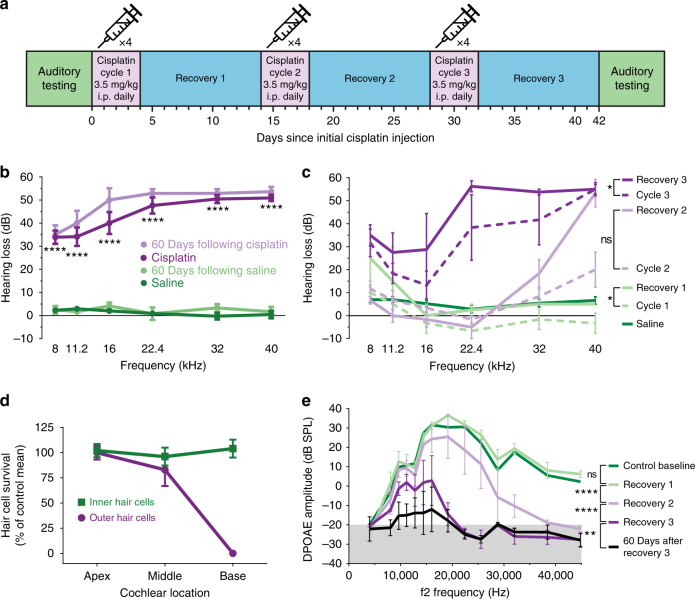
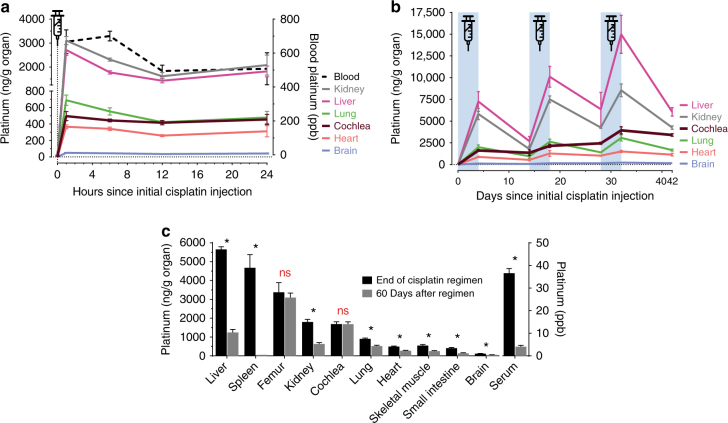
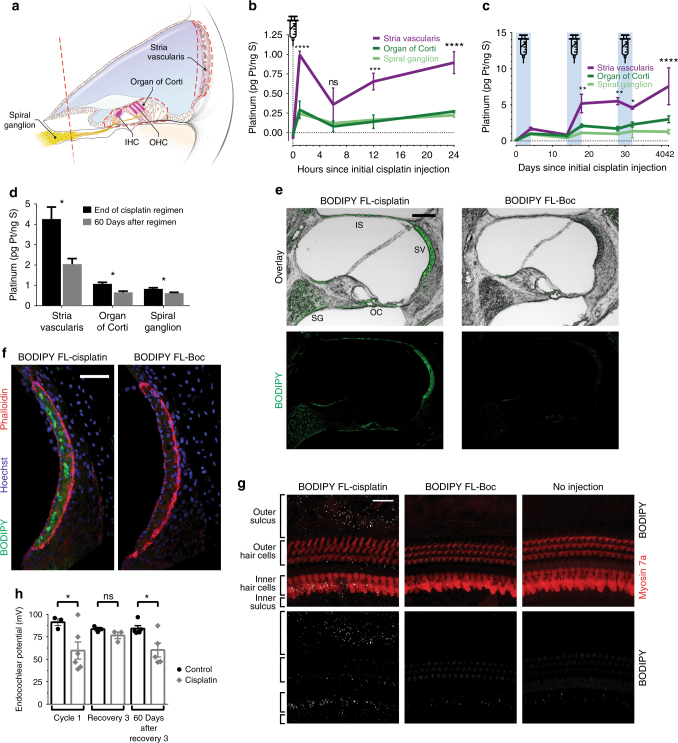
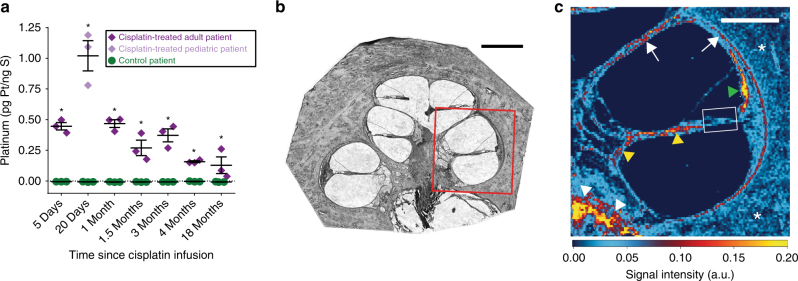
Cisplatin chemotherapy causes permanent hearing loss in 40–80% of treated patients. It is unclear whether the cochlea has unique sensitivity to cisplatin or is exposed to higher levels of the drug. Here we use inductively coupled plasma mass spectrometry (ICP-MS) to examine cisplatin pharmacokinetics in the cochleae of mice and humans. In most organs cisplatin is detected within one hour after injection, and is eliminated over the following days to weeks. In contrast, the cochlea retains cisplatin for months to years after treatment in both mice and humans. Using laser ablation coupled to ICP-MS, we map cisplatin distribution within the human cochlea. Cisplatin accumulation is consistently high in the stria vascularis, the region of the cochlea that maintains the ionic composition of endolymph. Our results demonstrate long-term retention of cisplatin in the human cochlea, and they point to the stria vascularis as an important therapeutic target for preventing cisplatin ototoxicity.
Overview
The claims and statistics of this paper haven’t been checked yet.
Free: it reads the open-access text and checks the first 5 claims that cite a source we can check. Create a free account to check every claim.
Integrity signals
Registry
Cites
Statistics
Figures
Verification
Claims the paper makes
The claims and statistics of this paper haven’t been checked yet.
Free: it reads the open-access text and checks the first 5 claims that cite a source we can check. Create a free account to check every claim.
Claims other papers make about this one
Each is checked against this paper’s own text: does it say what the citing paper says it does?
The source backs part of the claim, not all of it — or backs it for a different population, condition or comparison.
In the citing paper
“Certain antibiotics, DNA-crosslinking anti-cancer drugs, or intense sound trigger •NO, O2•−, and ONOO– as well as reduction in strial blood flow, detachment of melanocytes from capillaries, loss of the endolymphatic potential, elevated melanogenesis, Cox-2, and prostaglandins – killing strial melanocytes and hair cells for days afterward and resulting in deafness (185, 179–183, 194, 195).”
From Chemiexcitation: Mammalian Photochemistry in the Dark† (2023) · cites this paper as [194]
Experimental — accuracy not yet measured
Self-check
Percentages, sums and reported differences re-computed from the paper’s own numbers.
The self-check needs the paper’s full text.
Citations
Cites
Cancer treatment and survivorship statistics, 2016
Miller, K. D., Siegel, R. L., Lin, C. C., Mariotto, A. B., Kramer, J. L., Rowland, J. H., Stein, K. D., Alteri, R., & Jemal, A. (2016) · CA: A Cancer Journal for Clinicians · doi:10.3322/caac.21349 · Cited by 6,066
Cisplatin in cancer therapy: Molecular mechanisms of action
Dasari, S., & Bernard Tchounwou, P. (2014) · European Journal of Pharmacology · doi:10.1016/j.ejphar.2014.07.025 · Cited by 5,537
Cancer treatment and survivorship statistics, 2012
Siegel, R., DeSantis, C., Virgo, K., Stein, K., Mariotto, A., Smith, T., Cooper, D., Gansler, T., Lerro, C., Fedewa, S., et al. (2012) · CA: A Cancer Journal for Clinicians · doi:10.3322/caac.21149 · Cited by 2,928
The ImageJ ecosystem: An open platform for biomedical image analysis
Schindelin, J., Rueden, C. T., Hiner, M. C., & Eliceiri, K. W. (2015) · Molecular Reproduction and Development · doi:10.1002/mrd.22489 · Cited by 2,636
Mechanisms of cisplatin-induced ototoxicity and prevention
Rybak, L. P., Whitworth, C. A., Mukherjea, D., & Ramkumar, V. (2007) · Hearing Research · doi:10.1016/j.heares.2006.09.015 · Cited by 563
Knight, K. R. G., Kraemer, D. F., & Neuwelt, E. A. (2005) · Journal of Clinical Oncology · doi:10.1200/jco.2004.00.5355 · Cited by 542
An integrated view of cisplatin-induced nephrotoxicity and ototoxicity
Karasawa, T., & Steyger, P. S. (2015) · Toxicology Letters · doi:10.1016/j.toxlet.2015.06.012 · Cited by 475
K+ cycling and the endocochlear potential
Wangemann, P. (2002) · Hearing Research · doi:10.1016/s0378-5955(02)00279-4 · Cited by 450 · cited 1×
“Of those mice that received the entire cisplatin regimen, 100% (27) survived the regimen, and 85.”
Bone lead as a biological marker in epidemiologic studies of chronic toxicity: conceptual paradigms.
Hu, H., Rabinowitz, M., & Smith, D. (1998) · Environmental Health Perspectives · doi:10.1289/ehp.981061 · Cited by 435
Predicting cisplatin ototoxicity in children: the influence of age and the cumulative dose
Li, Y., Womer, R. B., & Silber, J. H. (2004) · European Journal of Cancer · doi:10.1016/j.ejca.2003.08.009 · Cited by 358
Cited by
Items 401–415 of 415
Wang, S., Li, J., Yang, B., Li, M., Yu, M., Zhang, P., Bai, S., & Zeng, X. (2026) · Frontiers in Molecular Neuroscience · doi:10.3389/fnmol.2026.1886218
“Sustained toxic accumulation can result from the persistence of cisplatin in the cochlea for extended periods and its accumulation to high levels in the stria vascularis region (Figure 2; Zhang et al., 2013; Breglio et al., 2017; Hou et al., 2020; Sekulic et al., 2023).”
A viscosity-tunable microgel-in-sol phase for localized inner ear delivery of small hydrophilic drug
Kim, S., Kang, J. H., Won, S. S., Yang, K., Kim, S., Kim, D.-K., & Shin, M. (2026) · Materials Today Bio · doi:10.1016/j.mtbio.2026.103590
“Unlike most organs, where cisplatin is detected and eliminated within days to weeks following administration, the cochlea retains cisplatin for months to years after treatment, making it far more vulnerable to cumulative toxic exposure and resulting in irreversible hearing loss [6,7].”
InfluentialJantzen, L., Wischmann, S., Mathiasen, R., Cayé‐Thomasen, P., & Percy-Smith, L. (2026) · Acta Oto-Laryngologica · doi:10.1080/00016489.2026.2717008
Wu, Y., Tao, Y., Wei, L., Liu, Q., Liu, J., Jiang, W., Shi, W., Cao, P., Fu, X., & Cheng, C. (2026) · Smart Medicine · doi:10.1002/smmd.70054
Gao, Z., Huang, H., Yang, P., Zhang, W., Hu, S., Han, L., Zhou, H., & Shu, Y. (2026) · Biochemical Pharmacology · doi:10.1016/j.bcp.2026.118432 · Cited by 1
Cisplatin Induced Ototoxicity in Patients with Head and Neck Malignancies: A Clinical Study
Kaur, H., Singh, J., Chauhan, A. K., Kalra, Singh, S., Sharma, S., & Manglik, S. (2026) · Indian Journal of Otolaryngology and Head & Neck Surgery · doi:10.1007/s12070-026-06837-6
“Cisplatin tends to accumulate more in the basal regions, where it induces oxidative stress and apoptosis in cochlear hair cells and supporting structures [22].”
Photobiomodulation Therapy (PBMT) for Preventing Noise-Induced Hearing LossPreprint
Griffith, O., Jarrouj, G., Kessler, L., Tan, X., Fiebig, T., Basta, D., Esmailie, F., & Richter, C. (2026) · Research Square · doi:10.21203/rs.3.rs-10731927/v1
Canet, J. M. S., Núñez-Batalla, F., Martinez, R. P., Vivanco-Allende, A., & Zubicaray-Ugarteche, J. (2026) · Romanian Journal of Preventive Medicine · doi:10.3390/rjpm4040011
“This explains the characteristic initial high-frequency pattern and subsequent progression towards speech frequencies [3,4].”
Thomas, D., Zhou, Y., Koo, C., Kessler, L., Pandya, P., Fuentes, R. J., Robinson, A., Sriram, S., Guntupalli, P., Richter, C., et al. (2026) · Pharmaceuticals · doi:10.3390/ph19101618
“This is consistent with our previous study [38] and is comparable with the results from other studies showing that CIHL primarily affects the high-frequency range [51,52]. all surviving animals.”
InfluentialSex-dependent and long-term effects of cisplatin on bone mineral density in juvenile mice
Torres-Rodríguez, H. F., Pérez-Reyes, S. A., Santiago-Méndez, D. A., Aguilar-Campos, C. G., Ramírez-Quintanilla, L. Y., Martínez-Martínez, A., Muñoz‐Islas, E., & Jiménez‐Andrade, J. M. (2026) · Pharmacological Reports · doi:10.1007/s43440-026-00914-x
Morgovan, A.-I., Balica, N. C., Negru, M. C., Guran, K., Orasan, A., Banta, M. A., Pintea, C. O., Sitaru, A. M., & Ştefănescu, E. H. (2026) · Journal of Clinical Medicine · doi:10.3390/jcm15207985
Li, Y., Han, M., Lu, C., Tang, J., Duan, M., Yang, J., 揭慧群, Song, Q., & He, J. (2026) · Biomedicines · doi:10.3390/biomedicines14102377
Standardizing ototoxicity monitoring for children treated with cisplatin: an urgent call to action
Knight, K. R., Drenovak, M., Langer, T., Streefkerk, N., Airlangga, T. J., Andriastuti, M., Asmarinah, A., Berndtson, D., Hartantyo, A. N. K. W., Hoetink, A. E., et al. (2026) · Frontiers in Oncology · doi:10.3389/fonc.2026.1923166
“Platinum is known to accumulate and persist within the inner ear (6), which could explain why a progression of hearing loss has been reported in 20-50% of childhood cancer survivors exposed to cisplatin (7, 8).”
Metadata
- Authors
- Breglio, A. M., Rusheen, A. E., Shide, E. D., Fernandez, K. A., Spielbauer, K. K., McLachlin, K. M., Hall, M. D., Amable, L., & Cunningham, L. L.
- Affiliations
- National Institutes of Health (US)
- Electro Scientific Industries (United States) (US)
- National Center for Advancing Translational Sciences (US)
- Corresponding author
- Cunningham, Lisa L.
- ORCID
- Venue
- Nature Communications
- Published
- 2017-11-21
- Volume
- 8
- Issue
- 1
- Pages
- 1654-1654
- ISSN
- 2041-1723 (ISSN-L)
- PMC
- PMC5698400
- OpenAlex
- W2768737575
- Semantic Scholar
- 7e27b37ade475c09daba3dd429b80a6479c7c2ec
- Cited by
- 412
- References
- 52
- Citations by year
- 2026: 45 · 2025: 57 · 2024: 56 · 2023: 59 · 2022: 43 · 2021: 49 · 2020: 42 · 2019: 42 · 2018: 19
- FWCI
- 17.61
- Type
- journal article
- Language
- en
- Open access
- gold
- doi.org
- Licence
- cc-by
- creativecommons.org/licenses/by/4.0 (tdm)
- creativecommons.org/licenses/by/4.0 (vor)
- Locations
- Nature Communications (publishedVersion, cc-by)
- Europe PMC (PubMed Central) (publishedVersion, cc-by)
- PubMed Central (publishedVersion, cc-by)
- PubMed (publishedVersion)
- RePEc: Research Papers in Economics (submittedVersion)
- DOAJ (DOAJ: Directory of Open Access Journals) (submittedVersion, cc-by-sa)
- Funders
- Massachusetts Eye and Ear
- National Heart, Lung, and Blood Institute
- National Institute on Deafness and Other Communication Disorders (ZIADC000079, ZICDC000080, DC000080)
- National Institute on Minority Health and Health Disparities
- Topics
- Life Sciences › Neuroscience › Sensory Systems › Hearing, Cochlea, Tinnitus, Genetics
- Life Sciences › Pharmacology, Toxicology and Pharmaceutics › Toxicology › Chemotherapy-induced organ toxicity mitigation
- Health Sciences › Medicine › Oncology › Metal complexes synthesis and properties
- Keywords
- cisplatin, cisplatin ototoxicity, cochlea, stria vascularis, endolymph, drug accumulation, hearing loss, laser ablation ICP-MS, human
- MeSH terms
- Animals, Antineoplastic Agents, Cisplatin, Cochlea, Female, Humans, Male, Mice, Inbred CBA, Neoplasms, Mass Spectrometry, Stria Vascularis, Hearing Loss
About these checks
Registry, retraction, Cites and statistics results are computed, not judged, with one exception: a printed reference that no index lists is read once by a model before it counts as a citation error. Claims are extracted by a model and kept only when their quote appears verbatim in the text; each cited source is then checked, with a model’s help, for whether it says what the claim relies on. Those verdicts can be wrong — read the claim’s quote and the cited source before relying on one.
Statistics and arithmetic are recomputed, not judged.
Confidence bands are shown only for fields calibrated on our annotated test set. None is calibrated yet, so no band is shown.
What counts as a claim ›How we measure confidence ›How we check this ›
Are you an author, or do you see a problem with this page? Request a review
Data sources
Bibliographic data: Semantic Scholar, OpenAlex, Crossref.
Contains information from the Semantic Scholar Academic Graph Datasets, made available under the ODC Attribution License (ODC-BY 1.0).
Semantic Scholar’s data is described in: Kinney, R., et al. (2023). The Semantic Scholar Open Data Platform. arXiv:2301.10140.
